Mind Over Mess: Understanding the Psychology of Procrastination
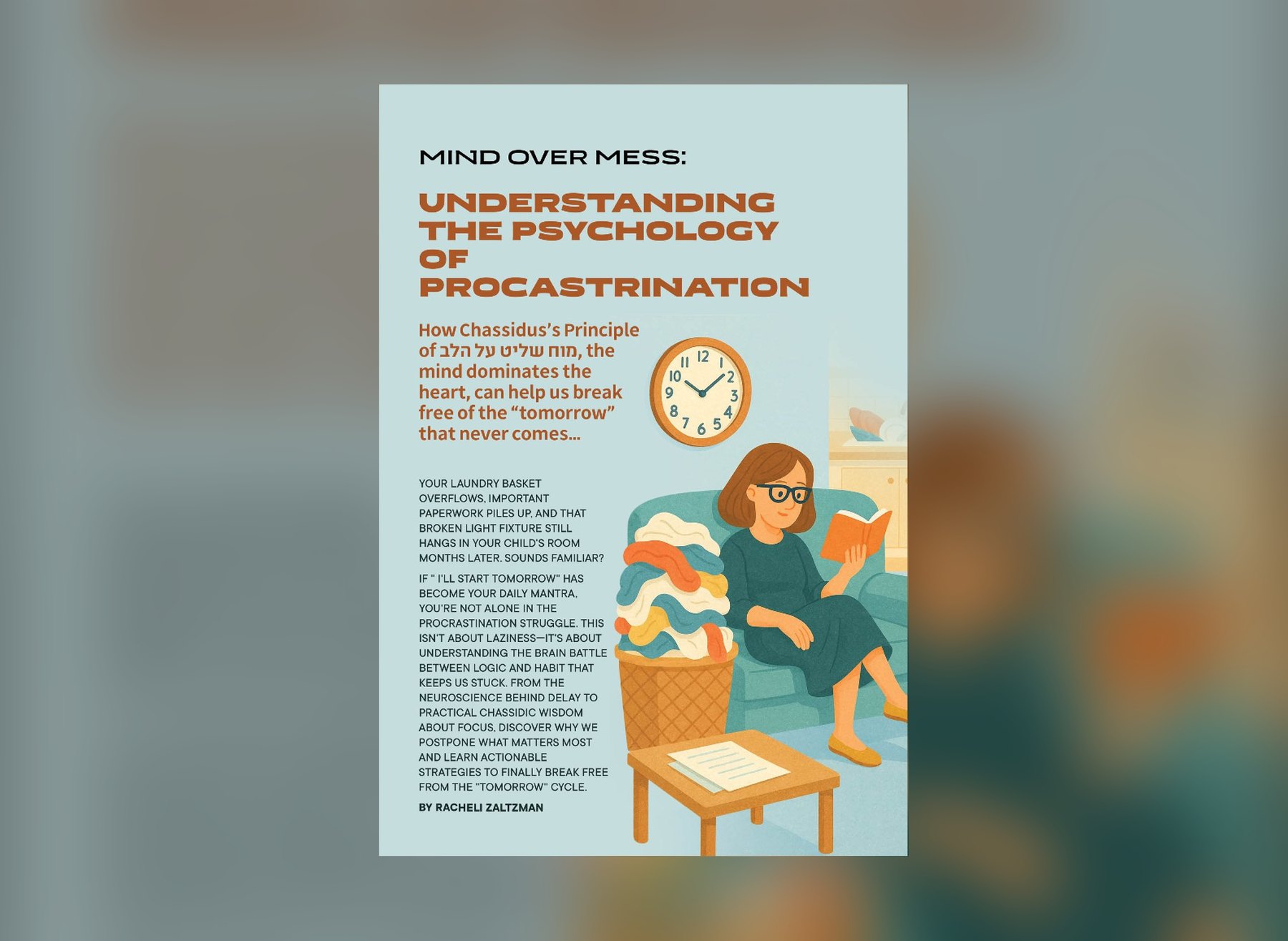
Your laundry basket overflows, important paperwork piles up, and that broken light fixture still hangs in your child’s room months later. Sounds familiar? If “I’ll start tomorrow” has become your daily mantra, you’re not alone in the procrastination struggle. This isn’t about laziness – it’s about understanding the brain battle between logic and habit that keeps us stuck. From the neuroscience behind delay to practical Chassidic wisdom about focus, discover why we postpone what matters most and learn actionable strategies to finally break free from the “tomorrow” cycle.
‘For years you’ve been dreaming of an organized home, empty sinks, folded laundry in closets – but each time you shake yourself from the dream and find yourself in a sea of scattered objects in the living room.
How many times have you said to yourself: “I lost money again because I didn’t file reports on time,” “I forgot my physical therapy appointment again, and the next one isn’t for four weeks,” “They didn’t accept my child to daycare again because we didn’t register on time,” or “I forgot to renew my passport again and I’m not sure I’ll be able to fly to the Rebbe for Tishrei”?
This article will deal with delays, lateness, lost opportunities, every promise you made to yourself and broke, every goal you set for yourself and abandoned because motivation decreased and disappeared, and everything you started but didn’t finish. The glasses through which you’ve looked at yourself are about to be replaced.
I allow myself to write this article not because I’ve overcome this hurdle, but davka because I’m there, falling and getting up, fighting and retreating, searching and exploring the best way to deal with the phenomenon called: P-R-O-C-R-A-S-T-I-N-A-T-I-O-N.
The word “procrastination” deters many of us. Quite a few women feel that it literally manages their lives and sucks out all desire to perform long-term activities, especially complex ones like: gardening, household management, budget management, filing reports, and more.
What is Procrastination?
Procrastination is behavior expressed in involuntary delay in performing tasks, even when this may harm us or damage our interests. For example: postponing a vital doctor’s appointment (even though it harms our health) or delaying debt payments (even though they only grow).
Procrastination doesn’t include emergency situations or schedule changes due to something important and unexpected.
Let me guess what’s happening in the depths of your heart and home: Is your laundry basket overflowing? Do you have a drawer full of documents that have long been lost track of? Is the phrase “tomorrow I start a diet” something you regularly say? Have you accumulated a sea of papers and leaflets that should have been thrown away two months ago? Is the lighting in the children’s room, which has lost its color and glow, still stuck there on the ceiling?
These statements and many others like them characterize those who postpone tasks and decisions – the word common to all is: “tomorrow.”
There’s a pattern that repeats itself among all types of procrastinators. Perhaps it’s familiar to you: initially, when you have some task to do, you feel you have plenty of time. You try to start, but the second you have an excuse to move to something else, it simply flies out of your head. Then comes the last moment, and the task suddenly looks like a high and threatening mountain and you just don’t feel like doing it now. There are more important things distracting you like: checking the last WhatsApp message – which lasts an hour, because you also watched all the statuses, read news, and bought clothes online – um… The task is postponed and postponed, and there are heavy prices to pay…
At the end of the process, when zero hour arrives, you stand before the disturbing mystery called – where did all the time disappear? The pressure is sky-high. In your heart of hearts you’re full of guilt and doubts, and you envy those who simply do what needs to be done.
At the real time of task submission, you limp to the finish line, unprepared, presenting to the world third-rate results. The main trouble is that procrastination is a deeply rooted habit. Instead of dealing with delays – we inflate the difficulties and improvise excuses and justifications for our actions (illness, multiple tasks, etc.).
Unfortunately, there’s no area of life immune to procrastination. But it seems students suffer from it more than anyone. Procrastination accompanies us from early morning, when the overflowing trash can awaits us in the kitchen, until late night hours, when the empty toothpaste tube reminds us we still haven’t bought another one. We encounter it again and again every day, and it has nothing to stop it.
Impulsive People Procrastinate More
Usually there’s a correlation between impulsiveness and the tendency to procrastinate. There can be several reasons for this:
Seeking immediate thrills: Impulsive people tend to seek immediate satisfaction and rewards. When facing a task requiring effort, with distant reward, they may postpone it in favor of activities providing immediate pleasure, even if they’re less important or urgent. For example, I’d prefer to eat cake even though I’m on a diet, or text with a friend for half an hour instead of making a one-minute phone call, finishing the matter and moving on to important tasks at hand.
Difficulty regulating emotions: Impulsiveness is often related to difficulty regulating emotions. When negative emotions arise like boredom, anxiety, or frustration from some task, an impulsive person might postpone the task to avoid these feelings, instead of dealing with them effectively.
Poor planning and difficulty making decisions: Impulsive people may struggle to plan ahead and think about long-term consequences of their actions. Lack of planning can lead to procrastination since they don’t formulate a clear action plan or make last-minute decisions.
Overestimating ability to handle time pressure: Often, impulsive people believe they’ll succeed in performing the task at the last moment under pressure, or at least can’t assess how much time that task will require with unexpected happenings. Then they discover the time is too short and the pressure too great.
The Horse and Its Rider
In psychology, this is compared to a horse and its rider: The horse embodies impulse and desire. The rider symbolizes logic and common sense. This is essentially a constant battle between the yetzer tov (Torah wisdom, logic, authority and boundaries) and the yetzer hara (desires, emotions and cravings).
The biological basis of procrastination originates in the brain.
Here come into play parts of the brain responsible for all this dragging: The frontal brain (frontal lobe) is responsible for complex processes like logical thinking, planning, decision-making and emotion regulation. This is the part that helps us set goals, understand consequences of our actions and think about the future. In other words, this is our rational center. In short, it chooses whether to perform this specific action or not.
Conversely, there exists another part of the brain called the posterior brain, which is responsible for basic and survival functions like breathing, heart rate and automatic movements. It’s also where habits are created and stored. When we do some action automatically, without thinking too much, for example brushing teeth or driving on a regular route, the posterior brain operates.
According to research literature, not only physical actions consume energy, but also thinking. The brain needs to make thousands of decisions per day, and this requires a lot of energy. The battery drains and we feel tired.
What does the brain do to maintain balance? It transfers actions that have been performed many times to the posterior brain, to autopilot, so it doesn’t need to deliberate and it saves energy. Example: when I see a stop sign – the brain doesn’t deliberate whether to stop or not, it simply does so automatically.
Why am I telling you all this? Because in a state of procrastination there’s a stubborn internal battle between these two brain parts.
The frontal brain (logical) knows what needs to be done. It identifies the goal (finish the work, pay the bills) and plans the way to it. It understands the importance of the action and the consequences of not performing it.
The posterior brain (habitual) prefers to stay in the comfort zone. It pushes us to do what we’re used to doing, what seems easy and familiar to us, even if it means avoiding the difficult or unpleasant task we need to perform.
In a state of procrastination, the posterior brain “wins” this battle in most cases. Instead of accepting the logical decision of the frontal brain and performing the task, we act on autopilot: we open the smartphone, browse on WhatsApp or look for another action that will give immediate satisfaction, all due to ingrained wrong habits.
Habit becomes second nature – our goal is to add current actions to automatic actions and instill correct habits in ourselves. For example: immediately when I enter the house, I start cooking – and don’t allow myself to be distracted by anything else.
Do’s and Don’ts in Procrastination
How do you do this? And how do you get out of the procrastination rut?
1. Reduce Distractions:
A messy workplace is a minefield of distractions. Imagine you didn’t prepare in advance for a new morning and woke up late, and now you need to pull out the tights for the little one from the loaded dryer and the notebook for the big one from the messy pile on the desk… Try these tips:
Empty surfaces – so all utensils and supplies on the counter go into cabinets, and the dining room table is almost empty, with only a few essential items remaining. Organize the living room and kitchen so everything looks clean and aesthetic.
Put the phone on vibrate in another room.
Prepare all ingredients for the recipe on the table in advance.
Time the work and deal only with that.
Store clothes in accessible and convenient boxes or drawers.
2. Try to be a pnimi as Chassidus teaches. A pnimi doesn’t look to the sides, but is laser focused on one thing: doing Hashem’s ratzon, and each time concentrates on only one thing. Focus on one thing until the end – now I’ll finish task A, then I’ll handle task B until the end and so on.
3. Plan a daily schedule, what you want to accomplish that day – try to estimate how much time you’ll need, double that time. Think about the start or preparation for the action, the action itself and also the conclusion – the time needed until everything returns to its place.
A very simple example: morning cup of coffee. Start – heating water, taking out cup, coffee and sugar. Middle – drinking the coffee. End – washing the dish and spoon and returning the coffee and sugar to where they belong.
Such planning will allow you to estimate how much time actions will require, and you won’t cram countless tasks into the same time slot. This way pressure won’t be created, and you won’t postpone tasks due to overload.
4. Deal with temptations:
Removal: Don’t bring sweets and pastries etc. into your house during the week, only close to the appropriate consumption time (before Shabbos). Delete games from your phone and all energy-consuming apps, and even turn off the phone for a few hours. The world will wait patiently and won’t turn over even if you’re not available for a while.
Saturation: Take care of your needs before the body starts broadcasting signals that will distract you from work. Give yourself time for rest, allocate time for distractions (WhatsApp and shopping), allocate time for conversations with friends. Don’t work too many hours, so your battery doesn’t drain. Don’t get to the edge – the brain doesn’t function there and only cravings and temporary pleasures are present.
Suppressing impulses: Try not to think about a pink elephant for a minute. Did you succeed? Not sure, and even if so, after the minute you probably thought about it a lot. Why is this so? Because if I decide to suppress myself in a diet for example, where this is off-limits and that is off-limits, very quickly the counter-mechanism will rise, meaning the desire to eat everything here and now. One extreme will always lead to the opposite extreme. Try the middle path, as Rambam writes.
5. Try to imagine what will happen if you postpone things. Consider constraints like flu or headache that might attack without warning, extreme fatigue that will appear exactly then, or sudden change in plans due to an urgent matter. How will you feel then? Will you experience embarrassment in front of friends, in front of the work team, or worse, in front of the boss?
6. When working with a computer: Don’t be tempted to open many tabs and jump from topic to topic. Allocate two profiles on the computer: one dedicated to work only, the other dedicated to distractions and shopping.
7. With small steps, life is easy; with big steps, life is quite difficult. Break down every big task into small portions, don’t accumulate laundry or dishes from day to day. This way you’ll have double benefit: first, each time you’ll need to deal with a small amount, second, an action performed every day becomes a habit. This way you can free up mental space for other important things and later perform the task easily.
8. Don’t have strength to perform the task? Simply start with its easy parts, and slowly “get into the swing of things,” and it will become easier.
9. Correct goal setting – the smartest step in fighting procrastination is turning the goal into something challenging and meaningful:
Formulate the goal in specific terms, so you know exactly what you need to do and by when. For example: instead of “write my expense report” write “track credit card expenses, detail them and record them all by tomorrow evening.”
Split long-term goals into a series of short-term objectives. For example, laundry: “initial sorting, spraying dirty clothes, washing, hanging laundry (or putting in the dryer), taking it down, folding and putting it away.” Or study material: “marking all days I can study for the exam, checking I have all exam material (if not – ways to obtain it), arranging a quiet place to study for the exam without distractions, sorting study material by my interest or importance and criticality of the subject, planning how many pages I’ll study each day, leaving time for review from above.”
Organize tasks into regular routine, same place and same time. The predictable is your friend, so open a diary and enter recurring tasks (not on the phone, it’s distracting).
The Chassidishe Vibe #1478 • pp. 14-17, 33
© 2026 Beis Moshiach Magazine. All rights reserved.
This article originally appeared in Beis Moshiach #1478. You are welcome to share it with friends and family by email or in print, provided that you do not change, add to or omit any part of it, you credit the author and Beis Moshiach, and you include a link to archive.bmoshiach.org (written out in full in printed copies).
To republish this article in a newspaper, magazine, book or website, please request permission in advance at [email protected].