The Shofar That Was Heard From Dharamshala to Rechovot
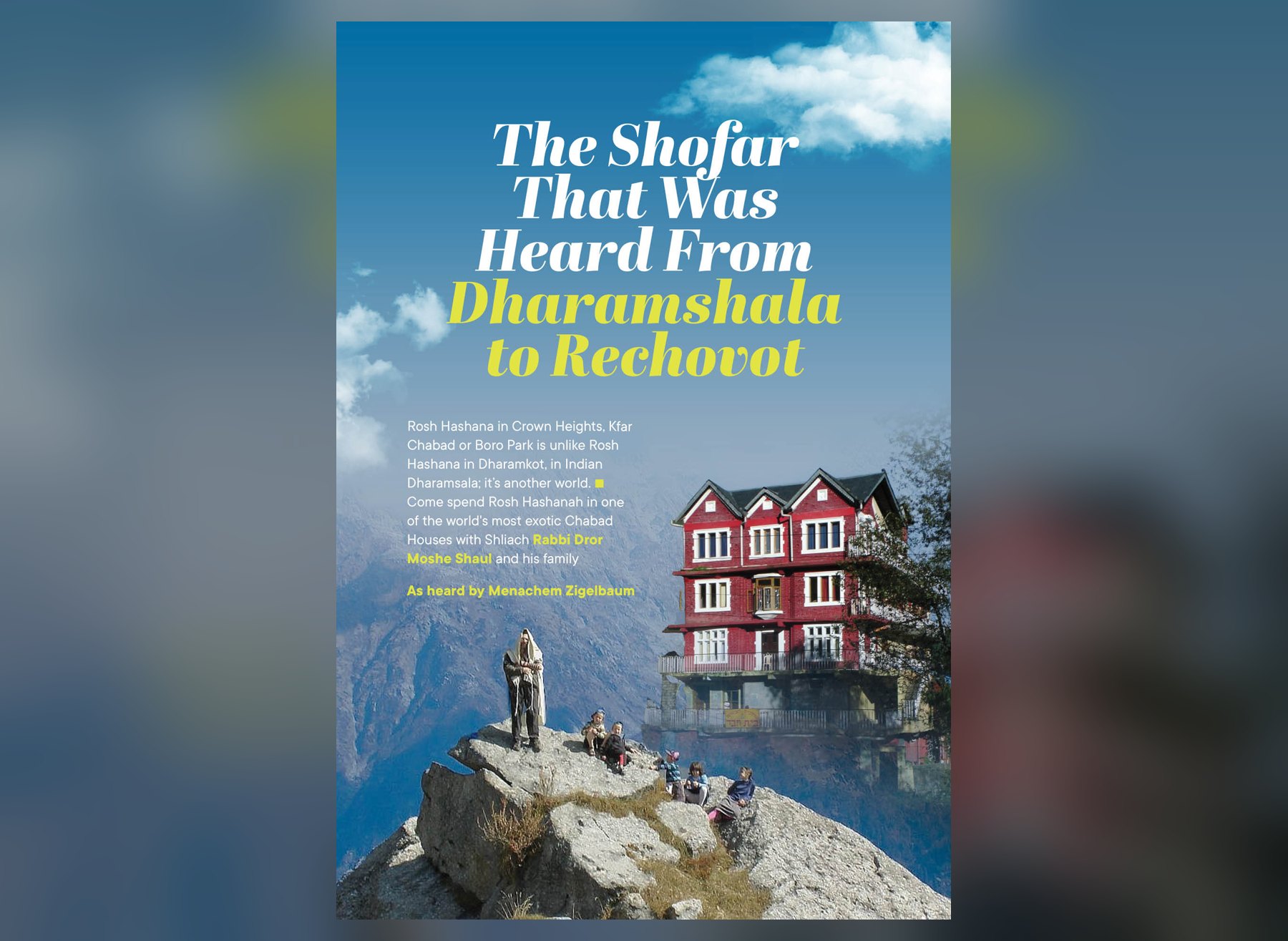
Rosh Hashana in Crown Heights, Kfar Chabad or Boro Park is unlike Rosh Hashana in Dharamkot, in Indian Dharamsala; it’s another world. * Come spend Rosh Hashanah in one of the world’s most exotic Chabad Houses with Shliach Rabbi Dror Moshe Shaul and his family
I
Rosh Hashana in Crown Heights, Kfar Chabad or Nachala is unlike Rosh Hashana in Dharamkot, in Indian Dharamsala; it’s another world.
Picture a place at the end of the spiritual world, trying to lead a minyan. Piyut after piyut, the tekios, with a group of tourists who are here today and gone tomorrow, who come to the minyan in their travel clothes, raising their prayers before the heavenly throne that He grant them too, a good sweet year, as they are…
Rabbi Dror Moshe Shaul woke up early in the morning on the first morning of the new year, full of ambitions, prayers and hopes. Just a few hours earlier, his Chabad House had hosted more than 400 people for the Yom Tov meal. They were still sleeping but he had to get ready for the davening, the tekios and a drasha.
In his experience, it wasn’t enough to say a vort; that might be fine anywhere else but here he had to speak to the heart and the neshama. It was a rare occasion that these young people came to shul, something they wouldn’t have done if they had been in Eretz Yisrael. He had to take advantage and say something that would inspire them, light their inner flame.
He took some sefarim to look for an idea. From here and there he realized that the main service of tzaddikim at this time, before the blowing of the shofar, is to speak well of the Jewish people, especially the simple ones.
He certainly had plenty of “simple Jews” at the Chabad House. Now he had figure out how to be melamed zechus on them in a genuine way. He considered a few ideas. He thought of telling a Chassidic story on the subject but decided it wasn’t for them. A story that took place two hundred years ago with some tzaddik in some town wouldn’t necessarily speak to their hearts. For many of them, it might be the first time they were in shul to hear the shofar.
He was out of ideas. He didn’t know how to present an idea in a way they could relate to. The davening began and people came in their flip-flops and their T-shirts. Most of them took a kippa from the stand that was prepared for just that purpose at the entrance when they walked in. The shliach was preoccupied with the tefilla as well as the drasha. Then he recalled a touching story.
II
It happened at the beginning of Elul. Rabbi Dror Shaul went with his oldest son, Levi, who came to visit from yeshiva in Yerushalayim, to a village for the purpose of Mivtza Tefillin. They would get to know the many tourists who were there at the start of the tourist season.
Minutes after they left the Chabad House, he noticed two tourists, a young man and a young woman, sitting on a porch on the second floor of a nearby hostel.
“Can we come up and visit you?” he asked sweetly. The two of them were excited to see a Jew with a beard, a genuine chareidi on the streets of Dharamkot.
“We’ll come down to you.”
After shaking hands with the man, the two asked whether they could talk for a few minutes. The shliach and the couple went to a nearby corn field and the conversation lasted longer than a few minutes.
Oren and Tami (pseudonyms) were Israelis who were on a long trip to the Far East. They were far from Yiddishkeit and even opposed, on principle, to anything Jewish. “We were with you for Kabbolas Shabbos and we really enjoyed it so that we decided to ask your advice,” they explained.
The subject they wanted to discuss was very sensitive. They wanted to know whether the shliach was born in a religious home or was a baal teshuva, so he wouldn’t be thrown by the subject matter.
A few days earlier, during a trip, they had met an Israeli girl who had gotten entangled with forces of impurity and magic and was being exploited by an Indian scoundrel who presented himself as a healer. The two of them, being soft souls, cried as they described the abuse she was suffering at the hands of this so-called healer. She quickly deteriorated mentally and seemed on the verge of a psychotic break. “Even being in her presence became very difficult.”
Even the shliach, who had seen and heard so much in his place of shlichus, was shaken up. Rabbi Dror, who understands people and knows how to guide them to their inner Geula, tried to think of a plan. He suggested that they try to convince her to come to the Chabad House and he would explain to her, using “the hidden Kabbalistic secrets in a name,” the essence of her name and try to guide her mentally to more beneficial, better places. He knew that many tourists sought spirituality and were attracted to hidden messages and kabbalistic secrets. Many of the tourists in Dharamkot changed their lives for the better thanks to the proper guidance.
The shliach offered various possibilities of trying to get her out of that impure place in order to heal her wounded soul. They arranged that the couple would check out developments with the girl and get back to him with a report.
A few hours later the two conveyed the message: She is not interested in meeting with the shliach. In addition, her state of mind is terrible and she needs to be under observation for her safety. “The only solution is to watch her 24 hours a day until she regains her sanity,” they said.
The shliach asked for her name and her mother’s name and together with his children said Tehillim for her.
A day passed and another day. The shliach expected to hear from Oren and Tami what was happening, whether there was any change in her condition, but the couple had left their room and disappeared.
III
There was just one week to go before Rosh Hashana. Rabbi Dror Shaul returned tired from shopping in the nearby city. It was late at night when on the way he was surprised by a police blockade. The policeman matter-of-factly said that the road was closed to traffic until the morning. Nothing the shliach said helped and he had to park his car on the side of the road and start walking, for about an hour, until the Chabad House.
He called the Chabad House to say he wouldn’t make it for the Chassidus class at eight o’clock. He wondered, “Ribono shel olam, what do you want from me?”
After an exhausting day, he began walking along the highway with his shopping bags. About a kilometer later, the road was no longer blocked and he looked for a rickshaw to take him to Dharamkot.
As he looked around he was surprised to see Oren and Tami. They were also on their way to Dharamkot. It was a warm reunion.
“I thought of you a lot, I prayed for you. I’d love to hear what happened since then,” said the shliach, without any trace of annoyance.
They told him that the girl’s condition was still critical. They knew that the only chance to save her from that wicked individual was to be with her, in her room, for three days straight and to shield her so she wouldn’t go out to him.
Miraculously, the fake healer himself went into a depression and told her that for some reason he suddenly saw she had “protection,” and therefore, he couldn’t help her. This made her more hysterical and fearful. Staying with her became a nightmare.
The two of them spent a horrible time with her until they managed to get her on a plane to Eretz Yisrael, to her loving, worried parents. The couple’s role in the saga had ended.
Staying with her had a negative effect on their psyches and they burst into tears and said they felt she had contaminated their souls and especially their relationship.
“We are not angry at her,” said Tami. “She wasn’t sane, but the damage was done,” she added in enormous pain. Oren nodded his silent agreement.
The two were very confused and hurting and they hadn’t even found the strength to go to the shliach and talk to him; they just wanted to forget about her.
As the rickshaw navigated the treacherous roads, the shliach told them about the purification process from contact with the dead with the kohen who sprinkles the “mei chatas,” ashes of the red heifer. During this purification process, the kohen himself becomes impure as he helps another become pure.
“Even though you sustained damage, you saved a Jewish soul and this is an enormous mitzva!”
The couple heard it and this gave them renewed strength. Rabbi Shaul suggested they come to the Chabad House to undergo a “purification process” from all the spiritual filth they absorbed. He suggested immersing in a mikva, learning Tanya, and reconnecting to “holy energy” that would remove all the kelipos of impurity.
The couple was happy to hear that there was a fix for their situation and they made up to come to the Chabad House the next morning.
“Immersing in a mikva is like a rebirth; learning Tanya is also restorative,” he explained.
When the couple left the Chabad House the next day for Kasol, they felt that their inner calm had returned and they were getting back to themselves.
IV
The shliach told this story minutes before the blowing of the shofar and crowning the King. He closed his eyes for a moment, breathed deeply, and then continued.
“I don’t know who has been tested with difficult experiences in their lives but to be in the presence of a person undergoing a psychotic break who is manipulatively trying to hurt you, is something extremely difficult. This is what the couple did with someone they knew superficially and met just a few days before. Nevertheless, they deeply identified with her because she was a Jew, their sister in the Jewish nation. This conduct testifies to the pure G-dly soul within every Jew who is willing to give up his time, soul, money, marital life and sanity for another Jew.
“With the blowing of the shofar that we will hear momentarily, let us contemplate that part of our soul that calls out to be revealed and which calls out to G-d to end the sorrow of exile of all Jewish souls and bring Moshiach immediately.”
R’ Shaul felt he had succeeded in touching a truly deep place of limud zechus right before crowning the King. What a privilege to present to the King moments of nachas from His children right before they all would say together, “He shall choose our inheritance for us, the pride of Yaakov, whom He loves forever.”
V
After Mincha of Rosh Hashana, the shliach, his family and many of the Israelis in the area went to Tashlich. They made their way to a nearby forest and stood near a river where they cast off their sins.
On their way back, the shliach suggested to his young son that he come with him for Mivtza Shofar. His son shrugged and said he was too tired.
The shliach went himself to enable Jews to hear the shofar and there were plenty in Dharamkot. He took his shofar and Moshiach cards and went around the village. He met many tourists and blew the shofar for them and gave them Tefillas HaDerech cards with the Rebbe’s picture.
On his way back, he walked through the center of the village where he knew there was a treif restaurant. He went inside and met some Israelis and blew the shofar for them. When he left, he began heading for the Chabad House.
On his way, he met some tourists and offered to blow the shofar for them.
“We heard it already,” was their surprising answer.
“You heard it? From whom?” He knew that there were no men or bachurim from Crown Heights or Kfar Chabad walking around with a shofar.
“A redheaded kid came here and blew the shofar for us.”
Rabbi Shaul smiled to himself. He realized that his son had pulled himself together and had gone on Mivtza Shofar after all.
* * *
A year later, the Shaul family spent a brief vacation in Rechovot in Eretz Yisrael. One morning, while he was in the mikva, a refined looking bachur with a beard said, “Hello Rabbi Dror from Dharamsala. You should know that last year I was sitting in a restaurant of goyim in Dharamsala with friends. Suddenly, a boy walked in and blew the shofar for us. The sound of the shofar went in one ear and hasn’t left till today.” .
Rabbi Dror Moshe Shaul relates:
If we want to see G-dliness, it’s only through mivtzaim that are done to draw Jews close. I do this not only to strengthen others but to be strengthened myself.
Erev Rosh Hashana 5768, I went with my nine-year-old Levi and eight-year-old Chaya Mushka to the village of Bhagsu at the foot of Dharamkot. We walked through the streets of the village and went into restaurants with Israeli tourists to invite them to the Rosh Hashana meal at the Chabad House.
In one restaurant, sat a Jew who was around fifty. My children went over to him and invited him for Rosh Hashana and they wished him a good sweet year. He began shouting at them, “What’s this religious coercion? Why are you bothering us? You go into restaurants and disturb people. How are you not ashamed?”
The children were frightened and offended. I couldn’t remain quiet. I went over to him and said, “This is how you talk to children? If you have something to say, say it nicely, but to shout like that at children?! What did they do to you?”
The children went home and said they weren’t going on mivtzaim anymore. The next day, when I suggested they join me, they refused.
I went by myself to Bhagsu and met the same man. He came over to me and apologized. “That really wasn’t nice of me. I apologize and want to come for the meal on Rosh Hashana. Where is it? How do I get there? How much do I need to pay?”
He came to the meal on Rosh Hashana. As for the children, when they saw that he was our guest and was nice, they went back to doing mivtzaim
Beis Moshiach #1428 • pp. 26-30
© 2026 Beis Moshiach Magazine. All rights reserved.
This article originally appeared in Beis Moshiach #1428. You are welcome to share it with friends and family by email or in print, provided that you do not change, add to or omit any part of it, you credit the author and Beis Moshiach, and you include a link to archive.bmoshiach.org (written out in full in printed copies).
To republish this article in a newspaper, magazine, book or website, please request permission in advance at [email protected].