“I Was Zoche to Light the Rebbe’s Candle, and You All Can Do the Same”
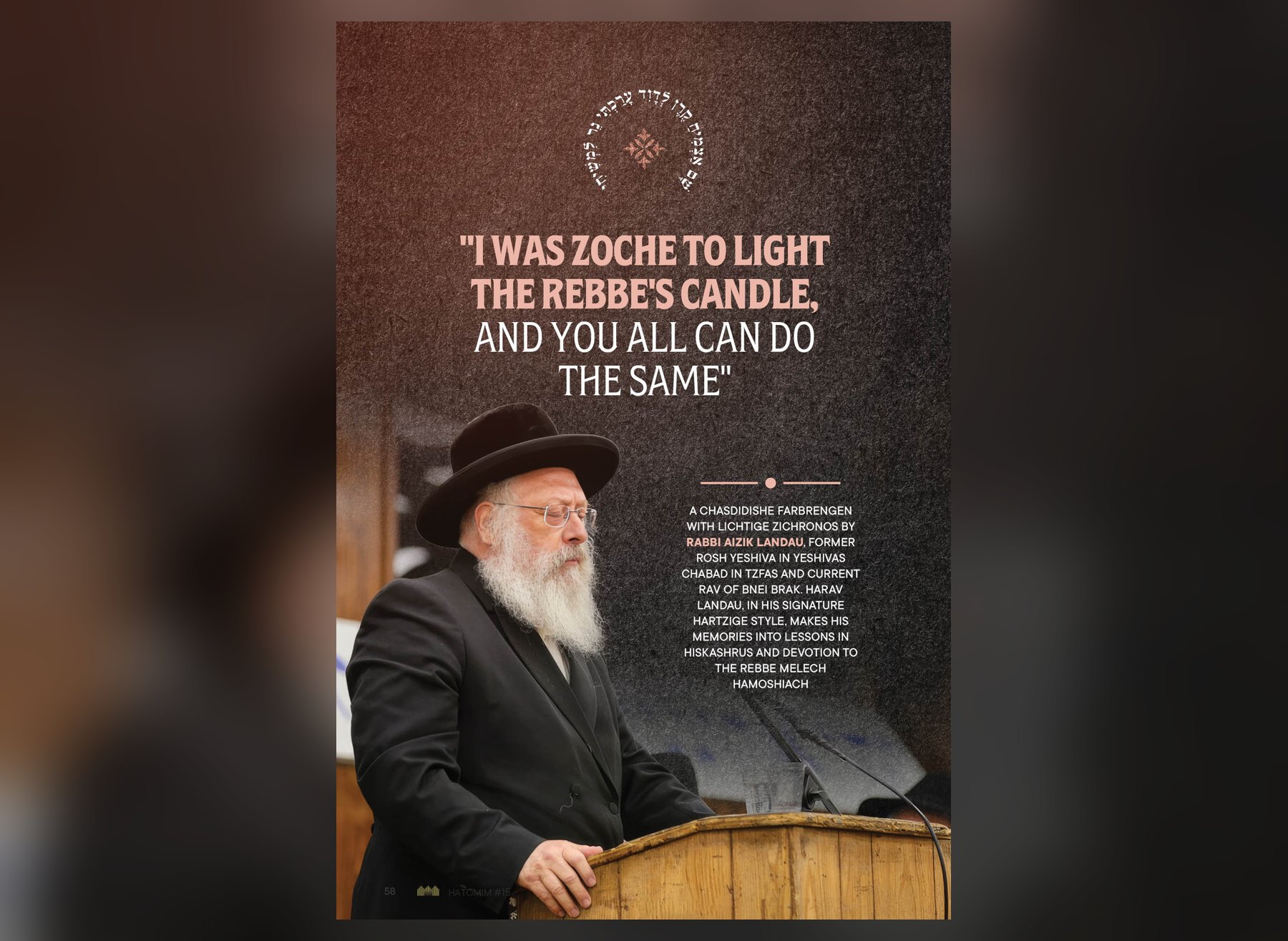
A Chassidishe farbrengen with lichtige zichronos by Rabbi Aizik Landau, former Rosh Yeshiva in Yeshivas Chabad in Tzfas and current Rav of Bnei Brak. Harav Landau, in his signature hartzige style, makes his memories into lessons in hiskashrus and devotion to the Rebbe Melech HaMoshiach.
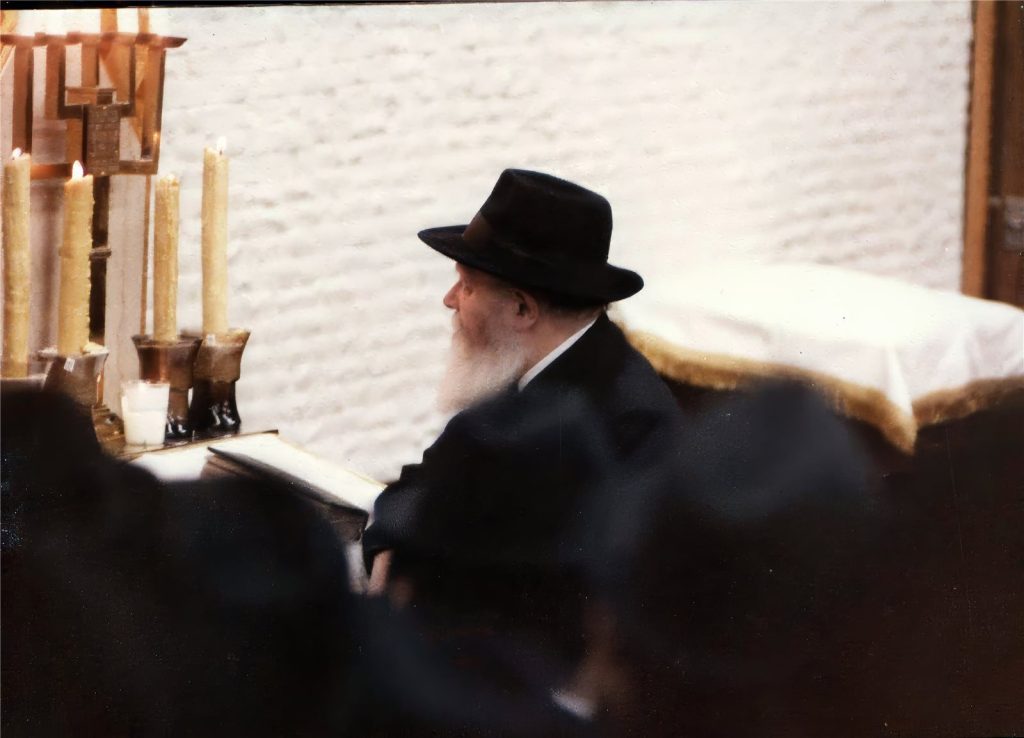
It was after the holy day of Yud Shevat, in my Kevutza year – 5741 (1981). As usual and customary on this day, the Rebbe MH’M, approached the amud and led the davening. Naturally, the entire congregation, including us tmimim, crowded around so as not to miss a single movement of his lofty, holy conduct. Five candles burned on the chazan’s podium – two tall candles on the sides, and between them three smaller yahrtzeit candles.
When the Rebbe entered for Maariv, the small candles had already gone out. One wax candle was still burning, while the second one had also extinguished. No one saw a need to light the candles before the Rebbe’s entrance – after all, it was already after the holy day, and those present probably thought there was no need to light all the candles anymore.
When the Rebbe arrived and approached his place in the east, he suddenly asked why the candle wasn’t lit. Immediately, several people tried to light the candle. The wick of the candle, which had gone out several hours earlier, had sunk into the melted wax, and it was no longer possible to extract and light it. They tried for quite a while to light the candle, but to no avail. I had a small screwdriver in my pocket at the time, the kind used to tighten loose glasses. I went over and took the candle in my hand. I scraped around the wax-covered wick, and the candle lit instantly. Maariv began.
At the end of the davening, when the Rebbe passed by the candle, he looked at it, and nachas was visible on his holy face. It’s impossible to describe my feelings at that time, the spiritual elevation of having merited to bring the Rebbe nachas. To this very day, I keep that screwdriver, stored together with the dollars I received from the Rebbe. That’s how I feel about it. Something with which I merited to bring nachas to the Rebbe is more precious than anything. I feel that this small screwdriver is something with which I merited to fulfill the Rebbe’s ratzon.
A Chassid has a special feeling, and that is the desire to bring nachas to the Rebbe. Every Chassid connected to the Rebbe knows that there is nothing he desires more than to bring nachas to the Rebbe. This desire is something straightforward that is rooted in every Chassid’s soul, and when he indeed merits to give the Rebbe nachas, he is moved by it and is infinitely happy.
This memory, which remains in a Chassid’s heart, stands and lives forever like a lighthouse illuminating his daily life. It goes with you through life and gives you the chayus needed to do the Rebbe’s ratzon at every moment.
In physical and simple matters, it’s easy to feel that you’re ‘doing something’ and causing nachas. But if you reflect a bit, you can see how much nachas the Rebbe has when a tamim learns, when a bachur davens at length and works on his middos. However, since the animal soul and physical body conceal and hide the divine soul, sometimes when doing these acts, the nachas brought to the Rebbe isn’t felt as much. Specifically in physical, tangible things, when we perform some concrete action to bring the Rebbe nachas when he is literally before us, sometimes it feels like we bring more nachas then.
The same applies to mivtzaim. To a bachur, avoda with the ‘outside’ often seems more necessary. He thinks that if he does mivtzaim outside and brings people closer, then this will bring greater nachas to the Rebbe. But the truth is that to the same degree, and even more so, the Rebbe has nachas from him when he diligently applies himself to Torah and avoda, is immersed in Nigleh and Chassidus, and works on himself in avodas ha’tefilla.
The same goes for inyanei Moshiach. We all know about the importance of bringing more Jews closer to inyanei Moshiach by explaining to them in good taste about the approaching Geula and all the good things that will accompany it. This is important and obligatory, and the Rebbe speaks about it. But one must know that the Rebbe has great nachas, and even greater, when the bachur himself lives Moshiach.
There are several interpretations of the statement of Chazal, “All the days of your life to bring about the days of Moshiach.”
The simple interpretation is, I know that my actions are what will cause Moshiach to come. This changes my entire conduct. Every action, speech, or thought of mine is guided and conducted according to the plan that will lead me there. All my daily activities and Torah and mitzvos are permeated with this.
A second explanation is, all your occupation is to enliven other Jews in inyanei Moshiach. To cause another Jew and another one to engage in Moshiach, to anticipate Moshiach – “to bring (others) to the days of Moshiach.”
But there is a third interpretation, especially related to the tmimim. Our occupation in Tomchei Tmimim is to turn ourselves into candles. Candles that illuminate, candles that radiate their glow on all our surroundings, but first we must transform ourselves from within. Hafatza and activity outside, actions that will help more Jews connect with inyanei Moshiach, all good and well – during times outside the sedarim. During the regular daily schedule, a bachur’s main concern is within the walls of the yeshiva, that’s where he’s connected and where he belongs.
This doesn’t mean that “bringing about the days of Moshiach” only concerns him at special times, during Friday mivtzaim and when he meets other people who haven’t yet heard that “hinei zeh Moshiach ba.” Rather – all the days of your life. All day. Not just between sedarim, not just bein ha’zemanim when he walks the street and meets people who haven’t yet heard that “hinei zeh Moshiach ba.” He lives it every day and every moment!
The third interpretation is – “to bring (yourself) to the days of Moshiach.” Cause yourself to live Moshiach. This is the work of a tamim, this is what the Rebbe demands from each and every one of the bachurim in the seventh generation. In free times, spread Moshiach, engage in mivtza Moshiach, and with enthusiasm. But your main concern as a tamim is “to bring (yourself) to the days of Moshiach,” to work on yourself to live in the days of Moshiach.
What does this mean? Our avoda is to study with diligence and persistence, Our avoda is to daven with kavana. Our work is to refine our middos – in this we work with chayus to bring about the days of Moshiach. Only thus do we fulfill within ourselves the Rebbe’s horaah. And when we conduct ourselves accordingly, we set ourselves on an entirely different plane of existence.
The Rebbe revealed to us – “revealed through His servants the prophets” – that we are in the generation of Moshiach. We need to know and internalize this deep inside the soul.
When a bachur, a tamim, thinks for a moment about what he’s going toward, what he faces, he knows that he is and will be in quite difficult situations and trials. After all, “a person knows his own soul.” Everyone who evaluates himself correctly will see what level he’s at and what nisyonos come before him. In matters of thought and actual deed, and also in matters of faith – he faces such nisyonos that weren’t in previous generations.
In the past, the tmimim lived in Lubavitch, disconnected from the world, and the ‘worst’ thing they could do was go swimming in the river… Those weren’t nisyonos.
Today when we come to a bachur and demand improvement in conduct or improvement in actual deed, this isn’t ignoring the difficulty and nisyonos he faces, the ‘vision of this world’ that’s revealed to him at every corner.
The animal soul and yetzer hara feel that their role in the world is coming to an end, and Satan exerts all his strength in his final death throes. And this is hard for us; but if a bachur knows that all this difficulty stems from his being in a state of “bringing about the days of Moshiach,” from the last moments of galus when the yetzer hara exerts all its powers, then he understands that this is what’s imposed on him now as a tamim, to exert that final effort that will completely remove the reality of the yetzer hara from the world.
How do we do this? The Rebbe told us do all that you can. And this needs explanation, for is there anyone who can say “I did everything I can?” Nevertheless, this is what the Rebbe demands.
The Rebbe means that you should do everything you can regarding yourself so that you reach the days of Moshiach. First and foremost – kabbolas ha’malchus. Every tamim needs to take upon himself something within his daily schedule that he does with kabbolas ol. A horaah from the Rebbe or additional stringency and hiddur in Shulchan Aruch that he takes upon himself and fulfills as an ‘unbreakable law.’ And as mentioned, “a person knows his own soul” in what he must currently strengthen himself.
Not long ago, I happened to talk with a Chassidishe bachur about his hiskashrus to the Rebbe. I asked him what’s happening with Chitas and Rambam? And he tells me that he doesn’t always manage to say it… He tries… And he’s a Chassidishe bachur! And I cried out, and said to him – If so, how is the kabbolas ha’malchus expressed? If on things the Rebbe tells you to do you answer ‘I try,’ then where is your kabbolas ha’malchus?
A bachur isn’t meant to solve this alone. The Rebbe says “asei lecha rav” and everyone needs to approach a mashpia and ask him, “the Rebbe says do all that you can, where am I fulfilling this?” And the mashpia, whose influence is in the power of the Rebbe, will guide him in what is demanded of him now. And this is ‘bringing about the days of Moshiach.’
I want to end with a story. Decades ago, I happened to be at a certain yeshiva high school on the Shabbos before 19 Kislev, to speak about the essence of the day. The arrangement was that on motzoei Shabbos, they would have a celebration in Kfar Chabad which students from all the yeshiva high schools that the tmimim visited would attend.
At the Shabbos meal, I spoke to the bachurim, and repeated to them what Moshiach said to the Baal Shem Tov: “When will the master come? When your wellsprings spread outward.” Even the high school students knew this. And I asked them – why? Why is spreading the wellsprings connected with the coming of Moshiach, what’s the connection between them?
I answered them – What will be in the days of Moshiach? Rambam says, “The occupation of the world will only be to know G-d.” There won’t be a break for games, there won’t be a break for the pool (the yeshiva had all the facilities and fields possible…), no one will engage in this.
So what will they do all day? They’ll sit and study Torah!
If you ask your friends, you’ll discover that no one wants to give up on soccer or an enjoyable swim in the pool. Moshiach loves every Jew, and he doesn’t want to ruin our games. Apparently, I told them then, that’s why he’s not coming.
When they learn Chassidus, they’ll understand the preciousness of Torah study, how through Torah study not only do you grasp beautiful intellect and wonderful wisdom, but you connect to G-d. When everyone understands the Chassidic conception of what is ‘G-d’s wisdom,’ internalizes the divinity in Torah, naturally everyone will want to study all day – then Moshiach will come. When we truly want him.
Tmimim, these words apply to us too. When we work on ourselves to bring ourselves to the days of Moshiach, when all we ask and want is to do another action to bring Moshiach, another deed to accept the Rebbe’s malchus – then Moshiach will come.
When we are permeated with inyanei Moshiach, our work to influence the outside also pulls us deeper into the subject. I saw myself how the inyan I spoke about, which exerted an influence on others, those many years ago, remains with me to this day deep in my bones.
Tmimim! Action is the main thing – everyone needs to accept upon themselves the Rebbe’s malchus, and do everything in their power to bring Moshiach.
Thus he brings himself to the days of Moshiach.
(From Rabbi Aizik Landau at a Chassidishe farbrengen. Written by the editorial staff and solely their responsibility.)
HaTomim #15 • pp. 58-62
© 2026 Beis Moshiach Magazine. All rights reserved.
This article originally appeared in Beis Moshiach #1446. You are welcome to share it with friends and family by email or in print, provided that you do not change, add to or omit any part of it, you credit the author and Beis Moshiach, and you include a link to archive.bmoshiach.org (written out in full in printed copies).
To republish this article in a newspaper, magazine, book or website, please request permission in advance at [email protected].