Bichelach of Chassidus
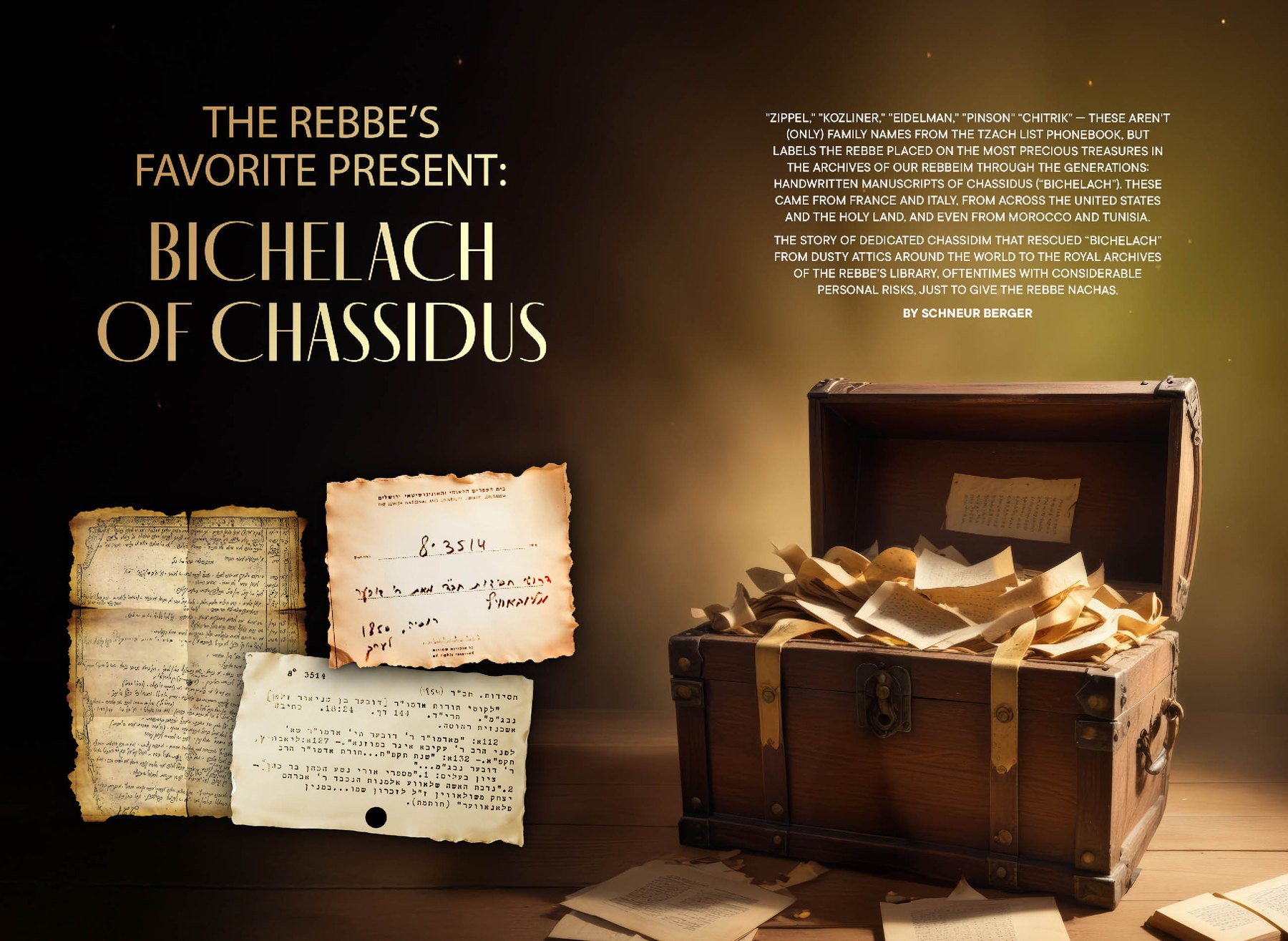
“Zippel,” “Kozliner,” “Eidelman,” “Pinson” “Chitrik” – these aren’t (only) family names from the Tzach List phonebook, but labels the Rebbe placed on the most precious treasures in the archives of our Rebbeim through the generations: handwritten manuscripts of Chassidus (“bichelach”). These came from France and Italy, from across the United States and the Holy Land, and even from Morocco and Tunisia. The story of dedicated Chassidim that rescued “bichelach” from dusty attics around the world to the royal archives of the Rebbe’s library, oftentimes with considerable personal risks, just to give the Rebbe nachas.
The Chassidim of the Rebbe knew that if they wanted to bring the Rebbe a gift that would truly bring him joy, they could do so by finding and sending a “bichel” (booklet of Chassidus).
“Bichel” – a magical word that contains within it handwritten texts of Chassidic teachings, as was customary in times gone by, before the age of low-cost printing (The word’s origin is Yiddish, and it means “book”). Long and dense lines, scribbled letters, and words that encapsulate entire worlds of Atzilus, Beriya, Yetzira and Asiya, alongside in-depth explanations of Chassidic teachings.
The existing “bichlach” are generally divided into two types – those written by our revered leaders, and those written by Chassidim. Obviously, the first type is considered more important.
Over the generations, the Rebbeim not only delivered maamarei Chassidus in public but also transcribed them. These writings were preserved in the Rebbeim’s treasuries and were considered valuable heirlooms passed down from generation to generation. When they had to go on a journey, the precious manuscripts were carefully preserved or entrusted to a trustworthy Chassid, whose job was to guard them diligently. When any of the Rebbeim needed to relocate, the “bichlach” were the first items to be packed with the utmost care, before any other household possessions.
There were also maamarei Chassidus written by Chassidim shortly after hearing them. These were recorded to be preserved and meditated upon. For many years, actual sefarim of Chassidus were rarely printed, and people studied from manuscripts that they copied themselves or had copied by a skilled scribe with a beautiful handwriting. These writings were called “bicher” or “bichlach.”
It’s worth noting that these manuscripts, although copies, were extremely precious – because what is sweeter and more precious than a maamar Chassidus delivered by one of the Rebbeim over the years?
Thanks to these copies made by the Chassidim, many maamarim of our Rebbeim were preserved despite the many upheavals, as well as the fires that struck the Lubavitch court.
Over the years, however, many “bichlach” were lost or even stolen, passing through many hands. Some were inherited but not always carefully preserved. Many “bichlach” were lost during the turmoil of the two World Wars and other difficult events that befell Russia over the years.
From this point on, the effort began to locate and retrieve as many Chassidic writings as possible, to bring them to the Rebbe – to the rightful place where they should be kept and preserved: the royal archives.
Chassidim invested tremendous efforts to locate such manuscripts, whether out of genuine hiskashrus or a sincere desire to bring joy to the Rebbe. From all corners of the globe, Chassidim worked tirelessly to locate these writings – sometimes entire manuscripts, sometimes even single pages that had separated from the original “bichel” over the years.
When such a “bichel” came into the hands of the Rebbe, it was truly a joyous occasion.
Various challenges did not deter those who sought to fulfill the Rebbe’s wishes. The Chassidim took risks and did so not for honor or money, nor for any spiritual benefit, but solely to fulfill the Rebbe’s holy will.
“…In a maamar of the Rebbe… which has just emerged from confinement to freedom,” is a phrase that frequently appears in the Rebbe’s maamarim and sichos. It seems that every time a new Chassidic manuscript was released from captivity, the Rebbe rejoiced as if he had found a great treasure, and he would speak at a farbrengen about topics from that “bichel” that had been redeemed.
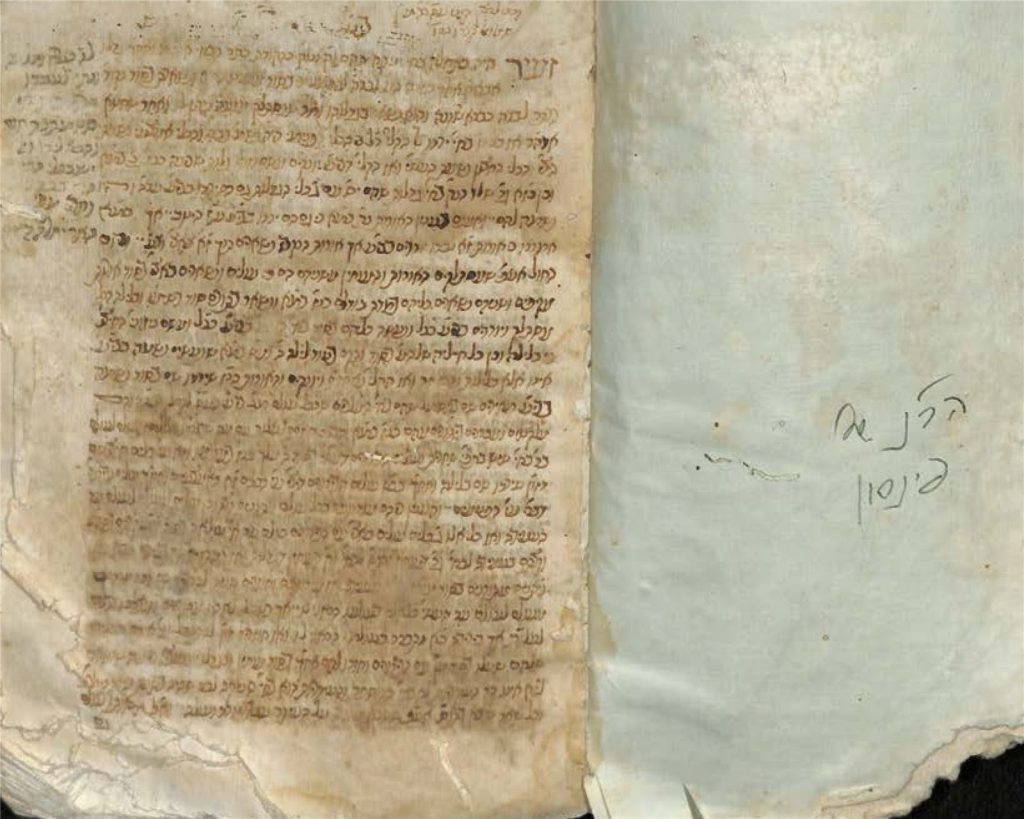
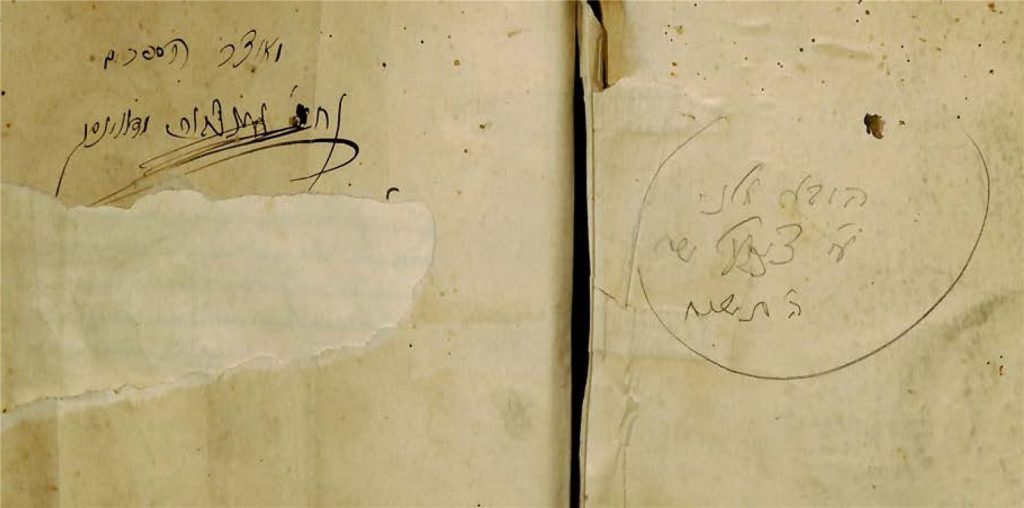
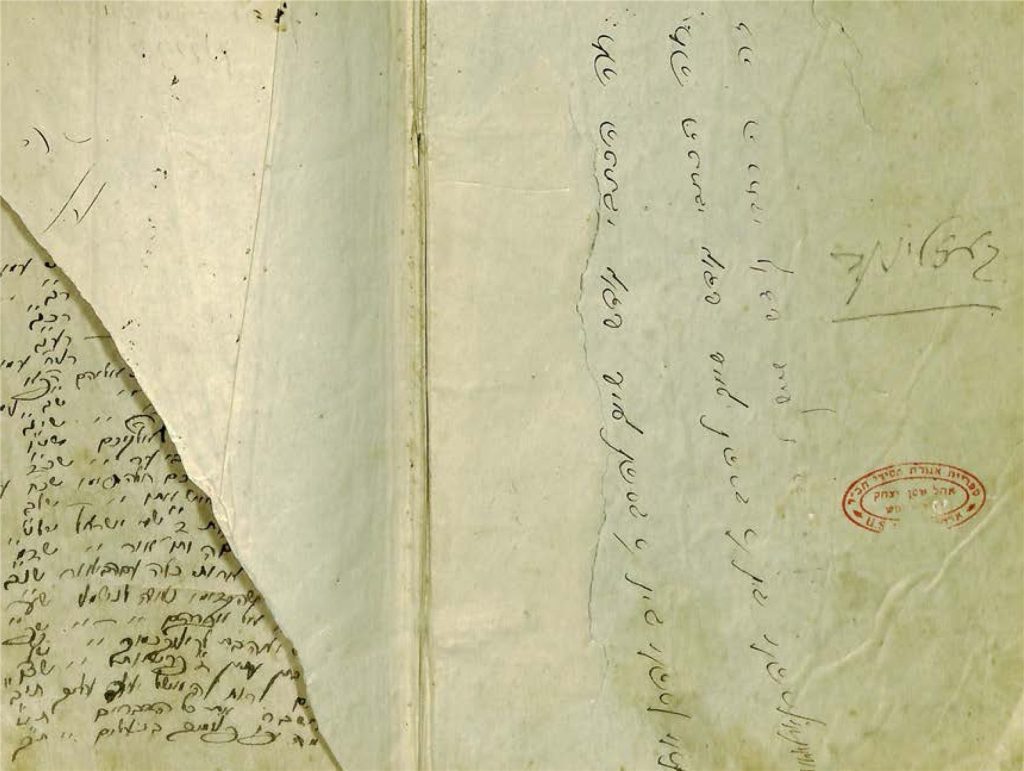
Often, the Rebbe would even note the names of the Chassidim who brought the precious manuscripts in his own holy handwriting at the beginning of the “bichel.” This notation was not merely for remembrance, but rather, the “bichel” that had been retrieved from unworthy places and brought to its redemption was worthy of being called by the name of its redeemer. Nothing less.
About three years ago, thousands of yellowing manuscripts, which have seen better years, were uploaded to the online site of the Lubavitch Library. These “bichlach” display the names of the Chassidim who were privileged to have their names written by the Rebbe on the “bichel” itself: “Slonim” – Rabbi Ezriel Zelig Slonim; “Shmotkin” – Rabbi Yehuda Shmotkin; “Glitzenstein” – Rabbi Chanoch Glitzenstein; “Kozliner” – Rabbi Mordechai Kozliner; “Zippel” – the Zippel brothers from Italy; “Eidelman” – Rabbi Sholom Eidelman; “Pinson” – Rabbi Nissan Pinson, and many others. In addition, in supplements to Torah Ohr and Likkutei Torah and other places, one can find “Buch Mishulovin,” “Buch Marinovsky.” These Chassidim were honored, and their names are associated with these teachings of Chassidus.
Many knowledgeable Chassidim in America, Eretz Yisrael, and around the world, worked over the years to locate Chassidus manuscripts from elderly Chassidim, or from their families, or from dusty archives. After verifying that these were indeed rare Chassidus manuscripts, they embarked on a fascinating journey to obtain them and send them to the Rebbe.
Over the years, many Chassidim behind the Iron Curtain, despite facing persecution, suppression, dangers, and surveillance, preserved these Chassidus manuscripts, including holy writings from our Rebbeim. They understood that they were safeguarding precious treasures. When they were finally allowed to leave the Soviet ‘vale of tears,’ they risked bringing out these manuscripts and, at the first opportunity, sent them to the Rebbe.
As mentioned, these sacred gifts have been revealed to the public in recent years on the website of the Lubavitch library, managed by Rabbi Shalom Dovber Levin, in what can be considered a great revelation of light for the public. Thousands of “bichlach,” handwritten books containing hundreds of thousands of pages of manuscripts, have been uploaded to the site and are now available for all to see, with the goal of making these valuable manuscripts accessible to everyone.
The treasures revealed recently from the library, which developed over the years under the leadership of our Rebbeim, will be studied for many years to come.
It would seem only fitting to get a glimpse at the stories of Chassidim who went to great lengths to bring to the Rebbe Chassidus manuscripts or other rare writings. It should be noted that many Chassidim were involved in this effort, and while space is limited, we will present a few stories of these Chassidim.
Lost and Forsaken
With the mass emigration of the majority of Chabad Chassidim from Russia in the years 1946–47, many rare and precious Chassidic manuscripts remained within the Soviet Union. However, these were not gathered in one place but scattered in archives and with elderly Chassidim throughout the country.
Many of the Chassidic families who had these manuscripts would simply toss them into the attics of shuls, and so, Chassidim knew to search the attics of shuls throughout Russia. They would also search various libraries where manuscripts might have found their way through different means.
One way to find “bichlach” was by locating Chassidim scattered throughout Russia. It’s worth devoting a few lines here to these Chassidim:
Generally, Chassidim tried to concentrate in the larger cities because it was easier to observe Torah and mitzvos there. However, there remained a small number of Chassidim scattered in peripheral towns, each for their own reasons. Some were specifically sent there by the Rebbe and did not have the courage to leave their place of shlichus; some did not want to leave a place where they were the only shochet or mohel; and some, in their old age, preferred to live near their family.
These Chassidim were often completely isolated from the central communities and were unaware of what was happening elsewhere (it’s important to remember that this was communist Russia, where information was not as freely accessible as in other countries). Many of them did not even know about the passing of the Rebbe Rayatz and the acceptance of the nesius by the new Rebbe – and this was in the 1970s and 1980s! Rabbi Mottel Kozliner recalled one Chassid asking him, “The Rebbe had a talented child – what happened to him?” The Chassid had not heard about the passing of the Rebbe Rashab, nor about the Rebbe Rayatz, let alone the appointment of a new leader for the seventh generation. They still lived in the fifth generation…
Rabbi Hillel Zaltzman told a story about the Chassid Reb Itche Garelik, who was known as “Itche Szcedriner” and was one of the teachers in “Tomchei Tmimim” in Lubavitch. At that time, Reb Itche was living in Nikolaev, and when R’ Hillel visited him, he asked whether it was true that “the son” (the Rebbe Rayatz) had become the Rebbe…
These Chassidim, for the most part, were not able to raise their children according to the ways of Torah. The non-Jewish environment and distance from the center of activity influenced their children. However, they themselves lived as if they were still basking in the light of Lubavitch, never changing or compromising. For these broken Chassidim, these Chassidic writings was their entire world, and parting from them was nearly impossible. But when they heard the sefarim were for the Rebbe, they gave up the very essence of their lives for him. Sometimes they were “bribed” with new maamarim from the Rebbe that had arrived in Russia through difficult means, or with the sefer “HaYom Yom” and the like.
‘Operation Kozliner’
Here and there, a few writings would trickle out. In late 1956 (or early 1957), Professor Avrohom Yitzchok Katz, who was in contact with the Rebbe, visited Russia. During this visit, and another one later, he succeeded in bringing many manuscripts of the teachings of our early Rebbeim.
And thus the Rebbe wrote to him in 1959: “On this occasion, I wish to express my heartfelt thanks for allowing me to review the manuscript ‘Buch Vayikra,’ and I am enclosing a separate sheet with a list of the maamarim that have already been printed, etc. – with gratitude.” Again, some time later, the Rebbe added: “Here, I wish to repeat my thanks for lending me the second manuscript, which is being returned separately, with a list of the maamarim and letters contained in it, which, to the best of my recollection, have already been published.”
In 1965 (or 1966), when the professor returned to Russia a second time, he went to the Rebbe for a private audience. A day or two later, Rabbi Chodakov, speaking on behalf of the Rebbe, told Rabbi Aharon Chitrik, who was involved in the publication of Chassidic writings, that the professor had brought with him many manuscripts, so they should contact him and examine the manuscripts. After several days of checking in his office, the professor lent him some manuscripts.
In the early 1970s, a special operation began in Russia: the transfer of manuscripts to the Rebbe. This operation was initiated by the Rebbe, who conveyed the message that sending Chassidic manuscripts out of Russia was like pidyon shvuyim.
The operation was managed by the famous Chassid, Rabbi Mottel Kozliner. He personally took charge of the work, and together with a group of Chassidim, they searched for old Chassidic sefarim and manuscripts from our Rebbeim in every possible place. He searched in the genizas of shuls and in the homes of Chassidic families from previous generations. Once found, everything was sent to the Rebbe, through every possible means.
To understand the immense importance of this matter to the Rebbe, we quote from the Rebbe’s sicha on Shabbos, Parshas Noach 1967, where he spoke about the importance of this holy task:
“It is well known that our Rebbeim, in general, and my revered father-in-law in particular, urged and worked fervently (‘zich gekocht’) to collect and gather all the minhagim related to psak halacha (since ‘minhag Yisrael Torah hee,’ especially those customs related to psak halacha), including the customs of the Rebbeim or early Chassidim who are reliable authorities (in writing or orally), as well as Chassidic manuscripts, letters, notes, and sichos kodesh. Even though many things have already been printed, they are but a drop in the ocean. Therefore, we request in every possible way that anyone who has (or knows someone who has) reliable copies […], including those inyanim that have already been printed, but with any additional explanations or changes (since they were edited by an authoritative source, the changes are definitely exact) – should strive to send all these materials here, so that they will be printed and disseminated, until we can see the practical results of this, and as it is written: ‘So that they may hear, and that they may learn and fear.’”
It was enough for the Chassidim in Russia to know that the Rebbe requested this, and they embarked, some with great haste, on a complex mission, often traveling thousands of kilometers, to locate manuscripts in remote places. One of those active in this mission was R’ Hillel Zaltzman, one of the leaders of the “Chamah” organization, who traveled throughout the Soviet Union to locate such manuscripts. He shared:
“How exactly the Rebbe’s directive reached Russia, we didn’t know. How R’ Mottel managed to find the addresses of the elderly Chassidim, we didn’t know either. In fact, as was common at the time, we didn’t ask or inquire about it. We only knew that there was a directive from the Rebbe, and that was enough. In the Russia of those days, everyone kept their curiosity to themselves. Each person only knew what concerned them, and nothing more.
“R’ Mottel Kozliner devoted himself to this matter with all his soul and might. After many efforts, he succeeded in locating the names and addresses of dozens of elderly Chassidim who had remained in remote corners of the Soviet empire and who were likely to possess Chassidic manuscripts from previous generations. After preparing organized lists, he raised funds for this extensive activity, and encouraged young men and yungeleit to travel across Russia according to the addresses he had prepared. Naturally, this activity, especially with the ultimate goal of removing these manuscripts from Russia, was fraught with danger. But when we heard that this was a directive from the Rebbe, we dedicated ourselves to the cause as best we could.”
Large sums of money were raised for this special project, used for purchasing the manuscripts from Jews who wanted payment for the Chassidic writings, as well as for covering the travel costs between locations. Sometimes, bribes had to be paid to border guards to look the other way when large quantities of manuscripts were involved.
Those tasked with locating the manuscripts arrived in towns and villages across Russia, saving hundreds of Chassidus sefarim and manuscripts from oblivion. Every Chassid who managed to leave Soviet Russia was discreetly given several manuscripts or sefarim to bring to the Rebbe.
Secret Deliveries
The smuggling operations of the manuscripts presented their own complex challenges, and the method of shipping evolved over time depending on the circumstances. In the early years of the operation, the manuscripts were generally sent through the Israeli embassy in Moscow.
Here’s how the smuggling worked: When someone was granted permission to leave Russia, they would go to the Israeli embassy to arrange their visa for Israel. Upon entering, they would bring a suitcase full of manuscripts, which they would “forget” at the embassy. The embassy staff were already aware of what was happening, and they would send the suitcase by diplomatic mail, which was exempt from customs checks, until it reached its final destination – 770.
After the Six-Day War, diplomatic relations between Russia and Israel were severed, and the Israeli embassy in Moscow was closed. As a result, the Chassidim had to find alternative ways to smuggle the manuscripts out of Russia. The ideal time for this was when Chassidim were leaving Russia. However, in those years, only a few were able to leave. In later years, the number of those leaving gradually increased.
This brought another challenge in the form of customs officials, who did not allow the export of ancient manuscripts from the country. The authorities knew how valuable these spiritual treasures were, both financially and culturally. One solution to this problem was made possible through Rabbi Moshe Katznelbogen. He established connections with customs officials in Moscow, through where those leaving were passing, and they “agreed” (for a hefty bribe?) that when they would leave for lunch, he would enter the passenger trains where the travelers’ luggage was kept “to watch over their things.” He took this opportunity to open the packages that had already been inspected and stamped for travel, and insert the precious Chassidic manuscripts inside.
The Rebbe Publicly Discusses the New ‘Bichel’
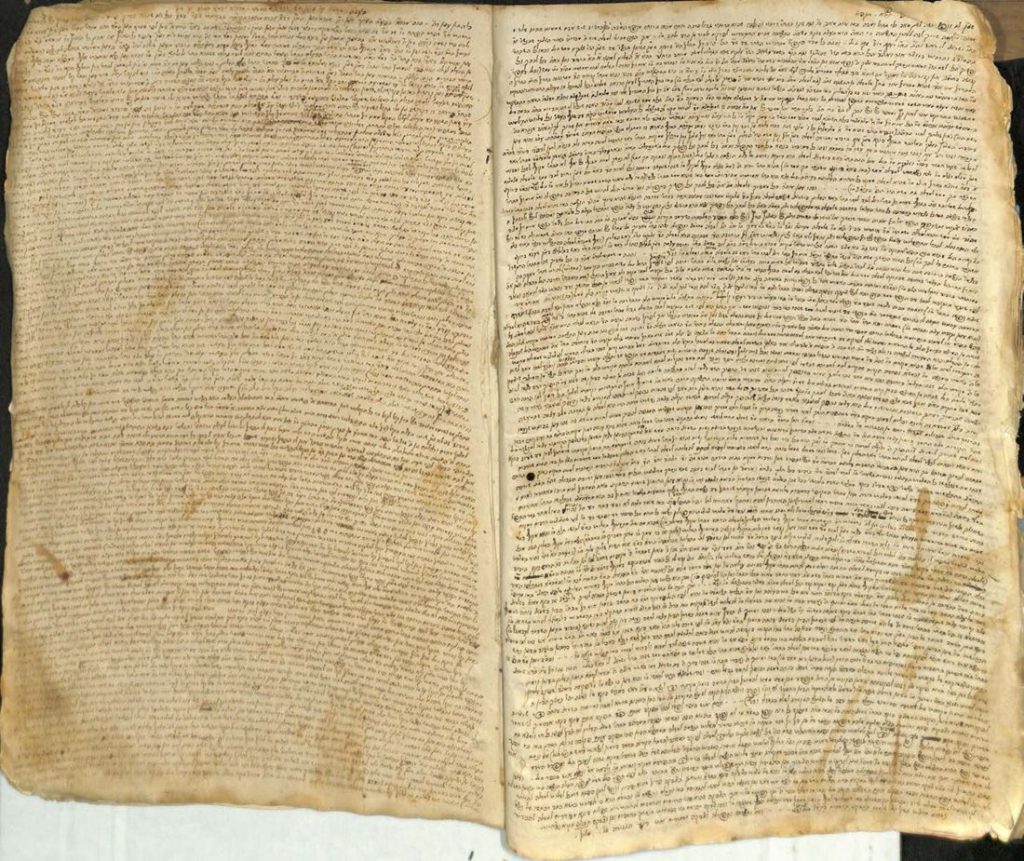
The brothers R’ Michel and R’ Henoch Rapoport, Chabad Chassidim in Russia, also joined the effort to locate ‘bichlach.’ When R’ Henoch managed to leave Russia with some of his belongings, he made sure to hide among them a precious treasure – bichlach containing copies of the Alter Rebbe’s maamarim. These were copies written during the Alter Rebbe’s lifetime.
When R’ Henoch arrived at 770 before Rosh Hashana 5733 (1972), he submitted the bichel to the secretariat. The Rebbe immediately responded, “Many thanks for the sefer.” At the farbrengen held on Erev Rosh Hashana, the Rebbe publicly noted: “A Jew who recently came up from Russia brought the bichel from ‘there’ and delivered it here.” The Rebbe emphasized “the bichel is here, and the Jew is here.”
R’ Henoch, who didn’t like to stand out, sat in one of the corners during this farbrengen, hidden from view. The Rebbe, who noticed him, turned to him, gestured for him to say ‘l’chaim,’ and then added with a smile: “Here you don’t need to hide, here the KGB isn’t chasing you…”
The Rebbe’s public reference to this matter demonstrates the great importance he attributed to this.
Also at the farbrengen held on the 6th of Tishrei 5733, the Rebbe continued to speak about the new bichel that had just arrived:
“Among the recent matters of ‘pidyon shvuyim,’ a ‘bichel Chassidus’ was also redeemed, written while the Alter Rebbe was still alive in this world, which is why it was written with the title – ‘may he live’ – and before Rosh Hashana it was brought here by a Jew who left there together with the ‘bichel.’ There is also found there a copy of the aforementioned holy letter (Tanya Igeres HaKodesh Chapter 14) but there [in the bichel] there is another section that wasn’t printed in Igeres HaKodesh (for reasons known to the author’s sons) which concludes: ‘And as we have merited this hidden light, so may we merit its revelation from His wrapped garment, etc.’ (as printed in full in Boneh Yerushalayim [Chapter 31]).
“And since by Divine Providence this ‘bichel’ was now redeemed and we are already several days after Rosh Hashana – may it be His will that what the Alter Rebbe wrote at the end of the aforementioned Igeres HaKodesh regarding the ‘new light… that has not yet shone since the days of the world’ be fulfilled, that we merit its revelation from His wrapped garment, in a revealed way below ten hand-breadths.”
Unexpected Help from a Customs Manager
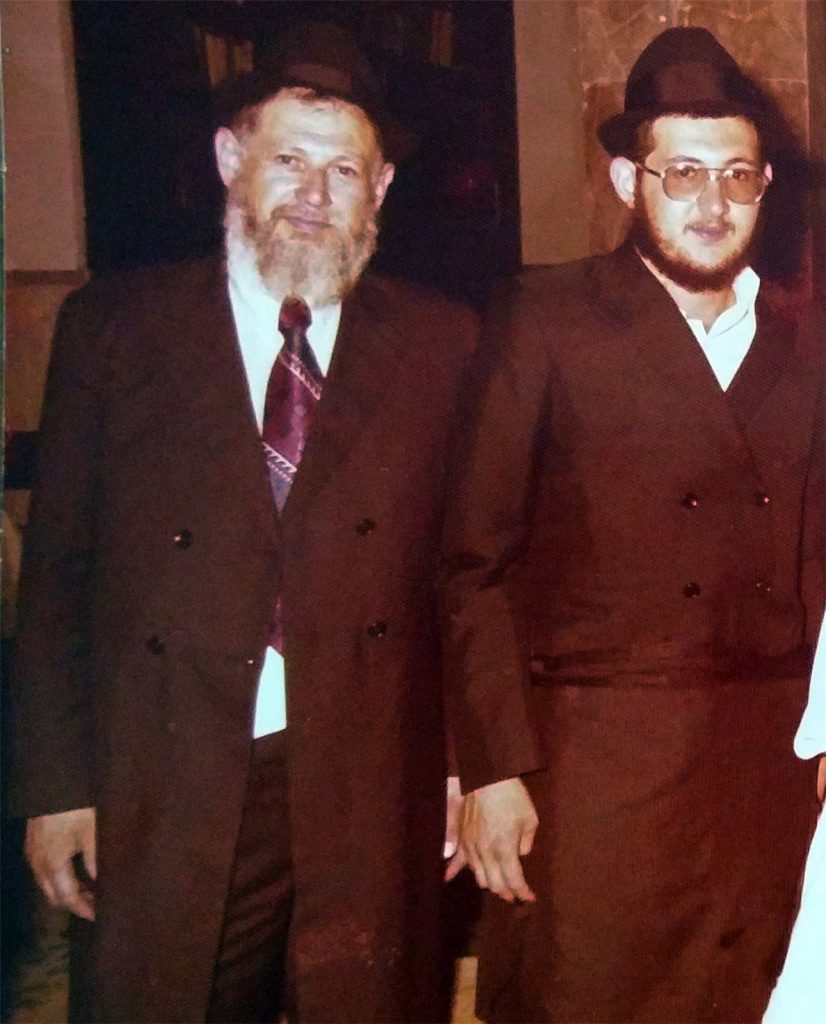
Another one of these smugglers was the Chassid R’ Abba David Gurevitz, who invested great effort in this project. He himself was involved in many cases, and here is one of the miraculous and special cases:
“Periodically, a fair was held in Leningrad attended by businessmen from around the world. Among the visitors was a Jew who, before his trip, went to the Rebbe to receive his blessing and merited to receive a special shlichus. He even received personal guidance on how to behave in the shlichus he received: to enter the shul in Leningrad and receive holy writings to bring to the Rebbe.
“Our contact person in Leningrad was R’ Yechiel Michel Rapoport who had recently returned from the ‘sanatorium’ [i.e. Siberia]. On the designated day when this messenger was supposed to arrive – R’ Michel was supposed to bring to the shul a suitcase with books we had brought him, give it to the ‘shamash’ (who was our confidant) who would place it near a specific window. The guest came to pray with an empty suitcase in his hand and placed it also near that window. The ‘shamash’ would hurry to leave before the businessman and ‘by mistake’ would take the second suitcase – the empty one, leaving behind the full one. When the businessman finished his prayers, he would take the suitcase with the writings and take them out of Russia. Due to his special status as a businessman, they wouldn’t check his suitcases.
“Once it happened that we brought R’ Michel a suitcase full of writings to transfer to the Rebbe. On exactly the same day when the businessman arrived, the shamash was absent from the shul, so the Chassidic writings remained with R’ Michel.
“Shortly after, we learned that an obvious miracle had occurred here. The KGB received information that a group of businessmen had brought a million counterfeit rubles into Russia. Immediately searches were conducted in hotel rooms and the bags of the visiting businessmen and the suspicion was indeed confirmed… From ‘above’ came an order: not to arrest them, but to quietly suggest they leave Russia. I don’t want to think what would have happened if they had found in their cargo a box of holy writings… Several dozen books of Chassidic writings, including the holy handwriting of the Rebbe the ‘Tzemach Tzedek’ on Tehillim (‘Yahel Ohr’) were saved from the Communists!
“After some years, when I merited to leave from the straits to freedom, before my trip I traveled specially to Leningrad and took the suitcase from R’ Michel. I knew that my friend R’ Moshe Katznelbogen had a good relationship with the customs offices in Moscow and I approached him with my request: to get permission to take the ‘writings’ abroad. I promised him that if he helped – I would later inform the Rebbe about his assistance. R’ Moshe advised me to approach the Lenin library. The library operated a special department where they would display the books according to a list, assess their value and return the list with detailed pricing and an amount that needed to be paid. In the list of books that I presented, I wrote what R’ Moshe advised me to pay for the holy writings. I paid on the spot and received permission to take the books out of Russia according to the list in my possession.
“However, when I approached the customs officer with the books he simply became frightened, ‘These are antiques and cannot be taken out,’ he ruled definitively. I tried to argue ‘But I paid for this and received approval in the library.’ But the clerk argued back ‘They didn’t see the original…’ I tried to get approval in various ways, but salvation came from an unexpected place.
“My wife Malka approached the chief customs officer who appeared more gentle and soft: ‘What do you need religious books for? You see that my husband is very religious and can’t do without them; let him take them out.’ The manager softened and said, ‘Now I’m going to eat lunch and when I return I’ll approve the books.’ Just when I returned from my attempts to arrange approval, the manager entered and asked: ‘Nu, where are the books?’ I took out the suitcase and put it on the inspection table. The clerk tried to comment that it was forbidden, but the manager responded: ‘Who is in charge here? Me or you,’ and instructed him to bring a strong wooden box and put the books inside. That’s how we sent the sefarim to Eretz Yisrael…”
I Brought the ‘Bichel’ Directly to the Rebbe
Not all manuscripts came from Russia. Many were located in Israel as well. About one of them, R’ Yaakov Reinitz from Lod told the story how he merited to bring a ‘bichel’ to the Rebbe during his stay in Beis Chayeinu in Tishrei 5723 (1962):
“In my suit pocket was an envelope containing a small ‘bichel’ of maamarim. This bichel resided in the archives of an elderly Jew in Yerushalayim, whose grandson was a student at the university in Yerushalayim and attended a weekly Chassidus shiur with Rabbi Hirshel Eisenbach.
“One day that student brought the ‘bichel’ to R’ Hirshel and asked if it interested him. R’ Hirshel immediately understood that these were maamarei Chassidus from one of the Rebbeim, and decided to send the ‘bichel’ to the Rebbe. When he heard that I was planning to travel to the Rebbe, he gave me the ‘bichel’ while explaining that this was a precious manuscript that I should deliver directly to the Rebbe’s hands, and not through any of the secretaries.
“I knew that if I told Rabbi Chodakov that I wanted to give the Rebbe the ‘bichel,’ he would strongly demand that I hand over the ‘bichel’ before the yechidus. Therefore I kept quiet, and decided to enter the yechidus with the ‘bichel’ in my suit pocket. I entered with tremendous excitement. I placed the ‘bichel’ on the Rebbe’s table and said that I was asked by R’ Hirshel Eisenbach to deliver this to the Rebbe. The Rebbe opened the ‘bichel’ and read the note that was placed inside. Afterwards he put the note back in the ‘bichel’ and said: Most likely this is Chassidus. Then he put the ‘bichel’ aside and said he would look at it later.
“At the farbrengen on Shabbos Shuva, the Rebbe delivered a maamar on the passuk ‘and no man shall be in the tent of meeting’ [later edited and published in 5751 – Ed] which deals with the avoda of the kohen gadol on Yom Kippur. The sichos said that Shabbos before the maamar were also delivered with serious emotion, but the maamar – which dealt with the subject of teshuva, surpassed the sichos in its seriousness, to such an extent that the Rebbe cried several times while delivering it.
“In the sicha after the maamar, the Rebbe revealed that until a few days ago he had been thinking of saying a different maamar, but he merited and by Divine Providence a handwritten ‘bichel’ containing maamarei Chassidus was brought to him in recent days from the Holy Land, and therefore he decided to say the current maamar, based on one of the maamarim that appeared in that manuscript. The Rebbe added and said that according to its style, it was apparently composed by the Tzemach Tzedek.
“I was very moved when I understood that the ‘bichel’ about which the Rebbe spoke was the ‘bichel’ that I merited to deliver to the Rebbe in the yechidus. At the end of the sicha the Rebbe looked in my direction and gestured to me with his hand to say ‘l’chaim.’ Since I was not yet accustomed to the style of the Rebbe’s farbrengens, I did not understand that the Rebbe was gesturing for me to say ‘l’chaim,’ until those around me said that the Rebbe was waiting for me to say ‘l’chaim.’ They immediately arranged a cup of ‘mashke’ for me, and I said ‘l’chaim.’ The Rebbe gestured that I should say it again and again. After the third time the Rebbe smiled and said: ‘One more time!’
“The next day, on Erev Yom Kippur, they managed to produce a transcript of the maamar and at the first opportunity I had, I sent one copy to R’ Hirshel Eisenbach. When I met him several years later, he told me that the Rebbe had sent him a copy of the maamar.”
‘We Sewed the Letters Inside the Kesavim’
When a ‘bichel’ containing Chassidic writings was finally found, the most important thing was to know its origin. Not always was there a source. In some of them a name or several names were written, sometimes with the addition of a few words like “delivered by” “belongs to.” In the computerized catalog of the Lubavitch library, explanations were added to some of the manuscripts – who brought the ‘bichel’ and in whose possession it was previously.
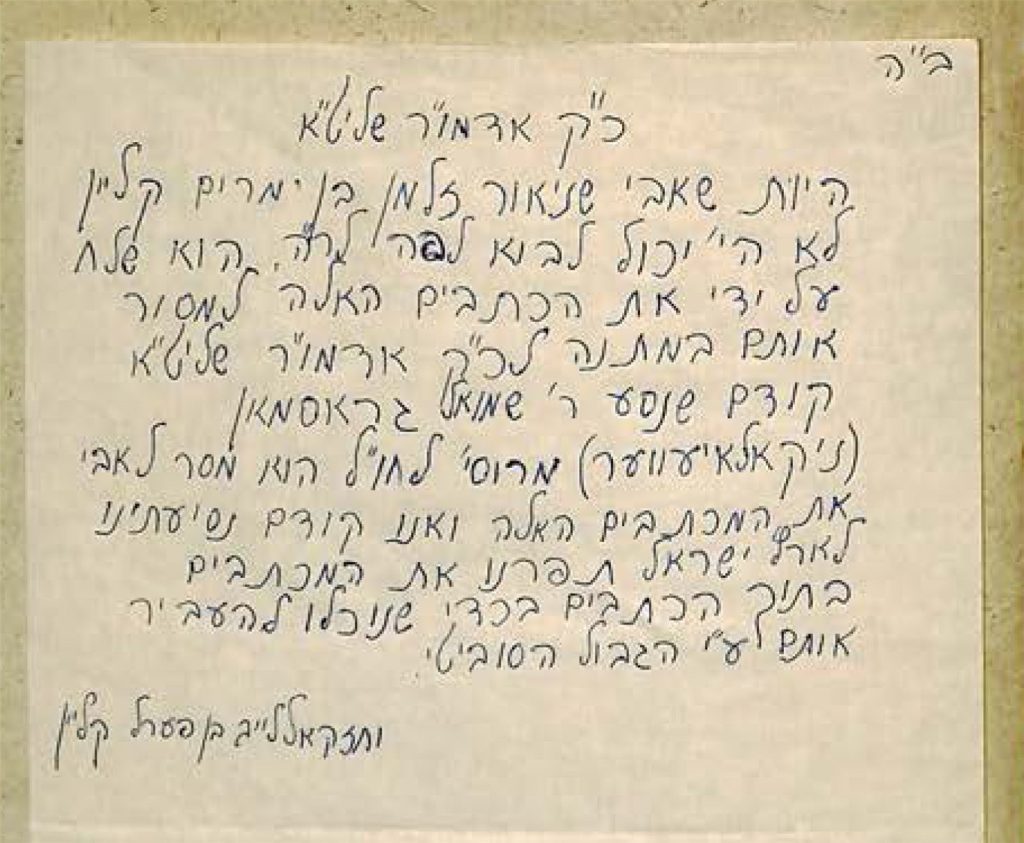
For example, a ‘bichel’ that was smuggled from Tashkent and reached the Rebbe, on which was written “Manuscript 240.” At its beginning appears a moving letter written by Rabbi Yechezkel Klein, the Chassid who merited to locate and bring to the Rebbe the aforementioned ‘bichel’:
“His Honor the Rebbe Shlita,
“Since my father Shneur Zalman son of Miriam Klein could not come here for Rosh Hashana, he sent through me these writings to deliver them as a gift to His Honor the Rebbe Shlita. Before R’ Shmuel Grossman (Nikolayever) traveled from Russia abroad, he gave these letters to my father and we, before our journey to Eretz Yisrael, sewed the letters inside the writings so that we could transfer them across the Soviet border.
“Yechezkel Leib son of Pearl Klein”
This ‘bichel’ includes copies of maamarim of the Rebbe Rashab and the Rebbe Rayatz that were written by R’ Shmuel ‘Sofer’ (the Scribe) from Lubavitch. He was one of the Chassidim who would copy maamarei Chassidus, and did so with great professionalism.
As mentioned, in those years, not everything reached print; there were no copy machines, and certainly no readily available cameras. When they wanted to distribute a maamar of the Rebbe, they copied it by hand. There were professional copyists who did this for payment, and there were those who did it for the importance of the cause.
Inside the ‘bichel’ were also sewn letters in the holy handwriting of the Rebbe Rashab. These were letters that were sent to Rabbi Asher Grossman of Nikolayev, one of the important Chassidim at that time. These Chassidic kesavim and letters were in the possession of his son R’ Shmuel Grossman all those years. When he left Russia, he was afraid to take them with him lest they be confiscated. He therefore gave them to R’ Zalman Klein, one of the Chabad Chassidim in Tashkent, so that he would find a way when the time came to transfer them to the Rebbe.
Years passed, and only in the month of Kislev 5732 (1971) did R’ Zalman Klein leave Russia together with his family members. He wanted to smuggle the Chassidic writings, but was afraid to take them out as many scattered pages. He therefore sewed all the pages together, and thus it was smuggled out of the Soviet Union’s borders and reached the Holy Land.
R’ Zalman Klein could not come to the Rebbe that year, and he sent the precious manuscripts with his son, Yechezkel, who traveled to the Rebbe for the month of Tishrei. R’ Zalman did not want to delay the gift until he would arrive.
This ‘bichel’ is called “Manuscript 240,” and the holy letters that were attached to it were printed in the ‘Igros Kodesh’ of the Rebbe Rashab.
Manuscripts from Morocco
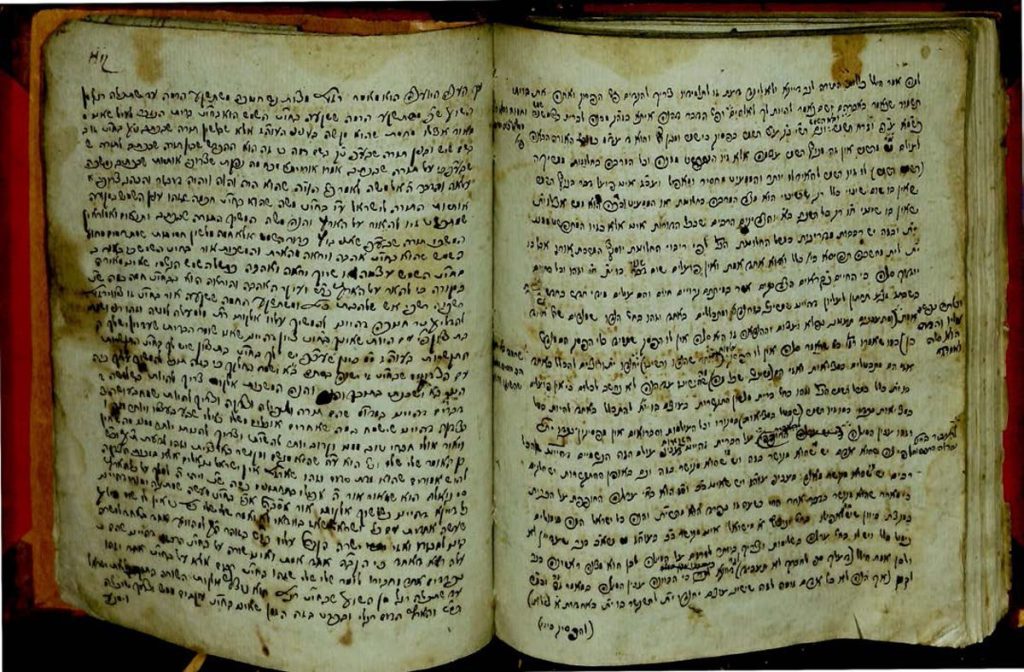
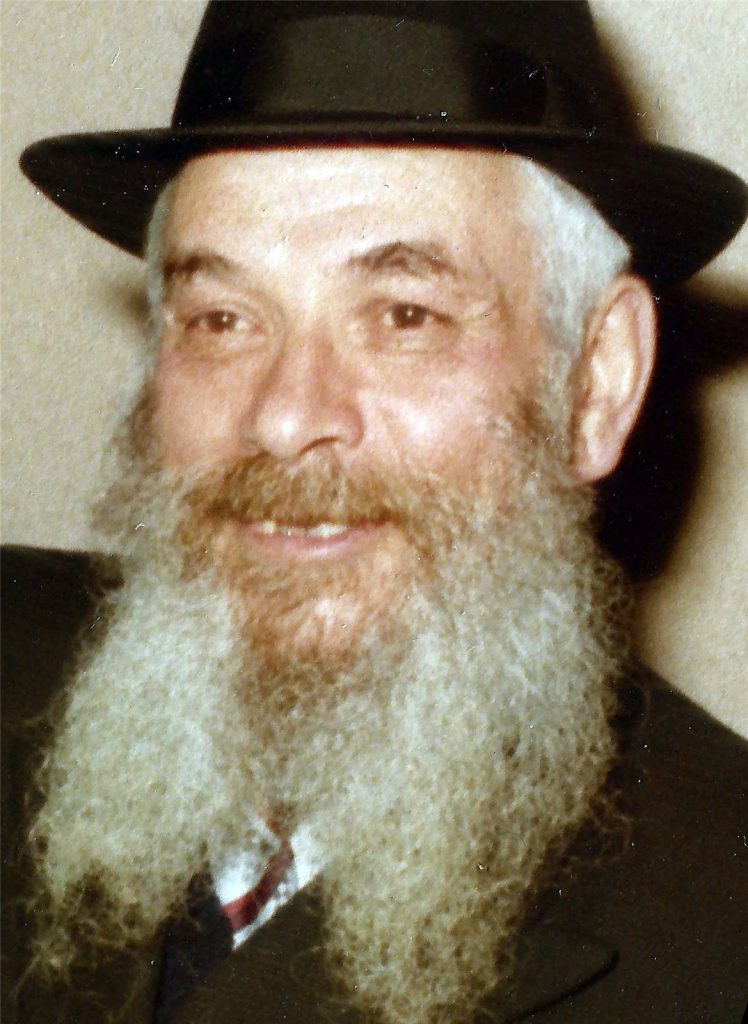
Not only in Russia, but throughout the entire world various shluchim and Chassidim enlisted in locating manuscripts of Chassidus as well as other rare writings, and these were sent to the Rebbe’s library.
One of those Chassidim who enlisted in this matter was Rabbi Sholom Eidelman a’h, the Rebbe’s shliach in Morocco. He engaged in this from when he was a young boy and on through his period as shliach in Morocco. Over the years he merited to receive special instructions from the Rebbe.
Already at age 16, R’ Eidelman assisted his brother-in-law Rabbi Hillel Pevzner in locating Chassidic writings throughout France. The two were also involved in locating Chassidic writings of Rabbi Dovid Tzvi Chein, one of the prominent Chabad rabbis. After many circumstances, his writings reached Eretz Yisrael and were with his son R’ Avrohom Chein. They convinced him to give his father’s writings to the Rebbe’s library.
Among the writings that were found there also appears a ‘bichel’ of maamarim of the Tzemach Tzedek, and in it were also bound pages with notes related to divorce documents with a kind of “stamp” drawn in Russian on which was written – “The Spiritual Rabbi, Mendel Davidovich [son of Dovid] Chein, Niezhin.”
In fact, the Rebbe sought to locate not only kesavim of Chassidus, but also writings in Kabbalah and pnimiyus ha’Torah. Such were not lacking throughout Morocco and Tunisia, countries that were known for great Torah scholars and spiritual giants who engaged in the study of Pnimiyus HaTorah and left behind many holy chiddushim and writings. These were abandoned in those countries after most of the country’s Jews left them and went to Eretz Yisrael and to Europe. The Rebbe encouraged the shluchim in these countries to locate the manuscripts and send them to him.
Over fifty years ago, the shluchim in Morocco found out that old marriage registers of the Jewish community in Fez were being put up for sale. They informed the Rebbe, and received guidance and instructions on how to acquire and send the marriage registers. R’ Eidelman carried out the purchase and the precious registers were packed and sent off to New York, and currently reside in the Rebbe’s library. As mentioned, these too were uploaded to the site by the library, and anybody researching the history of Moroccan Jewry can peruse them.
* * *
Obviously, the examples cited in the article are but a few of many. These stories serve at least as a glimpse into a fascinating world, laden with intrigue, of the efforts to save these priceless treasures in the form of writings of Chassidus.
Sources: Igros Kodesh, Lubavitch Library, Samarkand, V’Hayu L’os U’lemofes (Rappoport), History of Chabad in Morocco, Avnei Chen, Maaseh Avos Siman L’banim (Gorelick), Beis Moshiach. The author was also assisted by social media forums discussing the manuscripts.
‘TRUE PIDYON SHVUYIM’
R’ Hillel Zaltzman recounted:
I once found a large volume with a black binding, written in a beautiful handwriting on smooth white paper. The lines were long and curved. The volume contained maamarim of Chabad Chassidus as well as topics of Chassidus from other Chassidic courts. Obviously, I sent it off to the Rebbe.
When I got out of Russia, I inquired as to whether the volume had reached its destination. I was told that at one of the farbrengens the Rebbe came down with a very thick sefer and placed it on the table. In middle of the farbrengen, the Rebbe spoke about “pidyon shvuyim” and lifted the sefer and said, “This is true pidyon shvuyim.” The Rebbe also added at that time that this merit would stand for them (those who sent it) that they to be redeemed soon.
Beis Moshiach #1454 • pp. 10-23
© 2026 Beis Moshiach Magazine. All rights reserved.
This article originally appeared in Beis Moshiach #1454. You are welcome to share it with friends and family by email or in print, provided that you do not change, add to or omit any part of it, you credit the author and Beis Moshiach, and you include a link to archive.bmoshiach.org (written out in full in printed copies).
To republish this article in a newspaper, magazine, book or website, please request permission in advance at [email protected].