“Yud-Beis Tammuz Is the Rebbe’s Yom Tov”
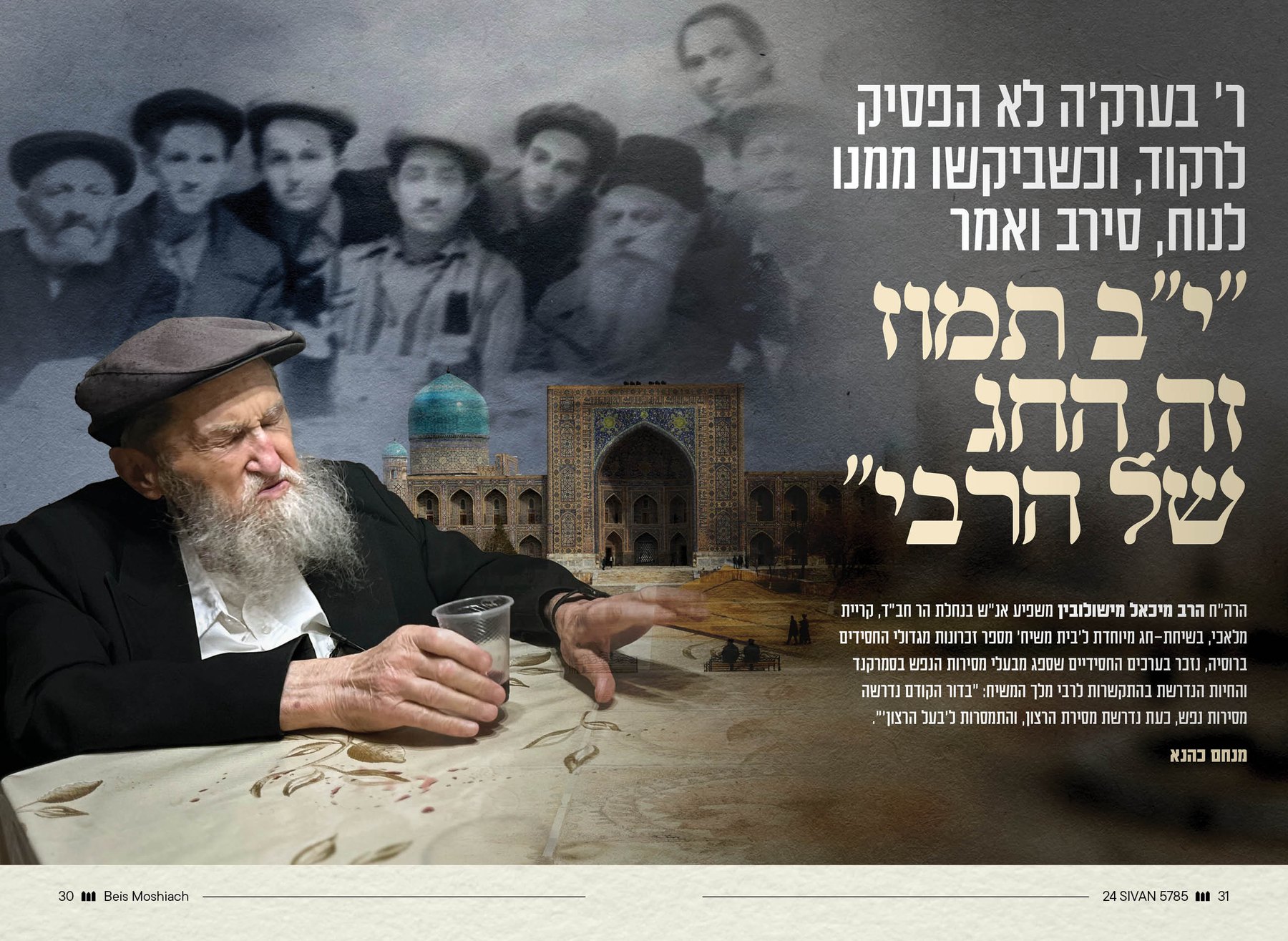
HaRav HaChassid R’ Michoel Mishulovin, mashpia of Anash in Nachalat Har Chabad, Kiryat Malachi, in a special Chag HaGeula conversation with Beis Moshiach, shares memories of great Chassidim in Russia, recalls the Chassidic values he absorbed from the men of mesiras nefesh in Samarkand, and the vitality required in hiskashrus to the Rebbe Melech HaMoshiach: “In the previous generation mesiras nefesh was required; now what is required is mesiras haratzon, and devotion to the ‘Baal HaRatzon’”
The Yom Tov of the Month of Tammuz
“During the farbrengens celebrating Chag HaGeula 12-13 of Tammuz in Samarkand, you could feel it was truly a yom tov—sometimes even more than 19 Kislev,” says Reb Michoel when we sit down at his home for an impromptu farbrengen. “The victory over the Communists felt much closer and more tangible during the ‘Iron Curtain’ period, when the KGB waged war against everything holy.
“I remember one year when the well-known Chassid Reb Berke Chen (who stayed in our home for a period while fleeing from the KGB – a time that greatly influenced us) danced for hours during almost the entire farbrengen, which lasted a very long time. The Chassidim asked him, ‘What happened? What’s all this joy about?’ But he just kept dancing and dancing.
“At some point they became concerned for his health (he was already considered elderly), and asked him to stop. But he said this was the Rebbe’s own joy, which made it even greater than the joy of a wedding. That’s why he had no intention of stopping his dancing… That was the Chassidic atmosphere in those days—celebrating the Chag HaGeula of the Rebbe Rayatz.”
“I also remember the man of mesirus nefesh, Reb Mendel Futerfas, sitting and farbrenging on 12 Tammuz. First, he filled a cup with ‘mashke’ to the brim, and the cup would pass among everyone. After the first glass finished, they’d refill it for another ‘l’chaim,’ and so the cup made several rounds among all the participants, about thirty people in several rows around the table. After the third round, Reb Mendel would begin to farbreng, saying that now they could properly begin celebrating the Chag HaGeula of the Rebbe Rayatz…”
This is how Reb Michoel opened our farbrengen style conversation marking what he calls “the Yom Tov of the month of Tammuz.”
To understand the background of these words and why this day holds such significance for our conversation partner, it’s worth knowing where and how Reb Michoel grew up—a man of mesirus nefesh in the dor hashvi’i.
A Home That Cultivated Mesirus Nefesh
Rabbi Michoel Mishulovin was born on 20 Menachem Av 5699 in Vitebsk, White Russia, to his father Rabbi Eliezer Mishulovin and his mother Mrs. Batya Mishulovin. In 5702 (1942), when he was three years old, his parents emigrated to Samarkand, where he studied in secret chadarim and underground ‘Tomchei Tmimim’ yeshivos.
“I was raised in a home where mesirus nefesh for every aspect of Torah and mitzvos was the norm,” he begins. “My parents always expressed deep emotion and warmth in their strong hiskashrus to the Rebbe, despite never having seen him. My older brothers studied in ‘Tomchei Tmimim’ in Samarkand, which greatly enhanced the Chassidishe atmosphere in our home.
“Before the mass exodus of Chassidim from Russia after World War II, all the great and distinguished Chassidim lived in Samarkand, Uzbekistan where the KGB operated with less intensity than in central Russia. Even after the Chassidim left, those who remained in Russia and couldn’t get out still retained the Chassidishe vitality and warmth that burned within them.
“The atmosphere among the Chassidim was very special. Besides ‘Likkutei Torah,’ ‘Derech Mitzvosecha’ and a few maamarim of the Rebbe Rashab and his son, the Baal HaGeula, the Rebbe Rayatz (Chassidus of the Rebbe Melech HaMoshiach wasn’t available yet), we had almost no Chassidishe sefarim—certainly nothing like the abundance available today, when anyone can access any sefer of Chassidus they want.
“Despite this, they lived with what they had. They learned from it and farbrenged about it. Though a Chassidishe minyan only convened on Shabbos, each time in a different location, during davening you could feel what it meant to daven like a Chassid – davening that came from deep within the heart.
“After davening we would sit and farbreng, strengthening one another. It wasn’t easy – not at all. But they knew there was no other way of life, no substitute for what they had. They needed to do everything possible to guard the ember in secret, never compromising on the Chassidishe values they protected with all their strength.”
For many years Rabbi Mishulovin lived in Samarkand alongside the great Chassidim of that generation. He absorbed their influence and maintained a Jewish Chassidishe way of life with mesirus nefesh.
“As young people, we first learned without any organized structure – a bit here and a bit there. Eventually, we talked about organizing a proper learning framework like ‘Tomchei Tmimim’ – seven hours of Nigleh study and four hours of Chassidus study,” he recalls. On 19 Kislev 5721 (1960), a group of young Tmimim formed and began learning according to the ‘Tomchei Tmimim’ curriculum. Classes were held underground in Reb Berel Zaltzman’s home.
The ‘yeshiva’ had only five students: Yitzchok Mishulovin, Naftali Estulin, Shmuel Chaim Frankel, Hilke Zaltzman and Yeshaya Gratzman. One person served as maggid shiur, mashgiach and mashpia – Rabbi Michoel Mishulovin. Shortly after, the Volovik brothers, Eliyahu and Yosef, arrived from Chernowitz and joined the yeshiva.
“Although we followed the ‘Tomchei Tmimim’ seder, we never called our learning framework by the holy name ‘Yeshivas Tomchei Tmimim.’ After all, we felt we were just a few bachurim learning together in a private apartment. While there was a Chassidishe atmosphere, it wasn’t like a regular yeshiva with dozens of students. However, when Reb Mendel Futerfas visited and learned about our activities and schedule, he called our framework ‘Tomchei Tmimim.’ From then on, that’s what we called it,” Rabbi Mishulovin adds.
We “Met” the Rebbe with a Ten-Year Delay
On 15 Elul 5723 (1963), Reb Michoel Mishulovin married Simcha Bas Sheva a”h, daughter of the man of mesirus nefesh Rabbi Aharon Chazan. The wedding was celebrated in Bolshovo, a town in Moscow’s suburbs. [On 25 Elul 5764 his first wife passed away, and about a year later he remarried his wife Chana in a second marriage לאויוש”ט.]
Even after his wedding, he continued teaching the young tmimim in the Samarkand yeshiva, instilling in them strong feelings of hiskashrus to the Rebbe and uncompromising values.
We’d love to hear more memories about hiskashrus to the Rebbe during those days in Russia…
We only learned about the histalkus of the Rebbe Rayatz about six months after Yud Shevat 5710 (1950), in the month of Elul. We “met” the Rebbe MH”M only around 5720 – a ten-year delay…
What I mean is that at some point we learned that the Rebbe’s son-in-law had become Rebbe in his place, but we didn’t know any additional details about him. Around 5720, we received for the first time a printed sicha from the Rebbe. We also hid his photo inside the cover of a reading book when it reached us.
The first materials that reached us were a siddur, a small Tanya, and a ‘HaYom Yom.’ The Rebbe sent these through ‘tourists’ who could move freely. They would ‘forget’ such books and holy items like tefillin and talleisim in the shul, and we would collect them afterward. It was forbidden for anyone to think we had contact with outsiders, so we couldn’t meet in an organized way to transfer materials.
When the ‘HaYom Yom’ reached us, we began to grasp the Rebbe’s greatness – how he had collected such special sayings and aphorisms for each day of the year.
Writing directly to the Rebbe was extremely dangerous. Only in absolutely urgent matters would we send a letter through a third party. Before my wedding, I wrote to Reb Berke Chein, who was already in the Holy Land. He conveyed my letter to the Rebbe and sent the Rebbe’s blessing back to me, disguised and with great cunning.
When discussing hiskashrus to the Rebbe, it’s important to study the maamar “V’Atah Tetzaveh” 5741 – the last Kuntres we received from the Rebbe’s holy hands on Purim Katan 5752. This Kuntres contains the innovation of the Dor Hasvi’i and our manner of avoda. In the maamar, the Rebbe discusses the virtue of mesirus nefesh as it stems from the essence of the soul itself, not just from the revelations the soul perceives above. This represents the “nurturing of faith” of Moshe to the Jewish people. The Rebbe elaborates that the primary mesirus nefesh in our generation is ‘mesiras ha’ratzon’—surrendering one’s personal will.
So the Rebbe essentially tells us: You don’t need the KGB to reveal your essence—true mesirus nefesh means surrendering your will to the Rebbe.
First Time With the Rebbe
On 9 Shevat 5729 (1969), Reb Michoel and his family made aliyah with his family to Eretz Yisrael, temporarily residing in his father-in-law Rabbi Aharon Chazan’s home in Bnei Brak.
He says little about how he managed to escape the ‘Iron Curtain’: “Hashem helped. We tried all kinds of schemes and efforts. Several times we were absolutely refused, and there was real danger involved. But the Rebbe was with us”…
When Reb Michoel says “the Rebbe was with us,” he means this was the secret of their success – through the Rebbe’s merit, they managed to leave the Soviet vale of tears.
When the Nachalas Har Chabad neighborhood was founded in 5729, the Rebbe asked Rabbi Efraim Wolf to prepare a list of yungeleit willing to live in Kiryat Malachi, which was then a distant spot, practically beyond the mountains of darkness. Rabbi Wolf approached Rabbi Mishulovin, among others, about joining the group. Reb Michoel agreed to join, even if only for a limited time.
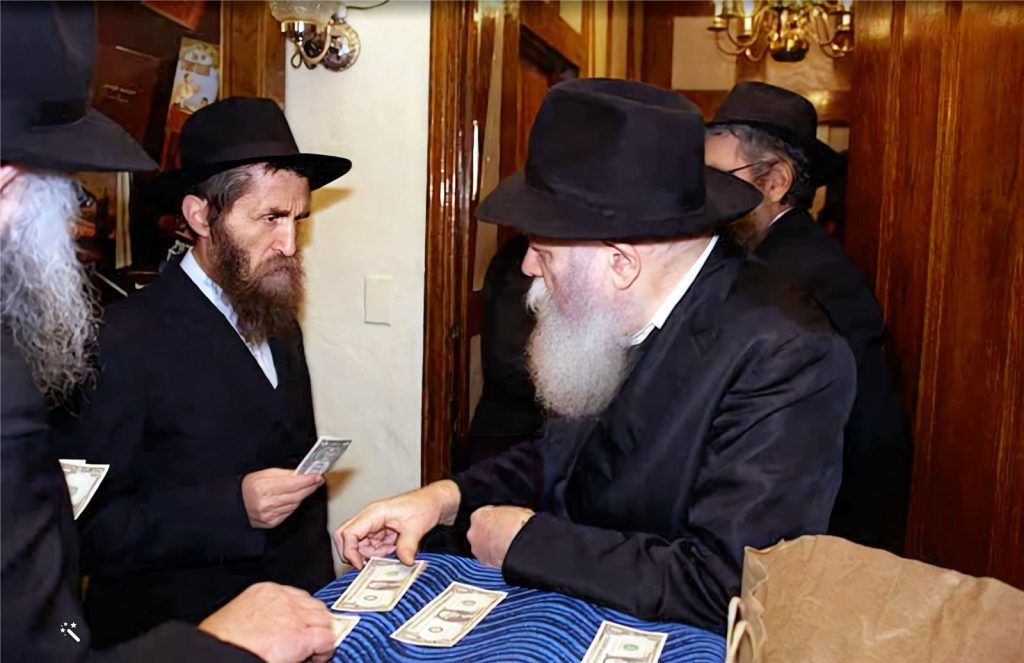
Reb Michoel’s first visit to the Rebbe was before Tishrei 5730, just a few months after leaving Russia.
The first time he saw the Rebbe remains clearly etched in the mashpia’s memory. “It was an outburst of tremendous emotion to see the Rebbe – the one we had grown up learning about and whom we had taught the tmimim about in Soviet Russia.”
At a farbrengen held on the Tuesday of the week of Selichos that year (5729), the Rebbe asked those present, “Who here is from the new olim who settled in Nachalas Har Chabad?” Only two people were present: “Myself and another Georgian Jew, a new immigrant who had settled in ‘Nachala.’ We were the only ones who had come from Kiryat Malachi to attend the farbrengen,” Rabbi Mishulovin recalls. “I was standing toward the back of the shul, and I felt uncomfortable about approaching and identifying myself.”
But the Chassidim around him urged him to respond that he was part of the group. “The Rebbe signaled for me to approach, so I did.”
Here Reb Michoel becomes emotional. “The Rebbe asked me, ‘Du bist in Nachalas Har Chabad?’ Are you in Nachalas Har Chabad?
I answered yes.
The Rebbe continued, ‘Mit a hityashvus?’ Are you settled there?”
I hesitated a bit. I was thinking that since I had only come for a short “shlichus” in Kiryat Malachi, I planned to move later to Bnei Brak near my in-laws or to Kfar Chabad, since Kiryat Malachi was considered very remote then. But since the Rebbe was asking, he apparently expected a positive answer. All this flashed through my mind in seconds. I nodded yes, and received ‘l’chaim’ from the Rebbe plus a bottle of ‘mashke’ for the entire group, along with the Rebbe’s blessing for the shlichus ‘in a manner of hisyashvus, settlement.’”
Did the Rebbe give you special treatment as new immigrants from Russia?
“The Rebbe brought us very close during that month of Tishrei. He made sure we stood near him during all the tefilos and even paid about ninety percent of our airfare. He really made us feel like his personal guests.
“During that visit I had yechidus twice—first when I arrived before the end of Elul, and again in Tishrei before returning to Eretz Yisrael. I asked about several personal matters and what I should focus on. The Rebbe blessed me to engage in influencing the community and environment, as well as continuing what I had done in Russia – learning and guiding tmimim.”
Several years later, when the Rebbe instructed the appointment of mashpiim, both he and Rabbi Shalom Eliyahu Vilenkin were appointed as mashpiim of the Nachalas Har Chabad neighborhood. Over the years he also served as mashpia in Chabad yeshivos in Rishon LeZion, Kiryat Gat and Beer Sheva.
The Rebbe is Everything
Reb Michoel is known as a baal shmuah with direct chains of tradition to the previous generations, he’s known to daven b’avoda, and has a special “koch” in learning Tanya. Despite his advanced age, he has remarkable energy. He gives daily Chassidus shiurim in the neighborhood shul, and frequently farbrengs at the central shul ‘Heichal Eliyahu.’ He’s regularly invited to farbreng at yeshivos and shuls throughout the Holy Land – both with Chabad and non-Chabad audiences.
Reb Michoel proudly carries the banner of faith of the Dor Hashvi’i. During his farbrengens he encourages Chassidim to strengthen themselves in all matters of Moshiach and Geula. He refers to the Rebbe as ‘Melech HaMoshiach Shlita,’ doing so naturally from an inner sense of truth.
Chassidishe Life in the USSR
As mentiond above, Reb Michoel Mishulovin, who studied in underground ‘Tomchei Tmimim’ yeshivos in his youth, absorbed the underground Chassidishe mesirus nefesh way of life.
What can you share about the atmosphere during those days?
The Gemara says, ‘Just as an olive produces its oil when crushed, so too the Jewish people – when they’re crushed, their oil emerges,’ meaning their inner goodness. That’s how I’d describe those days. Daily mesirus nefesh caused all of us to give ourselves over completely to the Rebbe. The Rebbe was the one who sustained us through those difficult and dark times.
Everything was done with extreme caution, fear and tremendous responsibility. We never compromised on anything. Everything was for the Rebbe, who guided us to mesirus nefesh that transcended reason and understanding.
Here I want to emphasize a fundamental point: Everything begins with hiskashrus to the Rebbe. When we recognize that we have no comprehension or understanding of this man of G-d – that we don’t truly know the Rebbe’s greatness and holiness – then our feelings become completely different.
I’ll share a story that illustrates this: Once while watching a video of the Rebbe, he appeared to me as truly royal. I thought to myself, “How is it possible that such a tzaddik exists in the world, yet not everyone flocks to him? How can evil still exist in a world that doesn’t become nullified before him?” Of course, Hashem wants free choice and for things to come through our own efforts. But when we truly understand that the Rebbe is everything to us—that he is our very life—then everything looks completely different.
What is Chassidishe Davening?
You mentioned the ‘avodas ha’tefilla’ of the Chassidim in Samarkand. We’d love to hear more about this…
There are several stories about Chassidim who davened with great length and chayus. Other people who heard their prayers were so moved that they did complete teshuva from the depths of their hearts. These Chassidim didn’t speak to them at all – they just davened with an emes, with truth, and this transformed people’s lives to ones of Yiddishkeit and Chassidishkeit.
There’s a story about a simple butcher who, after hearing a Chassid’s heartfelt prayer, said emotionally, “I’d give a large, fat piece of meat for such a davening…” Similar stories are told about wagon drivers and other simple Jews who were willing to give anything to merit praying a true Chassidishe davening.
I personally witnessed the power of Chassidishe davening. In Samarkand, there was a mikva that was only heated on Mondays and Thursdays – the rest of the week the water was freezing cold. The Jew responsible for the mikva wasn’t a Chassid, and he refused to let anyone enter because of the life-threatening cold during winter. Reb Berke Chein, who wanted to immerse daily to prepare for davening, pleaded with the caretaker to open the mikva for him, but the man was stubborn and absolutely refused.
Once, by Divine Providence, the caretaker was standing in the outer room of the house where Reb Berke was staying. He heard Reb Berke’s heartfelt prayer pouring forth from inside… The prayer that came from his innermost heart captivated the caretaker’s heart. From then on, he gave Reb Berke the keys to immerse whenever he wanted… Despite being a ‘stiff-necked’ person, he became completely nullified before him.
I’ll add that through avodas ha’tefilla, one reveals their personal ‘yechida’ – which is actually ‘personal redemption’ that leads to revealing the ‘general yechida’ of the ultimate redemption. The Rebbe says (sicha of Parshas Pinchas 5751/1991) that every Jew needs to make their personal space into ‘Eretz Yisrael’—to transform their personal day into a day of personal redemption and thereby bring the redemption.
Generally speaking, every mitzva is part of ‘Kabbolas P’nei Moshiach.’ Every Jew, through their personal avoda, brings more light to the world. The Rambam rules that through a single deed, word or thought, one can tip the entire world toward redemption.
Therefore avodas ha’tefilla is essential for bringing the complete Geula truly and completely. Since we’re now in the peak period before the complete redemption, we need to extend our prayers more and invest greater effort in this. This is how we’ll truly live Moshiach.
What message do you have for readers regarding the situation in the Eretz Yisrael?
Strengthen yourselves in ‘Kabbolas P’nei Moshiach Tzidkeinu.’ This is the gateway through which all avoda must pass. Every Chassid should constantly ask themselves: How is it possible that the Rebbe demands we bring Moshiach, yet we remain indifferent?!
There’s a story about the Rebbe Rayatz: When his father, the Rebbe Rashab, wrote something “as a possibility,” the Rebbe Rayatz took it as a certainty, not just “as a possibility.” When the Rebbe Rashab saw this, he said, “But I wrote this only ‘as a possibility’!” The Rebbe Rayatz answered, “What’s ‘possible’ by you is certain by me.”
In countless sichos, the Rebbe cries out and tells us that our generation is the last of galus and the first of Geula, that all the kitzin have passed, that we should do everything in our power to bring Moshiach in actuality. The Rebbe states clearly that Moshiach is already here and this is certain – but we still have questions, still wonder “maybe this” or think that it’s perhaps “a possibility”…
Once Reb Mendel told me, while we were still in Russia, that my aspiration – or at least what I should aspire to – is working so the Rebbe will have nachas from me.
When a Chassid knows that the Rebbe makes such an emphasis about Moshiach, and if he has genuine feeling for the Rebbe and a real connection, then with every good deed he does, he thinks, ‘May this action be the one that tips the scales and brings the revelation of the Rebbe immediately, along with the Baal HaGeulah at our head.’
Together with this, we all pray to Hashem for a great victory for the Jewish people and the return of the captive hostages. May “Hashem will fight for you” be fulfilled through the unity of all Chassidim, so we can thank Hashem for the miracles. Daloy galus (down with exile!)—Moshiach now!
Beis Moshiach #1466 • pp. 30-37
© 2026 Beis Moshiach Magazine. All rights reserved.
This article originally appeared in Beis Moshiach #1466. You are welcome to share it with friends and family by email or in print, provided that you do not change, add to or omit any part of it, you credit the author and Beis Moshiach, and you include a link to archive.bmoshiach.org (written out in full in printed copies).
To republish this article in a newspaper, magazine, book or website, please request permission in advance at [email protected].