A Rosh Yeshiva Made in the USSR
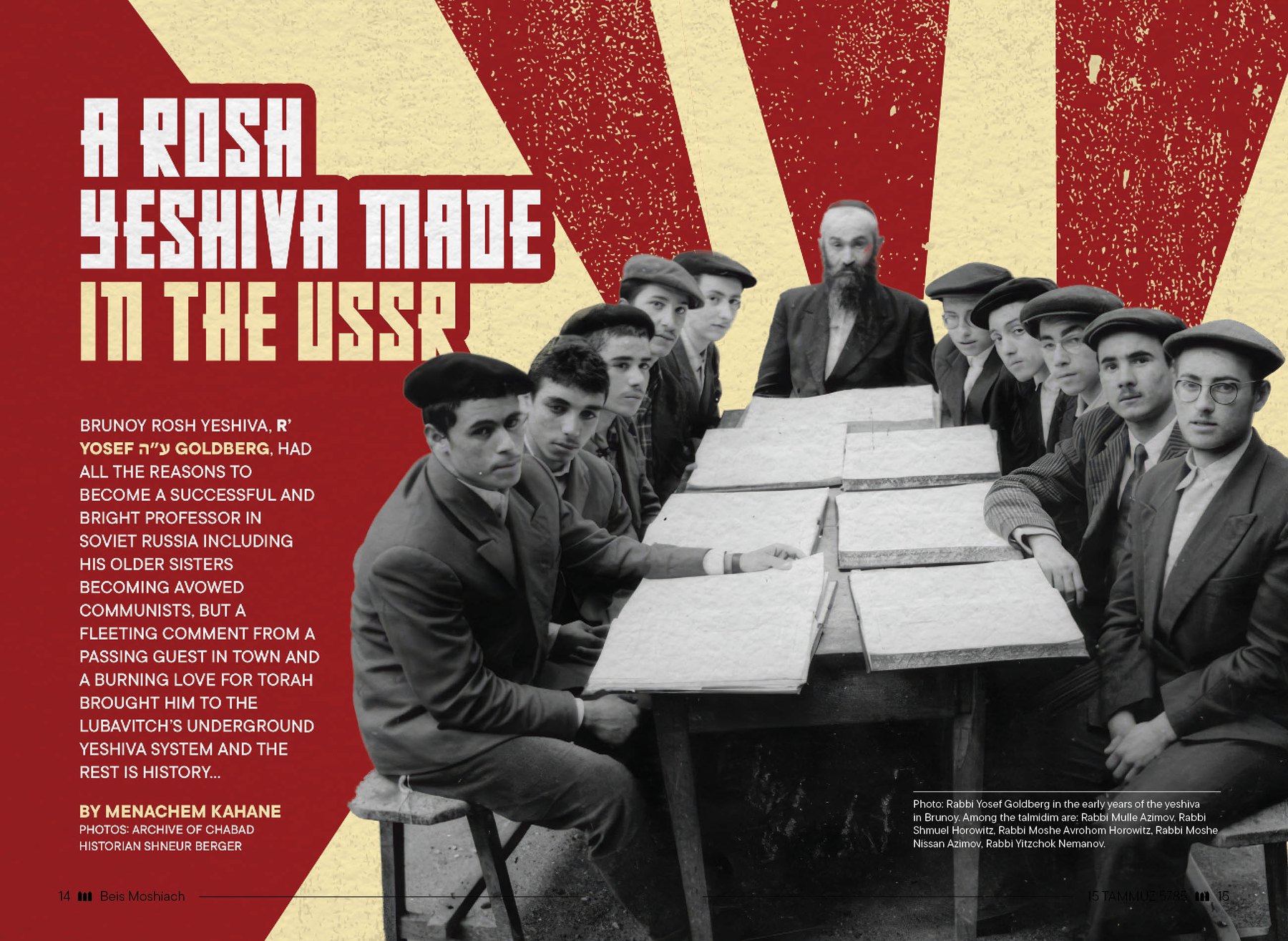
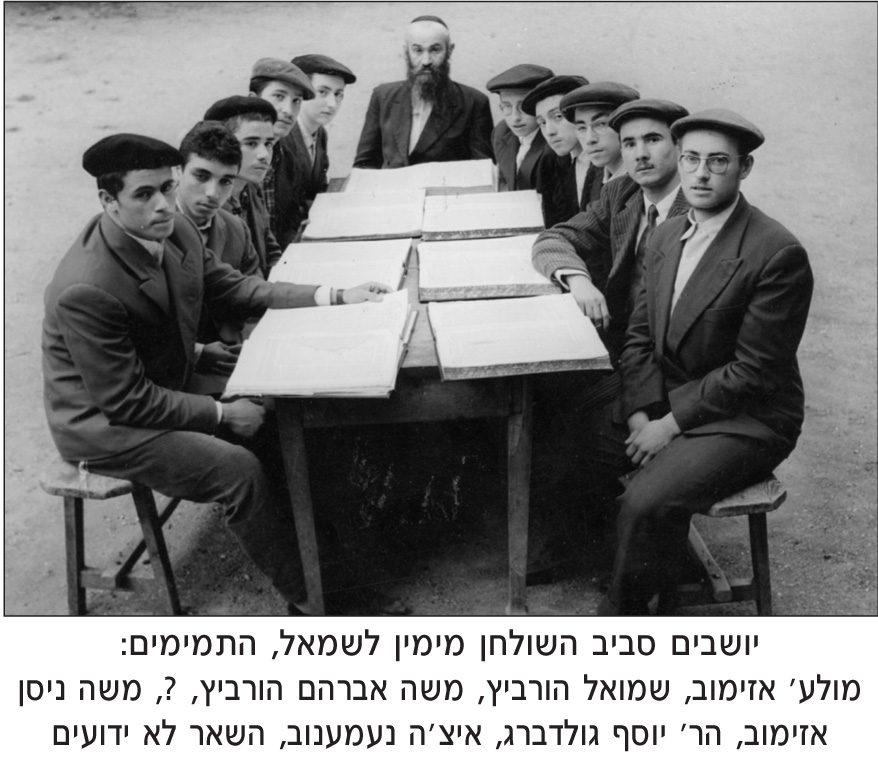
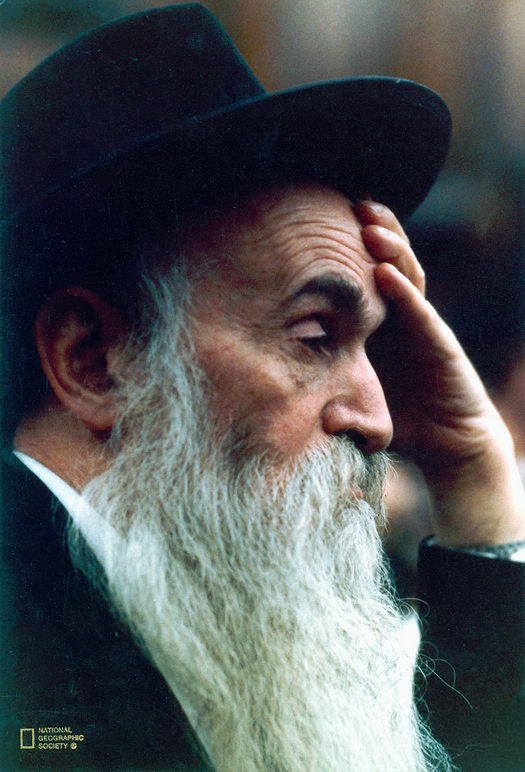
Brunoy Rosh Yeshiva, R’ Yosef a”h Goldberg, had all the reasons to become a successful and bright professor in Soviet Russia including his older sisters becoming avowed communists. But a fleeting comment from a passing guest in town and a burning love for Torah brought him to the Lubavitch underground yeshiva system and the rest is history.
It was a routine train ride. A small Jewish boy was traveling with his mother. Suddenly, a burly, coarse goy began harassing and mocking the skinny child for his peiys, tzitzis, and overtly Jewish appearance. The insults stung the child’s ears, but out of fear, he remained silent.
When the train conductor passed by, the child turned to him and asked loudly, “What does the law say about dogs on trains?”
The conductor replied that their mouths must be muzzled.
The boy asked again, “Then why hasn’t this dog’s mouth been muzzled? He won’t stop barking!” as he pointed toward the goy.
The man was stunned by the audacity of the small boy and having gotten the message, fell silent for the rest of the journey.
This boy would grow up to be the gaon and Chassid, R’ Yosef Goldberg (known as “Yoske Tiraspoler,” named for his hometown), renowned in the Chabad world for his brilliant Torah knowledge and unwavering devotion to darkei ha’Chassidus and the Rebbe.
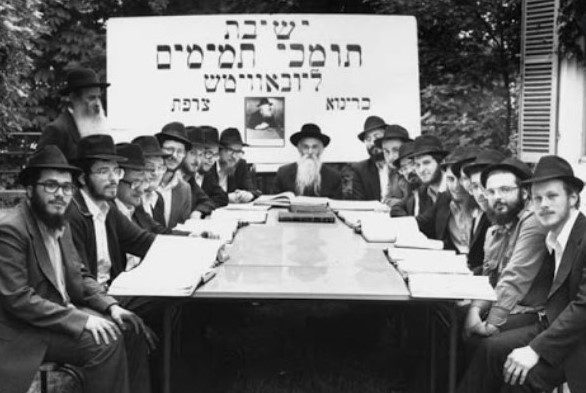
For many years, he selflessly nurtured generations of tmimim in his role as Rosh Yeshiva of Tomchei Tmimim in Brunoy, and earlier in Soviet Russia. Thousands drew from his Torah and his distinctive Chassidic personality.
Rabbi Goldberg was appointed by the Rebbe on Shemini Atzeres 5731 (1970) to be the “baal ha’bayis” (one responsible) over France. He dedicated most of his life to Tomchei Tmimim, teaching and guiding thousands of students in proper Torah learning infused with the light of Chassidus and firm hiskashrus to the “Tree of Life” – the Rebbe.
His many students over the years continue to hold deep love and boundless respect for him. Many of them have become prominent roshei yeshivos, mashpiim, maggidei shiurim, and shluchim, as well as devoted balabatim who serve Hashem with emuna and devotion.
The Stranger Who Changed Everything
Rabbi Goldberg was born in the year 5674 (1914) in the city of Tiraspol, in the Odessa region, and grew up in Communist Russia during the turbulent post-revolution period. His father, Reb Koppel, was a melamed who passed away when Yosef was just three and a half years old. His mother, Mrs. Rivka Goldberg, displayed tremendous mesirus nefesh to raise her children in the path of Torah, while struggling daily to provide for the family. She especially focused on educating her only son, Yoske.
Some of his older sisters had embraced communism and even tried to influence him to follow in their footsteps. But he resisted and, encouraged by his mother, devoted himself to Torah study.
In later years, R’ Yosef would recall how one sister berated him, saying, “What will become of you? Nothing will remain of you!” But history proved the opposite: from R’ Yosef emerged sons and grandsons walking in the path of Torah and Chassidus, thousands of students. From that sister, sadly, nothing remained.
When the time came for him to begin putting on tefillin, the city’s rabbi helped prepare him for his bar mitzva. The state of Yiddishkeit was in such decline in the city that he was the only child – other than the rabbi’s son – who wore tefillin.
As a child, Yoske managed to avoid attending the communist school (shkola) and instead spent time in the local shul. A turning point occurred when a Jewish stranger arrived in their town and sat in the shul. Young Yoske, full of energy, would jump on benches and look for mischief to occupy his active mind.
The guest, seeing a boy with such a clear Jewish look even in those dark times, was moved. He called the boy over and began speaking with him, marveling at the boy’s sharp grasp and intelligence. Speaking aloud, as if to himself, the man said: “What a pity – a child like this belongs in the Beis Medrash!”
The man left town, but his words left a deep impression on the young boy. Daily, he pleaded with his mother to let him go learn in yeshiva. She would respond that he was too weak and frail to be sent far away. Eventually, she told him, “First gain some weight, then we’ll see…”
The boy, whose soul craved Torah, did everything he could to gain enough weight to ease his mother’s concern but was unsuccessful. It reached a point where he filled his pockets with stones before stepping on the scale.
His older sisters, ardent Communists, disapproved of his direction and tried to dissuade him. One night, while he was asleep, one of them cut off his peyos. That event, combined with his burning desire to learn, tipped the scale. With a heavy heart, his mother finally agreed to send him to yeshiva. The city’s rabbi, who had supported the young orphan, sent letters to the two yeshivos in Kremenchug: the Chabad Tomchei Tmimim and a Lithuanian-style yeshiva.
Hashgacha led him first to Tomchei Tmimim. And so, in the summer of 5687 (1927), at just 13 years old, Yosef Goldberg arrived at the Lubavitch yeshiva in Kremenchug.
To Memorize The Entire ‘Shev Shmaatsa’
Upon his arrival, Yosef noticed the somber atmosphere. The Rebbe Rayatz had just been arrested, and there was no clear information about him. But shortly afterward, the news of his release brought joy to the yeshiva.
In Kremenchug, Yosef learned in the class of Rabbi Mendel Gribov, known by all as “Reb Mendele Neveler.” The yeshiva operated in an organized manner. Every Shabbos, Rabbi Yisroel Noach Blinitzky tested several students in Nigleh. Occasionally, Rabbi Yehuda Eber or Rabbi Zalman Kornitzer would also come to test them.
Despite starting to learn Mishna and Gemara relatively late, Yosef’s brilliance and sharp mind allowed him to quickly make up for lost time. But the beginning was far from easy. Meals were provided by local Jewish homes – a system known as essen teg (“eating days”). The shy and frail orphan suffered greatly and would go to sleep hungry because he was too embarrassed to eat in strangers’ homes.
Once, he mustered the courage to go into his host’s home – a cobbler. He saw the man use a knife soiled with glue and leather scraps to cut him a slice of bread. Disgusted, he couldn’t bring himself to eat.
The cold and hunger took a toll, causing his delicate skin to crack which increased his suffering. On one occasion, his host took one look and said, “You’re a leper!” and expelled him from the home, hungry and suffering because of his injured skin.
The yeshiva staff feared that Yosef might not return after bein ha’zmanim due to his suffering. Reb Yisroel Noach Blinitzky, who saw greatness in him, encouraged and strengthened him so he would return to yeshiva. Reb Yisroel Noach spoke to him about the lofty quality of learning in Tomchei Tmimim and how it doesn’t come easy. Finally, Yoske promised him he would return. Mrs. Sterna Blinitzky even baked cookies for Yosef to eat on his journey back home.
This warmth worked and Yosef returned to the yeshiva and continued to grow in Torah and Chassidus. He remained forever grateful to Rabbi Blinitzky for convincing him to stay. As his son, Rabbi Yaakov Goldberg, recounted: “My father always felt deep gratitude for Rabbi Blinitzky, who cared for him in his youth. Whenever he came from Paris to the yeshiva in Brunoy, he would sleep in our home.”
Eventually, the Kremenchug yeshiva closed, and the students dispersed. Most of them continued to the yeshiva in Vitebsk, including Yosef, where he learned under the famed Rabbi Yehuda Eber, Hy’d.
While learning in Vitebsk, the communist persecution intensified. The bachurim lived under constant tension, hiding from the authorities and worried about material staples that were very much not organized. Their living conditions were difficult. Some of the bachurim slept in the homes of balabatim and others slept on benches in shul.
Before Pesach, the bachurim were banished from their living accommodations and most of them had to leave. Only Reb Yehuda’s class remained to learn, under the supervision of Reb Avrohom Maiyor-Drizin. Reb Avrohom told Yosef to learn the entire scholarly sefer, Shev Shmaatsa in order to accustom his brain to learn straight and deep. Yosef did so despite the intolerable material conditions.
Yosef would go on short walks to air out, for his health. Reb Avrohom told him to think over parts of the Shev Shmaatsa even on these walks. This is how entire sugyos were engraved in his mind, backward and forward.
This learning of his youth stood by him, and all his life he had particular enjoyment from this sefer, as well as from the other learned works of the same author, the Ketzos HaChoshen and Avnei Miluim.
Within a few months, Vitebsk also became too dangerous. Some Chassidim were arrested by the NKVD. Having no choice, Yosef left for Kutaisi in Georgia.
Hiding His Beard In A Bandage On His Head
After a few relatively quiet years in Kutaisi, Reb Yosef once again found himself on the run.
In the summer of 5693 (1933), an attempt was made by several of Anash to smuggle themselves across the border, but they were caught. As a result, the yeshiva in Kutaisi disbanded. Still, Reb Yosef did not give up. He joined a group of talmidim who began learning in the town of Novozivkov from the summer of 5693 until the start of summer 5694.
He later recounted: “When we escaped from Kutaisi at the start of the summer of 5693, I wandered from place to place looking for a new place to learn. Eventually, we settled in Novozivkov, where four of us studied: Rabbi Moshe Karlavitzer (Robinson), Rabbi Dovber Gurevitch, Rabbi Yitzchok Statin, and myself. The city’s rabbi was the gaon Rabbi Shlomo Yosef Zevin. We studied there for close to a year – until Lag B’Omer 5694 – then moved to Karlavitz, where we learned until the middle of the winter of 5696.”
Even among the exceptional tmimim of that era – lions among men, ablaze with the “spirit of G-d” – Reb Yosef’s dedication to Torah study and his G-d-fearing conduct stood out. This is evident in a report titled “Status of the Surviving Students of Tomchei Tmimim” sent to the Rebbe Rayatz on 2 Iyar 5693. Next to each student’s name was a short spiritual profile – designations like “masmid,” “yerei shomayim,” “lamdan,” etc. But next to Reb Yosef’s name appeared an uncommon term: muflag (outstanding)!
It seemed as though his life of wandering would never end. In the summer of 5695 he spent a brief period in Haditch. At that time, a decision was made among the Chassidim that married young men would no longer serve as roshei yeshivos, out of fear they might be arrested and leave behind agunos. Instead, older unmarried students were entrusted with leadership and educational responsibilities.
The years 5696–5700 (1936–1940) were the harshest of all – years of constant persecution in which millions were murdered throughout Russia, with special focus on religious people, including many Chassidim.
Faced with the dire situation, a secret meeting of senior bachurim was convened in Moscow to discuss how to continue operating the chadarim and yeshivos.
The meeting took place at the home of Rabbi Moshe Zalman Katzman. It was there they were told plainly: there was no choice – volunteers were needed who would take responsibility, with self-sacrifice. The bachurim understood that despite the tremendous danger, the future of Tomchei Tmimim in Russia rested in their hands.
After that meeting, five students set out to open new branches across White Russia. Reb Yosef, only 21 years old at the time, was one of them.
Years Of Leadership Under Fire
For the next four years, Reb Yosef Goldberg led several yeshivos. This role was fraught with danger – traveling from one yeshiva or cheder to another, living with the constant fear of arrest or worse. Not much is known regarding his activities during those years, as everything was done in utmost secrecy. Even in later years, he rarely spoke about that period. However, bits and pieces have been gathered over time, offering glimpses into his remarkable work.
In the summer of 5696, he founded a yeshiva in the city of Krivoy Rog, where he taught until Tishrei 5697. In the summer of 5697, he opened a division in Klintsy, a city in the Bryansk region of western Russia. One night during Chanuka, police officers entered the shul where he taught, but he was not present at the time and thus was saved. Somehow the warning reached him, and he fled immediately.
A similar story was recounted by the Chassid, Rabbi Chaim Horowitz (Tashkenter): “I went with Reb Yosef on one of his journeys. One day, as we sat in the shul learning, agents of the NKVD burst in to arrest Reb Yosef. Without hesitation, he jumped out the window and fled for his life!”
“On another occasion,” Reb Chaim continued, “I met him during the summer at a train station. His head was wrapped in a bandage. I grew concerned and asked what had happened. He signaled with his eyes for me to remain silent. Later, he confided in me: During his many journeys, he had been detained by police more than once but had always been released. When he once asked the police why he kept being arrested, they replied that his beard immediately aroused suspicion – he simply stood out too much in the Russian landscape.
“In the winter months it wasn’t a problem; he could hide his beard under a large fur coat. But in the summer, that was impossible. After some thought, he came up with a clever solution: before each trip, he would wrap his face in a bandage, pretending to have a toothache. In this way, he managed to hide his beard – and save his life.”
Despite the daily fear, Reb Yosef continued his holy avoda of spreading Torah. As he would say: “Until they catch me.”
“I Was Certain That No Memory Of Me Would Remain”
Another dangerous cloud descended upon the heads of the tmimim during this period when they began recruiting young men to the army, even by force.
Once, while walking in the street, a policeman called to Reb Yosef to stop. Without thinking twice, he began running at full speed, which increased the suspicion against him. According to the law, the policeman was permitted to shoot him, but by a heavenly miracle, the policeman was satisfied with chasing after him. It was a matter of seconds before he would be caught.
And here a miracle within a miracle occurred when a goy who was passing by and saw the commotion thought they were chasing after him! He too began running, but in the opposite direction. The confused policeman became convinced that he had a ‘bigger fish” here, and began chasing after the goy!…
Since this was the case, his travels between the yeshivas involved mortal danger. It once happened that upon arriving at one of the cities, two goyim grabbed him by the head and legs, and dragged his body across the railroad tracks, so that the train would cut through his body, r’l.
Suddenly the goyim heard some noise, and out of great fear they abandoned him and fled, and he too fled… He was accustomed to miracles…
During Pesach 5690 (1930), Reb Yosef stayed at the home of Rabbi Betzalel Wilschansky. During these days he learned about the caution and strictness customary in Lubavitch during Pesach. The family members spoke among themselves that “it will interesting to see who will be zoche to this special chassan…”
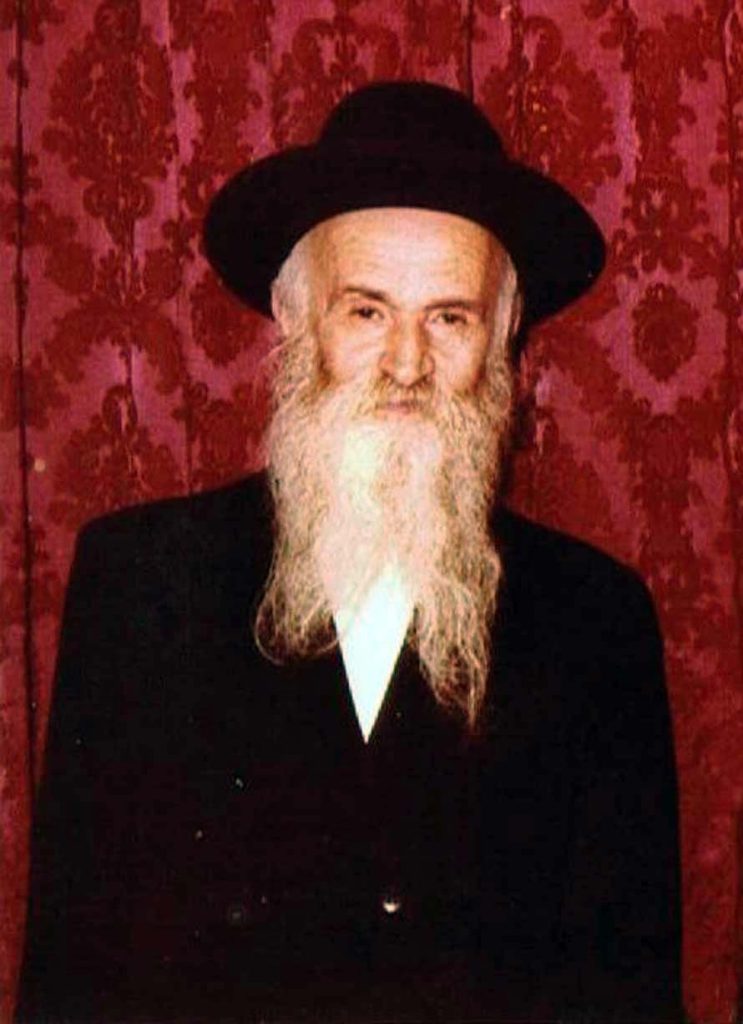
There was no time for rest, as he had taken upon himself to open yeshivas in every location. Therefore, immediately after Pesach, Reb Yosef traveled to open a division in Kuibyshev where he remained until after Shavuos, and then traveled to open a division in Kutaisi, which he ran until the summer of 5700 (1940).
Rabbi Yechezkel Brod, his student from this period, related years later: “When Reb Yosef Goldberg arrived in Kutaisi, we felt that we finally had everything we needed. First and foremost, Reb Yosef was an enormous talmid chacham; in addition, he was also devoted to us with all his heart and soul and cared for all our needs. If we lacked bread, he would take the trouble to obtain it so that we would lack for nothing.
“After he arrived in Kutaisi, a real yeshiva arose there. Around him gathered many bachurim who sought to learn seriously. These were relatively happy days. We learned with diligence and perseverance, and the fear that filled our hearts during the days of wandering in Russia gradually faded. Finally we were living among Jews, and they even had respect for us as Torah students.
“It once happened that I misbehaved,” related R’ Yechezkel Brod, “and did not properly maintain the yeshiva’s schedule. According to the yeshiva’s rules, I deserved a fine for my actions – not to receive the daily allowance to buy food for myself. And indeed Reb Yosef, as the rosh yeshiva, implemented the punishment as required. But after a few hours he called me and said with compassion ‘You will eat at my house today!’
“When I asked why, he explained that what he had said in the morning was on behalf of the yeshiva. ‘But now, to leave a boy hungry – to this, I as a private individual, will never agree!’ This is just one example of his good heart and his concern for us, his talmidim.”
About his feelings in those years, Reb Yosef spoke to his son Rabbi Yitzchok, saying that “in that period I was certain that no memory of me would remain, G-d forbid, and it was only a question of time until I would be caught and that would be my end. When I see all my family, and essentially the continuation of my life, I see this as pure kindness that Hashem did with me!”
On another occasion he said that despite serving thirty-seven years as rosh yeshiva in France and establishing many talmidim, the six years in which he operated underground were “the most precious years of my life.”
“A Complete Shas!”
Finding a shidduch at the time was not an easy task for Reb Yosef, as he had an uncompromising requirement: the kalla must wear a full head covering, something that was almost not accepted in communist Russia at that time. Despite this, he did not give up.
At the beginning of the summer 5700, Reb Yosef left Kutaisi in order to seek a suitable shidduch. Rabbi Peretz Mochkin, who knew the ‘Muma Sarah’ because they worked together on communal affairs, greatly esteemed Reb Yosef and suggested him as a husband for her daughter Tzivia. After she agreed to accept upon herself the condition of head covering, the couple married in Leningrad, in 5700.
His brother-in-law Rabbi Moshe Katzenellenbogen related: “When Reb Yosef became engaged to my sister, I was then a young boy and I got to learn with the new chassan, who instilled in me much chayus in learning. In order to motivate me in learning, he once told me that I could test him on all the ‘yeshivishe mesechtos.’ And indeed, wherever I began reading in the Gemara, he would continue by heart the ‘give and take’ of the Gemara! This was a very interesting game…” he concluded.
After their wedding, the new couple moved into the house of his wife’s grandfather, Rabbi Chaim Benzion Raskin, who had passed away some time before. Immediately upon entering the house, he caught sight of a complete set of Shas, something that was a rare and precious treasure. He called out in excitement: “A complete Shas!”… After many years in which he used individual volumes of Gemara, worn and torn, he made the best use of the complete Shas.
For his livelihood, Reb Yosef began engaging in business under the guidance of his mother-in-law, the ‘Muma Sarah.’ He saw blessing in his work. He dedicated the evening hours to giving shiurei Torah to balabatim in Leningrad. Also throughout the daytime hours, he utilized many hours for learning, aside from the time he spent on business.
War, Survival, And A New Beginning
World War II and the Russian-German front that broke out in 5701 (1941) shook Russia with storms of blood and fire and pillars of smoke. Soon all young men were drafted for military service. Reb Yosef was miraculously saved from this harsh decree.
When the Nazis approached Leningrad and imposed a siege upon it, he understood the approaching danger, and convinced his extended family to leave the city and flee for their lives. On the long train ride that carried them eastward, he saved their lives from the hardships of wandering. He found creative ways to protect them from the severe cold and the terrible hunger that prevailed everywhere.
After a prolonged escape journey, Reb Yosef and his family arrived in distant Samarkand, where the turbulence of life quieted somewhat. Even the persecutions of the KGB agents eased, due to the authorities’ preoccupation with what was happening at the fronts.
In Samarkand too, he engaged in business, but nevertheless, he gave many shiurim to balabatim. His brother-in-law Rabbi Moshe Katzenellenbogen defined in one sharp sentence Reb Yosef’s occupation in Samarkand: “Reb Yosef hut in Samarkand ah sach gelernt, ah bissel gehandelt, un b’ikar gehungert”… (= Reb Yosef during his stay in Samarkand learned much, engaged in commerce a little, and mainly – went hungry…”)
Only in 5706, did relief come, when Reb Yosef merited to escape from Russia with his family in the famous ‘exodus from Russia’ that was organized by his mother-in-law, the ‘Muma Sarah,’ Hy’d. After their departure, they stayed for a long period in the refugee camp in Vienna, where he taught in the temporary yeshiva that opened in the camp.
When most of Anash moved to Brunoy, France, he too moved – and after a short period, he was appointed as one of the roshei yeshiva and its administrators, a position in which he served until his passing.
Testimony from those early days was given by his student, the mashpia, Rabbi Pinye Korf: “In 5709, I learned with him meseches Gittin. Reb Yosef himself did not farbreng with us, as he would farbreng only with his peers and with Reb Nissan Nemanov. But in the middle of the shiurim he would stop from time to time to arouse and motivate us to learn. Sometimes this was in the manner of ‘throwing bitterness into the students’ and sometimes in the way of ‘the right hand draws near’ – but he always succeeded in getting us to learn.”
On the 23 Shevat 5708, a short period after his appointment as Rosh Mesivta, Reb Yosef received a letter from the Rebbe Rayatz. This was the first holy letter he merited to receive. Among other things, the Rebbe blessed him:
“…and may he succeed in his work to raise students who fear G-d and engage in tikkun ha’middos and in conduct of fear of Heaven and success in their studies and in tikkun u’birur ha’middos.”
Reb Yosef was moved to receive the letter. Particularly impressive to him were the Rebbe’s words that his role was to raise students in tikkun ha’middos and yiras shomayim, even though his job was solely to guide them in learning, and not to be a mashpia. The words that the Rebbe repeated and doubled at the end of the letter did not escape his notice: “and in tikkun u’birur ha’middos!”
Interestingly, several years later (23rd of Tammuz 5713/1953), the Rebbe wrote to him: “With blessings of success to instill the spirit of yiras shomayim in all his students and those influenced by him…”
The First Time At The Rebbe
Since being a student in Tomchei Tmimim, Reb Yosef yearned to travel to the Rebbe Rayatz, but did not merit this. Though he was a soldier, even an officer, in the Rebbe Rayatz’s army, he did not merit to see him.
Immediately upon his departure from the Soviet Union in 5706, he began collecting money in order to finance such a trip to thereby quiet his longing for the Rebbe. However, divine providence decreed that he was not able to ever see his holy face before the passing of the Rebbe Rayatz in 5710.
Only prior to Tishrei 5719 did he succeed in arriving for the first time to the Rebbe MH’M. In yechidus, the Rebbe instructed him to test the yeshiva students in 770 and give them a shiur in the mesechta being studied in the yeshiva.
Over the years Reb Yosef merited to go to the Rebbe several more times, to have yechidus, and to participate in farbrengens.
Throughout the years he reported to the Rebbe through letters about every step in yeshiva matters, as well as in his private matters.
Boundless Love For Torah
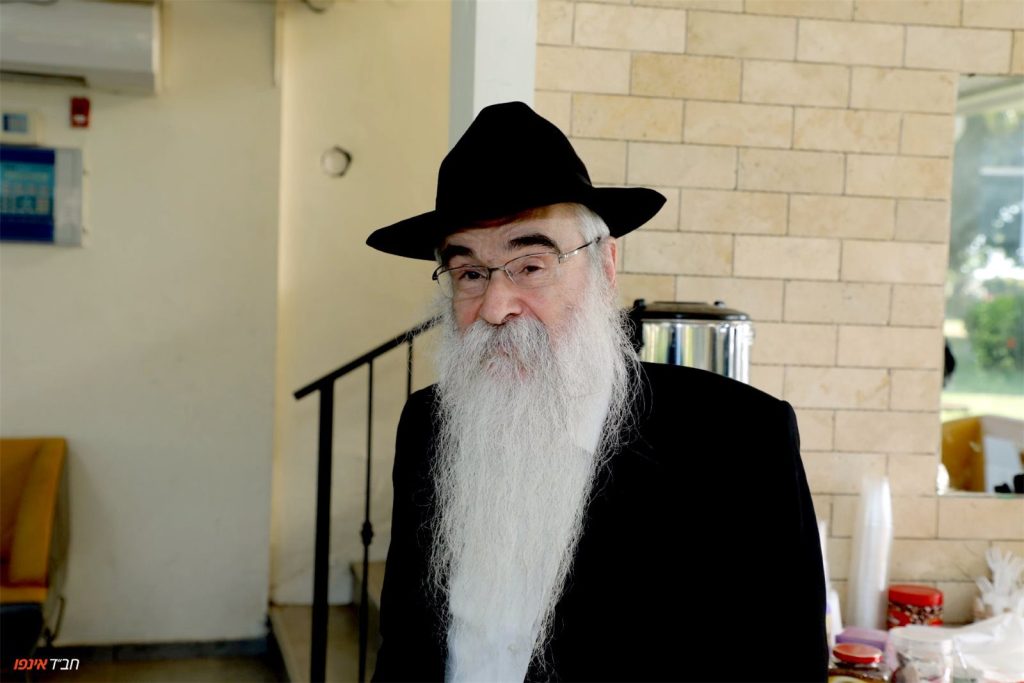
Throughout his life Reb Yosef was immersed in learning in an extraordinary way. It was the joy of his life. His students remember him walking around the courtyard of the yeshiva in Brunoy, completely absorbed in a topic that he would repeat and review to himself, waving his hands as if ‘conversing’ with the logical arguments in the topic. Even in the middle of the night he would get up from bed, approach the bookshelf, look at some Rishon or deep Tosafos, and then go back to sleep.
His son-in-law Rabbi Yitzchok Shalom Klein relates that once he traveled with him to a train station in England, and his father-in-law, being occupied in his own world, a world of Torah, began walking back and forth by the train. As was his way, while thinking, he raised and rejected arguments and ideas with hand movements and facial expressions.
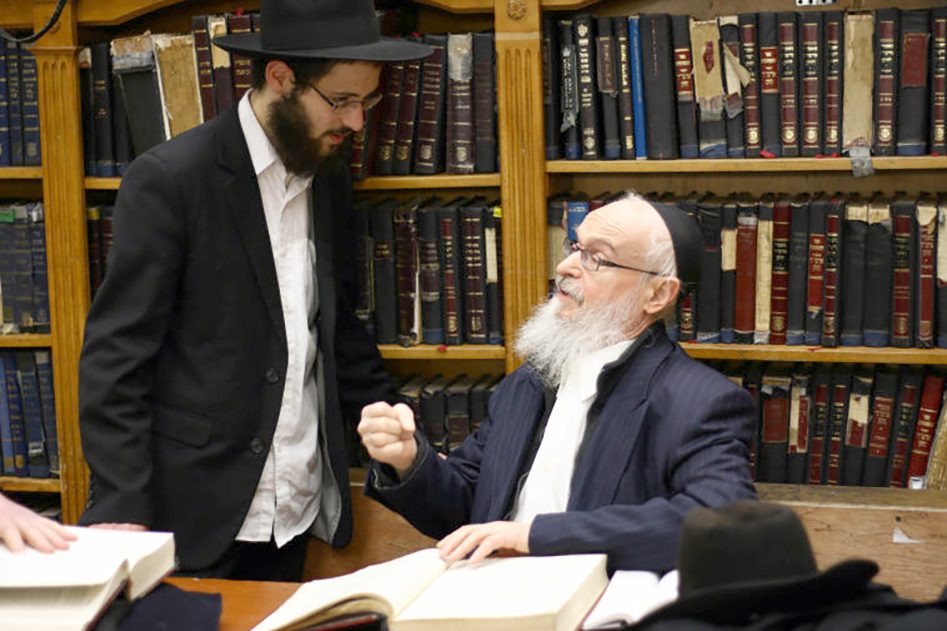
Hundreds of English gentiles, for whom this was the first time they saw such a thing, looked at him in astonishment. It was an extraordinary sight to see hundreds of pairs of eyes widening in wonder, following his steps from right to left along the entire length of the station, while he paid no attention to what was happening around him!…
Many of his students note that the logic and depth in their learning came from him. He was a living embodiment of love for Torah; he didn’t just speak about it – but lived it.
Reb Yosef’s approach in learning was a straight path, fundamental understanding according to what he received from his teachers Reb Yehuda Eber and Reb Avraham Maiyor. However, upon arriving in France, he changed his way of learning somewhat. And the incident that occurred was as follows:
In 5716, several students from Morocco arrived at the yeshiva, whose brothers and friends studied in other yeshivas in the Lithuanian style. During bein ha’zemanim they met with their friends and “spoke in learning.” As a result, they felt somewhat deflated in the face of the style of learning with pilpul.
The students returned to the yeshiva in Brunoy and complained about the style of the rosh yeshiva’s shiurim. They argued before the other students that in his fundamental way of learning as he received in Lubavitch from earlier times, there were no ‘chakiros’ and ‘lomdus’ customary among the Litvishe roshei yeshiva. Their words made an impression, and a storm began to brew among the yeshiva students.
Reb Yosef heard about this, and before Reb Nissan Nemanov traveled to the Rebbe for Yud-Beis Tammuz 5716, Reb Yosef asked him to ask the Rebbe’s opinion what to do in this matter.
The Rebbe answered Reb Nissan: “Why not, indeed! Let him look in their sefarim. After all, he has a brother-in-law in Cleveland [referring to Rabbi Shneur Zalman Kazen]. Let him ask him for the shiurim of the Telzer [referring to the Gaon Rabbi Chaim Telzer]. He doesn’t have to say exactly like him, he can say the opposite too. But to look – that yes…”
Reb Yosef accepted this and his brother-in-law Reb Zalman indeed sent him the shiurim of Rabbi Chaim of Telz. From then on, although he did not abandon his beloved sefarim like Ketzos HaChoshen etc., a new flavor was also felt in his shiurim. Over time, he acquired for himself the sefarim Even HaEzel and Shaarei Yosher, as well as the scholarly works of other Litvishe roshei yeshivos of the last generation, which left their mark on his shiurim.
Education For Love Of Torah
Reb Yosef invested and devoted himself physically for his students so they would know how to learn properly. Rabbi Hirshel Chitrik, who studied with Reb Yosef back in the 40’s, told of his derech ha’limud (style of learning): “We learned meseches Bava Metzia with him. He instilled in us that it’s forbidden to speak mere sevaros (logical theories) ‘in the air’ – every sevara must be anchored in the words of the Rishonim. Reb Yosef set us on our feet, in the path of straight thinking.
“In the middle of the shiur, Reb Yosef would sometimes stop and show us how he arrived at the sevara he had just stated,” adds Rabbi Hirshel Rabisky. “His frequent saying was: ‘There are many sevaros you can say, but if it’s not written in a Rishon, what is it worth?’”
Another anecdote about his scholarship is told by his son Rabbi Yaakov: “In 5725, my father received instruction from Rabbi Yisroel Jacobson that the Rebbe wanted him to travel to the Litvishe yeshivos in England: London, Manchester, and Gateshead – in order to dispel the false rumors that ‘Chassidim don’t know how to learn.’
“He indeed succeeded in demonstrating this to the extent that the roshei yeshiva said that ‘surely he studied previously in a Litvishe yeshiva!’ They simply didn’t believe that such sevaros could be said by a ‘Lubavitcher’…”
About his method of delivering shiurim, his son Rabbi Yitzchok related: “My father would deliver the shiur and the learning in an interesting way. When talmidim see a person who lives the learning, and also says interesting things, they receive real chayus in learning.”
His devotion to his students was enormous. Even after the shiur, he would converse with them for a long time to clarify what needed clarification. If there was a talmid who encountered difficulty in understanding the material, he would offer to learn with him in his free time, and would not give up until the talmid completely understood the material being learned.
Reb Yosef didn’t only set his talmidim on their feet spiritually, but also materially. A bachur knew that if he needed something materially, he had someone to talk to, even about personal matters. With Rabbi Goldberg, the students felt they could talk to him about anything. They simply loved him and were drawn to him.
Even after he suffered a heart attack in 5732, he continued to dedicate additional time to his talmidim, despite his family’s pleas that he rest more. Even on days when he was too weak to get out of bed, he asked his talmidim to come to him and talk in learning with him…
Eventually, his weak heart overcame him, and he was often forced to stop the shiur because of the pain he felt. When he once entered for a yechidus with the Rebbe, he asked whether to reduce the frequency of shiurim, and the Rebbe replied that he should keep the frequency as it was, but take short breaks during the shiur that would allow him to recover, and also, so the talmidim could process the material being learned. The Rebbe even added that reducing the frequency would actually weaken him more, explaining that this follows what is said in the Gemara about the “residents of Mechoza” – that the moment they’re not working, it weakens them…
His Final Days
After the passing of the mashpia Reb Nissan Nemanov in 5740 (1980), Reb Yosef took upon himself the burden of fundraising for the yeshiva.
On his last Pesach, he felt intense weakness, but despite this insisted on eating the matza and maror according to the requirements of halacha. His son-in-law, Rabbi Yitzchok Klein, recalls that during the burning of the chometz, Reb Yosef stood and wept bitter tears – as if he understood that this was the last time he would merit to perform the mitzva of destroying chometz.
He passed away on 22 Sivan 5745 (1985) at age 71. According to his request, he was buried on Har HaZeisim in Yerushalayim.
This is the story of the amazing life of a Chassid and mekushar, in whom the love of Torah learning burned with his entire being, both under conditions of mesirus nefesh in Soviet Russia, and in devotion to talmidim in France. Many, many of his students serve as maggidei shiur, roshei yeshiva, and mashpiim, and through them his influence is still evident in the world of Chabad yeshivos throughout the globe.
(Thanks to the family members for their abundant help in preparing this article.)
SHABBOS WITH ‘REB LEVIK’
During his many travels throughout Russia in overseeing the underground yeshivas, he once arrived in the city of Yekaterinaslav, where he spent Shabbos with the Rav of the city, Reb Levi Yitzchok, the Rebbe’s father. Reb Yosef recalled from that Shabbos that Reb Levik never stopped speaking words of Kabbala and ‘secrets of the Torah.’ Even during the eating of the ‘chrein’ (horseradish), he explained its significance according to Kabbala.
While he was there, he overheard a conversation between Rebbetzin Chana and her husband about a letter she received from her daughter-in-law, Rebbetzin Chaya Mushka. In the letter, the Rebbetzin wrote that they received food packages to their home in Paris from her father, the Rebbe Rayatz, since the manifold stringencies of her husband – their son – made it impossible for him to eat properly!
Beis Moshiach #1467 • pp. 14-26
© 2026 Beis Moshiach Magazine. All rights reserved.
This article originally appeared in Beis Moshiach #1467. You are welcome to share it with friends and family by email or in print, provided that you do not change, add to or omit any part of it, you credit the author and Beis Moshiach, and you include a link to archive.bmoshiach.org (written out in full in printed copies).
To republish this article in a newspaper, magazine, book or website, please request permission in advance at [email protected].