The Moshiach Chidon
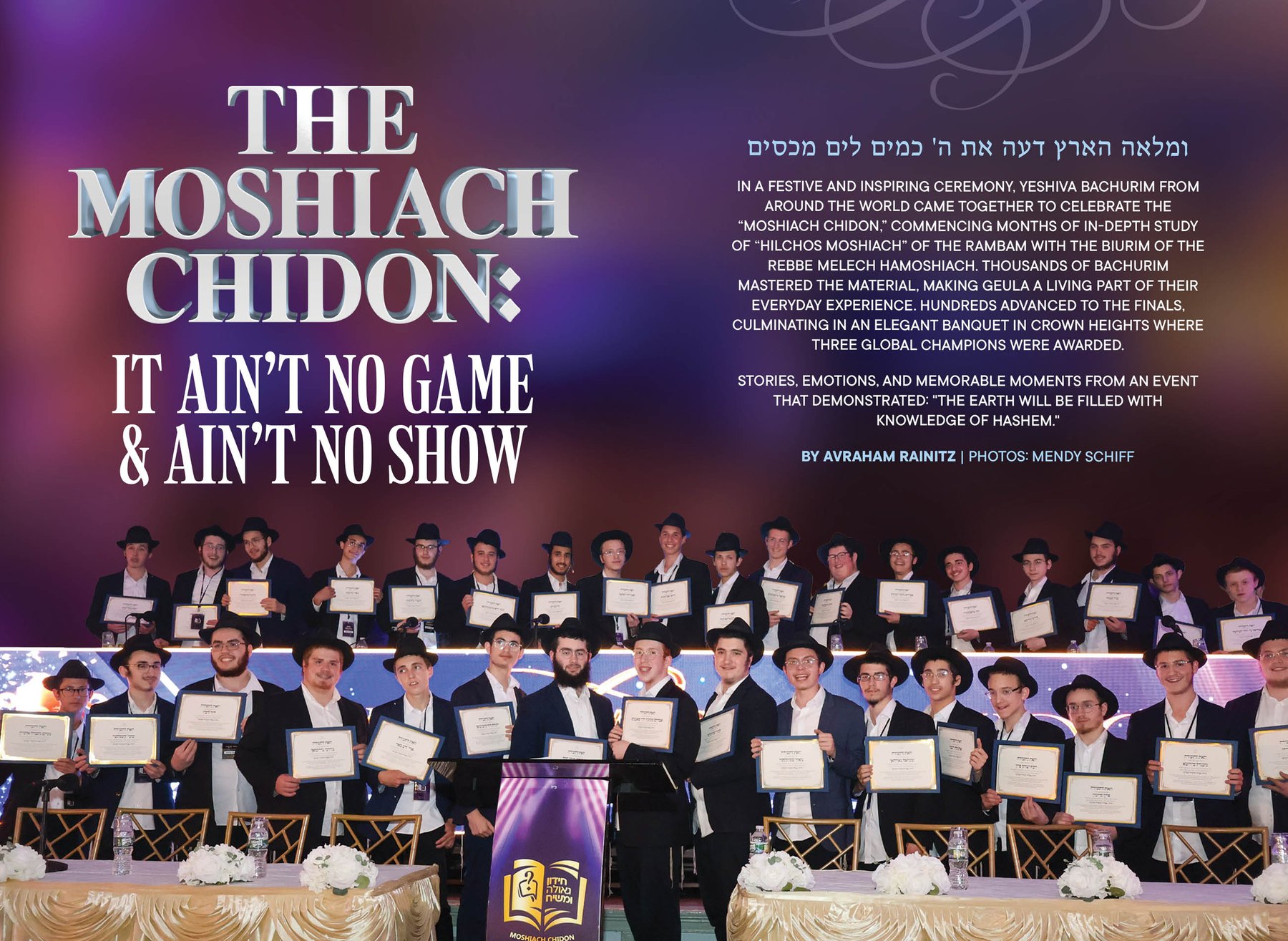
In a festive and inspiring ceremony, yeshiva bachurim from around the world came together to celebrate the “Moshiach Chidon.” Commencing months of in-depth study of “Hilchos Moshiach” of the Rambam with the biurim of the Rebbe Melech HaMoshiach. Thousands of bachurim mastered the material, making Geula a living part of their everyday experience. Hundreds advanced to the finals, culminating in an elegant banquet in Crown Heights where three global champions were awarded. Stories, emotions, and memorable moments from an event that demonstrated: “The earth will be filled with knowledge of Hashem.”
About 850 years ago, the Rambam completed his sefer with a description of the world’s condition in Yemos HaMoshiach, when “the occupation of the entire world will be solely to know G-d.” While we have not yet merited to reach this state, when talmidim from yeshivas around the world gathered in one hall, all with one single occupation – to know only G-d – this felt very close…
When the names of the yeshivas that participated in the intensive study over the past two months were announced, it wasn’t just a technical roll call. It was a powerful moment. The Chidon, which began as an initiative of Tomchei Tmimim Yeshiva in Queens – a yeshiva that stands for living with inyanei Moshiach and Geula, conquered the yeshiva world and became a worldwide powerhouse within just a few years.
The emcee calls out the name of the yeshiva in Dnipro, Ukraine, where a missile war is being waged between Ukraine and Russia, and the bachurim sit and study the Torah topics of Moshiach and Geula as if there were no war. They join their brothers in Moscow, Russia, all studying from the same high-quality booklets that artfully weave together the two perakim of Rambam with hundreds of the Rebbe’s sichos, creating an entire Torah of Geula through the lens of halacha.
Yeshivas located in pastoral and unknown places like the Poconos, Postville, or Napierville (Quebec) are mentioned alongside more well-known yeshivas from Brunoy, Argentina, Brazil, and Australia. Different languages, different cultures, but the same emuna and the same yearning for Geula.
And when the roll call ended, there was a small moment of silence. Thousands of bachurim suddenly understood that if a student from Australia and a student from Ukraine share the same deep knowledge about the Geula, as if they’re studying in the same yeshiva – then the pasuk, “and the earth shall be filled with the knowledge of G-d” is not just a future prophecy, but also a contemporary taste of reality here and now.
Those Who Are Here – Should Certainly Be Joyous!
The emcee for the evening, Rabbi Menachem Mendel Yuzevitz, director of cheder Ohr Menachem and member of the executive committee of Tomchei Tmimim Queens Yeshiva, opened by saying: “We find ourselves at the high point of Gimmel Tammuz (‘the day of our king’). Every bachur here exerted himself on this day in hiskashrus to the Rebbe with every fiber of his soul, and here we see the deepest point in hiskashrus to the Rebbe – studying the Toras ha’Geula, with extraordinary bekius.”
He told them a story he heard the night before in 770, in the name of the Chassid Reb Yosef Benzion Reizes who was an eyewitness to the following event: In 5710, Gimmel Tammuz fell on Sunday, exactly like this year, and on Shabbos, the day before Gimmel Tammuz, a group of bachurim held a farbrengen in the small zal at 770, with the elderly Chassid Reb Yerachmiel Benjaminson. Suddenly the Rebbe entered and stopped by the group of those farbrenging, saying: “A gleicheh zach” (This is a proper thing). It is proper to hold a farbrengen for Gimmel Tammuz.
This was just months after the passing of the Rebbe Rayatz, and the Rebbe had not yet officially accepted the leadership, and Reb Yerachmiel said to the Rebbe: “But we are sad…” The Rebbe responded to this decisively: “What? Are we sad? We, who are here, are joyful! The only sad one is he who is not here!” Rabbi Reizes who told the story didn’t remember whether the Rebbe himself went afterward to his room to bring a bottle of mashke, or took a bachur with him and sent him to the farbrengen with the bottle, but the message was clear!
Rabbi Yuzevitz looked at the hundreds of students filling the giant hall of Oholei Torah and said: “You, who invest yourselves in studying inyanei Moshiach and Geula should certainly be b’simcha gedola; I have not a shadow of doubt that to such an event, the Rebbe would send you a bottle of mashke!”
Deep Questions And Accurate Answers
Each of the hundreds of tmimim who sat in the hall became, over recent months, expert in the Toras ha’Geula, after successfully passing a series of tests on in-depth study booklets covering the Torah of Geula and Melech HaMoshiach according to all the approaches of the Rishonim and the Rebbe’s explanations, and of course – the psak halacha of the Rambam.
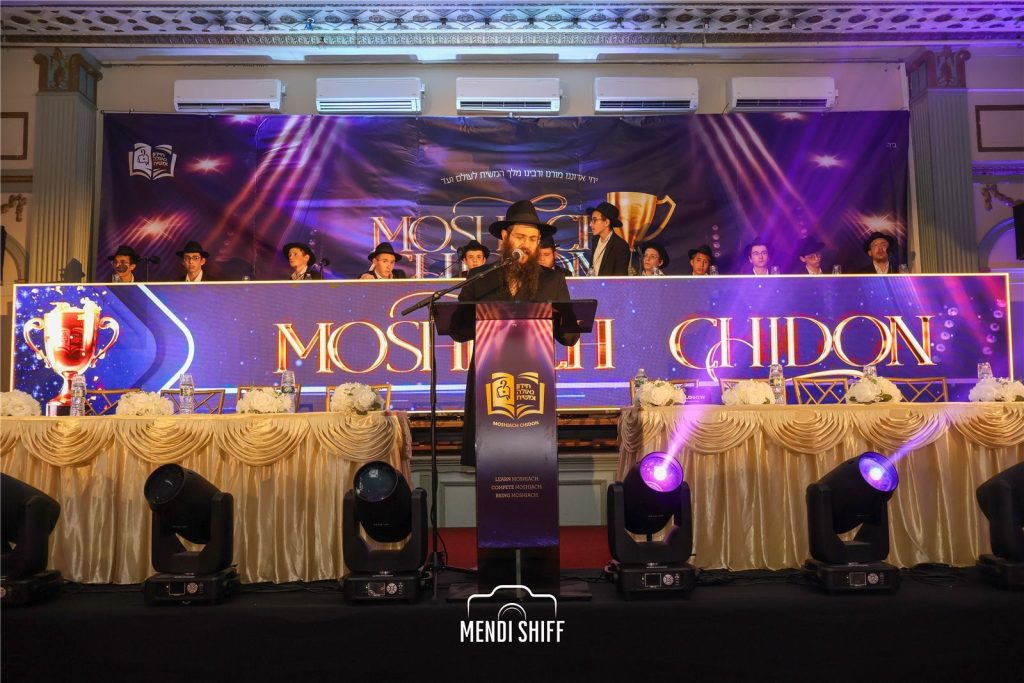
The highlight of the evening was, naturally, the Chidon itself. Dozens of representatives from all Chabad yeshivas worldwide (except for Eretz Yisrael, where a special Chidon is held) sat in rows on the stage and, one after another, answered deep questions about inyanei Moshiach and Geula. The panel of judges consisted of a team of rabbanim known for their expertise in inyanei Moshiach and Geula: Rabbi Yosef Yeshaya Braun, Mara d’Asra of Crown Heights; Rabbi Mendel Blau, the menahel ruchni of Oholei Torah; and Rabbi Sholom Zirkind, a well-known lecturer on the topics of Moshiach and Geula.
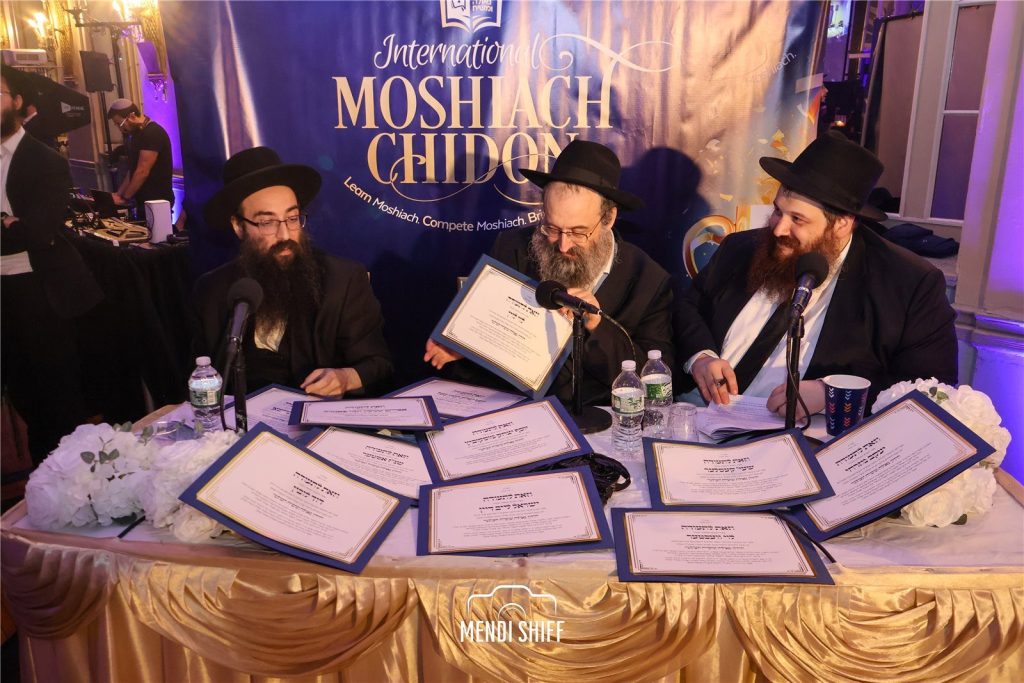
The Chidon combined bekius questions like “Why did Rambam bring three proofs for the coming of Moshiach, and what is the uniqueness of each one?” and in-depth questions like “Why, when the Rambam establishes that Moshiach doesn’t need to perform miracles, does he express himself with ‘let it not enter one’s mind,’ while when he clarifies that in Yemos HaMoshiach there will be no change from the world’s natural order, Rambam expresses himself with the words ‘let it not enter one’s heart’…”
When Stones Begin To Speak – The Geula In The Digital Age
During the event, a fascinating presentation was screened about the connection between technology and the coming of Moshiach. After opening remarks by Rabbi Mendel Scharf about the connection between the revelation of worldly wisdom and Geula, R’ Meir Schmukler spoke about artificial intelligence that has recently burst into our lives and its connection to Geula:
“Artificial intelligence isn’t something new, it has existed for 15-20 years under the name ‘machine language.’ I’ve been using it for many years for document analysis. Only now, with ChatGPT has it become popular.”
R’ Meir explained how the prophecy “a stone from the wall will cry out” is already being fulfilled today: “We carry small devices that are, by definition, inanimate – stones that don’t move and don’t say anything. They just sit there like a stone. And yet we speak to them and they answer us. This is already ‘a stone from the wall will cry out.’”
But the most amazing part was the explanation about the future of avoda in Yemos HaMoshiach: “The Rambam writes: ‘The occupation of the entire world will be solely to know Hashem.’ Why? Because ‘your work will be done by others.’ All work, all manual labor, and even more sophisticated work, everything can be done by machines and by other forces that operate. So we’re left with something that no machine will ever be able to do – to reach higher levels of divine consciousness.”
R’ Meir Schmukler also shared a personal example: “I prepare a summary of the Tanya every day, using artificial intelligence as my editor. I built a model that already knows how I want to write and what I want to write, and I’ve been doing this for almost two years. The Rambam’s vision of ‘and the occupation of the entire world will be solely to know G-d’ is being revealed naturally – freeing humanity to focus entirely on knowing Hashem until ‘and the earth shall be filled with the knowledge of G-d.’ Everything is ready, we are in the final moments, ready for the complete and final Geula.”
As part of the technological presentation, a fascinating timeline was presented of the use of technology for spreading Chassidus, which the Rebbe foresaw and initiated decades ago: 5730 (1970) – the first telephone broadcast from a farbrengen; 5733 (1973) – the first radio broadcast; 5741 (1981) – the first cable television broadcast; 5750 (1990) – on Chanuka, the first intercontinental satellite broadcast with audio and video, connecting millions worldwide with the Rebbe.
“The Rebbe greatly encouraged this and even participated in the expenses,” it was explained in the presentation. “The Rebbe urged journalists and media outlets to utilize all platforms and emphasized that their very creation was intended for this purpose. The Rebbe saw technology itself as participating in bringing Moshiach.”
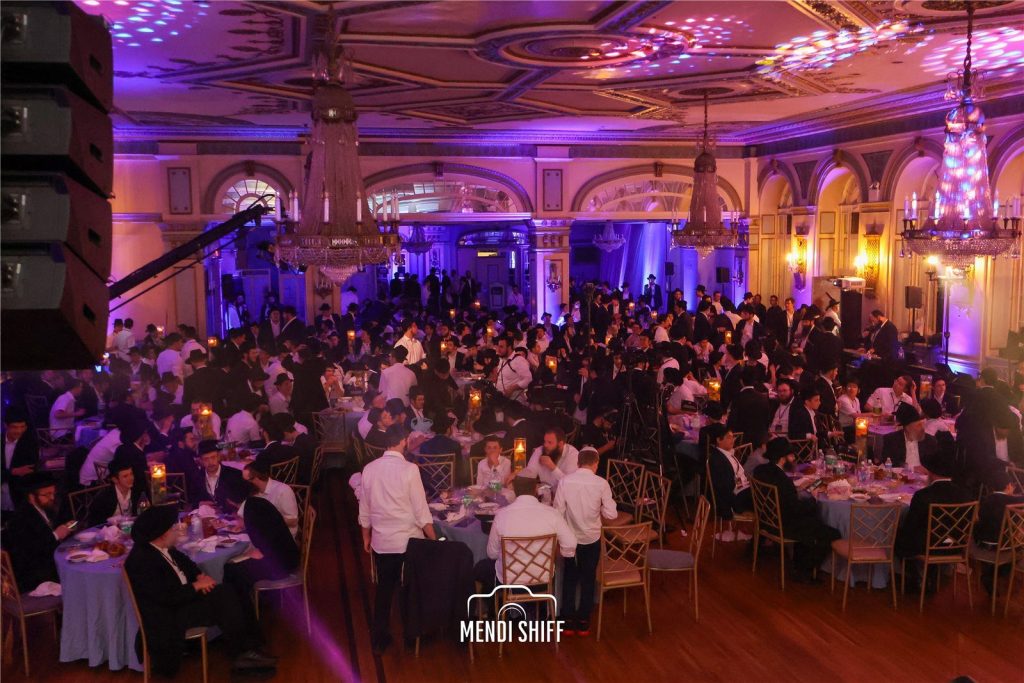
Incidentally, an interesting fact: The global Moshiach Chidon was also broadcast live to Chabad yeshivas around the world, and as of the time of writing, it has been viewed 16,403 times!
The Peak: The Final Round And The Exciting Results
In the final round, four students remained – Mendel Cohen, Sholom Segal, Shmuel Dovid Morozov, and due to a tie, also Sholom Engel – who went up to the stage to the tune of “Yechi Adoneinu.” The questions in the finals were at a high academic level, and the answers demonstrated amazing depth of understanding.
“Mendel Cohen,” Rabbi Zirkind addressed him, “the first proof that Rambam brings – where is it from, what is it, what is its special power, and why does it include everything said by the prophets?”
Mendel’s answer was precise and detailed: “The proof is from Parshas Nitzavim, where it is written that Hashem will return the Jewish people from galus, its content is a clear promise in the Torah about Geula, and since it also prophesies about the restoration of all the mitzvos to the Jewish people, it includes all prophecies dealing with the return of the completeness of Torah and mitzvos.”
And so Rabbi Zirkind went on, with all three of Rambam’s proofs, with each representative explaining clearly and concisely Rambam’s intention according to the wonderful detailed analysis of the Rebbe in his sichos.
The questions became increasingly more complex. For example, Rabbi Mendel Blau asks Chaim Sholom Segal: Detail all the actions brought in the two booklets regarding the actions of Eliyahu HaNavi… and he asks Shmuel Dovid Morozov: Bring all the proofs from the Torah mentioned in the study booklets – about Geula and about Melech HaMoshiach. Sholom Engel is asked to list all the changes mentioned in the booklets, whether Moshiach comes in the manner of “they merited” or in the manner of “they did not merit”…
The Greatest Gift That Can Be Given To The Rebbe!
Between one round of questions and the next, Rabbi Yuzevitz shared a moving insight with the bachurim, following a Chassidishe story:
“The holy Ruzhiner once entered the study hall and found a Chassid davening in the late hours of the day. When the Rebbe asked the Chassid why he was davening so late, the Chassid replied: ‘All the tzaddikim daven at these hours, so do I. What’s good for them – is good for me too…’”
The Ruzhiner looked at him and began with a mashal: “Whenever a certain man returned home, his wife would serve him green peas. This was the regular routine. One day he came home, and there was nothing on the table. He waited, and while he waited, he began to think – maybe she caught on to the problem, and she’s now preparing something more respectable than green peas. So he begins to imagine – surely fish. Minutes pass, and he begins to imagine – surely it’s meat, and surely meat with sides dishes. His mind takes him on a journey, and he imagines things. And in the middle of all this fantasy, his wife comes out with a tray of peas. So he’s stunned and says to her: ‘Bad enough that I had to wait so long, but after all this time – to come with peas?!’”
And the nimshal: “In the morning, Hashem listens to all the Jews who come to daven. And then there are the tzaddikim, and it takes them time. Hashem waits. He says – for such a prayer, when their davening is so special, it’s worth waiting. And indeed, they come with a ‘complete meal,’ they come to the Hashem with divine unity. It was worth the wait. But you – you daven late, and what do you serve? You serve peas!”
Rabbi Yuzevitz applied the mashal to our times in a moving way: “It is Gimmel Tammuz 5785, something that no Chassid ever imagined in his wildest dreams. Geula is taking time. Why Hashem waits, we don’t know, but I want to tell you that not long ago, my personal feeling was that after all these years that we’re waiting – we’ll come with peas (like in the Chassidic story, where Chassidim received Moshiach with remnants of mashke saying: if you had delayed a bit more, even this wouldn’t have remained)…
“But now, as we sit here together on Gimmel Tammuz 5785, and get to see a group of bachurim who became experts in inyanei Moshiach and Geula, finished learning the study booklets successfully and finally reached the final, and each of the bachurim here is expert and labored and sweated in inyanei Geula and Moshiach – I want to say that indeed we’ve waited many years, but when the Rebbe enters immediately right now, at least we can say to the Rebbe: we have a ‘meal [worthy] for Shlomo [HaMelech] in his time,’ this is the most powerful gift we could give the Rebbe!”
The Happy Winners
The tense moment of announcing the results arrived. In third place – Sholom Engel. He came up to the stage excited, received his prize with a stamp that the Rebbe held in his holy hand, and the audience burst into applause.
In second place – Shmuel Dovid Morozov, who received a dollar from the Rebbe. He stood on the stage like someone who had just won the greatest prize in life.
And then the great moment: “The first-place winner is – Mendel Cohen!” Hundreds of attendees in the hall rose to their feet, sounds of joy shook the place, and Mendel came up to the stage moved to tears, receiving a dollar that was received from the Rebbe’s holy hand and also a handwritten note from the Rebbe.
But what was most moving was to see how all the other participants rejoiced with each other. There was no disappointment or jealousy here – only pure joy of those who all know they are part of something much greater than a competition.
When The Geula Permeates One’s Life
Rabbi Aron Ginsberg, in a moving closing speech, told about a Jew who became closer to Chassidus but encountered significant difficulty with his family. He came from a community that didn’t particularly like Lubavitch, and every time he met with his family members, they would enter into exhausting arguments and disputes about Lubavitch and its ways.
This man felt completely lost. Should he answer all their critical questions? Should he not answer at all? He didn’t want to leave them with unanswered questions, but he also didn’t want to enter into constant confrontations. He felt uncomfortable with the entire situation.
Finally, he decided to write to the Rebbe and ask for advice: “What should I do? I’m having all these discussions and arguments with my family, and it’s very hard for me.”
The Rebbe’s answer was simple but revolutionary: “Don’t answer anything about their questions and arguments. I have no desire for arguments – I don’t appreciate people who enter into arguments just for the sake of argument. Instead, talk about the parshas ha’shavua.”
Following this advice, every time the man encountered a challenge or difficult question, he would immediately divert the topic to the weekly parsha, and naturally found an opportunity to share from the Rebbe’s teachings.
At the last farbrengen of Gimmel Tammuz, to date, 5751, the Rebbe shared a special story – something that wasn’t common in the later years. The Rebbe told with pride about a Chassid who left a farbrengen in Russia, at a time when it was forbidden to walk in the streets during late night hours.
When the Chassid walked in the street, still immersed in the spiritual atmosphere of the farbrengen, a policeman stopped him and asked in Russian: “Kto idyot, kto idyot?” (Who goes there?)
Without thinking twice, the Chassid answered in the same language: “Bittul idyot, bittul idyot” (bittul goes, bittul goes).
The Rebbe explained that the beauty of the story is not just that the Chassid lived with the spiritual world of that farbrengen, but that it was so real and internalized for him, that when he was stopped in the street by a Russian policeman, he reacted naturally in the language of Chassidus.
The spiritual truth he lived in the farbrengen wasn’t something abstract in higher worlds, but a tangible truth that translates to this physical world, in the Russian language. Torah became such a natural part of him that he expressed it spontaneously.
We stand here this evening and see the wonderful achievement of tmimim around the world. They not only studied inyanei Geula and Moshiach and not only excelled in their studies, but they show how this became natural for them. Their immediate responses, in which words of Geula flow from their tongues, testify that this deeply influenced their minds and hearts. This is their natural response.
Today the Rebbe calls to all of us: “And speak about inyanei Geula and Moshiach!”
The Rebbe wants the involvement of every tamim – with his family, friends, or a stranger on the street. What should come from his mouth? Words about the upcoming Geula. The Geula is coming. Moshiach’s reality isn’t something just to tell or know theoretically – it’s not something acquired as information stored in the brain’s warehouse, but this has to become part of the essence and being.
There’s no doubt that each of the tmimim gave the Rebbe the greatest gift – a soul that expresses true love. Something that expresses that the Rebbe’s words are so deeply and preciously meaningful, that they’re ready to invest hours, days and nights in study, completely immersed in inyanei Geula and Moshiach. Everyone had the great zechus to give the Rebbe this gift. And there’s no doubt that today the Rebbe gives in return his love to everyone. The Rebbe loves and showers blessings on everyone and their families.
Continue to be the bright candles that illuminate the final moments of galus with the light of Geula, with the light of Moshiach. Do all this from strength to strength and walk with pride, immediately right now, to greet Moshiach – whom you not only studied about and not only absorbed, but caused to happen.
An End That Is A Beginning
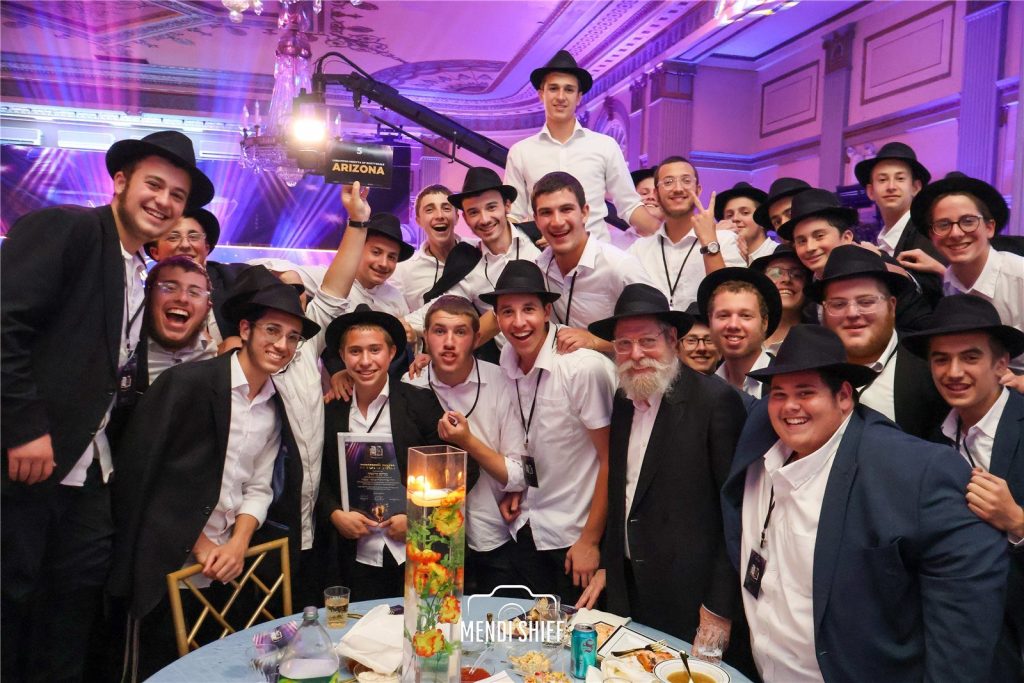
When the event ended and the participants left, each of them, who successfully passed the three tests and proved wonderful expertise, received a gift of choice – either the sefer ‘Dvar Malchus’ or a book in English about the Chassid Reb Shlomo Chaim Kesselman. In addition, they received the HaTamim supplement of ‘Beis Moshiach’ in English.
On behalf of thousands of bachurim Rabbi Yuzevitz thanked the wonderful team of the Moshiach Chidon – the organizers, R’ Chaim Piekarsky, R’ Levi Teitelbaum and R’ Shammai Eidelman; as well as the editors of the study booklets – Rabbi Sholom Zirkind and Rabbi Zvi Eidelman.
“The booklets are available to everyone at moshiachChidon.com,” Rabbi Yuzevitz announced before the conclusion, “anyone who wants can be part of this derech, the derech ha’yeshara to bring the Geula.”
The bachurim proved that when young people connect to a true and supreme purpose, they can reach amazing heights. They are not just the next generation of Chabad – they are the engine that drives the world toward the complete and true Geula. In the end, as Rabbi Yuzevitz said with a big smile: “If I had to give the Rebbe a gift right now, this would be exactly it – hundreds and even thousands of bachurim in whose hearts the Toras ha’Geula lives.” Soon in our days, with the Rebbe Melech HaMoshiach at our head, Amen.
Beis Moshiach #1469 • pp. 12-20
© 2026 Beis Moshiach Magazine. All rights reserved.
This article originally appeared in Beis Moshiach #1469. You are welcome to share it with friends and family by email or in print, provided that you do not change, add to or omit any part of it, you credit the author and Beis Moshiach, and you include a link to archive.bmoshiach.org (written out in full in printed copies).
To republish this article in a newspaper, magazine, book or website, please request permission in advance at [email protected].