A Dream Worth $40,000

Rabbi Yosef Carlebach stared at his phone in disbelief. The contractor’s ultimatum was crystal clear: no money, no construction. The massive Chabad House at Rutgers University had promised a state of the art mikva, but would remain an empty shell unless he could produce an impossible sum within days. Hundreds of miles away, Yasha, a Russian-Jewish businessman, woke up from a startling dream and gave Rabbi Leibel Groner a call…
I
Rabbi Yosef Carlebach, the Rebbe’s shliach at Rutgers University in New Jersey, sat lost in thought in his office. The last phone call had nearly shattered him completely. He didn’t know how he could get out of this predicament.
Not long before, he had begun constructing a magnificent building on the famous Rutgers campus. According to the plans, the building was meant to house all the Chabad activities on campus. Additionally, the place was supposed to serve as lodging and provide full hospitality to the Jewish students studying at Rutgers University, becoming a kind of physical ‘home’ as well as a spiritual shelter for their lives. This was to be a building spanning a very extensive area and would be the largest Chabad house in the world.
Swept up in the fervor of construction, he didn’t pay attention to the huge expenses involved. The deficit in his bank account grew alarmingly, but he decided to continue building come what may. After all, he had grown up on the principle of “l’chatchila ariber.”
But the last call made it unequivocally clear to him that it would not be possible to continue this way. “I’m not prepared to continue construction as long as I don’t receive my money,” the contractor made clear to him, in an angry tone. He even added that the lawyers summoned to his office to discuss the matter were not ruling out the possibility of seizing the building until full payment was made.
The contractor’s announcement meant a death blow to the Chabad activities at the university for the next academic year. If the building wasn’t completed by the start of the academic year the Jewish students who wouldn’t be housed in the Chabad house would find alternative lodging for themselves, and the structure would remain desolate until the next academic year. A whole year’s worth of activities could go down the drain!
The situation was difficult, and the solution – eight hundred thousand dollars in cash – was nowhere in sight.
But a man like Rabbi Carlebach would not despair. As the Rebbe’s shliach, he had personally experienced countless miracles and wonders that the Rebbe had performed for him. Even now he was certain that the Rebbe would not abandon him in his difficult situation and would show him wonders.
About the wonders that occurred on that day, he hadn’t even dreamed…
II
Yasha (Yaakov) was born in Russia. In those years, the attitude toward Jews was not encouraging. Chabad Chassidim helped his parents get by – under the watchful eyes of government officials. Later they immigrated to Eretz Yisrael, where he grew up and was educated. In his heart, he always had warm feelings for Chabad Chassidim. He turned to the business world and America beckoned to him. He left Eretz Yisrael and went to live in New York. Initially he rented an apartment, but later, when his financial situation stabilized, he bought a spacious apartment in Queens.
Over the years his businesses flourished, and Yasha saw blessing in his work. He never forgot Lubavitch. From time to time he would go on Sundays to the distribution of dollars in order to receive the Rebbe’s bracha.
Then, a son was born to him with serious medical problems. The specialists who came to examine him determined unanimously that the child would never be able to walk. The child’s vision and hearing would also not function, and the doctors informed the father that the child’s chances of ever hearing were nil. They shook their heads in sympathy and hinted to the parents that they could leave the child at the hospital.
In his distress, Yasha decided to turn to the Rebbe and request his bracha. He traveled to the Rebbe and laid out the story. The Rebbe gave him two additional dollars and bestowed his blessing upon him.
Not many days passed, and to the doctors’ amazement, some significant improvement was noticeable in the child’s condition. From then on the situation stabilized, and day by day one could see how his health was improving. Although from time to time additional medical problems arose, the Rebbe’s brachos worked wonders and the child continued to develop at a normal pace. At a certain stage it was no longer apparent that he had been born with such complicated medical problems.
III
One day in 5756, the child went for a routine medical examination, during which a serious problem was discovered with the child’s leg. The father, trusting in the brachos of the Rebbe, knew that even today it was possible to receive the Rebbe’s brachos, and that they are miraculously effective. He wrote about this to the Rebbe and waited for the fulfillment of the Rebbe’s blessing. Deep in his heart he knew that he was in ‘good hands.’
That night Yasha had a strange dream. In his dream he sees the Rebbe, exactly as he remembered him from his meetings with him. He takes advantage of the opportunity and lays before the Rebbe his request to bless his son with a refuah shleima, as he had blessed before. The Rebbe listens and instructs him to turn to his secretary – Rabbi Yehuda Leib Groner, to hear what he has to say in this regard, and then return to him.
Since the Rebbe had so instructed, he turns – in his dream – to Rabbi Groner and tells him that the Rebbe had referred him to him. Rabbi Groner heard the problem and suggested that he go visit a mikva.
He listens to Rabbi Groner and in his dream he goes to the mikva and sees that the place is full of stones, tiles, and plaster. He understands that the construction of the mikva has not yet been completed – and he wakes up!
Yasha got up from his bed and began pacing like a sleepwalker in his room; he understood that this dream was not just random, but had meaning, though he didn’t know what he should do now. Suddenly he remembered that recently he had indeed taken upon himself to fulfill an old instruction from the Rebbe to him – to separate maaser from his profits, except that for some reason he still had not put his thoughts into action.
When the office opened, he checked with his accountant who updated him that to complete the maaser on his profits from the past year, he needed to give another $40,000.
He therefore decided to check if anywhere in the United States there was a mikva in the middle of construction, and if he indeed found such a one – he would fund the construction cost from his maaser money, thus fulfilling the Rebbe’s instruction in the dream. In his heart he felt that this was what the Rebbe’s words were pointing to.
He didn’t hesitate and immediately dialed the phone number of the Rebbe’s secretariat.
“Do you know of a mikva in the United States that is in the middle of construction?” Yasha asked Rabbi Groner when he answered the phone.
Rabbi Groner wracked his brain trying to remember a mikva that was in construction stages. Suddenly the Chabad house being built at Rutgers University in New Jersey flashed in his mind. He had participated in the cornerstone laying ceremony for the building, and over time had even helped Rabbi Carlebach raise money for the building’s construction. To the best of his memory, the building was supposed to include a mikva. He promised Yasha to check for him if the mikva was indeed in construction stages and to inform him about it as soon as possible.
Before ending the call, Yasha also asked him to check about the cost of completing the mikva.
IV
Rabbi Carlebach sat lost in thought in his car. He was still stunned by the contractor’s announcement that had struck him out of the blue.
The ring of the cell phone in his car awakened him from his gloomy thoughts. On the phone was the Rebbe’s secretary, Rabbi Groner.
“Is the Chabad house building that is in advanced construction stages supposed to include a mikva within it?” asked Rabbi Groner. “Yes,” answered Rabbi Carlebach, not understanding what Rabbi Groner had to do with the mikva whose construction had not yet been completed. “How much would completing the mikva construction cost?” Rabbi Groner went on to ask.
Rabbi Carlebach didn’t understand why Rabbi Groner was suddenly interested in the mikva specifically. “Forty thousand dollars,” he finally answered, without knowing why he mentioned precisely that amount.
“If so,” Rabbi Groner concluded, “it’s very possible that you’ll have a donor for that amount.”
Rabbi Groner didn’t delay and immediately called Yasha. “There’s a mikva at Rutgers University in New Jersey. It’s in the middle of construction, but there’s no money to complete its construction. The cost of completion amounts to about forty thousand dollars.”
Yasha found himself at a loss for words. He was stunned by the precise match between the maaser from his profits that he had set aside for immediate giving and the amount needed to complete the mikva. He informed Rabbi Groner that he was interested in meeting with Rabbi Carlebach, and Rabbi Groner gave him the phone number.
The phone again interrupted Rabbi Carlebach from his thoughts. On the line was our acquaintance Yasha.
“Could I meet with you next week at the Chabad house?” asked Yasha. Rabbi Carlebach understood that the speaker on the other end of the line was connected to the previous conversation with Rabbi Groner.
“Next week will already be too late; it’s preferable that the meeting take place this week,” Rabbi Carlebach replied boldly. “If it’s difficult for you, I can come myself to New York and pick you up.”
Yasha agreed and the meeting was set for the next day. During their meeting, the two toured the expansive student building that was in the middle of construction, but Yasha didn’t show any particular signs of being impressed.
Later in the tour the two arrived at the basement floor, where the mikva was supposed to be located. Rabbi Carlebach noticed that Yasha suddenly became lost in thought. When time stretched on and he remained standing in place, Rabbi Carlebach understood that something had touched him deeply, and he should be given his time. He said to his guest that he was going up meanwhile for Mincha and would return to him in about ten minutes.
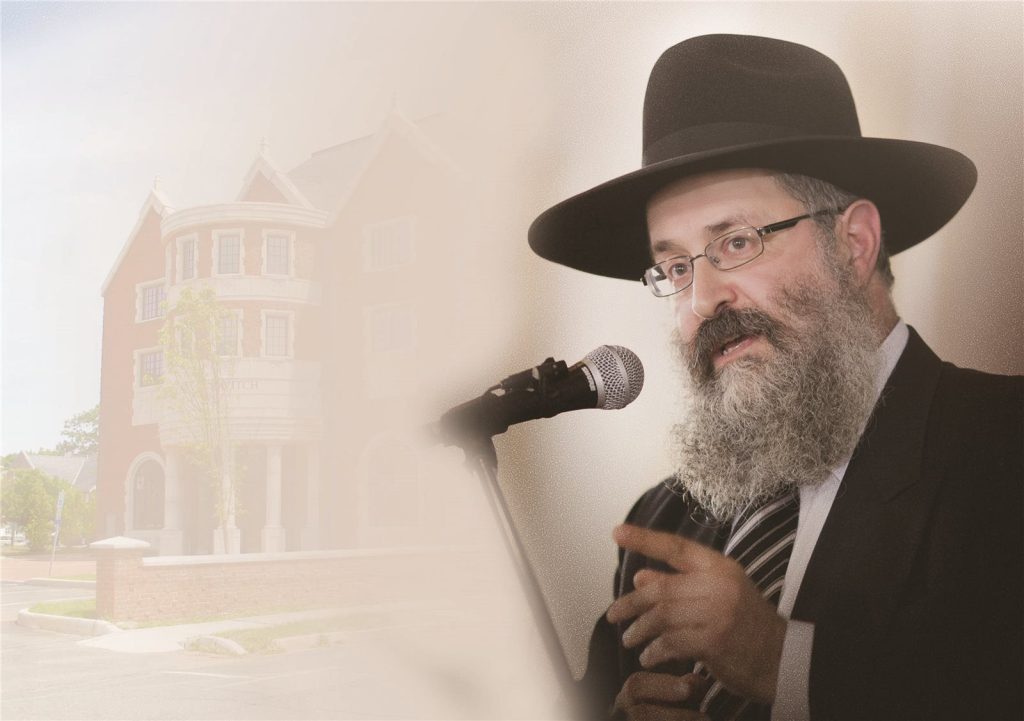
When he returned, Yasha was talking on his phone and sounded excited. Rabbi Carlebach waited on the side for the end of the conversation and then understood the reason for the man’s excitement.
“These walls, the walls of the mikva standing exposed in construction stages, appeared to me in my dream last night with the Rebbe,” Yasha explained…
V
The next day, a meeting took place between Rabbi Carlebach and the contractor. The conversation was conducted in a harsh spirit and the contractor announced to the shliach that the place would not open for the upcoming academic year.
When he already got up from his chair and turned to leave, Rabbi Carlebach decided to try. He placed a sealed envelope on the table and said: “Take this, it’s for you.” The surprised contractor opened the envelope and found in it a check for $40,000. This was Yasha’s donation…
The contractor demanded an explanation, and Rabbi Carlebach told him the complete story of the envelope. Gripped with amazement, the contractor announced that he would do everything in his power so that the construction would be completed even before the start of classes! “And as for the rest of the money – we’ll manage somehow…”
* * *
Anyone who wants to see the fulfillment of the dream – can come for a visit and see the hundreds of students who visit the giant building every day.
Beis Moshiach #1473 • pp. 32-35
© 2026 Beis Moshiach Magazine. All rights reserved.
This article originally appeared in Beis Moshiach #1473. You are welcome to share it with friends and family by email or in print, provided that you do not change, add to or omit any part of it, you credit the author and Beis Moshiach, and you include a link to archive.bmoshiach.org (written out in full in printed copies).
To republish this article in a newspaper, magazine, book or website, please request permission in advance at [email protected].