Prophecy in Print
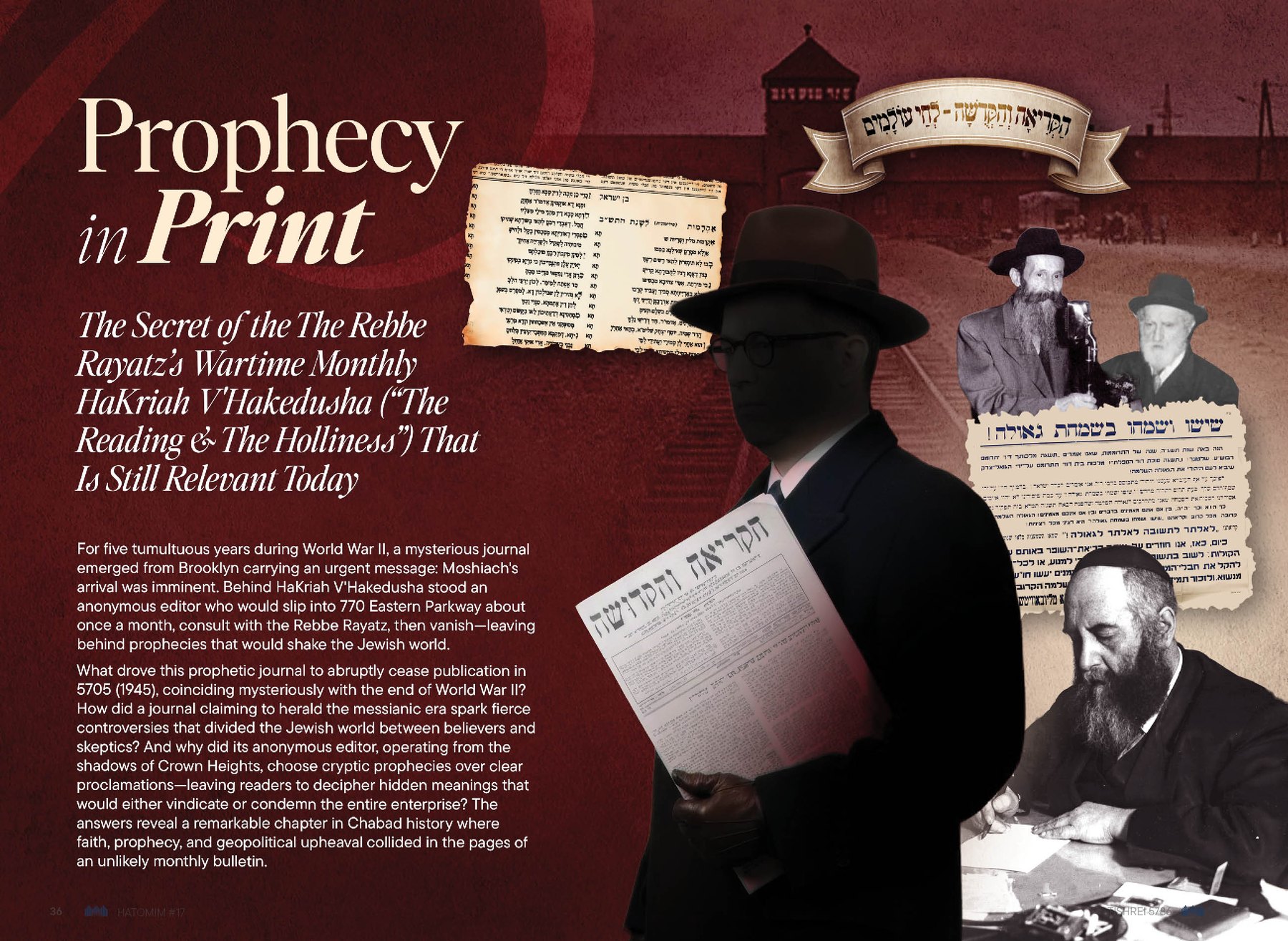
The Secret of the Rebbe Rayatz’s Wartime Monthly HaKriah V’Hakedusha (“The Reading & The Holiness”) That Is Still Relevant Today
For five tumultuous years during World War II, a mysterious journal emerged from Brooklyn carrying an urgent message: Moshiach’s arrival was imminent. Behind HaKriah V’Hakedusha stood an anonymous editor who would slip into 770 Eastern Parkway about once a month, consult with the Rebbe Rayatz, then vanish – leaving behind prophecies that would shake the Jewish world. What drove this prophetic journal to abruptly cease publication in 5705 (1945), coinciding mysteriously with the end of World War II? How did a journal claiming to herald the messianic era spark fierce controversies that divided the Jewish world between believers and skeptics? And why did its anonymous editor, operating from the shadows of Crown Heights, choose cryptic prophecies over clear proclamations – leaving readers to decipher hidden meanings that would either vindicate or condemn the entire enterprise? The answers reveal a remarkable chapter in Chabad history where faith, prophecy, and geopolitical upheaval collided in the pages of an unlikely monthly bulletin.
“When I saw the terrible situation, I began publishing the monthly HaKriah V’HaKedusha to remove the shame of those who destroy the congregation of the community of Israel. For about three years it has appeared monthly, pointing with its finger at the troubles coming upon all of Israel, which are the birth pangs of Moshiach, in very serious articles based on very logical foundations.” (Rebbe Rayatz; Igros Kodesh Vol. 7, p. 191)
Chapter 1: The Birth of HaKriah V’HaKedusha
In late Elul 5699 (September 1939), with the outbreak of World War II when the Germans ym”sh invaded Poland, the Rebbe Rayatz left Otwock. B’chasdei Hashem, he succeeded in escaping to Riga along with some family members and a group of Chassidim. From there he arrived in New York on 9 Adar 5700 (March 1940).
Upon the Rebbe Rayatz’s arrival on safe shores and the establishment of the Lubavitch kingdom on American soil—”the capital of Rome”—he began sounding the shofar of Moshiach. As time passed, his talks became increasingly explicit and his words more direct: “Jewish people, prepare for Moshiach’s arrival. The walls of exile are burning; in another moment they will dissolve as if they never existed, and before our eyes the redemption will be revealed in all its glory and splendor!”
A few months passed, and at the beginning of 5701 (1940-41), the Rebbe Rayatz launched tremendous activity to awaken the Jewish people to await and prepare for the approaching redemption. In those days, when millions of Jews suffered under Nazi occupation, the Rebbe Rayatz started to publishe the monthly journal HaKriah V’HaKedusha.
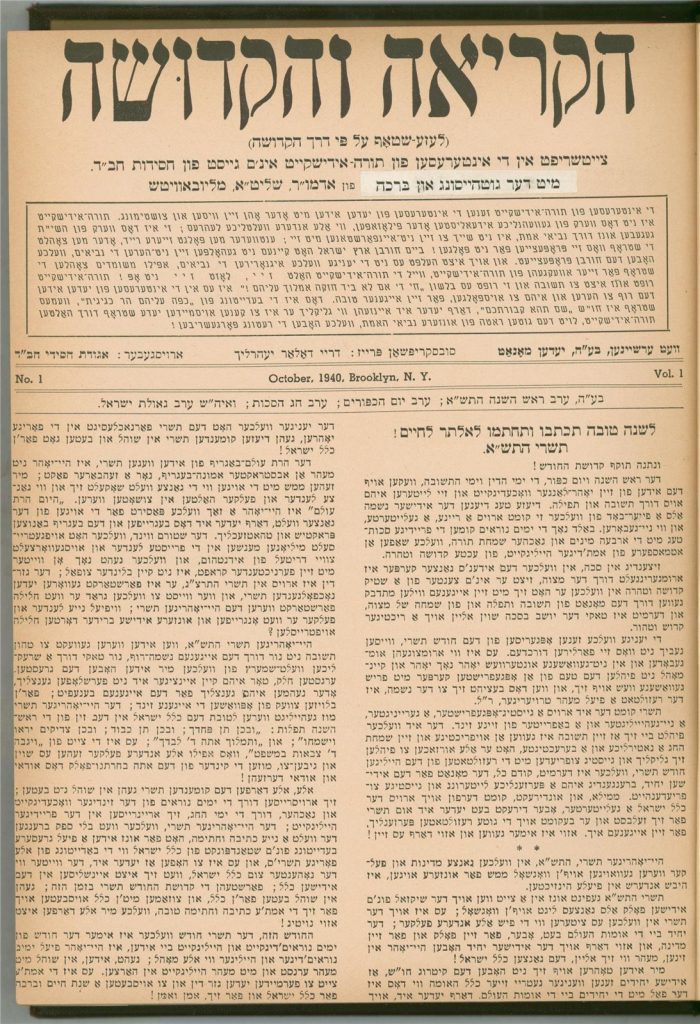
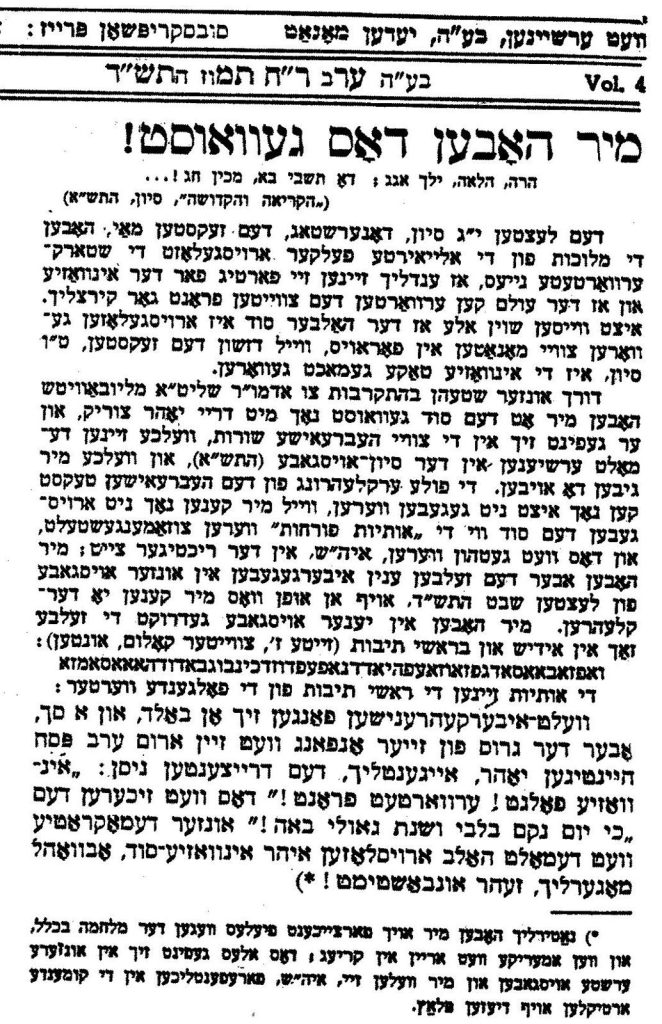
HaKriah V’HaKedusha was published under the auspices of Agudas Chassidei Chabad for exactly five years. The first issue appeared for Tishrei 5701 (1940), bearing the date “B”H, Erev Rosh Hashana 5701 (1940); Erev Yom Kippur; Erev Sukkos; and G-d willing, Erev the Redemption of Israel.”
The monthly was titled “HaKriah V’HaKedusha – Reading Material According to the Path of Holiness.” Its subtitle read “A journal for matters of Torah Judaism in the spirit of Chabad Chassidus.” Below appeared “With the approval and blessing of the Rebbe of Lubavitch.” Interestingly, the first issue originally read “With the guidance and participation of the Rebbe of Lubavitch”—but this was covered with a sticker bearing the revised text (see facsimile).
The Meaning of the Name HaKriah V’Hakedusha
In a letter to Rabbi Moshe Shapiro of Atlantic City, the Rebbe Rayatz explains the journal’s name: “The calling of this name is a call to holiness, as the explanation and concept of this holiness is preparation – to be ready for Moshiach’s arrival, and the preparation must be through teshuva and good deeds” (Igros Kodesh Rebbe Rayatz, Vol. 5, p. 359).
The Rebbe Rayatz saw the journal as “the pillar of fire illuminating the dark paths of weary householders living within the hoo-ha of the stormy marketplace of the street” (Igros Kodesh Rebbe Rayatz, Vol. 5, p. 5).
The Format
The monthly’s format was that of a bulletin, printed on letter-size pages (8.5”×11”) with anywhere from 6 to 24 pages per issue, but mostly 8 or 16 pages. Starting from Issue #7 that came out for Pesach 5701 (1941), the journal appeared with an English-language supplement titled “Reading and Holiness.” Interestingly, this first English edition was called a “Haggadah Supplement” meant “to be read on Passover and all year round.”
This development further expanded the Rebbe’s reach to American-born Jews who might not be fluent in Yiddish. This bilingual approach ensured that the message of redemption could cross both linguistic and cultural barriers within American Jewry.
Months after World War II ended, the last issue came out for Elul 5705 (1945), and HaKriah V’HaKedusha never resumed publication.
Chapter 2: The Mysterious Editor

The abrupt halt of the journal’s publication is not the only mysterious aspect about it. The journal’s publication was done under a veil of secrecy, and only those involved knew about the idea and preparations for publication. The articles were signed with pseudonyms: “Ish Yehudi,” “HaRav Meir,” “Ben Yisrael,” “Y. Segal” and others, with most of the journal written by an anonymous editor.
One of the greatest mysteries was the editor’s identity. Rumor has it that when HaKriah V’HaKedusha began appearing with the editor’s name concealed, someone noticed an unknown man arriving at 770 once a month. He would enter directly to the Rebbe’s office, sit there for some time, and return as he came without saying a word to anyone. A few days after the mysterious visit, the monthly edition would be published. Curiosity grew, until one of the bachurim learning then in 770 decided to follow the man when he came next.
On the man’s next visit, after he left the Rebbe’s room, he entered the subway station, followed by that bachur. The two traveled for several hours on the subway, with the mysterious man changing cars or routes every half hour, and the yeshiva bochur in close pursuit. Finally the man approached the boy and said to him: “Do you really want us to sit like this and ride the train all day? As long as you don’t leave me alone I won’t get off the train.”
So that man got rid of the bachur, and the mystery of his identity remained for the years that followed.
Only many years later was the editor’s identity discovered. He was a Jew named Aharon (Harry) halevy Hirsch, who was the editor of the publication “Dos Yiddishe Licht – Vochentlicher Journal fahr Chizuk HaDas.” Because of a complex financial affair, he changed his name to Aharon H. Levitt. He was HaKriah V’HaKedusha’s editor, and we know with certainty that the pen name A.Y. Segal is his pseudonym.
We do not know who stands behind the other names, however we should note that many of the names have the initials A.Y. (for example “Ish Yehudi”) which raises the assumption that he is behind them as well (especially since in many of these articles one can see the same style of writing).
Mr. Levitt was not a Chabad Chassid, and at the beginning of his work he knew very little about Chabad Chassidus. This caused several embarrassing errors that entered the pages of HaKriah V’HaKedusha. For example, in the first issue in the section “Toras Chassidus Chabad” it tells about a “Rabbi Shneur Zalman Schneerson who founded the dynasty of Rebbes in Lubavitch”—something that anyone familiar with basic Chabad history knows is completely untrue. Another example is how in the Nissan 5701 (1941) issue in the first year, a brief explanation of the “Mah Nishtana” appears at the front page, when the questions appear in the order “matza, maror, matbilin, mesubin,” unlike the order in the Alter Rebbe’s siddur and countless other examples.
One error even led to an unpleasant controversy whose details are told in a dedicated article that will be published in a forthcoming edition with Hashem’s help.
More Secrecy
The fresh issues were transferred from the printing press to Rabbi Eliyahu Yaichel(Simpson’s) home, the Rebbe Rayatz’s secretary who was one of the few who knew the back story of the journal. There, family members and yeshiva students labored over packaging for shipment worldwide. The shipments were made according to the Rebbe Rayatz’s detailed instructions – he was involved in every aspect from writing to distribution.
Rabbi Leibel Bistritzky, who was among those responsible for preparing the monthly for shipment, related: “The secrecy around the work on HaKriah V’HaKedusha was absolute. One didn’t know about the other; we didn’t know who brought the booklets, who took them further, and so forth. All the details around them were classified.”
It was said that when Reb Elya – who was a confidant of the Rebbeim due to his ability to keep a secret – passed away, he took with him the secret of HaKriah V’HaKedusha.
Chapter 3: Purpose and Vision
“What Are We? What Is Our Life?”
The second issue featured an editorial titled “What are we, what is our life?” which clarified the journal’s founding purpose.
The editor first clarified what the publication’s purpose was NOT:
Not to convert people to become Chabad Chassidim (“The Jewish people seek no converts, nor does Chassidus Chabad”)
Not to give mussar (as Chabad Chassidus does not rebuke)
Not fundraising for Chabad
Not to compete with other newspapers
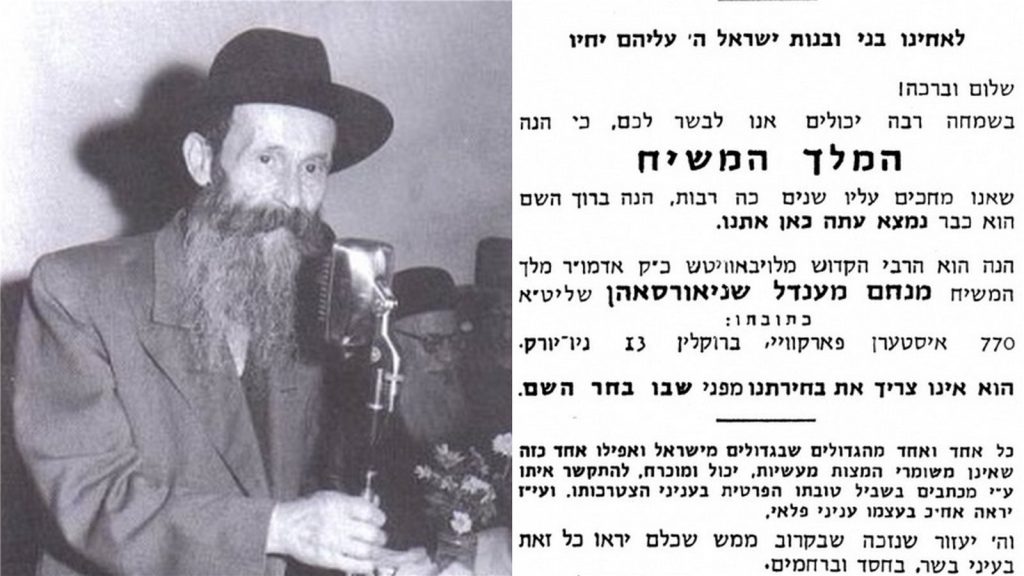
What then was the monthly’s purpose? The answer was somewhat surprising: The editor admitted he did not know what content would appear in the bulletin or what its ultimate purpose was. Nor did he need to know. The messages meant to appear in this bulletin would be determined solely by the Rebbe.
Since the world’s situation was turbulent, with a terrible world war raging and everyone groping in darkness – no one knowing what tomorrow would bring or the true meaning of events – there was a need to broadcast the one clear and confident voice: the Lubavitcher Rebbe’s voice. This entire bulletin with all its sections served no purpose other than to function as a “mouthpiece” at the Rebbe’s service.
One brief, pointed summary sentence concluded, using the phrases from the morning prayers mah anu, meh chayeinu:
“What are we? – Imbued with emunas tzaddikim, faith in the righteous. What is our life – why did we establish this monthly? We will know this very soon when the Rebbe illuminates the present and the future ‘from the counsel of the wise and understanding and teaching knowledge to those who understand!’”
Mission Accomplished?
A year later, in a “summary article,” the editors reflected: “Our purpose was therefore to create a platform where the voice of the Rebbe of Lubavitch would be heard, and our purpose was achieved in a surprising way – since the voice the Rebbe wanted heard is that of a herald and announcer, proclaiming that we are truly in the days of redemption. Because of this, he did not cease arousing the Jewish world to teshuva in order to ease the birth pangs of Moshiach and to merit immediate redemption.”
Chapter 4: The Rebbe Rayatz’s “Columns”
As promised by its anonymous editor, the primary purpose of HaKriah V’HaKedusha was to serve as a mouthpiece for the Rebbe. It is therefore fitting that we first describe the journal’s sections that brought the Rebbe’s words directly.
The most significant sections of the journal were those that the Rebbe Rayatz himself penned and published under his own holy name. Two categories of content stood out as particularly crucial to the publication’s mission.
The “Kol Koreis”

The Kol Koreis (=public proclamations) were the public announcements about Moshiach that appeared simultaneously in HaKriah V’HaKedusha as well as other major newspapers like the Yiddish-language daily “Morgen Journal.” These proclamations, with their urgent call of “immediately to repentance, immediately to redemption,” were distributed not only throughout America but also sent abroad to Jewish communities worldwide. They too deserve a specialy dedicated article which will follow b’ezras Hashem.
These public calls represented the Rebbe Rayatz’s most direct and unfiltered message to the Jewish people. Writing in his own name, he declared that the catastrophe engulfing European Jewry constituted the “birth pangs of Moshiach” – the final suffering before redemption. Through these proclamations, he urged immediate, universal repentance as the key to ending the Holocaust and bringing about the complete redemption.
“Disclaimer – The Rebbe Doesn’t Approve The Editor’s Responses”
In the issue of Elul 5701 (1941), an article was published under the title “Responses to Critics in The Press.” In the subtitle it was written that at the request of many readers, the editorial responds to articles in various newspapers about the Kol Korei of the Rebbe Rayatz. In addition, a clarification appears that the editorial board of HaKriah V’HaKedusha alone is responsible for the responses and the Rebbe has no connection to them.
The writer sharply attacks those who do not believe in the Rebbe’s message of Geula and states unequivocally that they do not believe in Geula at all! So he writes to one of the writers:
“You write: ‘as a misnaged, and a Vilna misnaged at that, a Rebbe of Chassidim has no importance in my eyes.’ But from the continuation of your words it emerges that even the words of the early prophets have no importance in your eyes… and you believe only in Karl Marx and Kropotkin [ideologues of the communist idea] and others.”
“The Moshiach of the Lubavitchers”
To another writer who wrote that “even if Moshiach comes tomorrow as the Rebbe says, he will be the Moshiach of the Lubavitchers and not of all Israel, and he will not be the leader of all the Jews. Because Jews need a different type of leaders, physical leaders belonging to this world, whose way is not the way of miracles and angels, but the way of simple mortals like us,” the editor responds with a reminder about what happened to their predecessors in the past – Korach, Doson and Aviram.
The Yiddish Maamarim
First and foremost were the maamarim (=Chassidic discourses) written in Yiddish, distinguished by their unique literary style. They appeared under the title Yelamdenu Rabbeinu—Our Rebbe Shall Teach Us. These pieces were crafted with particular care to reach the broadest possible Jewish readership. (In the first few issues, the maamarim appeared in Hebrew, but they soon changed to Yiddish, already in the middle of 5701 [1941].)
The Rebbe wrote in a deliberately accessible, down-to-earth (“balabatish”) style that didn’t require extensive prior Talmudic or Chassidic knowledge. Unlike the often-esoteric nature of traditional Chassidic literature, these maamarim were designed for a crowd that reads newspapers – ordinary Jews who might pick up a publication at their local newsstand or receive it in the mail. Their length was also significantly shorter than standard maamarim.
This “populist” approach represented a calculated editorial decision. The Rebbe Rayatz understood that his message of imminent redemption needed to reach beyond the insular world of committed Chassidim. The Holocaust had created an unprecedented crisis that demanded an unprecedented response – one that could penetrate the consciousness of every Jew, regardless of their level of religious observance or learning in Chassidus.
Many of these maamarim spoke about current topics and about faith in Moshiach in general, and particularly about accepting the announcement of the Geula from the true Jewish leaders of the generation (see, for example, the maamar V’kibel HaYehudim).
The Rebbe noted on several occasions that the practice of the Rebbe Rayatz of publishing Chassidus in foreign languages, especially Yiddish, was a crucial step in preparing the world for Moshiach.
The maamarim were subsequently published in book form as “Sefer Hamaamarim—Yiddish” in 5706 (1946) and decades later translated into English in two volumes under the title “Chassidic Discourses.”
Chabad History
The Rebbe noted at the farbrengen of Parshas Pinchas 5745 (1985):
“Several of the sons of the Tzemach Tzedek acted as Rebbes and were described by the title ‘Admor’. This is how they were referred to by my father-in-law the Rebbe in HaKriah V’HaKedusha.
“[In general,] whatever was printed in HaKriah V’HaKedusha, for the most part, was edited by the Rebbe. On occasion, he instructed to add some things and sometimes did so himself in his holy handwriting. Matters related to the history of the Chabad Rebbes were written by him in the first place.” (Hisvaaduyos p. 2640)
Chapter 5: The Rebbe Rayatz’s Involvement in the Publication
As described above, the Rebbe’s involvement in this journal extended to the smallest details, and he took care of its distribution throughout the Jewish diaspora, investigating and taking interest in how it was received by the public.
This can be seen, among other things, from a letter the Rebbe writes to the newspaper’s editor:
“I am sending herewith 1) a letter from an acquaintance with some comments. 2) an article from Rabbi… and I want to know your opinion about it. It didn’t make the proper impression on me. It has material worthy of building, but as it is now, besides the lengthiness and repetition, the content is also disorganized. We need to think about the material for the Kislev issue, because it’s necessary that the monthly appear before Rosh Chodesh, and reach its readers at the beginning of the month.”
In the Rebbe Rayatz’s letters there are many expressions about the publication’s virtues:
“The journal HaKriah V’HaKedusha is very important; it deals with very important questions, and is reading material of the best religious logical articles… I believe… it would surely be very necessary for them to read the journal; it will bring them a certain refreshment in their souls…” (Igros Kodesh Vol. 5, p. 342).
“It contains within it the essential materials needed by every Torah student in general, like air for breathing” (ibid p. 215).
“I was very pleased with the great awakening and pleasant impression it made on the young people… the monthly HaKriah V’HaKedusha awakens and encourages all the living in Israel to pay attention to the Torah and mitzvos which were and are the pride of Yaakov…” (ibid p. 376).
“HaKriah V’HaKedusha is a complete book and not a temporary newspaper whose matters become outdated when time passes” (ibid p. 402).
On a certain occasion, the Rebbe told Rabbi Avrohom Pariz, who worked with the Rebbe on publishing the issues of “HaKriah V’HaKedusha”: “If we succeeded in ‘scraping’ the ‘world’ – in the sense of ‘concealment and hiddenness’ – with these booklets – then we succeeded in our goal. But if this didn’t ‘move’ anyone – then we lost the battle from the start.”
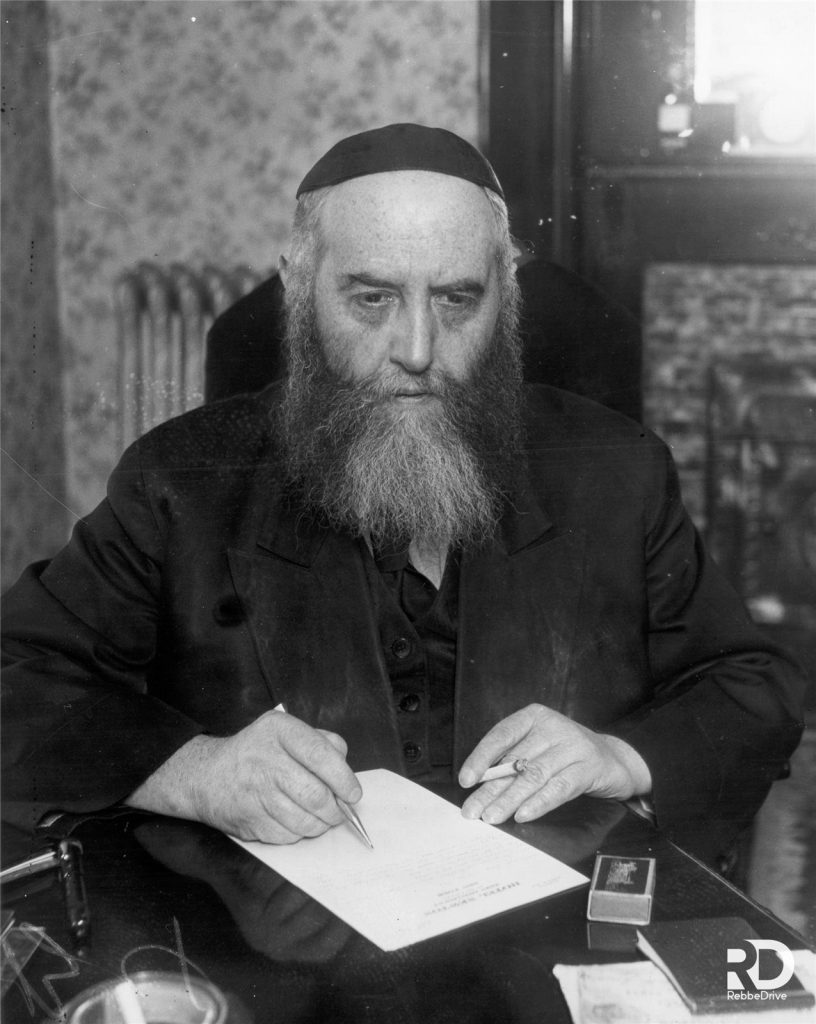
The Rebbe unceasingly spurred, encouraged, and aroused the Chassidim to distribute the monthly everywhere possible. Thus he writes:
“Regarding the distribution of HaKriah V’HaKedusha... one must make an effort in this, both oneself and to ask one’s children to help with this, and through our friends the Chassidim and those who fear G-d’s word, that each and every one should try to distribute among his acquaintances and friends.”
“We need to publicize it as much as possible, and this is for the benefit of the many.” “It’s necessary to make an effort to distribute HaKriah V’HaKedusha in our camp, that is, to obtain subscribers who will sign up for it and pay the price set for it, and perhaps a decent person will be found for this who will engage in this.” “We need to publicize it to the public to increase the number of its readers.”
“Want To Be Mekushar? Learn Chitas And Read HaKriah V’HaKedusha!”
Furthermore, the Rebbe writes that reading and distributing these monthlies is the way to connect to him.
To a group of students the Rebbe writes:
“You bless the Almighty for your connection to me; it’s pleasant for me to hear such things, but you must consider whether it is indeed so that you are connected to me or if it’s just imagination or an empty phrase, because necessarily the connection must bring about, with G-d’s help, practical action, and what is the practical action that your connection brought about? Don’t you know what I demand…?” And among the things the Rebbe lists, he writes “the distribution of HaKriah .”
More explicitly the Rebbe writes: “In response to his letter that he wants to be a member of my shul, besides the payment of the annual membership fee as the president of the synagogue will write to him, every member is requested to observe the regulations: a) To learn every day Chumash with Rashi from the weekly Torah portion. b) To observe the takana of reciting Tehillim… c) To read the sichos and the monthly HaKriah V’HaKedushah.”
Chapter 6: The Primary Theme
Even before the Kol Korei proclamations appeared, their content already appeared in HaKriah V’HaKedusha. The essence running like a thread through all the articles was: We are now in fateful times. We will not be saved by “false prophets” – socialism, democracy, Zionism, etc., nor do we depend on British victory over the Germans. The troubles we currently experience are “birth pangs of Moshiach,” and we must do teshuva to merit complete redemption.

This idea appeared frequently in the newspaper even before the first Kol Korei, and increased sevenfold after their publication. Following the publication of the first and second Kol Korei, the editorial board reprinted two articles under the title “Finally the voice is heard” which had previously appeared in the monthly, particularly emphasizing that we must recognize this time as the era of birth pangs of Moshiach.
Regular Sections and Features:
From the Torah, Prophets and Writings – By “Ish Yehudi”
In this section, the writer examined current events through the lens of prophecies and occurrences from the Torah, Prophets and Writings. The conclusion was almost always identical: the troubles the Jewish people currently experience are birth pangs of Moshiach, and we must do complete teshuva to merit complete redemption. We must not believe the false prophets and messiahs promising great and wondrous things – namely democracy, socialism and Zionism – because the only way out of these troubles is the coming of Moshiach Tzidkeinu.
Under the heading “Get to Know the Moshiach,” the writer sharply attacks the opinion that the days of Moshiach symbolize a lofty ideal or anticipated period, omitting the main emphasis on Moshiach’s persona as a man of flesh and blood:
“Many Jews who consider themselves believers and pray daily in synagogue somehow think that Israel’s redemption will come through a universal ideal rather than through a single redeemer… Nothing is further from the truth than this idea.”
After a description of Moshiach “from the Torah, Prophets and Writings,” the columnist has this piece of information to say which is surprisingly relevant today as it was then, and is reminiscent of the Rebbe’s way of presenting the laws of Moshiach:
“The Rambam, who summarized all the deliberations in the Gemara into halacha, obviously had nothing to say about a case where Moshiach would be revealed in the manner of ‘If they merit’ – then everyone would recognize him immediately without any doubt. But what would they do in the case of ‘if they do not merit’ – how would they then recognize his greatness? For this purpose, the Rambam writes in the Laws of Kings the following law: ‘And if a king arises from the house of David…’
May it be His will that we merit to see with our own eyes our righteous Moshiach and the miracles and wonders, and we shall wish each other ‘L’alter L’Geula (=immediately to redemption)!’”
Holy Satire – Ben Yisrael’s Sections
Every good newspaper has a satirical column and HaKriah V’HaKedusha was no exception, except that the times were not at all a time for fun. The satire was more irony and witty biting cynicism and wordplay directed against those who challenged or doubted the call of the hour, namely to be prepared for the Geula, whether on “secular” grounds or otherwise.
He would often mock the “false prophets” who hung the Jewish people’s future on British victory, democracy, or Zionism, etc., while strengthening the firm declaration that only through repentance will we be saved by our righteous Moshiach.
Unlike most other sections and columns, Ben Yisrael wrote in Hebrew.
During the first three years, his section appeared regularly under the title “Sichos Chulin B’Tahara—Casual conversation in purity.” The style was uniform: first he would present the prevailing street opinion on any given topic, generally political developments affecting the war, then write “and I, the humble one, say – not necessarily!” continuing “not necessarily this, and not necessarily that.” He would conclude “as it is said:” bringing a verse connected to the matter.
For example, after the first Kol Korei was published Ben Yisrael wrote in bitter irony:
“The Rebbe of Lubavitch’s declaration through a Kol Korei in the press that we stand at the appointed end time did not make a deep general impression on our brothers’ hearts. On the contrary, many say there is no substance to the matter, that many have already proclaimed this in earlier generations and were wrong; the Rebbe too is mistaken in his dream like them!”
“It’s a pity,” he continues, “that the Rebbe does everything on his own opinion and consults with no one, not even with the writer of these lines. Had he asked my advice, I would have advised him to announce British victory, Hitler’s downfall, establishment of the kingdom of Israel in partnership with the Arabs in the Land of Israel, and democracy’s victory throughout the world – all this ‘now, speedily and in the near future,’ and the entire congregation would have answered: ‘Amen and Amen!’…
“However, the Rebbe announced what he announced, but I, the small one, say – not necessarily!
“Not necessarily that American Jews are waiting for the coming of Moshiach, and not necessarily that they need to be told about his coming soon! Of the entire concept of Moshiach, all that remains for our brothers in this country is the ‘I believe’ that one should not believe any person who announces the coming of the Moshiach!…
“My opinion was from the outset that the Rebbe should not have [announced] about the appointed time of the end, but now that he has announced it, I, the humble one, say: Know, gentlemen, that Moshiach will certainly be revealed soon as promised by the Rebbe, and there is no doubt about his holy words at all…
“The bottom line: the voice is heard! [this too is a play on the words of the verse which means “everything is heard”—Ed.] The voice of the herald of the coming of our righteous Moshiach soon was heard through the man who labored with wisdom and knowledge and talent… and it is no wonder that we are divided into these two camps – those who want life and an end to all our troubles in exile, and those who choose death, God forbid, and no end to the exile of the people of Israel.”
And here, Ben Yisrael presents a play on the words of the prayer U’nesaneh Tokef:
“It is said: מי יחי’ ומי ימות – ‘Who will live and who will die?’ This is a question and its answer follows right after: מי בקצו ומי לא בקצו – ‘Who holds of the “ketz” and who does not’…”
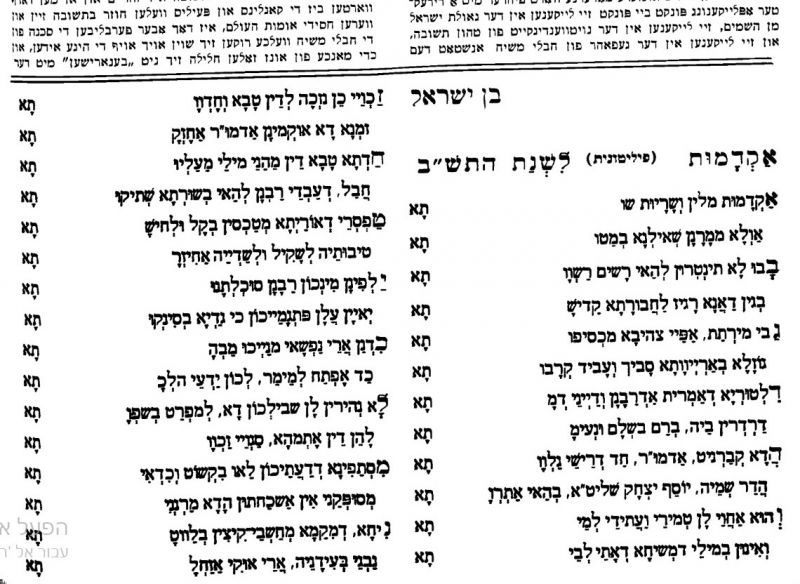
Akdamus
A unique piece by Ben Yisrael that appeared in the Sivan 5702 (1942) issue was a “parody” on the Akdamus that many communities recite on Shavot. Ben Yisrael fashioned a long lyrical ballad in Aramaic mimicking the Akdamus, in which he calls rabbis and Jewish leaders to join the Rebbe in his call for Jews to prepare themselves for the arrival of Moshiach (see facsimile).
Who Was Ben Yisrael?
Here is the place to address a strange rumor claiming that this “Ben Yisrael” is none other than the Rebbe himself. This is refuted for several reasons:
a) Anyone familiar with the Rebbe’s style would immediately see that the style does not match the Rebbe’s style.
b) The writer holds extreme positions regarding Jews who have distanced themselves from Torah and mitzvos, opinions which mostly do not align with what we know of the Rebbe’s opinion that every Jew should be brought close.
c) Most importantly, it is very difficult to believe that among all the upheavals the Rebbe went through at that time in burning Europe, for the duration of three quarters of the journal’s first year of operation, he wrote these articles.
In addition to the regular articles and sections, articles, columns and meditations on various topics were added from time to time. Occasionally, news about what was happening in Chabad communities around the world was also published. However, even these sections and articles were not lacking the redemptive spirit that pervaded the entire bulletin.
Chapter 7: “D-Day: We Knew It All Along!”
The Encrypted Prophecies
“WE KNEW IT ALL ALONG!” read the headline of the Tammuz 5704 (1944) issue. What did we know and how?
The answer to this is perhaps the most fascinating and intriguing part of HaKriah V’HaKedush – the encrypted prophetic messages that appeared in two special sections:
Flying Letters – Small poems in rhymes whose content was deeply encrypted. Only once was a song published unencrypted, with the editorial noting that all other segments were “written in riddles that cannot be solved in any way in the world, and only when the key is revealed… will the lock open.”
Reversed Lines – Sequences of meaningless letters which, when deciphered through their acronyms, revealed future events.
The Normandy Nevuah
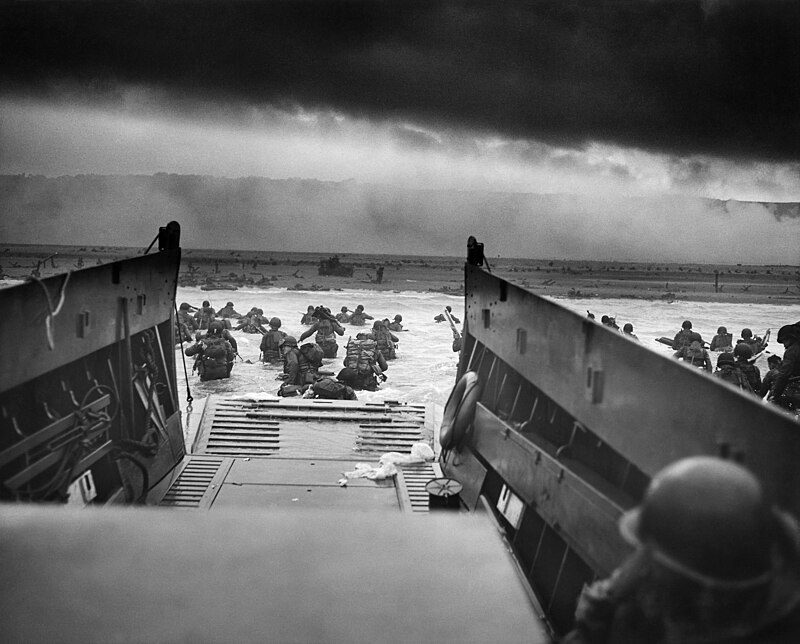
What the readers (and to be more exact, the editor…) of HaKriah V’HaKedusha knew all along was about what later came to be known as D-Day – the Normandy invasion in which Allied forces (USA, Britain, Canada and Free France) invaded Nazi-occupied France, was a complete surprise. The Nazis expected a major attack at any time and moment, but in a completely different area. The Allies surprised them from an unexpected location – the Normandy coast. First, many paratroopers were landed behind enemy lines, and in the next stage, tens of thousands of soldiers were landed from ships on the French coast, in an operation remembered as the greatest landing in history. Many thousands were indeed killed, but this attack constituted a first and important step in tipping the scales against the Nazis.
The attack began on the 15th of Sivan 5704 (June 6, 1944), and the Tammuz issue headline was referring to the hints that were published previously that prophesied that during this period the attack would begin.
Three years earlier, in Sivan 5701 (1941), within the “Flying Letters” section, the shocking prophecy appeared. The prophecy was published in a line of Hebrew words that appeared meaningless on the surface. In Shevat 5704 (1944), the prophecy was published again, this time encrypted in acronyms. The editor of HaKriah V’HaKedusha decoded the acronyms in the Tammuz 5704 issue, revealing an amazing prophecy describing the time when the final decision about the great invasion was made (while leaving the cipher key of the letters themselves as a riddle). Only in some of the “Flying Letters” sections was a hint given at the beginning on how to decode them.
The editor decoded the Yiddish acronyms, revealing an amazing prophecy:
“World revolutions will begin soon, and many! But the announcement of their opening will be around Passover eve, this year. Actually, it will be on the thirteenth of Nissan: ‘The invasion is about to be carried out! It is waiting at the front!’ This will surely be the ‘for the day of vengeance is in My heart and the year of My redeemed has come!’ Our democracy (the Allies) will then begin to reveal half the secret of the invasion it is planning, even if it’s on a small scale and very unclear!”
The invasion was indeed announced on the 13th of Sivan 5704, exactly as predicted.
Big & Small Letters
Another interesting thing is that in many of the dates on the journal cover, some of the letters are enlarged, and at a superficial glance there seems to be no logic, gematria or the like. Is there also a hidden intention here?
In any case, it seems that we will know the solutions to these riddles only with the revelation of the Rebbe very soon!
“A Rebbe Isn’t a Fortune Teller!”
And we will end this chapter with the words of the Rebbe in Shabbat Parshas Pinchas 5710 (1950): “Once someone asked about the fact that in HaKriah V’HaKedusha the Rebbe wrote revealed future events – why did he write in hint and not openly, and why after a period of time did he stop saying future events. The explanation is: If the Rebbe’s desire was to become famous as a ‘fortune teller,’ he would have done so, but this is not his point – it was once said that with Chassidim it does not matter at all if the Rebbe knows future events, and not because of such matters is the connection to the Rebbe made. The main thing is that he is the Rebbe – and therefore, he did not reveal future events simply, since ‘in all my house he is faithful,’ but rather, to a certain extent as needed for the matter of L’alter L’Geula [to encourage people to prepare for Moshiach through teshuva].”
Perhaps what the Rebbe means here is something along the lines of the following:
In the book of Yechezkel (Chapter 29, read as the Haftorah of Parshas Vaeira), we find a lengthy prophecy describing the downfall of Egypt as a punishment for being an unreliable ally to the Jewish people.
The prophecy ends with the following words: “On that day [when this prophecy will be fulfilled] I will give you free speech in their midst, and they shall know that I am the L-rd.” (verse 21) Rashi explains that “free speech” means that Yechezkel’s words will be accepted by those who still doubted him.
In a sicha that was published for Parshas Vaeira 5751 (January 1991) during the very weeks of the Persian Gulf War when Iraqi SCUDs were falling on Israel’s cities, the Rebbe points out that “Yechezkel at the time was an ‘established’ prophet who most Jews believed.”
“Yet, Hashem makes it a point to notify us that this whole great war between Babylon and Egypt that involved thousands of soldiers was mainly to convince a few Jews who still doubted Yechezkel that he is a true prophet, so they will accept his future messages of comfort!”
The Rebbe was saying almost explicitly that the whole Persian Gulf war was orchestrated by Hashem for the sake of the Jewish people, particularly so they can hear the Rebbe’s prophetic voice assuring them that Eretz Yisrael is the safest place in the world; see that the prophecy came true and thus take seriously the Rebbe’s following prophetic messages about Moshiach and our role in the process. (See Likkutei Sichos vol. 36 p. 33-37)
Chapter 8: The Lasting Legacy
The final issue was published before Elul 5705 (1945). The reason for its cessation was never explicitly stated. However, in 5715 (1955), the Rebbe wrote in response to a question: “Regarding your inquiry about continuing the publication of HaKriah V’HaKedusha, surely you know that together with the end of World War II, my father-in-law the Rebbe also ceased the monthly’s publication.” The reason, however, is not given.
What is clear, is that HaKriah V’HaKedusha and its messianic message were seen by the Rebbe as something still current and relevant decades after the publication stopped.
On 24 Teves 5752 (1992) the Rebbe said:
The imminence of the Redemption was, however, explained by the Rebbe [Rayatz] in three public notices printed in one of the newspapers of that time, HaKriah V’HaKedusha, and he directed that these public notices be publicized to many people specifically through a printed newspaper. Print, in general, is something eternal that lasts for generations, and a newspaper is [printed material] associated with a specific time.
Significantly, the name HaKriah V’HaKedusha was also chosen by the Rebbe. HaKriah means “the call,” i.e., the material printed in HaKriah V’HaKedusha represents a vibrant “call” to every Jew of this generation to increase holiness, and to make this holiness live and vibrant (“A living holiness”). And indeed, in many instances, through the study of the concepts printed in HaKriah V’HaKedusha, an increase in holiness was brought about.
In the talk of Parshas Pinchas 5744 (1984) the Rebbe addressed this matter rather sharply:
[…] Because a person is so permeated with the feeling of exile – he cannot feel the Geula, and to such an extent that when others speak to him about Geula – the matter appears to him as a fantasy.
However, the opposite is true: The “dream” is – not the talk about Geula, but on the contrary: the reality of exile is a “dream,” for what does a Jew have to do with the matter of exile! While Geula is – awakening, this is the true reality of a Jew!
…Especially after the Nasi HaDor proclaimed “L’alter L’Geula” and announced that the situation is that “behold, he stands behind our wall,” Moshiach Tzidkeinu stands behind our wall. …[But] there are those who claim that from this very point there is cause to question: The proclamation of Nesi Doreinu of “L’alter L’Geula,” “behold he stands behind our wall,” was decades ago, and nevertheless, he still has not come! And also Eliyahu HaNavi has still not come to announce the Geula!
This very question itself comes from the fact that they are permeated with the feeling of exile… and therefore cannot free themselves from the “dream” of exile, and feel that the true reality in awakening is – actual Geula in practice. (Hisvaaduyos 5744, Vol. 4, p. 2210)
This message resonates deeply with our situation, over three decades since the Rebbe’s announcement of the Geula, an announcement that for the Rebbe was an extension of the Rebbe Rayatz’s announcement of the Geula, only that at this stage, after all the work was completed in all its smallest details, the ideas and concepts of Geula penetrated the world’s reality in an irreversible way.
On Purim 5747 (1987), the Rebbe returned to this subject once more and drew the practical applications:
In spite of the fact that the world has undergone such change, nevertheless Moshiach still has not come. In the times of the Gemara our Sages already said, ‘All the appointed times have passed’… But a new era began when the Rebbe [Rayatz] proclaimed, ‘L’alter l’teshuva, L’alter L’Geula’ (‘Do teshuva now and Moshiach will come now!’). He had it printed and publicized, and in spite of bitter opposition, had it continually repeated.
It is decades after these proclamations, and nevertheless, Moshiach still has not come. I have searched and searched for an explanation for this, and the only answer I’ve found is the following. In earlier generations, since ‘the leader is everything’ it was possible to rely on the leader’s efforts. However, after so long, when even the Rebbe [Rayatz]’s proclamation has passed and Moshiach still hasn’t come, the only possibility is that every single Jew must be involved in bringing the redemption.
This is why now is the time to stress the ruling of the Rambam mentioned above – that even one action, etc. of a single Jew can bring the redemption. Since so much time has passed, and the world situation has even changed for the better (as mentioned above) and Moshiach still has not come, the only thing which could be missing is that every Jew feel that bringing Moshiach is his personal responsibility.
***
May this reading about HaKriah V’HaKedusha indeed bring holiness and encouragement to each of us to see to it that we take the message of this holy and special publication to heart and take an even more active role in ushering in the Geula into the world, or to use the phrase the Rebbe Rayatz coined (later to be re-coined by the Rebbe as “We Want Moshiach Now!”) – L’alter L’Geula!
This overview was prepared based on a Hebrew Review published by ATO for Tishrei 5776 as well s material from Chabad Pedia and historical articles by Schneur Berger from Beis Moshiach
HaTomim #17 • pp. 36-53
© 2026 Beis Moshiach Magazine. All rights reserved.
This article originally appeared in Beis Moshiach #1477. You are welcome to share it with friends and family by email or in print, provided that you do not change, add to or omit any part of it, you credit the author and Beis Moshiach, and you include a link to archive.bmoshiach.org (written out in full in printed copies).
To republish this article in a newspaper, magazine, book or website, please request permission in advance at [email protected].