Seventy Shades of Submission:
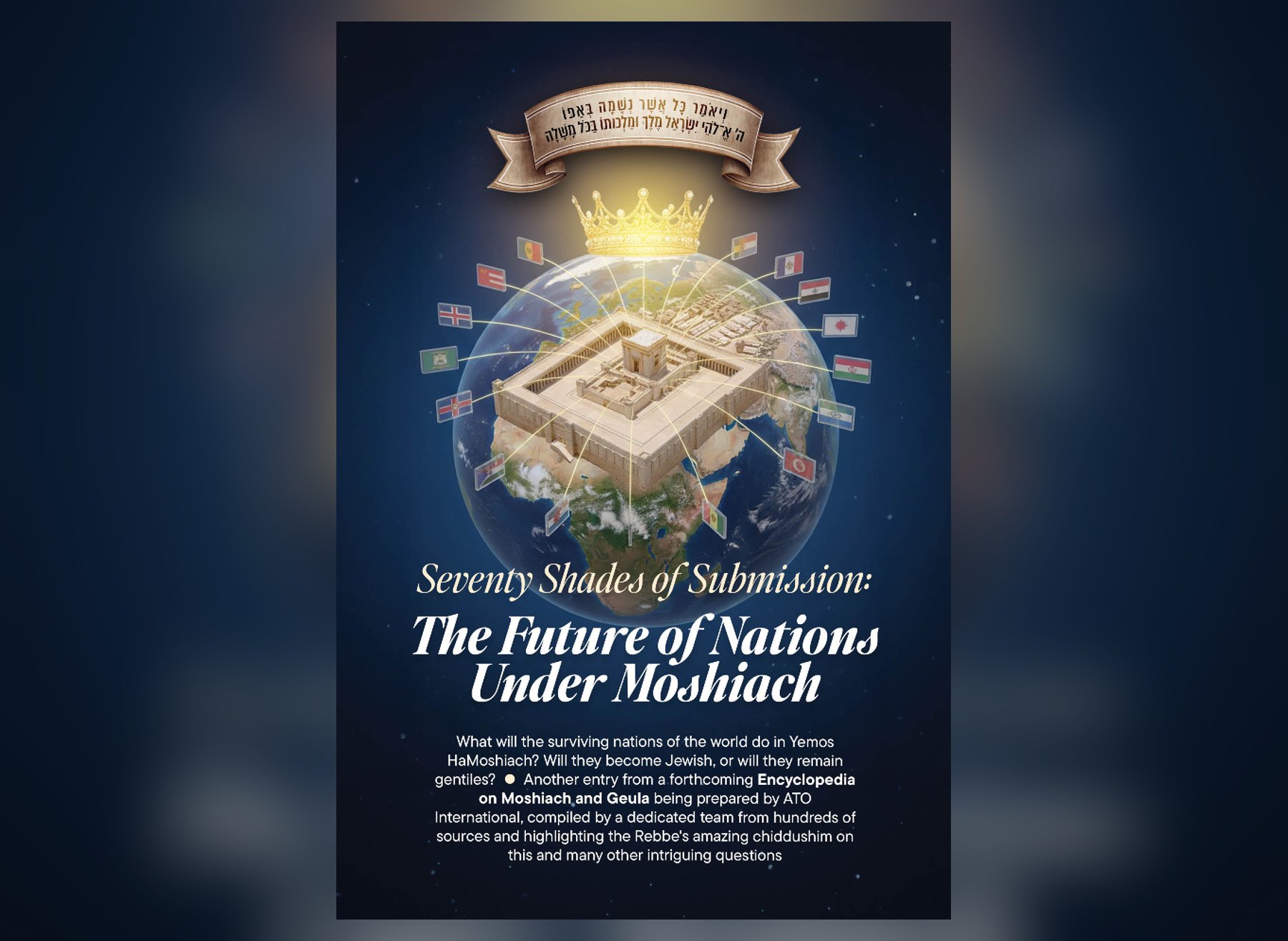
What will the surviving nations of the world do in Yemos HaMoshiach? Will they become Jewish, or will they remain gentiles? Another entry from a forthcoming Encyclopedia on Moshiach and Geula being prepared by ATO International, compiled by a dedicated team from hundreds of sources and highlighting the Rebbe’s amazing chiddushim on this and many other intriguing questions.
אומות העולם לעתיד לבוא The Nations of the World at the Geula
The nations of the world will be redeemed and refined in the future-to-come, but for the sake of the Jewish people – who are the ultimate purpose of creation; and the nations of the world will be their servants.
Contents:
Which Gentiles Will Survive?
The Nature of Their Existence.
Their Tikkun (Rectification).
As Servants of Am Yisrael.
The Divine Revelation to Them.
Will They Convert to Judaism?
Changes in their Lives
Their Observance of Mitzvos.
Will they Resurrect?
Preparation for this During Galus.
The Beginning of the Promises About Them Being Fulfilled Now.
Note: Chapters A-D of the entry were published in the previous issue
E. The Divine Revelation to Them
(a) The nations of the world will merit the increase of the Divine light that will be revealed to the Jewish people in the future-to-come, which will illuminate their spiritual darkness as well, albeit on a lower level.¹
(b) There will shine among them only a revelation from the Seder Hishtalshelus (=Divine emanation), and not like the Jewish people who will have shine within them a revelation that is above the Seder Hishtalshelus².
F. Changes in Their Lives
(1) Appearance: The physical form of the nations of the world will be like animals³.
(b) Eternal Life: There is a Talmudic debate whether in the future-to-come the nations will live eternal life (like the Jewish people) or not:
Rabi Chanina⁴, Rabi Yochanan⁵ and Ula maintain that they will die in the natural way as it is written⁶ “and the youth of a hundred years will die”⁷.
Rabi Yehoshua ben Levi disagrees and maintains that even regarding them there will be no concept of death at all, as it is written⁸ “and Hashem will wipe away tears from all faces”⁹.
The Rebbe Melech HaMoshiach explains that the nations of the world will also live eternal life in the future-to-come, but that the intention of the Rabi Chanina and his contemporaries is not that they will actually die, but that they will descend from their level and this matter is considered like death. ¹⁰.
(c) Language: It is stated¹¹ “Then I will turn to the peoples a pure language.” There are two ways to understand the meaning of the passuk:
1) They will speak only in Lashon HaKodesh (=the holy tongue) (as it was before the Dor Hapalaga, generation of the dispersion)¹². Sources in Chassidus seems to accept this position¹³.
2) That they will not call upon other gods but only in Hashem’s name alone¹⁴, but in their own language¹⁵.
The Rebbe MH’M explains that the dispute stems from two approaches in understanding their birur (=refinement); whether the service in kedusha itself draws to it the Divine sparks hidden in the world, or that we use the world and its garments themselves for kedusha. He explains that the world will be refined in its own right, and therefore they will use their languages for kedusha¹⁶.
G. Their Conversion
(a) After the nations of the world will recognize Hashem’s full reign of the world in the future-to-come, they will want to convert and become Jews.
Regarding their acceptance as converts¹⁷ Chazal say¹⁸ that we will not accept converts in the days of Moshiach (since all their desire to convert is not genuine and stems from them observing the Jewish people’s superiority in the world¹⁹).
Some explain that after great examination and clarification of their intentions, batei din of laymen who see that their intention is truly to fulfill Torah and mitzvos will accept converts (similar to the times of Dovid and Shlomo)²⁰, and that eventually all of them are destined to repent from idolatry and convert²¹.
According to the Rambam’s approach²² the nations of the world will not convert²³. Similarly, in Chassidus it is brought that they will not be able to convert in the future-to-come²⁴.
(b) Some maintain that since it is a gezeiras ha’kasuv, a scriptural decree, that they will not accept converts from the nations in the future-to-come, it does not help that their intentions are for the sake of Heaven²⁵ and we still won’t accept converts.
Furthermore, they will not accept them as a rectification for the ‘erev rav’ (mixed multitude) that Moshe accepted in Egypt and ultimately the Jews stumbled through them²⁶.
Chassidus explains that conversion is a matter of birur (=refinement) of sparks, and since we will no longer need to refine sparks, we will not accept converts²⁷.
The Zohar explains that they will not accept them because in the future-to-come only good will rule and it will not be possible to accept evil – the nations of the world²⁸.
(c) Ger Toshav: While we won’t accept converts to be part of the Jewish people, all of them will be in the status of a ger toshav (=resident alien), and will observe the seven mitzvos of the Bnei Noach with all their details and intricacies²⁹.
H. Their Observance of Torah and Mitzvos
(a) Voluntary Observance: It is written that in the future-to-come, all the nations will “serve Him in unison.” The Gemara deduces from this that even though they will not accept them as converts, they will behave like the Jewish people and will take upon themselves to observe all the mitzvos³⁰ exactly like the Jewish people³¹. In the Yerushalmi, Rabi Chiya expounded in the name of Rabi Hoshaya likewise, and that in the end they will regret this³².
Rav Hoshaya there expounded that they will accept upon themselves thirty mitzvos.
The Alter Rebbe writes that they will fulfill all the mitzvos that women are obligated in³³.
(b) Aliya L’Regel: They will be required to make pilgrimage to celebrate the festival of Sukkos; “from all the nations coming upon Yerushalayim and they shall go up year by year to bow down to the King, G-d of hosts, and to celebrate the festival of Sukkos”³⁴.
(c) Other Mitzvos; In the Medrash it states that they will be obligated in several additional mitzvos like sukka and lulav³⁵. And in other sources that approximately six additional mitzvos will be added to them beyond the seven they already have, like sukka, lulav and tefillin³⁶.
I. Their Resurrection
(a) Some learn³⁷ that the Tannaim are in dispute whether the nations of the world will rise in Techiyas Ha’meisim, the Resurrection of the Dead³⁸:
Rabi Yehoshua maintains that gentiles who are righteous will merit the World to Come as it is written³⁹ “The wicked shall return to Sheol, all nations that forgot G-d”⁴⁰, while Rabi Eliezer disagrees with him and maintains that all the gentiles will not rise in resurrection. Other authorities explain this debate otherwise and hold that this is not the topic of Rabi Eliezer and Rabi Yehoshua’s debate.
(b) Opinions that they will not rise: Chazal say that “great is the day of rains more than the day of Resurrection of the Dead,” since rains benefit the entire world, as opposed to resurrection of the dead which is only for the Jewish people⁴¹.
Commentators⁴² understand the passuk⁴³ “He will call to the heavens above and to the earth to judge His people” thus: “to the heavens” – is the neshama, “and to the earth” – is the body, “to judge His people” – that only for His people will Hashem carry out judgment and raise them to life, and not the other nations⁴⁴.
Similarly, it is written⁴⁵ “The dead will not live, the refaim (spirits) will not rise”, which means that the gentiles who are called ‘dead’ already in their lifetime will not rise in resurrection⁴⁶. Another passuk says, “And many of those who sleep in the dust of the earth will awake”⁴⁷,; it it does not say that all will rise, but rather ‘many’ and its intention is to the Jewish people alone⁴⁸.
Reasons why they will not rise:
1) The purpose of the resurrection is that there should be resurrection of the Jewish nation, and therefore it is intended for our nation alone⁴⁹.
2) HaKadosh Boruch Hu is considered (so to speak) like a kohen, and it is forbidden for a kohen to become impure through the dead except for his children. Therefore, He can raise to life only His children – the Jewish people⁵⁰.
3) At the resurrection, the body is “built up” from the luz bone which does not decay, and this bone is found only in the bodies of the Jewish people. Therefore, the nations of the world cannot rise⁵¹.
(c) Opinions that they will rise: Some authorities say that the nations of the world will rise in resurrection⁵², and not necessarily only their righteous ones but all of them. A proof for this is what the Mishna says of certain gentile generations and groups that they will not resurrect, like the generation of the Mabul (=the flood), Dor Hapalaga (=the dispersion after the attempt of the tower of Bavel), and the people of Sodom, which leads to the understanding that otherwise, gentile nations will resurrect. ⁵³
Likewise, some have written that from the fact that Bilaam has no portion in the world-to-come we learn that the other nations do have, and they will rise in resurrection⁵⁶.
(d) Purpose: The purpose of the rising of the nations is so that when the nobles of each nation and their wise men rise they will accept faith in Hashem and publicize Him⁵⁸.
(e) Individual Gentiles: The Gemara says that Adam, Sheis and Mesushelach (who are not from the Jewish people) are among the seven shepherds destined to rise in the Resurrection of the Dead⁵⁴.
Sancheriv and his soldiers will rise because the evil sparks were taken from them before, and there remained in them holy sparks that will return to good⁵⁵.
(f) Reconciliation: Some have written to reconcile this dispute that their rising will be in the third Resurrection of the Dead – after the resurrection of the Jewish people. The time of this resurrection is the end of the 5th millennium and seven hundred and sixty years from creation.⁵⁷
J. The Preparation in Galus
The birur in the future-to-come will be through the nullification of the nations to the Jewish people during galus (=exile), as it is stated regarding Esav “and your brother you shall serve”⁵⁹.
Several particulars have been pointed out:
(a) Translation and making Torah accessible – so that the nations of the world can learn the matters of Torah that pertain to them, and especially teachings of Chassidus from which they can learn about faith in Hashem, which they are obligated in, constitutes preparation for fulfillment of the promise⁶⁰ “Then I will turn to the peoples a pure language to call all of them in Hashem’s name and to serve Him in unison”⁶¹.
(b) Acceptance of the seven mitzvos of the Bnei Noach were commanded by the nations of the world constitutes preparation and paving the way for fulfillment of the mentioned promise (and therefore there is an obligation on each one from the Jewish people to compel all who come to the world)⁶².
(c) Fulfillment of the mitzva of circumcision constitutes giving power to refine also the nations of the world⁶³.
K. The Beginning of the Promises About Them
In recent times, we can observe a beginning of the fulfillment of the Torah’s promises regarding the relationship of the nations of the world with the Jewish people at the Geula. Several examples:
(a) Gentiles Recognize The Chosen People: The recognition of the nations of the world regarding the virtue of the Jewish people strengthens as we approach and come closer to the Geula⁶⁴.
(b) Assisting Jews and Judaism: Since the Geula is already present and one only needs to open the eyes; the world is already prepared and the nations of the world are prepared for the Jews to conduct themselves publicly (in matters of Judaism) with all strength and balebatishkeit (lit. ownership; i.e., pride)⁶⁵, and when the Jew does his avoda properly (above measure and limitation but within “vessels,” i.e., within the parameters of nature, then) he will see that also the nations of the world (and the world itself) assist him in his service⁶⁶.
(c) World Peace Through Moshiach: We already see the beginning of fulfillment of the promise⁶⁷ “and they shall beat their swords into plowshares,” which is Melech HaMoshiach exerting his influence on the conduct of the nations of the world as will be in the future-to-come⁶⁸.
¹ Tanya Ch. 36; See Likkutei Sichos Vol. 12 p. 75, gloss to fn 30.
² Or HaTorah on Nach p. 44.
³ In truth it should be so even now, and the reason their form is like the Jewish people is so that the Jewish people should have free choice. Sefer HaMaamarim 5656 p. 319 in margin.
⁴ Bereishis Rabba 26:2.
⁵ Yalkut Shimoni on Nach 427-8.
⁶ Yeshaya 65:20.
⁷ Pesachim 68a; Sanhedrin 91b.
⁸ Yeshaya 25:8.
⁹ Yalkut Shimoni ibid 428. Bereishis Rabba ibid.
¹⁰ Sefer HaMaamarim Melukat Vol. 2 p. 280.
¹¹ Tzefaniah 3:9.
¹² Ibn Ezra, cited in Radak on Tzefania ibid. Metzudas David ibid.
¹³ Or HaTorah on Shemos Vol. 7 Parshas Mishpatim; Dvar Malchus Mishpatim (Sefer HaSichos 5752 Vol. 2 p. 637, note 53) follows this interpretation.
¹⁴ Radak on the passuk; the Rebbe Melech HaMoshiach understands this to be the position of the Rambam in Hilchos Melachim end of ch. 11 (Sefer HaSichos 5750 Vol. 1 p. 190).
¹⁵ In Sefer HaSichos ibid the Rebbe shows how this emerges from the words of Radak.
¹⁶ Sefer HaSichos 5750 Vol. 1 p. 187ff.
¹⁷ Avoda Zara 24a and Rashi there.
¹⁸ Yevamos 24b.
¹⁹ Rashi 53b. Zohar Vol. 2 123b; Ramaz on the Zohar Vol. 2 p. 191a; See Ravan on Yevamos 24b); cf Yafeh Toar on Koheles Rabba 1:6, Sefer Beis Yaakov (Radzin) Parshas Tzav Sec. 6.
²⁰ Beis HaBechira by the Meiri on Avoda Zara 3b.
²¹ Opinion of Rashba, Berachos 57b. Gilyonei HaShas and Pnei Moshe on Yerushalmi Berachos 63b.
²² Hilchos Melachim end of ch. 12.
²³ Likkutei Sichos Vol. 23 p. 179 note 76.
²⁴ Or HaTorah on Devarim Vol. 4 p. 1567-8.
²⁵ Meromei Sadeh on Avoda Zara 24a s.v. Amar Lahen.
²⁶ Or HaChaim on Shemos 32:10.
²⁷ Or HaTorah on Devarim p. 1685.
²⁸ Zohar Vol. 1 26a.
²⁹ R’ Shlomo son of the Rashbatz in Milchemes Mitzva.
³⁰ See explanation of the Maharsha on Yevamos ibid, that the intention of “they will convert” is that they will fulfill part of the mitzvos.
³¹ Avoda Zara 24a and Rashi there. See also Drashos HaRan Drush 7.
³² Yerushalmi Avoda Zara 2:1a; see also in Bavli Avoda Zara 3a. And in another version in Pirkei Heichalos ch. 37:1 (brought in Batei Midrashos Vol. 1 p. 125).
³³ Likkutei Torah on Shelach 43a.
³⁴ Zecharia 14:16 et al.
³⁵ which will be given to them by Melech HaMoshiach. Yalkut Shimoni Nach Remez 582.
³⁶ Medrash Tehilim on Psalm 21:69. See Iyun Yaakov on Menachos 43b.
³⁷ See in the commentators on the sugya.
³⁸ Sanhedrin 105a.
³⁹ Tehilim 9:18.
⁴⁰ The Yad Rameh in the second commentary on the sugya writes that from the words of Bilaam one can learn like Rabi Yehoshua.
⁴¹ Bereishis Rabba ch. 13:6. See Taanis 7a.
⁴² Bereishis Rabba 13:6. Zohar HaKadosh Parshas Vayeishev 181. Rabbeinu Bachya on Vayikra 1:1 and V’zos HaBeracha 33:28; Kad HaKemach entry Avel sec. 2; Nachalas Tzvi on Parshas Vayikra p. 49.
⁴³ Tehilim 50:4.
⁴⁴ Rabbeinu Bachya on Avos 4:30.
⁴⁵ Yeshaya 26:14.
⁴⁶ Rabbeinu Bachya on Avos ibid, Teitzei 22, and V’zos HaBracha ibid.
⁴⁷ Daniel 12:5.
⁴⁸ Metzudas Dovid ibid. (See also Zohar I:181b, which seems to indicate so).
⁴⁹ Emunos V’Deos, Derech Emuna p. 48.
⁵⁰ Chidushei R’ Chaim ben Atar on Parshas Masei p. 183. See there extensively in the commentary for Shabbos Eicha and Parshas V’eschanan p. 184.
⁵¹ Siddur of the Arizal (on mizmor L’Dovid Beshanoso). Otzar HaYedios HaShalem 2 p. 554. Cf Kovetz Or Yisrael (nu. 26 p. 224) who proved from several places that the luz bone exists also in the nations of the world.
⁵² Emunos V’Deos 7:7. Tana D’Vei Eliyahu Zuta 11. Tiferes Yisroel at the beginning of Parshas Balak. Version of Yalkut Eliezer in Pirkei D’Rabi Eliezer ch. 34 (p. 408 letter 28). See Likkutei Sichos Vol. 17 p. 344 where the Rebbe MH’M establishes this opinion in the position of Rabi Yehoshua in the Gemara there.
⁵³ Mishna, Sanhedrin 10:3; Sanhedrin Gedolah (Chidushei Rabbeinu David Bonafil) p. 88.
⁵⁴ Sukka 52b.
⁵⁵ Maamarei Admor HaZaken – Inyanim p. 111.
⁵⁶ Piskei Rid on Sanhedrin 105a.
⁵⁷ See Chesed L’Avraham Second Spring Ein HaKoreh p. 20. Cf Sefer Olam Chesed Yibaneh on Tanach and Moadim p. 30.
⁵⁸ Introduction to Mashmia Yeshua p. 31 and The Sixth Root., p. 34 .
⁵⁹ Or HaTorah on Esther p. 2376.
⁶⁰ Tzefania 3:9.
⁶¹ Hisvaaduyos 5746 Vol. 4 p. 363. Dvar Malchus Mishpatim (Sefer HaSichos 5752 Vol. 2 p. 637).
⁶² Hisvaaduyos 5746 Vol. 3 p. 168.
⁶³ Dvar Malchus Lech Lecha (Sefer HaSichos ibid Vol. 1 p. 79).
⁶⁴ Dvar Malchus Bereishis (ibid p. 54).
⁶⁵ Dvar Malchus Vayigash (ibid p. 255).
⁶⁶ Dvar Malchus Korach (ibid 5751 Vol. 2 p. 663).
⁶⁷ Yeshaya 2:4.
⁶⁸ Dvar Malchus Mishpatim (ibid 5752 Vol. 2 p. 362).
HaTomim #17 • pp. 6-13
© 2026 Beis Moshiach Magazine. All rights reserved.
This article originally appeared in Beis Moshiach #1477. You are welcome to share it with friends and family by email or in print, provided that you do not change, add to or omit any part of it, you credit the author and Beis Moshiach, and you include a link to archive.bmoshiach.org (written out in full in printed copies).
To republish this article in a newspaper, magazine, book or website, please request permission in advance at [email protected].