The Litvishe Gaon From the Lubavitcher Neighborhood
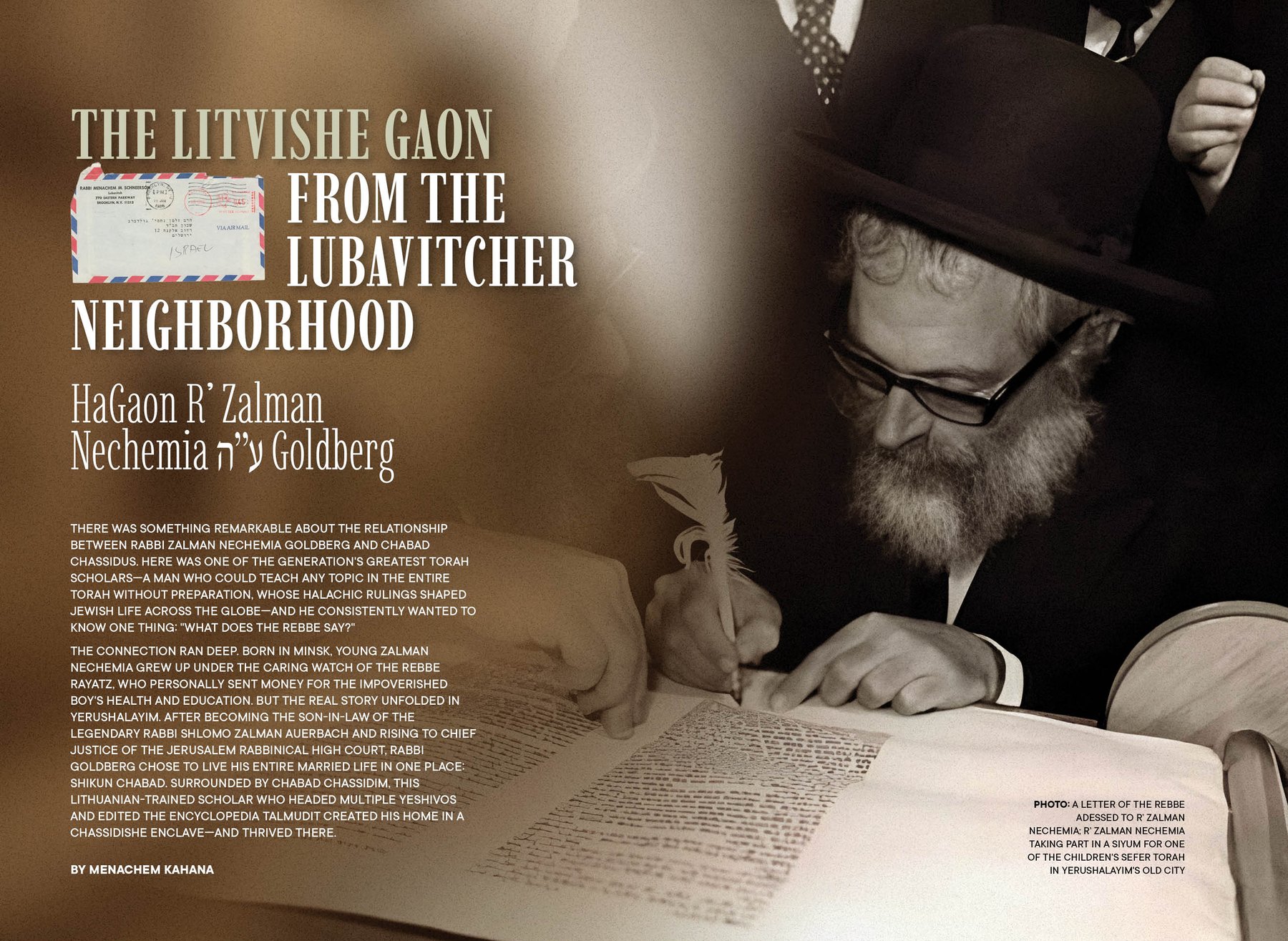
There was something remarkable about the relationship between Rabbi Zalman Nechemia Goldberg and Chabad Chassidus. Here was one of the generation’s greatest Torah scholars – a man who could teach any topic in the entire Torah without preparation, whose halachic rulings shaped Jewish life across the globe – and he consistently wanted to know one thing: “What does the Rebbe say?” The connection ran deep. Born in Minsk, young Zalman Nechemia grew up under the caring watch of the Rebbe Rayatz, who personally sent money for the impoverished boy’s health and education. But the real story unfolded in Yerushalayim. After becoming the son-in-law of the legendary Rabbi Shlomo Zalman Auerbach and rising to chief justice of the Jerusalem Rabbinical High Court, Rabbi Goldberg chose to live his entire married life in one place: Shikun Chabad. Surrounded by Chabad Chassidim, this Lithuanian-trained scholar who headed multiple yeshivos and edited the Encyclopedia Talmudit created his home in a Chassidishe enclave – and thrived there.
Among the modest paths of the quiet Yerushalmi neighborhood, Shikun Chabad, there lived for decades a giant of Torah and humility – the gaon Rabbi Zalman Nechemia Goldberg z’l, who was among the greatest poskim and dayanim of our generation, chief editor of the ‘Encyclopedia Talmudis’, and above all – a person for whom Torah was his neshama and chayus. Despite his lofty status, he remained an unusual personality who crossed all the artificial boundaries between streams and communities. He taught in Chassidish, Litvish, and Religious Zionist yeshivas, with Torah as his only compass.
Beneath the mantle of a tremendous genius and premier talmid chacham, lay hidden a deep and long-standing connection with Chabad Chassidus and with the Rebbe.
Years later, when his grandchildren asked him: “Saba, did the Lubavitcher Rebbe know you?”
“Know me? I don’t know. He knew my name,” he responded humbly…
When Rabbi Chaim Shalom Deutsch, one of Rabbi Goldberg’s longtime friends, heard this, he reacted – “Only knew”?…
Despite belonging to the Litvishe Torah world, he found his place in the mixed neighborhood populated by Chabad Chassidim, Chassidim from other courts, and Litvishe as well. Even in difficult times, when walls of divisiveness separated the camps in the chareidi sector, Rabbi Goldberg stood out in his humility and nobility.
“The atmosphere at home was always good and comfortable toward every Chabad chiddush. We were also subscribers to the weekly Kfar Chabad, so we were almost as updated as our Chabad neighbors,” relates his son, Rabbi Aharon Goldberg. “My father always took an interest in the Rebbe’s Torah, in farbrengens, in horaos, in mivtzaim and inyanei Moshiach. Even when he saw things differently, he would write to the Rebbe from his perspective and with holy reverence. Sometimes the Rebbe mentioned in farbrengens topics that my father wrote to him, without mentioning the writer’s name.
“My father had a relationship of enormous respect and appreciation for the Rebbe. He supported and assisted to the best of his ability for the three shleimuyos: shleimus ha’aretz and Mihu Yehudi and of course shleimus ha’Torah” (see sidebar).
Imprisonment on the Day of the Bris Mila
Indeed, Rabbi Goldberg’s roots were planted deep in the world of Chassidus.
He was born on Yud Shevat 5691 (1931) in Minsk, to his parents Avrohom and Freidel. Although his father was educated in the Litvishe Novarodok yeshiva, his father’s brothers, Rabbis Yehuda and Tzemach Dovid Goldberg, studied in the Tomchei Tmimim yeshiva in Lubavitch. Despite the different paths, the family maintained a deep connection with Chabad throughout, as his father corresponded frequently with the Rebbe Rayatz, while he himself studied Chassidus and Tanya.
A tragic and formative event in his life occurred on the day young Zalman Nechemia had his bris. On that day his father was arrested by the Communist authorities for his “crime” – operating an underground yeshiva. He was sentenced to ten years of hard labor in Siberian camps. This event, according to a close student, stayed with Rabbi Goldberg throughout his life, and instilled in him the understanding that Torah is something for which one actually sacrifices one’s life.
After a long year of efforts made behind the scenes, the father’s sentence was reduced. The family was exiled to Latvia and from there emigrated to Eretz Yisrael. Even there, they lived in severe poverty, but Reb Avrohom continued with mesirus nefesh to learn and teach, a trait his son inherited fully.
In the midst of the terrible Holocaust, the Rebbe Rayatz issued a call to study Mishnayos by heart and review them while walking in the street to purify the air. “Toward bar mitzva age,” relates Rabbi Aharon Goldberg, “my grandfather told my father that he would not let him celebrate his bar mitzva if he didn’t join the Rebbe Rayatz’s Mishnayos study project.”
Young Zalman Nechemia took this seriously, and learned all Shisha Sidrei Mishna by heart, and from then recited them at all times… This habit remained with him all his life, and thus he turned himself into a “walking Torah.” He was always immersed in words of Torah, when sitting at home and in his walking along the way. Some time later, his father reported this in a letter to the Rebbe Rayatz.
In a moving letter from 5705, the Rebbe Rayatz writes to the father that he is happy to hear of the bachur Zalman Nechemia’s progress in his studies, and blessed him to strengthen and continue learning Torah with yiras shomayim. The Rebbe even sent him 25 dollars, a respectable sum in those days, to improve his health.
“My father had no idea about this letter,” his son relates. “When they showed him this letter which was only discovered a few years ago, he was very moved,” Rabbi Aharon relates. “He said ‘Who am I and what am I that the Rebbe Rayatz would care for me to the extent of sending a sum of money’?”
Later that year, in a letter the Rebbe Rayatz sent to an aid organization in Jerusalem, he asked to convey personal greetings to Rabbi Goldberg who gave shiurim there.
An Unexpected Farbrengen on Shabbos Afternoon
Rabbi Goldberg’s connections with Chabad were not only distant history, but existed throughout his life. While still a young man, after his marriage to the daughter of the renowned posek the Gaon Rabbi Shlomo Zalman Auerbach z’l, he lived in Shikun Chabad in Yerushalayim with the atmosphere of the place and its residents influencing him.
One of his practices was insistence on tefilla in an early minyan. He used to daven in a minyan that took place in nearby Kiryat Sanz where they were careful about the time for reciting Shema according to the Magen Avrohom’s shita. One day, Rabbi Azriel Zelig Slonim, one of the distinguished Chabad rabbanim in the city, met him and asked him why he kept away from the Chabad shul closer to his home. Rabbi Goldberg explained that he was careful about tefilla according to the Magen Avrohom, while in the Chabad shul they don’t have a minyan at such an early hour (following the Alter Rebbe’s later time).
When this story reached the Rebbe, he immediately instructed to make an earlier minyan in the Chabad shul, so that Rabbi Goldberg could daven near his home. This directive was exceptional, and reflected the deep respect and appreciation the Rebbe had for Rabbi Goldberg and recognition of his Torah greatness. From then on, Rabbi Goldberg continued to daven in the Chabad shul at the bottom of Shikun Chabad for decades.
While davening there “he so honored his surroundings that when he approached the amud on a yahrtzeit, he wouldn’t be satisfied just to daven in nusach Ari, but would be particular about wearing a gartel as is the Chassidic custom, and some say he always carried a gartel in his pocket for time of need,” testifies Rabbi Shimon Eisenbach.
Rabbi Eisenbach, who grew up in the neighborhood and is now rabbi of the Shahamon neighborhood in Eilat, recalls that as children they didn’t know how to appreciate his Torah greatness, but felt his natural humility. Thanks to his unique status, he bridged all sorts of frictions that were part of the past in those years. “I never heard him express his opinion in any argument that erupted in the shul between talmidei chachamim over this or that Chassidic issue,” Rabbi Eisenbach adds. “Our childish hearts told us that despite Rabbi Goldberg belonging to the Litvishe camp, deep down he sided in favor of Chabad, even though we heard nothing from him.”
R’ Eisenbach notes a characteristic story of Rabbi Goldberg’s noble middos: “When my father, Rabbi Tzvi Eisenbach z’l, passed away, Rabbi Goldberg came to console us as we sat shiva in Shikun Chabad in Ramat Shlomo, despite the fact that many years had passed since my father moved from the old Shikun Chabad near Yeshivas Toras Emes to the new Shikun in ‘Reches’.
“During the visit I asked him if he remembered my father’s visit to him one Shabbos afternoon. He smiled and said the visit was well remembered.
“It was in the early days of Shikun Chabad, when a young Chassidic spirit blew through the neighborhood. One Shabbos, the Chassidim sat to farbreng in the shul. When everyone got up to return home, my father suggested to those present, in his wine-enhanced good spirits, that they go up to Rabbi Goldberg’s home to pass along some of the fragrance of the farbrengen to his home. When they set out, the participants slipped away one after another, each to his home and family, and only my father remained alone to carry out the mission he had conceived.
“The knocks on the door of the great gaon brought him to open the door, and soon he found himself standing and listening to divrei Elokim chaim and thoughts on timely matters that poured forth from my father for some time. All these were seasoned with words about the obligation of hiskashrus to the Rebbe, and he in his great humility listened to them with much attention. At a certain point this small farbrengen ended, and only then did my father go up to our home for the Shabbos meal.
“The next day my father asked Rabbi Goldberg’s forgiveness and apologized for the sudden appearance at the hour when the Jewish people fulfill the mitzva of ‘sheina b’Shabbos taanug’ (sleep on Shabbos is a delight). He, of course, dismissed him casually as if to say the request for forgiveness was completely unnecessary.
“I heard this story from my father when I grew up, with him concluding that to this day he doesn’t know for certain whether perhaps a too-sharp Chassidic saying, or an expression of the type that aren’t said in the presence of a great rabbi, slipped from him during that visit to Rabbi Goldberg…
“I therefore took advantage of the opportunity when we talked, and before he was about to leave I asked him if he remembered that Shabbos afternoon meeting. He smiled and said he remembered it well, ‘It was very good’”…
The Rebbe Follows His Torah Articles
Rabbi Goldberg gave many scholarly shiurim to Chabad Chassidim. In the 1970s, Rabbi Goldberg gave classes at the Chabad kollel in Nachalat Har Chabad for immigrants from Russia.
A close relationship existed between Rabbi Goldberg and Professor Yirmiyahu Branover (may he have a complete recovery), who on the Rebbe’s recommendation consulted with him regularly on halachic matters. R’ Yirmiyahu’s son established a chavrusa with Rabbi Goldberg. Years later, during a yechidus, the Rebbe asked him about his chavrusa – and hinted that he was the one who arranged this partnership…
Rabbi Goldberg had great affection for the Torah of the Alter Rebbe in his Shulchan Aruch. Rabbi Goldberg even headed the “Iyun Halacha” project of Rabbi Chaim Shalom Deutsch and the ‘Tzemach Tzedek’ kollel in Jerusalem. He would write many articles on the Alter Rebbe’s Torah that were published in the ‘Yagdil Torah’ kovtzim published by the kollel’s students.
Rabbi Deutsch relates that on one occasion Rabbi Goldberg didn’t have time to write an article and submit it before printing the kovetz. Following this, the Rebbe inquired why there was no article by Rabbi Goldberg. When Rabbi Deutsch replied that Rabbi Goldberg didn’t have time, the Rebbe responded and said that if they had pressed him more, he surely would have brought the article, since he is “a great lamdan and wonderfully versed in the Alter Rebbe’s Torah”…
This response from the Rebbe illustrates the enormous appreciation the Rebbe had for Rabbi Goldberg, and rare testimony to the gaon’s exceptional expertise in Toras Chabad.
A Letter of Blessing and Its Journey
Another wonderful story about his connections with the Rebbe is told by Rabbi Aharon Goldberg:
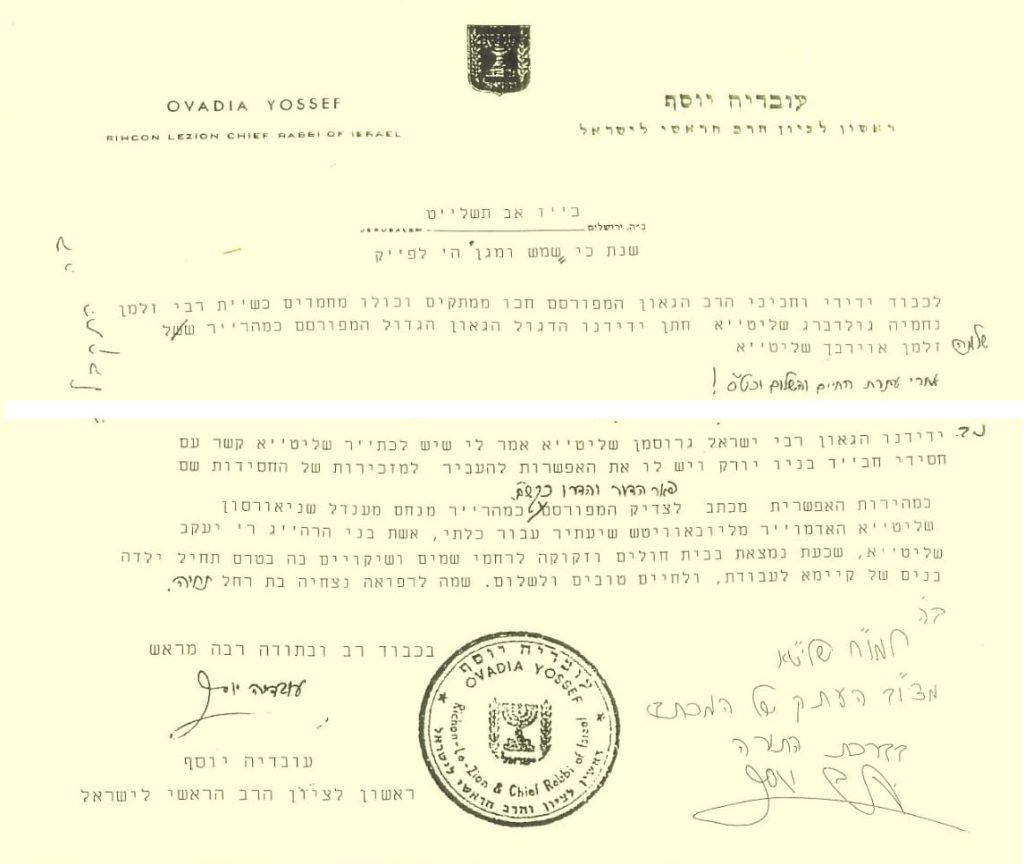
“Close friendly relations existed between Rabbi Ovadia Yosef and my father. Many halachic letters were written from one to the other, and one of them – dated the 26th of Av 5739, revolved around a halachic question that came before halachic authorities at that time. On that day Rabbi Ovadia’s driver arrived at our home with a letter in hand. At the end of the letter, in an unusual manner, Rabbi Ovadia added a personal request to my father, that through his connections he would convey to the Rebbe the name of his daughter-in-law – wife of Rabbi Yaakov Yosef zt”l – for an urgent blessing for an easy and quick birth properly and easily:
“’…P.S. Our friend the Gaon Rabbi Yisroel Grossman shlita told me that your honor has a connection with Chabad Chassidim in New York, and he has the ability to convey to the secretariat of the Chassidus there with maximum speed a letter to the famous tzaddik, glory of the generation and its splendor, his holy honor the title of glory, his honor Moreinu HaRav, Rabbi Menachem Mendel Schneerson shlita, the Admor of Lubavitch, that he should pray for my daughter-in-law, wife of my son Rabbi Yaakov shlita, who is now in the hospital and needs heavenly mercy and that it should be fulfilled in her before she gives birth. Children of permanence for His blessed service, and for a good life and peace. Her name for healing: Nitzchia daughter of Rochel may she live.
“’With great respect and much thanks in advance, Ovadia Yosef, Rishon L’Zion, Chief Rabbi of Israel.’
“Immediately after receiving the letter, my father sent me to our neighbor Rabbi Glitzenstein who sent the request to the Rebbe, who gave a bracha for an easy birth, as indeed it was” (see sidebar).
Deep Appreciation for the Shluchim
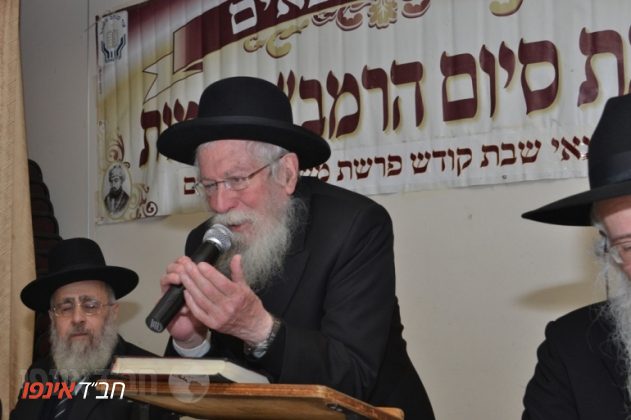
When the Rebbe instituted the takana of daily Rambam study in 5744, Rabbi Goldberg joined enthusiastically. He even frequently spoke at the gala Rambam siyumim held each year. At one of the siyumim he related that he studied the entire Rambam on the track of three perakim per day, and said this was a wonderful kuntz in which one studies all the Torah in its entirety within a year.
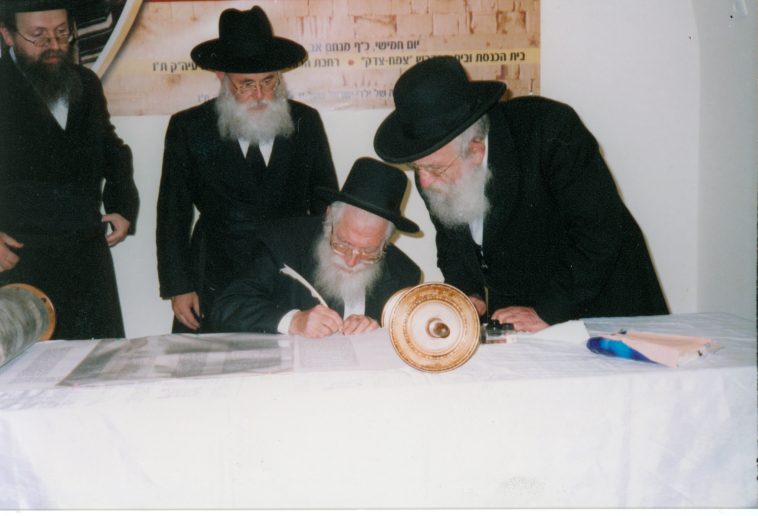
Rabbi Goldberg also participated actively in many Chabad projects. He supported the struggle over the definition of a Jew according to halacha, and participated in ceremonies completing Sifrei Torah written in honor of Yaldei Yisrael. His son explains that he saw the enormous value in Chabad’s outreach activity, and the Rebbe’s greatness.
A regular connection existed between Rabbi Goldberg and Chabad rabbis. Rabbi Tuvia Zilberstrom, rabbi of Shikun Chabad in Yerushalayim, relates that every week he would speak with him by phone and convey to him questions from Chabad rabbanim and dayanim from all over the country as well as from many shluchim abroad. “Rabbi Goldberg always answered immediately, with a solid halachic basis for every answer, as if the subject was open before him. He had a warm and supportive attitude toward the shluchei ha’melech. He valued and appreciated their tremendous work, and assisted them to the best of his ability.”
Over the years he gave many shiurim at Yeshivas Toras Emes near his home, and was always ready to give a shiur on any topic. He was a Torah genius and had a pleasant temperament, accessible to all. Many semicha students were given semicha by him in tests he often conducted, as he encouraged thousands of young rabbis to continue learning and not rest on their laurels.
Rabbi Goldberg left behind treasures of chiddushei Torah, sefarim and many shiurim, but above all – generations of students who absorbed from him not only Torah, but also a derech ha’limud, Ahavas Yisrael without masks, and true humility, and as Rabbi Zilberstrom aptly defined him, he was “a world-class gaon who exemplifies what true humility and simplicity really are.”
Rabbi Zalman Nechemia Goldberg passed away on 20Av 5780 (2020). His legacy is a rare combination of Torah genius with boundless Ahavas Yisrael. Because of this greatness he merited appreciation and true awareness of the great work of the Rebbe.
We Need to Repeat the Divrei Halacha!
At a gathering a few years ago, when Rabbi Goldberg was chosen to be the first speaker at the Kinus Rabbanei ‘Pikuach Nefesh,’ he spoke briefly and sharply:
“When it comes to shleimus ha’aretz and standing strong against the enemies of Israel, there is no need for speeches and explanations! We rabbanim need to read the halacha in Shulchan Aruch, Orach Chaim siman 329, again and again. In one short se’if, the halacha says it all. It’s a clear halacha and nobody contests it!
“We all know that the Lubavitcher Rebbe doesn’t repeat things again and again just like that. And it is not his way to protest or scream. On this subject of shleimus ha’aretz, the Rebbe diverted from his usual practice and repeated this again and again and he protested and screamed from the depths of his heart. If this is what the Rebbe did on this subject, surely this is the way and nothing else!”
My Birth
R’ Yehonatan Yosef, grandson of Rabbi Ovadia Yosef, told of his mother whose father-in-law (R’ Ovadia) asked the Rebbe for a bracha.
“Within seven years, my mother lost three babies in the ninth month. My father went to Baba Sali for a bracha that she would have a healthy baby. My mother was expecting and the doctors took no chances. They hospitalized her in the fifth month.
“The family was so nervous about a repeat stillborn that my grandfather did all he could so my mother would have a healthy birth. This is why he asked Rabbi Zalman Nechemia to use his connections and receive a bracha from the Lubavitcher Rebbe, a bracha that would be fulfilled with my birth.”
“The Lubavitcher Remains the Lubavitcher”
Rabbi Shimon Weizhandler, Rosh Yeshiva of Tomchei Tmimim in Rishon L’Zion, wrote:
On a personal note I will allow myself to share with readers a certain impactful moment that happened years ago. The morning of 22 Shevat 5748, hours after the passing of the Rebbetzin, someone came with the shocking news. Even before davening, I rushed to Shikun Chabad in Yerushalayim to be in the “thick of things.”
Naturally, the Shacharis minyanim didn’t stop talking about the tragic loss. Those in the know sensed that something earth-shattering was taking place. “Lubavitch changed now.” Just a day later, a fax was put on the door of the shul which had the edited sicha which the Rebbe said immediately at the start of the shiva. Everyone crowded around to see “what the Lubavitcher says.”
I remember that when the gaon Rabbi Zalman Nechemia Goldberg learned the sicha he sighed with relief and said, “The Lubavitcher remains the Lubavitcher.”
What did it say in the sicha? The Rebbe took the shocking event of 22 Shevat and put the emphasis on “the eradication of the inyan of death through Ahavas Yisrael.” That is when everyone felt that Lubavitch is alive and well. This is Lubavitch in its strength and glory! This is a direct result and realization of everything they instilled for six generations: ein od milvado and the tzimtzum is not k’peshuto, chalila!
Beis Moshiach #1487 • pp. 18-26
© 2026 Beis Moshiach Magazine. All rights reserved.
This article originally appeared in Beis Moshiach #1487. You are welcome to share it with friends and family by email or in print, provided that you do not change, add to or omit any part of it, you credit the author and Beis Moshiach, and you include a link to archive.bmoshiach.org (written out in full in printed copies).
To republish this article in a newspaper, magazine, book or website, please request permission in advance at [email protected].