Rambam Is Food, Not Information!

At last year’s central Siyum HaRambam in Yerushalayim, HaGaon HaChassid R’ Daniel Alter shlita, son of the Gerrer Rebbe – the Pnei Menachem, delivered a stirring address on the nature of true Torah acquisition. Drawing on the wisdom of Chassidic masters and personal memories of his father’s devotion to the Rambam study cycle, he explored why authentic learning creates a perpetual hunger and an insatiable appetite for daily learning, rather than satisfaction and complacency. Presented for the 42nd Siyum HaRambam on 15 Shevat.
With the permission of the Rav, the mara d’asra, the great rabbanim, and all the Torah learners who have gathered for the joy of completing Torah at the Siyum HaRambam. Tonight is Beis Adar; it is the yahrtzeit of my uncle, the holy Rebbe, the “Beis Yisrael” of Gur zt’l [d. 1977]. I will therefore begin with a dvar Torah of his.
On the well-known expression, Mishenichnas Adar marbim b’simcha (When Adar enters we increase joy), the Beis Yisrael asks: why do we say “enters”? It could have written, “From Rosh Chodesh Adar we increase in joy.” What is this “enters”? He explains that the joy must enter into our very bones. In Yiddish this is even better: “Adar” [Yiddish – ‘vein’] is related to gid, giddim – sinews. “When Adar enters” means that the joy must enter all our bones and sinews.
The Beis Yisrael added the well-known statement from Tanna d’Bei Eliyahu, brought by Tosafos at the end of meseches Kesubos in the name of the Medrash: “Before a person prays that words of Torah should enter his intestines, he should pray that an abundance of delicacies should not enter his intestines.”
That is the question: what enters your insides? A person learns, a person eats – but what really goes inside him? Let food and delicacies not enter the intestines; they come and they go. But divrei Torah – let them enter and become part of our very essence. Perhaps this is also the meaning at the end of the Rambam, that in the days of Moshiach delicacies will be as plentiful as dust. When delicacies are in abundance, who will look at them? But divrei Torah will enter us, into our depths.
A Personal Connection to the Rambam
When I have the zechus to speak at a Siyum HaRambam, for me it is also an act of honoring my father. One year there was a Siyum HaRambam for children at Binyanei HaUmah. My father ztvk’l, the Rebbe – the Pnei Menachem – one year before his passing, was supposed to attend. He was not feeling well. He could not even go up on the yahrtzeit of the Beis Yisrael, which is on Beis Adar like today. He went as far as Har HaZeisim but did not go up to the cave itself because he was unwell.
He sent me to bring his bracha, but before that he told me how sorry he was that he could not participate himself: “These are two things that are so close to my heart – the Rambam and children. But I cannot participate, so speak on my behalf.” Even now, when I speak at a Siyum HaRambam, it constitutes kibud av.
The Rambam was very dear to my father’s heart. After the Rebbe instituted the daily study of Rambam, my father told me that several years earlier, at the last Great Knessia of Agudas Yisrael [in 1980], he had wanted to propose learning the Rambam in an orderly sequence. He said: “The Rambam can be learned briefly and truly acquired and absorbed.” But at that gathering his brother, the Rebbe – the Lev Simcha – announced the takana of studying Talmud Yerushalmi, and the Yeshuos Moshe of Vizhnitz announced an enactment to study Chovos HaLevavos. It did not seem appropriate to announce yet another proposal at that time.
Therefore, when the Rebbe later instituted the daily study of Rambam, my father rejoiced greatly over this zechus and participated in all the cycles – one perek a day, three perakim a day, and also Sefer HaMitzvos.
The Greatness of the Rambam
My father once explained: why does the Raavad, in his critiques of the Rambam, use such sharp language? In one place the Raavad writes about him, “the opinion of his belly.” This is the Rambam’s “belly-opinion”! My father said: this is not, Hashem forbid, disrespect; it is esteem and greatness for the Rambam.
After all, the Rambam himself writes in Hilchos Yesodei HaTorah that one should not “stroll in the orchard,” meaning study the inner wisdom, except for one who has “filled his belly with Shas and poskim – with meat and bread, with halacha and Gemara.” The Raavad was so impressed with the Rambam that he said: this is reasoning that comes from such a holy belly, filled with ‘meat and bread’ – with halachos and knowledge of Hashem.
There is a story of a poor Jew who needed parnassa; he had no food. He sold his Shas, sold the Rambam he had at home, and thus had something to eat. They said of him that he “filled his belly with Shas and poskim”…
But on the other hand, there is a Jew who scrimps on his food so that he can buy a Shas – not to buy it, for today anyone can buy a Shas – but so that he will have time to learn the Rambam. He must cut back on his pleasures, on his time.
Time and Priorities
There was a great educator in Gur, Rabbi Gad’l Eisner. He once said: people say, “I have no time.” He said this is a ridiculous expression, an absurdity. You say you have no time? There are eight billion people in the world; everyone has the same amount of time – 24 hours a day. In China, in India, in Eretz Yisrael. Twenty-four hours a day, sixty minutes an hour, sixty seconds a minute – everyone has the same time!
When I say “I have no time,” what I really mean is: I have no time to learn because I need to eat; I have no time to eat because I need to sleep. It is only a question of priorities.
So fill the belly with Rambam, not the opposite! Do not sell the Rambam for your time; rather, sell the time devoted to delicacies and all that you enjoy – for the Rambam, so that you will have time to learn Rambam. This is called “Your Torah is within my innards.”
A True Hunger for Words of Torah
The Rebbe of Kotzk asked: Why do we say the expression “he filled his belly with Shas and poskim”? When I learn Rambam, does it enter my belly, my intestines? – it enters my head! It should have said, “he filled his brain with Rambam.” Why “he filled his belly”?
The Kotzker Rebbe explained: When I learn something in my head, that’s it – tomorrow I don’t need it; I already have it, I know it. Tell a person an idea he already heard yesterday and he will say: I don’t need it; I already heard it, I know it.
But the way to fill ourselves with Torah, with Rambam, and with everything good, is not into the head but into the belly. Into the belly – I eat a proper meal, and tomorrow at noon I am hungry again! If someone says, “Why? You already ate yesterday!” I answer: I am hungry again! When one truly wants to acquire Torah, one must fill the belly, not the head – to be hungry for it again and again.
How did the Rambam become the Rambam? Because he was hungry for divrei Torah! As the Rambam himself describes Yemos HaMoshiach, quoting the Navi: “Not a hunger for bread, nor a thirst for water, but to hear the word of Hashem” – not merely that the ear hears, but that a person is hungry to hear, thirsty to hear.
A Perspective on ‘Spending’
Reb Mendel Futerfas would collect funds with mesirus nefesh for the underground yeshivos in the Soviet Union. There was a Chassid there, not among the great maskilim, who in that period succeeded in making substantial sums on the black market and distinguished himself with unprecedented generosity – he did not suffice with donations of 10% or 20% as customary, but gave 50%, 60%, even 80% of all his profits!
Once Reb Mendel asked him in amazement, “Do you really give such a large portion of what you earn?” The Chassid replied with moving simplicity: “I don’t know any other way; this is what I heard and understood. I once sat in a shiur on Ein Yaakov and we learned that the Gemara says: ‘Hamevazbez – one who spends – should not spend more than a fifth.’ That is, one who gives to tzedaka should not give more than a fifth of his assets.”
And he added with simple, profound life wisdom: “So I say to myself: ‘Spending’ means what I buy for myself – clothes, boots, food for me and my household. That is real bizbuz – waste, for it wears out and does not remain forever. Therefore I try not to spend more than a fifth on my personal needs, and all the rest I can happily give to tzedaka.”
What a wonderful worldview! What a deep understanding of the true value of money and possessions – coming specifically from a Jew who defined himself as pashut. “I have no time” – because I need to learn! That is the correct outlook.
I have no money to waste on coats, socks, and food. Those I will buy sparingly. Why? Because I need the money to support Torah!
The same applies to our other resources: I have no time for delicacies and worldly nonsense, because I need to give that to Torah, to the Rambam!
So when a person comes and says: how can I learn three perakim a day? It takes so much time! We tell him: if you give 80% of the day to Torah and 20% to your personal matters, you will have enough time to learn Rambam.
Confronting the Yetzer Hara
There was once a Jew who lived in a town on the border of Russia and Poland. Every day he would ride a bicycle and cross the border. There was a non-Jewish customs officer who would ask, “What are you carrying?” The Jew would answer, “Nothing, sand.” Who carries sand in a bicycle carrier? Surely he is hiding a diamond! The officer would pour out all the sand, sift it, trying to catch the diamond – nothing! The officer thought: “He must be trying to lull me, to test me; tomorrow I’ll catch the diamond.” And the Jew kept bringing bicycles day after day, and the officer did not give up: “Today he’ll bring the diamond!” But there was none.
Eventually, when the officer was promoted to another position, he met the Jew and said: “Tell me the truth, were you smuggling something? I can’t harm you now. Tell me, how did you smuggle the diamond?” The Jew answered: “What a goyishe kup… bicycles! Every day I smuggled bicycles! I would go by train and return with new bicycles. You didn’t catch that?”
We too have this goy inside us, the yetzer hara. That goy says: “I will not let this person know all of Torah. He is mine. He puts on tefillin, he learns – fine. But for him to learn Rambam and cover the entire Torah in a year – no way! I won’t allow it. I’ll look for the diamond he wants to smuggle.”
Indeed, sometimes we have big plans: “I’ll learn Rambam with all the nosei keilim (commentaries),” “I’ll finish Shas.” We have many plans, and the goy doesn’t allow it. How can we succeed in smuggling under his nose? If it’s day by day, day by day – he doesn’t notice. I smuggle the bicycles, not the diamond.
Three perakim a day, one perek a day, Sefer HaMitzvos. I don’t become a talmid chacham through this. But suddenly, after a year in which I did my part – smuggled bicycles every day – the wheels kept turning, I did my part, and he is still looking for the diamond he won’t let me have.
The yetzer hara waits for the day when the diamond will come – when the person will close all his businesses and start learning from morning to night. “That I won’t allow!” But we, under his nose, smuggle day by day – three perakim a day – and when the year ends, we have a complete Rambam in hand! And another year, we know the Rambam even better.
The Golden Language
It is customary in the sefarim – I don’t know if it begins with the Rishonim or later – that when quoting the Rambam, especially the Rambam, they always say “the golden language of the Rambam,” “this is his golden phrasing,” and the like. In truth, anyone who begins to look into the Rambam understands why this expression fits; it is as though gold is being poured, clear, pure, precise, comprehensive, wondrous.
There is a question between Parshas Teruma and Parshas Tetzave. In Teruma the Torah speaks about all the klei ha’mikdash, the aron, the mizbeiach, the shulchan, the menorah – everything is written, except for one vessel: the mizbeiach ha’zahav, the incense (inner) altar. It does not appear! At the end of Tetzave, after the days of consecration, there suddenly appear a few pesukim about making the mizbeiach ha’pnimi.
Why was the inner altar omitted as compared to the outer altar? I think the Netziv of Volozhin once said: the inner altar was made to atone, but not for ordinary kapara – not for a regular sin. On Yom Kippur the blood was sprinkled there; likewise for the Korban Chatas of communal error, when the tzibbur sinned inadvertently – very special cases. That is, there is a regular aveira of a person who sins against Hashem, and there are other sins. It’s not an actual aveira – it’s something that for one who is so close to Hashem is considered a sin.
I will explain with a mashal. Reb Chonye Morozov Hy’d, once asked: what is the definition of a Chassid? There are very expensive pieces of furniture, worth millions. But there are simple pieces – second-hand, floor samples – affordable at a fraction of the price.
A person goes to buy such a table, and on the way he sees someone else buying a table so expensive he can’t even dream of it. That person says to the seller: “Give me 50% off.” The seller asks: “Why?” He answers: “There’s a scratch here; the color isn’t quite right.”
The other person looks at the simple table he’s buying – second-hand and from the floor display – and thinks: “There are lots of scratches; surely they’ll give me 50% off.” The seller says to him: “If you don’t want it, leave it. You’re already getting it at a bargain price!”
There are people for whom it’s not an aveira if they didn’t learn three perakim of Rambam a day; there are bigger things to reckon with. But a Jew who wants to be close to Hashem, is first-class furniture. Every tiny scratch is already a problem. When we speak of a Chassid, we mean that every small blemish is already an issue.
In the donations for the Mishkan there was gold, silver, and copper. There are Jews who want to give Hashem gold – not silver and not copper. They want to be members of the “gold club.” For such Jews, every small deficiency is a great flaw; it bothers them. This is called a Chassid, he draws close to Hashem; he is mischased im Kono (he acts with piety toward his Creator).
Connection to the Rebbe
The Rebbe, the Beis Aharon of Karlin, once traveled with his Chassidim. It was a hot day; they were thirsty, and they had no water. They passed by a river but had no kli – no cup, no mug. There was one man there, his shochet, who could not restrain himself from thirst. He simply scooped water with his hand and drank. This greatly bothered the Beis Aharon, not that it was forbidden, but is this how a Chassidishe Yid drinks?
So the Beis Aharon said: “One to whom I am dear, one who loves me, will not eat from the shechita of this shochet.”
The incredible power of this story is that this shochet was a yerei shomayim, and despite what happened he said: “Rebbe, ir zent ta’ir bai mir, ir zent leeb bai mir, ich leig avek di messer – Rebbe, you are dear to me, you are beloved to me, I am putting down the knife; I will no longer shecht.”
I enjoyed the hagdara (categorization). There is no pesul; Rabbanim are sitting here; I don’t think anyone would dismiss a shochet for such a thing – not even from Chabad. He drank water in an unrefined way. But in the hergesh of the Beis Aharon of Karlin, he says: “One to whom I am dear.” He does not say “it is asur,” but “one to whom I am dear.”
Now the Rebbe gets up and says: “One to whom I am dear, one who loves me, should cleave to my koch in Rambam, should be in this inyan.” So it is not a question of “Do I have time or not?” You are patur m’l’chatchila (exempt from the outset)! As a mashgiach in yeshiva once said to a bachur: “You’re already justified from Elul… from the beginning of the zman you’re already justified; I don’t need you to justify yourself.”
The Rebbe turns to us: Am I dear to you? Am I precious to you? Do you want to go along with me? Do you want to be with me?
How much would we pay if the Rebbe said, “Who wants to be with me in my presence?” We would be ready to leave this world yesterday! But the Rebbe says: “Live good and pleasant lives, but be with me! Be involved in my inyanim.” And my inyan is the Rambam – so be there, and be gold there, in the gold club of the Rambam. Learn well, without skipping! Take the best, most precious track – the gold. Don’t go for less than that. It is a wonderful thing!
Yemos HaMoshiach and Knowledge of Hashem
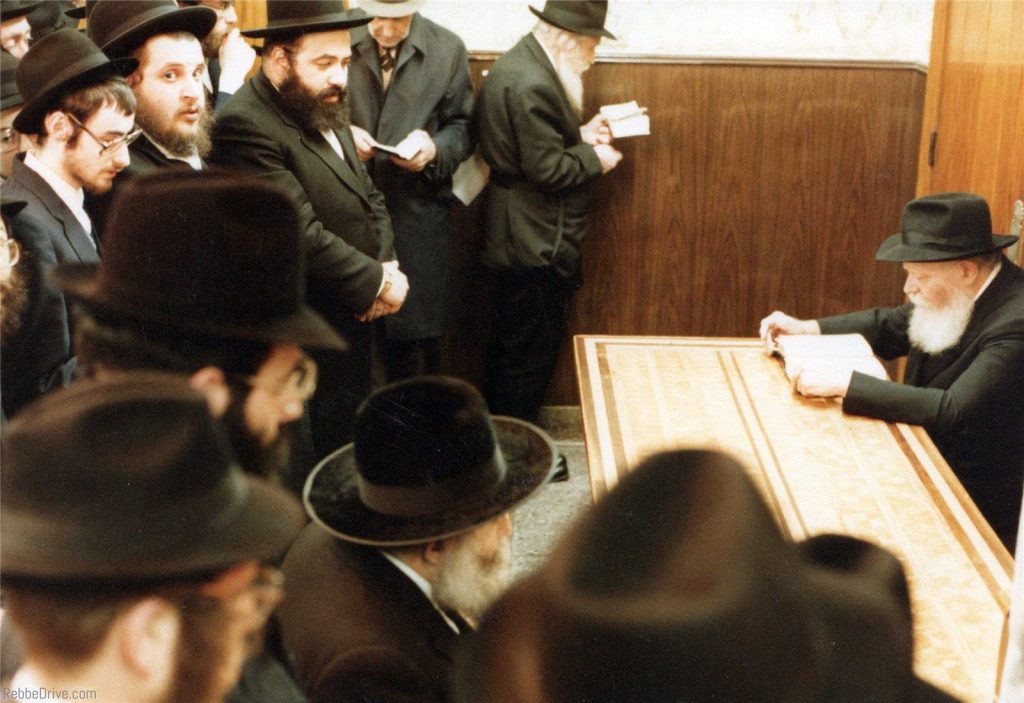
The Rambam concludes with how it will be at the coming of Moshiach: “The earth will be filled with the knowledge of Hashem as the waters cover the sea.” There is a well-known saying: why “as the waters cover the sea”? There will be abundance like dust, as he says about delicacies. What is “as the waters cover the sea”?
From above, the sea is evenly covered, but not everywhere does it have the same depth. There are valleys and trenches. That’s to say, when Moshiach comes, we will all be people of knowledge; we will all be filled with knowledge of Hashem – but how deep will it be? That depends on how we prepare ourselves.
And the Rambam begins again with: “The foundation of foundations and the pillar of wisdom is to know that there exists a First Being.”
This immediately reminds us of the famous story of Reb Levi Yitzchok of Berditchev, who traveled to his Rebbe, the Maggid of Mezeritch. When he returned, his father-in-law asked him: “You traveled for several weeks, a newly married yungerman – tell me, what did you learn from the Rebbe?”
Reb Levi Yitzchok replied: “I learned that Hashem created the world; there is a Creator and a Leader of the world; there is an Originator of all that exists.”
The father-in-law was astonished: “For that you needed to travel, to wander on the roads, to be mevatel Torah for weeks? Our Jewish maid knows how to say that! Call her and ask her, ‘Who created the world?’ She’ll answer immediately: ‘Hashem.’”
Reb Levi Yitzchok said: “Yes – she says it, and I know it!”
When we want to know Hashem – everyone will say “as the waters cover the sea.” But one who prepares himself in this world knows it at a deeper level, in the depths of the sea, in the abysses, where there is gold and pearls. Thus he will know with a much truer knowledge.
Learning the Rebbe’s Sugya
I want to conclude with a teaching from the Beis Yisrael, whose yahrtzeit is today. He explained in an original way the maamar Chazal that “when Adar enters, we increase in joy.”
The holy Zohar says on Parshas Kedoshim: “When the chaverim, the Tannaim, reached this parsha, they rejoiced.” Reb Simcha Bunim of Peshischa said: why were they so joyful in this parsha more than others? When a talmid learns Gemara and reaches the sugya that his Rebbe is engaged in, he is filled with joy. He is now learning exactly what his Rebbe is learning; he has someone who will open his eyes – he is connected to the Rebbe now.
When they reached Parshas Kedoshim, the talmidim were so joyful because “Be holy, for I am holy” – they were learning the very sugya of the Master of the World.
So the Beis Yisrael said: one can say the same about the month of Adar. In Adar, what are we engaged in? The erasure of Amalek. This is the sugya that the Master of the World is always engaged in: “A war for Hashem against Amalek from generation to generation,” “I will surely blot out the memory of Amalek.” So when we blot out Amalek, it causes us great joy – we are engaged in the same sugya that Hashem is engaged in.
When we make a Siyum HaRambam, we are engaged in the sugya that the Rebbe is engaged in. First of all, as regards heaven, it is truly the erasure of Amalek – for two reasons. It is known that the spiritual source of Amalek is the [angel referred to as] “Samach-Mem,” whose name is an acronym for Siyum Maseches Ein Laasos – “do not make a siyum.” The ‘other side’ hates siyumim – a siyum mesechta, siyum of Shas, and siyum of the Rambam.
It was said in the name of the Admor, the Divrei Chaim of Sanz, that learning Nedarim with the Ran is the erasure of Amalek. Why? Because Amalek is crooked and tortuous – and what straightens the mind most? The reasoning of the Ran!
What straightens the mind more than the Rambam? So making a Siyum HaRambam, do you have a greater erasure of Amalek than that?
Also as regards the Rebbe, the fact that the Chassidim are engaged in what the Rebbe is engaged in, the Rebbe who brought this light to Klal Yisrael, of the daily limud of Rambam. Thus, when we make the siyum, we are truly engaged in what he is engaged in.
Certainly through this we will also merit to bring closer the coming of Moshiach, which is the sugya the Rebbe is engaged in. And we will see, b’ezras Hashem, very soon – let’s not say that the Rebbe will merit to make the siyum of the next cycle with us – but that the Rebbe will start the new cycle!
Beis Moshiach #1492B • pp. 12-19
© 2026 Beis Moshiach Magazine. All rights reserved.
This article originally appeared in Beis Moshiach #1492B. You are welcome to share it with friends and family by email or in print, provided that you do not change, add to or omit any part of it, you credit the author and Beis Moshiach, and you include a link to archive.bmoshiach.org (written out in full in printed copies).
To republish this article in a newspaper, magazine, book or website, please request permission in advance at [email protected].