Eliyahu HaNavi: A Journey Through the Generations
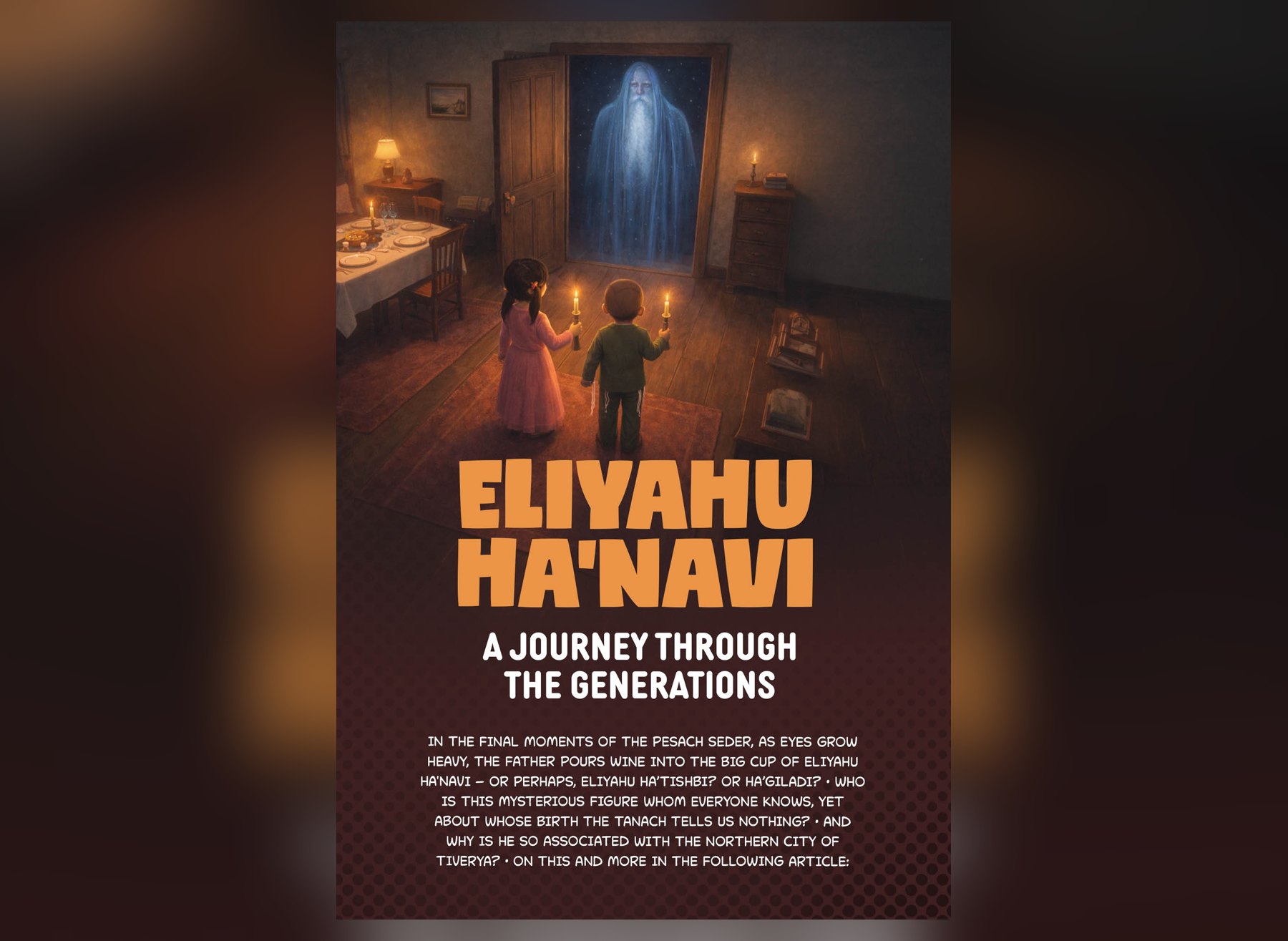
In the final moments of the Pesach Seder, as eyes grow heavy, the father pours wine into the big cup of Eliyahu HaNavi – or perhaps, Eliyahu HaTishbi? Or HaGiladi? Who is this mysterious figure whom everyone knows, yet about whose birth the Tanach tells us nothing? And why is he so associated with the northern city of Teverya? On this and more in the following article.
Avel Ha’Shittim, 2487
What a commotion there was in the camp. Loud sounds of singing and dancing burst forth from the central event hall of Shevet Shimon, and against them — sounds of outcry and protest: “A disgrace has been committed in Israel!” “Woe to this shame! Woe to this humiliation!”…
The bnei Shevet Shimon did not stay silent against the fierce protests, and responded in kind: “You should be ashamed!” they argued firmly. “Our distinguished prince, Zimri ben Salu, is about to put an end to the rampant plague in the camp!”
To an outside observer, there seemed to be some justification to their words. At the time, a terrible plague had spread among the people, following their sins with the daughters of Midyan. Zimri ben Salu, Nasi of Shevet Shimon, decided to act in order to “prove” that the punishment upon Israel was supposedly unjustified: he claimed that Moshe himself had married a gentile woman (he forgot to mention that Tzippora had converted before her marriage to Moshe), and invited everyone to his own princely wedding with Cozbi daughter of Tzur, king of Midyan…
The sounds of argument rose to the heavens. Some wept: “Zimri is intensifying G-d’s wrath and worsening the plague!” And others argued: “Finally someone is sacrificing himself for the Jewish people, and proving before all that marriage to a gentile is not such a grave sin!”…
Only one man was not confused by the empty words. That was Pinchas son of Elozor son of Aharon the Kohen, who had no time for clever arguments: he entered the tent and stabbed both Zimri and Cozbi together with his spear. Thus the forbidden intermarriage was ended at once, and the terrible plague — stopped.
As a reward for his brave act, Hashem promised Pinchas two rare gifts: the priesthood, which until then had belonged only to his grandfather Aharon and his father Elozor — was given also to him and his descendants. Additionally, Hashem said: “Behold, I give him My covenant of peace.” According to the Medrash, with these words Pinchas was granted eternal life, and in time he became Eliyahu HaNavi, who would herald the Geula and bring peace to the world.
The Valley of Yezreel, 2887 — 400 Years Later
Achav son of Omri, husband of Izevel daughter of the king of Tzidon, ascends to the throne of the Kingdom of Yisrael. On the advice of the wicked Izevel, Achav spread idol worship throughout his kingdom, causing all to follow the idol Baal.
When Achav encountered Eliyahu HaNavi, he challenged him: “Moshe Rabbeinu promised that if Israel worshiped idols, G-d would stop the heavens and there would be no rain! And yet — his promise is not being fulfilled!”
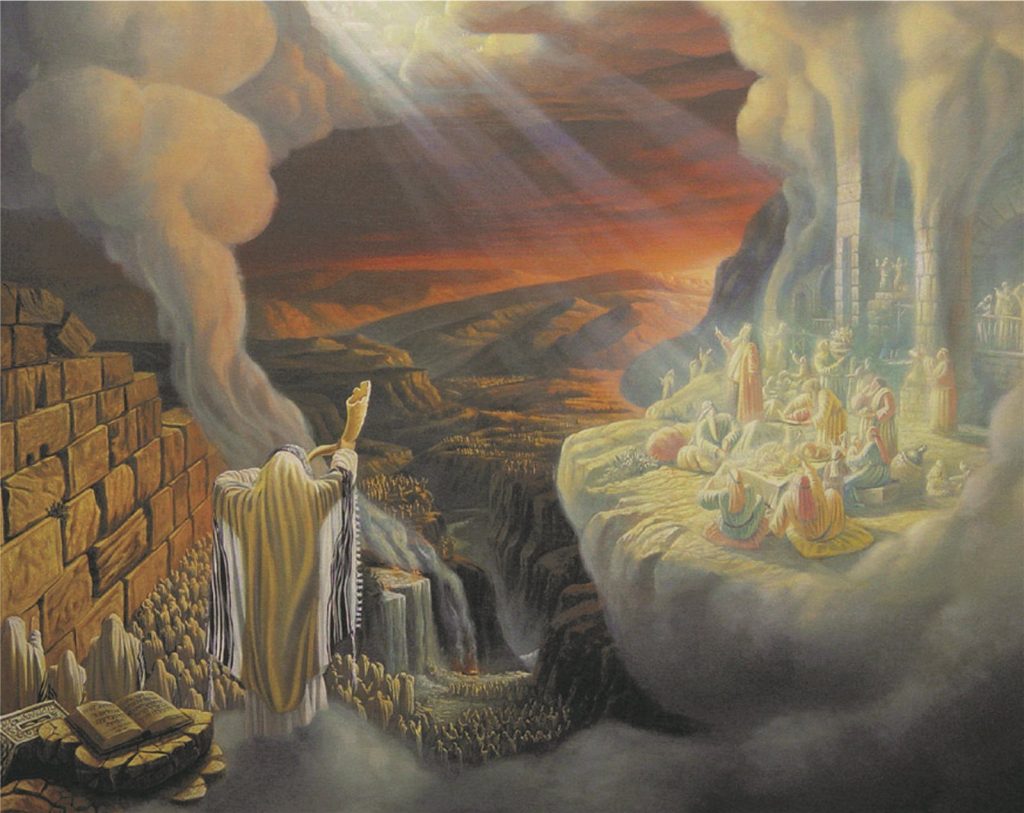
In the face of Achav’s mocking words, Eliyahu rose and said: “As the Lord G-d of Israel lives… there shall be neither dew nor rain these years — except by my word.” From this day on, Eliyahu made clear, all would see who the true Ruler of the land was. Rain would not fall, crops would not grow, and no one would have anything to eat — until they repented. The key of rain was given into Eliyahu’s hands, and from now on Hashem had entrusted him with the right to determine where and when rain would fall.
Achav and Izevel were very angry at Eliyahu for daring to stand against the idol worship they had established. They wanted to kill him, but Hashem sent Eliyahu to hide by the Nachal Kris, where he received his food through a special airmail service: each day, morning and evening, a number of ravens sneaked into the royal kitchen of Achav’s palace, snatched a loaf of bread and a portion of meat, and delivered them to him by direct delivery to his hiding place. Eliyahu thus ate from the king’s kitchen and drank from the brook’s water — until even the brook dried up…
The drought was now unbearable and even Eliyahu had no water to drink. Hashem did not want to take the key of rain from Eliyahu, and so arranged for him to return it on his own. Eliyahu was sent to the home of a widowed woman in Tzorfatis of Tzidon, and blessed her that the flour and oil in her home would not run out until the drought ended.
Eliyahu’s blessing was fulfilled miraculously, but the widow had complaints: her beloved son fell ill and died, and she blamed Eliyahu: “Before you came to live in my attic, I was considered righteous before the Creator. But compared to a righteous man like you, I am full of sins… therefore G-d caused my son to die.”…
Eliyahu prayed to Hashem and asked for the key of resurrection — in order to revive the son of the woman who had hosted him so graciously. But Hashem set a condition before him: “I have three keys in My possession, which I do not hand over to any angel or messenger… The key of rain I gave to you, but the key of birth and the key of resurrection — remained with Me. If I give you the key of resurrection as well — people will say you have more keys than I do!”…
“If you wish to receive the key of resurrection,” Hashem said to Eliyahu, “return to Me the key of rain, and in due time — you will need to pray to Me and ask Me to send rain upon the earth.” Eliyahu accepted the condition, revived the widow’s son, and after three years of drought — returned to Achav’s palace…
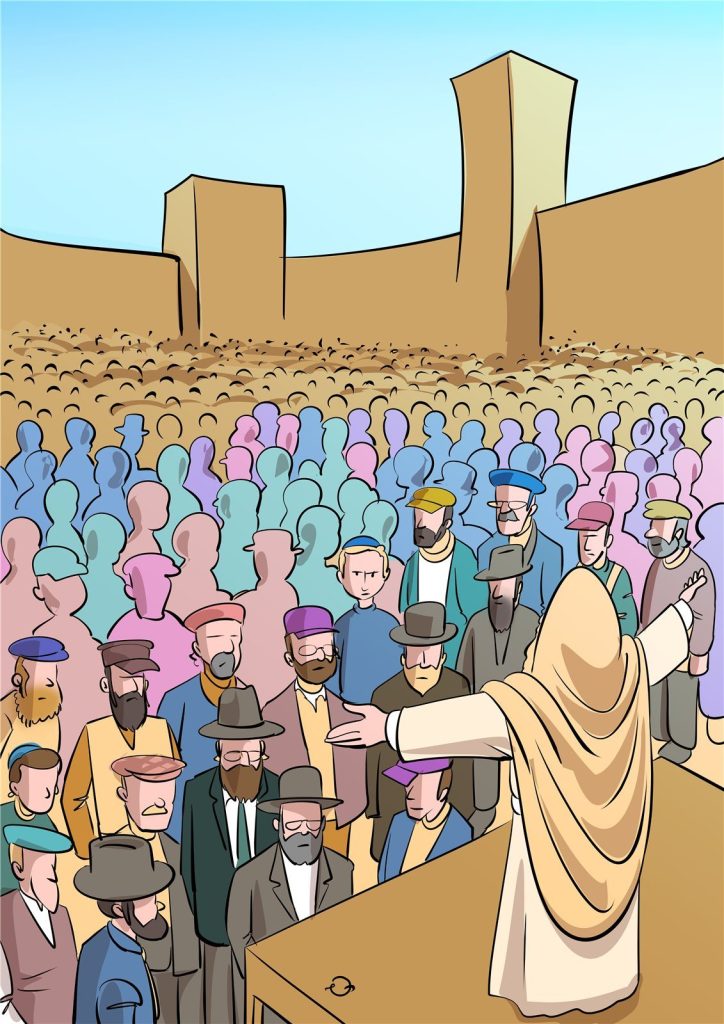
At the sight of Eliyahu, Achav turned to him with sharp words: “Is it you, the one who brings troubles upon Israel?”… Achav accused Eliyahu of bringing famine upon the people of Israel, but Eliyahu was unmoved: “It is not I who have brought troubles upon Israel,” he replied calmly, “but you and your father’s house, by forsaking the commandments of G-d.”…
He asked Achav to gather all prophets of Baal to Mount Carmel, and to build there two altars: one for Hashem, and one for Baal. Each group would pray for fire to ignite on its own upon the altar, and whoever’s prayer was answered — would prove that his G-d is the true G-d.
The people gathered before the fascinating spectacle, and Eliyahu addressed them: “How long will you waver between two opinions?!”… he rebuked the crowd. “If G-d is the Lord — follow Him, and if Baal — follow him!”… The Jewish people looked at him in bewilderment and could not find words to answer. Their yetzer pulled them to worship idols again and again, but deep in their hearts they knew that Hashem is the one G-d. They could not detach from either side, and always leaped between the side of holiness and the opposing side…
The prophets of Baal, as expected, failed to bring fire down upon their altar. They called out hoarsely from morning until noon, but there was no answer. At the time of the afternoon offering, Eliyahu built an altar to Hashem, and filled it and the trench surrounding it with enormous quantities of water (to magnify the miracle). “Answer me, Lord, answer me,” Eliyahu called, “that this people may know that You are the Lord G-d.”…
At the end of Eliyahu’s prayer, the people witnessed a magnificent sight: fire descended from heaven and, despite the abundant water, seized the altar of Hashem and consumed everything — the sacrifice, the wood, and even the stones, the dust, and the great quantities of water surrounding the altar. At this wondrous miracle, all cried out together: “Hashem Hu HaElokim, Hashem Hu HaElokim!”
The prophets of Baal fled for their lives, but the people chased them and killed them at Eliyahu’s command. Now, when idol worship had ended and the Jewish people did teshuva — rain began to fall and soak the land, and the great famine gradually disappeared. Once again, Pinchas-Eliyahu had turned Hashem’s wrath away from the Jewish people and saved their lives.
The Holy City of Tiverya, 5785
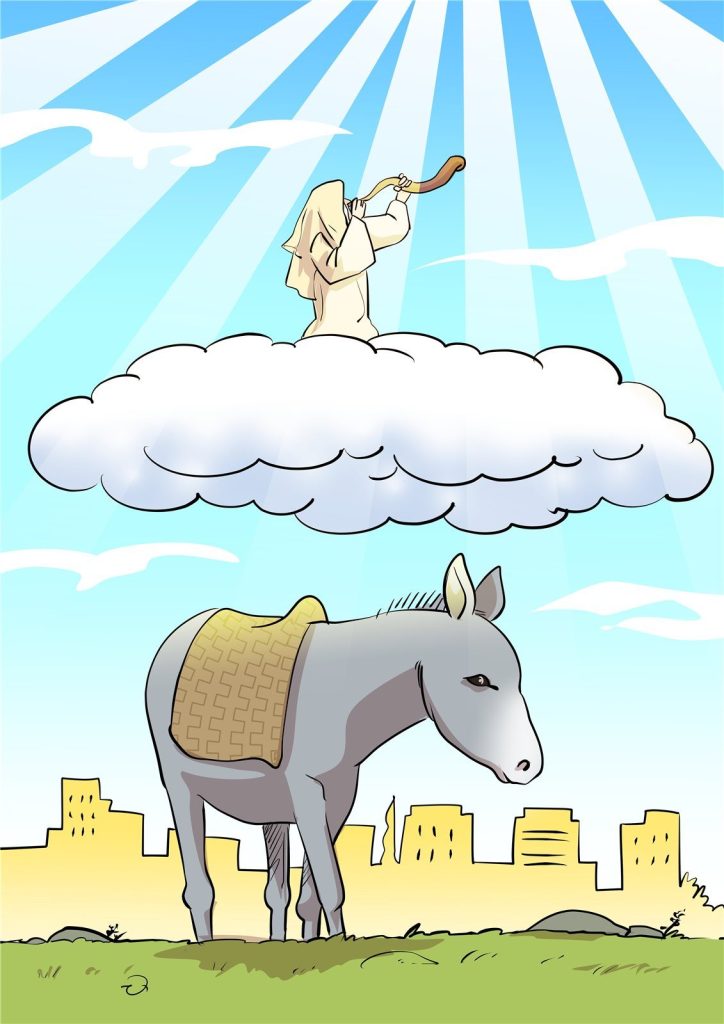
Throughout the generations, Eliyahu has been assigned many important roles: he converses with tzaddikim, performs miracles, and serves to this day as the “Malach HaBris” who sits in his honored chair at every bris mila, bearing witness that the people of Israel observe the bris with mesirus nefesh.
But the most distinguished and important task assigned to Eliyahu HaNavi is the role of heralding the Geula: “Behold, I will send you Eliyahu HaNavi before the coming of the great and awesome day of the Lord… and he shall turn the hearts of fathers to their children, and the hearts of children to their fathers.”…
Eliyahu is tasked with preparing the hearts of Am Yisrael for the Geula, returning them in teshuva, and announcing that Moshiach Tzidkeinu is coming. The official announcement of Moshiach’s arrival must be delivered to the Beis Din HaGadol — the Sanhedrin — whose original seat was in the Lishkas HaGazis in Yerushalayim, but after the churban ha’bayis the Sanhedrin wandered from place to place, until coming to Teverya, where it is destined to be renewed, and where Eliyahu is expected to come and herald the coming of Moshiach.
In a yechidus with the Chief Rabbis of Israel (11 Iyar 5749), the Rebbe stated that “no one would mind even if Eliyahu HaNavi came outside of Israel, even in Brooklyn, and the next day Moshiach came to Teverya.”… On another occasion (a private audience for wealthy donors, 7 Tishrei 5751), the Rebbe revealed: “Since Moshiach can come any day… Eliyahu HaNavi literally comes to Teverya every day and heralds the coming of Moshiach (particularly) to those who stand in the state and position of ‘I await him every day that he will come’ — even those who do not say this in speech (as is the Chabad custom), but think about it.”…
Eliyahu has already come, the Rebbe has already heralded, and all that remains for us is to believe and accept his malchus with the proclamation: Yechi Adoneinu Moreinu V’Rabeinu Melech HaMoshiach L’Olam Va’ed!
Three Keys Together?
At the farbrengen marking the acceptance of leadership by the Rebbe on Yud Shevat 5711, the Rebbe said: In the Rayatz one could see all three keys together — he blessed Jews with children, parnassa (rain), and saving of lives — at the same time. The Rebbe’s words became widely known and stirred controversy: how could it be said of a particular tzaddik that he is greater than Eliyahu HaNavi?…
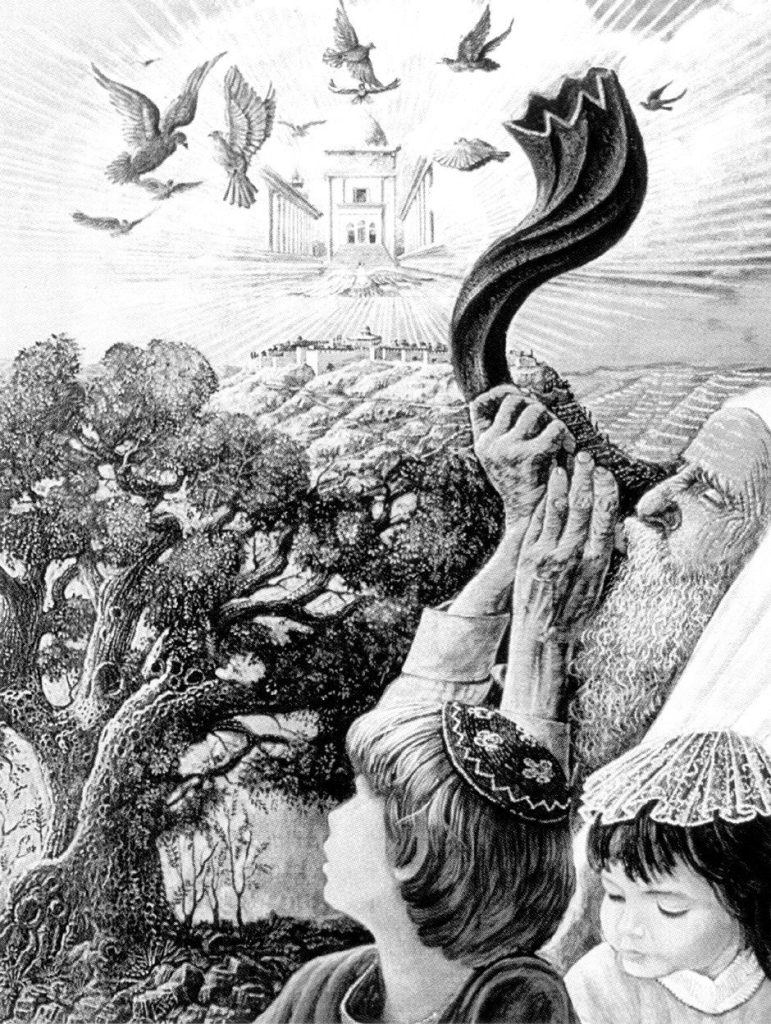
Later, at the farbrengen of Yud-Gimmel Tammuz, the Rebbe explained: Eliyahu HaNavi received the key of rain as a shliach, who is ultimately considered a separate entity from the one who sent him. Therefore it was not possible to give him an additional key at that time. However, the Rebbe’s role is to serve as a “memutza ha’mechaber” between the Chassid and Hashem, and the blessings he grants the Chassid are given directly from G-d’s word. Therefore he can use all the keys together — for even when he uses them, they remain in Hashem’s hands…
The Fire Will Descend Again, But on the Other Side…
The great Chassidic masters of earlier generations warned that before the coming of Moshiach there would be difficult and bitter trials that would make emuna challenging. In Eliyahu’s time, the people saw fire descend upon the altar of Hashem — but on the eve of Geula, said those tzaddikim, the fire would appear as if it were descending on the other side — the side opposing faith in Hashem and His Moshiach… Therefore, we are called upon to fortify ourselves with firm and strong faith, and not be swayed by what appears before our eyes.
“The Tishbi Will Resolve Questions and Problems”
Throughout the generations, the image of Eliyahu as Ha’Navi who resolves all doubts and dilemmas became deeply rooted among the Jewish people. One who finds a lost object and does not know to whom to return it — may set it aside “until Eliyahu comes.” A sugya in Gemara that reaches no resolution is concluded with the expression “Teiku” — an acronym for: “Tishbi Yetaretz Kushyos Ve’ibayos” — “Tishbi will resolve questions and problems.”
Why will specifically Eliyahu resolve the questions and doubts, and not Moshe himself? The Zohar explains that Moshe will be resurrected in a state of being “heavy of mouth and heavy of tongue,” and Eliyahu will serve as his “interpreter” — just as Aharon the Kohen of whom it was said “he shall be your mouth.”
Zachur La’Tov – Remembered for Good
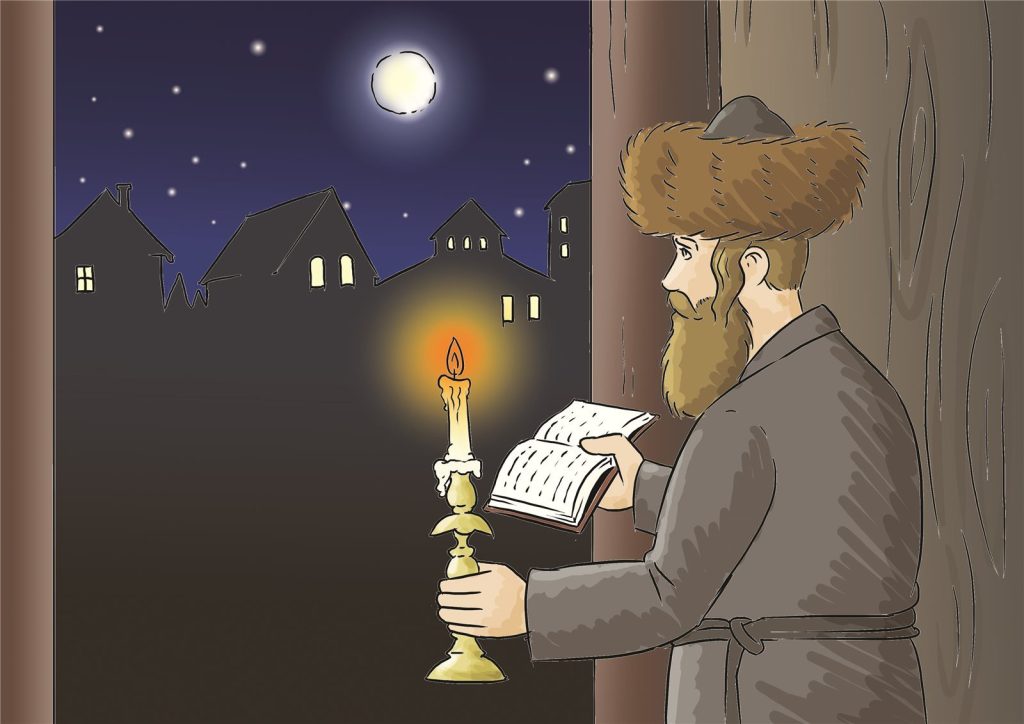
A common addition to Eliyahu’s name is the phrase “remembered for good.” Thus we daven in Birkas HaMazon: “May the Merciful One send us Eliyahu HaNavi, remembered for good, and may he bring us good tidings of salvation and consolation.”
Generally, expressions like “may his memory be a blessing” or “remembered for good” are said of tzaddikim who have passed away. Eliyahu HaNavi, as is known, ascended to heaven in his body, and he continues to act in the world on certain occasions. Therefore the intention of the phrase “remembered for good” as applied to him is the reverse of the usual — not referring to the past, but to the future, in which he will herald for us the tidings of the Geula (Siddur “Iyun Tefilla”).
The Seventh Lives Forever
Eliyahu is not the only one promised eternal life. It is also said of Moshe that “Moshe did not die,” and likewise of other tzaddikim such as Chanoch. Rabbeinu Bechayei points to a common denominator for all these figures: they are all “seventh” (Chanoch — seventh from Adam, Moshe — seventh from Avrohom, and Pinchas who is Eliyahu — seventh from Yaakov), and they symbolize the era of Geula, the “day that is entirely Shabbos,” in which all will live forever.
In several of his sichos, the Rebbe expressed that the leader of our generation, the seventh generation, would also merit eternal life. He would not need to depart from the world in order to complete his mission, but would continue his life in his body and redeem the entire Jewish people in the true and complete Geula.
Ha’Navi, Ha’Tishbi, Ha’Giladi?
In the account of Achav’s encounter with Eliyahu, he is described as “Eliyahu HaTishbi, of the inhabitants of Gilad.” According to the commentators, Eliyahu resided in the city of Tishbi located in the region of Gilad, and thus he was given his three famous titles: Eliyahu HaNavi — for his famous prophecy and righteousness; Eliyahu HaTishbi — named after the city of Tishbi in which he resided; Eliyahu HaGiladi — named after the region from which he came.
Following the Baal?
On one occasion, the Rebbe asked: how did Eliyahu allow the Jewish people the option of following the Baal? Is it not preferable to waver between two opinions than to abandon faith in Hashem entirely? The Rebbe explained that deep in the soul of every Jew is embedded an eternal faith in Hashem, which he cannot resist. Eliyahu knew that if he forced the Jewish people to choose between two paths — there is no doubt they would choose the path of Hashem, and not the opposite…
Salute #1500 • pp. 2-9
© 2026 Beis Moshiach Magazine. All rights reserved.
This article originally appeared in Beis Moshiach #1500. You are welcome to share it with friends and family by email or in print, provided that you do not change, add to or omit any part of it, you credit the author and Beis Moshiach, and you include a link to archive.bmoshiach.org (written out in full in printed copies).
To republish this article in a newspaper, magazine, book or website, please request permission in advance at [email protected].