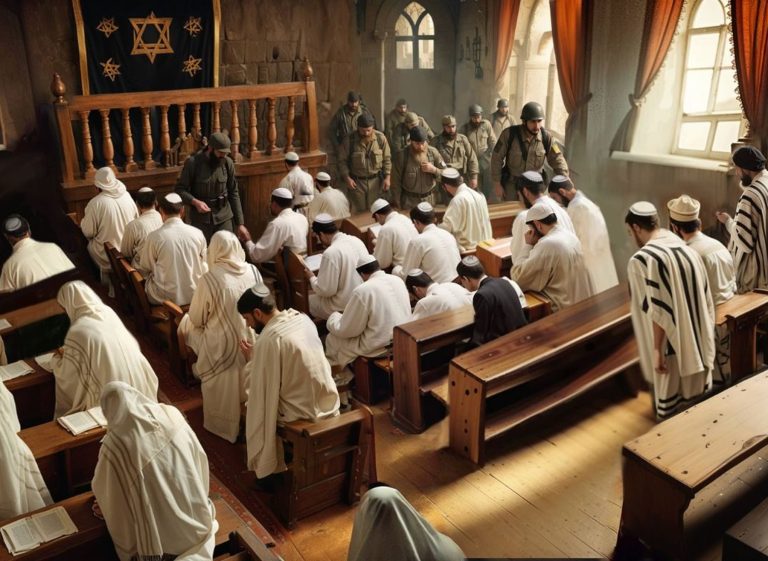
The Night I Walked to the Rebbe
From the TzaddikStory.org collection
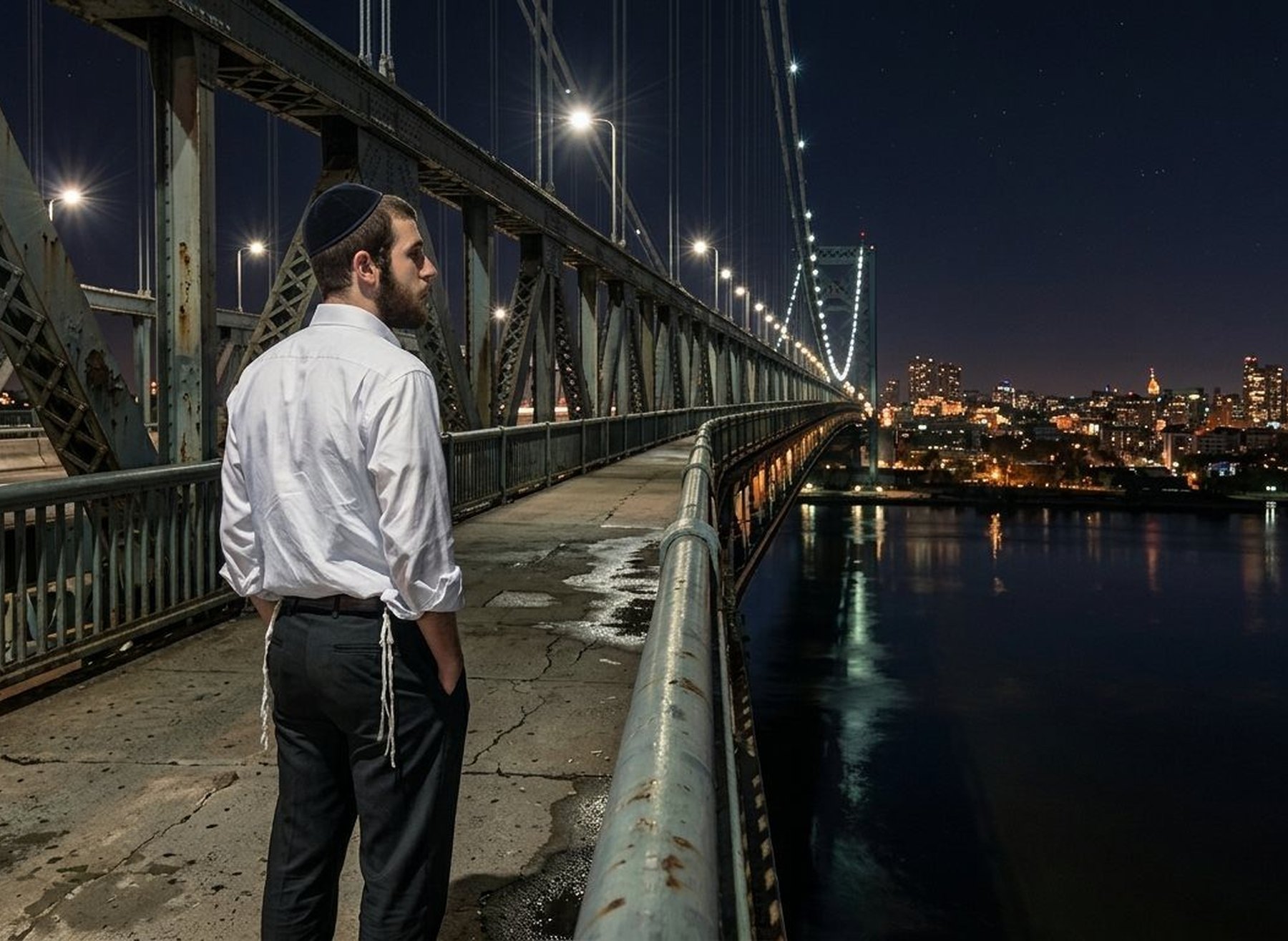
It was 1:00 in the morning. It was Yom Tov, so I couldn’t use a car, taxi or a subway. But I had two feet, a yarmulke, tzitzis, and somewhere deep inside me – something pulling me forward.
I was standing outside my aunt and uncle’s house in New Jersey, still dressed from the seder, looking down the dark road toward Route 4.
“That’s it,” I whispered to myself. “I’m going to 770.”
Now, if you know anything about Crown Heights, you know it’s not exactly around the corner from New Jersey. It’s across the George Washington Bridge, through all of Manhattan, past Brooklyn – a walk that would take most of the night.
And it was Pesach. The first night of Yom Tov, going straight into the second.
I didn’t have a car. I couldn’t take a taxi or a subway. But I had two feet, a yarmulke, tzitzis, and somewhere deep inside me – something pulling me forward.
So I started walking.
You might be wondering: how does a Jewish kid from Teaneck, New Jersey end up in the middle of the night, walking alone toward 770 Eastern Parkway on Pesach?
That’s exactly what I want to tell you.
But to tell you that story, I have to start at the beginning.
* * *
My name is Rabbi Immanuel Storfer, and I grew up in Teaneck, New Jersey.
Nothing dramatic. Just a regular kid in public school, doing regular kid things.
We were Jewish, sure. But not the kind of Jewish that filled up your whole day. It was more like… a label. Something you knew about yourself, but didn’t really live.
No one sat me down and explained Yiddishkeit. No one taught me how to daven. If you asked me back then what a siddur looked like, I probably would’ve guessed it was some kind of history book.
Life was school, friends, sports, homework, weekend plans. That was it.
And then came college.
I went to New York University – NYU – right in the middle of Manhattan, where everybody is everything. You could walk one block and hear five languages. You could pass a musician on the corner, a businessman rushing by, and someone handing out flyers for a club you’d never go to. The city didn’t slow down for anyone.
And me? I was just like any other college student. Going to class, figuring things out, living a regular life.
One afternoon, I was walking through the crowded streets of Manhattan when I noticed something I’d never seen before.
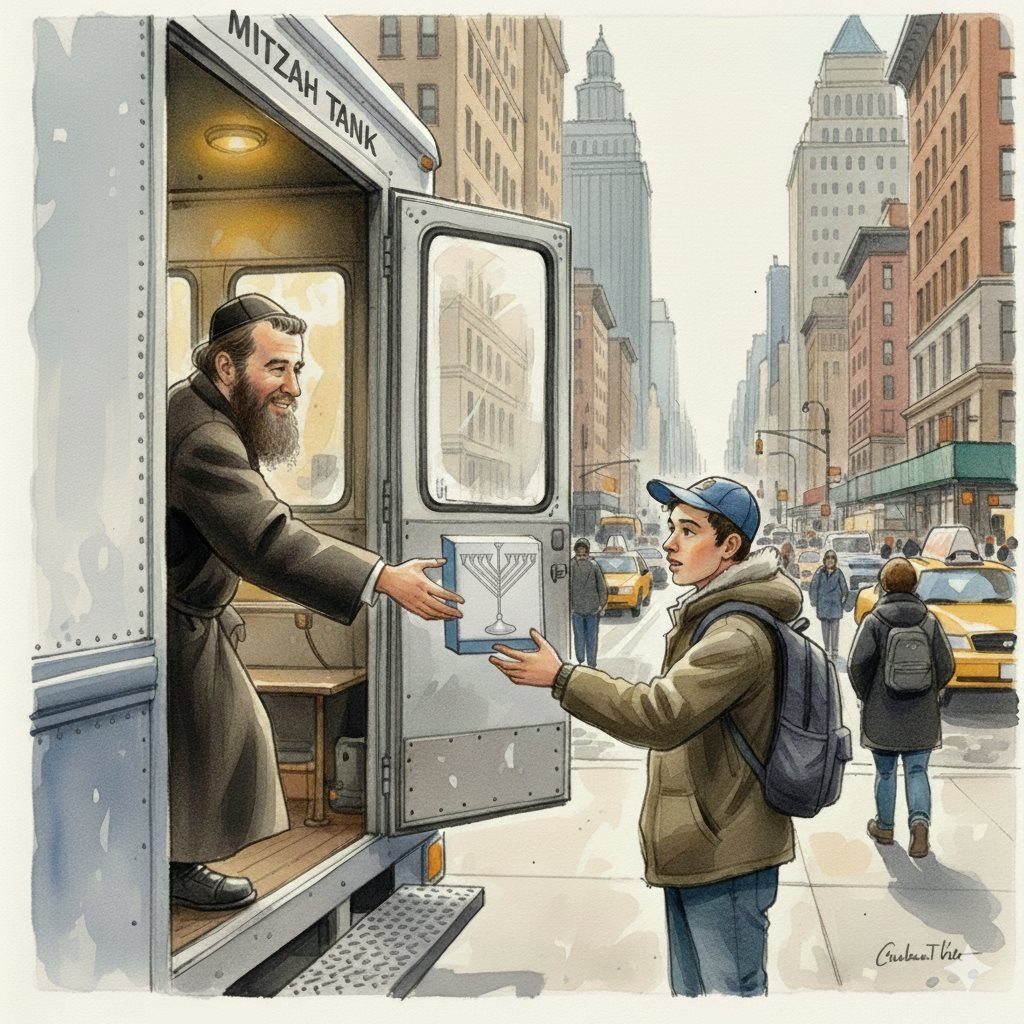
A truck. Actually, more an RV than a truck. This one was colorful, almost like a rolling billboard. It had pictures on the side, big Hebrew letters, and words I couldn’t read.
I slowed down. I wasn’t even sure why. I just felt myself drifting closer, staring at the Hebrew and wondering what it meant. My brain was trying to guess. Was it an advertisement? A museum thing? Some kind of festival?
Just then, the door opened.
A man stepped out.
“Excuse me,” he said kindly.
I froze for a second, because in New York you don’t usually stop for strangers. Not like that.
Then he asked, “Are you Jewish?”
I blinked. “Maybe… uh… no,” I said.
The man smiled. “I think you’re Jewish.”
“I’m not really interested,” I muttered, trying to walk away.
But he didn’t give up. “You are interested,” he said lightly, like he was sure. He reached into the truck and held out a small box. “Here – take a menorah.”
“A menorah?” I stared at it. “Why?”
“Because you’re Jewish,” he said. “And I need to tell you something. I’m a shliach of the Rebbe.”
“The Rebbe?” I repeated, confused. “Who’s that?”
Instead of answering right away, the man began to tell a story.
“My name is Psachya Korf,” he said, “and I’m from Crown Heights.”
I listened politely. I didn’t even know why I was still standing there… but something about how Psachya told his story made me want to hear more.
“When I was younger,” Psachya said, “I was caught in a terrible fire. The firefighters rushed me to the hospital with very serious smoke inhalation. It was so bad, they put me on a helicopter and flew me to Westchester Children’s Hospital.”
Psachya’s face turned serious.
“The doctors told my parents… they said I had brain damage that wouldn’t go away, and that I only had a few hours left to live.”
My eyes widened. “How could that be?” I thought. “He’s standing here right now!”
Psachya nodded, like he understood the question without it even being asked.
“My father ran to the Lubavitcher Rebbe for a bracha,” he said. “The Rebbe gave him a dollar and a blessing. And from that moment, everything began to change.”
Psachya paused.
“I opened my eyes for the first time since the fire,” he said quietly. “The doctors were shocked. I got better and better… until I was healed. It was a miracle.”
I stood very still. I looked at Psachya – alive, talking, smiling – and felt something shift inside me.
Who is this Rebbe? I wondered. I want to know more.
Psachya took my phone number so we could stay in touch and invited me to visit 770, the Rebbe’s shul. He also made sure I met Rabbi Eli Cohen, who ran the Chabad House at NYU. I began learning a little bit, very slowly – asking questions, listening carefully, taking one small step at a time.
And that was the beginning.
* * *
A few months later, Rosh Hashana arrived. I met a frum student at NYU who was taking Jewish education classes. When I told him I was looking for a meaningful place to spend Yom Kippur, his face lit up.
“You want inspiration? You want truth? You need to go to 770!”
What do I have to lose? I thought. “Sounds great,” I said. “I’ll go.”
I felt excited and nervous at the same time. I’m going to the world’s biggest Chabad House – even though I wasn’t exactly sure what that meant or what it looked like.
* * *
The moment I walked into 770, my eyes widened.
The place was packed with thousands of people from all over the world – Israelis, French Jews, and many others – each one getting ready to daven for Yom Kippur. There was no space to move.
I squeezed myself into a tiny spot. People pressed in from every direction, elbows and backs and knees touching me all at once. I felt like a sardine squished inside a can.
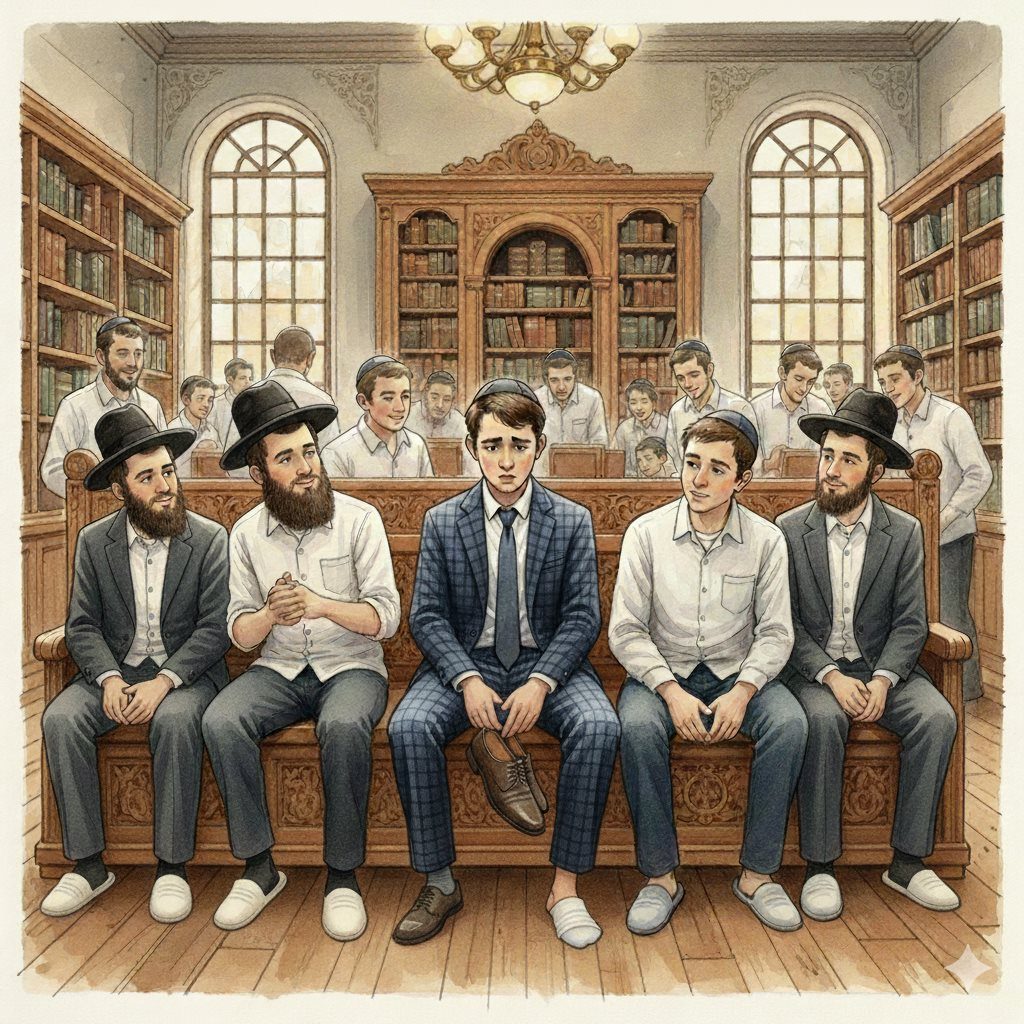
As I stood there trying to breathe, I noticed something strange. The baqchurim were wearing beautiful suits and hats – but instead of regular shoes, many of them had slippers on their feet.
Confused, I leaned toward one of them. “Why are you wearing slippers?” I asked. “They don’t match your nice clothes.”
“It’s Yom Kippur,” the bochur explained.
“I know it’s Yom Kippur,” I replied. “That’s why I came here!”
“You can’t wear leather shoes on Yom Kippur!”
I had no idea. I thought when you dress up for shul, you wear a suit and leather shoes. No one had ever told me there were special rules.
The bachur brought me over to Rabbi Yehuda Kalman Marlow a’h, one of the rabbis of Crown Heights. Rabbi Marlow looked at me kindly and gave me my very first psak halacha. “You have to take off your shoes,” he said.
My heart dropped. “This is crazy,” I thought. “I’m standing in a room with thousands of people, and I have to take off my shoes?”
But the Chassidim around me leaned in encouragingly. “Do a mitzva! Come on. You can do it!”
I hesitated – then slowly bent down, and with shaking hands, slipped off my leather shoes. I stood there in my socks.
That was when things suddenly grew louder. People began calling out as the Sefer Torah was taken out.
And not just any Sefer Torah. It was the Rebbe’s own Sefer Torah.
The Torah was brought closer and closer, and all at once people from every side pushed forward. I tried to stay on my feet, tiptoeing carefully. Suddenly, a very large man stepped right on my foot and I gasped in pain. Before I could recover, someone’s elbow slammed into my stomach. I lost my balance – and fell to the floor.
The big man stepped on my stomach, and for a moment I couldn’t breathe.
“I’m stuck down here!” I called out, grabbing onto someone’s foot.
“There’s a kid on the floor!” someone shouted.
“I’m not a kid!” I cried back. “I’m eighteen years old. I’m just trying to do Yom Kippur!”
I felt overwhelmed and upset. For a moment, I wanted to leave and never come back.
But the bachurim around me wouldn’t let me go. “Just try a little more,” they said. “We’ll help you.”
I took a deep breath. I decided to stay.
At the end of davening, I saw something that completely shocked me. Everyone around me started spitting.
Spitting? In shul?
They were up to Aleinu – where Chabad has a minhag to spit after mentioning avoda zara – but I had no idea. All I knew was that the floor suddenly felt like a minefield. And I was still in my socks.
I tiptoed carefully, trying not to look too startled, but inside I was completely grossed out.
Finally, after davening ended, I turned to the person next to me and blurted out, half-joking and half-serious, “Can I at least have some shoes now?”
One bachur, Gershon Avtzon, nodded. “I have an extra pair of slippers at my house.”
“Great,” I said. “Bring them here and I’ll wear them.”
Gershon shook his head. “I can’t do that.”
“Why not?”
“It’s Yom Kippur. You can’t carry.”
I had never heard of a “no carrying” rule before! Gershon explained that if I wanted the shoes, I’d have to walk to his house to get them.
“This is crazy!” I thought. But somehow, Gershon convinced me.
So I walked out onto Kingston Avenue in Crown Heights – in my socks. When I reached President Street, I discovered something very unpleasant. The night before, people had done kaparos with chickens, and the street was filthy. My socks got completely ruined, covered in feathers from every direction.
When I finally got back to 770, I peeled off my socks and thought: This is the craziest experience of my life. I don’t think this is for me.
But Gershon looked at me kindly. “Just come back tomorrow.”
The next day, I came back in proper slippers – more prepared, standing my ground, making sure no one pushed me around.
I still wasn’t sure I was happy to be there. But then, as Yom Kippur drew to a close, everything changed.
Thousands of people burst into song, dancing and jumping to a powerful tune called Napoleon’s March.
The room shook with energy and joy. I felt like Moshiach might come at any moment.
That niggun, sung by thousands of voices together, went straight into my heart. It touched my neshama in a way I had never felt before.
The year before, I had broken my Yom Kippur fast at a pizza shop, eating non-kosher food. Here in 770 it was completely different.
“This is a powerful place,” I thought. “This is the Rebbe’s shul. This is the holiest time of the year, in the holiest place I’ve ever been.”
Just hours before, I had been sure I would never return. Now, Baruch Hashem, my heart felt completely changed.
I wanted to come back.
* * *
And that brings us back to that Pesach night.
That year, Shabbos went straight into Pesach. I had asked my rabbi whether I should go home to New Jersey or spend Yom Tov in Crown Heights. “My parents aren’t frum,” I told him. “But I really want to have a proper Seder.”
“You belong with your parents,” he said.
Even though it was hard, I listened and went home.
The family gathered at my aunt and uncle’s house. People came late, some had been shopping on Shabbos, and the Seder felt more like a regular meal than anything else. I tried to share some divrei Torah, but no one seemed interested. A few people even laughed – my new way of living felt strange to them.
As the night went on, I felt more and more out of place. When I accidentally knocked over some wine, someone commented that I was causing too many problems.
I can’t take it anymore, I thought.
I quietly finished the Haggada on my own, ate my afikoman, and went upstairs. I changed my clothes and looked at the clock.
1:00 in the morning.
Which is exactly where we started.
* * *
I stepped outside and began walking toward Route 4. I reached the George Washington Bridge, but the police stopped me and sent me to a different path.
By 2:30 in the morning, I was walking through Washington Heights. Then Harlem. People stared at me as I passed – a young man with tzitzis and a yarmulke, walking alone through the night.
“Where are you going?” a group of people called out.
“I’m going to 770 to daven,” I answered.
Later, people asked if I had been scared.
“It was Leil Shimurim,” I always answered. “A night of protection. Hashem was watching over me. And besides – I was going to the Rebbe.”
I walked past Times Square as the sky began to lighten, then through Little Italy and Chinatown. By seven in the morning, I reached Williamsburg. Around eight o’clock, my legs felt heavy and every step hurt. Someone tried to convince me to stop and rest.
“No,” I said. “I’m going to 770.”
At exactly 9:45 in the morning – after walking nearly nine hours – I arrived.
I walked through the doors of 770 just in time to daven with the Rebbe’s minyan.
I was exhausted. But my heart was full. I davened with more kavana than ever before in my life.
That Pesach was the first time I ever celebrated Yom Tov in a truly frum home. And even though I had never seen the Rebbe with my own eyes, I knew something for certain.
Through Yom Kippur, through that long walk on Pesach – I had been there with the Rebbe. I had davened with the Rebbe even though I couldn’t see him.
* * *
After that Pesach, I couldn’t stop thinking. I knew I needed to take my learning seriously. I wanted to go to a Chabad yeshiva for people who were just starting out – a place called Mayanot.
I called the shluchim I knew and told them my plan. But for some reason, they didn’t get back to me. I tried again. Still nothing.
Around the same time, a rabbi on campus suggested I try a different yeshiva – not Chabad. The place sounded welcoming, and they encouraged me to come. As winter break approached, I felt pulled in two directions.
One part of me said: This is easy. Just go.
But another part whispered: I started this journey with Chabad. Something tells me I’m not finished yet.
I didn’t know what to do.
That’s when one of the shluchim said something that surprised me.
“Why don’t you go to the Ohel,” he suggested, “and write to the Rebbe about your plans?”
I stared at him. “Write to the Rebbe? How?”
It was the year 2000, a few years after Gimmel Tammuz, and I couldn’t understand how you could write a letter to a Rebbe you can no longer see. The shliach answered calmly, like it was the most natural thing in the world.
“Chassidus explains,” he said, “that tzaddikim are above nature. Even if it looks like they have left this world, they’re still very much with us – and in ways we don’t fully understand, but very much see, they can still give us advice and brachos.”
I nodded slowly. I still didn’t fully understand. But something about the way he said it made me feel safe enough to try.
“I guess it doesn’t hurt,” I decided.
A short time later, my parents were driving me to JFK for my flight to the non-Chabad yeshiva. The Ohel was right on the way.
“Can we stop there first?” I asked.
My parents looked at each other… and agreed.
At nineteen years old, I took the moment very seriously. I wrote carefully, thinking hard about every word.
“Rebbe,” I wrote, “I want to learn Torah and grow in my Yiddishkeit. One yeshiva will help me learn. Another yeshiva – Mayanot – will help me learn and connect to the Rebbe. Where do I truly belong?”
I folded the letter and stepped outside, unsure how an answer would even come.
Just then, I noticed a screen nearby. A video of the Rebbe was playing.
The very first word out of the Rebbe’s mouth was – “Mayanot.”
I froze.
The English subtitles spelled it out clearly: M-A-Y-A-N-O-T. The exact name I had written in my letter, just minutes before.
The Rebbe continued speaking about the wellsprings of Torah spreading outward – repeating the word “Mayanot” again and again.
I felt my heart racing.
This is real, I thought. The Rebbe is answering me.
To be continued
Salute #1500 • pp. 17-23
© 2026 Beis Moshiach Magazine. All rights reserved.
This article originally appeared in Beis Moshiach #1500. You are welcome to share it with friends and family by email or in print, provided that you do not change, add to or omit any part of it, you credit the author and Beis Moshiach, and you include a link to archive.bmoshiach.org (written out in full in printed copies).
To republish this article in a newspaper, magazine, book or website, please request permission in advance at [email protected].