The Story of Atlantic City Mikvah
What did the Rebbe tell the elderly Mr. Sommers, chairman of the committee for building the Atlantic City Mikvah, when he gifted the Rebbe a special watch?
I
Sometimes revolutions begin with a small, quiet shiur.
So it was with a Tanya class given by Rabbi Berel Baumgarten (who would later serve as the Rebbe’s shliach in Argentina) at the Jewish Theological Seminary in Manhattan. His eloquence and the way he delivered the class earned him a reputation among the university’s attendees.
The taste of th’ose shiurim stayed with Rabbi Aaron Krauss for several years afterward, when he was appointed rabbi of a large Conservative congregation in Atlantic City. He remembered the wonderful shiurim and the dedication of the young Lubavitcher, and asked Rabbi Baumgarten to organize a Shabbaton in the Lubavitch spirit at his synagogue.
And so, on a dreary Friday in the month of Cheshvan 5724, Rabbi Baumgarten set out together with Bentzion Shafran a’h, Mordechai Kalmenson a’h, and – may he live and be well – Avrohom Lipsker, to hold the Shabbaton. For understandable reasons, the Shabbaton was not held in the Conservative synagogue itself, but in an adjacent auditorium.
Rabbi Baumgarten, with his deep voice, led the prayers. Bentzion Shafran was among the main speakers. And the tmimim Mordechai Kalmenson and Avrohom Lipsker presided over a fascinating symposium of questions and answers on Judaism and Chassidus.
Although Shabbos began at an early hour, the program started late – due to the fact that many community members work on Fridays until late in the evening, regardless of when Shabbos comes in. It was first at eight o’clock that people begin arriving at the synagogue.
It is not hard to guess that if a Chabad evening begins after eight o’clock, it will not end before midnight… The rich program, delivered by such talented Chassidim as Baumgarten, Shafran, Kalmenson, and Lipsker, captivated those present throughout an evening full of Jewish content. The joyful Chabad niggunim blended with the oldtime niggunei dveikus. An expression of genuine happiness was visible on the faces of the participants. None was happier than Rabbi Krauss.
Well after midnight, the Shabbos meal concluded and the community members dispersed to their homes. Only the Lubavitchers remained in the auditorium together with the community rabbi for a wrap-up conversation and exchange of impressions and experiences.
Just before they turned to leave, the Lubavitchers remembered something.
“How do we get to the mikva tomorrow?”
“What mikva?! Which mikva?!” wondered the rabbi. “I’m very sorry, but our city has no mikva…” he said, seemingly unaware of the absurdity of that statement.
The shluchim could not believe their ears. Atlantic City was known as a city with large Jewish communities, including observant residents. They had come to the city believing there was a mikva there, and suddenly – this.
No mikva, so one must be arranged – but that was a long-term project. What would happen now? Would they have to daven Shacharis without a prior immersion?
After a brief consultation, it was decided to go to the pool in the courtyard of a nearby hotel. No other option was in sight.
Rabbi Krauss promised to arrange the pool as a substitute for the mikva in the morning, and headed home tired and satisfied.
That was the moment they were left alone – when they began to absorb the grave significance of the situation. They knew the statement in the HaYom Yom that states: when a mikva is built in a Jewish city, it saves the entire city! It is hard to find a Jewish city to which that saying applies – and here an opportunity had presented itself.
With the resolve that everything must be done to ensure a mikva would soon be established in the city, they retired for a brief rest…
II
After immersing in the pool of one of the large hotels in the area, the Lubavitchers davened “just like at 770”…
That very day they approached Rabbi Krauss and asked him to convene, immediately after Shabbos ended, several balebatim for a special meeting, at which they would explain the importance of the mikva. This was not a Shabbos matter, yet they were faithful to the halacha that “communal needs may be attended to on Shabbos.” And is there anything greater or more necessary than this?
Despite the short notice, more than a minyan of laymen – among the community’s most prominent members – arrived at the emergency meeting. The meeting was very focused; during it, the participants were explained the great importance of the mikva, and how vital this mitzva is for the continuation of the Jewish family unit. At the conclusion of the meeting, it was decided to establish a special committee for the building of the mikva. Mr. Yitzchok Sommers was appointed chairman.
Mr. Sommers was one of the community’s wealthy men. He had made his fortune in the antiques trade. In the course of his business, he did not always take care to tell the whole truth about the objects he sold. For example, he might sell a fine chair from some unknown estate as a chair belonging to a famous and admired personality…
Decades had passed this way, and in his old age he had grown weary of a life of falsehood and hypocrisy. During the meeting, he turned to Mordechai Kalmenson and asked what he should do to atone for all those years of dishonest behavior.
Kalmenson answered that he could not prescribe a tikkun for him, but of one thing he was certain: if he took upon himself the chairmanship of the committee, there was no doubt this merit would stand in his favor…
Mr. Sommers accepted the offer, even though the role demanded much of him.
The Lubavitchers wasted no time. Already on Sunday morning, they arrived for a meeting with the city’s chief rabbi, Rabbi Moshe Shapira. They found a very elderly rabbi, shomer mitzvos and bearded, who had served as the city’s Rav for forty years. In conversation with him, it emerged that in his youth he had studied at Tomchei Tmimim in Lubavitch, in the aura of the Rebbe Rashab.
The delegation breathed a sigh of relief and for a few minutes felt “at home.” How pleasant it was to speak with an original ‘tamim’ who had studied in Lubavitch-of-Lubavitch and remembered the Rebbe Rashab and his son the yeshiva’s menahel, the Rebbe Rayatz.
After a pleasant exchange of pleasantries, they came to the unavoidable question: how could a city have no mikva?
Rabbi Shapira looked at them with an innocent expression: “I don’t understand what you want – there is an ocean here!”…
The delegation told him about the Shabbaton they had organized, and about the establishment of the new committee for building the mikva. It was plainly apparent that he was not pleased by the unexpected incursion of young Chabad men who, in the space of a single Shabbos, had managed to set things in motion that he had not even thought about in forty years… And worst of all – it had all been done without informing him!
It was impossible not to notice the changes that came over his wrinkled expression. They apologized if they had offended him, explaining that they had not come to encroach on his territory and had no intention of taking over the rabbinate…
Wishing to ease the tense atmosphere, they suggested that he be the rabbi in charge of the project. Even this offer did not soften his heart, and he remained firm in his position.
III
Upon the tmimim’s return to Beis Chayeinu on Sunday night, they hastened to write the Rebbe a detailed report on the entire Shabbos, with the crowning highlight being the establishment of the committee for building the mikva. The report was brought in to the Rebbe the very next morning.
A few days later, Mordechai Kalmenson was summoned to Rabbi Chodakov’s room, where he was asked to take on the management of the mikva project. He was chosen because he was a bachur with time at his disposal, capable of dedicating himself to the job.
And indeed, Mordechai Kalmenson dedicated himself to the matter with all his energy. He traveled again to Atlantic City, convened the elected committee for a meeting, and together they decided on a division of responsibilities in which each committee member took on a role. From then on, he traveled there at least twice a month to closely monitor the progress.
The Rebbe was involved in every detail and assisted greatly through the secretariat. When the detailed architectural plans for the mikva needed to be drawn up, Rabbi Chodakov directed him to approach Rabbi Nissan Telushkin, who was an expert on mikvas. Rabbi Chodakov himself called Rabbi Telushkin and asked him to assist as much as possible.
Many others of great standing were also enlisted in the building of the mikva, for in those years – the early ‘chofs’ – building a mikva was no small thing. Only a few people were knowledgeable in all the intricate details involved in such a project.
And more than that – the Rebbe blessed Mordechai Kalmenson in an unusually personal way: “Az du vest endiken dem proyekt – vest du veren a chassan.” [= When you finish the project, you will become engaged.]
IV
Establishing a committee and holding meetings was not enough. A spiritual awakening needed to be created within the Jewish community of the city.
With this in mind, young Kalmenson decided to bring dozens of community members to a farbrengen of the Rebbe. He made great efforts to bring as many people as possible to the Rebbe.
After much effort, he succeeded in bringing about fifty of the community’s leaders and prominent figures to a farbrengen of the Rebbe held in honor of Yud-Beis Tammuz.
The distinguished guests arrived a few hours before the farbrengen began. One by one they stepped off the bus and walked straight into 770. At first they felt some trepidation, but the walls of estrangement soon crumbled, and the G-dly soul swept them into a visit of spiritual elevation within the Rebbe’s dalet amos…
The large group stood out among those present, and the Rebbe even addressed the purpose of their visit. During his sichos, the Rebbe emphasized several times the importance of the mikva to maintaining a proper Jewish life, noting that it is the only mitzva that affects a Jew’s life even before birth…
Between one sicha and the next, Mordechai Kalmenson introduced the committee chairman, Mr. Yitzchok Sommers, to the Rebbe. He shook the Rebbe’s hand, and then suddenly produced from his pocket two watches on which, in place of numbers, Hebrew letters were inscribed. He presented one watch to the Rebbe and another to Kalmenson…
The Rebbe took the watch, glanced at it for a fraction of a second, then looked at Mr. Sommers and said with a broad smile: “I accept the gift – on the condition that you take responsibility for building the mikva.”
Mr. Sommers nodded his head in agreement, and to everyone’s surprise the Rebbe placed the watch in his inner pocket.
The Chassidishe farbrengen had its effect, and after the farbrengen all the community’s prominent members returned home, imbued with a spirit of dedication toward building the mikva. The Rebbe’s words throughout the farbrengen had penetrated deep into their hearts and gave them no rest.
V
A few weeks later, Mordechai Kalmenson had yechidus with the Rebbe. Among other things, the Rebbe addressed the mikva construction project, which for some reason had been delayed longer than expected and was not moving forward.
“Tell the committee chairman, Mr. Yitzchok Sommers, in my name, that if he does not see to finishing the mikva as quickly as possible – I will have to return the watch to him…” said the Rebbe.
It seems the “threat” worked, and the committee chairman immediately began moving things forward swiftly, fearing the Rebbe might send the watch back to him…
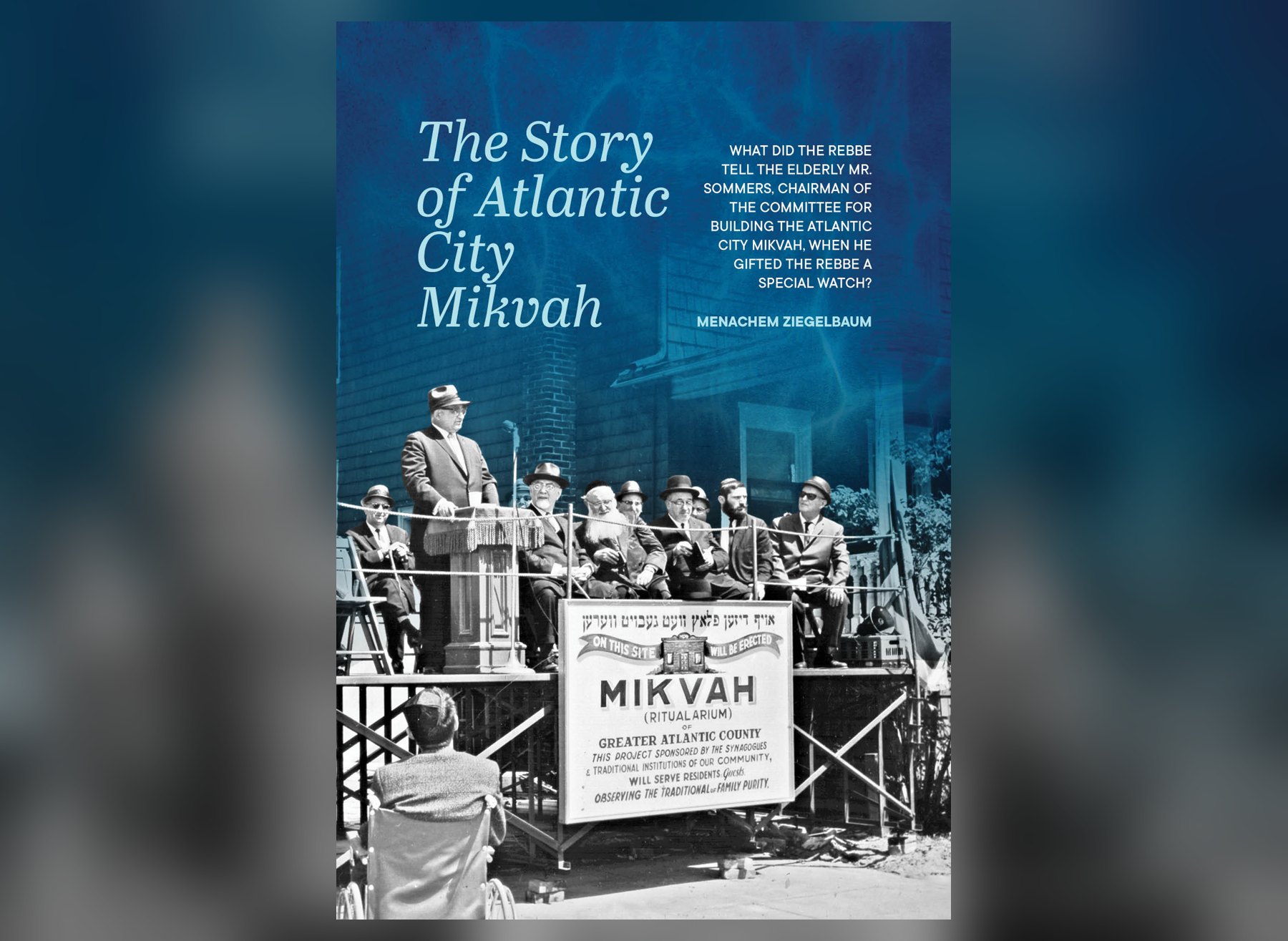
Less than a month later, on Rosh Chodesh Elul, the cornerstone-laying ceremony took place before a large crowd. The ceremony was held with great splendor and wide publicity, with the aim of arousing public enthusiasm around the building of the mikva.
The Rebbe’s bracha to Mordechai Kalmenson was fulfilled quickly, and his intended kalla already participated in the cornerstone-laying ceremony…
Preceding the cornerstone laying there were three letters that the Rebbe had sent to “The Association for the Mikva in Atlantic County.” All three letters were written within less than two weeks of each other – testimony to the great importance the Rebbe attached to the project!
From the time of the cornerstone laying, things began to move forward quickly and without obstacle. A few months later, the mikva stood complete. It was a magnificent and sophisticated mikva by the standards of those days.
“THE REBBE LEARNED TORAH THE ENTIRE TIME”
As mentioned in the article, distinguished Jews from Atlantic City attended the Rebbe’s farbrengen. One of the participants, Rabbi Shuvalsky, met with his rebbi afterward, the gaon, Rabbi Yosef Ber Soloveitchik, and told him about the farbrengen. R’ Shuvalsky marveled at how the Rebbe spoke deep divrei Torah for hours, citing hundreds of sources that encompassed the sea of Talmud and commentaries, and all without notes.
Rabbi Soloveitchik replied, “You’re telling me who the Rebbe is? I was together with him in Berlin and I was aware of his greatness already then!”
Rabbi Soloveitchik said that when they were at the university in Berlin, the rule was you only had to show up for tests, not for classes. The Rebbe, he said, only showed up for examinations and despite that, did well on the tests.
Rabbi Soloveitchik said, “I also have a good head but before the exams I also had to sweat a little, but the Rebbe learned Torah the entire time and nevertheless he passed the tests and did very well.”
Beis Moshiach #1501 • pp. 22-26
© 2026 Beis Moshiach Magazine. All rights reserved.
This article originally appeared in Beis Moshiach #1501. You are welcome to share it with friends and family by email or in print, provided that you do not change, add to or omit any part of it, you credit the author and Beis Moshiach, and you include a link to archive.bmoshiach.org (written out in full in printed copies).
To republish this article in a newspaper, magazine, book or website, please request permission in advance at [email protected].