A Soldier at 12,000 Feet Elevation
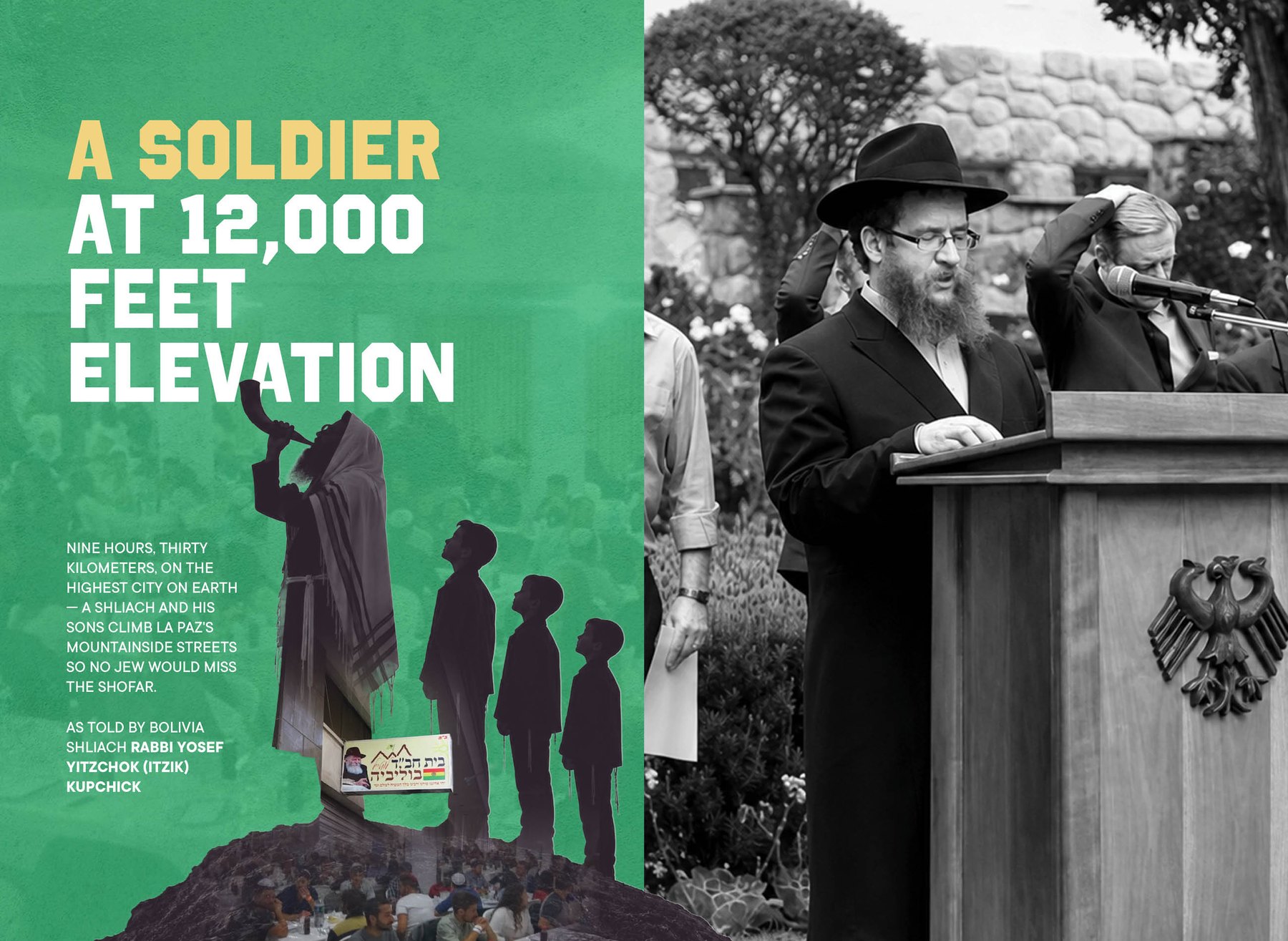
Nine hours, thirty kilometers, on the highest city on earth – a shliach and his sons climb La Paz’s mountainside streets so no Jew would miss the shofar.
“I knew Chabad people were crazy, but I didn’t know how crazy…”, Patty said to me back then, when she saw us here after we’d returned to Bolivia.
Patty knows what kind of madness and difficulties come with running a Chabad House. Living at the end of the world, in the south, without family, dealing with problems with the local government, unable to find a proper place to live. Once, we even called her when we found ourselves without a single chicken just days before the Seder with 1,200 guests…
But even she thought that this time we’d overdone it.
“Why did you come back here?? Covid is raging. And there are no Israeli travelers around at all now…”
The truth? We asked ourselves that question too. If not out loud, then quietly…
“Why did we come back?”
Rosh Hashana (5782) gave us something of an answer…
We’ve been here in La Paz for more than a decade, but in 5782 something unprecedented happened. It was the first year without a minyan in the shul.
The tiny community of La Paz is anxious. Just recently it suffered several hard blows. Just this past Sunday, I said Kaddish with a handful of other Jews at the cemetery during the unveiling of a headstone for a member of the community, and from there we went to the grave of a second Jew, for whom it was exactly the sheloshim. They and others had passed away from corona…
Sadly, the community decided on “prayers over Zoom.” They don’t understand the problem with that… (though I’m sure Rabbi Levi Yitzchok of Berditchev would have made a big deal out of that…)
So what could we do?
We decided to go around to every Jew living in the city, in order to give enable them to hear the shofar.
In previous years we hadn’t been able to do this. We held the tefillos at the Chabad House, located in the north of the city, far from the Jewish neighborhood and from the shul. We held the Yom Tov meals there with hundreds of people and walked around the nearby streets blowing shofar, mainly at hostels for tourists and backpackers.
And what about the local community’s Jews? Some of them heard the shofar at the shul (“only” an hour and a half walk from the Chabad House), but others, who lived farther away—we simply couldn’t reach.
This year we decided to focus “Mivtza Shofar” on members of the local Jewish community. We tried to arrange home visits in advance, but it’s very hard to estimate when we’ll arrive and to whom during Rosh Hashana. One person leaves the house early, another comes home early but goes to rest, and so on.
Before continuing with the details of the operation, you need to know that La Paz is the highest city in the world. It’s spread across a mountainside; every street runs at inclines you’ve never seen the likes of. And to the effort of the climb, add the thin oxygen at this altitude.
The day before, I check Google Maps, and it tells me we’ll need to walk more than thirty kilometers (over 18 miles) under these conditions. I could tell it that the streets run at completely absurd angles, and that the descents are, without a doubt, also climbs…
Searching for Neshamos on Rosh Hashana Morning
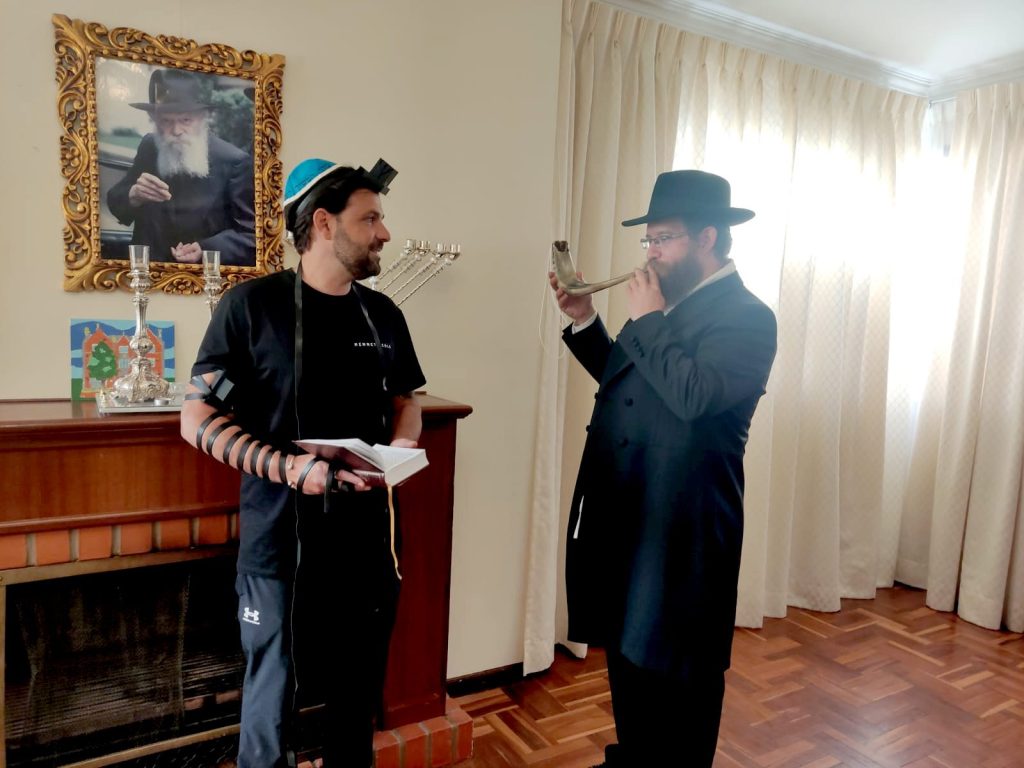
The time set for departure on Mivtza Shofar was early morning of Rosh Hashana.
Just as we were heading out, we heard knocking at the gate. A thought crept into my head—we hadn’t even left yet, and we’d already begun Mivtza Shofar.
Two Israelis showed up unexpectedly. Our big surprise was that both of them had been living here for over 15 years. One had never set foot in the Chabad House, nor in the community shul. We’d never met. The second guy had been at a Seder a few years back. He came in late and left early. We barely managed to exchange a few words with him then, and he vanished.
This year, they arrived early in the morning for the shofar blowing, genuinely joyful (more on the story with these young men in a sidebar).
Only after the shofar blowing could I set out with Mendele (11), the oldest, and Shmulik (8), who really begged to come along, though I hoped they’d have the strength for the whole long road ahead.
After a brisk hour of walking, we reach the southern neighborhood.
The first house.
Disappointment. After strong knocking on the gate, the guard comes. He hears who we are. Five minutes later he comes back to tell us the lady of the house is busy. It doesn’t help that we explain it will only take a minute; she’s not willing to come out, not even to stand at the doorway.
Sad. Precious time burned.
We move on. We go into the apartment of a Jewish man. In the past he’d lived in Israel for several years and speaks excellent Hebrew, even studied in a yeshiva… Sadly, he later returned to Bolivia and even married a non-Jewish woman, rachmana litzlan. In recent years he’s left her.
From today’s tekias shofar came a good hachlata: we decided to affix a mezuza and hold a shiur at his new apartment.
Twenty minutes of exhausting climbing and we reach a gated apartment complex. The guards direct us to two buildings; in one lives a single Jewish man, and in the other a Jewish family. Sadly, it turns out the mother and daughter have gone out running errands. The son, who was in the middle of lifting weights, puts on a shirt and kippa in honor of our arrival and stands to accept malchus shomayim.
To my delight, the mother and daughter came to our house later on and heard the shofar there.
From there we go back down ten streets until we reach a private house. Vigorous knocking on the gate.
Here lives a Holocaust survivor, a woman who fled Germany just before the Holocaust. On her old passport is the emblem of the Nazi party.
Luckily, the elderly woman manages to hear us and comes to the door, overcome with emotion. Who knows how many years since she last heard a shofar?!
Oh, how many blessings and good wishes we received from her: in German, in Yiddish, in Spanish—all from a warm Jewish heart.
We Reached Street 46. Yesss!
Now we need to take a deep, deep breath. We begin the serious climb.
Slowly we leave the central neighborhoods of the city. The higher we climb, the more broken the sidewalks become; the road is no longer paved but made of cobblestones which makes walking harder. And the climb? It never ends. The angles and slopes get sharper and sharper.
This is where the poor live. Apparently they have no money, and the municipality behaves accordingly, making no effort at all when it comes to developing the area… I don’t know if there are inclines this steep anywhere in Israel. We’ve been climbing for forty minutes already and it’s not about to end.
The kids are already red-faced and sweaty. Wiped out from the hard walk.
At some point I ask myself too whether we’ll manage to make it. Whether the effort is worth it. Who says the family will even wait for us at home. True, I’d coordinated a time with them. But I hadn’t calculated the climbs and the effort correctly and we’re already an hour and a half late…
Slowly we get closer to our destination. Forty-five streets of climbing are about to come to an end.
We reached Street 46. Yesss!
But where’s their house? All the gates look the same. I start knocking on a few of them.
“Open the gate for us…” I pray in my heart, aware that I’m getting a bit ahead of myself; that’s a Yom Kippur tefilla.
If they don’t open the gate, the kids will never forgive me…
Boruch Hashem, the prayer is heard and answered, and the gate opens.
The lady of the house was very moved by the news of our visit with the shofar, and in its honor she’d brought her mother to her home for the holiday meal that evening already. The mother, may she be well, is well past 80. She last heard a shofar when she was in Israel during the Six-Day War…
Two grandchildren (15 and 11) join in for the shofar blowing.
Interesting, in the last letter we received from the Rebbe in the Igros Kodesh, it spoke about saving children from missionary influence, and I know their aunt converted to Christianity, Hashem yerachem. I feel that the whole hour-and-a-half of difficult climbing was mainly so that we could meet these boys.
G-d willing, we’ll manage to stay in touch with them.
Beginning to Daven—Rosh Hashana Davening in the Street
My children can barely move anymore. It doesn’t help to explain that from here it’s all downhill, because the downhill parts aren’t at all easy.
Before Yom Tov, I spoke with one of the supporters/partners of the Chabad House. When he heard we wouldn’t have a minyan, he told me about a shliach who goes out shofar-blowing on Rosh Hashana morning and doesn’t return home until evening. He davens along the way.
When I heard that from him, I thought to myself, what a nice little anecdote. But thanks to him, when I packed a bag for the road, I also put in a tallis. Now, as I see the clock hands moving faster than I am, I realize that I’m in that same situation myself…
I wrap myself in the tallis and begin to daven. In the street. There’s no minyan in the shul anyway.
“Ha—Me—Lech…” (“The King…”) I’ve never experienced anything so surreal. I pray with Mendele at the top of our voices. We don’t care about the passersby staring at us, not understanding what this strange spectacle is. The truth is, I keep looking around the whole time, hoping maybe we’ll find yet another stray Jew on the street…
* * *
Noon arrives, and we’re back in the southern neighborhood where a large part of the community’s Jews live.
The work is easier now, because we “caught” most of them at their holiday meals. In almost every house we found several Jews sitting together, which saved us a lot of time and effort. Such miracles.
That’s how dozens of members of the community merited hearing the shofar on Rosh Hashana.
Open the Gate for Us
At one of the buildings, something embarrassing happened to us.
We knocked on the gate. A neighbor opened it and so we entered the courtyard, but then the courtyard gate locked behind us, and in front of us the building’s door locked too.
After long minutes of knocking and shouting, my son Shmulik, our climbing shliach, climbs over a fence into the parking area. From there he somehow squeezes into the building and opens the door for us from inside.
Only then did we discover the family wasn’t home, and all our efforts had seemingly been for nothing.
The truth is, nothing ever happens for no reason. Thanks to this delay, we arrive afterward at a small building on a nearby street just as a resident is entering it, and we go in with him.
What luck! This building has no guard. I hadn’t arranged anything in advance with the family living there, because they hadn’t answered my calls on Erev Yom Tov. So really, we’d have had no way in had we not been delayed and arrived at exactly the right moment…
Another family, three generations of Jews, merited hearing the shofar!
I finish the round in the southern neighborhood at the home of an Israeli living with a non-Jewish woman. He’s overjoyed to hear the shofar, and as a bonus, he introduces me, on the 11th floor (of course, another climb…), to a Jew from Ecuador!
Climbing to the 23rd Floor
We finished the south of the city; now we need to climb to the city center, two more hours of climbing in the other direction…
My wife the shlucha and the rest of the children hadn’t heard the shofar yet. So in the middle of the mivtza, we have to go home for shofar blowing and a quick Kiddush and immediately head back out.
After nearly 9 hours of walking, the children’s shifts change. Mendele and Shmulik stay home, and Berel and Shneur join in.
The walking now turns into a light jog. We have only two more hours until sunset, and we need to reach as many Jews as possible in the city center… It’s not enough that they live at an altitude of 3,700 meters, they had to go and live on the 23rd floor too!…
We meet an elderly, nice couple. On Erev Yom Tov they came to buy kosher chickens. Their only son is even studying at a yeshiva in Baltimore… I have no time to talk. Just the shofar blowing, and we run onward immediately.
Right across from them, “only” on the tenth floor, lives another Jewish couple. He’s a local Jew, and she’s from the Jewish community of Turkey from 80 years ago. She remembers all the special Jewish life that existed back then. Here in La Paz she ran the Jewish school for years. Their children are in Israel and they’re planning to join them, but the shofar of 5782 they get to hear thanks to the Rebbe MH’M, whose shluchim reach every corner.
One More Neshama, Moments Before Sunset
Just moments before sunset, we made a visit to an elderly Jewish man, hospitalized in serious condition at a small local medical facility. The shofar blowing there concludes Mivtza Shofar for the first day of Rosh Hashana 5782.
Sadly, we didn’t manage to reach every Jew in the city, but we did our utmost and our best. Within the limits of our own two feet…
Keeping to the Schedule
Special stories usually happen when we encounter wondrous instances of hashgacha pratis that surprise us, or that change our planned schedule…
“Last year, two days before Rosh Hashana (5785), I returned from a trip to see the Rebbe,” recounts Rabbi Kupchik. “We began preparing for six (!) Rosh Hashana meals without knowing in advance how many people would come to the meal.
In the midst of this workload, the president of the community informed me that it was his mother’s yahrtzeit on Erev Rosh Hashana, so I needed to organize a minyan and refreshments for him for Erev Rosh Hashana in addition to all the other many preparations, and in addition to a trip the day before to supervise the milking so we’d have something to drink during Yom Tov.
On the morning of that day, the community president informed me that his sister had passed away and he would not be coming to daven, meaning I now also had to arrange a Jewish burial… I couldn’t figure out how to fit this into the already tight schedule of holiday preparations.
I stayed home with the children while my wife went with the women of the Chevra Kadisha to arrange the tahara. When she returned, I went to the funeral while she stayed with the children and did what she could to get ready for Yom Tov. You can imagine we had very little time left to prepare for Yom Tov (of course there were a few more unexpected delays too, like a refrigerator that suddenly stopped working, a hospitality tent whose construction was delayed, and more).
At the height of the pressure, an hour before Yom Tov began, the family of the American consul (Jewish, of course) arrived at our home—he, his wife, and the children, dressed festively. His wife said to me with satisfaction: “You see? We made it in time”…
I didn’t understand what time they were referring to or why I needed to host them in the middle of the peak pressure of preparations. Suddenly I realized they had mixed up the day. When I had invited them, I had told them that the latest time for hearing the shofar on Thursday was 6:15 PM so that even if they were a little late, they’d still make it before sunset.
Hashgacha pratis. I tried to take advantage of the opportunity and offer tefillin, but the wife said her husband would absolutely not put them on.
While my wife took the mother and daughter to light candles (for the first time in their lives!), I brought a pair of tefillin, and without asking unnecessary questions, I rolled up the consul’s sleeve, and he put on tefillin with great emotion.
(While putting them on, I told him I had just returned from 770 the day before. “Yes, I know 770,” the consul told me. “How exactly?” I asked, curious, and he said: “When I was consul in Yerushalayim, many young people requested visas because they wanted to travel to 770”…)
The consul and his family stayed for the davening and kiddush, ate an apple dipped in honey, and rushed off. I asked them if they’d be coming the next day to hear the shofar, and they said no. I tried to find out from them when I could come to blow the shofar for them and I understood that they were leaving the house at 7:30 in the morning and returning only at night.
Early in the morning, my two children and I set out on foot—more than an hour’s walk each way—toward the consul’s house, worried we wouldn’t catch them before they left.
Boruch Hashem, we arrived in time. The consul let us into his home and called all the children. They were very moved. It was the first time in their lives they had heard the shofar blown on Rosh Hashana.
At the end of the visit, we hurried back to the Chabad House to organize Shacharis, and afterward set out again for 5 hours of walking to the homes of the Jews of La Paz, on Mivtza Shofar.
From the Shofar Blowing to a Cup of Coffee with Milk…
As mentioned, on Sunday morning of Rosh Hashana, two young men unexpectedly arrived at the home of the Kupchik family—the Chabad House in Bolivia—to hear the shofar blown. Their appearance was a surprise to the shliach, Rabbi Yosef Yitzchok Kupchik, who continues the story:
Before the Israeli went on his way, he asked me: “Rabbi, tell me, what do you need for the Chabad House? I’ll get it for you!”
I explained that I needed milk.
“Milk?!” he was surprised.
Yes. I understood his reactio—it’s a bit funny to ask for a bag of milk; it’s available in every grocery store.
“Chalav Yisrael,” I explained, “we haven’t had kosher milk for several years now, and without milk, the children have no cornflakes… and we have no coffee in the morning”…
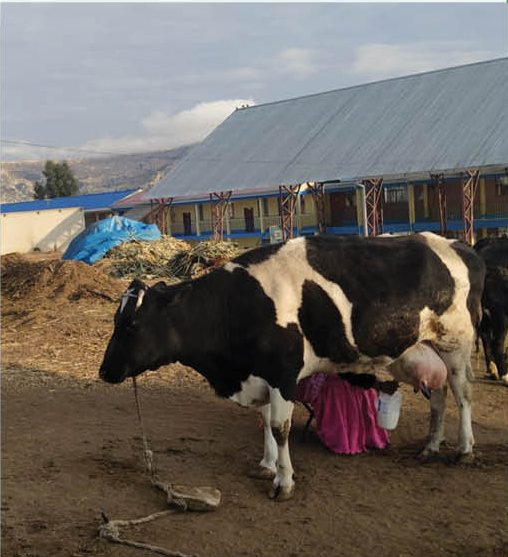
In the past I would drive out early in the morning to some village, almost an hour from home, where I found people with a cow or two in their yard. Sometimes I arrived after the milking was already done, or in the middle of it; sometimes I had to wait an hour or more in the bitter cold. Sometimes they explained that they had a contract with a company and couldn’t sell me milk. Mostly, though, I would still return home with “white gold,” literally…
Following changes the village underwent, they stopped raising cows there. Since then, we’ve had no chalav Yisrael.
“So yes, I need milk. Chalav Yisarel,” I explained to him. “A place with a few cows where I could come in the morning, or better in the afternoon, and be present at the milking.”
“I’ll handle it,” he answered matter-of-factly, and went on his way.
A few days later, he showed up at six in the morning, waiting for me with his jeep outside the community building. “I found cows,” he said briefly.
Together we drove to a nearby village, where a Bolivian woman was already waiting for us with her daughter, and beside them, three cows…
We returned home with twenty liters of milk. All that was left was to strain it, pasteurize it, and make a cup of coffee…
From that cup of coffee we went on to establish a joint Torah class. He and his friend put on tefillin after many long years, and we even affixed a mezuza at the entrance of his home.
B’ezras Hashem, the fruits of this Rosh Hashana will continue to grow.
Beis Moshiach #1522 • pp. 24-31, 32
© 2026 Beis Moshiach Magazine. All rights reserved.
This article originally appeared in Beis Moshiach #1522. You are welcome to share it with friends and family by email or in print, provided that you do not change, add to or omit any part of it, you credit the author and Beis Moshiach, and you include a link to archive.bmoshiach.org (written out in full in printed copies).
To republish this article in a newspaper, magazine, book or website, please request permission in advance at [email protected].