Chinuch for Real Life
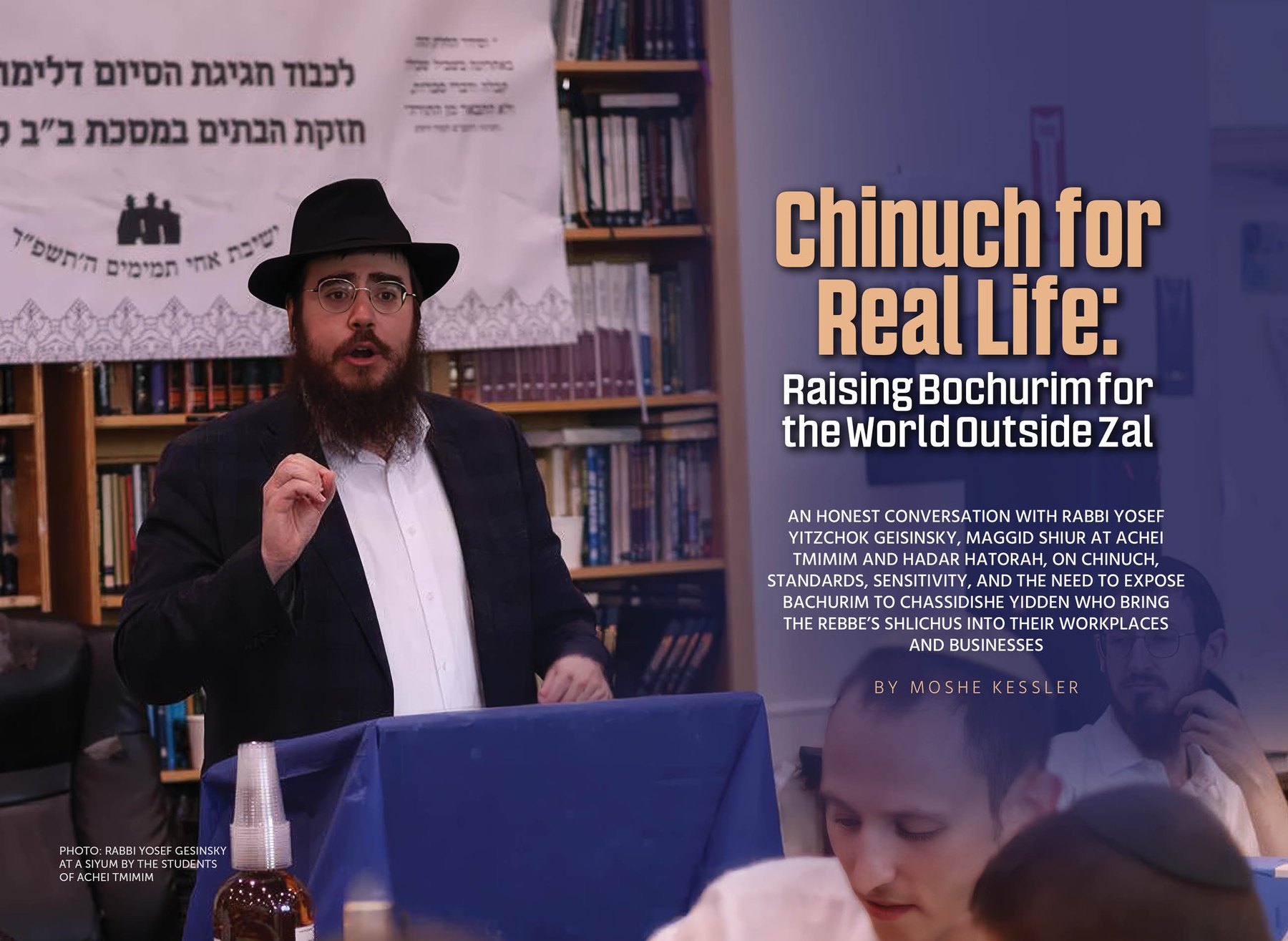
Raising Bochurim for the World Outside Zal
An honest conversation with Rabbi Yosef Yitzchok Geisinsky, maggid shiur at Achei Tmimim and Hadar HaTorah, on chinuch, standards, sensitivity, and the need to expose bachurim to Chassidishe Yidden who bring the Rebbe’s shlichus into their workplaces and businesses.
There are conversations in chinuch that everyone knows are happening, but not everyone knows how to say them clearly.
On the one hand, every yeshiva wants to raise serious bachurim: bachurim who learn, daven, dress like Chassidishe bachurim, and remain connected to the Rebbe’s inyanim. On the other hand, anyone involved with bachurim today knows that the questions have become more complicated. Many bachurim need more personal attention. Some need more chesed than gevura. Some do not fit neatly into the regular mold. And many, after their years in zal, will not remain in chinuch or shlichus, but will go out into the world of business to earn their parnassa.
So what exactly is yeshiva meant to give them?
These questions are especially present in Achei Tmimim, a Crown Heights based Chabad yeshiva that provides a smaller and more personal setting for bachurim who benefit from greater individual attention. While firmly maintaining the ideals and standards of a Chassidishe yeshiva, its mechanchim regularly confront the practical question of how those ideals can reach bachurim with different personalities, strengths, and needs.
In this conversation, Rabbi Yosef Yitzchok Geisinsky, a maggid shiur at Achei Tmimim headed by Rabbi Levi Tzukernik, speaks with unusual directness about the dignity of chinuch, the role of a mechanech, the challenge of holding standards without breaking bachurim, and the urgent need to speak openly about the Chassidishe “baalabos.” His approach is not to weaken the system, but to explain what the system is meant to build: a bachur with Torah, with identity, with pride, and with a clear sense that wherever he goes, he belongs to the Rebbe’s world.
A Life Shaped by Chinuch
MK: Let’s begin with your background. Before we speak about your work with bachurim today, can you tell us a little about where you come from and how chinuch became such a central part of your life?
RYG: I grew up in a home where both my father and mother were involved in chinuch. My father, baruch Hashem, has been a mechanech and maggid shiur in Oholei Torah for many years. In addition to his work there, he also teaches in the Igud Talmidei HaKevutza program connected with 770, and more recently, was appointed as Rosh Yeshiva of the Queens Mesivta.
My mother, too, is in chinuch. She teaches in Beis Rivkah, teaching Hebrew, Navi, and other subjects.
That is important to mention, because chinuch was not something I saw from the outside. It was the atmosphere of the home. Both of my parents were focused on teaching. In my extended family, not everyone went in that direction. There are people in business, accounting, construction, electronics, shlichus, and other fields. But by my father and mother, chinuch was central, and that had a very strong effect on me.
MK: So from a young age, you already saw yourself going into chinuch? Or was that something that developed later?
RYG: I remember when I was a child, my fourth-grade teacher, Rabbi Shlomo Futerfas, asked us what we wanted to do when we grew up. Different boys gave different answers. Some said they wanted to become rabbanim. I did not say rav. I said I wanted to be a maggid shiur and mechanech.
That was the way I saw myself: teaching Torah, giving over Torah, and being involved in shaping talmidim.
Part of that came from the respect I had for my parents. I was very proud of them. But it also came from something I noticed very early: chinuch shapes the way a person thinks.
I saw this very clearly in summer camp. In Chabad camps, very often a bunk is not just a random collection of boys. Many times, a certain bunk comes from a certain school, or from a certain community. So, you could see very clearly how boys from one mossad carried themselves one way, and boys from another mossad carried themselves another way.
They were all good boys. I am not saying it as a criticism. Kulam ahuvim, kulam berurim. Every community has its maalos. But you could mamash see how the chinuch shaped them. The language was different. The style was different. The sensitivities were different.
And I saw it again on camp trips. Sometimes different camps would end up in the same amusement park or water park. You would have boys from Chabad camps, Litvishe camps, general-Chassidish camps, Sephardic camps, and other communities, all in the same place. And again, you could see it. You could tell who came from where—not because of a label on his shirt, but because of the way he carried himself.
That made a very strong impression on me. I realized that chinuch is not merely about giving over information. It builds the person. It shapes the way he thinks, what he notices, what he respects, and how he sees the world. What enters a child through his chinuch remains with him for life.
MK: You then went through the yeshiva system yourself. What did your own path look like?
RYG: I learned in Oholei Torah from kindergarten onward, all the way through zal. Later, when I was eighteen, I switched to Chovevei Torah Zal because I wanted a smaller setting and more personal attention.
That was a very good experience for me. Rabbi Yossi Paltiel taught Chassidus, and Rabbi Labkowsky taught Nigleh. I felt that the move was worth it because I needed that personal attention.
After that, I went on shlichus to Brazil, which was a warm and meaningful experience. The next year, I went to Melbourne, Australia, where I learned for semicha in Rabbi Levin’s program. After that, I came back to Crown Heights and served as a meishiv in Chovevei Zal, while also beginning to do some teaching and tutoring.
After a few years, I taught in Monsey, in Rabbi Gil Chami’s yeshiva. Then I went to Mexico, which later became part of my path into working with bachurim in the Achei style. Today, I teach as a maggid shiur in Achei Tmimim.
The “Shtoltz” & Pride of Chinuch
MK: One thing I noticed, both by you and by your father, is a real shtoltz in chinuch. Not just that chinuch is important—everyone says chinuch is important. But by you, there is a pride in it, a feeling that being a mechanech is something chashuv. Why is it that many people today don’t seem to feel that same “shtoltz”?
RYG: I think there are two main reasons why people feel a little left out when it comes to chinuch.
The first thing is very simple: the economy. People feel a certain guilt on their shoulders that they are not earning enough money when they go into chinuch. Because chinuch is limited. There is a cap. A person can push himself with tutoring, extra classes, maybe teaching at night, but it is not always sustainable. So that is one thing that bothers people.
But I would answer that a person should not feel guilty about that. Chinuch is an ideal. If a person believes that he can give invest his lev v’nefesh (heart and soul) to this cause, then it is okay to have a little less gashmiyus in order to do it. That is part of giving yourself to an ideal.
And I believe that at a certain point, there will be a revolution. The gevirim will begin opening their pockets for the cause of chinuch. Maybe it has not happened yet the way it should, but I believe it will happen.
The second thing is that some mechanchim are afraid that people will accuse them of being a “leydigeyer.” In other words, they are going into chinuch because they could not find another job.
And you know something? The way to fight that foolish feeling is to take a hustle and be very serious about the job you do.
Make sure your worksheets are top perfection. Make sure you give the talmid your utmost attention. Make sure you do not come late to class. Make sure you give proper discipline. And make sure that in your private life, you are not looking at stupid things, so that when you face the talmid, you can look him honestly in the face and say: I am doing this l’sheim shomayim, for Hashem’s sake.
Then you are not a leydigeyer.
You are a hero. You are a soldier devoted to the cause.
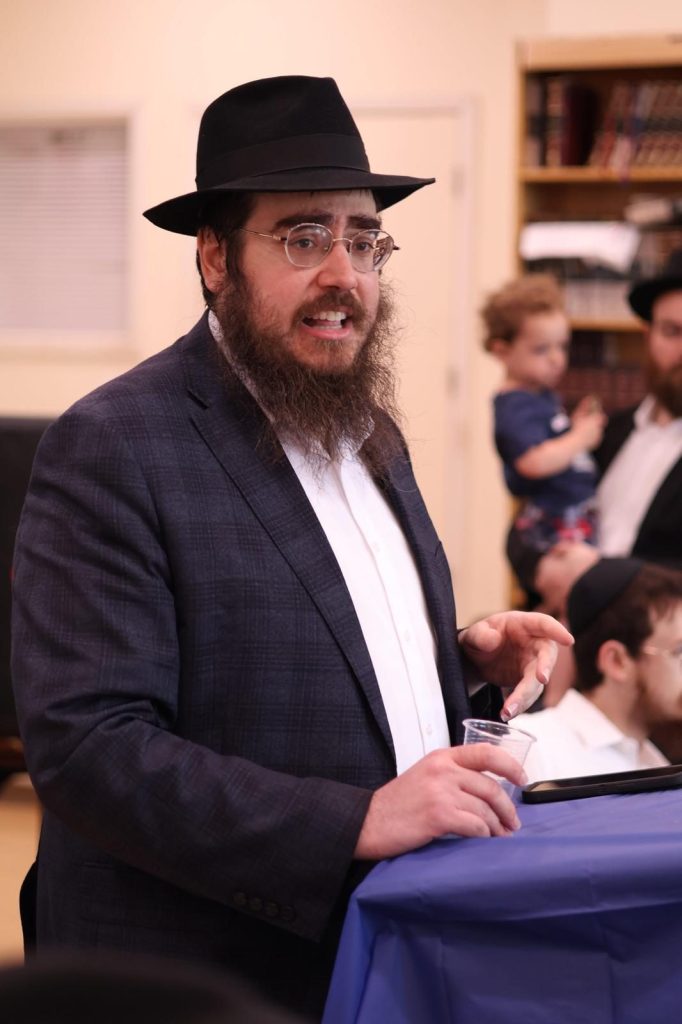
And let me tell you something. That kind of discipline is not simple. A true mechanech takes home his chinuch responsibility. He keeps himself on a certain level of yiras shomayim. He understands that this is serious business.
So if a person goes into chinuch like that, with that seriousness, then he has nothing to be embarrassed about. He is not a cop-out. He is a soldier.
MK: You mentioned two reasons. But isn’t there also another feeling—that maybe if someone is going into chinuch, he feels he is not really going on shlichus?
RYG: There used to be that feeling also, but I think that is already changing.
More and more, people are seeing the Rebbe’s view on chinuch. There are documents and sichos being publicized that show how central chinuch is, how it is an ultimate shlichus. The Rebbe wanted mechanchim to be included in the Sefer HaShluchim together with the shluchim. Rabbi Chodakov pointed out that they belong there. And Rabbi Chodakov himself, who was so involved in the Rebbe’s shlichus—what was his background? He was involved in education.
And let us remember: the central organization under whose umbrella the Rebbe’s shluchim around the world operate is called Merkos L’Inyonei Chinuch. That name itself tells us something. Chinuch is not a side element of the Rebbe’s work. It stands at the center of its entire structure.
So I think that particular guilt is becoming weaker. People are beginning to understand that chinuch is not outside of shlichus. Chinuch is shlichus.
Achei, Today’s Bachurim, and the Need for Balance
MK: You mentioned the bachurim you worked with in Mexico, who were more in the Achei style. I want to ask about that more broadly. Achei is obviously its own type of yeshiva, but in a certain way, many yeshivos today are dealing with similar questions. The style of enforcement has changed. Many bachurim need more chesed than gevura. Some have anxiety, perfectionism, learning issues, or difficult situations at home. So how do we set a real standard, and push bachurim, without creating the kind of high-pressure environment that we do not want?
RYG: You are asking a very good question.
My relationship with what you are calling the “Achei style” began when I was twenty-six, when I went to Mexico. I worked there with Rabbi Eli Engelson, under the broader auspices of Rabbi Benny Hershkowitz. It was not a regular yeshiva setting. These were bachurim who were brought down to help with mivtzaim and shlichus work, and I taught them for half a day.
There I began to realize something very important. A lot of the problems today come from a certain grayness in the air, and a certain pressure for perfection. Many bachurim who are in the “Achei style” feel inferior to the regular, traditional Chassidishe bachur. And that bothers me.
Because in the frum world there is a cookie-cutter element. A rav has to speak in a certain way. A rav has to write in a certain way. Everything has to fit into a certain mold.
But you have to allow for expression within the system.
Now, I want to be very clear what I mean. I am a proud Chabad Chassid. My loyalties are to the derech of Chabad. I believe that Chabad has the answer for everything, and I do not think we have to look elsewhere. But loyalty to the system does not mean that every bachur has to lose his personality. There is a system, and you have to be loyal to the system. Principles and ideals matter. You cannot compromise on principles. But within that system, there has to be room for expression.
A bachur has to wear a hat and jacket by davening. A bachur has to daven with a minyan. A bachur has to daven the whole davening. These are not optional.
But you do not have to make a bachur meshuga about every small detail. If a bachur wants to wear a little bit of a cooler style hat, you do not have to make him crazy over that. Let him feel that he has some room for expression.
Of course, there is a maalah in dressing in the way of your Rebbe. There is such a concept. But along with that, you have to give room for expression.
And this is very individual. There is no general rule. You have to look at every bachur and know where the line is. Is this personal expression within the system, or is he breaking the system? That is the delicate balance.
You also have to allow expression in learning. Some bachurim do not want heavy pilpul. Some need lighter learning. Some need more emotional learning. Some want to learn one line of Mishna and farbreng about what it means to them.
That does not mean there is no yeshiva. A yeshiva has to be a yeshiva. There has to be seder. There have to be standards. But within Torah itself, there are different derachim.
That is the balance: principles are not negotiable, but not every small difference is a rebellion. A mechanech has to know the bachur, know the system, and know where to draw the line.
Why Focus on Hat and Jacket?
MK: If we’re saying that not every small difference is a rebellion, then I want to ask about something very practical. A lot of times, hanhala will focus very strongly on dress code things like hat and jacket. But sometimes the bachur doesn’t even really know how to learn yet. He doesn’t have the taste in learning. So why is that where the pressure goes? Why focus so much on the levush before the inside is fully built?
RYG: I think the answer is that there have to be principles that are non-negotiable.
I do not have to debate with a person why he has to love his father and mother. And I should not have to debate with a person why he has to be loyal to the Rebbe’s ideals. Of course, we can discuss it, we can explain it, but at the end of the day, a bachur has to know: this is a principle. This is who we are.
Of course, that does not mean every bachur has to express the same principle in the exact same way. If it is your friend’s birthday, you have to do something. One bachur bakes, another sings, another writes something, another draws a picture. But doing nothing is not an option.
The same is true in Torah.
Everybody has to learn Torah. There are no excuses. This is a principle. But what to focus on in Torah—v’sein chelkeinu b’Sorasecha. Everybody has his own part. Some people are drawn more to halacha, some more to aggadah. There are many aspects to Torah.
And this is important because people are not going to stay in yeshiva forever.
At age twenty, a bachur gets semicha, as is the tradition in Chabad, and then he goes out to make parnassa. Not everybody is going to remain in chinuch. It is not healthy for everybody to remain in chinuch, and not everybody could remain in chinuch. Chinuch is a very specific mentality, with a very specific discipline. Some people could handle it for a year or two, but longevity in chinuch is tough.
So the bottom line is that many bachurim are going to go out and get jobs in all kinds of fields. And that means that the yeshiva years have to give them more than information. Of course they need knowledge of Torah. A bachur has to learn and has to know. But he also needs Jewish pride. He needs Jewish ideals. He needs to know who he is before he goes out.
And that is why it is important to focus on the Chassidishe levush.
The hat means: I belong to the tribe.
There has to be belonging. There is a healthy element of tribalism. Before Masei, before the journeys, there has to be Matos. A person has to know the shevet (tribe) he belongs too before he goes out on the journey.
That is what the levush gives him. It tells him where he belongs.
And this was always part of Jewish life. Jewish garb means what the Tzaddikim decided their community should dress with. Every community had its levush, its way of showing that it is separate from the street. The exact style changes from place to place, but the point is that a Yid does not simply dress like everyone else.
In Lubavitch too, this was guided by the Rebbe and by the roshei yeshiva who built the yeshiva system. The Rebbe pushed the kapota in Lubavitch. The Rebbe guided how Lubavitch was to dress. The roshei yeshiva under the Rebbe—Rabbi Mentlick, Rabbi Piekarsky, and others—built the way Lubavitch bachurim dressed in yeshiva.
So when we speak about hat and jacket, it isn’t a technical thing. It is part of belonging to the yeshiva, to the mesora, to the Rebbe’s derech.
Of course, you have to explain it. You cannot just scream “hat and jacket” and think that is enough. But the hat itself is not small. It tells a bachur where he belongs before he goes out into the world.
The Chassidishe “Baalabos”
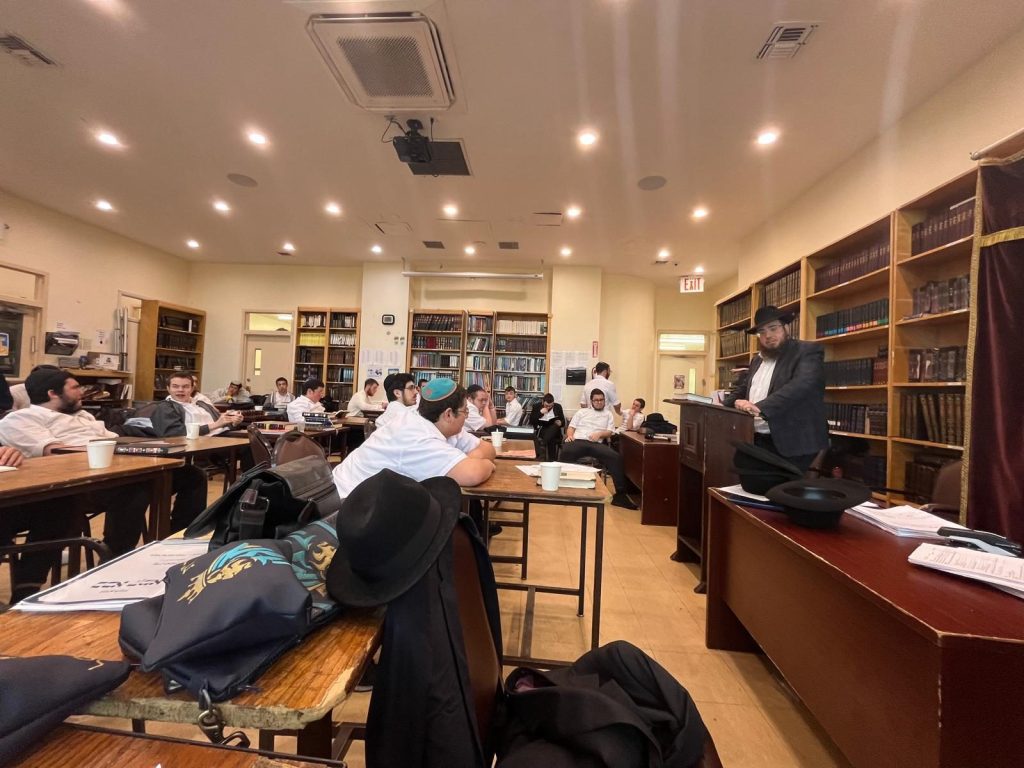
MK: I want to talk about the next stage. Many bachurim today are going into parnassa even before marriage. Once a person starts going into that world, his whole mindset changes. In some ways, yeshiva prepared him for that, and in some ways maybe it did not. Are we giving bachurim a clear picture of how to be a Chassidishe yungerman in the world of parnassa?
RYG: That is a very powerful question. And I will tell you clearly: this is something that has to change immediately.
We have to start talking about being a Chassidishe “baalabos.”
For many years, the focus was on shlichus, and there was a reason for that. There was a time when shlichus had to be pushed. Later, chinuch also became more recognized as a very important shlichus. But now there is another thing that has to be spoken about: the maalah of being a Chassidishe baalabos, a Chassidishe “baal parnassa.”
This cannot be treated as second class. It cannot be spoken about as if a person is a failure because he did not become a shliach or a mechanech. Klal Yisrael was always built by Yissachar and Zevulun together. There have to be Yissachars, and there have to be Zevuluns.
A “baal parnassa” who lives as a Chassid is not outside the system. He is part of the system. He is part of dira b’tachtonim. In many ways, that is where dira b’tachtonim happens even more strongly—in the workplace, in business, in the regular physical world.
In Chabad history, this was normal. Most Chassidim were balabatim. They were involved in business, they made parnassa, and they were Chassidishe Yidden. Nobody looked at that as a contradiction.
The Rebbe Maharash was known as the Rebbe of the balabatim. What does that mean? It means there is such a thing as a Chassidishe baalabos. Not b’dieved. Not second class. An inyan.
And this has to become the talk of every farbrengen.
Mashpiim have to speak about the maalah of a Chassidishe baalabos. Mechanchim have to speak about it. Bachurim have to hear examples of Chassidim who lived that way—balabatim, baalei parnassa, and at the same time serious Chassidim involved in Torah, avoda sheb’lev and of course, the Rebbe’s mivtzaim.
This can no longer remain a side point. It has to become part of the regular conversation in farbrengens and in chinuch.
For many years, people took the Chassidishe baalabos for granted. They assumed that a bachur would leave yeshiva and somehow know how to remain Chassidish in parnassa. But today, that is not enough. If many bachurim are going to work, then we have to speak about what that life is supposed to look like.
MK: But many mechanchim never lived that life themselves. They know how to speak about learning, shlichus, and chinuch, but not necessarily about being a Chassidishe baalabos in the world of parnassa. So how are they supposed to farbreng about it?
RYG: First of all, they can speak about the Torah side of it. They can speak about what Chazal say. They can speak about Yissachar and Zevulun. They can speak about the role of the “baal parnassa” in building Klal Yisrael.
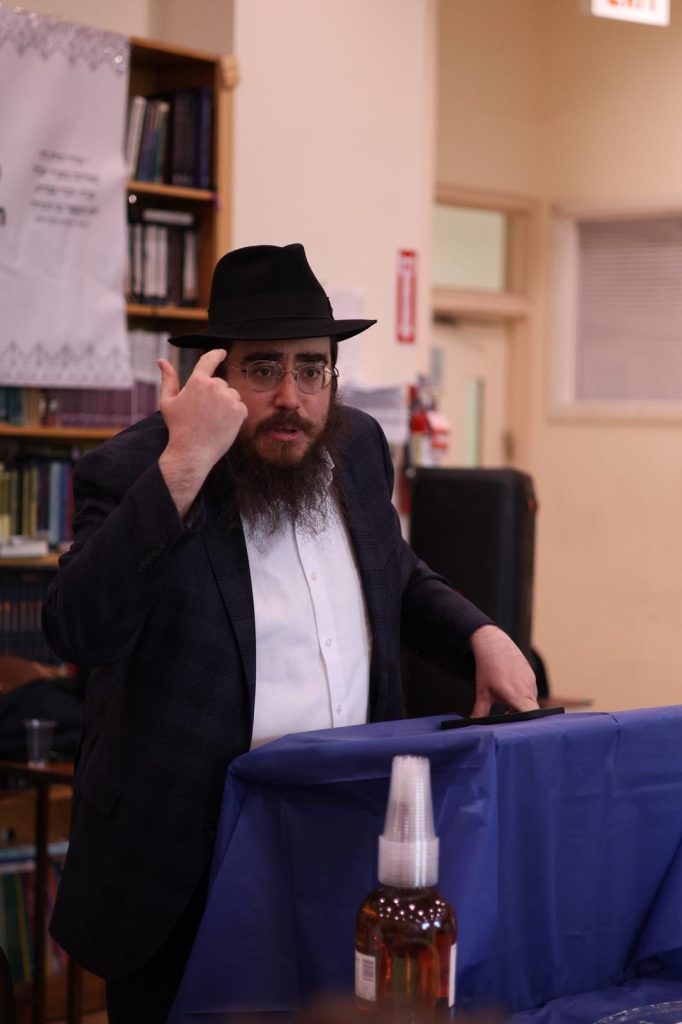
And also, a maggid shiur does not know how to be a shliach either. He is not running a Chabad House in every place in the world. So what does he do? He invites shluchim to speak.
So do the same thing here.
Invite Chassidishe balabatim. Bring in people who are in business and are doing it in a Chassidishe way. Let bachurim hear from them. Let them see that this exists.
I remember how in Oholei Torah, they once invited Reb Aharon Leib Raskin from Raskin’s Fruit on Kingston Avenue for Tu B’Shevat. He spoke about running a store in a Chassidishe way. He spoke about balancing Chassidishkeit with running a store. He spoke about hiring workers, collecting the fruits, finding which farms to go to. It is physical. You have to deal with the oranges and the apples.
It was beautiful. It was very touching. A lot of students were inspired.
And I said to myself: why don’t they do more of this?
They should do more of it. Bachurim hear from shluchim, and they should. They hear from mechanchim, and they should. But if many bachurim are going to become balabatim, then they also need to hear from Chassidishe balabatim—from people who are living that life and showing that parnassa itself can be lived in a Chassidishe way.
Beis Moshiach #1512 • pp. 24-32
© 2026 Beis Moshiach Magazine. All rights reserved.
This article originally appeared in Beis Moshiach #1512. You are welcome to share it with friends and family by email or in print, provided that you do not change, add to or omit any part of it, you credit the author and Beis Moshiach, and you include a link to archive.bmoshiach.org (written out in full in printed copies).
To republish this article in a newspaper, magazine, book or website, please request permission in advance at [email protected].