Not Everyone Is Excited To Go Back To School…
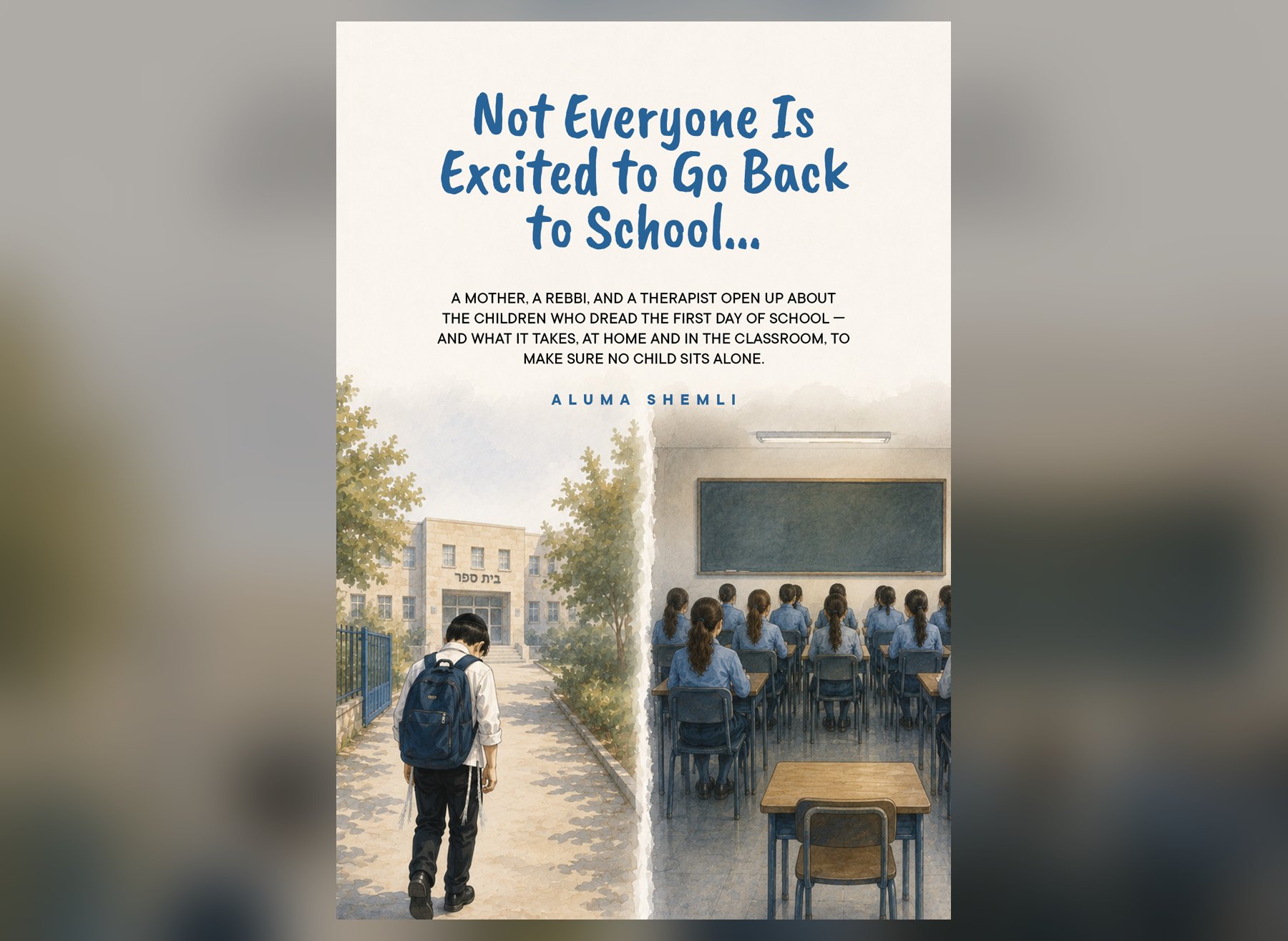
A mother, a rebbi, and a therapist open up about the children who dread the first day of school – and what it takes, at home and in the classroom, to make sure no child sits alone.
The beginning of the school year is an exciting moment, a beginning, a new page, hope, of lots of expectations. Two months of sweaty freedom make us wait for it, prepare for it, get excited!
But there are children that it fills with fears. They would rather stick their heads deep in the pillow. No eager anticipation fills them, only deep fear and great pain.
From a Mother’s Perspective:
Chagit, mother of Aharon Eliyahu, says:
My Aharon is not doing well in class. What does ‘not well’ mean? Bad. Very bad. When we immigrated to Israel and came to Chabad, we were enthusiastic. My husband and I met such dear, loving, welcoming people. I, who was orphaned at the age of sixteen, felt like I had found my family. But when we put the children in the schools, it became clear that the parents’ Ahavas Yisrael does not always transfer to the children. It hurts to write this, but it’s true.
My daughter, Sarah, still survives in the classroom. She is a forceful type, and found her social way with the help of her elbows, as they say. She has a big mouth, and when someone tries to insult her, she answers immediately. Tehilla, already in high school, quickly learned the social codes that I had not yet grasped. She no longer has a French accent at all, she buys very specific clothes in certain stores and also does her hair and adjusts accessories according to clear rules for her and her friends.
She doesn’t bring friends to our house because French doesn’t pass in her class, and every purchase of a book, bag or pencil case is an annoying and expensive affair. It hurts me to see how she is ashamed of her home and hides her origin, but I am not a mother who would force herself on her children.
So the older one adapted in a frenzy, the other became aggressive, and Aharon Eliyahu? He is still young. Very gentle in his soul and not sophisticated enough. So he goes to third grade every day and suffers. I have no other word. They scoff at his bag, a beautiful bag of excellent quality that his uncle proudly used for two years. They laugh at his appearance, he is a bit chubby. Every word he utters causes bursts of laughter and imitations. Even the spreads in his bread are cause for pantomime of holding your nose and walking away.
I tried to talk to the teachers, they are all such good people! Last year’s teacher was very strict. He curbed any attempt at humiliation very severely, and this was the only year that my child felt safe to come to school without fearing what would be done to him this time. The teacher was tough not only in cases that happened in the classroom but also in the bullying of children from higher classes. It was a pretty good year. Why do I say pretty good? Because he had confidence, but no friends. A teacher can firmly prevent insults, but not build friendships.
This year I hoped that the children had grown up a bit, and maybe got used to leaving him alone, but it’s really not like that. They insinuate themselves into his life in ways that are not at all pleasant and even violent. Objects are hidden from him, mocked, not shared with him.
I turned to the teacher, a really nice person. He sat with me and my husband and listened, assuring us that he was doing what he could for our child. Later in the conversation he explained to us what in our child causes him to be rejected. He talked about his appearance, recommended working with him on physical activity, buying more up-to-date clothes. Maybe a different haircut. We like the long peyos, although it is not so accepted in Chabad.
My husband began coming up with ideas. He was willing to spend time and money to make our child better. I was a little angry. Excuse me, is this what they teach in Chassidus, that if the other person is a little chubby or if his clothes, that are clean and neat, were chosen at a gemach and not at a store for young princes, then there is no Ahavas Yisrael?
I asked the rabbi: What do you mean when you talk to the children in your class about Ahavas Yisrael? To love someone who looks like me? To love someone whose father and my father studied together on Kevutza? Or is it permissible to love other, slightly different Jews as well?
If my child hurts children or beats them, I understand. We will take care of it immediately as we know how to take care of it. We are not parents who look away from things like that, but to insult a child because of his appearance, his mother tongue or his economic situation, and then to blame the parents for the fact that he is rejected? Please, talk to your children. One day you will want them to go on shlichus and bring a Jew closer to the Rebbe. Every Jew, right? Not only successful and rich young people. Or are there different sorts of mekuravim now too, Grade A and Grade B? Teach them to love others, every other person, from a young age. There is no reason for a child to suffer at school!
From the Teacher’s Perspective:
Shimon teaches Talmud Torah. Every year he receives at least one ‘Aharon Eliyahu’. A child who “doesn’t look good to the other children” and suffers from bullying:
The story of the children who are bullied is not an easy one. The child is unhappy, his parents are upset, and you, the teacher, are supposed to try to create a miracle, to make the unhappy and wretched child fit in the class.
One year, I had a very fat boy in my class, weak academically and a little neglected. Each of the problems can still be overcome, but the combination of all three with a lack of self-confidence and some extremely socially powerful friends who went against him created an almost impossible challenge.
Like any teacher, I first of all tried to firmly prevent any statement or bullying against him, but it was clear to me that this was not enough. The child needed friends. I contacted the educational consultant, and he started a process with the parents and the class. Something that seemed to take time.
By divine providence, I had the opportunity to attend a lecture at a teacher training, and the lecturer spoke about rejected children and brought up all kinds of theories and implications. It was interesting At some point he asked us, the teachers, to think about the rejected child in our class, and to ask ourselves if we can understand why he is rejected. Well, it wasn’t hard. A little fat, a little neglected, not “the sharpest pencil”…
Then he said something startling: “If you, the teacher, are able to understand why he is rejected, he will be rejected! It doesn’t matter what you talk about in class and how firm you are in dealing with violence. Only when it is clear to you beyond any doubt that this child must not be rejected, and there is no excuse for this situation, will you be able to help him.”
I came home really confused. I thought about racism, even anti-Semitism. I was shocked at myself. There is no justification for rejecting a child. He is an integral part of our class, like that, as he is. I would love for the educational consultant to continue the process for the sake of the child, who will feel good about himself. But it has nothing to do with the class. He is an inseparable part of it, as he is. No excuses.
In Rabbi Hillel Zaltzman’s amazing and moving book, Samarkand, he tells a story that happened to him as a child in cheder. I will quote it word for word:
“A similar story once happened with me. R’ Benche also studied with us taamei ha’mikra, Tanach, and writing, and he had a very beautiful handwriting. Once, in the writing class, my friend Mottel Goldschmid forgot his inkwell and I did not want to give him mine. R’ Benche noticed this and said nothing. After a while he asked me: “Hilka! Did you say ‘Modeh Ani’ today?” And I said I did. R’ Benche asked me to say the meaning of ‘Modeh Ani’, and I explained it as well as I could. R’ Benche stopped me and said sternly and emphatically, as he does when he intends to rebuke someone: ‘That is not what it means!’
“I realized that something was wrong here and I was going to be reprimanded for something, but I didn’t know what! Then R’ Benche said his interpretation: ‘Modeh’ means bittul, that when the friend asks for the inkwell—one should give him the inkwell. ‘Ani’ means that when the friend asks for the pen—you should give him the pen. And so he went on to interpret the following words, ‘before you’, ‘King’, etc. And finished: ‘Now do you know what the meaning is of ‘Modeh Ani Lifanecha?!’
“This was the way he taught, and these things remained engraved in our souls for life.”
I, as a teacher, took it to my class. The meaning of “Modeh Ani” is to love this sweet boy, to protect him. There is no other interpretation for any parsha and any chapter of Gemara studied in class. I entered the classroom, and he still hadn’t shown up. He was often late. I sighed. I told the children: “I prepared a beautiful story for you, and I was thinking of telling it to you even before the davening, but when Moshe is not here, we can’t do it. We will wait for him.”
One of the kids said: “He’s always late.”
The teacher I was yesterday would have sighed, made a face, continued the lesson. This time I looked at him and asked: “And what are you doing to help him arrive on time?”
“Me?” He was stunned. “What does it have to do with me?”
“He’s a boy in your class,” I insisted. “What are you doing to help him arrive on time, to succeed in his studies?”
They didn’t understand what happened to me. One shrugged. “He’s such a nebach, he has no friends, everyone bullies him.”
“And what are you doing to protect him?”
They were stunned.
One of the good ones, not one of the bullies, apparently afraid that I was going to punish them, said, “Kids from other classes bully him…”
“Really?” I was taken aback. “And what are you doing to protect him? Why didn’t you call me? How did you let a boy from another class insult one of ours?”
Another boy raised his hand and said: “Once a boy from a high school called him Fatty and I told him this is not Ahavas Yisrael.”
I made him the hero of the day. I gave him a citation and wrote a nachas note to the parents.
“You have to understand,” I explained to them, “if someone insults one of our boys, it humiliates the whole class. We will not let anyone touch the fingernail of someone from this class!”
I saw in their eyes something new, calmness. Suddenly they realized that they will always be protected here. That was the moment I realized that accepting Moshe as an inseparable part of the class is not just about protecting him. It is to protect the whole class. Every child secretly, even the strong and the abusive, is afraid to find himself one day in the victim’s place. I’m not a psychologist, but it may be that some of those who bully do it for this very reason, to keep themselves up.
I thank that lecturer, whose name I have forgotten, who changed my life and that of hundreds of other children I have educated since then, and I ask all teachers and parents: listen to your children, share their experiences, do not accept explanations for rejection. Ahavas Yisrael is our “Modeh Ani,” the first thing we have to say in the morning.
From a Professional:
Ruth Ziegelbaum is a therapist for children and teenagers who uses the NLP method, specializing in anxiety and trauma. We asked her to delve deeper into the intricacies of the issue, along with solutions both for the parents and the educational staff.
The beginning of the school year is a sensitive time when social problems emerge. As someone who deals a lot with children who suffer socially, could you tell us why this exciting, initial moment is so problematic for them?
For children who suffer from social problems, every day at school is challenging and not easy. It presents an almost impossible challenge. The child who faces social problems asks herself almost every day whether to go to school at all, and where she will find the strength to get through the day. Of course, it depends on the level of difficulty, insult and vulnerability she experiences.
This is the way it is, every day of the year, and even more so on the first day of the year. This day is a particularly stressful day for her. Let’s try to imagine ourselves, the mothers, arriving at a new study course, and having to find a place to sit. No one saves us a place, of course, and when we carefully try to sit down in an empty spot, someone immediately jumps up: “That’s reserved for Rochel!” And the same in the next chair…
Having no choice, and since we already know our social status from the previous years, we decide to arrive early and take a seat on an empty bench. At first it gives us a sense of security; I already have a place, and I don’t have to beg for it. But very quickly, when others arrive in the classroom one after the other, they look at the empty place next to me and prefer to sit somewhere else, as if I don’t exist. The bad feeling is getting stronger.
That’s how it is with us, mature and experienced women. What will the young children say?!
This is just one example of concern and stress. There could be a thousand and one other ‘small’ reasons: the briefcase is not new, the pencil case from last year, the book cover is not ‘up to date’ enough in the eyes of his friends… As it is, she is not so sure of himself and her position in society, and now she is full of anxiety about things that we parents don’t even realize have any significance, but for her it is the whole world…
What is the school’s part in this?
The educational staff at the school has a large part in curbing the phenomenon. First, the teaching staff must be trained to be aware of all aspects of the students’ social skills. It is important to give the teachers the tools so that they can identify the child who has social difficulties and needs help. In kindergarten or lower grades, a child can be strengthened and uplifted by seating him next to the kindergarten teacher. At an older age, children can be helped through praise for real things, with encouragement and a positive attitude. At that moment, the child feels that he is important.
When the children in the class see that this is the attitude the child receives from the teacher, subconsciously this makes them also look at him differently. Yes, teachers do not only come to give knowledge, but they are also needed to lead the class to a positive, respectful and better climate.
A socially aware teacher can easily identify the students who need help. Can you give an example from the class?
When you let the students do some work, and a student stands up and says: “Teacher, can I do the work on my own?” and it happens again and again—this should be a red flag. It is very possible that the student struggles socially, and is hurt by his friends or no longer expects cooperation from them—so he gives up in advance…
It is very important to bring up in the classroom the issue of sensitivity to others, middos tovos and acceptance of the one having a hard time. You can use stories or different contests.
I dealt with Torah Talmud children who participated in learning contests for Gemara, but as far as ‘Ahavas Yisrael’ was concerned, the situation was bleak… Sometimes it seems to me that the main thing is missing: What is the point of learning if they are not made aware of middos and derech eretz? This is the foundation.
I’m not even talking about the subject of bullying at school, about children whose ‘stronger’ and more ‘mekusharim’ friends shame them… They are not in their Chassidishe ‘clique’…
You know, there are children who are embarrassed by their low social status, and do not dare to share this with their parents. How can I tell if my child is being bullied in class?
First and foremost, it is very important that we have a good and open relationship with the child, so he knows that he can tell us anything and we would always accept him, believe him and not have a dialogue with him from a judgmental place (“What did you do to them that they told you that?”…) when our relationship is easygoing and honest, the child will come of his own accord and share his experiences with us, even the less pleasant ones. When a child returns from school, it is important not only to ask him: “How was your day?” but also to ask: “Tell me one good experience you had today, and one less pleasant experience you had today.” That way there is a chance that the child will share.
The parent can also tell the child the experience he had today, so the mutual sharing becomes a meaningful habit.
And if the children avoid sharing?
There are still other ways to identify problems and difficulties in their social functioning. It should be remembered that the child’s mental state and behavior at home are often influenced by his social situation in the classroom. Sometimes behavior is different from what we are used to, outbursts, bedwetting and stuttering—they originate from social coping. It is important to be alert.
If a child does not like going to school, many times this can indicate a social difficulty, and not necessarily an academic one. Children whose social life is structured and fun, keep going to school even if they are not particularly bright academically. Friends are so important to them that they are willing to deal with a few exhausting classes between breaks… On the other hand, a talented and smart child but one who has no friends, may be able to excel in class, but during the breaks he will feel lonely. For him the classes are a real salvation.
Can I, as a mother, prevent this?
Of course! Teaching middos tovos and sensitivity to others begins at home. The subject should always be on the agenda, give a personal example, tell stories that inspire the child to look at the other person with a good eye and help him. Praise and make a big deal about a child who shares with his friends, who protects the weak. You can even make contests just on this topic. I heard from someone that every week they crown the caring child in the family—all the children in the house choose who to award the title of ‘caring child of the week’, and hang a sign with his name and picture on the refrigerator…
So yes, if my child gets along socially, is accepted and enjoys going to school, boruch Hashem, it gives me satisfaction and hanaah. But what about other kids in my son’s class who are less bright and ‘sparkly’? Before the first day of school, you can certainly ask the children who they plan to sit next to, and what about boys who most likely no one will want to sit next to?
Even during the year, you should find out: “Which of your friends is never invited to play? Maybe we can invite him to our place? Maybe invite him to play with you during recess”… Many of the lonely children are nice, smart and gentle. But the muscle of social skills is not developed enough for them. Sometimes it is enough for someone to reach out to them, smile at them, and open their heart to them, and they will be revealed in all their beauty and other talents.
This kind of conversation must be part of life at home, certainly in a Chassidic home! Not only erev Purim, when you are looking for a rejected child in class to give him a mishloach manos (and maybe this is in the category of “matanos l’evyonim”…). When a child knows that his mother will ask him: “Who were you mekarev today? Which lonely child did you play with during recess? Who did you help today?” his awareness of the weak will be sharpened. The children on the margins will no longer be invisible to him, and he will try to help them.
Our job, the parents, is to open our eyes and make our children sensitive to others.
How can I help my child who is not so socially accepted?
First, we must identify what the source of the difficulty is. Sometimes our child is smart and sweet, but lacks the social skills necessary to fit in. Some children are born with social skills, and some lack the social skills required to be with friends. Such children need help, someone to teach them how to integrate socially, and how to read social cues. What is simple and natural for some children, seems like a high and impassable mountain for others.
It is of course possible to send the child to individual therapy that will help him in this matter, or to therapeutic social skills groups where they learn how to apply these skills.
And as I said before, our child needs us to hear what he went through, to listen, to be with him in his pain. We must encourage him, see the good in him, praise him. There is no place for blame. The child needs at least one place where they accept him as he is and see his virtues.
It is very useful to identify his strengths and cultivate them, through sports lessons, music, art, etc. In this way the child will recognize areas where he is good and he will begin to believe in his strength and abilities. By the way, in these extra-curricular groups there is an opportunity to meet new friends who will accept him as an equal among equals, and this will give him a different view of himself, and strength also in the challenges that await him in his regular class.
When should we not trust ourselves, and is it important to seek help?
When the child is aware of his difficulty, talks about it and wants to try to get out of it, and our help is not enough, you can turn to professional help. When a rejected boy or girl comes for treatment, I first of all strengthen their internal resources, take their strong points and strengthen them.
When a child is connected to himself and his inner goodness, his self-confidence grows stronger and gradually increases, and he looks at things differently and begins to think differently. This way he becomes stronger, makes a real internal change with himself.
Sometimes the people around him will need time to absorb the change and accept it. After all, everyone has already gotten used to him being a boy who is easy to hurt and keep him away from the circle of guys. Even after the friends already perceive the change, it is not comfortable for them and they try to drag the child to his previous place, which is familiar and comfortable to them. This is not an easy period, where it is necessary to constantly strengthen the child and remind him that changes do not happen all at once, but they happen little by little and that he should not despair.
And the bottom line?
To believe in our children, to uplift and empower them, both for their own sake and for being a good influence on the friends around them.
Beis Moshiach #1518 • א׳ אלול תשפ״ו • pp. 38-43, 49
© 2026 Beis Moshiach Magazine. All rights reserved.
This article originally appeared in Beis Moshiach #1518. You are welcome to share it with friends and family by email or in print, provided that you do not change, add to or omit any part of it, you credit the author and Beis Moshiach, and you include a link to archive.bmoshiach.org (written out in full in printed copies).
To republish this article in a newspaper, magazine, book or website, please request permission in advance at [email protected].