A Belzer Shtreimel, a Chabad Heart
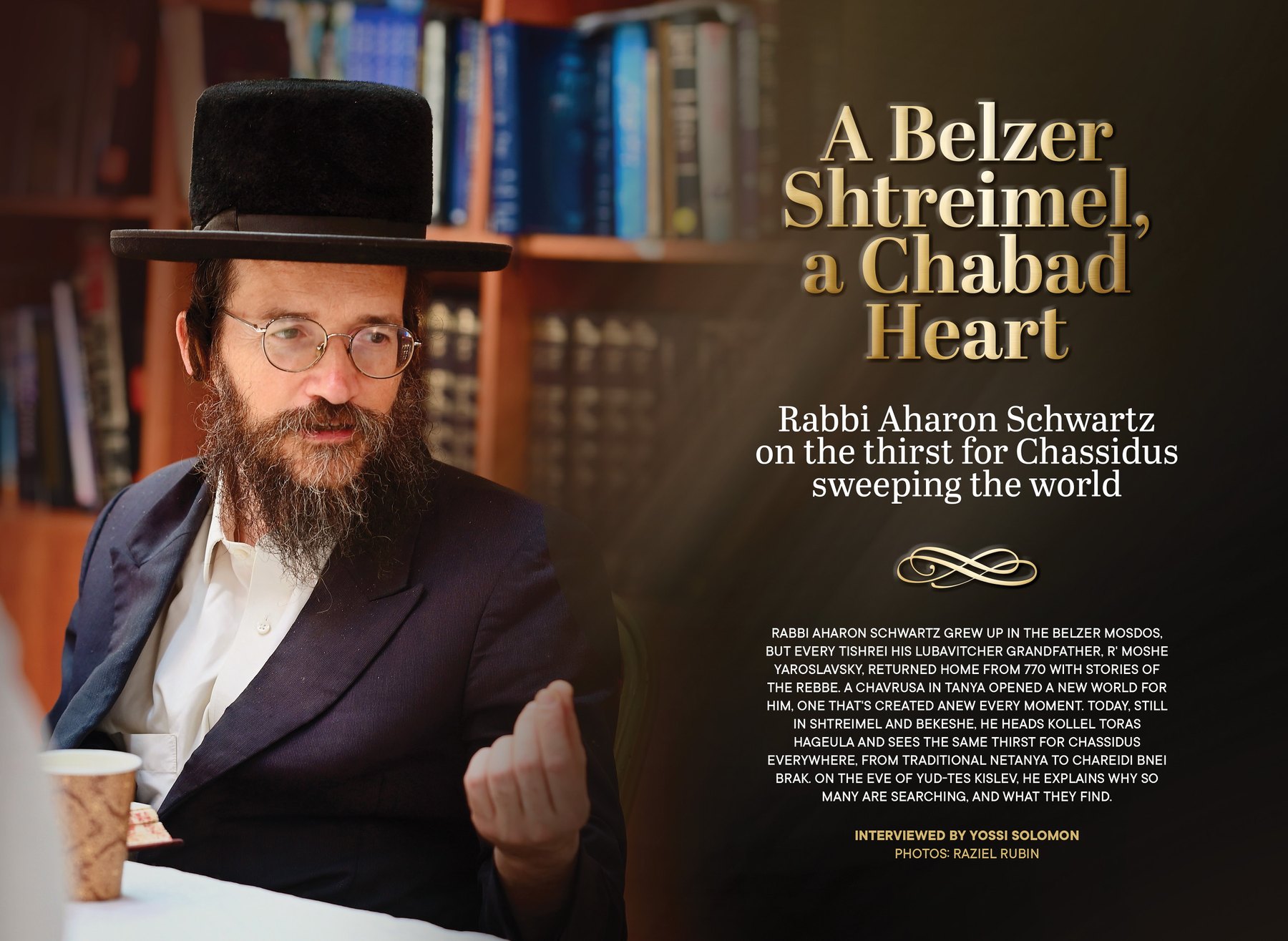
Rabbi Aharon Schwartz on the thirst for Chassidus sweeping the world
Rabbi Aharon Schwartz grew up in the Belzer mosdos, but every Tishrei his Lubavitcher grandfather, R’ Moshe Yaroslavsky, returned home from 770 with stories of the Rebbe. A chavrusa in Tanya opened a new world for him, one that’s created anew every moment. Today, still in shtreimel and bekeshe, he heads Kollel Toras HaGeula and sees the same thirst for Chassidus everywhere, from traditional Netanya to chareidi Bnei Brak. On the eve of Yud-Tes Kislev, he explains why so many are searching, and what they find.
On the morning of Rosh Hashana, you can find him wrapped in a tallis, standing before the amud. His face is not seen, but his voice rises from the folds of the tallis, melodious and expressive, in the traditional Chabad nusach of the Yamim Noraim. His voice pleads, laden with emotion, and as one who is expert and fluent, he sweeps the tzibbur along with him in the Chabad shul in the center of Bnei Brak.
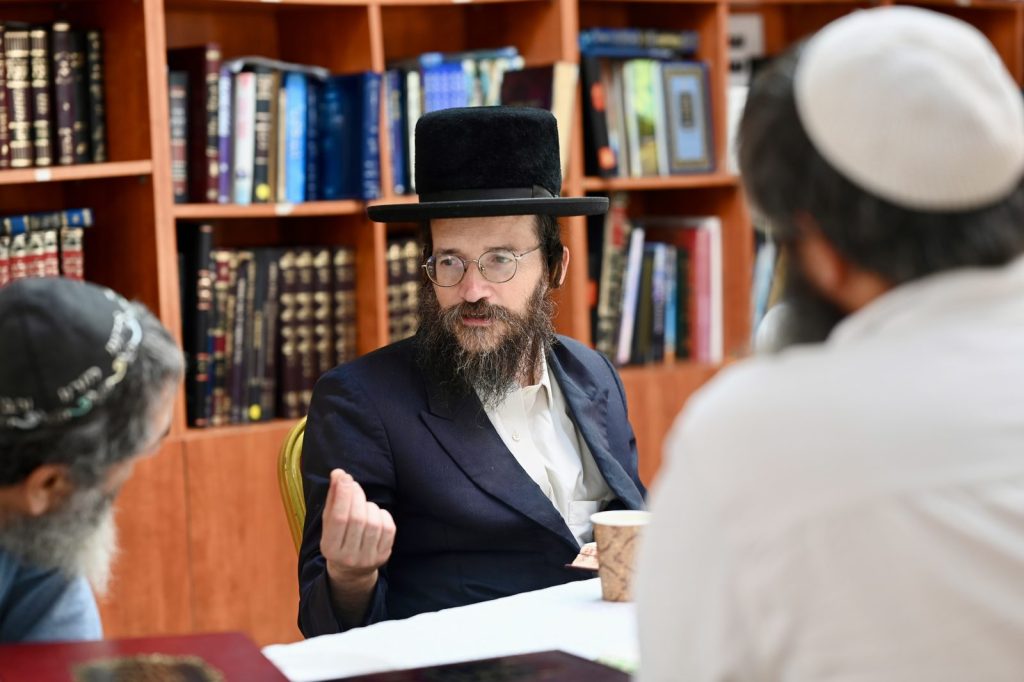
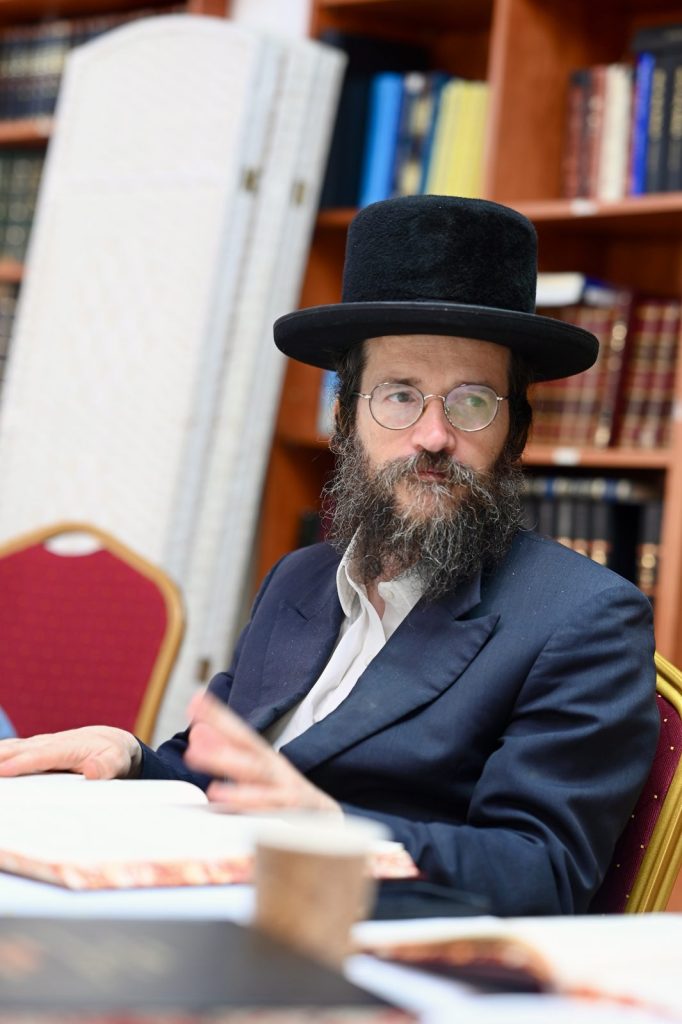
Only after the davening does Rabbi Aharon Schwartz put on his shtreimel and his Chassidic kapote, with his long peyos curled around his ears. His roots lie deep in the Belzer Chassidus, but today he is a refined yungerman blossoming in the field of Chabad, and he also serves as a Mashpia and a Rosh Kollel of “Toras HaGeula” in Netanya.
“As a child and a teenager, I was educated in the cheder and yeshivos of Belzer Chassidus,” he says of his roots, but he elaborates: “At the same time, I also have roots in Chabad Chassidus.”
His grandfather was one of the well-known Chassidim of the seventh generation, the renowned host Rabbi Moshe Yaroslavsky a’h, who merited extraordinary treatment from the Rebbe MH”M. Every year in the month of Tishrei he would travel to the Rebbe and he ran the Hachnasas Orchim organization for the Rebbe’s guests.
“Because of my grandfather, the presence of the Rebbe as Moshiach in our family was very strong,” says Rabbi Schwartz. “Every time my grandfather returned from the Rebbe, he came back with stories of wonders and with inspiration that lasted the whole year.”
Can you share with us one story about your grandfather, one that for you is a case of “girsa d’yankusa”?
Once, when my grandfather merited to enter yechidus, the Rebbe suddenly took a nice amount of money out of the drawer and told him, “This is for Hachnasas Kallah in Eretz Yisrael.” My grandfather didn’t understand what the Rebbe meant. To whom was he supposed to give it?
A day or two after he returned from the Rebbe to Bnei Brak, where he lived, he went to daven Shacharis in shul. While he was in the street, he met a Gerrer Chassid named Reb Avrohom Rottenberg, who was wearing Shabbos clothes. My grandfather understood that he was dressed like this because of a simcha he was making, and immediately wished him a heartfelt ‘Mazal tov.’ In a flash, he felt in his heart that the money the Rebbe had sent was meant for this Yid. Without a word, my grandfather pulled the bundle of money out of his pocket and handed it to him, saying: ‘I was just in yechidus with the Lubavitcher Rebbe, and he sent you this money for the wedding.’
Rabbi Rottenberg was astonished at the money and at why the Rebbe had sent it specifically to him.
A conversation then developed between him and my grandfather, in the course of which he told my grandfather about an incident that had happened to him a few years earlier, when he passed by the Rebbe at kos shel bracha. Ahead of him, someone had passed by and asked the Rebbe for a bracha for his friend, who had fallen into debt. The Rebbe answered him to tell the friend to stop taking loans… Rabbi Rottenberg, who was standing behind and heard this, took it upon himself at that very moment that he, too, would never take loans again, and would live according to what he had.
That very day he was marrying off his daughter, but in recent days he had faced a great challenge since he had no way to cover the wedding expenses. Good people offered him convenient loans, but he did not want to break what he had accepted upon himself as an indirect instruction from the Rebbe. And behold, the Rebbe sensed this from afar, and sent him, through my grandfather, money for all the wedding expenses…
Rabbi Schwartz stresses: “The special moments my grandfather merited with the Rebbe made a powerful impression on the entire family.”
Not Ashamed of the Scoffers
One could therefore say that Rabbi Schwartz’s childhood and teenage years stood at a kind of crossroads between Belz and Chabad. His formal studies took place in the Belzer court, but in practice he peeked into the world of Chabad and got to know it.
“As a bachur, I began learning Chassidus with the mashpia Rabbi Zalman Landau,” he says. “Then I came to know the depth and light that Toras HaChassidus has to offer. My closeness to Rabbi Landau also implanted in me the power of the Rebbe as one who works salvations and as a Manhig Yisrael. He knew how to weave the Rebbe’s holy sichos into the statements of the holy Tanya, and how together they illuminate the way in everyday life. Thanks to him I connected deeply with Chabad, and after I married I became an open Chassid of the Rebbe, even though I didn’t change from what is customary to wear in Belz Chassidus.”
What in the learning with Rabbi Landau grabbed you in particular?
When we began learning Shaar HaYichud V’haEmuna, where the Alter Rebbe explains how Hashem creates the world anew every single moment, especially accompanied by the Rebbe’s profound explanations on this subject, it won me over.
I remember that in the first weeks in which I learned Tanya, when I would step outside the walls of the Beis Medrash, I would look at the world as a brand-new universe, one that is constantly being created anew…
Afterward we added learning Igeres HaTeshuva of the Alter Rebbe, together with the Rebbe’s sichos on the explanations of his father, Rabbi Levi Yitzchok, in which one sees how every word in Tanya is precise and takes on a deeper meaning. The Tanya and the explanations illuminate life. The learning made me understand that all the Chassidic courts are good, but there is a place where the truth shines without compromise: in the teachings of Chabad.
How did your acquaintances and the community around you take your move to Chabad?
That’s an interesting question. In many areas, people avoid making fundamental changes in life out of fear of how those around them will react. But a person who comes to the recognition that he must make a change must do it regardless of his surroundings and how people will react. When those around me see that I am resolute and believe wholeheartedly in the new path, they respond with love as well. But if one hesitates, the environment responds with mockery.
One of the explanations the Rebbe gives for the dictum, ‘And do not be ashamed before the scoffers’ is not to think about how the environment will react. Although in my case, people didn’t react very negatively since it was already clear to them that I belonged in Chabad as I also have brothers who moved from Belz to Chabad.
The Spirit of Awakening Encompasses All Sectors
Rabbi Aharon Schwartz lives in Bnei Brak and is an inseparable part of the Chassidic landscape of the city. He is slight and modest, one of those people who speaks little and does much. He has a constant smile. A yungerman whose entire concern is Torah and spreading Torah.
As one who grew up within the Chareidi community and lives in Bnei Brak, how do you see the spread of learning Chassidus in the Chareidi world?
One can’t help but see the interest there is today in very broad sectors. Unlike a place where there is a thirst and people go off in every direction to seek water to quench it, everyone knows that the truth is found in the teachings of Chabad Chassidus, and they want to drink from it.
It is said in the name of one of the gedolei Yisrael, who said after the Six-Day War, a wind of teshuva blew through the world. What a pity that only those who do not keep Torah and mitzvos took from it…
Today we see that besides the wave of return from all sectors of the public, in the Chareidi public too they feel the words of the Navi, ‘And I will send a famine in the land, not a famine for bread and not a thirst for water, but to hear the words of Hashem.’ The word of Hashem in its inner meaning, which is pnimiyus haTorah. People are searching for meaning in life, and many are beginning to learn the sichos and maamarim of the Rebbe that give them meaning, and not just nice ideas on the weekly parsha and the like.
I met a ‘chareidi’ Jew who told me that some time ago he purchased a set of Likkutei Sichos and he learns from it every week. Each time he is amazed at the depth of the sichos, and repeats the ideas to his acquaintances. There are many from all sectors of the Chareidi public who, although outwardly are not identified with Chabad, know that in pnimiyus haTorah there is depth. They are not satisfied with short vertlach alone, but seek to delve deeper and apply it to their actions.
Recently I began learning with a yungerman every Shabbos morning before davening. He has been learning Chassidus for a while, and he told me that the learning changed his whole approach to life, both in terms of emuna in Hashem and in terms of meaning in life. Chassidus simply illuminates life.
Tell us about your kollel.
The kollel has existed for over a decade and Yidden from all over the area come to learn there. The daily schedule begins even before Shacharis, with a seder of Chassidus. After davening and breakfast, there is a shiur in the daily Tanya, and afterward there is in-depth learning of halacha.
Most of the kollel’s participants come from the traditional-religious sector. Through the kollel we see a possibility of connecting them to the Rebbe.
The kollel’s approach to learning is not just learning for the sake of learning, but learning that leads to action. People who are not Chabadniks go and open tefillin stands, and themselves become mashpiim on their surroundings. [Here he shares two stories that illustrates the level of influence]:
One of the kollel’s participants, who comes from a traditional home, would come from time to time to enjoy the Chassidus shiurim. The learning, of course, affected him, and he decided to join me on the trip to the Rebbe for Tishrei.
As a result of the trip to the Rebbe he drew closer to Chabad, and since then he sets up a tefillin stand every Friday. We see that when the learning is connected to the Nasi HaDor, it doesn’t remain only in the intellect, but percolates into daily life, to the point of affecting himself and his surroundings.
There is another Yid, a stonecutter by profession, who came to the kollel in order to write to the Rebbe in the Igros Kodesh. The Rebbe, in his letter, answered, ‘Fortunate is his lot that he merited to build shuls.’ This man indeed had a part in building many shuls in Netanya, and when he saw the Rebbe’s answer, he was amazed at how the Rebbe had answered him so precisely…
These are two examples out of many that illustrate how profound the kollel’s influence is on its learners, and how much it touches many Yidden.
The Geula Train Has Departed
On the eve of Chag HaGeula, the “Chag of Chagim,” the great call of “Yafutzu maayanosecha chutza” is heard. Once again the heavenly, Geula-oriented call that was heard in the prison cell of the Alter Rebbe echoes: “Aderaba (On the contrary), since you were imprisoned, when you leave here you will spread the wellsprings of Chassidus far and wide.”
The Geula train that departed in those first years of spreading Chassidus is now arriving at the final and last station of galus, after more than two hundred years of spreading the wellsprings.
“In many of the Rebbe’s holy sichos, he explains that the Geula of the Alter Rebbe is an inseparable part of the process leading to the complete Geula,” Rabbi Schwartz explains.
“We all know the letter the Baal Shem Tov wrote to his brother-in-law, Rabbi Gershon of Kitov, in which he describes the ascent of the soul he had, and Moshiach’s answer to the Baal Shem Tov that he would come to redeem Yisrael ‘when your wellsprings will spread outward.’ It is therefore self-evident that spreading Chassidus and implementing it in everyday life brings the Geula closer. We already see that everyone who begins learning Chassidus can attest that he has a personal Geula in everyday life.
“When we learn Chassidus and understand our significance, both as Yidden and as Chassidim, and especially our being Chassidim of the Rebbe, this itself is already a process of personal Geula. Lack of clarity in life is like galus, and the clear knowledge of our place and our task is a kind of Geula.
“The Rebbe explains in depth that the entire essence of the Geula is not to innovate or invent new things, but to reveal, within galus itself, the alef that hints at the ‘Alufo shel Olam’. In simple words: to reveal our connection with Hashem. This is the central thing that Toras HaChassidus accomplishes in our lives: to instill the Alufo shel Olam within everyday life, through understanding, recognition, and reviving the inner emotion.”
We learned (supposedly) in yeshiva how to learn Chassidus; but how does one learn how to live Chassidus?
“‘Not the study is the main thing, but the deed.’ The Rebbe mentions countless times that specifically ‘the deed is the main thing.’ The Rebbe draws a lesson for everyday life from everything. If in previous generations the emphasis was more on hisbonenus and avoda pnimis, the Rebbe places the emphasis on spreading the inyan to another Yid. What is the advantage of this? First, that another Yid will recognize and know. But in addition: when we spread the message to another Yid, we ourselves live with the message more deeply and with greater feeling. It connects us to the essence of the matter.
“This can be explained from another angle, the mitzva of tzedaka. In many sichos the Rebbe explains the importance of giving tzedaka, which elevates a person and makes his mind and heart a thousand times purer. The Rebbe emphasizes that Chazal’s intention is not an exaggeration with the word ‘thousand,’ but is literal: that by doing good for another, a person succeeds in his learning and his spiritual service a thousand times more than he would have succeeded had he not given to another.
“This is the case when it comes to giving tzedaka materially. But of course there is also spiritual tzedaka: when one gives another spiritual tzedaka, whether through teaching Chassidus or through Mivtza Tefillin and the like, it causes the inyan to shine more within us, to permeate us more deeply, and consequently also to affect our chayus and feeling.”
In a generation that is immersed in the rush of life, with countless distractions and confusions—how can one create space in one’s daily schedule for proper study of Chassidus, every day?
The kelipa tries to cause us distraction. Its goal is that even if a Chassid learns Chassidus, he should not be permeated by it and live it.
The way to create study time during the day is not to create an empty slot of time and then fill it, but the opposite way: to reveal the truth that already exists within us.
The Alter Rebbe says in his explanation of ‘Hallelu b’Shem Kodsho (Praise Him with His holy name)’ that the neshama praises Hashem and we need to listen to the praise of the soul; we must let ourselves hear the soul’s song, and this will influence us automatically. While we are learning Chassidus or davening, we must be open to what our soul is saying.
The teachings of Chassidus teach us about the true will of a Jew. The minutes in which we learn a Dvar Malchus or a sicha of the Rebbe are meant to teach us about the song of our soul. To discover that this song already exists within us, and we only need to do ourselves a favor and listen to ourselves, and not to the other distractions—like the well-known mashal of the man who went to search for the treasure under the bridge in Prague, when it was in his own home. This is really the great gift of the teachings of Chassidus—we don’t need to search outside, since the inner connection of a Jew with the Eibishter already exists within us.
It is not enough to learn; we must also contemplate the content of what we learn. When we contemplate what we are learning, it gives our neshama the space to be revealed and to naturally want to learn more Chassidus, for Chassidus is sweet—‘Taste and see that the L-rd is good’—who doesn’t want to experience more and more sweetness?!
In HaYom Yom it is written that Chassidim should set aside at least two hours a week for learning Chassidus, and tmimim an hour every day. When we observe this kevius not only in time but also in the soul, it will surely have an effect and influence on us.
Since we are erev Yud-Tes Kislev—the chag of the Alter Rebbe, is there great importance in dedicating our time and mental energy to learning Tanya by heart?
It is no secret that anything we want to influence those around us with must first be engraved within ourselves, in the sense of ‘chai l’hachayos (living in order to give life).’
The mashpia Rabbi Mendel Futerfas said many times that what sustained him in the difficult years in the labor camps, so that he would not lose his joy and his feeling of hiskashrus to the Rebbe, were the chapters of Tanya that he knew by heart, which he had learned after being punished as a bachur in Tomchei Tmimim…
If we understand that knowing Tanya by heart affects our very lives, everyone will want to learn it.
A certain person told the Rebbe that he wanted to be connected to him, and how could he do so? The Rebbe answered him that while he walks in the street, he should review Tanya by heart, and if the Rebbe does likewise, it turns out that they are doing the same thing, and thus they will be connected to each other.
So, in addition to all the other benefits, there is also a connection to the Rebbe by doing so, not to mention the virtue of purifying the world’s atmosphere when reviewing Tanya in the street.
What is the point that a Chassid should take from the Tanya and from the Chag HaGeula?
I live in Bnei Brak and every day I travel to the kollel in Netanya. So several times a week I end up traveling with those who are not from Anash and talking with them on the way.
Recently I traveled with someone who told me that he was taken advantage of as a result of doing a certain mitzva, and he is disheartened because of it. I explained to him the words of the Alter Rebbe in the Iggeres HaKodesh that begins with ‘L’haskilcha bina’—that everything Hashem does is for the good, and no evil descends from above, and when one holds on to this faith, everything becomes good in the revealed sense as well. This means that when a Jew relies on the fact that what happens to him is good from Hashem, everything takes on a different meaning and he becomes a happier person.
The ability to live this is through learning the teachings of Chassidus.
The same applies to galus—we can say that galus is an illusory reality and Geula is the revealed good. By learning the teachings of Chassidus and connecting to our Rebbeim, the Nesiim, we will merit that the illusory evil will become revealed good, the Almighty’s unity will penetrate the exile, and in this merit we will merit the true and complete Geula.
In the past there was difficulty in instilling the importance of studying Chassidus among broad circles in the Chareidi sector, whereas today it is “the generation is ready” [achshur dara]. Can it also be said that the Chareidi public is ready to greet Moshiach Tzidkeinu and the messages of Geula?
The Rebbe says that Moshiach is already at the door, and all that remains is to polish the buttons. And if the Rebbe says so—that is the reality, and certainly it is so among the Chareidi public as well. Our role as Chassidim and as those connected to the Rebbe is to set up another chavrusa in Chassidus, with an emphasis on the Rebbe’s teachings. They are only waiting for us to share with them the teachings of Chassidus, which is the essence of our role as Chassidim of the Rebbe, who demanded countless times ‘Let your wellsprings spread forth’—which is the preparation for the revelation of Melech HaMoshiach.
This past Tishrei I was with the Rebbe. One day I went with a ger tzedek who, tragically, became blind after converting, and we went out to do mivtzaim in a shul in Williamsburg where they honored him to say a few words. He said that today he knows that sight has a different, more inner essence. When he could still see physically, he didn’t truly see anything, according to him; davka today, when there is a decline in his physical sight, his spiritual sight has been strengthened many times over.
From this story we can draw an application to what the Rebbe says, that we must open our eyes and see how the world is ready. How do we open our eyes? It means beginning to learn the Rebbe’s sichos on inyanei Geula and Moshiach, and to share this with one more Jew and then another—and through this we will surely merit to greet him.
Beis Moshiach #1532 • pp. 10-18
© 2026 Beis Moshiach Magazine. All rights reserved.
This article originally appeared in Beis Moshiach #1532. You are welcome to share it with friends and family by email or in print, provided that you do not change, add to or omit any part of it, you credit the author and Beis Moshiach, and you include a link to archive.bmoshiach.org (written out in full in printed copies).
To republish this article in a newspaper, magazine, book or website, please request permission in advance at [email protected].