The Professor and the Prophet – Part II
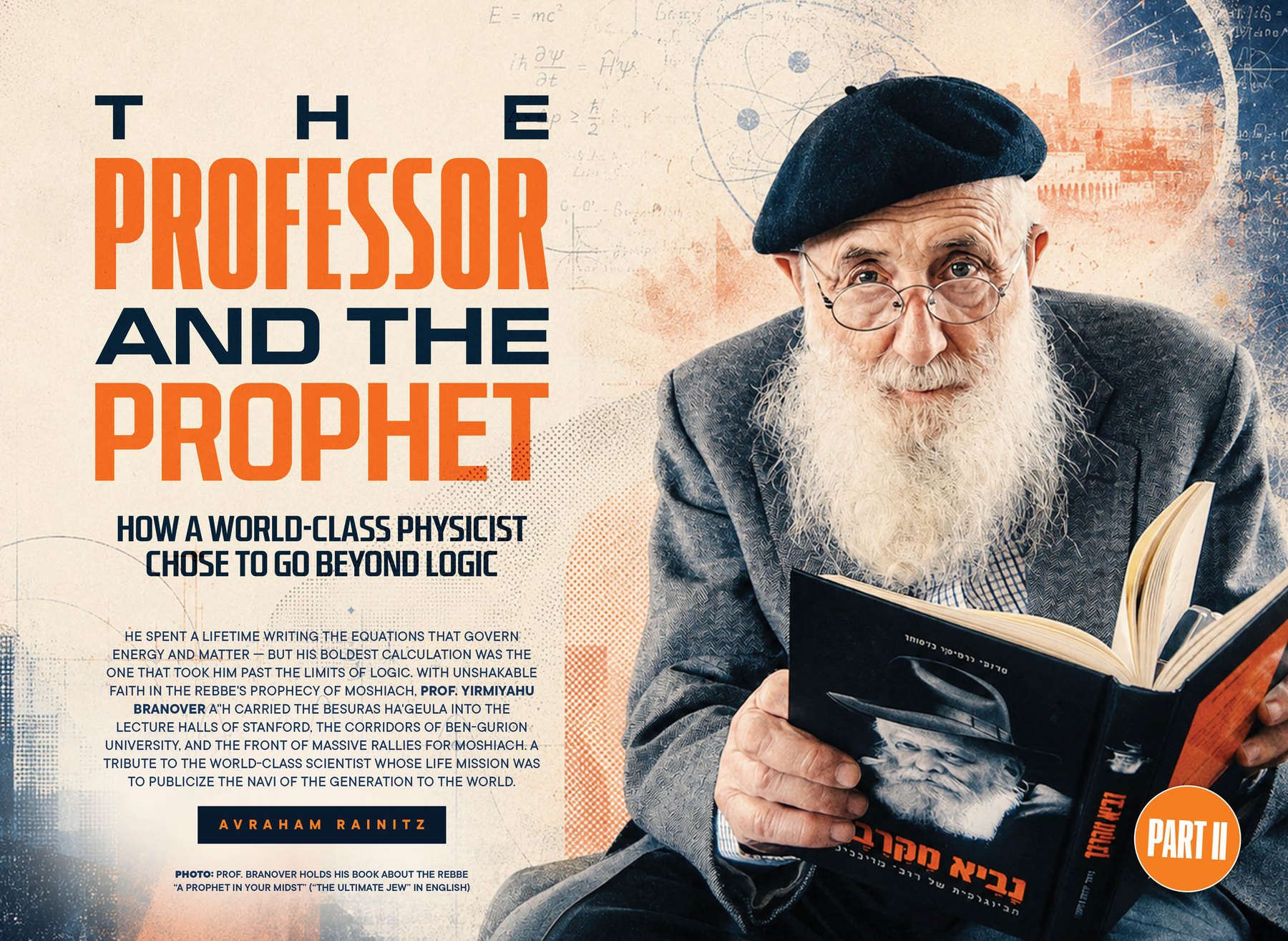
How a World-Class Physicist Chose to Go Beyond Logic
He spent a lifetime writing the equations that govern energy and matter – but his boldest calculation was the one that took him past the limits of logic. With unshakable faith in the Rebbe’s prophecy of Moshiach, Prof. Yirmiyahu Branover a”h carried the Besuras HaGeula into the lecture halls of Stanford, the corridors of Ben-Gurion University, and the front of massive rallies for Moshiach. A tribute to the world-class scientist whose life mission was to publicize the Navi of the generation to the world.
Educating Russian Minds
“You must take into account,” said Professor Branover in a historic interview he gave to radio station WEVD in 5734, explaining his motivations, “that the Jews arriving now from the Soviet Union to Eretz Yisrael have absolutely no idea of the significance of a simple Hebrew letter.”
These words, spoken only about two years after his own immigration to Israel, reflected the deep pain he felt for his Jewish brothers who had remained spiritually “frozen.” Out of this pain, and with the blessing and direct guidance of the Rebbe, Branover founded the SHAMIR Association (the Association of Observant Academics from the Soviet Union). The Rebbe did not merely support the initiative, he pressed for it, with a deep understanding that physical freedom was not enough; spiritual freedom was required. “The Rebbe was the first to mention the necessity of returning the new immigrants to their Jewish heritage. Other people believed it was quite sufficient to bring them here physically but we see now, more and more, how necessary it was.”
For the Professor, SHAMIR was not just another chessed organization, but the means for a tremendous conceptual revolution. The Russian mind, accustomed to analytical thinking and a materialistic, spirit-free worldview, demanded rational intellectual nourishment. Branover understood that one could not approach them with slogans alone; a complete “reprogramming” of their worldview was needed.
“They received their education in Soviet universities,” Branover analyzed his target audience, “and they still cling very strongly to Russian culture and a materialistic worldview. We had to begin by explaining that even in the modern era, the Torah is the only possible worldview for Jews. And we had to do this on a very detailed and scientific basis, to explain how modern science cannot in any way affect the eternal truth of the Torah.”
From this grew SHAMIR’s massive publishing enterprise, which produced and distributed millions of copies of foundational Jewish books and essays in the Russian language. These books were not only printed in Israel, but smuggled in clandestine operations across the Iron Curtain, with the aim of spreading light into the heart of Soviet darkness.
Branover saw this work as a mission of saving souls. He described how many immigrants who searched for their roots but could not find them remained adrift. “They were accustomed to seeing their Jewishness as a burden,” he said with rare candor. The goal of SHAMIR was to reverse that equation and help them feel the blessing of being Jewish.
His activity did not remain within the borders of Israel. Many Jews who left Russia emigrated to other countries in Europe and the United States, and he worked tirelessly to maintain connection and strengthen them as well. “When a Jew goes somewhere else and settles in a non-Jewish environment, he is completely lost,” he called out from the depths of his heart with deep concern. In his view, spiritual roots and community connection were the only guarantee of continuity.
At a certain point, the intensive work of Branover and the underground activists in Russia stood on the brink of a tectonic shift, not from the KGB, but from a completely unexpected direction: an astonishing prophecy the Rebbe sent them, one that would overturn all the political cards of the Soviet superpower.
The Heavenly Prophecy of the Iron Curtain’s Fall
In the month of Adar 5745, the Western world held its breath. Mikhail Gorbachev, a young and dynamic leader (by Soviet leadership standards of the time), entered the Kremlin as General Secretary of the Communist Party. Western analysts and major newspapers predicted the worst, estimating that the new ruler would harden his domestic positions and suppress with an iron fist any attempt at freedom or Jewish awakening. Even the Chabad underground activists in Russia, who lived in constant fear, braced for the worst.
But in the Rebbe’s room, reality looked entirely different. “I will never forget what happened then, in the spring of 5745,” testified Professor Branover, his voice trembling with emotion in one of his interviews. “I was in New York, and the Rebbe instructed me to make phone calls to the people who were working with us, who were spreading Torah there. This was only two or three weeks after Gorbachev had entered the Kremlin.”
The message the Rebbe told him to convey to the activists was utterly inconceivable by the standards of those dark days: “You must tell them that from now on the situation in Russia will only improve, and that ultimately everyone will be able to leave, and complete freedom will reign in Russia.”
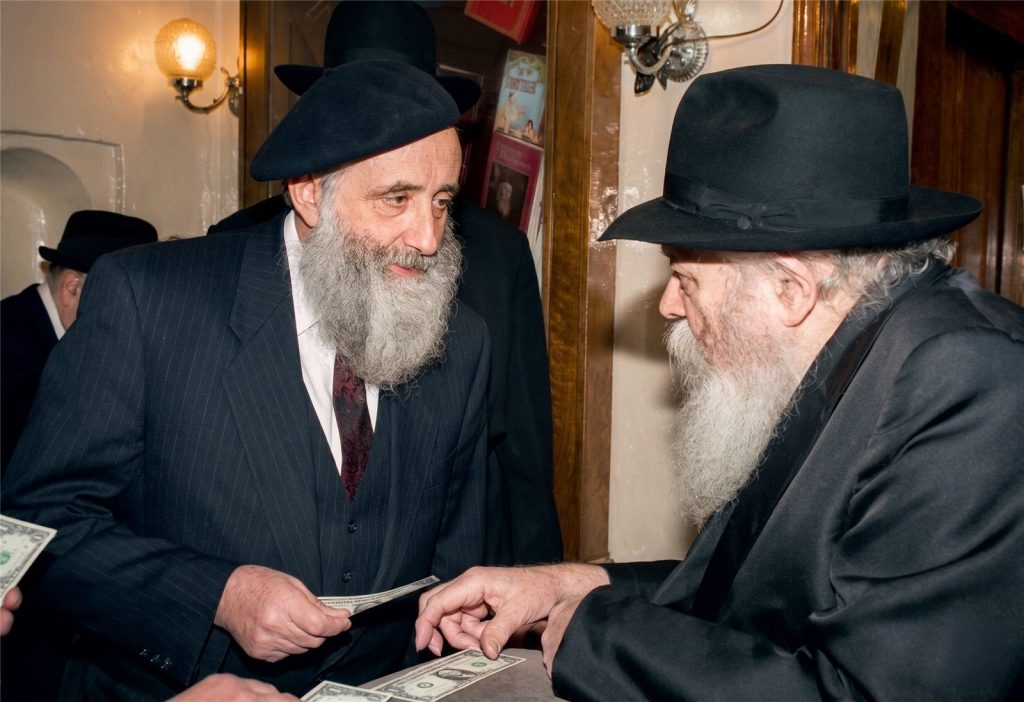
Branover, who by then knew well that the Rebbe’s words were more precise than any forecast, asked no questions. He hurried to make contact by telephone, which was itself a complex and dangerous undertaking, with the activists in Russia. “I told this to the people and they could not accept it,” Branover recounted the painful reaction he received from the other end of the line. “One said that a KGB car stood beside his door at all times… another told me that his wife had been taken in for questioning two days ago and still hadn’t returned… ‘How can we believe what you are telling us?’ they said to me. We had to believe, of course, because they knew about the Rebbe, and I told them these words came from the Rebbe, but they had great difficulty accepting it.”
When he wrote to the Rebbe about the anxiety-laden reaction of the Chassidim behind the Iron Curtain, the Rebbe did not retract a single word of his prophecy, but instead conveyed an additional message, even more resolute: “Call them again. Tell them that it is not yet visible to the eye, but the process has begun and the situation will improve gradually. It will become better and better, and in the end everything will be fine. Everyone will leave, all who wish to do so.”
A few years later, these words became openly manifest historical reality. The Iron Curtain collapsed, the mighty Soviet Union disintegrated, and waves of hundreds of thousands of Jews immigrated to Israel, exactly as the Rebbe had prophesied!
The stunning closing of the circle occurred in the summer of 5752. Mikhail Gorbachev, now the former president, arrived for a visit to Israel. As part of the visit, Professor Branover was responsible for the reception held in his honor at Ben-Gurion University. “After the ceremony and speeches, I took him aside,” Branover reconstructed the historic moment, “and said to him: ‘Mr. Gorbachev, do you know that the Lubavitcher Rebbe, the wisest and most righteous man of this generation, foresaw what would happen in Russia as far back as April 1985?’”
The reaction of the leader who had reshaped the world was one of complete astonishment. “He was stunned,” recalled Branover. “He asked me: ‘Who is this man? Tell me more about him. How could he have known this, when even I myself—in 1985, in 1986, and even in 1987—could not foresee what would happen in Russia? How did he manage to do that?’”
For Branover, Gorbachev’s total shock added nothing new; it only gave validation to what the Chassidic physicist had long known: the Rebbe’s leadership stands far above the veils of history and world politics. This clear recognition of the Rebbe’s greatness drove him to undertake one of the most challenging projects of his life, to attempt to translate that infinite greatness into writing, in a book that would explain to the entire world who the Lubavitcher Rebbe was.
A Life’s Project — To Know the Heart
After witnessing with his own eyes how the Rebbe navigated world history and the laws of science, a deep need burned within Professor Branover to convey this power to the wider public. He wanted to make accessible to the world not only the Rebbe’s genius, but above all the emotional and heartfelt dimension.
Thus was born the idea for the book B’Ayin HaLev, which later developed into Navi MiKirbecha (“A Prophet From Among You”). “I had previous experience writing books, but those were works of thought and philosophy,” he shared with me in an interview for Beis Moshiach. “Since I wanted the book about the Rebbe to speak to people from the emotional and heartfelt dimension as well, I could not write the book alone.”
Hashgacha brought him together in the late 1980s with Avraham Naveh, a young journalist with a special soul who was then staying at 770 and had been deeply influenced by the Rebbe. Together they created a perfect work: Branover supplied the vast knowledge, the profound ideas of Chabad Chassidus, and the inside perspective, while Naveh cast them into a journalistic and compelling narrative form. Of their collaborative process, Branover said: “We internalized the feeling that when writing a book about the Rebbe and Chabad, one must nullify one’s ‘I’… to think about what the Rebbe wants, what is better for Chassidus.”
But the most astonishing detail in the entire creative process of this monumental project is that Branover never reported it to the Rebbe. Despite meticulously sending the Rebbe a detailed report every weekend on all his public activities, his work on writing the book he kept in absolute secrecy from the inner sanctum.
When I asked him why, his answer revealed the depth of his Chassidic devotion: “Whoever reads the book arrives at the conclusion that there is no other person in the world like the Rebbe,” he explained with rare candor. “How can I write to the Rebbe that I am writing a book about him, whose conclusion is that there is no other person in the world like the Rebbe?” In his view, reporting to the Rebbe about writing a book that elevated the Rebbe to such a level was an act of tactlessness.
For years, during long private audiences with the Rebbe (one of which lasted three hours and fifty minutes, an eternity by the standards of the Rebbe’s time), he tried to analyze with his scientific mind exactly what it was that drew him inward toward this holy figure. “People tend to think that as a scientist I was captivated by the Rebbe’s astonishing knowledge of all the sciences,” he recounted. “True, the Rebbe’s mastery is beyond any human explanation but that is not what captured me.”
“In the end,” he revealed his ultimate conclusion, “I understood that my pull toward the Rebbe stems from the fact that he is the heart of all of us. The ‘heart of all Israel.’” This was the message he sought to impart to the world: the Rebbe is not merely a genius, but the heart that pumps physical and spiritual life to every Jew wherever he may be.
This humility, and the deep understanding that the intellect must yield before truth, led him at a later stage to the boldest and most decisive step of all, updating the book to a new edition bearing a clear redemptive message, a message of unwavering faith, even when it clashes with accepted norms of reason.
Navi MiKirbecha — When Intellect Makes Way for Faith
The republication of the book (in 5767/2007) was not merely a matter of redesign or re-editing; it brought with it a dramatic and deeply meaningful change of title: from B’Ayin HaLev to Navi MiKirbecha. The shift from a name hinting at emotion and connection, to a name declaring, absolutely and without any apology, the presence of a living prophet in our generation, was no accident.
When I asked him about the significance of the change, his answer was unequivocal: “In the sicha of Shabbos parshas Shoftim, 5751, the Rebbe instructed that it be publicized that there is a prophet in our generation, and that his primary prophecy is that ‘behold, the Moshiach comes.’” Branover pointed to a fundamental chiddush in that sicha that many may have missed: “Usually, when people study this sicha, they note that the great chiddush is that the Rebbe testifies about himself that he is a prophet. That is true, but in this sicha there is an additional chiddush: for the first time, there is an open call to publicize to all the people of the generation about the Rebbe!”
For Professor Branover, this instruction was a direct call to action. Feeling the sense of shlichus placed upon him, he felt obligated to implement the directive on the literary front as well. “Since the essence of our book is to publicize the Rebbe,” he explained, “it was only natural that the book fulfill the Rebbe’s instruction from the sicha of parshas Shoftim.”
But here the scientist faced the greatest intellectual and explanatory challenge of all. How does one take the Chassidim’s abstract, yet absolute, belief that the Rebbe lives and exists in a physical body even after the concealment of Gimmel Tammuz, and make it accessible to the broader academic public? How does one contend with the rational barrier of the modern reader, who cries out that this “makes no sense”?
Branover divided this challenge into two: what to write and how to write it.
Regarding the content itself, he did not flinch. “Everything brought in the Rebbe’s edited sichos… is material that can be written. Of that I have no doubt,” he declared. “Even if these are statements that might be interpreted as extreme, the Rebbe certainly took that into account, and nevertheless released them for publication.” In his view, truth need not hide.
But the real difficulty lay in the how. “To take the Rebbe’s words, alongside the pure faith of the Chassidim that all of the Rebbe’s words will not return void, and to convey them in journalistic writing, that is hard work.”
And it was precisely here that the Professor’s physical and analytical mind shone in its full glory. Drawing on his deep familiarity with the “religion of reason” (for he himself had been raised on thoroughgoing materialism in Russia), he developed a brilliant strategy: he used the intellect itself to demonstrate its own limitations.
“I searched for a form of writing that would lead a person to the conclusion that the intellect is not the chief scientist. That a person can, under certain circumstances, set aside the intellect and believe. Simply believe. And the great wisdom is to write this in such a way that the intellect itself arrives at that conclusion.”
To explain to the rational reader the belief in the Rebbe’s eternal life, he did not try to invent new laws of physics, but turned instead to explicit precedents from the words of Chazal, people who appeared to be deceased yet continued to live in a physical body.
“When a Jew who believes in the words of Chazal reads about these events,” the Professor explained the logical sequence, “he understands that there are extraordinary events in which the laws of reason and logic are not relevant. Once he reaches this conclusion, it becomes easier to lead him to the conclusion that our present reality is likewise such a case. We need to set aside our intellect and simply believe.”
This approach became not only a chapter in the book, but his life’s mission. The international scientist was now ready to go out to the front lines of global outreach, not merely as a biographer, but as the head of Matteh Moshiach (Moshiach Headquarters) organization.
Ambassador of Moshiach
For Professor Branover, the belief in the Geula and the imminent revelation of the Rebbe as Melech HaMoshiach was an active and practical way of life. He did not retreat into an ivory tower but came down to the ground. In 5759, he was appointed by the then-chairman of Agudas Chassidei Chabad, Rabbi Shlomo Maidanchek a’h, to serve as chairman of the Matteh Moshiach organization in Eretz Yisrael.
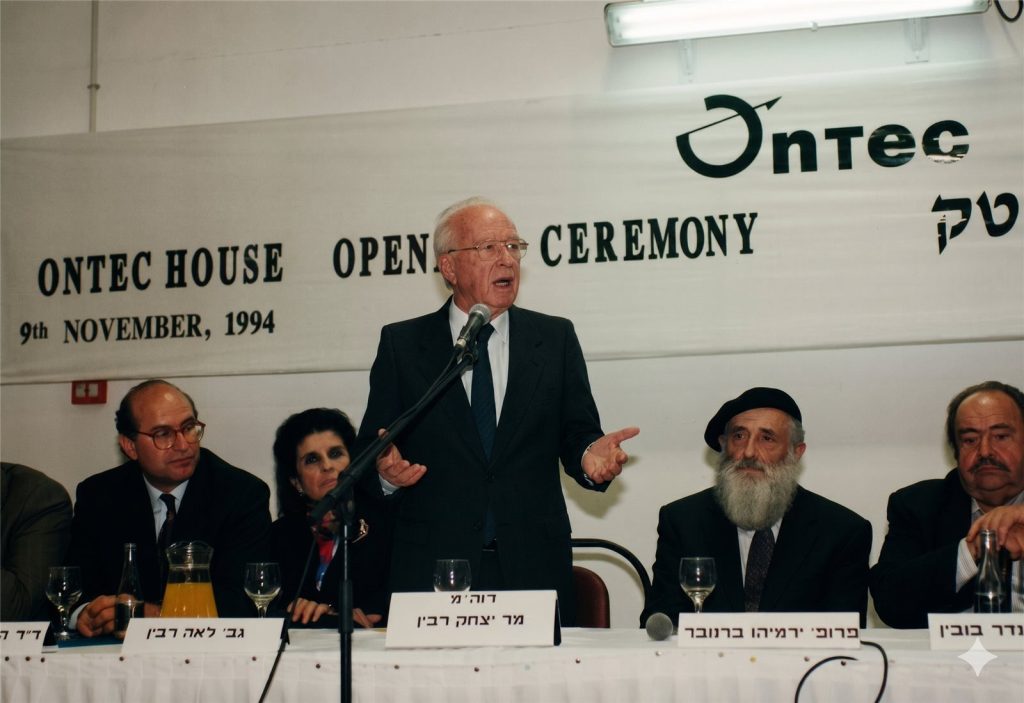
This role was not merely an honorary title for him. As a scientist and academic who moved through the corridors of universities in Japan, the United States, Russia, and Israel, Branover placed his entire professional prestige at the forefront of the campaign to introduce the Besuras HaGeula to every stratum of the Jewish people.
Imagine the scene: a physicist of world renown, heading prestigious laboratories at Ben-Gurion University, receiving multi-million-dollar grants from the United States government, taking the stage at massive rallies for the cause of Geula and Moshiach, crying out with blazing faith the sacred declaration: “Yechi Adoneinu Moreinu V’Rabbeinu Melech HaMoshiach L’Olam Va’ed!”
He did so without a trace of shame or apology, even before halls filled with cynical journalists and politicians. “I don’t understand how anyone could be opposed to this campaign,” he marveled.
“The Rebbe has already carried out many campaigns. The Rambam already established that one must not only believe in the coming of Moshiach, but must do everything to bring it about. And just as the Rebbe takes everything seriously and does not merely speak, now comes the most important thing of all, the coming of Moshiach.”
As part of his role in Matteh Moshiach, Professor Branover contributed his clear explanatory ability to a regular weekly column published in the bulletin HaGeula Meanyen V’Achshavi (“Geula, Interesting and Current”). In these columns, Branover poured forth fascinating content, proving again and again how the laws of physics and technological developments align themselves precisely with the era of Geula.
He pointed out that the technological revolution, global communications networks, and the ability to convert raw matter into accessible energy are not random developments. This is an accelerated and well-directed process from above, the “refinement of matter.” Modern physics, he explained, reveals in practice how matter (“physical existence”) is nothing but energy forming a garment for the Divine light that constitutes it. Even quantum mechanics, which proves that a particle can contain opposites simultaneously, served him as a precise physical metaphor for understanding the Chassidic concept of the Holy One, blessed be He, who is simultaneously “surrounding all worlds” and “filling all worlds.”
* * *
The passing of Rabbi Yirmiyahu Branover leaves an immense void in the worlds of Chassidus and science alike. The scientist who was a global pioneer and recipient of prestigious awards, including the Knesset Speaker’s Prize for Quality of Life and the “Lifetime Achievement” Prize from the Minister of Infrastructure, will be remembered first and foremost as a Jew who chose of his own free will to give up everything in the Soviet Union in order to live as a Chassid bound in heart and soul to Nasi Doreinu.
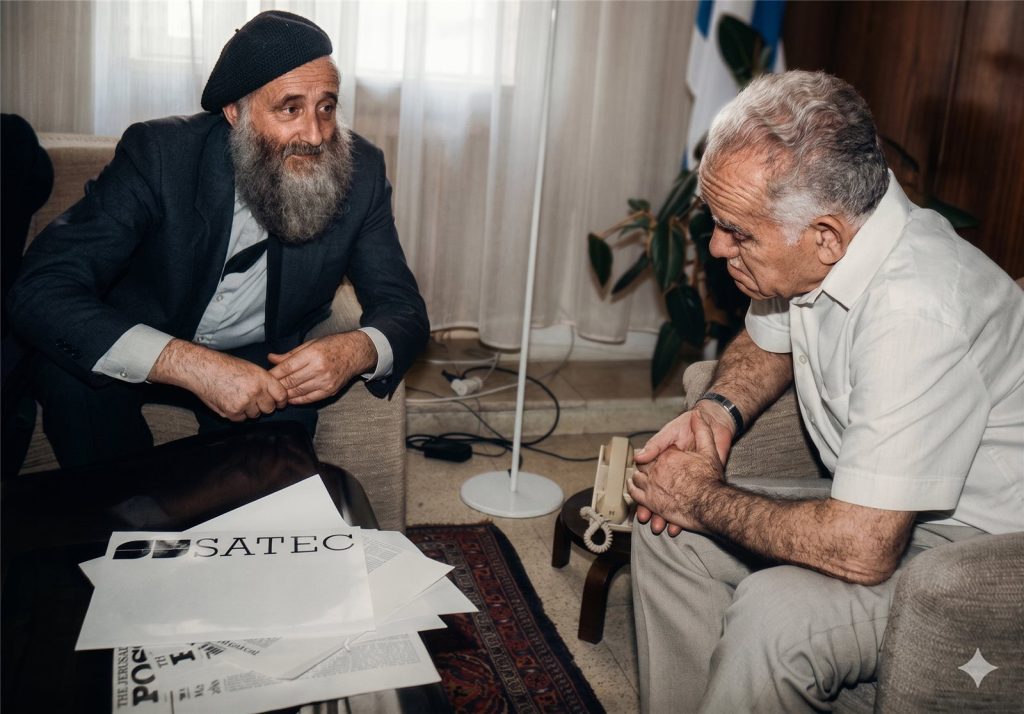
His wondrous life’s journey, from that public telephone booth in the Russian snow all the way to the pinnacle of academia and Chassidic outreach, demonstrates in the most practical terms the deepest purpose of Chabad Chassidus: making a “dwelling place in the lower worlds.” He proved that Elokus resides deep within the formulas, within the equations of energy, within the laboratory in Beer Sheva and in the corridors of Stanford University, if one only knows how to view them through the pure lens of the prophet of the generation.
Professor Branover will be remembered as one of the most faithful and devoted soldiers of the Rebbe Melech HaMoshiach. ■
Beis Moshiach #1511 • pp. 22-29
© 2026 Beis Moshiach Magazine. All rights reserved.
This article originally appeared in Beis Moshiach #1511. You are welcome to share it with friends and family by email or in print, provided that you do not change, add to or omit any part of it, you credit the author and Beis Moshiach, and you include a link to archive.bmoshiach.org (written out in full in printed copies).
To republish this article in a newspaper, magazine, book or website, please request permission in advance at [email protected].