Mérida, Mexico: A One-Eyed Vision of Shlichus
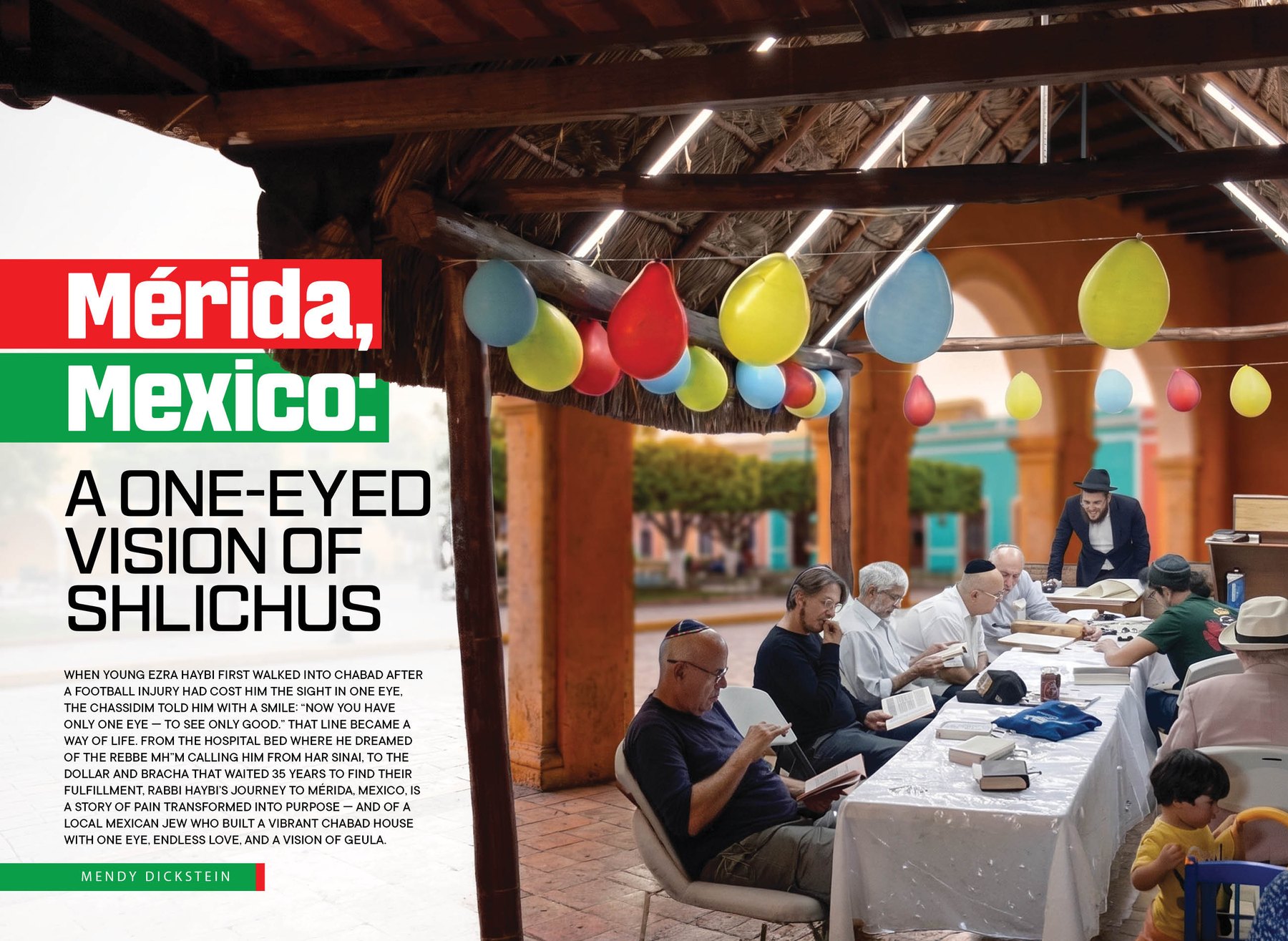
When young Ezra Haybi first walked into Chabad after a football injury had cost him the sight in one eye, the Chassidim told him with a smile: “Now you have only one eye – to see only good.” That line became a way of life. From the hospital bed where he dreamed of the Rebbe MH”M calling him from Har Sinai, to the dollar and bracha that waited 35 years to find their fulfillment, Rabbi Haybi’s journey to Mérida, Mexico, is a story of pain transformed into purpose – and of a local Mexican Jew who built a vibrant Chabad House with one eye, endless love, and a vision of Geula.
Shades of red and gold pour over the white stone of the colonial buildings in the city of Mérida, Mexico, painting the archways of the elegantly designed structures and the broad plazas where children run and vendors loudly hawk sweet tamarind candy and juicy mango. Around every corner, the sounds of mariachi can be heard—street musicians in colorful dress, their violins wailing, their wide smiles wrapping the late afternoon air in an irresistible, rhythmic music.
Mérida, capital of Yucatán, a city of a million residents built almost five hundred years ago on the ruins of an ancient Mayan city, still feels the weight of history beneath its feet. This city is in no hurry to get anywhere. It lets time flow through it at ease.
And within that rich energy, among the streets painted in yellow, sky-blue, and turquoise, lives and works a young, dynamic Chabad shliach. No, he didn’t arrive here from far away on shlichus from the Rebbe. He’s entirely local; Mexico is his homeland, and Spanish is the language of his childhood. He knows every neighborhood, every alley, every custom and every scent of this culture.
And yet, he is a shliach of the Rebbe MH’M. Two worlds living together in ease and joy, as if it had always been that way.
Meet Rabbi Ezra Haybi, the shliach who didn’t come from afar, who didn’t leave New York or Kfar Chabad to “go out to Charan.” He didn’t spend years getting to know Mexico, nor did he need to gradually adjust to it. Mexico is in his blood, the place of his childhood. That is precisely what makes the story told in the lines below one of the most fascinating and moving I’ve written about shluchim of the Rebbe who went out on shlichus in the seventh generation.
The Bracha That Waited 35 Years
His story begins long before he was born. It happened on a Sunday, 14 Shevat 5752 (1992), over thirty years ago. A Jewish resident of Mexico named Mordechai Mareshli, Ezra’s uncle on his mother’s side, stood on a line that stretched the length of Eastern Parkway. He stood and waited, like hundreds and thousands of others who had come from every corner of the earth just for that brief moment when one could ask for a bracha.
When his turn came, the uncle received a dollar, and from the deepest place in his heart asked the Rebbe for one thing: a bracha for Chabad in Mexico. The Rebbe looked at him, and along with giving an additional dollar, blessed him: “A Chabad House, great success!”
In those years there was no Chabad House in Mexico. The stunned uncle asked the Rebbe: “To open one? To open a Chabad House?” Rabbi Groner, too, repeated the uncle’s question, saying to the Rebbe: “He’s asking whether to open a Chabad House in Mexico?”
The Rebbe’s response was: “Yes, that’s correct!”
The uncle returned to Mexico with the dollar and the bracha. Years passed since then and the uncle himself never opened the Chabad House, but the bracha wasn’t lost, since no bracha of the Rebbe is ever lost.
When he returned to Mexico, he met his brother-in-law, Ezra’s father, a Jew of Syrian descent whose family story is one of overt hashgacha pratis: his mother left Syria as a seven-year-old girl, grew up in Be’er Sheva, and afterward the family moved to Bat Yam. There, among the crowded southern neighborhoods, the family found its way to Chabad teachings and to the Rebbe, thanks to a Chabad House run by Rabbi Zimroni Tzik, who welcomed them warmly and gave them a sense that they had a place in the world.
Later the family emigrated to Mexico. “My father came to Mexico with no connection to Chabad at all; in fact, he took part in opening the first kollel that the Litvish established in Mexico, and was among the first men in that kollel. Later on, together with Uncle Mordechai, a deep friendship was born, and from the friendship a partnership was born, and from the partnership a shul was born, a beautiful Sephardic shul for Mexico City’s Syrian community. Seven stories that contained a mikva and a bustling communal life. It wasn’t an official Chabad House but it had something of Chabad within it, like a small, living spark just patiently waiting for the right moment.”
“I believe it succeeded because of that bracha from the Rebbe,” Ezra says simply, like a man who long ago learned not to be surprised by the wonders of hashgacha. “The bracha was there; it just waited 35 years.”
Suddenly Losing an Eye
Ezra Haybi was born into a home that lived between two worlds: the rich Syrian heritage, with the smells of his grandmother’s cooking, with the holidays celebrated at home, and on the other hand, the Chabad neshama that loved fellow Jews and constantly felt that something great was waiting around the corner.
“I felt that it needed to be prepared properly,” he says today. Sometimes the Rebbe meets people along paths they never planned or expected, and sometimes the encounter hurts a little before it lights up and shines.
A week before Ezra’s bar mitzva, a football hit him directly in the eye while playing with friends. In an instant, the planned event, the excitement of taking on the ol mitzvos, the aliya to the Torah and the speech before the community, all of it was postponed. Ezra found himself in the hospital with an injured, painful eye, caught between pain and confusion, between embarrassment and fear. And then, one night during those difficult days of hospitalization, he had a dream.
“I dreamed about the Rebbe,” he recalls, his eyes closing for a moment as if returning to that distant night. “I dreamed that the Rebbe was standing on Har Sinai, calling me to come to him.” The dream was so vivid, so sharp and clear, that Ezra woke from it a different person.
When he left the hospital, he came out an entirely different person. With that same feeling, he walked for the first time into the Chabad House in Mexico City, sat there, listened, watched, and his eyes were opened. “They told me there, ‘Now you’re a Chassid, because you only see through your right eye’… After they said that to me, I realized that Chabad Chassidim are the only ones who turn suffering into bracha,” he recalls.
That line became for him an entire worldview, born out of the real pain of a young boy, and it has accompanied him from that night to this day, in every difficult moment, every time reality dealt him a blow.
His uncle continued to teach him and be mechazek him. “Whenever I had doubts throughout my childhood and teenage years,” Ezra recounts, “he educated us. Even though he didn’t have a Chassidic appearance, he always explained to us why the Chabad approach is the best. It strengthened me enormously.” The uncle who had once stood at 770 and asked for a bracha to establish a Chabad House turned young Ezra’s teenage doubts into foundational pillars. And those pillars, built year after year, conversation after conversation, eventually led him to become a full-fledged Tamim.
What did your schooling consist of?
“At first I studied at the Jewish community school in Mexico City. When I got older, I went to learn in a Chabad yeshiva ketana in Queens, New York, where I learned what seder means and what seriousness is; what it means to get up in the morning knowing what you’re getting up for.”
Afterward, Eretz Yisrael entered his life. For yeshiva gedola, he learned in the yishuv of Yitzhar, under Rabbi Itzik Sandroi. “It was a formative year,” he says with a satisfied smile. “Every moment at the yeshiva teaches you a lesson for life. Alongside the studies there, all the yeshiva’s activities made me feel that there was nothing stopping me from fulfilling my dreams.”
When he returned to Mexico, he came back with something that can’t be learned from books: the deep, quiet self-confidence of a bachur who knows who he is and where he’s going.
Still, the moment that would determine his future as a shliach hadn’t yet arrived. Like everything else, it needed to wait for exactly the right moment.
Training for Shlichus
One day, Ezra’s father traveled to Cozumel—the colorful island on the Caribbean coast—to bring a Sefer Torah to Rabbi Dudi Caplin, the Rebbe’s shliach there. Ezra went along with him and, for the first time, entered the Chabad House in Cozumel. He looked around at the chairs, the books, and the people coming and going.
“When I arrived at his Chabad House,” he recalls, “I told myself that I wanted to do this too.”
For all his passion, Ezra is first and foremost a practical person. He sat and thought seriously about what would be needed for a shlichus that would last until the coming of Moshiach. He looked for a city near the sea because the humid climate would be better for his injured eye. He also needed a developed city with a hospital and pharmacy within reach, not an isolated rural place cut off from the world. “I looked for a place that would suit me, where we could be shluchim the way it should be done, i.e. actually live there.”
He made a special trip to the Chabad House in Playa del Carmen, Mexico, where he studied for six months under the shliach Rabbi Chaim Binyamin Brod, learning the laws and practices of being a shliach, which strengthened in him the resolve to go out on his own shlichus and open his own Chabad House.
Signs of Encouragement From the Rebbe to Open a Chabad House
The city of Mérida was his destination which he arrived at after a long search. A city of a million residents and extensive tourism. One hundred thirty local Jewish families lived there quietly, most of them without any warm Jewish framework. Four hours’ drive to the nearest Chabad House. “In that whole region there was nothing Jewish,” he says. “A real spiritual desert.”
Despite that, the local community welcomed him with open arms. They paid for his plane ticket, brought a Sefer Torah, helped him in every way they could. Ezra arrived with his wife, opened a Chabad House, and built a community essentially from scratch.
“I didn’t expect anything,” he says of those first days. “It was truly special. I told myself this was what I’d been searching for my whole life, that this was my purpose in the world. From the beginning, and in fact to this day, there are sometimes difficulties.”
The Jews of Mérida live intermingled with their neighbors. Some have no Jewish habits at home at all. Some aren’t sure exactly what belongs to them and what doesn’t. Ezra arrived in the city with a black yarmulke and a Chabad niggun on his lips, and with a gaze that neither judges nor demands. He simply opened a door and told everyone: “Come, there’s room here for you.”
The first event Ezra organized in Mérida wasn’t in a grand Chabad House, nor in a large, brightly lit hall, but in an Airbnb apartment that he and his wife had rented facing the sea. It was Lag B’Omer. They set up tables, lit a bonfire, and called people to come. The Caribbean Sea whispered in the background through the darkness of the night.
People trickled in: some Israeli travelers, some community members whose curiosity overcame their doubt. There were also a few non-Jewish neighbors who didn’t quite understand what was going on there. Ezra stood in the middle and did everything: handing out food, hugging, singing. It wasn’t organized and it wasn’t perfect but it was alive and authentic. Then, in the middle of the evening, the homeowner approached him. A local Jew who didn’t quite know what he was looking at, but who watched the young Mexican man with the black yarmulke organizing a Lag B’Omer celebration in his own living room and he pulled a small bottle of Smirnoff off the shelf.
“He let me say ‘l’chaim,’” Ezra recounts with emotion, “and told me that the bottle had been given by the holy hands of the Rebbe thirty-five years earlier. The Rebbe had given it then to someone who opened a shul in Miami, and told him he’d never have problems and would always succeed.” Somehow, the bottle had made its way into his hands.
Ezra still sits with that moment. The owner of the Airbnb, the sea murmuring outside, the bonfire lighting up the faces, and a stranger arriving at precisely the right moment, the opening moment of the Chabad House, handing him a small bottle and saying, “Here, this is from the Rebbe, and it’s yours…”
That was just the first encouragement he received from the Rebbe. A few months later, when he needed money to build the mikva, Ezra had no idea where he’d raise the funds. Suddenly an unfamiliar man approached him, pulled out two dollars he’d once received from the Rebbe, and told him: “Here, this is from the Rebbe, it’s for you, because you’re his shliach.”
“I have so many encouragements and moments of attention from the Rebbe that I can’t even remember them all,” he says with a slight smile.
Jews who never knew their own Jewish identity come to the Chabad House, and now they’re an inseparable part of it. “Not tourists who came to eat, left a tip, and got on a flight home, but people whose encounter with the Chabad House, with Chassidus, changed them.”
The Walls Came Down
But then came COVID in the late winter of 5780, and dropped a heavy, menacing silence over Mérida. Like in many places around the world, the colorful streets crowded with tourists emptied out overnight. The great plazas that just yesterday had bustled with people, vendors, and music stood empty and mute, like a forgotten, abandoned city. Entry to the shul was forbidden, praying together was forbidden, touching was forbidden. Everything that had been built with such effort seemed to stop breathing.
It was precisely then that Rabbi Ezra Haybi discovered something that only someone who works with people can understand: precisely during that time of isolation and fear, doors opened in hearts that had been closed for years. “It was interesting to see those same people who, in ordinary life, would never have walked into a shul, suddenly searching for comfort and a warm human voice. They wanted to feel that someone saw them,” R’ Ezra recounts. And so they found their way to Ezra, the Rebbe’s shliach, whether through a screen, through a phone call at night, or through a box of food that he himself drove through the empty streets and left on doorsteps without knocking and without asking for thanks.
There’s something every shliach knows: many people come to the light not when everything is fine, but only when everything is falling apart. COVID broke many things in Mérida’s informal community—businesses, plans, routines. But it also broke the invisible wall that people had built around themselves over the years. And suddenly, through a screen or in a WhatsApp message at midnight, a Jew who hadn’t set foot in a shul in twenty years would ask quietly: “Can we talk?”
The Rebbe’s shliach, Rabbi Ezra Haybi, and his wife were there for them.
Deep Spiritual Plowing
Alongside the help and support given to the local Jewish residents, there is, of course, the activity with the many travelers who come to the city.
Mérida is a tourist city at the heart of Yucatán, a gateway to the vast Mayan ruins, to the blue Caribbean coastlines, to the colors and scents of authentic Mexico.
Israeli travelers arrive there in waves: summer vacation, a gap year, the big trip after the army, people searching to understand what they want from their own lives. After weeks of jungle and beaches, of colorful markets and long white nights, that small, deep moment arrives, the moment when a young Israeli looks for a warm Shabbos meal, for a feeling of home he didn’t know he was missing so much.
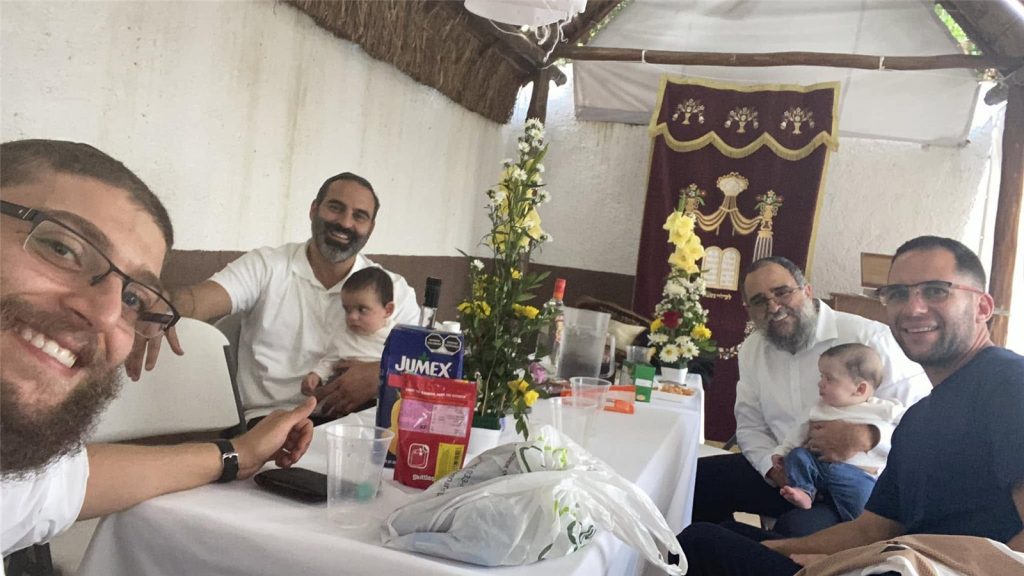
The Chabad House of Merida waits for them, open and welcoming. “While you see the community members every day and they see you, with the travelers there’s always something new.”
And there are also the soul-stories that carve themselves deep, like children from the local community who came to the Chabad House and whose light was kindled.
R’ Ezra tells of a young Jewish man who had sunk into himself and ended up in difficult places, who eventually arrived at the Chabad House. He was received there without judgment and without grades. Slowly, he integrated into the Chabad House, and something deep opened within him, as if someone had given him back his breath.
The Chabad House also lends a shoulder in difficult cases. R’ Ezra describes life situations that demand serious effort, not just beautiful Shabbosos with singing and candles, with happy travelers whose faces shine. Sometimes it’s a phone call ringing at midnight, or a drive to the hospital at three in the morning to help a Jewish traveler at a moment when he has no one else in the world—and you’re there.
There was also a case where one of the women of the community passed away. Her family had no money for her burial and didn’t know where to turn. In a country where Jewish burial isn’t a given, where there isn’t a Jewish cemetery in every city, and the bureaucracy is cold and rigid, the situation was far from simple.
“We almost buried her in a non-Jewish cemetery,” he recounts. “After great effort, we buried her in a Jewish cemetery. Since then, a connection opened with the family members, a connection that continues onward. The family members grew stronger in their Judaism, and as a result, their son went to Israel to study in a yeshiva.”
Days of Crisis
The shlichus in Merida proceeded smoothly; most of the Jewish families were connected, more or less, to the Chabad House until the Conservative movement arrived and opened a beautiful synagogue in the heart of the city.
“It was very hard,” R’ Ezra admits, his voice growing weary for a moment as he describes one of the great crises of his shlichus. “To see how everything splits in two, to see people who ate at your table, who opened up to you, who you thought were already on the path of Torah and mitzvos, suddenly behaving toward you with a bit of anger. Not out of something real, but out of deep inner confusion. But on the other hand,” he continues, “you understand that you are the shliach of the meshaleiach, who gives up on no person, and isn’t hurt by any situation, because there’s a mission to carry out, and so, you must carry out the shlichus faithfully. I know that goodness is truth, and truth isn’t afraid. We all know that a little light pushes away a lot of darkness.”
R’ Ezra’s decision was clear and simple: not to argue, not to explain, and not to waste a single second of precious energy on what’s in front of him. He simply needed to do things more beautifully, more deeply.
The Magnificent Mikva of Merida
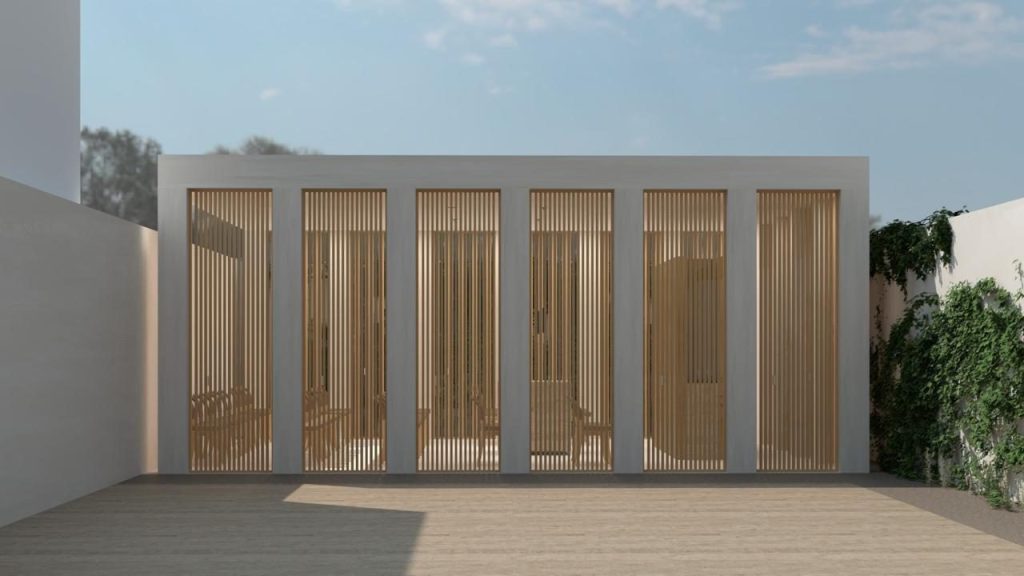
As part of building the community, the time also came to build a shul, a community center that would host the Shabbos meals, the activities, and be a warm Jewish “home” for everyone who comes there.
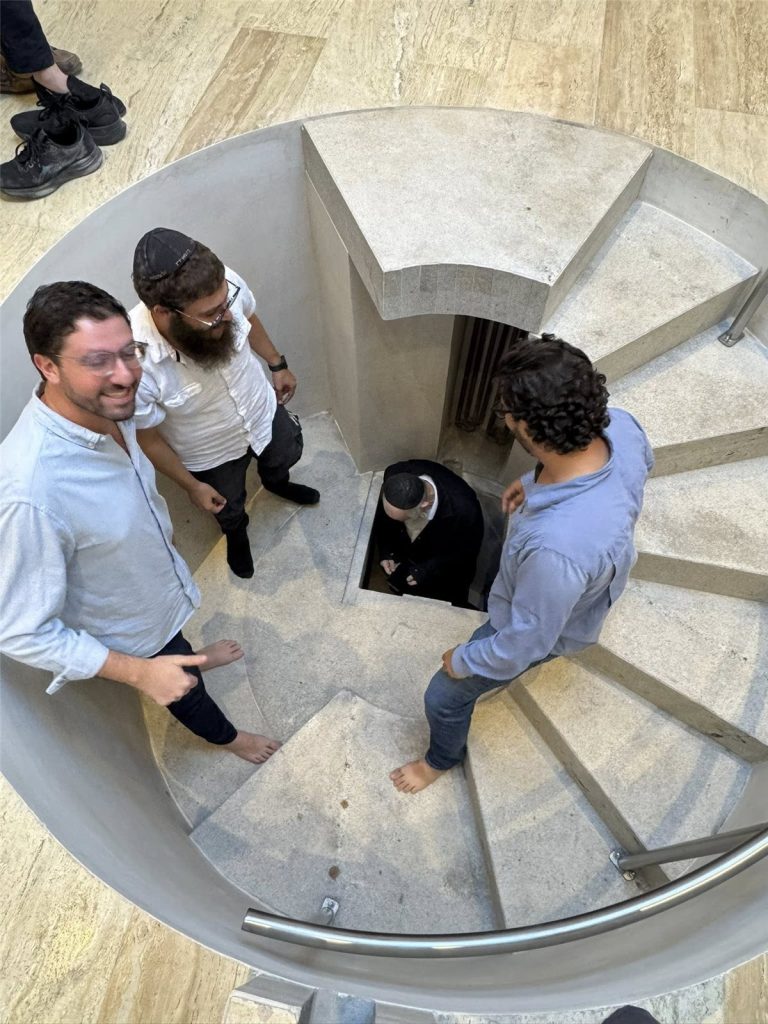
R’ Ezra waited until the right time came. “Based on what I saw in letters from the Rebbe that I opened to in the Igros Kodesh, and based on my consultation with my mashpia, I didn’t want to build a permanent shul until we had a beautiful and magnificent mikva here,” he explains calmly. “First you need to build the mikva which is the foundation, the purity, and afterward the shul. Each stage needs to be built firmly on the previous one.”
When he approached building the mikva, he received a sign from heaven that his path was correct. In the excavations of the planned structure, a natural spring was discovered beneath the mikva building! These days, the plan for building the mikva is progressing under the supervision of Rabbi Yosef Yitzchok Feigelstock, who specializes in building mikvas around the entire world.
When R’ Ezra talks about the Merida of the future, he knows everything will move forward and progress safely, step by step. He already has a kindergarten that’s operating and flourishing, and he’s already planning a school as a continuation. In his plans, he also intends to establish a yeshiva with a dormitory for bachurim who will come from all over Mexico and all of Latin America. In his mind’s eye, he sees a large, magnificent shul that will stand proudly. A full schedule of Torah classes that makes you want to stay and not go home after davening. “An atmosphere of fun and holiness together.”
He wants the place to host bar mitzvas that will be remembered for many years, brissin, and even Jewish weddings that will fill the community with an atmosphere of pure Jewish joy. Lectures by well-known speakers who will come from afar and draw many Jews to them. The closer dream is establishing a kosher restaurant with a chef, a place where you sit down and eat food that is kosher to the highest standard, and go home satisfied in body and soul, all this of course in addition to the magnificent mikva.
The one shlichus the Rebbe spoke about at the last Kinus HaShluchim is to bring the actual Geula. How does this find expression in your shlichus?
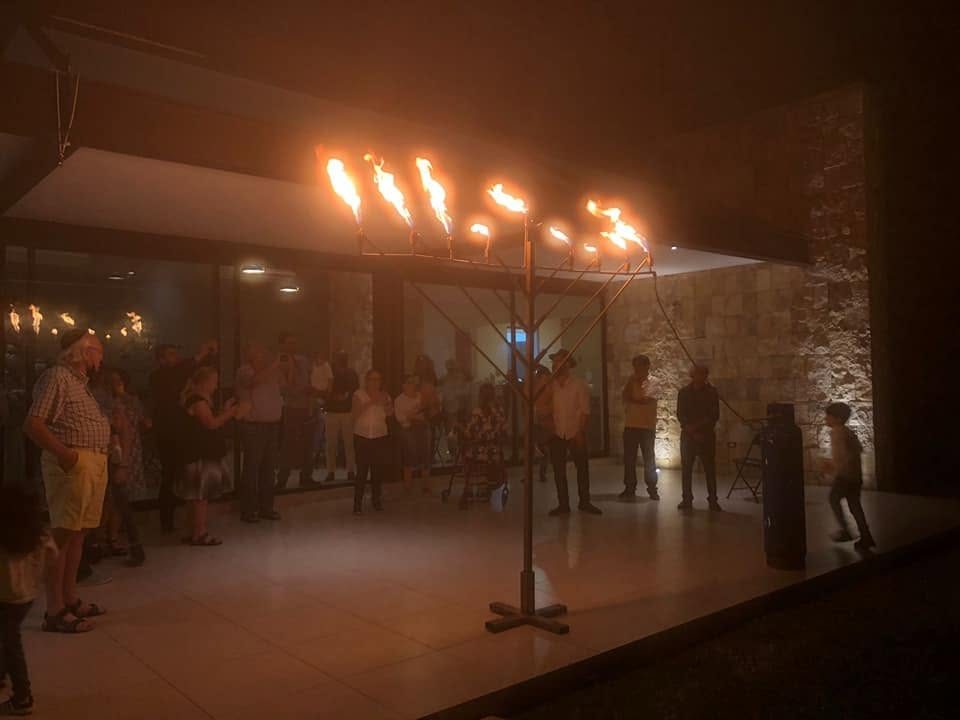
“In every single thing!” he sums up briefly. “Every hanochas tefillin or fulfillment of any other practical mitzva is accompanied by an explanation that this is another action to hasten the Geula. There’s nothing simpler than that.
For the local residents we have special classes on topics of Geula and Moshiach in Spanish, as well as classes in Hebrew for the travelers. In addition, I send recorded classes on Moshiach and Geula in dedicated WhatsApp groups, together with Chitas and Rambam classes. Anyone who enters the Chabad House, or even sees it from afar, recognizes this is a Chabad House operating as a shlichus of the Rebbe MH’M and that the place ‘burns’ with faith and anticipation of his coming.”
With One Eye That Sees Only Good
R’ Ezra thinks big; that’s how it always is. Whoever knows the path he traveled—the man who wanted a mikva and got a spring; wanted a community and got a family—can only smile and say: how could it possibly be otherwise?!
And so, in the colorful streets of Merida, the bracha given at 770 more than 35 years ago continues to grow, blossom, and be built. One uncle stood in line before the Rebbe in Brooklyn, asked for a bracha, and received it along with a dollar. A nephew who now operates in the world with an eye that sees only good, and with a love that knows no bounds…
Beis Moshiach #1513 • pp. 20-29
© 2026 Beis Moshiach Magazine. All rights reserved.
This article originally appeared in Beis Moshiach #1513. You are welcome to share it with friends and family by email or in print, provided that you do not change, add to or omit any part of it, you credit the author and Beis Moshiach, and you include a link to archive.bmoshiach.org (written out in full in printed copies).
To republish this article in a newspaper, magazine, book or website, please request permission in advance at [email protected].