Aharon, Yechezkel – or Moshe Rabbeinu?
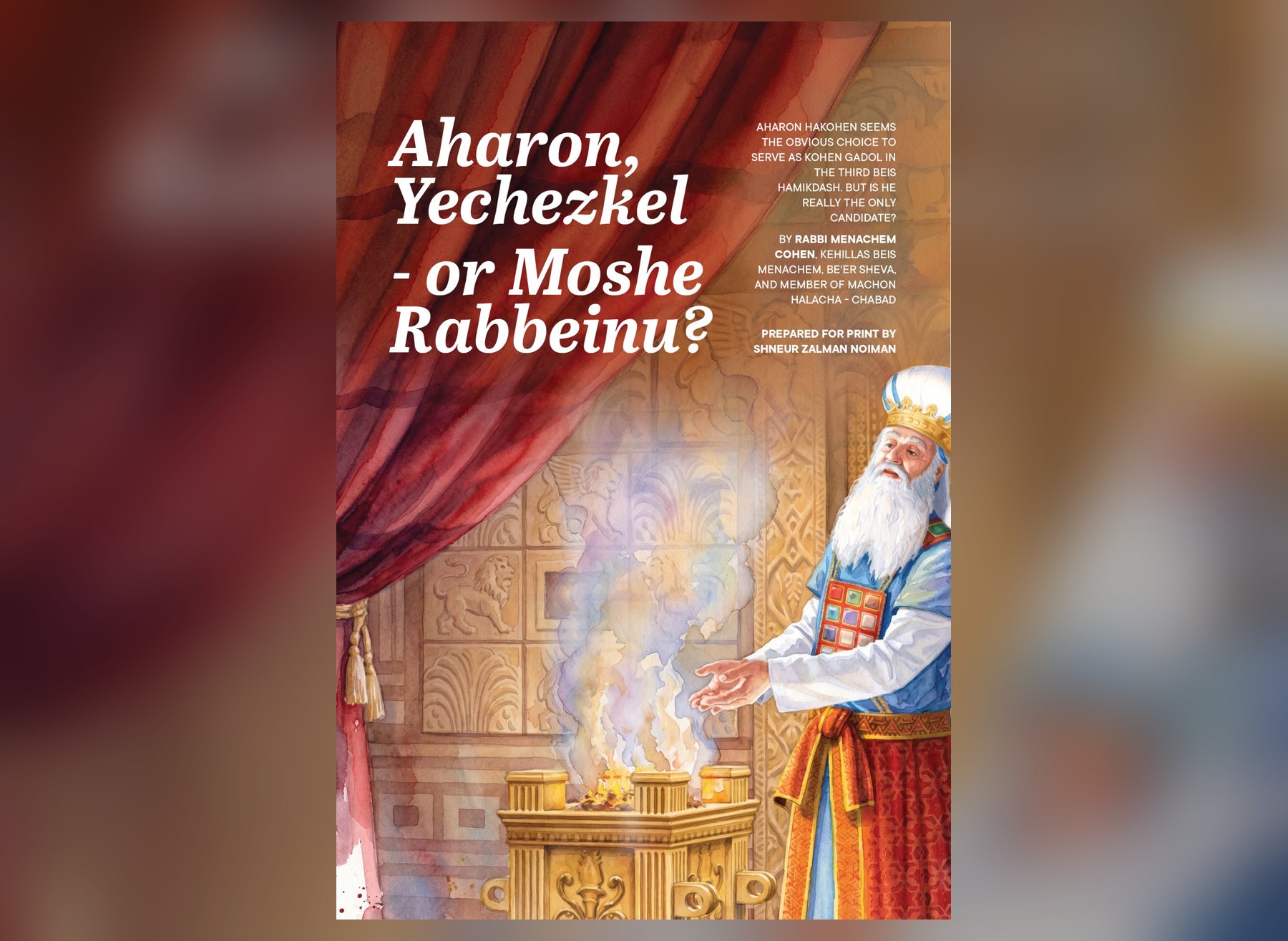
The Kohen Gadol holds the most important position in the Beis HaMikdash. He brings a special Mincha offering every day, performs the Yom Kippur service, and much more. Come the Geula, when every generation rises in Techiyas HaMeisim, the greatest Kohen Gadol of all time will be chosen for the job—and since death will be gone for good and life will be eternal, he’ll hold the position forever. There’s just one question left: who gets the job?
The obvious pick is Aharon HaKohen. Several sources say he’ll merit the role in the Geula, and it makes sense: Aharon will rise in Techiyas HaMeisim, he was the first Kohen Gadol, so he’d naturally keep the job. As the Rebbe, MH’M put it: “Immediately… we will merit to see the lighting of the Menorah by Aharon Kohen Gadol, in the Third Beis HaMikdash.”
But then a second candidate enters the picture. The Rashbatz, in his sefer Magen Avos, argues that it’s actually Yechezkel HaNavi—who was also a Kohen—who will get the role. His proof comes from the pesukim describing Yechezkel handing korbanos to the Kohanim: “Behold, they have promised him that he will be Kohen Gadol in the days of Moshiach… for Yechezkel did not go up from Bavel, since tradition holds that he is buried in Bavel; and moreover, the order of korbanos brought by those who returned from Bavel does not match the order mentioned in this parsha—therefore it appears that this will take place in the future, in the days of Moshiach.”
And then there’s a third candidate, and this one’s a real surprise. The Tzemach Tzedek writes that “in the future, when the Leviyim will become Kohanim, it stands to reason that Moshe Rabbeinu, who was also a Levi, will become Kohen Gadol!” (Worth noting: several opinions hold that Moshe himself was actually a Kohen during his lifetime, and the kehuna only passed him over when it came to his own descendants.)
So who actually gets the job? Maybe all three. It’s entirely possible that in the Geula, several Kohanim Gedolim will serve at once. Yes, the Rambam rules that you can’t appoint two Kohanim Gedolim at the same time—but that’s only to prevent hatred and rivalry between them. In the days of Moshiach, once “there will be no jealousy or rivalry,” that restriction falls away, and two, three, or more Kohanim Gedolim could serve together. Or maybe just one of them takes the top job while the others serve as his deputies, as Segan Kohen Gadol.
Either way, that’s all about who fills the role. But when it comes to the sanctity of the Kohen Gadol, the Rebbe says every single Jew will reach that level—which means everyone, not just the Kohen Gadol, will be able to enter the Kodesh HaKodashim once the Geula arrives.
Sources: Sicha of 7 Adar 5748, section 13. Magen Avos, Part 3, 87:2. Yechezkel 43:19. Ohr HaTorah of the Tzemach Tzedek, Shemos, vol. 5, p. 1,586. Rambam, Hilchos Klei HaMikdash 4:15. Yerushalmi Sanhedrin 10:2. Radak on Yechezkel 43:19. Sefer Lev Chaim, siman 32, by Rabbi Chaim Palagi, s.v. “gam.” Sefer HaGilgulim, ch. 23. Yoma 5b. Sanhedrin 90b. Likkutei Sichos vol. 31, Tetzaveh 1 and footnote 47 there; vol. 32, Tzav, section 6. Sichos of Shabbos Parshas Tazria-Metzora 5751, section 14; 10 Elul 5751, section 12.
Will the Kohanim Who Rise in Techiyas HaMeisim Remain Kohanim?
Let’s start with a small Talmudic mystery. Commentators have long wrestled with a question that sounds simple enough: was Rav Kahana a Kohen, or wasn’t he?
Every sign seems to point one way. Even his name—“Rav Kahana”—seems to say it all. And several places in Shas back that up: Maseches Kiddushin describes him performing a Pidyon HaBen and collecting five selaim, and elsewhere the Gemara says his rebbi told him not to go around telling people “I am a Kohen.”
But other sources point the opposite way. Maseches Chulin explains that his wife was a Kohenes, and it was only because of her that he was allowed to eat kodshim reserved for Kohanim. Elsewhere, Rav Kahana says he was punished for marrying a Kohen’s daughter, since a Yisrael marrying into a Kohen’s family can sometimes cause harm. So which was he—Kohen or Yisrael?
A few answers have been proposed over the years (maybe there were two people named Rav Kahana, and so on), but the sefer Megadim Chadashim, drawing on the Gaon known as the Aderes, offers a fascinating solution. The Gemara in Bava Kama tells the story: when Rav Kahana came up to Eretz Yisrael, he sat in on Rabbi Yochanan’s shiur and asked a string of unusually sharp questions. Rabbi Yochanan, whose eyesight was failing, asked his students to help him get a look at the brilliant scholar who’d shown up. Here’s the problem: Rav Kahana had a split lip from an old injury, which made him look like he was always smiling. Rabbi Yochanan, seeing him for the first time, assumed he was smirking and mocking him—and Rav Kahana died on the spot from Rabbi Yochanan’s displeasure. Only the next day, once the students set the record straight and explained that Rav Kahana hadn’t been mocking him at all, did Rabbi Yochanan pray for mercy and bring him back to life.
That story ties the contradiction together neatly. Every source describing Rav Kahana as a Kohen is from before this incident. Every source suggesting otherwise comes from after—because his kehuna left him the moment he died, and once Rabbi Yochanan’s prayer brought him back, he was essentially a new body, no longer carrying that original sanctity.
Which leads to a striking idea about the Geula: every Kohen alive in the generation of the Geula will stay a Kohen afterward. But any Kohen who already lived and died—once he rises again in Techiyas HaMeisim—would no longer be a Kohen, because his body is now considered a new one!
Kehuna After Techiyas HaMeisim and After a Miraculous Revival
Actually, though, that idea doesn’t hold up —for two reasons.
First, simple logic: kehuna passes entirely from father to son, and a Kohen’s status as his father’s son obviously doesn’t change just because he’s been revived through Techiyas HaMeisim. So his kehuna has to stay intact too.
Second, the sources back this up directly. The Medrash reads the pasuk “Zos mishchas Aharon” as teaching that even in the future, Aharon and his sons won’t need a new anointing—they’ll simply remain Kohanim. And the Gemara in Sanhedrin goes further, stating outright that in the Geula, Yisrael will give teruma to Aharon HaKohen, exactly as the Torah commands: “and you shall give from it the teruma of Hashem to Aharon HaKohen.” The Gemara even asks the obvious question: “Is Aharon then alive forever? But did he not fail to enter Eretz Yisrael, that they should give him teruma? Rather, this teaches that he is destined to live again, and Yisrael will give him teruma!” In other words, his kehuna survives Techiyas HaMeisim intact.
So we’re left with a real distinction between two kinds of revival. When Techiyas HaMeisim happens today through a miracle—through a tzaddik’s prayer, say, as with Rav Kahana and others in Tanach—the neshama has already fully left the body, with no remaining ‘potential’ to rise again on its own. A body revived that way essentially gets a fresh start, without carrying over whatever sanctity it had before. (Compare this to the Radak in Sefer Melachim: the oil that flowed miraculously through Elisha’s blessing was exempt from the laws of terumos and maasros, precisely because it came about through a miracle rather than through nature.)
The Techiyas HaMeisim of the Geula works differently. That potential is already built into the body’s nature in this world. As Rashi explains in Chumash (Bereishis 2:7), Hashem built two “versions” into the human body from the start—one for life in this world, and one for Techiyas HaMeisim. So when that future revival happens, the body comes back with everything it had before, including kehuna, for anyone who was a Kohen.
Sources: Pesachim 49a; 113a. Kiddushin 8a. Bava Kama 117a. Chulin 132a. Sefer Megadim Chadashim on Berachos, Kuntres “Over Orach” by the Aderes, Orach Chaim siman 167. Sanhedrin 90b. Sichos of the Rebbe, MH’M, Kuntres “Halachos shel Torah Sheb’al Peh” 5752; Shabbos Parshas Teitzei 5747, section 14. Klei Chemda, Parshas Bereishis, p. 12. Rabbi Chaim Berlin in Sefer HaZikaron for the Pachad Yitzchak, p. 660. Sanhedrin 90b. Likkutei Sichos vol. 18, p. 88. Radak, Melachim II 4:7. Shaarei Tohar, vol. 8, siman 110. Toras Kohanim, Parshas Tzav, ch. 18. Bamidbar Rabba, Parshas Naso, ch. 18.
Will the Leviyim Replace the Kohanim in the Geula?
Here’s one of the most striking chiddushim about the Geula, straight from the Arizal: at that time, the Kohanim will become Leviyim, and the Leviyim will become Kohanim.
The Arizal uses this to explain a puzzling pasuk in Yechezkel (44:1): “VehaKohanim haLeviyim bnei Tzadok”—“the Kohanim, the Leviyim, sons of Tzadok.” The Kohanim are always just called ‘Kohanim’ elsewhere—so why does this pasuk call them ‘Leviyim’ too? Because, says the Arizal, the Kohanim serving in the Third Beis HaMikdash will actually be people who were Leviyim before.
Where does this come from? The Arizal traces the Kohanim’s neshamos back to Hevel, son of Adam HaRishon, and the Leviyim’s neshamos back to Hevel’s brother, Kayin. Kayin was the firstborn, and the kehuna should have gone to him by rights—but his sin cost him that honor, and it passed instead to Hevel, whose lineage became Aharon and his sons, the Kohanim. In the future, that original wrong will finally be righted: the Leviyim, rooted in Kayin’s neshama, will take over the kehuna, while the Kohanim step into a supporting role as Leviyim. Fittingly, it was Yechezkel—whose own neshama traces back to Kayin—who prophesied about this exact turnaround.
But this raises an obvious problem. The Beis HaMikdash ran on a strict division of labor: only Kohanim could bring korbanos and perform the other services, while only Leviyim could assist them (the Torah literally says “venilvu alecha”—“they shall accompany you”—which is where their name comes from) and provide the music during the offerings. That division comes straight from the Torah.
As the Rambam puts it: “Just as the Leviyim are warned not to perform the service of the Kohanim, so too the Kohanim are warned not to perform the service of the Leviyim.” So how could Kohanim and Leviyim simply swap roles? Does the Torah itself change?
The Rebbe explains that the Arizal is talking purely about the spiritual level, not halacha. The law itself won’t change: only someone whose father is a Kohen will actually perform the kehuna service, and the same for Leviyim.
What changes is this: right now, during galus, someone born to a Kohen has a neshama especially tied to kehuna, and the same for Leviyim.
In the future, that connection flips—someone born to a Kohen father will actually carry a Levi’s neshama, and someone born to a Levi father will carry a Kohen’s neshama. Halachically, the Kohen’s body stays a Kohen’s body. Only on the level of the neshama does the switch take place.
Sources: Likkutei Torah of the Arizal, Shaar HaPesukim, beginning of Yechezkel. Rambam, Hilchos Yesodei HaTorah, beginning of ch. 9, and Hilchos Klei HaMikdash 3:9–11. Shiurim B’Sefer HaTanya, ch. 50. Igros Kodesh vol. 23, p. 274. Igros Kodesh vol. 21, p. 95.
Beis Moshiach #1515 • pp. 32-35
© 2026 Beis Moshiach Magazine. All rights reserved.
This article originally appeared in Beis Moshiach #1515. You are welcome to share it with friends and family by email or in print, provided that you do not change, add to or omit any part of it, you credit the author and Beis Moshiach, and you include a link to archive.bmoshiach.org (written out in full in printed copies).
To republish this article in a newspaper, magazine, book or website, please request permission in advance at [email protected].