Helping Yidden in Ohio Go One Step Higher
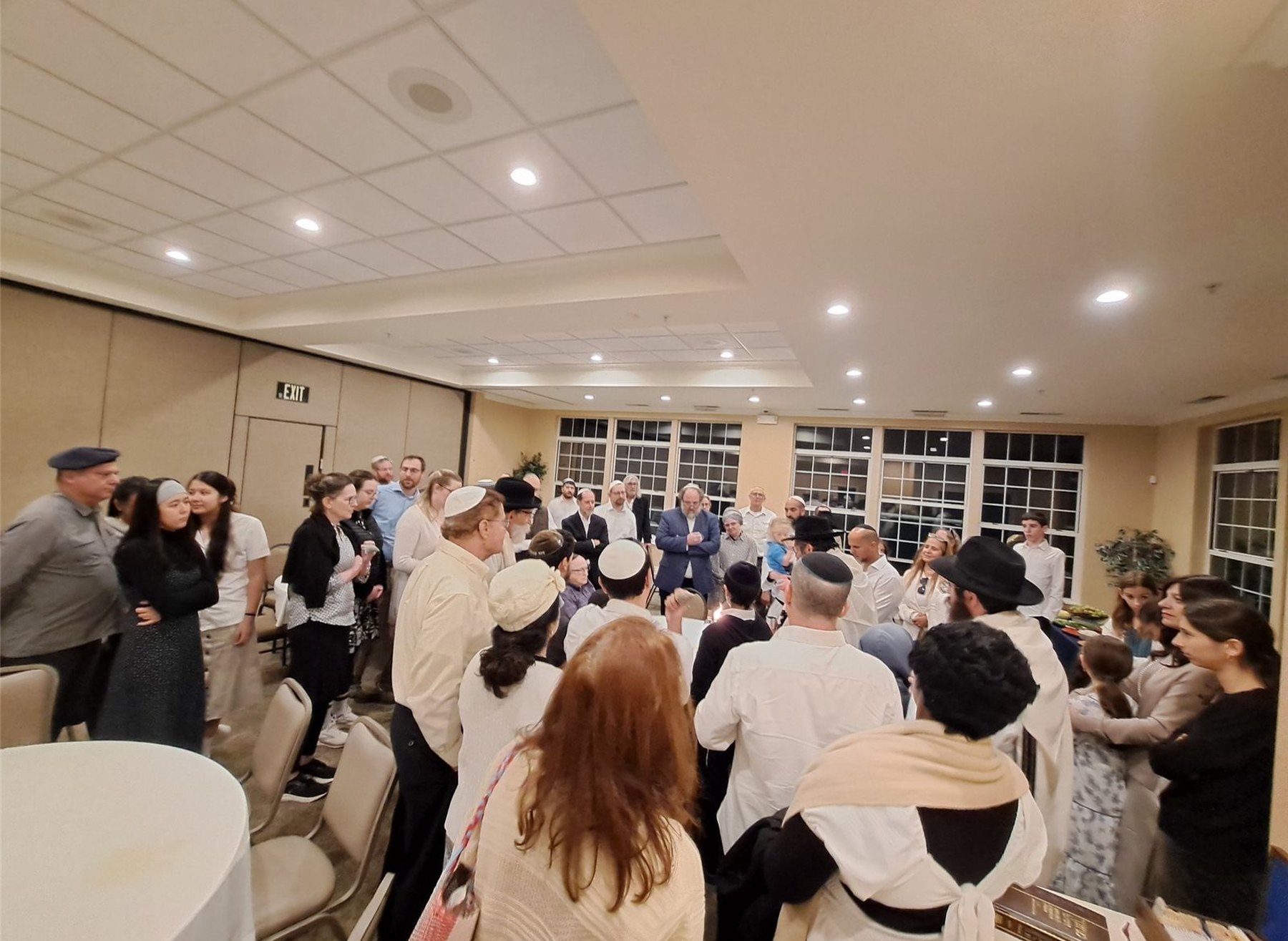
Shoshana Lifshitz is a shlucha in Cincinnati, Ohio. She’s very warm, open, down-to-earth, energetic, and is known for her byword, ‘take the first step.’
Growing Up in a Family Committed to Frumkeit
“I grew up in Farmingdale, Long Island,” she begins. “We lived in that out-of-the-way city, where we were the only Orthodox Jews, because it was where my father worked. There was a Conservative Jewish community but my parents were committed to frumkeit. My mother wore a sheitel and taught me about tzniyus, which I was careful about after my Bas Mitzva. My father never watched TV for religious reasons.
“Both of my parents were born in the Bronx, New York, and grew up in homes that were shomer Shabbos. My mother went to public school, which was pretty much the only option at the time, so she didn’t have a strong chinuch. My mother had a deep neshama and only wanted to marry someone frum. My father fit that bill, educated in Torah Vodaath and passionate about Yiddishkeit.
“My father suffered from multiple sclerosis and wanted a bracha from the Rebbe for his health,” she continues. “We had a family yechidus. Though I was only seven years old at the time, I clearly remember my father sitting in a chair across from the Rebbe’s desk, my younger brother standing beside him, and my mother and I standing in the back of the room. Towards the end of the yechidus the Rebbe called me to come forward and asked me what I was learning. Those are the details that I remember, but the yechidus is etched deeply in my neshama….
“Until ninth grade I went to the Hebrew Academy of Nassau County, which is an Orthodox day school. Every summer my parents sent me to Camp Emunah. There were girls there from all different backgrounds, but after ninth grade, when I was fifteen, I got very close to those from Lubavich families. I remember coming home from camp and saying to my father, ‘I want to be Lubavitch!’ I pleaded to learn in Beis Rivka, but my parents were afraid of the commute to Brooklyn. I bought my first Chassidic books, the two-volume set of ‘Rabbi Shneur Zalman of Liadi,’ after that summer. I continued my studies in another Orthodox school, the Yeshiva High School of Central Queens, for tenth and eleventh grades. The well-known educator and kiruv activist Rabbi Izzy Rosenfeld a’h was teaching there at the time, and had a big impact on me. I was also blessed to have ylchtv’a Rabbi Shlomo Teichtal as my teacher. Until today I’m in contact with the Teichtals, his wife Shaindel is a dear friend of mine.”
Searching and Finding My Path
“I went on early admissions to Queens College, which had no Chabad presence at the time,” Shoshana says. “I agreed to go only on the condition that I spend every Shabbos Mevorchim in Crown Heights to be able to participate in the Rebbe’s farbrengen. It didn’t take long for me to discover that Lubavitchers are dedicated, knowledgeable Yidden, and have a clear set of minhagim, which is what I was looking for. My parents viewed my interest in Lubavitch as a passing phase. But it wasn’t. I was set and determined that it was the path that was right for me.
“I’ll never forget the first time I was at a farbrengen, which was Shabbos Mevorchim Chodesh Kislev. After that Shabbos, on Rosh Chodesh Kislev, I changed my davening to nusach Ari, and never looked back. I consider Rosh Chodesh Kislev my Chassidishe birthday. Years later I was blessed with a daughter born on that holy day.
“When I was nineteen my parents encouraged me to go on shidduchim. I met and married my husband Rabbi Yitzchok Meir Lifshitz who has a similar background to me. He grew up in Flatbush, Brooklyn, went to Yeshiva Torah Vodaath and received semicha from Rabbi Gedalia Schorr a’h. We moved to Crown Heights and lived there for two years while my husband was in kollel.
“Afterwards, in 5736, we went on shlichus to Cincinnati, Ohio. My husband was sent there to open a yeshiva, but it existed for only sixteen months. We wrote to the Rebbe and received a directive to remain. My husband got a job teaching in the local Jewish day school, where he worked for forty years. Fifteen years ago Rabbi Gershon Avtson opened a yeshiva in Cincinnati, and my husband teaches there.
“As more and more Yidden were leaving the neighborhood, we decided to move too. Twenty-five years ago we moved to Blue Ash, a suburb in Cincinnati, and we’ve been there ever since.
“Raising a large family kept me very busy, but my husband and I were always involved in hafatza,” Shoshana shares. “I did many women’s programs together with Rebbetzin Shterna Sara Kalmanson a’h, a longtime shlucha in Cincinnati together with yblcht’v her husband Rabbi Sholom Ber Kalmanson.
“Once a week I teach in the Jewish Discovery Center Hebrew school, twice a week I do aftercare in the cheder, and on erev Shabbos I do a Shabbos program for developmentally-delayed adults. They drink grape juice and eat some challa as they sing Jewish songs. I tell them about the parsha, or about the chagim. It’s very special for them, and for me too. At the Chabad Blue Ash I do various jobs including being an attendant at the mikva. In the summer I work in Gan Yisroel of Michigan, doing everything and anything. For the last fifteen years I’ve been running the infirmary.”
It sounds like Shoshana has a very packed weekly schedule, though she does emphasize that in recent years she’s freeing herself up in order to visit her children and grandchildren. Many of her children are shluchim. Her oldest son is in Eretz Yisrael, others are in Boise, Florida and Arizona, and two sons are on shlichus in New York.
Small Acts have Huge Impact
Shoshana shares her message, “Never underestimate the impact of small acts! I, personally, was never a head of an organization, or a principal, most of what I’ve done in my life has been small things. My Shabbos table may only have a few guests – not thirty, and I may be successful in giving out only a few bags of neshek. I may not have acquired the ‘numbers,’ but shlichus, and Yiddishkeit, is not a ‘numbers game.’ When someone posts that they need money, even if I only send ten dollars, it makes a difference. If everyone would donate ten dollars it would have a huge impact.
“You don’t have to feel that you’re conquering the world, you just have to do something, whether it’s for yourself, such as finding fifteen minutes to learn something, or for someone else. I say this to everyone I meet, even to goyim. They can take some change, put it in a charity box, and it will be a better world.”
She looks at me very sincerely, adding, “Whenever you have a problem and you need Hashem’s help, ask yourself, ‘What am I going to bring to the negotiating table?’ There are so many easy, simple, ‘small’ mitzvas you can do! Such as saying ‘Modeh Ani’ in the morning, it’s only twelve words! I email it to people, and afterwards, if they’re open to it, I send them instructions about doing negel vasser.
“There are those who may not appreciate the value of doing mitzvas in a vacuum, but the Rebbe taught us otherwise. There are countless stories of how lighting Shabbos candles and putting on tefillin led Yidden to becoming frum! That’s how far it can go!
“There’s a famous saying, ‘The longest journey begins with one step.’ I encourage people to take that one step, and that’s how we’ll bring Moshiach!”
Beis Moshiach #1502 • pp. 38-39, 54
© 2026 Beis Moshiach Magazine. All rights reserved.
This article originally appeared in Beis Moshiach #1502. You are welcome to share it with friends and family by email or in print, provided that you do not change, add to or omit any part of it, you credit the author and Beis Moshiach, and you include a link to archive.bmoshiach.org (written out in full in printed copies).
To republish this article in a newspaper, magazine, book or website, please request permission in advance at [email protected].