The Unspoken Curriculum
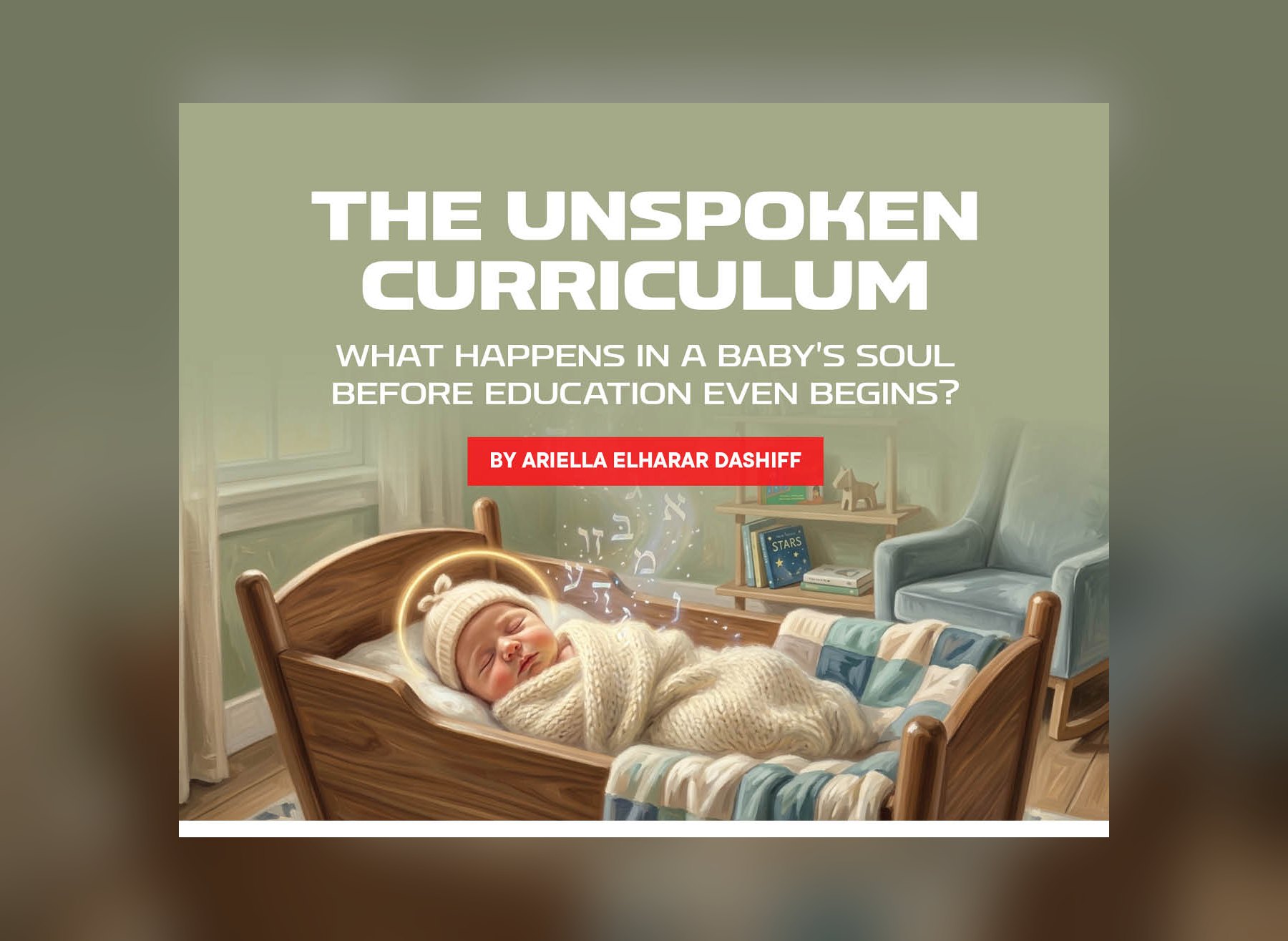
What Happens in a Baby’s Soul Before Education Even Begins?
The baby’s conceptual world develops slowly. He seems to understand so little.
So in infancy, is he like a potted plant, l’havdil? Should we just feed him, water him, open a window so the sun can shine on him and he gets fresh air, and make sure he sleeps (and the more, the better)?
Do we have any educational responsibility toward him at this stage? Is anything meaningful happening there? Is there even a point in investing?
On the surface everything seems the same, but only on the surface. Within this baby who “understands nothing” there is a kind of “add-on” – a Jewish neshama, a Jewish genome that has all sorts of side effects which, over time, will come to expression: total devotion, pursuit of truth and justice, high emotional intelligence, connection to the infinite and the spiritual, boldness and courage combined with responsibility and compassion.
The powers of the soul, which manifest in intellectual capacities and allow for wise use of a person’s innate traits, are barely expressed at this age. As the child grows, the neshama gradually comes to expression through the body, until the age of 13, which marks the completion of the nefesh Elokis’ entry into the person.
This “add-on” is what has stirred so much hatred, persecution, and envy – and, on the other hand, admiration – among all the peoples of the world. For Haman and his companions in every generation, Jewish infants were considered significant enough to pursue, to destroy, to kill, and to annihilate. And if our enemies recognized the power latent within a tiny Jewish infant – even one who understands nothing – how much more must we recognize the enormous educational significance embedded in his primordial present.
But if he understands nothing, how can we educate him?
This question stems from the mistaken assumption that education is a purely intellectual process. According to this view, as long as functions such as comparison, discernment, decoding information, and translating thought into speech are not yet developed – there is no room for meaningful educational action. And the logical conclusion is that at this stage we relate to the infant somewhat like a potted plant… we’ll wait for him to grow.
Of course, this is a profound mistake in understanding the nature of chinuch. The purpose of chinuch is to connect the Jewish person with his G-d in a complete and unbreakable bond, so that throughout his life he faithfully fulfills the specific role Hashem has designated for him – his life’s mission. The role of the parents is to make this possible. The infant stage is the preparation for chinuch.
The connection between a Jew and Hashem is, first and foremost, a bris – a bond that stands above understanding, above intellectual functions, and in the language of our Rebbeim – beyond reason and knowledge. This bris is the foundational layer of the relationship between Hashem and the Jew, and it is all that this infant has. Chinuch at this stage is directed at strengthening, deepening, and engraving this essential bond across all layers of the soul – even those not yet revealed – until it is engraved in the body itself: the bris mila.
This is why a Jewish boy is circumcised at eight days old and not upon reaching maturity. Precisely when he is eight days old, without choice or understanding, this is the fitting time to begin fulfilling his covenant with Hashem – an eternal bris, dependent on nothing, beyond reason and knowledge and beyond all choice.
Strengthening the Bris
How does one strengthen the super-conscious, the soul?
Many instructions have been given to us in the Written and Oral Torah. The bris mila is the first and most important of them. But there are many additional practices meant to strengthen this place within the soul:
We endeavor to let the infant hear only pure and good things (Chabad niggunim, Torah classes – just as the mother of Rabi Yehoshua ben Chananya did, and it served him well); to speak to him gently and calmly, and to ensure that speech is clean and refined; it is customary to pay on behalf of the newborn to the yeshiva he will presumably attend, as a segula for protection and long life in Torah and tefilla; to have him look at pictures of our Rebbeim; to wash his hands in the morning from a very young age; to recite “Shema Yisrael” with him every day from birth; to bring him to kiss the mezuza and other objects of kedusha; to bring him to tzaddikim; and more.
On the side of avoidance: one guards the purity of sight and hearing and the kashrus of food; one does not allow the child to play with non-kosher animal toys or with toys and games that involve deviation from values such as tznius or derech eretz.
All these actions strengthen the child’s general consciousness and the way he sees the world and himself. In addition to being segulos (actions that amplify the power of fulfilling the mitzvos themselves), they encourage good middos, hiskashrus to the Rebbeim, and purity and holiness.
How do these actions strengthen the connection with Hashem?
There is great importance in the way a person sees himself – that is, the category he places himself in. A person, even a young child, will often act in a manner consistent with how he defines himself. If he sees himself as fundamentally good, as someone who has a warm relationship with Hashem, he will feel that doing the mitzvos is the best thing for him. And then, even if he stumbles at something, his reaction will be: “This action doesn’t suit me – it’s just a small, one-time deviation. I’ll correct it immediately and return to my path, the derech Hashem.” It is understood that all of this inner dialogue is not conscious. And since this part – the subconscious – begins to develop already in infancy, it is already important at that stage for parents to invest in shaping it.
Father, Mother, and the Creator of the World
Let us think for a moment – what have parents gained from the fact that children were born to them? Sleepless nights, spending on food, clothing, shoes, and accessories, health concerns, running to doctors and medical check-ups, educational worries, disagreements between them about raising the children, back pain and leg pain – and many more such “gains.”
Raising children is the kind of thing that demands a great investment of pain and effort before one merits seeing fruit from the toil and experiencing true satisfaction.
Chassidim are accustomed to saying that when it comes to kelipos, beginning with the kelipas nogah, the sigh of pleasure precedes the sigh of difficulty and effort – but in matters of goodness and holiness, effort and difficulty precede pleasure and satisfaction. This is the strongest proof that raising children comes from the side of holiness…
So what keeps parents going?
The great love born in their hearts the moment the child is born – a love dependent on nothing: even if the child is born ill, disabled, or with a developmental challenge r’l. The parental bond, dependent on nothing, touches the unconscious parts of the child’s soul and gives him the strength to meet life’s challenges when they arise. When an infant experiences love, tenderness, and human warmth, he learns that the world is safe, and that the people in it are trustworthy and welcoming. When he grows and learns of Hashem’s presence in the world, the soul will already be ripe for a warm and loving relationship with the One who is the ultimate authority and the Parent of the entire world – Hashem Himself.
Therefore, the next time we, as parents, approach our little one, let us remember how important the small details are in preserving a pure upbringing at this age – and how vital is our boundless love for the treasure that has been entrusted to our care.
Beis Moshiach #1502 • pp. 48-49, 50
© 2026 Beis Moshiach Magazine. All rights reserved.
This article originally appeared in Beis Moshiach #1502. You are welcome to share it with friends and family by email or in print, provided that you do not change, add to or omit any part of it, you credit the author and Beis Moshiach, and you include a link to archive.bmoshiach.org (written out in full in printed copies).
To republish this article in a newspaper, magazine, book or website, please request permission in advance at [email protected].