You’re Also Right: Logic for the Messianic Era
What is Logic? Where does it come from? Well, conventional wisdom says that it comes from the Greeks. Indeed, it appears in a lot of Greek writings, especially in Euclid’s geometry. He makes assumptions (hypotheses) and proves things from them. That’s logic.
But this is wrong. Some years ago, I read a book on the history of logic and the author discusses this logic of the Greeks but then asks: Where did it come from? He goes on to say that they did not develop it on their own. How do we know? Because something as complicated and complete as a system of logic takes time to develop. In one generation, they start out, get some things right and some things wrong, then the next generation develops it further, until finally you have a complete and correct system. But in the Greek writings, we find that suddenly they are using a complete and correct system of logic. So they didn’t develop it on their own. They got it from somewhere.
Where did they get it from? The author of that book says that we don’t know. That’s it!
But we know where it came from because we have the Kuzari, and he says that the Greeks got it from us. No surprise there. A lot of their math and science came from the Jews. For example, their astronomy came from the Jews. We used to use it in the time of the Beis HaMikdash when we declared new months based on the testimony of witnesses and knowledge of astronomy. The tribe of Yissachar specialized in this and, as Rambam points out, they wrote many books on this, which were later lost. I guess the Greeks got hold of them somehow, because Rambam goes on to say that he drew much of his information on astronomy from the Greek writings – which, he said, was okay since they gave proofs for what they wrote, so Rambam was not just “taking their word for it.”
But the logic found in Greek writings, like all other scientific knowledge, just sat around, for many hundreds of years, with no further significant development.
The Flood of 1840
All this changed with the great flood of 1840. What flood? “I never heard of any flood then,” you might say.
Well, it all goes back almost 2,000 years to Rabi Shimon bar Yochai, who wrote the Zohar. The Zohar discusses the flood in the Parsha of Noach, where it says, “In the 600th year of the life of Noach… all the fountains from below split open, and the windows of heaven opened” and a flood of water came.
The Zohar states a prediction (a prophecy?) that the same thing will happen “in the 600th year of the 6th millennium (1840): The windows of heaven above will open up and the fountains below will break open,” and there will be a flood – except this time it won’t be a flood of water. It will be a flood of knowledge. Wisdom and knowledge will pour down from heaven; similarly, wisdom and knowledge will spring up from below. And this confluence will be a preparation for the Era of Moshiach.
What exactly was this flood and how does it prepare us for the Era of Moshiach? The Rebbe MH’M has an entire sicha explaining it. (See Likutei Sichos vol. 15, 2nd sicha on Parshas Noach, p. 42.). At the beginning he explains that the wisdom from above is Chassidus which began to be published at the time, starting with the Alter Rebbe’s Torah Or and Likutei Torah. The wisdom from below is scientific knowledge – the theories that began to be developed and the experiments that began to be done at that time, initiating modern science.
The development of modern logic was part of this. It began in the 1850s with the work of George Boole. (Did you ever hear the terms “Boolean logic,” “Boolean function” or “Boolean term?”) Boole developed an algebraic system that it sometimes called 2VL-Two Valued Logic, because it uses two terms: T and F for true and false. More algebraically, especially in computer science, they would be written as 1 and 0. This is the logic we use every day, even in math and science.
But sometimes two values are not good enough. For example, suppose we’re having a discussion and a certain alleged “fact” comes up. It may be true, or it may be false. But what if we just don’t know. If it’s just a discussion or I’m doing my own thinking, I can just say “I don’t know” and continue. But what if I’m a programmer and I need that “fact” even if I don’t know if it’s true or false? I need to work it into my program. I have to be able to say something.
Logic Has a Roof
At this point, we should point out that logic has a roof. We can’t figure out everything or answer all questions with logic. The Rebbe explains this in a famous maamar (see Maamarim Melukat vol. 5, Kuntres 18 Nisan) published for 18 Nisan – Rabbi Levi Yitzchok’s birthday and the day of The Rebbe’s bris.
The maamar starts with a verse (Tehillim 65:5) which is part of the service of the bris ceremony:
אשרי תבחר ותקרב ישכן חצריך נשבעה בטוב ביתך קדש היכלך
The verse mentions חצריך – “your yards,” and the Rebbe analyzes this. In halacha, there are two kinds of yards for holding animals, with a roof or without a roof. A yard, or corral, without a roof, enclosed only by a fence, is adequate for holding animals like cows and bulls. But to hold birds, you need a corral which is enclosed by a fence – and covered by a roof. Without a roof, the birds will fly away!
Now, this makes perfect sense, of course. But from an analytical point of view, there is something rather unsettling. How could it be that big husky animals like cows and bulls are contained by a mere fence. But to hold small flimsy birds a fence is not adequate; you need a roof as well? There must be a deeper message here…
So, the Rebbe explains. The big coarse animals, the cows and the bulls, represent the Nefesh Ha’behamis (animal soul), and the small, delicate birds represent the Nefesh Ha’sichlis (intellectual soul). The coarse animals, just wander around looking for food and other things to give them satisfaction and pleasure. A simple fence is enough to watch them, to keep them in line. But the small birds are like the intellect, which is always searching and looking to go to higher and higher levels until it finds the logical answers to the questions being investigated.
Since these birds – the intellect – keep flying higher and higher, we need a roof over the corral to keep them inside. The message is that intellect – logical investigation – has a roof over it to tell it that you have to stop here. At this point you have to stop using logic. You cannot use logic in certain investigations because not all questions have logical answers. Logic is a tool and can be applied only to what it was designed for.
As an example, it is written in Chassidus that the fact that the world was created from nothing is within the realm of logic, we are able to understand it and we are actually obligated to understand it. But as to how the world was created form nothing is beyond the realm of reason and logic. (Don’t even try – it’s a waste of time.) That’s the roof.
I have seen many cosmologists wasting their time trying to “figure out” how the universe began. They come up with crazy theories that go around in circles and are eventually rejected. They certainly cannot be experimentally verified!
Who is Right?
Before we get carried away with the roof, let’s go back to the situation where we said that sometimes we need more than 2 values. We start with a story. There were two business partners, call them Reuven and Shimon. One time there was a project that didn’t work out and an argument arose between them as to who should pay for the loss. So, they went before a judge.
Reuven spoke first and stated his claim before the judge: “Shimon should pay me the money because of this and that.” The judge listened carefully, then said to Reuven, “You’re right.” Then Shimon spoke: “Reuven should pay me the money because of this and that.” The judge listened carefully and then said to Shimon, “You’re right.” At that point the student sitting there taking notes spoke up. He said, “Excuse me your honor, but you just said to Reuven that he’s right, then you said to Shimon that he’s right. But they’re saying two opposite things. How could they both be right?” The judge looked at him carefully and said, “You’re also right.” That’s the 3rd value.
So we need a 3rd value not just for unknown information but also for contradictory information. Physicists also found that they needed a 3rd value. The quantum physicists started doing the experiment, known as the Double-Slit Experiment, with electrons in the early 1900s. To keep the story short, they would shoot electrons at a target that had 2 vertical slits, and a photographic plate behind it. Some electrons would go through the left slit and some through the right slit and you could see that the photographic plate had 2 columns of marks from the electrons. So far, everything is normal. But they kept reducing the quantity of electrons that they shot, and when they reduced it to shooting just one electron at the slits, the only way that they could describe what happened is that the electron went through both slits. Impossible? Well, let’s just say that this is something that you need a 3rd value for.
Fortunately, in 1920, a man named Jan Lukasewicz developed an algebraic system for 3-Valued Logic (3VL), so it was now an official part of logic and algebra, and the 3rd value could be used to represent True and False simultaneously, so a statement could be “True and False” and be represented in logic. Numerically, the 3 values were represented by: 0, ½, 1. This is the logic that we need for the Messianic Era.
It was at this time (1920) the Previous Rebbe, Rabbi Yosef Yitzchok Schneerson, began his Nesius (became Rebbe), and started teaching more and more about the Messianic Era and Messianic phenomena.
Messianic Logic
We will now discuss how many of the phenomena in the Messianic Era need a 3-Valued Logic to be “understood,” or at least, to be represented. Once again, we will see the actualization of the words of the Zohar that the Chassidus (wisdom from above) and the new developments in math and science (wisdom from below), work together to prepare us for the Era of Moshiach.
We start with an example that’s “easy to understand” (relative to 3VL). In a sicha early in 5752, the Rebbe started talking about the story of Purim. At the beginning of the Megillah it tells the story of the big party that King Achashverosh made. It was a party for everyone – he wanted to make everyone happy. In fact, the Megillah uses the phrase לעשות כרצון איש ואיש – (literally) “to do according to the will of one man and another man.” Who were these two men that Achashverosh wanted to satisfy? The Medrash says that they were Mordechai and Haman.
The Medrash continues that Hashem commented on this saying (to Achashverosh), “You fool, you want to make both of them happy when, in fact, what each one wants is exactly the opposite of the other?! You’ll see: you will make one of them your viceroy (Mordechai) and you’ll hang the other (Haman).”
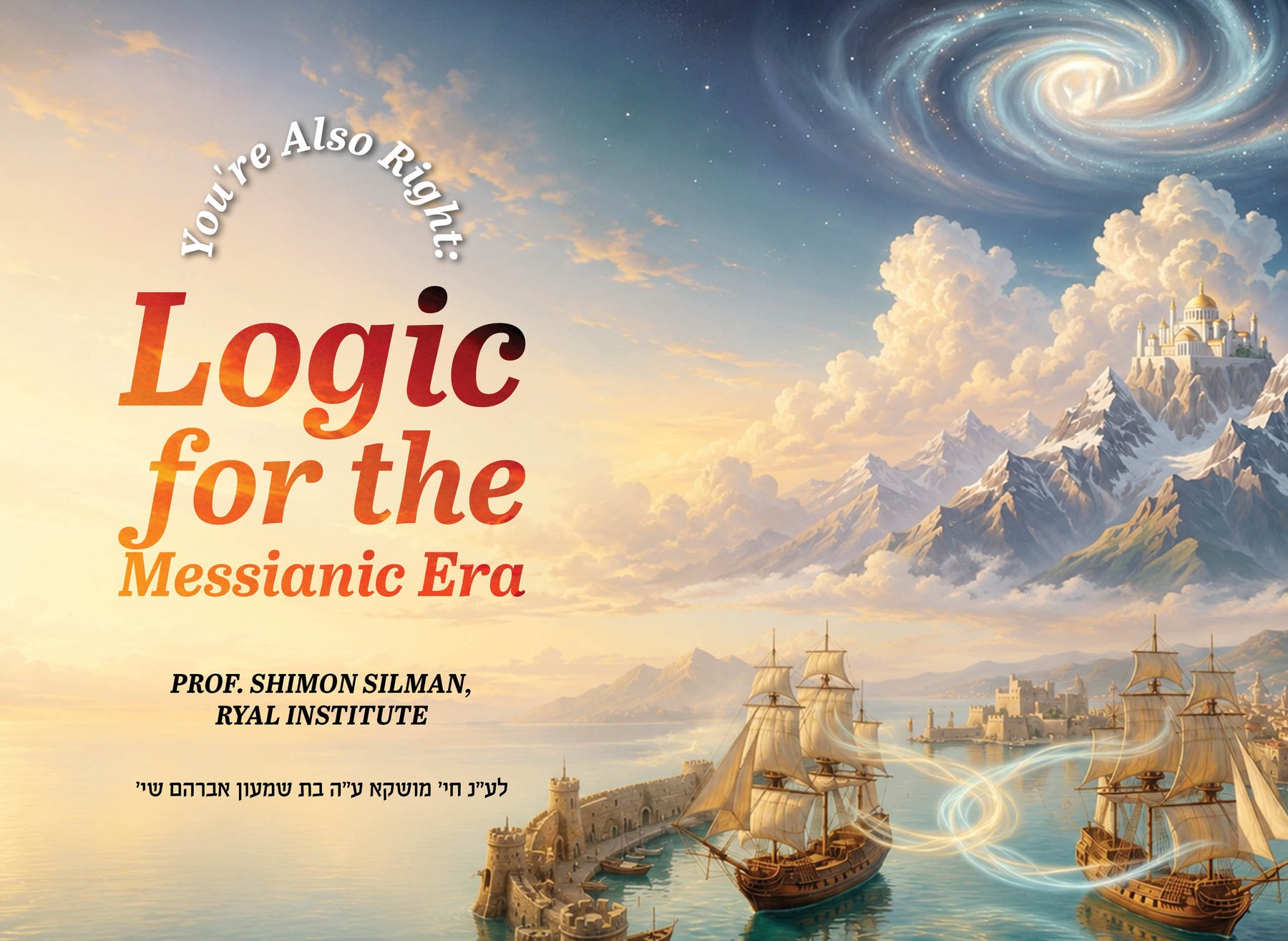
Then the Medrash gives an example: Suppose two ships leave the harbor. One needs a wind blowing North and one needs a wind blowing South. Can there be a wind that satisfies both of them? No. But in the future, the Medrash continues, at the time of the ingathering of the exiles (in the Messianic Era), it will be possible. Hashem will bring in a multi-directional wind (רוח ארגסטיס) blowing both North and South at the same time and they will both be able to go where they need to go.
In this example, we can see that we need a 3rd logical value to represent a genuine paradox – 2 opposites occurring simultaneously.
Messianic Miracles
This is a bit more complicated than the two ships leaving the harbor, but I’ll try to keep it simple.
There are two kinds of miracles. One is an open obvious miracle that breaks nature (שידוד הטבע), such as splitting the Red Sea, water turning into blood etc. The 2nd type of miracle works within nature (מלובש בטבע), such as the miracles of Purim. Both of them come from an infinite revelation from Hashem. But the first kind breaks nature because it can’t work within nature. The 2nd kind comes from a higher infinite revelation from Hashem and has the power to work within nature. Hashem makes nature itself do what He wants.
The extreme case of a miracle working within nature is the miracle where there is no indication that a miracle has even occurred. As Chazal describe this type of miracle: אין בעל הנס מכיר בנסו – the one to whom the miracle has occurred doesn’t even know that a miracle has taken place. This type of miracle comes from the highest infinite revelation from Hashem and shows that Hashem can work within nature, making it do what He wants without giving any indication that something unusual has happened. Chazal describe this quoting the verse: לעושה נפלאות גדולות לבדו – only Hashem knows that a miracle has occurred.
But in these cases, the miracle is not visible because the infinite revelation from Hashem (בלי גבול) is covered up by the finite limitations of the natural order (גבול) – which also comes from Hashem. But in the Era of Moshiach this will not be the case. Nature will no longer hide the infinite revelation occurring in a miracle and we will see the finite and the infinite revelations working simultaneously. As the Rebbe says in a maamar (Melukat vol. 5, p. 145):
שאז הגבול לא יעלים על הבל”ג שנא’ ונגלה כבוד ה’… …גם בגבול יהי’ גלוי הבל”ג
“In the finite, there will be the revelation of the infinite… because then the finite will not hide the infinite, as it says, “The glory of Hashem will be revealed and all flesh will see it…”
You’re Also Right
Now, we switch to something that is literally mind-boggling, yet very down to earth, very practical.
We are in the days following the holiday of Shavuos, celebrating Hashem giving us the Torah (Matan Torah). Along with the written Torah we received the Oral Torah. Many things in the Oral Torah were intended to be discussed and debated by the scholars and the halacha (practical application of the law) was to follow the majority. This was Hashem’s intent – that issues arising in the Torah given down here on earth, should be decided by the majority of scholars here on earth.
A clear example of this is the law of the shomrim (people responsible for an object belonging to someone else). The Torah speaks of four shomrim and the law for each of them – except for one, the sachir (one who is renting an object belonging to someone else) where the Torah doesn’t specify the law. Rashi comments on this: “[The Torah] didn’t specify what the law is for him…Therefore, the scholars of Israel argued about him [as to what the law should be for him].” (see Rashi on Shemos 22:14). So here, Hashem intentionally left out the information so that the scholars would decide.
The most famous controversies among the scholars were those between Beis Hillel and Beis Shamai (the followers of Hillel and the followers of Shamai). They argued about many things; most of the time Beis Hillel was more lenient. After many years of controversy, a bas kol (heavenly voice) called out and said something amazing. It said: אלו ואלו דברי אלקים חיים והלכה כבית הלל which means, “Both opinions are words of the living G-d, but the law follows Beis Hillel.”
Why is this so amazing? Well, the fact that the law is like Beis Hillel is natural because most of the scholars agreed with Beis Hillel. But the first part: “Both opinions are words of the living G-d” – what does that mean? That they are both right? How is that possible? They’re saying two opposite things. It’s like the student taking notes in the story above – “You’re also right!”
Fortunately, this issue is directly addressed by the Rebbe – and we will quote him shortly. But as an introduction to his words, it is helpful to see some general comments on this track from the Previous Rebbe. He writes:
“In G-dly intellect there are arguments of positive and negative, but the positive and negative of the G-dly intellect are not opposites. In human intellect, one of these paths is false, but in G-dly intellect, both the positive and negative are true. They are two branches of light, two rays of light from one source, each illuminating a part of the concept.” (Likutei Diburim, translated)
The Rebbe MH’M addresses Hillel and Shamai specifically. There are some unique aspects here:
The bas kol announced that the halacha is like Beis Hillel.
But there is a Mishna in Pirkei Avos that says that any controversy that is for a G-dly purpose will continue on. But after the bas kol announcing that the halacha is like Beis Hillel, the opinion of Beis Shamai “is gone.”
So, the AriZal says that in the Messianic Era, when the scholars on the Sanhedrin are very great scholars, the majority will see the halacha like Beis Shamai and decide the halacha like them (Beis Shamai were actually greater scholars), so their opinion will endure.
The Rebbe then asks: But then what happens to the opinion of Beis Hillel? Now their opinion “is gone!” [Can you see where this is going?]
Both opinions have to endure. How is it possible that the law will be like both opinions when in fact they contradict each other and are thus mutually exclusive? The Rebbe explains that from the perspective of G-d, the opposite opinions coexist simultaneously:
“He contains both opinions – the positive and the negative and both of them together… As far as G-d is concerned, they can come to be revealed in the reality of the world just as they are relative to G-d’s essence (Atzmus) – positive and negative together. This is because He is the impossible of the impossibilities, above the limitations of the impossible and the contradictory.”
This is what we have come to understand as the 3-Valued Logic of the Messianic Era.
The Life of Melech HaMoshiach
There’s one more thing to make this discussion complete: the life of Moshiach himself. The Mitteler Rebbe (son of the Alter Rebbe) writes:
“Regarding Moshiach it says, “Life… You granted it to him” which means a gift with no interruption. Regarding Dovid – his life came only from the ten sefiros of Atzilus, but regarding Moshiach it says, “’You granted it to him,’ which means from Atzmus, the infinite.” (Addressing G-d in second person -“You” – refers to G-d Himself, i.e., His essence, Atzmus.)”
It is significant that the Rebbe spoke of his life from Atzmus (the “essence” of Hashem) on the eve of Rosh Hashana 5752, the Rosh Hashana before his stroke. He said, “Regarding Moshiach – in addition to the revelation of the name of Moshiach… we also have the Atzmus of Moshiach Tzidkeinu which is one thing with the infinite Atzmus.”
A life that comes from Atzmus is above all definitions and limitations of natural life and death as we know them. As Rabbi Sholom DovBer of Lubavitch (the fifth Rebbe of Chabad) says, “Relative to Atzmus, life and death are equal.” In fact, as mentioned above, Atzmus transcends all limitations. Thus, the miraculous and the natural are equal relative to Atzmus and can coexist. It follows that the life of Moshiach is completely above the laws of nature. As the Maharal of Prague writes, “Moshiach will be… outside of nature and the way of the world.”
Let’s be ready… it’s happening now!
Beis Moshiach #1508 • pp. 24-29, 30
© 2026 Beis Moshiach Magazine. All rights reserved.
This article originally appeared in Beis Moshiach #1508. You are welcome to share it with friends and family by email or in print, provided that you do not change, add to or omit any part of it, you credit the author and Beis Moshiach, and you include a link to archive.bmoshiach.org (written out in full in printed copies).
To republish this article in a newspaper, magazine, book or website, please request permission in advance at [email protected].