The Rebbe Who Fought – PART II
Previously: In Part I, we followed the Belzer Rebbe, Rabbi Aharon Rokeach, from the ashes of Europe to the war-torn streets of Tel Aviv. He blessed soldiers, refused to leave while Jewish boys were fighting, and stood with his people through every bomb and every loss. Now, as a new enemy rises in Egypt and another war looms over Eretz Yisrael, the Rebbe’s battle continues — not on the battlefield, but in his room, on his feet, for hours on end, pouring out his heart to Hashem.
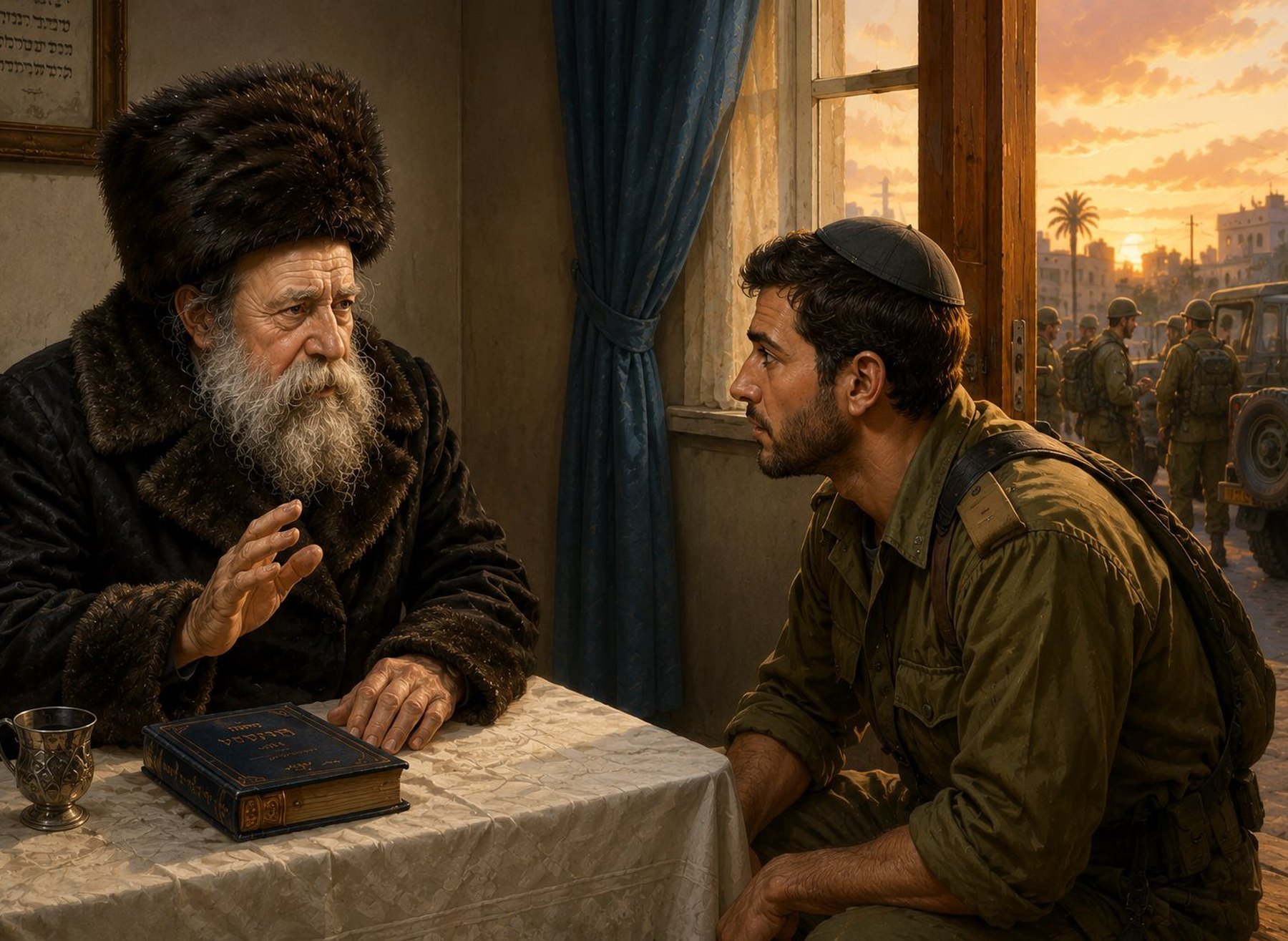
Reb Pinchas Bresna was a platoon leader in the army, so he understood before most people how close war really was. One Friday afternoon, just before Shabbos, he got an urgent order to report to his battalion in Beer Sheva at once, in the south. He was already on his way with his soldiers, when he decided that, before going any farther, he had to receive the Rebbe’s Bracha.
He hurried to the Rebbe’s house in Tel Aviv. It was almost candle-lighting time. Someone at the door tried to stop him, but Reb Pinchas insisted it was urgent and went in. The Rebbe looked at him, and Reb Pinchas quickly explained war could break out at any moment. He’d come for a Bracha before leaving for the front. The Rebbe answered with only a few words: “Stay here for Shabbos.”
Reb Pinchas was shocked. He explained that he was a platoon leader, he had to report right away, and he couldn’t simply stay behind. It was a command. But the Rebbe repeated the same words: “Stay here for Shabbos.” Reb Pinchas didn’t understand, but he couldn’t ignore the Rebbe. He told his men to go on without him and remained in Tel Aviv.
That whole Shabbos, he was filled with worry. The fighting was already growing worse. He was afraid not only of the war, but also of what might happen to him for disobeying orders. Then he saw the Rebbe standing near the Mezuza, deep in Tefilla. The Rebbe seemed to feel the danger very clearly.
As soon as Shabbos ended, Reb Pinchas received the Rebbe’s Bracha and hurried south to join his men. He still wondered if he’d be punished for not showing up when he was supposed to. But when he arrived, no one even mentioned it. Everyone was too busy preparing.
Then he heard what had happened. The bus carrying his soldiers had hit a mine. It exploded, and most of the men inside were killed. Reb Pinchas was shaken to his core. He cried over the soldiers he’d lost. But he knew one thing for certain: if he’d gone with them, he wouldn’t have come back alive.
* * *
During the war itself, his Tefillos grew even stronger. On the Yahrtzeit of the Rebbe of Chernobyl, the eighth of Kislev, his Avoda was especially intense. Usually, he’d give out cake and mashke, but that year, he spent the whole morning deep in Davening. Then he said that the holy Tzaddik whose Yahrtzeit it was should go and beg in Shamayim for peace in Yerushalayim, peace in Eretz Yisrael, and peace for Yidden everywhere.
One Chassid had become so frightened of the coming war that he decided to leave Eretz Yisrael until the danger passed. He ordered a taxi to the airport. On the way, the driver, who wasn’t Frum, asked him why he was leaving. The man answered honestly that he was afraid of the war. The driver looked at him in surprise and said, “How can you leave because of fear, when the holy Belzer Rebbe is here in Eretz Yisrael?”
The Chassid was shocked. What did this driver know about the Belzer Rebbe? Then the driver told him what had happened to him.
A few months earlier, the driver’s wife had been taken to a mental hospital with a very serious condition. The doctors weren’t sure if she would ever recover. A few days later, the driver happened to take a Frum passenger to Tel Aviv, and during the ride, he poured out his heart. The passenger said, “Why don’t you go to the Belzer Rebbe for a Bracha? What do you have to lose?”
The driver decided to go. The Rebbe told him, “She is well. She is healthy. She is ready to go home.”
The driver rushed back, hardly believing what he’d heard. But when he arrived, he found his wife was suddenly feeling much better. She herself was asking the doctors to examine her again, because she felt ready to leave. They checked her, and to their amazement, her condition had improved so much they agreed she could go home.
After sharing the story, the driver turned to the frightened Chassid and said, “If such a holy Rebbe lives here in Eretz Yisrael, why should you be afraid of war?”
A similar story was told by Nachman Rotner. He said that during that tense time, his father, Yaakov Bentzion Rotner, in London, was very worried. He went to the Shotzer Rebbe for a bracha.
The Shotzer Rebbe told him not to be afraid, because the holy Belzer Rebbe was in Eretz Yisrael. People felt that as long as such a great Tzaddik was there, the land had protection.
* * *
One of the first signs something major was about to happen was a quiet visit from Reb Yitzchok Meir Levin. He was one of the senior leaders of Agudas Yisrael and an important public figure in the young State of Israel. Even though he was a Gerrer Chassid, he sometimes went to the Belzer Rebbe to discuss serious matters. This time, shortly before the war, he came for a private meeting with the Rebbe, and the Yechidus lasted far longer than usual.
After that meeting, people noticed a sharp change. The Rebbe’s daily schedule became different, and his Avoda grew even more intense. He spent longer hours in Davening, and those around him could see something very heavy was resting on his heart. They didn’t know why, but they understood it had to do with the danger hanging over the Yidden.
At that time, Reb Yitzchok Meir was closely connected with the government and met often with David Ben-Gurion, the first prime minister. Later, people told that Ben-Gurion had asked him to visit one of the generation’s great Tzaddikim and ask for Tefilla and a Bracha for the coming war.
Levin told Ben-Gurion that the Belzer Rebbe was the right person to ask. Ben-Gurion then shared the details of their military plans with him in great secrecy, so he could bring the matter to the Rebbe for a Bracha. Levin met with the Rebbe behind closed doors. No one outside the room imagined the safety of the whole country was being discussed inside.
The Rebbe gave a Bracha for success and said the Aibishter should bring a quick victory. Exactly what else was said in that room was never revealed. At one point, a Chassid accidentally opened the door, just for a moment.
Right away, the Rebbe changed the subject. “So, what did the doctor say?” he asked, as if they were talking about something simple. But as soon as the door closed again, the secret conversation continued.
From then on, people saw the Rebbe Davening with even greater strength. For long hours, he stood and poured out his heart for the safety of the Jewish people. When danger came closer, the Rebbe felt the fear and pain of every Yid as if it were his own.
* * *
The Sinai Campaign happened fast. By Thursday night, Gaza had already been captured, and by Shabbos, the explosions had begun to grow quieter. But even in those few frightening days, stories about the Rebbe’s Tefillos spread among the Chassidim.
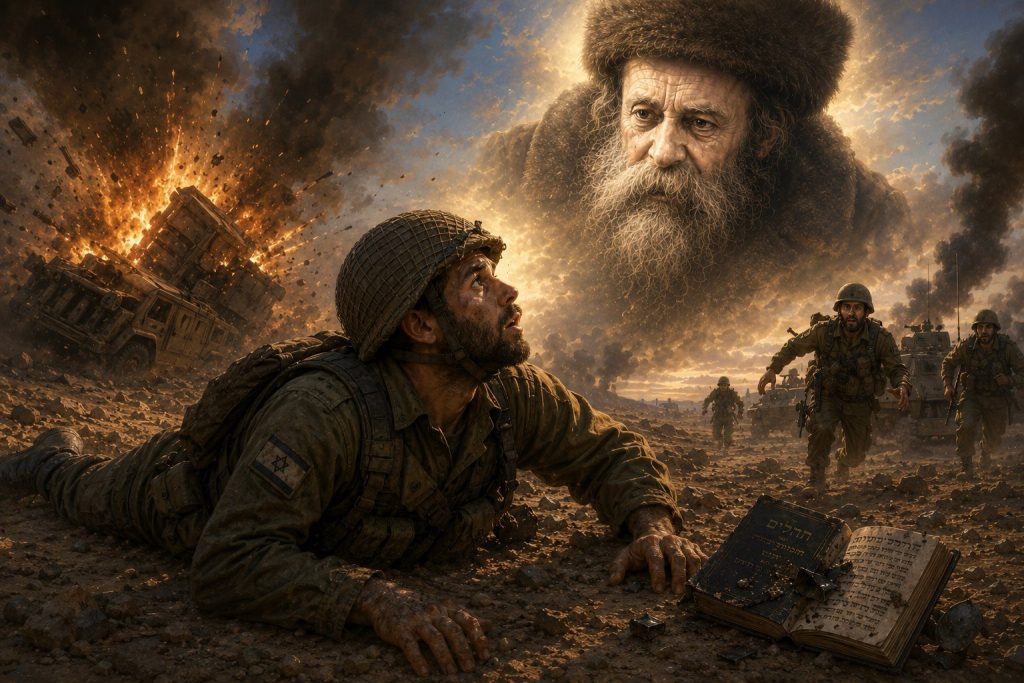
One older Belzer chassid, Reb Moshe Friedman, was riding in a military vehicle with some army commanders, when an Egyptian tank suddenly fired at them. The blast threw the whole vehicle into the air. Everyone was tossed out, and Reb Moshe himself was hurled far away before crashing to the ground. In those first terrible moments, he didn’t even know if his body was in one piece. Then, lying there, shaken and stunned, he suddenly saw the clear face of the Belzer Rebbe, shining with holiness. Startled, he began whispering Tehillim. The Rebbe’s face remained until soldiers came and took him to the hospital.
The nurses could hardly believe he was alive. The vehicle had been smashed and burned, yet he’d survived. Later, he discovered something else. In his backpack was a sefer Noam Elimelech, a precious sefer he’d received when he came to Eretz Yisrael in 1949, and which he learned from every day, even during the war. Pieces of metal from the explosion had ripped through the sefer, but he was untouched.
When Reb Moshe returned home, he hurried to the Belzer Rebbe to tell him what had happened. But before he could say a word, the Rebbe looked at his Kvittel, read the name, Moshe ben Chana, and suddenly said, “Where is he? Where is he? Shalom Aleichem, Shalom Aleichem, Shalom Aleichem!”
At that moment, Reb Moshe understood. The Rebbe already knew. There was no need to explain anything. Somehow, the Rebbe had been with him through it all.
* * *
One Belzer chassid, Reb Shmuel Aharon Yuskovitch, served in the Sinai Campaign, and one day, his commander told him he was traveling to Tel Aviv, so Reb Shmuel Aharon gave him a Kvittel to deliver to the Rebbe.
A few days later, a ceasefire had been announced, but the area was still dangerous. Reb Shmuel Aharon was outside with other soldiers, and his father was nearby, sitting and learning. Suddenly, enemy forces fired a shell at their area. They heard it whistling through the air, and then it exploded right next to them. Pieces of metal flew in every direction. One piece even struck his Gemara! But in an open miracle, Reb Shmuel Aharon himself wasn’t hurt at all.
When he was finally released from the army, it was Friday. He went straight from the army to the Rebbe, still wearing his army uniform and still carrying his gun, because he hadn’t even gone home first. As soon as he arrived, the Gabbai, Reb Yissochor Dov, looked at him and said, “Tell me, what happened to you?”
Reb Shmuel Aharon was startled. “How do you know something happened?” he asked. The Gabbai explained that when the Kvittel had reached the Rebbe, the Rebbe hadn’t simply placed it with the others. He looked at it, again and again. Later, they understood why. At the very moment the shell had exploded near the soldiers, the Rebbe had been reading his Kvittel.
* * *
During all this uncertainty, the Belzer Rebbe continued his Avoda. He would stand for long hours, barely eating and barely resting, Davening for the safety of the Jewish people. He was already older, and the people around him were afraid that such Avoda would weaken his body. Some of the elder Chassidim and Rabbanim begged him to stop. But the Rebbe would only answer, “Yes, yes, yes, I am almost finished,” and then continue.
While the war was being fought on the battlefield, the Rebbe was fighting for the Yidden in his own holy way. He was there with the Jews of Eretz Yisrael the whole time.
Beis Moshiach #1508 • pp. 56-59
© 2026 Beis Moshiach Magazine. All rights reserved.
This article originally appeared in Beis Moshiach #1508. You are welcome to share it with friends and family by email or in print, provided that you do not change, add to or omit any part of it, you credit the author and Beis Moshiach, and you include a link to archive.bmoshiach.org (written out in full in printed copies).
To republish this article in a newspaper, magazine, book or website, please request permission in advance at [email protected].