Egypt: The Border That Time Forgot
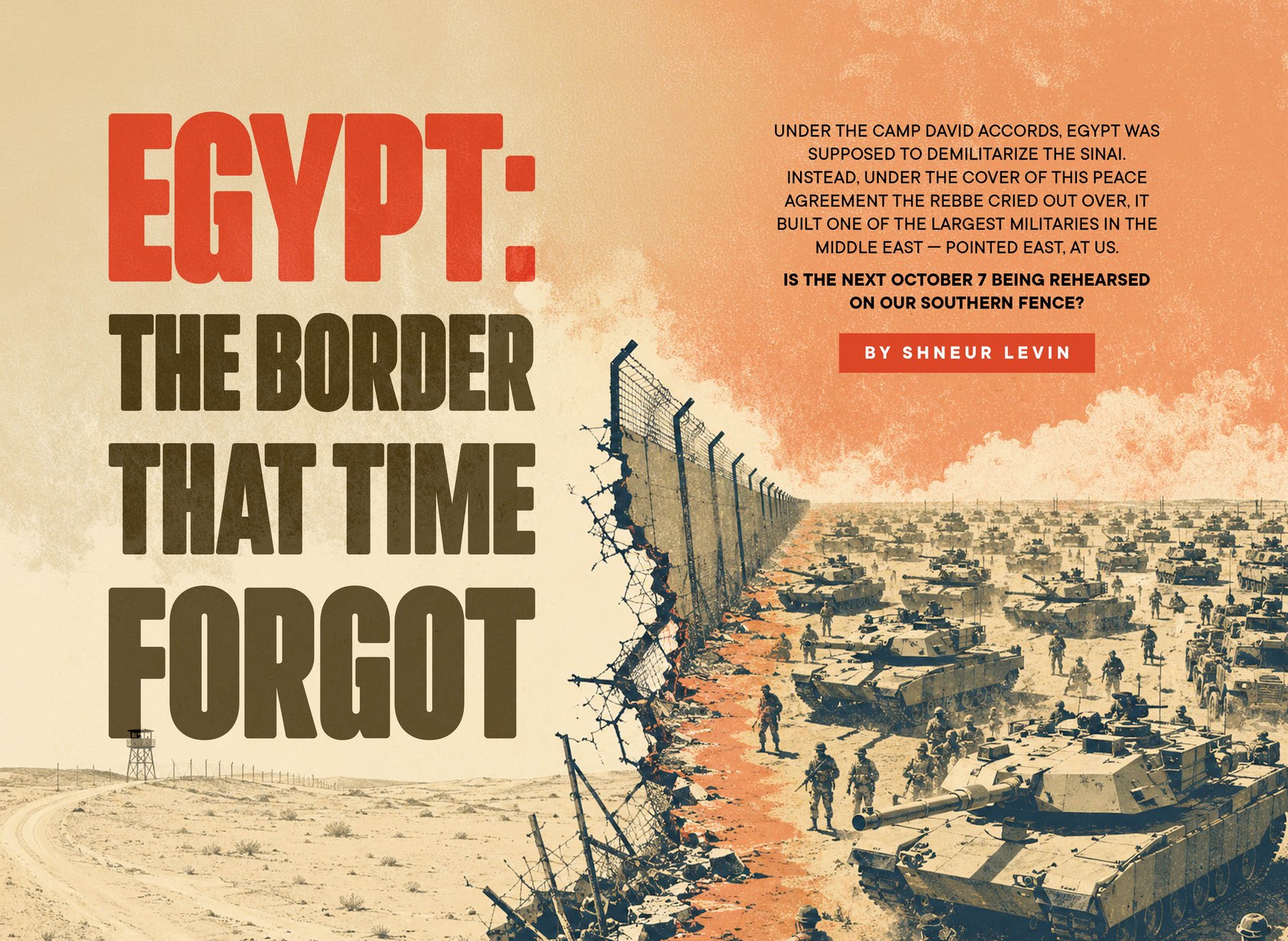
Under the Camp David Accords, Egypt was supposed to demilitarize the Sinai. Instead, under the cover of this peace agreement the Rebbe cried out over, it built one of the largest militaries in the Middle East – pointed east, at us. Is the next October 7 being rehearsed on our southern fence?
On the morning of Sunday, 9 Iyar, residents living in communities near the Israeli-Egyptian border received an unusual and alarming message.
The sender: the Paran Brigade, the brigade responsible for the sector.
The message’s content: a warning about intensive military activity by the Egyptian army within touching distance of Israel’s border. According to the message, during that week the Egyptian army would be conducting live-fire exercises across wide areas, from 6:00 AM until 7:00 PM.
“Between April 26–30, live-fire exercises will take place 100 meters west of the border,” stated the official notice — which, notably, was issued by the IDF itself.
And the residents? Furious. The message sparked widespread anger and a sharp response from residents as well as from the “Otef Israel Forum,” which represents communities along Israel’s borders. The forum claimed this constitutes a security recklessness eerily reminiscent of Hamas’ conduct on the eve of the Simchas Torah attack.
“It is inconceivable that the Egyptian army is being allowed to train in such close proximity to the fence,” the forum stated.
The residents of the area are not merely angry, they are genuinely fearful. A resident of Moshav Bnei Netzarim, located right on the border, said: “How, after everything we’ve been through, is the IDF permitting and authorizing a foreign army to reach the contact line of the border with live weapons? Where has such a thing ever been heard of? The sounds of gunfire are a perfect smoke screen for smuggling or even a raid that could take place. Why are they being allowed to approach? They want to train? They have enormous expanses in Sinai!”
The resident added: “In recent months we have been witnessing events that recall the disaster of October 7.” She went on to describe how “a month ago, white vans arrived several times near the border fence, stopped opposite the community and the nearby military base, and conducted surveillance unimpeded. We saw a man with a camel who sat for hours opposite an IDF base on the border. The response we received was that ‘he is in an area where he is permitted to be,’ but it is obvious to any reasonable person that this is intelligence gathering. How can the army authorize them to conduct live-fire training near civilian communities?!”
“The patterns that existed in recent years along the Gaza border are repeating themselves here. You cannot miss it. We see them coming back again and again. They are testing the border and testing our vigilance and now they are also receiving official authorization to shoot near our homes. Normalizing armed presence on the fence is a failure!”
The Rebbe Cries Out: A Sham “Peace” Agreement
Two central problems underlie the puzzling behavior of the security forces on the Egyptian border.
The first problem: the buildup of the Egyptian army, an army that signed clear and detailed agreements prohibiting it from approaching the border with weapons, conducting training nearby, or maintaining any military force of any kind within a certain distance of the border.
The second problem: smuggling, primarily via drones which we will address shortly.
In the year 5737 (1977), a historic event occurred: Anwar Sadat, the President of Egypt, decided to visit Israel. Until then, we had only met the Egyptians on the battlefield. At this point, they sought to sit and talk without the need for intermediaries. Sadat understood that the path he and his predecessors had walked had not brought them success, and would not in the future. He understood that through war he would gain nothing and that he would have to achieve his aims by other means. Against all the advice he received, he decided to do something no one had dreamed of: he would visit Israel, and only in this way could he restore to Egypt’s sovereignty the vast Sinai territories it had lost in the Six-Day War.
Furthermore, a peace agreement with Israel would also give him the time needed to rebuild his military strength without the threat of war. In addition, he knew that signing an agreement would earn him generous American economic aid.
To his Arab counterparts he explained that he was not surrendering to the Israeli government. “I will take what can be obtained without war, and then I will be able to strengthen Egypt’s standing,” he said openly, while the government leaders in Yerushalayim pretended not to hear. “The challenge of defeating the Israeli army on the battlefield I will leave to the next generation.”
And the government of Israel, led by Menachem Begin, was swept up in excitement over the illusory “peace” that their long-bitter enemy had now offered them.
On the 27th of Adar, 5739, a “peace” agreement was signed and the price we paid was enormous. We handed over to Egypt a vast territory, along with the complete destruction of sixteen communities in the Yamit region, the total evacuation of all Jewish residents (with Ariel Sharon overseeing the evacuation operation). In addition, we sacrificed the developed and valuable oil fields in Sinai, thereby nearly destroying the economy of those years. Those oil fields could have not only supplied Israel’s needs, but brought billions of dollars into its coffers.
All of it was given to Egypt in exchange for a piece of paper promising “peace.”
“And Mordechai the Jew knew all that had been done” — the Mordechai of our generation, the Rebbe, understood the magnitude of the danger concealed behind this miserable agreement. While everyone was euphoric — finally, a peace agreement with a neighboring Arab state — the Rebbe quickly moved to cool the enthusiasm. From that time onward, over the years, he cried out countless times against the signing of the agreement.
One of the foundations of the Rebbe’s position was Siman 329 in the Shulchan Aruch, and he said that their entire desire is that “the land should be easy for them to conquer.” The Rebbe also spoke with great pain about the foolishness of surrendering territories containing oil wells that could greatly strengthen Israel’s military and economic standing — and certainly when given away without any real return.
Over the years the Rebbe sharpened his position that it is impossible to rely on the Egyptians to honor the agreement. At the farbrengen of 18 Elul 5741, he said that even if the current Egyptian government were to honor the agreement, there could be a change of regime, and the next government that arose might not honor it.
Thirty years later, in 5771 (2011), as part of the “Arab Spring,” Mubarak was toppled from power and his place was taken by the Muslim Brotherhood terrorist organization, which even threatened to cancel the agreement until they too were removed from power.
And what about the quiet that prevailed along the Egyptian border over the years? The Rebbe addressed this as well, explaining that the quiet along the border was not necessarily a result of the agreement, but rather stemmed from the Egyptians’ bitter experience from the previous wars, in which they suffered heavy losses. It is also known that the Egyptian army has been continuously arming itself with heavy weapons despite the peace agreement.
And if that were not enough, a very large portion of the weapons that armed and continue to arm Hamas terrorists in Gaza, causing hundreds of fatalities, was smuggled through Egypt, with the clear turning of a blind eye by the Egyptians.
(There are numerous sichos of the Rebbe’s on this subject and they are compiled in the books “Shalom Shalom V’ein Shalom” and “Daas Torah.”)
Agreements Violated
As part of the peace agreements signed at that time, it was agreed that Egypt would maintain a distance from the border with Israel. According to the agreement, the Sinai Peninsula was divided into three security zones: A, B, and C. Only in Zone A, the farthest from Israel’s border, is Egypt permitted to bring in heavy weapons such as tanks, APCs, artillery, and the like. The zone closest to the border (C) was defined in the agreements as almost completely demilitarized. Egypt is permitted to bring in only Egyptian civilian police to carry out routine policing functions, with officers equipped only with light weapons. There is an absolute prohibition on the presence of military forces or heavy weapons.
Remarkably, over the years, the Israeli government has authorized Egypt to introduce forces and weapons (including tanks and combat helicopters) even into eastern zones, far beyond what the original agreement permitted. These authorizations, granted for a temporary period, have since become permanent.
Under the cover of the “peace agreements,” the Egyptian army has grown stronger, constantly testing the thin line (in every sense) between Israel’s strategic interests and the fragile relations between the countries, particularly since Simchas Torah 5784 (October 7, 2023).
Peace agreements are supposed, according to human logic, to lead to a reduction of military forces but in Egypt, the opposite occurred. Since the signing of the agreement with Egypt, the Egyptian army has grown steadily stronger and has become one of the most powerful and large in the Middle East. The Egyptian army today looks primarily eastward and is preparing for a possible confrontation with the Jewish people. Egypt’s current president, el-Sisi, has repeatedly chosen to deliver threatening messages to the Jewish people while standing before the armored formations of the Egyptian armored corps in Sinai.
Security assessments point to an Egyptian military presence in Sinai significantly higher than the quotas established in the original peace agreement. According to reports, Egypt currently maintains a force of between 40,000 and 66,000 soldiers deployed throughout the peninsula, including in areas close to our border while Egypt is only permitted, as noted, to put policing forces there.
It’s not only soldiers; heavy combat equipment has also been brought to the border, including tanks, APCs, artillery, and advanced air defense systems. There is also infrastructure buildup: the Egyptian army is constructing three bases in Sinai that include airfields, in violation of the agreement; it is expanding its other bases on the peninsula and building new bunkers. Satellite images have revealed that since 5773 (2013), Egypt has erected dozens of floating bridges (most of them military) across the canal, in addition to a rail bridge and the digging of tunnels beneath the canal. All of these will allow Egypt to stream forces into Sinai much more rapidly than before.
As with the ‘conception’ that prevailed regarding Gaza, so too on the Egyptian border, the IDF and heads of the security establishment prefer to turn a blind eye. Not only to the massive forces brought there, but also to the unusual military activity being conducted in recent months near the border.
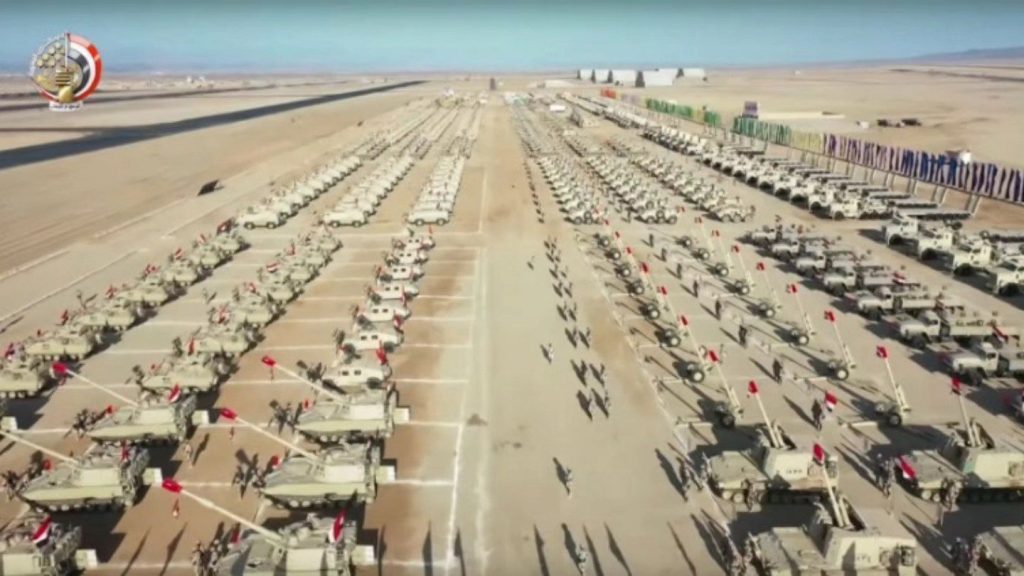
As noted, two weeks ago it was reported that the Egyptian army conducted a series of exercises and live-fire drills at a distance of only approximately 100 meters from the fence with Israel. The exercises (“Badr 2026”) involved all units of the Third Army: armor, air force, and special commando forces.
Israel Must Address This With Severity
Colonel David Chacham served as an advisor on Arab affairs to numerous defense ministers. He previously served in the Operations Directorate and the Intelligence Directorate, headed the Department for Arab Affairs in the Israeli administration in the Gaza Strip for several years, and also held a senior position in the Mossad.
Chacham states that “the defense establishment is aware of all the violations being committed by the Egyptian army in Sinai.” In this context, he recounts that as an advisor on Arab affairs to defense ministers, he participated in meetings with the Egyptians at which the violations were raised as part of the ongoing dialogue between the Israeli government and Egypt. “Israel monitors with vigilance what is happening in Sinai and is aware of all the violations,” he says.
In an interview he gave to Channel 7, when asked – as someone who is well acquainted with events in Egypt and the Sinai Peninsula – about the missiles and tanks, the helicopters and aircraft being streamed there and concealed in tunnels carved into the mountains, Chacham replied: “As a former intelligence officer, I am never at ease.” He added: “The operational implication is that Israel must monitor with seven eyes what is happening and act toward the Egyptians according to the principle of ‘respect him and suspect him.’ Honor the peace agreement and ensure its continuity but at the same time, closely and systematically track every violation that occurs, and clarify all issues in the ongoing dialogue with the Egyptians. Israel must address with severity, through security contact channels, every Egyptian violation of the peace agreement.”
A Painful Reminder of the Enemy’s Method
The security coordinators responsible for ongoing security in the communities along the Egyptian border are not at ease. Not at all; neither they nor the residents. When Egyptian army soldiers use live fire 100 meters from their homes, it is frightening and raises serious concerns. As if that were not enough, recently, white Egyptian vans have been spotted stopping near the fence. These sights bring back memories of the white vans that constantly circulated near the fence between Gaza and the civilian communities of the Gaza Envelope. The outcome we all know, to our great sorrow.
MK Tzvi Sukkot, upon learning of the Egyptian exercises, urgently addressed Prime Minister Benjamin Netanyahu, calling for his immediate intervention in light of the information about the Egyptian army’s intention to conduct these drills. According to MK Sukkot, this is a dangerous security-political development that must be addressed as quickly as possible. “Egyptian army activity with live fire adjacent to the international border raises serious questions about Israel’s preparedness and could affect the security of residents in the area.”
In his letter he recalls the lessons of the October 7th events, and warns against relying solely on assessments of intentions while ignoring actual military buildup. In his view, reality demands a more sober approach to prevent the formation of another security ‘conception.’
The “Otef Israel Forum” is not calming down: “This is a painful reminder of the enemy’s method of conducting exercises on the fence before 07.10.2023,” the forum states. “We call on the political echelon to stop the live-fire exercises and training. Residents of the Gaza Envelope are neither Israel’s trial balloon nor Egypt’s training ground. We warn against the creation of dangerous norms that led us to the October massacre.” The forum also recalls the terror of the incendiary kites and balloons that Israel tolerated for a long period before thousands of terrorists invaded the heart of Israel.
The Government Chooses to Turn a Blind Eye
As noted, the buildup of the Egyptian army on our border fences is one problem. Another problem facing the IDF is smuggling.
You readers are probably not familiar with Husam Abu Gardud or Mustafa Miyatal from Bir Hadaj. Both were recently indicted for smuggling across the Egyptian border.
It is no secret that the world of drones no longer confines itself to the charming toy drones that children fly in the backyard. We are talking about large, heavy drones capable of carrying substantial loads. The Egyptians on one side and hostile elements on the Israeli side of the border have been working in recent years to transfer heavy weapons across the border barrier.
The two individuals mentioned earlier are part of a broad criminal network that arranged the transfer of dozens, if not hundreds, of weapons across the Egyptian border.
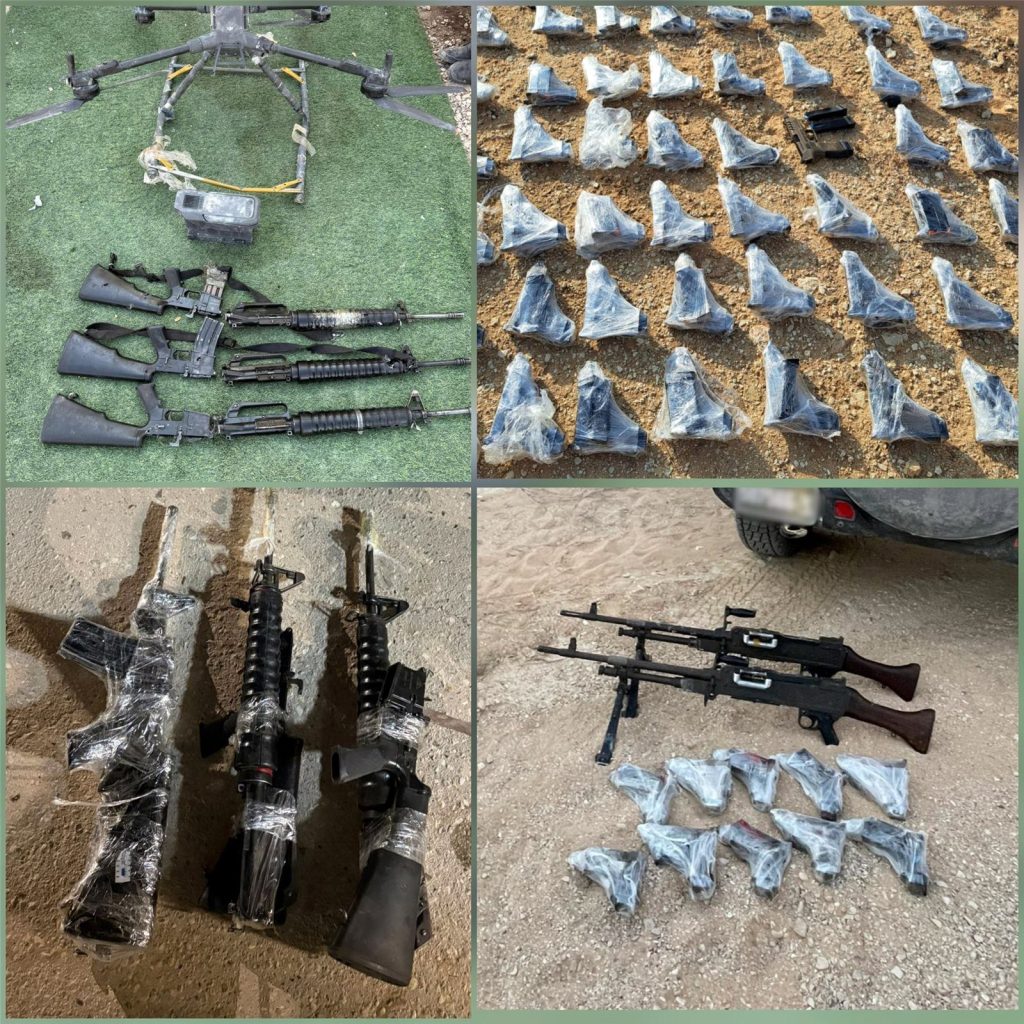
During a joint operation by the Magen Unit and the Southern District conducted a short time ago, several Israeli civilians were arrested near the border fence after being caught with a drone carrying three M-16 rifles. Their interrogation revealed an infrastructure involving dozens of smuggling operations across the country’s borders, including more than 100 weapons of various types that had been brought into Israeli territory.
The defense establishment acknowledges the fact that the smuggling of combat equipment across borders poses a genuine security risk, due to concern that the weapons will reach terrorist organizations.
Elchanan Groner is the founder of “HaKol HaYehudi” (The Jewish Voice), an independent media outlet that exposes phenomena along the borders and throughout Yesha. HaKol HaYehudi also has an investigative desk that exposes the alarming situation on the porous border.
“The Egyptian border has been a problematic border for many years,” says Groner in conversation with Beis Moshiach. “This started even before there was a fence there. Bedouin smugglers would cross the border with camels, each time for something different: sometimes it was dangerous materials, sometimes dangerous people, infiltrators from Africa seeking to reach our country, prohibited goods, and of course weapons as well. At some point the government made a decision and erected a barrier along the border at a cost of tens of billions of shekels. But even then, the border smugglers became more sophisticated and smuggled over or under the fence.
“During the ‘Swords of Iron’ war, the smuggling evolved in the direction of drones which is of an entirely different order of magnitude in terms of capability and frequency. This is an enormous danger to the residents of Israel, as terrorist elements smuggle weapons and combat equipment, and many other ‘surprises.’ At some point the IDF decided to deal with the matter but not seriously. They reduce the volume of smuggling here and there, but each time the smugglers find new smuggling solutions.”
What do you think needs to be done?
Until you deal with the root of the problem, there will be no solution. The problem is not the drones; the problem is the Bedouin. The Bedouin militias function as organized gangs, well-funded, sitting on billions as a result of the crime they operate. If the Israeli government does not decide to fight them this will continue.
What scale are we talking about?
This is a super-strategic event that is arming the Arabs throughout the entire land – first and foremost the Bedouin militias themselves, as well as the Arabs and terrorists in Yehuda and Shomron, and even in Arab communities within the Green Line. This is an enormous danger, but unfortunately the Israeli government has not yet decided to determinedly fight it. Here and there the Shin Bet has begun arresting some cells. But if we get excited about arresting a handful of criminals here and there, that only points to the magnitude of the absurdity of the situation. This is an enormous failure.
There is an enemy here, and it must be called by name. This is not a criminal incident but a nationalist one. A short time ago, within just 48 hours, a variety of weapons were successfully seized that had crossed the Egyptian border: 48 pistols with 2 magazines each, 5 M-16 rifles, 2 MAGs (a MAG is a super-problematic and even dramatic weapon), and 10 additional pistols, and that is only what was caught in those two days of enforcement. If the interdiction rate for smuggling stands at 10 percent, you can calculate for yourself how much firepower has arrived in recent years into the heart of Yehuda-Shomron, into the Bedouin squatter villages, or to other locations.
One of the regional security officers in the sector said: “To rob a convenience store or even a bank, you don’t need such weapons. It is obvious that this is not a criminal event but a terrorist one.”
Who is behind the smuggling?
There is an enemy here who is attending to this; much of it is Iranian forces who are infiltrating weapons into our land and storing them for a day of reckoning. If we do not wake up, what the Torah said would happen will happen …
Why in your view does the government choose to look away and not deal decisively with the existential threat of smuggling?
For decades they have ignored, denied, and shut their eyes to the real dangers that lurk for the Jewish people. It is the same question that was asked – and still without an answer – as to why they allowed Gaza, Hamas, and all the Arabs surrounding Israel to build up and arm themselves. Slowly a monster was created through a creeping buildup, and now they say: “Oh, there’s a monster, what do we do? Are we going to go to war now? Destroy all the Bedouin villages? Kill everyone?” They don’t know what to do.
There is a loss of identity here, and when there is a loss of identity you cannot say that there are Bedouin here, the large majority of whom have become an enemy – because that is ‘not politically correct.’ And so you ignore the problems that keep growing, until it becomes much harder to deal with them. And then, heaven forbid, when it blows up in our faces, as we saw in the massacre in the Gaza Envelope, you are left with no choice but to be dragged into difficult wars.
Returning to the buildup of the Egyptian army near the border in the Sinai Peninsula, the Prime Minister is the one who chooses to authorize Egypt to build up its strength…
I truly do not understand why he authorizes this. I think it stems from the same flawed approach, the same creeping erosion of vigilance, that the Egyptians ‘are actually among the good ones, and if we just let them enter the Sinai Peninsula, they will help us against Hamas.’ The Egyptians are slowly violating the agreements. And then what? Are we going to start a war with Egypt just because they brought in a few tanks? So we normalize the situation and authorize it retroactively. That is how this entire affair keeps developing.”
Beis Moshiach #1509 • pp. 24-32
© 2026 Beis Moshiach Magazine. All rights reserved.
This article originally appeared in Beis Moshiach #1509. You are welcome to share it with friends and family by email or in print, provided that you do not change, add to or omit any part of it, you credit the author and Beis Moshiach, and you include a link to archive.bmoshiach.org (written out in full in printed copies).
To republish this article in a newspaper, magazine, book or website, please request permission in advance at [email protected].