Booklet Number 20
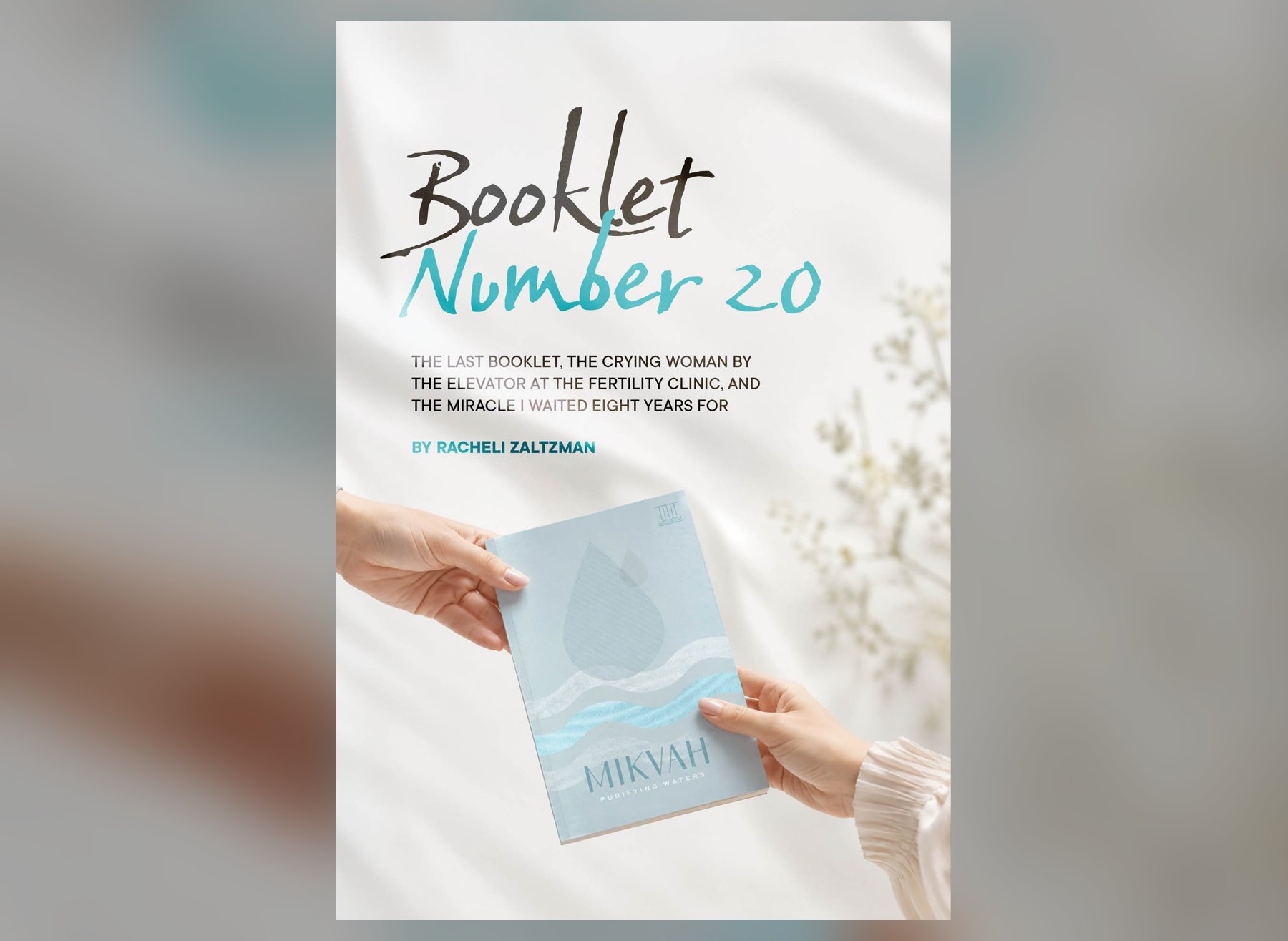
The last booklet, the crying woman by the elevator at the fertility clinic, and the miracle I waited eight years for
The house is quiet in a way I had forgotten houses could be quiet.
My baby boy is asleep in his crib. The nursing pillow is still on the chair where I left it. Outside, the world is doing whatever the world does. Inside, there is only the small, unreasonable sound of his breathing.
I sit down. And then, without warning, I cry.
Not the way I used to cry. Not the long, familiar crying of the eight waiting years. Something else. Something I haven’t learned the shape of yet.
The word forms slowly in my mouth, syllable by syllable, as if I am tasting it for the first time.
M-o-t-h-e-r.
Eight years.
I sit there a long time, putting the pieces back together—every spark, every sign, every small turning that brought me here. There were so many. I had not let myself count them.
The Farbrengen
It began, I think, with a farbrengen.
Every year, on Erev Pesach, the mashpiah Mrs. Shterna Alperovitz opens her home in honor of Yud-Aleph Nissan. Women come from across the country, despite the impossible timing. They sing. They take on a hachlata. They ask for a bracha. And the following year, they come back to tell what happened.
I had been coming for years.
The first time, I was single, and a friend pulled me along. I sat in the room and sang the niggunim and didn’t really understand what everyone was so moved by. Another farbrengen, nu, shoin. I went home and forgot about it. The next year I came again. And the year after that. I made resolutions—small, vague ones—and they evaporated the way such resolutions do, and nothing came of any of it.
Then, one year, a young woman stood up. A newly-wed kallah. She told us she had come to this same farbrengen year after year, made her hachlata year after year, and year after year had failed to keep it. And year after year, the bracha she needed—to find her bashert—had not come.
Until the year she kept it.
I understood, then, what I had been missing.
A bracha needs a keili. A vessel. The blessing is always being poured. The question is only whether there is something built to receive it.
After that, I never missed the farbrengen. I felt, in some unembarrassed corner of my heart, that being in that room mattered more than winning the lottery.
Last year, I took on three hachlatos. Two were for others—a refua shleima for a close friend, another for my father-in-law. The third was for my husband and me.
For a child.
By the year’s end, my friend was well. My shver was well. Two of the brachos had landed.
And we were still waiting.
The Twentieth Booklet
The hachlata I had taken on for myself looked simple enough, simple when written down. In reality, it turned out to be a wall.
I would bring twenty booklets on Taharas HaMishpacha to the fertility clinic and place them, one by one, in the hands of women I did not know.
At the first treatment, I brought ten.
I left with ten.
I sat in the waiting room with the booklets in my bag and could not move my hand toward them. I felt the way I imagine those first bachurim must have felt, standing on a corner in Manhattan sixty years ago, asking a stranger in a suit if he might consider putting on tefillin. Exposed. Foolish. Certain of being refused.
I gave them out slowly, one at a time, over many appointments. A woman would take a booklet without looking up. Another would thank me with a small, careful nod. A third would slip it into her bag the way you slip in something you are not sure you want. Each time, my heart pounded as if I had done something dangerous.
By the day of the last booklet, I had stopped expecting anything from any of them. The hachlata had become its own kind of waiting.
Number twenty.
I was leaving the clinic when the elevator doors opened in front of me, and a woman stepped out.
She was crying.
Not loudly. The kind of crying that has been going on for a while and has nowhere left to go. I had seen that face before. I had worn it.
I did not know what had just happened to her, on the other side of those clinic doors. I did not need to.
I walked toward her. The booklet was in my hand before I had decided to give it to her.
“Take it,” I said. My voice was very quiet. “It will help you.”
She took it.
She did not speak. She did not need to.
The elevator doors closed behind her, and I stood there in the corridor with my hands empty for the first time in months.
A few days later, the call came.
The treatment had worked.
I do not have a word for what I felt. I am not sure such a word exists in any language I speak. I thanked the Aibishter. I thanked the Rebbe Melech HaMoshiach. I called my parents and heard my own voice from far away, saying the sentence I had not been able to say for eight years.
For a long time afterward, I could not quite believe it was true.
Sticking With The Field Of Education
Eventually, I told the principal at the school where I worked, and she was extremely happy for me. I had been privileged to care for very young children and dedicate myself to their education. I loved my job, but during my pregnancy, it became really difficult for me to go to work. I would “collapse” into bed at an early hour, yet I was unable to get up in the morning. I would arrive for a short time, but then I would find myself “collapsing” again in the day care center’s playroom.
I felt uncomfortable. I was getting a salary, yet the output I gave at work was virtually nothing. I wrote to the Rebbe that I wanted to leave my job, but he replied in dozens of letters to remain in my shlichus work in the field of education, finding tasks requiring less physical exertion, etc., etc.
As a result, I stayed. I felt that the Rebbe was with me throughout the entire pregnancy, precisely because of my work in the field of education.
A Geula’dike Pregnancy And Birth
The pregnancy itself was kind to me.
The tests came back clean, one after another. The nausea came at night and left the mornings alone—a small mercy that meant I could keep showing up at work. There was no heartburn to speak of. Only a tiredness so deep it felt like another country I had to cross every day.
Most of the months were winter months, and I was spared the heavy heat of an Israeli summer. I fell once. Nothing happened. Malachim were walking beside me, I am sure of it, on either side and a little ahead.
For the birth, I had Devorie Doron, the most extraordinary doula. She had been with me through the long months, advising and explaining and steadying me each time I felt the date approaching like a wave. In the room itself, she made a kind of quiet that I had never known a room could hold. She massaged me for almost a whole day. She did everything in her power so that I could deliver my first child without an epidural.
And there was one last gift.
Besides the child himself—and what is there beside that?—I was given a birth in a brief lull in the war. No sirens. No fear. Only the long work of bringing him into the world, and then his cry, and then his weight in my arms.
* * *
So along with all my thanks—to the Aibishter, to the Rebbe, to my husband who carried me through every part of this, to every person who stood beside us—I want to say one thing to you, dear reader.
Start searching.
Search for the sparks scattered through your life. They are there. They are always there. They are easy to miss because the world is so loud with treadmills and pitfalls, and because they tend to look, at first, like nothing at all—like an ordinary farbrengen, like a small stack of booklets in a bag, like a stranger crying by an elevator.
But they are sparks.
And only you can find the ones meant for you.
And only by finding them can you bring Geula—to yourself, to those around you, and to the whole, waiting world.
Beis Moshiach #1510 • pp. 40-42, 43
© 2026 Beis Moshiach Magazine. All rights reserved.
This article originally appeared in Beis Moshiach #1510. You are welcome to share it with friends and family by email or in print, provided that you do not change, add to or omit any part of it, you credit the author and Beis Moshiach, and you include a link to archive.bmoshiach.org (written out in full in printed copies).
To republish this article in a newspaper, magazine, book or website, please request permission in advance at [email protected].