Tragedy On The Way Up To Meron
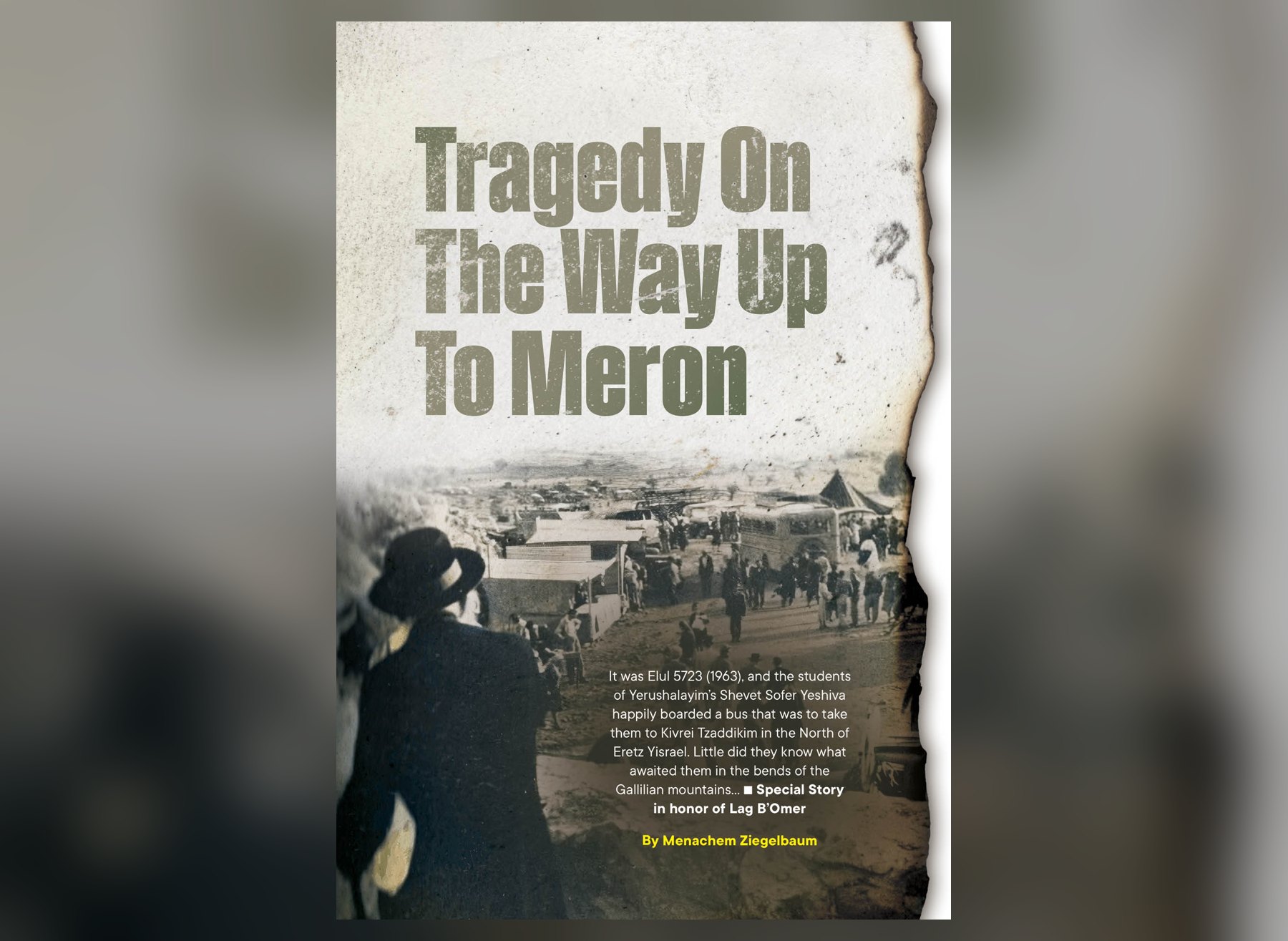
It was Elul 5723 (1963), and the students of Yerushalayim’s Shevet Sofer Yeshiva happily boarded a bus that was to take them to Kivrei Tzaddikim in the North of Eretz Yisrael. Little did they know what awaited them in the bends of the Galilean mountains… ■ Special Story in honor of Lag B’Omer
I
Elul 5723. After a successful summer zman in the yeshiva Shevet Sofer (a yeshiva in Yerushalayim which is named for the original yeshiva in Pressburg), the pleased roshei yeshiva decided to award the students with a two-day organized trip to the holy sites in the Galil. There, the talmidim would be able to pray at the graves of the Tannaim and Amoraim such as Rabi Shimon bar Yochai and his son, Rabi Elozor in Meron. Pouring out one’s heart before the Yomim Noraim is always a good thing.
Fifty bachurim from the yeshiva, along with staff members, boarded a tour bus. The atmosphere was good. A change of scenery, being outdoors, was good for them when they spent most of the year toiling over their studies.
After praying in Meron, the bus headed toward Teverya. According to their itinerary, the talmidim were going to pray at the gravesites of tzaddikim in that city and then have supper which had been ordered by the hanhala.
The bus driver, Chaim Barashi, drove along the winding roads of the Galil leading down to Teverya. When he felt more secure, he pressed on the gas pedal and on one of the sharp turns he lost control. In that terrifying moment, he veered from his lane and flipped over into the deep wadi on the edge of the road. The bus rolled over several times. Most of the bachurim flew out the windows and the roof, which had been crushed. The bus landed on its side.
At first, there was a chilling silence of shock. Then, terrible cries could be heard from the many injured. As time passed, the enormity of the tragedy came to light. Four precious souls had been lost. This was besides the dozens of those injured to various extents. The driver had fallen out of the front of the bus and had been crushed under the bus. Three yeshiva bachurim were killed: Yitzchok Neustadt, Avrohom Binyamin Friedman, and Mordechai Pollack.
Each of those bachurim was a gem, though Mordechai Pollack was the most outstanding. He excelled in all three “pillars.” He was so extremely diligent in his learning that his peers were astonished, his tefilla was exceptional, and he was masterful when it came to chessed and interpersonal relations. If that wasn’t enough, whatever he did was always discreet. He tried to hide what he did and only a few knew of his daily practice of writing his deeds in a little notebook as well as his failings for each day. At night, before going to sleep, he would read what he wrote, and thoroughly examined his actions to see whether corrections needed to be made. Mordechai Pollack was a model of an oveid Hashem. Not surprisingly, his tragic death plunged all who knew him into deep mourning.
Later on, it became known that Mordechai’s father, Rabbi Sholom Pollack, who taught in an elementary yeshiva in Petach Tikva, had been given a sign from heaven about the tragedy. He was teaching his students at the time of the accident and the hands on his watch stopped moving.
II
Mordechai had a good friend, Zev Levy. For various reasons, he had been unable to go on the trip and remained in yeshiva. When he heard the news he felt his heart break. Three of his good friends did not return alive from a trip that was meant to be uplifting and a preparation for the days of judgment.
He was particularly pained over the loss of his friend Mordechai. Although he believed that Hashem is just, he couldn’t quiet the question that bothered him: Why had there been such a terrible decree against three good bachurim?
III
A few weeks passed and one night, when Zev went to sleep, he had a frightening dream. His good friend Mordechai appeared to him with a glowing face. “My friend Zev, I saw your great sorrow and came to still your suffering.”
Mordechai looked happy. “Don’t be upset about what happened to us. The tragedy only appears thus to your eyes, as you live in Olam Hazeh, but for us, it looks altogether different. I am happy. You should know that as soon as I rose to heaven, they brought me into Gan Eden and opened the gates of the chamber of the Tanna, Rabi Shimon bar Yochai who immediately had me join his heavenly academy, since we merited to sacrifice our lives for the good of Am Yisrael on a trip to pray at his holy grave.
“Do you remember Zev, that every erev Shabbos I would learn the parsha ‘shnayim mikra v’echad targum’ along with Rashi? Do you know what my reward is for that? I get to learn together with Rashi too, and bask in his presence. Don’t I have it good? So why cry and sigh over my lot?”
Zev quickly recovered from the unusual visitation and said to his friend in the world of truth, “I have two questions for you. One, how did you enter Gan Eden before being judged by the heavenly court? Second, why was a terrible, unusual death decreed for you and your friends and in your youth?”
Mordechai replied, “A year ago, during Elul 5722, a decree was made against the entire Jewish settlement in Eretz Yisrael because of sins that tipped the scale. However, G-d had mercy and decided to atone for this with a communal offering of four pure souls, including three yeshiva students. We four were a korban for all of you. Now, you will also understand how despite the bus turning over and over, no more were killed so that the police chief who came to the scene asked in amazement, ‘Who rescued you? Only four were killed from this total wreck?’ Indeed, yes. The decree was only on four.
“Not only that but with those who were injured, every scratch, every broken tooth and deep cut, was calculated; all the more so for those seriously and moderately injured. For each one there is a precise reason as to why it happened. It’s all calculated by Hashem.
“Now you will understand why we didn’t first get judged in the heavenly court. A ‘korban olah’ goes directly to Gan Eden and doesn’t need to stand before the heavenly court.”
Mordechai had finished what he had to say and in a flash of light quickly disappeared.
Zev woke up in a fright. For days, he walked about in a tizzy with the glowing image of his friend constantly before him. As is human nature, time had an effect and he began to doubt whether it was a true dream or it was just because this is what he had been thinking about. The doubt plagued him and greatly disturbed his peace of mind. Without telling anyone, he decided to ask Mordechai to come to him a second time and give him a sign that would indicate that the dream was real.
To make such a request, he knew that he had to prepare himself properly. He began to undertake ascetic practices, he immersed in the mikva, fasted a lot and prayed with many tears, pleading that Hashem be so kind as to send his friend, Mordechai, to let him know whether the dream had been true or a product of his thoughts.
Mordechai did not appear. Not the first night and not the following nights. A long time passed and he despaired of realizing his hope. However, since he had acclimated himself to practices of holiness and asceticism, and he continued to diligently pursue lofty conduct, he experienced great spiritual growth.
Eighteen months passed before Mordechai appeared for a second time.
“In heaven, they were watching you and closely following all of your conduct, every practice of holiness and purity, and now you are deserving of hearing an answer to your questions. This is why I was sent to you again.
“You were unsure whether the dream was real or a product of your imagination. You should know with absolute certainty that the dream was real. Here are two signs that will remove any doubt from your heart. The first sign is that in seven weeks from today, you will become engaged. Your kalla’s name is Devorah bas Shimon. The second sign is that three weeks after the engagement, your fiancee’s uncle will suddenly appear. He had disappeared during the Holocaust and was thought to be dead.”
Zev woke up and remembering the dream he felt a calm. He wrote down the signs and wondered whether they would come true.
IV
A few days later, his parents began to discuss marriage proposals with him. They had a suggestion of a girl for him, from Argentina. Her name: Devorah bas Shimon.
The shidduch got off to a slow start and only after a while, seven weeks to be precise, was the engagement celebrated.
At the end of the vort, he went over to the kalla’s father and asked him, “Excuse me, I have a question. Do you have a brother who disappeared during the Holocaust?”

His future father-in-law, surprised by the question, said, “Yes! How do you know?” And without waiting for an answer he said, “My dear brother was sent to a labor camp and we have no information about him since then. There is no testimony about what happened to him. It seems he perished among the six million.”
The young chassan looked right and left and then spoke quietly to the man. “Your brother is alive and will make an appearance soon.”
The kalla’s father looked at the new chassan in astonishment. How odd. His future son-in-law was predicting the future; was he normal?
Three weeks later, a telegram came to the yeshiva. The father-in-law wrote to the chassan, “You were right! My brother suddenly came to Eretz Yisrael. He had fled to Russia where he was sent to labor camps. He just got his exit visa and came here immediately and found us.”
Now Zev knew for sure that the regards he got from above was authentic. The four who were killed were communal offerings. He also learned how valuable it is to study the parsha weekly, especially with Rashi.
(based on the weekly Ah Gedank which is based on what is told in He’emanti V’Adabeira)
Beis Moshiach #1410 • pp. 26-29
© 2026 Beis Moshiach Magazine. All rights reserved.
This article originally appeared in Beis Moshiach #1410. You are welcome to share it with friends and family by email or in print, provided that you do not change, add to or omit any part of it, you credit the author and Beis Moshiach, and you include a link to archive.bmoshiach.org (written out in full in printed copies).
To republish this article in a newspaper, magazine, book or website, please request permission in advance at [email protected].