Advice For My Soul: A New Book Presents The Rebbe’s Teachings On Psychology
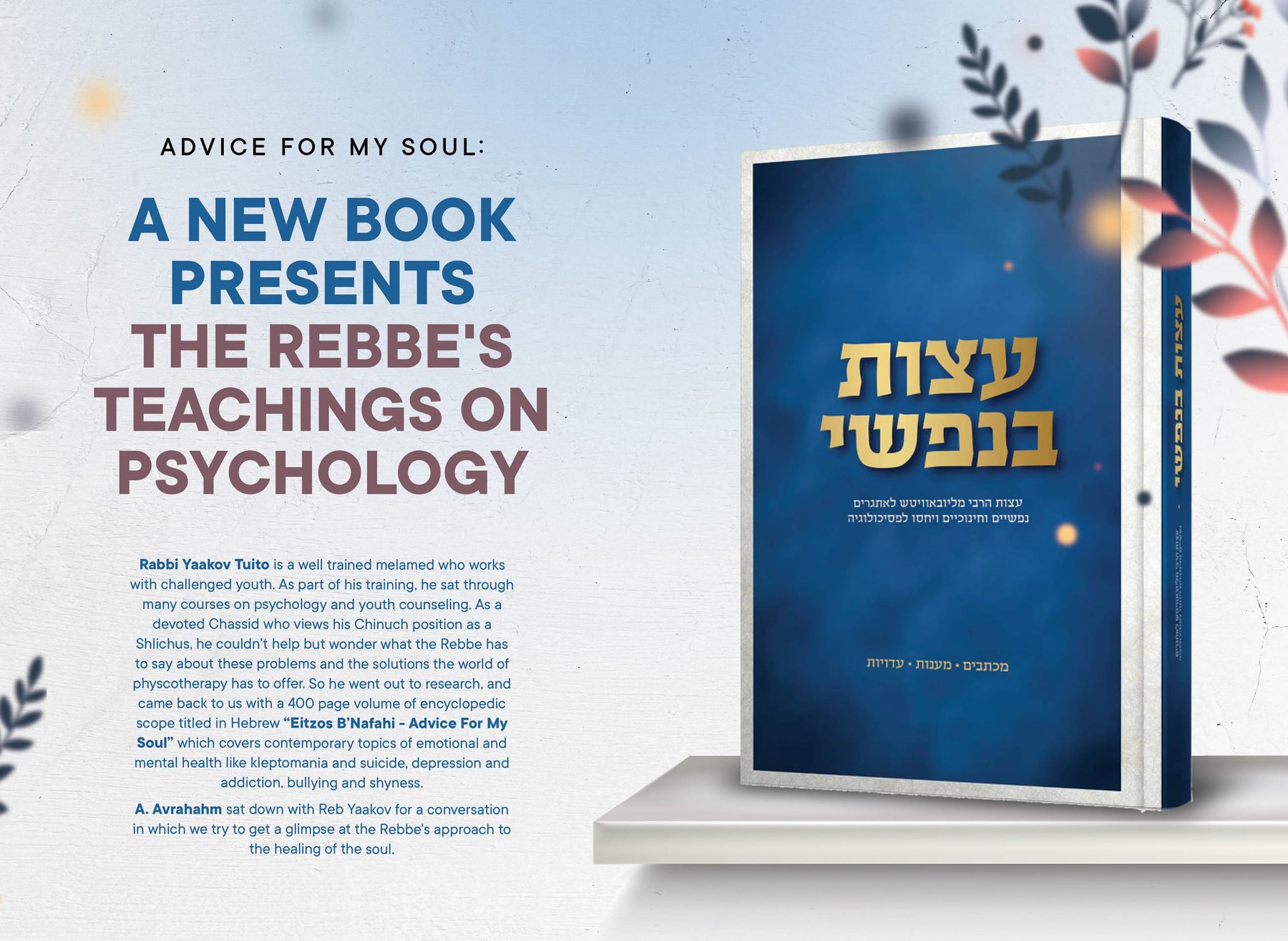
Rabbi Yaakov Tuito is a well trained melamed who works with challenged youth. As part of his training, he sat through many courses on psychology and youth counseling. As a devoted Chassid who views his Chinuch position as a Shlichus, he couldn’t help but wonder what the Rebbe has to say about these problems and the solutions the world of psychotherapy has to offer. So he went out to research, and came back to us with a 400 page volume of encyclopedic scope titled in Hebrew “Eitzos B’Nafshi – Advice For My Soul” which covers contemporary topics of emotional and mental health like kleptomania and suicide, depression and addiction, bullying and shyness. A. Avraham sat down with Reb Yaakov for a conversation in which we try to get a glimpse at the Rebbe’s approach to the healing of the soul
There’s a story about a Chassidishe yungerman who decided to throw himself into shlichus in the form of chinuch; not as a last choice job of working as a teacher but seeing chinuch as shlichus, a mission. He passed his teacher training and went on to earn a masters in educational counseling while he began working as a rebbi in a yeshiva that works to integrate students back into the mainstream.
Until now, this sounds familiar, but this young man had seen how many psychology courses there were back when he was first training, and he noticed, as every teacher, maggid shiur, or mashpia does, that every mainstream mosad today, from elementary school up to yeshiva gedola, is dealing with a slew of problems and educational and emotional challenges that they never had before.
He began to wonder, what does the Rebbe have to say about this? Can we find in his writings detailed responses to the changes in the subject of emotional health, the new problems and new treatments?
No lecturer, Lubavitch or otherwise, and no course, had presented him with an organized body of teachings. Nor did he find an organized collection of these materials in published books. And so, he decided to do the work himself. For years, he went through an unbelievable amount of material, the Rebbe’s own sefarim, books about the Rebbe, interviews, yechiduyos, stories and maanos, and he published a 400-page anthology which amazed everyone in the field.
All the suffering and afflictions of the psyche of our generation are addressed and have a solution in the teachings of the Rebbe which are now collected in Eitzos b’Nafshi which is a veritable “Shulchan Aruch” on matters of emotional health, for both those doing the treating and those being treated. Kleptomania and suicide, depression and addiction, bullying and shyness. It’s a book that consists entirely of the Rebbe’s own words; not theories based on what he said.
Full disclosure: This young man, R’ Yaakov Tuito, is a good friend of mine. When we saw that I can’t write about him objectively, we decided to sit down and talk.
My first question is, why are there so many emotional problems in this generation?
A theme running through the book is the Rebbe’s view that only a life lived according to Torah and mitzvos can be a happy, good life. The general climate used to be more conservative, and within the Jewish world people were still protective of the family unit and uncontested moral principles, but lately, especially in recent decades, the world has made an extreme transition to a culture which promotes freedom from “the bonds of religion” and the right of the individual to do nearly anything he pleases while breaking every convention and tradition.
The first to suffer from this were goyim, of course (who dropped the moral principles which the Torah gave them in the framework of the Seven Noahide Laws). Then, irreligious Jews followed, and slowly, this has had an impact within religious groups too. This is connected with other changes the world is going through like superficiality and shallow thinking which is an outgrowth of media in general and social media in particular. This has allowed in all the internal conflicts and complexes, which sometimes remain on the level of anxieties and instability and sometimes gets worse than that in the form of mental illness or total licentiousness which is no less bad.
The Rebbe explains that when there is harmony between man’s behavior and his inner essence, he has peace of mind. When there is a gap between them, the bigger the gap the more confusion and lack of serenity there is.
A Jew’s conduct according to Shulchan Aruch creates harmony, and allows his soul to express itself in a healthy way. So too, with Bnei Noach; extreme wantonness engenders a lack of inner peace and from there it’s a short path to all the ills of the psyche.
Here comes what might be the most important principle in the Rebbe’s treatment of this subject: In other matters, such as other health problems or problems with parnassa, an increase in Torah and mitzvos serves as a “vessel” for blessing or as a segula. When it comes to emotional health, Torah and mitzvos are the direct cure for the psyche, because the innermost essence of a person is living a life according to Torah. Due to the importance of this idea, this is elaborated on in the first part of the book, a sort of introduction even before the first chapter; you’ll then see this concept repeating itself throughout the book.
Until now, we’ve spoken about the spiritual aspect; there is good news about the tangible material aspect too. We have more problems today and there also exist many more solutions and treatment options than there ever were before.
What happens when a problem arises. Is the answer “Permission is given to a doctor to heal” just as we say in other areas of health?
You left out the ending which the Rebbe also added, “Permission is given to a doctor (only) to heal” but not to cause despair. This rule is definitely in force here too. However, according to the answers in the book there is a fundamental difference between physical health and emotional health. When it comes to emotional health, permission is not granted to every doctor to heal! There’s an entire chapter (the seventh) about choosing a therapist and dealing with treatment which affects Torah.
The first rule of thumb is that the doctor must be a believer in G-d. Second, it has to be a therapist who can differentiate between treatments which are permissible according to Shulchan Aruch and those that aren’t. That means, as far as I understand it, that the therapist must be religious. There is also an answer from the Rebbe in which he sends someone to a psychologist and suggests speaking to someone who “knows the mentality of yeshiva yungeleit and those who received a Chassidishe chinuch.”
[There’s an answer which is an exception, in which someone who was studying psychology had to undergo therapy himself for the course. The Rebbe told him he didn’t need to do this with a Jew; it could even be a goy, providing that he believed in G-d. It seems this answer was given to someone outside of Eretz Yisrael and to someone who didn’t personally need the therapy.]
The third rule is, the involvement of a rav moreh horaah as an inseparable part of the consultation process with the doctor and ongoing involvement with the doctor or treatment team. What the Rebbe says leaves no room for doubt, “My opinion is (as I already had occasion to state) that in any therapy for a Jewish family there needs to be an ordained rabbi, whether as a regular member of the team or as a regular consultant whose view must be accepted before a decision is made.”
You use the word “therapist” but today, a differentiation is made between a doctor, i.e. psychiatrist, and therapist, psychologist. Does “doctor” refer only to an MD – psychiatrist, or also to a psychologist and therapist?
In order to better understand the question, we should demonstrate this from physical healing. When a person has a problem with his limbs and bones, he goes to an orthopedist, who can send him for therapy to a physiotherapist. The first difference between them is that the orthopedist can prescribe medicine and do surgery. The physiotherapist mainly works with exercises and lifestyle.
When it comes to mental health, the parallel is the psychiatrist who can prescribe medication, and the therapist or psychologist who help through talk and “massage” of the consciousness of the patient. What is dissimilar is that only the orthopedist can diagnose, and the physiotherapist can only help and make recommendations based on his observations of the problem of the client, while the psychologist can also diagnose.
As to your question, whether a psychologist/therapist is considered a doctor according to halacha, the answer is, “Every person who is trained (and who has official license) to provide healing for people has the status of a doctor in his field of expertise.” From the wording of the response, it would seem that this training and authorization are under the supervision and recognition of the government. By the way, in that same letter, the Rebbe notes that the science of psychological healing is measured today just like that of the healing of the body, in the same way that an eye and ear doctor become expert in their field. This might be another proof that this is not talking about anyone who is called a therapist but someone who goes through training in schools that are recognized and is certified to become a psychologist, therapist, etc.
Since nowadays there is an explosion of training programs that are putting out thousands of people who work in this field, the one who can determine the standard in each case is a rav moreh horaah.
Some people are afraid to go for psychological help, especially to a psychiatrist who might use medication.
Are you being serious or are you joking? Time after time, we see how the Rebbe says to follow the instructions of the doctor and often the Rebbe says “medication” explicitly, or “pills.” And this is regarding problems that are considered relatively minor like problems with sleep (“Surely the doctor will prescribe some pills or the like”), and more acute problems like anxiety (“Be in regular touch with experts in this field to prod them and ask them occasionally about forms of treatment and medication that are often being discovered and the like.”)
A person who seriously hurts his little toe won’t refrain from going to the doctor, but when it comes to the head there are people who are willing to make themselves and those around them miserable so long as they don’t swallow a pill. This itself is a problem that needs to be treated.
Let’s get back to the classroom and family. A student causes problems. How do we know whether to go to the therapist/doctor/whatever you want to call it?
The Rebbe sees proper chinuch as the all-inclusive component – this is the way to prevent problems and also to identify them when they come up. If there’s a problem, the mechanech needs to get the treatment plan moving. Sometimes, the school can provide the treatment (like for most social problems) or the needed adjustments, and sometimes it has to go up a level.
On a number of occasions, the Rebbe says to first consult with anshei chinuch. They can determine whether it’s an educational problem or something that needs treatment.
As someone who went through so many answers of the Rebbe, can you translate for us the pasuk that says, “one who withholds his stick hates his child?”
The Rebbe addresses this in regards to one of the problems, where the Rebbe translates this as “strong chinuch.” You can see the exact context in the book (p. 176) but what’s important for our discussion is the expression the Rebbe uses again and again, “strong chinuch” which, according to the Rebbe, can even change acquired traits and inborn traits. The term “chazak” does not only refer to forceful but primarily to the stability, firmness and consistency of the mechanech for the values he wants to instill in the student.
In that sicha, the Rebbe explains that chinuch is not only meant to fix weaknesses but to bolster strengths, as he puts it, “People are born with mixed natures and there always needs to be intervention by the mechanchim in order to balance it.” In other words, positive ambitions in children require development, guidance and acculturation. We cannot rely on the child handling it on his own; we need to “train” him the right way so that the untrained part won’t control him. On the other hand, in the event that negative traits are identified, they can be changed and this is the “responsibility of the parent and mechanech who love the child and want what’s best for him” (and this too can be put under the category of “strong chinuch,” chinuch which comes from someone who strongly loves the child). If the chinuch focuses only on one side of the equation, it’s very possible that it can be called “weak chinuch.” In general, this is a fundamental sicha about chinuch for every parent and teacher .
Is there a fundamental difference between the Rebbe and other poskim when it comes to psychotherapy?
Yes! First of all, the Rebbe didn’t just answer questions on these topics but turned to and encouraged experts in the field, was in touch with them, pointed out the approaches that are more recommended and those that are less so, or even not at all. The entire fifth chapter of the book deals with this. Over the years, the Rebbe corresponded with psychologists and therapists, sometimes extensively, and even referred people to specific therapists.
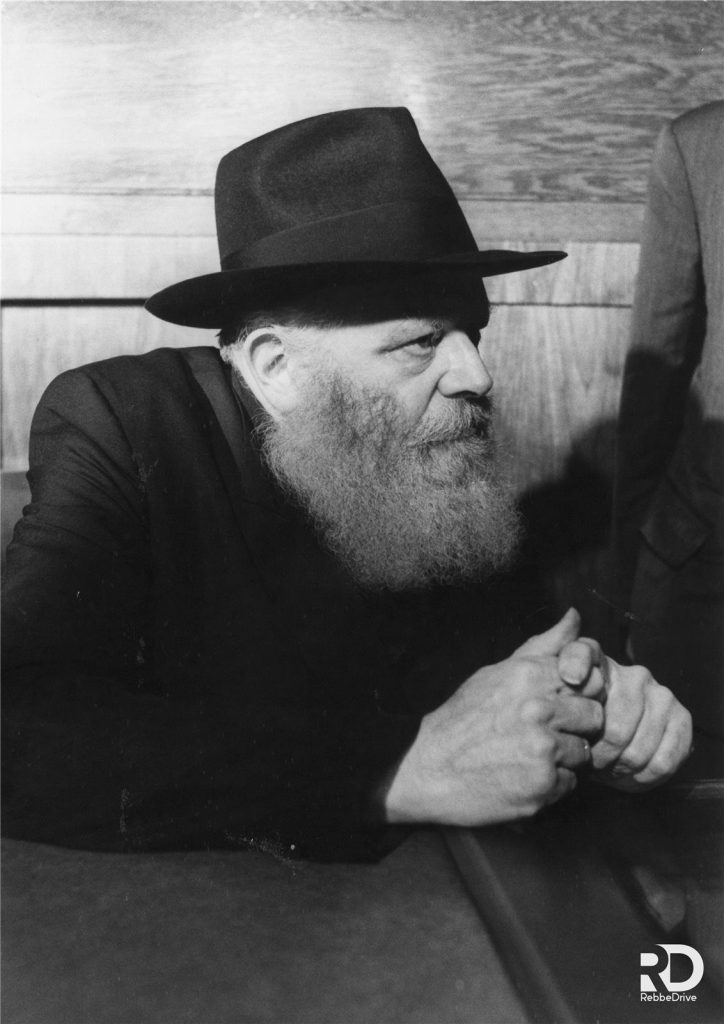
For example, the Rebbe rejected Freud’s approach. Freud considered religion as something limiting and a hindrance to mental health. For this reason, the Rebbe asked Rabbi Dov Lent to find non-Freudian psychologists and psychiatrists and compile a list of those who wouldn’t tell clients to drop Torah and mitzvos.
The Rebbe was in favor of the approach of the famous psychiatrist Viktor Frankl who said man’s search for meaning is his central motivating force. The Rebbe personally encouraged him and and encouraged others to look into this approach.
When it came to meditation, a popular trend in the seventies, the Rebbe tried to convince professionals to separate between the medical basis of the approach from the idol worshiping elements attached to it by the Eastern cults and provide “kosher” meditation. Again, the Rebbe said there needed to be someone with halachic expertise to determine what is and isn’t kosher.
I’m not talking about all sorts of extreme approaches that completely reject psychological treatment such as a certain American rosh yeshiva who said that psychological treatment is in the category of “be killed and don’t transgress.” For nearly every sort of treatment, whether the type that some forbade and those that rabbanim were afraid to deal with, the Rebbe provided a clear answer. Sometimes, the Rebbe explicitly pointed out the various prohibitions included in these treatments and how to address them.
To summarize, it’s important to mention what was said before. When it comes to actual practice, there are rules regarding the persona of the therapist and most important: always ask a rav moreh horaah. Even a therapist who uses Frankl’s approach, for example, can theoretically put nonsense into the client’s head like he can find meaning in life that doesn’t require religion, G-d forbid.
I myself have seen cases where therapists gave clients heretical ideas, no less, and tried to convince them to “forgo” certain mitzvos. So besides for the general guidelines of the good and not-good approaches, there needs to be the constant oversight of a rav in approaching a health care provider and the course of treatment itself.
You mentioned meditation before. What the Rebbe wanted from a religious perspective, came about from the opposite direction when western therapists adopted the therapeutic elements without the extras. With yoga too, most of those who use it in the west focus primarily on the physical exercises and mental focus without connecting it to specific messages, so maybe the problem was resolved?
What you say sounds reasonable and may be aligned with the reality in some instances. The only problem is that in order to establish that as fact, one must ask a rav moreh horaah. Let’s say it’s as you said, does every meditation and yoga center observe tznius? You can’t be sure that the instructor didn’t travel to some ashram in the east to train and brought back ideas with him. Maybe you’ll tell me about some problem and that a rav moreh horaah determined that the only way to heal it is with meditation or yoga? I would suggest holding back on the excitement. It is possible that in certain fields there have been changes and Jews are transgressing idol worship less. That doesn’t automatically make it kosher l’mehadrin or generally recommended, based on flimsy suppositions.
Let’s end with what we began. The Rebbe says that a guarantee to avoid mental illness is a life harmonious with Torah and mitzvos?
That is generally true but the super-vitamin for a calm life is emuna and bitachon in Hashem, knowing that everything is by divine providence and that Hashem is in every detail of a Jew’s life. Again, this is a message which repeats itself in nearly every letter but we devoted a separate appendix to the book for this basic principle.
This idea is particularly important these days, as the Rebbe said, “Just as in the Geula from Egypt it says that in the merit of bitachon the Jewish people were redeemed from Egypt, so too with the Geula from this final galus… and may it be so for us, that in the merit of the bitachon of the Jewish people that ‘My salvation is close to coming,’ Hashem redeeming us with the true and complete Geula speedily in our days.”
Beis Moshiach #1411 • pp. 16-23
© 2026 Beis Moshiach Magazine. All rights reserved.
This article originally appeared in Beis Moshiach #1411. You are welcome to share it with friends and family by email or in print, provided that you do not change, add to or omit any part of it, you credit the author and Beis Moshiach, and you include a link to archive.bmoshiach.org (written out in full in printed copies).
To republish this article in a newspaper, magazine, book or website, please request permission in advance at [email protected].