His Name Is Koppel Bacher
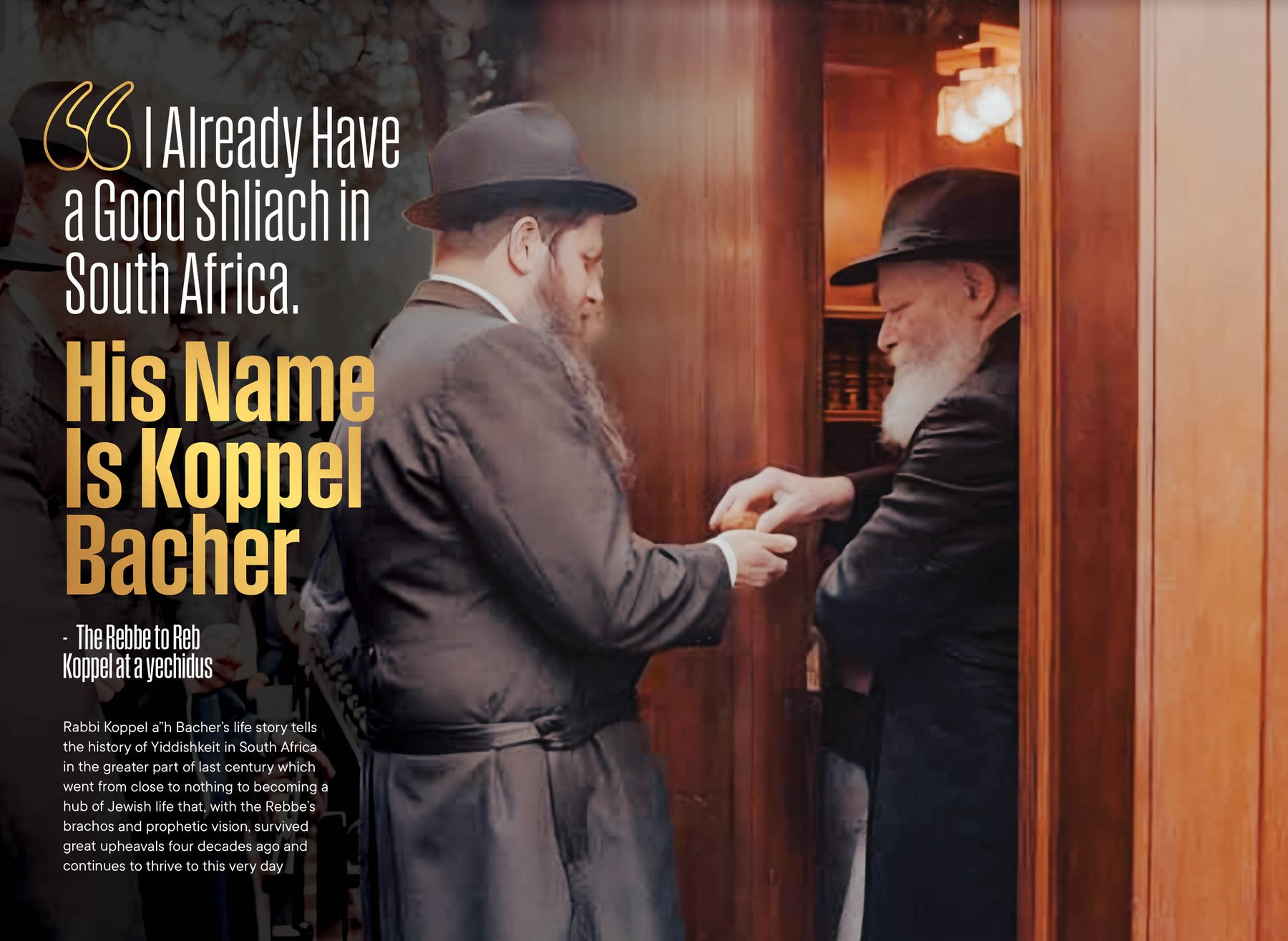
The Rebbe to Reb Koppel at a yechidus
Rabbi Koppel a”h Bacher’s life story tells the history of Yiddishkeit in South Africa in the greater part of last century which went from close to nothing to becoming a hub of Jewish life that, with the Rebbe’s brachos and prophetic vision, survived great upheavals four decades ago and continues to thrive to this very day
Simchas Torah 5744 (1983). As every year, R’ Koppel Bacher was in the big shul of 770, caught up in the tremendous Chassidic excitement alongside the Rebbe and other Chassidim. But this time, something was different. Throughout the hakafos, R’ Koppel sensed the Rebbe’s eyes upon him again and again. The Rebbe’s gazing at him was so lengthy and meaningful that one of the Chassidim, R’ Berel Weiss, couldn’t help but notice. “Koppel, if the Rebbe is looking at you like that, it’s a sure thing that it’s worthwhile doing business with you.”
But R’ Koppel himself was at a complete loss. He stood there, disconcerted by the Rebbe’s gaze and with his heart pounding. Why was the Rebbe staring at him repeatedly? He could not come up with a reason. He just continued to dance and rejoice while he fruitlessly tried to figure out the mystery. Deep in his consciousness there was the clear sense that something momentous was about to happen.
Indeed, as soon as Yom Tov was over, the terrible blow landed upon him. The country had undergone an economic collapse. The value of the rand plummeted sharply, customers vanished, and the debts swelled. The companies he owned had collapsed, one after the other, the bank seized his assets and he was left with nothing, sunk in a sea of huge debts. That is when R’ Koppel understood the meaning behind the Rebbe’s piercing glances. As always, the Rebbe anticipated what would happen.
R’ Koppel asked the Rebbe what he should do. Surprisingly, the Rebbe’s answer was murky. “You are not the only one. There are many others in South Africa in your situation. Do what they’re doing.” R’ Koppel had no idea what this meant but what happened in the weeks to come is hard to describe in words.
Suddenly, in an unexpected ways, R’ Koppel’s mazal began to turn around. Money that he had borrowed was returned, the bank waived most of his debts, an old customer who owed him a favor paid him back many times over. After only a short time, R’ Koppel rose from the financial crash debt-free and even quite wealthy. He had no doubt that the one behind these open miracles was the Rebbe himself, whose piercing gaze during hakafos had prepared the great salvation. Thus, shortly after everything seemed lost, the Rebbe picked R’ Koppel up even higher and restored him to his prior greatness and even higher than that.
The Light of One Jew in the African Darkness
Behind the life story of every Jew there is always wondrous divine providence, which sometimes is more openly revealed and clear. This is the unusual story of R’ Avrohom Koppel Bacher a’h, a veteran Chabad Chassid in South Africa who passed away on 23 Adar II a few months ago, at the age of 83.
For most of South African Jewry, the very existence of a strong Judaism in South Africa was considered nearly impossible. The country is at the tip of Africa, disconnected and far from other Jewish strongholds. At its peak, there were 120,000 Jews among a population of tens of millions, most of the latter, black. The spiritual and cultural atmosphere was frivolous and western, and the attitudes of openness and modernity characterized most of the Jewish community, especially the youth.
Under these circumstances, a Jew such as R’ Koppel Bacher, who had a full beard and traditional dress, was highly unusual. Even an ultra-Orthodox rabbi who came from America joked with his colleagues that within two months, R’ Koppel, would “break” and would shave his beard as a result of speedy assimilation.
In addition, the violent political battle against the white government was a constant threat to the future of the Jewish community. Many feared that when the blacks would come into power they would take revenge on the Jews who were seen as a powerful force of economic and political power. Feelings of despair and fear pervaded the community. Many hastily left the country.
Against this backdrop, the outstanding persona of R’ Koppel stood out. Not only did he proudly accept upon himself the yoke of Torah and mitzvos and the conduct of a Chabad Chassid, but with mesirus nefesh he spread Yiddishkeit among the Jews in the country and strengthened the community spiritually and materially. All his life he was totally devoted to the Rebbe and received direction and guidance from the Rebbe for every step he took.
The results were astonishing by every measure, whether these were the personal miracles he experienced when his life was saved again and again, his and his family’s meteoric spiritual rise, his enormous influence on his surroundings, and of course, the powerful revolution that brought the Chabad movement to the entire country thanks to him and the work of the Rebbe’s shluchim.
R’ Koppel’s life story serves as wondrous chapter in the history of the Jews of South Africa and in the development of Chabad in this country in particular. His whole being personified endless devotion to spread the light of Yiddishkeit and Chassidus among South African Jews, along with a deep, exceptional connection to the Chabad Rebbeim, particularly to the Rebbe. A living testimony to the power of a Jew to rise above all limitations if he but devotes himself without limit to the will of the Rebbe.
The Special Blessing of the Rebbe Rayatz
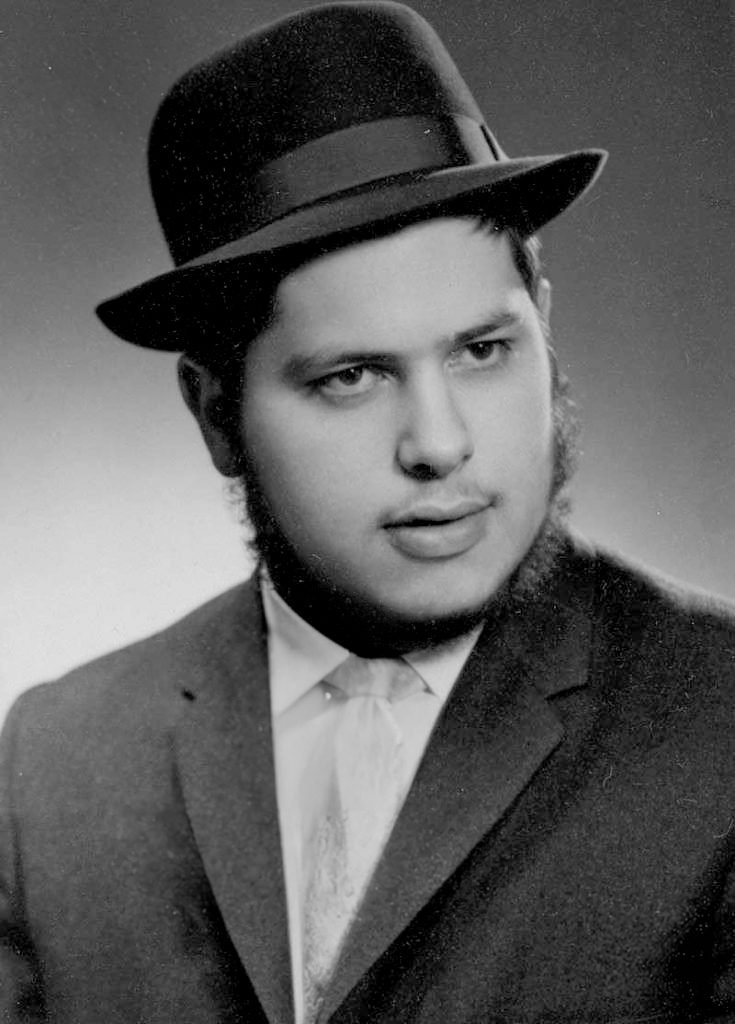
R’ Koppel was born in 5701 to a family that came from the Chassidic town of Rakeshik (Rokiskis) in Lithuania. His father, R’ Chaim Shaul Zev, was a successful businessman, shomer Shabbos, who went to South Africa in 5682. A few years later, he married R’ Koppel’s mother, also from Lithuania.
The family’s connection to Chabad began in 5705 with the visit of Chabad shliach and shadar, Rabbi Yosef Wineberg. R’ Yosef forged a relationship with R’ Koppel’s father who, from that point on, asked for the Rebbe Rayatz’s advice in all his business matters and saw outstanding success in his parnassa. R’ Wineberg would go to South Africa once a year and was always hosted by the family.
A significant milestone took place in 5706, when the city wanted to buy R’ Chaim Shaul Zev’s estate in order to build homes for black residents. Although the amount they offered was very high, R’ Chaim Shaul Zev obeyed the Rebbe Rayatz’s instruction not to sell. Two years later, when the Rebbe gave his consent, he sold the estate for the astronomical sum of fifty thousand pounds sterling, way more than what he would have gotten earlier.
Thus was formed a deep soul bond between the Rebbe Rayatz and R’ Chaim Shaul Zev that lasted until Yud Shevat 5710. The last letter that the Rebbe Rayatz wrote to him was sent ten days before the Rebbe’s passing, on 29 Teves. At the end of the letter, the Rebbe Rayatz wrote (in his handwriting) “blessing you with all good to succeed materially and spiritually.”
When R’ Koppel was already older he found out the astonishing information that his father donated toward the building of the Rebbe Rayatz’s ohel, something that the Rebbe told him to keep a secret. His father revealed this to him before he died and showed him the Rebbe’s letter about this.
Bar Mitzva – First Step on a Long Journey
One of the most significant chapters in R’ Koppel’s life was his bar mitzva. He received a special letter from the Rebbe for the occasion, with a deep explanation about the true meaning of a bar mitzva for a Jewish boy. The Rebbe emphasized that a bar mitzva represents a boy changing into a member with full rights in the Jewish nation. At the same time, he is now required to take on all the obligations and privileges of an adult Jewish male. Therefore, in a case when the bar mitzva does not fall out on Shabbos or Yom Tov, he can do melacha and say Tachanun [i.e. it’s a regular day for him].
The message is that this event demands the utmost serious commitment and ongoing effort to become an integral and active part of the Jewish people, according to the demands and guidelines of the Torah. It’s possible that, at first, a boy will make mistakes without realizing it, which is why Tachanun is said on this day, as vidui for errors, a request for forgiveness and a commitment not to repeat them.
Until he was bar mitzva, R’ Koppel’s life was completely absent of a Jewish atmosphere. He went to public school and only at high school age did he go to a Jewish school. Even there, it wasn’t much different. The Tanach teachers, for example, were communists who didn’t cover their heads when teaching.
Mashpia to the Rescue
The first thing that happened to move R’ Koppel toward Yiddishkeit happened seemingly by chance. At first, his father wanted to send him to a tough boarding school in England so he would be more disciplined. He was going to travel with someone who came from England and was going back there, but on the day of the trip, Tisha B’Av, the man suddenly died. Since Rabbi Wineberg was staying with the family at the time, the father asked him to take R’ Koppel to learn in yeshiva in New York. Although Rabbi Wineberg first opposed the idea due to the boy’s young age, he suggested that the father ask the Rebbe and the Rebbe told Rabbi Wineberg to take him.
It wasn’t at all easy for R’ Koppel at first. He didn’t relate to the material being taught and had a hard time adjusting, to the point that he was given a personal tutor to help him fill the gaps.
One night of Chanuka, young Koppel heard that the Rebbe was giving out Chanuka gelt to the students in 770. He decided to stand on line. When it was his turn, the Rebbe asked him, “Do you learn Chassidus?” Koppel froze. He didn’t know what to say. The truth is that the concept “Chassidus” was still foreign and unfamiliar to him. The confusion was apparent on his face and then, like an angel to the rescue, the mashpia, Rabbi Shmuel Levitin, quickly said to the Rebbe with a smile, “He will learn Chassidus, he will learn!” Hearing this, the Rebbe smiled and gave Koppel a dollar bill.
The Rebbe Looked After Him
Throughout that time, Koppel received kiruvim (special gestures of affection) from the Rebbe. As a young boy who didn’t understand much of the farbrengens, he sometimes left in the middle. Afterward, he heard from his friends that the Rebbe asked, “Where is Koppel Bacher?” The Rebbe gave him lekach several times and told him to say l’chaim for himself and his father.
In a letter that the Rebbe sent to his father, he wrote (in Yiddish), “I was happy to see your son here and to contemplate – obviously, without his noticing – how he participates in farbrengens and how he is acclimating and getting into the scheduled learning sessions of the yeshiva. I am confident in my hopes to G-d, that you and your wife will have real nachas from him which will be Yiddishe nachas.”
His good friend, Yitzchok Meir Gurary, decided to recommend Koppel for the yeshiva in Montreal, where he thought it would be better for him. Koppel asked the Rebbe about this and received the Rebbe’s encouragement, “It is very proper, providing he learns diligently and this depends on his will, because he can do it. I will mention him at the tziyun for success in all the above. Obviously, you first have to discuss it with the hanhala in Montreal.”
Montreal was a turning point in his spiritual journey and he began to turn into a Chassid. The mashpia, Reb Volf Greenglass once told the Rebbe that he felt, despite the many years he spent disseminating Torah, that he did not accomplish much in Montreal. The Rebbe immediately responded, “Is Koppel Bacher a small thing?!”
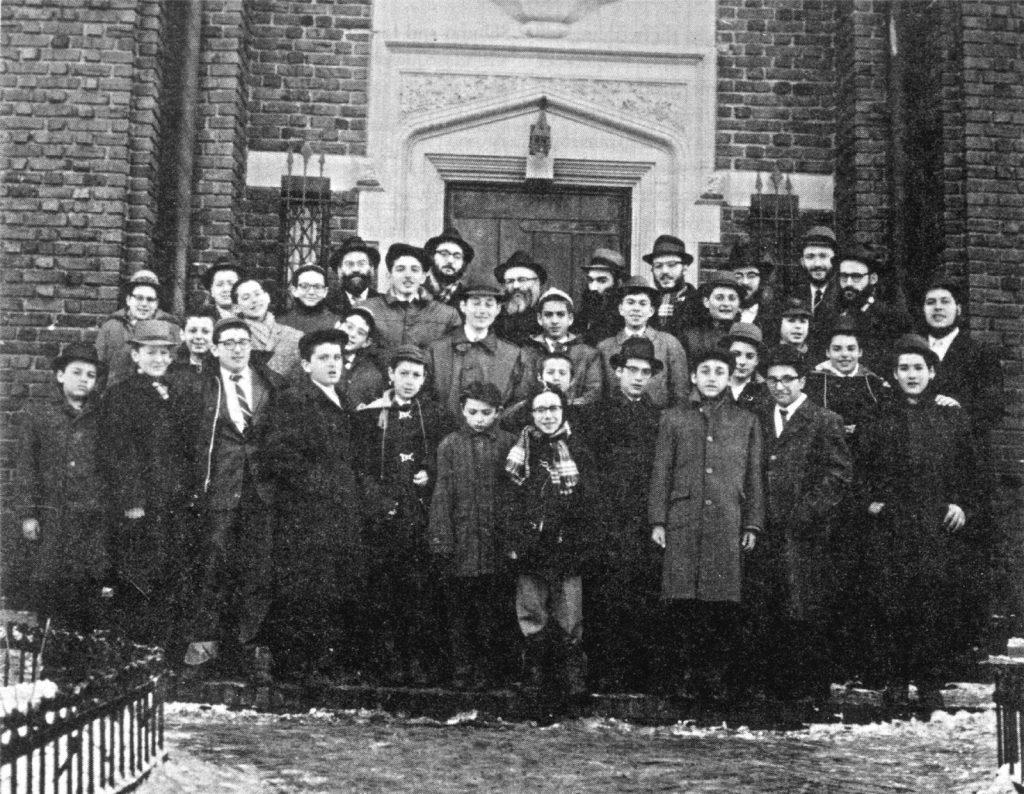
In 5719, a group of 25 boys from Montreal arranged a trip to the Rebbe for Yud Shevat. They had yechidus and the Rebbe said a sicha for them. R’ Koppel wasn’t present at the beginning of the yechidus and the Rebbe sent to call for him since he was responsible for the group. After that, for many years, a group of boys was organized to visit the Rebbe for Yud Shevat.
The Rebbe put a lot into the chinuch of R’ Koppel. For five years, the Rebbe did not allow him to go home, not even for significant family events. Apparently, this was to shield him from problematic influences in the environment he would have gone back to since, at that time, the atmosphere was very modern in South Africa.
One of the times he asked to visit his family, the Rebbe wrote to him in a letter that he heard from the hanhala that his learning is improving in diligence and any break would be a pity, and that his parents would surely prefer that he grow to be a real talmid chacham even at the expense of this temporary separation.
It was first in the summer of 5722, that R’ Koppel was allowed to return to South Africa, within the framework of Merkos Shlichus, together with Rabbi Shmuel Pesach Bogomilsky. The perspective had changed; he wasn’t going home to be influenced but to be the influencer. He was the only Jewish young man in the country with a full beard, something which drew a lot of attention.
The Story of His Shidduch
Another dramatic turn in R’ Koppel’s life occurred during his shidduch. It was 5724, when R’ Koppel was still a young bachur. On one of his frequent trips from the yeshiva in Montreal to the Rebbe, Rabbi Chodakov, the Rebbe’s secretary approached him with a shidduch idea.
R’ Koppel was hesitant. Just the month before he had received a similar suggestion but wasn’t particularly enthused about it and he didn’t rush to respond, but this time was different. R’ Chodakov told him to go over to the public phone, then and there, and call the shadchan to find out more about the shidduch. Having no choice, R’ Koppel did so. After a brief conversation, R’ Chodakov pushed him to meet with the girl as soon as possible.
With nervousness and a pounding heart, R’ Koppel went on a first date. Afterward, R’ Chodakov asked him for a detailed report. The same thing happened after the second and third date. After the fourth date, R’ Chodakov firmly told him, “It’s time to decide and to respond positively to the suggestion.”
R’ Koppel hesitated. He had been favorably impressed by the girl but still didn’t feel sure enough to commit.
R’ Chodakov surprised him with an unusual order. “Write a note to the Rebbe and ask for his approval and advice.”
This was right before the Yud-Tes Kislev farbrengen, and R’ Chodakov told him to submit the note before the farbrengen and to come right after the farbrengen to find out whether the Rebbe had responded.
Shortly after the farbrengen, R’ Chodakov came out of the Rebbe’s room and R’ Koppel’s heart began pounding.
“You received the Rebbe’s blessing for the success of the shidduch! But for now, you cannot publicize this because the girl herself still didn’t hear about it!”
When he called the girls’ house, he was told she was at class and would return close to Shabbos. After consulting with R’ Chodakov, the father contacted his daughter by phone and received her permission to convey her consent to the shidduch, but before publicizing the news, R’ Koppel had one final job – to inform his parents in South Africa and ask for their blessing.
Right after the emotional conversation with his parents, and right before Shabbos began, R’ Koppel could finally announce the news: Mazal Tov! The Rebbe gave his blessing and both sides agreed; the wedding was underway!
This was another clear manifestation of the Rebbe’s brachos that accompanied R’ Koppel every step he made.
‘in Johannesburg, I Have Koppel Bacher’
After he married, when R’ Koppel and his wife moved to South Africa, he undertook to be the Rebbe’s shliach there, at least until the arrival of an official shliach. For years, R’ Koppel begged the Rebbe to send a permanent shliach to South Africa. One of the times, the Rebbe told him he would send a shliach only when a rabbinic position became available.
R’ Koppel got up the courage to ask: The Rebbe sends shluchim all over the world without available rabbinic positions. Why in South Africa does the Rebbe make it conditional? But the Rebbe reiterated his position.
On another occasion, when he had yechidus and once again asked for a shliach, the Rebbe told him that he actually had a good shliach in South Africa. R’ Koppel was taken aback and asked who it was. The Rebbe said: In Johannesburg I have Koppel Bacher.
In the meantime, R’ Koppel continued with initiatives to strengthen and establish Yiddishkeit in South Africa. At his initiative, Rabbi Shmuel Lew of England came to visit for a month for the purpose of spreading light and Yiddishkeit among the Jews there. R’ Lew was extremely successful. He met and spoke with all the heads of the local communities and schools, strengthened the youth, and instilled a genuine chayus in the hearts of those far from mitzva observance.
The real turning point began with the arrival of the first shliach, Rabbi Menachem Mendel Lipskar, whom R’ Koppel had suggested as shliach when he was still a young bachur. This was made possible when a rabbinic position opened in “Der Chassidishe Shul,” the old and famous shul. R’ Koppel couldn’t imagine what an enormous impact R’ Lipskar would have on South Africa.
Today, it can be said that Chabad is the central, dominant player in South African Judaism. 80% of shuls in the country have Chabad rabbis. Dozens of shluchim operate all over the country. R’ Koppel declared, “There is no doubt that Lubavitch built Judaism in South Africa.” He emphasized that the majority of activists in Jewish organizations were those who got their first Jewish inspiration through Chabad and only afterward were “caught” by other organizations. Since then, with every new Jewish endeavor, the building of a mikva, starting a kehilla, etc. Chabad is the pioneer who paves the way.
I Missed You This Morning…
Over the years, R’ Koppel would visit the Rebbe at least once a year, for Simchas Torah. One year, the flight was delayed and he arrived at 770 on Hoshana Raba late, when the Rebbe was already in the middle of giving out lekach. When it was his turn, the Rebbe said to him, “I missed you at the aliya this morning.”
R’ Koppel continued going to the Rebbe even after Gimmel Tammuz and was one of those special Chassidim who, despite the concealment, continued going for Tishrei.
On Yud-Tes Kislev 5735, R’ Koppel and his wife had yechidus. R’ Koppel told the Rebbe that since he wouldn’t be at the Rebbe for Yud Shevat, he was already giving a sum of money to correspond to 25 years of the Rebbe’s nesius. The Rebbe said they needed to undertake 25 activities before Yud Shevat, and when they were about to leave, the Rebbe smiled and said, “And 26 is also fine.”
In the years that followed, whenever R’ Koppel would pass by the Rebbe for lekach, the Rebbe would ask him to give regards and special wishes to the Jews of South Africa. One year, when R’ Koppel asked for a bracha and lekach for the Jews of the country the Rebbe gave him lekach and said, “I’m giving this to you because you are the baal ha’bayis of South Africa.”
A dramatic incident that occurred, which shows how much weight the Rebbe’s view carried for the Jews of South Africa, happened around 5750, when the legendary leader of the blacks, Nelson Mandela, was released from prison and was about to take over the government. There was panic in the Jewish community in fear of revenge on the part of the blacks, and a widespread belief that it was necessary to escape the country immediately. One exception was the Rebbe who conveyed a calming position and said nothing bad would happen to the Jews. As soon as Mandela was released, R’ Koppel went to the Rebbe. The shliach, R’ Yosef Goldman, asked him to tell the Rebbe that the Jews were very apprehensive about their fate and the situation was very bad.
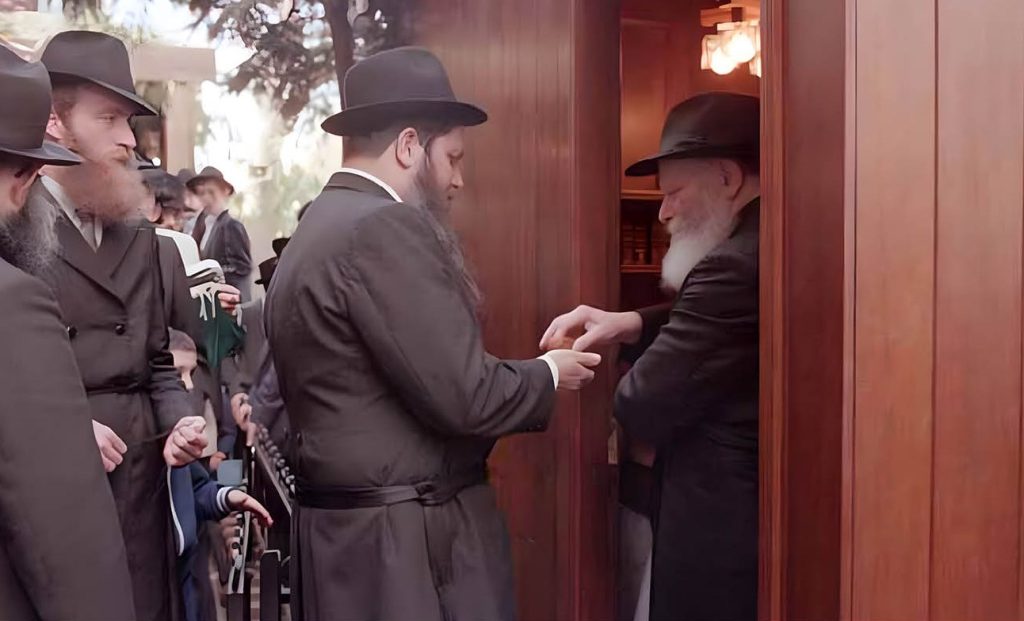
When R’ Koppel passed by the Rebbe for dollars, the Rebbe gave him a dollar and told him to tell the Jews “that they had nothing to fear. It would be good until the coming of Moshiach and after that it would surely be even better.” This line calmed down the community and, amazingly, contrary to the pessimistic predictions, the Jews were not harmed at all by the revolutionary transition of power.
R’ Koppel himself experienced four instances when armed blacks invaded his house and business and his life was in great danger. One of the times, the hoodlum even put a gun to his head and asked who would take care of his kids when he killed him. R’ Koppel said that during those moments he thought of what the Rebbe told him, that there was nothing to fear. Each time, he miraculously emerged unharmed.
R’ Koppel told about the chairman of the Jewish Agency who wrote to the Rebbe asking why beautiful schools were being built in South Africa when there was no future for Judaism there. The Rebbe told him decisively that the Jews of South Africa could anticipate a rosy future.
Today, everyone sees how everything the Rebbe said came true. Out of a community that once numbered 120,000, only 50-60,000 remain following the mass exoduses, but R’ Koppel quoted an interesting comment from an irreligious Jew, who said, “If the Rebbe would have told Jews to leave the country, not one Jew would have remained!”
The Rebbe’s Bracha – Key to a Life of Success and Blessing
An amazing epilogue to R’ Koppel’s life story is found in a moving letter that the Rebbe wrote to his father at the beginning of 5711. In the letter, the Rebbe advised him how to raise his children and he reassured the father that he had nothing to worry about his not succeeding in completely fulfilling the instructions of the Rebbe Rayatz, because that was the opposite of the Rebbe’s wishes. A year later, the Rebbe sent another letter in which he reassured the father who, because of his poor health, was unable to work long hours as in the past. This was because what Hashem wants to give as parnassa, He could also give with an investment of less time and energy, especially if it was at the expense of Torah study and the fulfillment of mitzvos. The main thing, said the Rebbe, was not to decrease in diligence in tefilla, in saying Tehillim, giving tzedaka, etc. because these are the vessels and conduits for receiving Hashem’s bracha. If they are enlarged, the G-dly blessing would expand too.
In that letter, the Rebbe wrote the following amazing line: “And even if you still don’t see the fulfillment of some of the brachos, it’s clear that soon you will see it even with eyes of flesh.” That describes perfectly the life story of R’ Koppel who saw with his own eyes and in the most tangible way, how the Rebbe’s brachos in all areas of his life, personal and communal, came true. All of them, R’ Koppel, his family and those around him, became blessed in every way, both spiritually and materially, with R’ Koppel’s three children, R’ Shaul, R’ Shalom and Mrs. Rivka Chaikin, serving as shluchim in Johannesburg.
Beis Moshiach #1413 • pp. 10-19
© 2026 Beis Moshiach Magazine. All rights reserved.
This article originally appeared in Beis Moshiach #1413. You are welcome to share it with friends and family by email or in print, provided that you do not change, add to or omit any part of it, you credit the author and Beis Moshiach, and you include a link to archive.bmoshiach.org (written out in full in printed copies).
To republish this article in a newspaper, magazine, book or website, please request permission in advance at [email protected].