The Musician in the Room
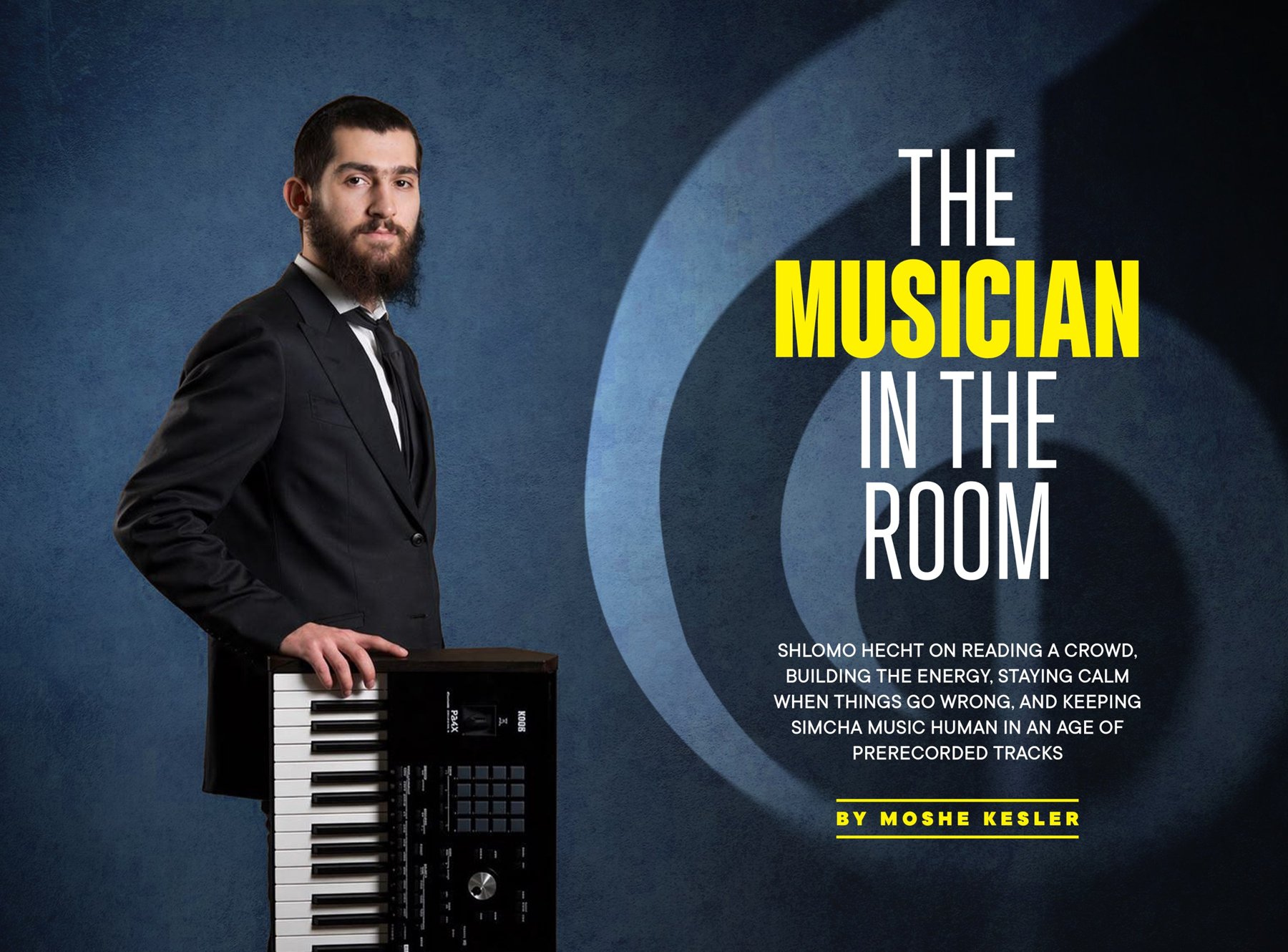
Shlomo Hecht on reading a crowd, building the energy, staying calm when things go wrong, and keeping simcha music human in an age of prerecorded tracks
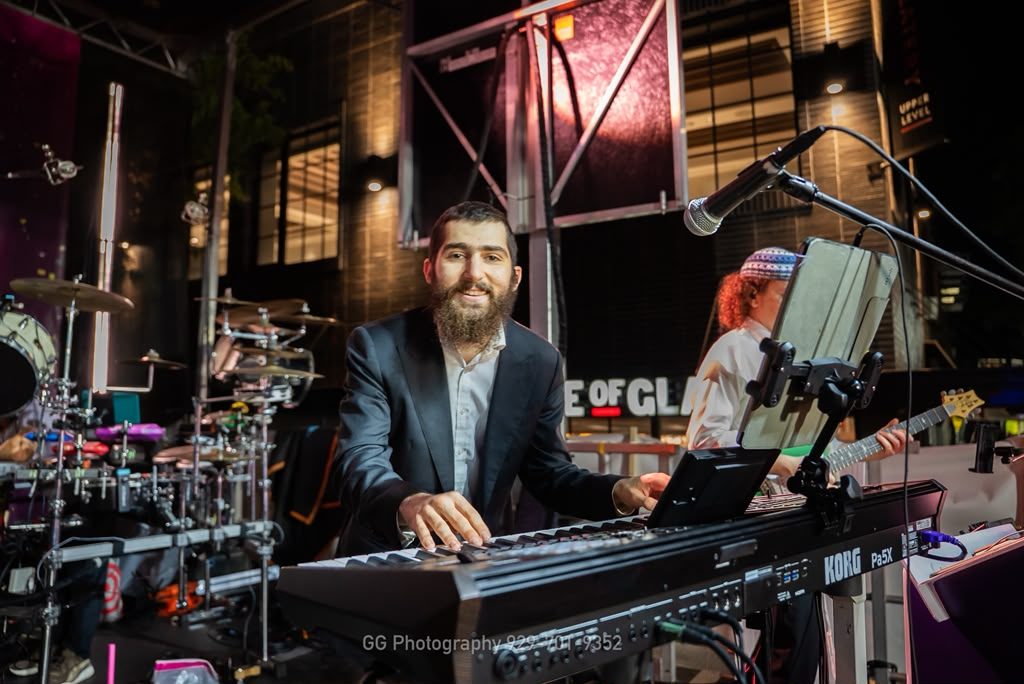
If you have been to a wedding or simcha in Crown Heights over the last few years, there is a good chance you have seen Shlomo Hecht behind the keyboard.
Hecht has become an increasingly familiar part of the Crown Heights music scene, playing weddings, simchas and 770s kiddush levana. This year, the Shlomo Hecht Band was also among the bands playing the massive Simchas Beis Hashoeiva celebrations on Kingston Avenue.
But increasingly, Hecht has also been moving beyond the simcha circuit and putting out projects of his own. His first Chanuka release, in 2024, was a dance medley featuring Berel Zucker. A year later came a much larger production: a high-energy Yevanim Medley, filmed at the Crown Heights Dreidel and featuring Shmuly Hurwitz, Orya Shiff and Mendy J. He has also worked on Purim and Lag B’Omer projects, and more recently teamed up with Shmuly Hurwitz for Melodies of Elul, a series of live-feeling musical videos leading into the Yomim Noraim.
In this conversation, Hecht discusses how he taught himself to play, how he broke into an already crowded Crown Heights music market, what he believes separates a good musician from someone who can simply play, and where he hopes to take his music next.
MK: Tell us a little bit about yourself, and how you first got involved in music.
SH: I grew up on shlichus in Sunnyvale, California. I was born and raised there. I went to a local Jewish dayschool until sixth grade, and then from sixth through eighth grade I did shluchim online school. After that I went off to yeshiva.
Music really started for me when I was around ten or eleven years old. My brother Shmully got a Casio keyboard for his bar mitzva, and somebody in the community started teaching him a few songs on it. I remember watching him learning and thinking, basically, “I want to do that too.” And probably, like any younger brother, I wanted to do it even better…
So I started playing around with his keyboard. It came with one of those manuals that teaches you some of the basics—how chords work and things like that—and I just started teaching myself from there. I never really had formal training. I would play, figure things out, learn some music theory, and then just keep playing.
And that was really how I learned. There wasn’t one point where I decided, “Okay, now I’m going to become a musician.” I just really enjoyed it, so I kept doing it. When you’re spending enough time on something, playing again and again and trying different things, eventually you start getting better. A lot of it was simply spending hours at the keyboard because I wanted to.
When I went away to yeshiva, the keyboard came with me. I would play for Chodesh Adar dancing, for Purim, and at different yeshiva events. During breaks I would also spend a lot of time at the keyboard, just playing around, working things out and making up songs.
I always had a very creative side to me. I enjoyed yeshiva, but at the same time, as a creative person, being within a very structured system could sometimes be challenging. Music gave me a place to express that part of myself.
So when I finished yeshiva, I had a decision to make about what I wanted to do next. I decided to pursue music seriously and begin playing professionally in Crown Heights. It was taking something that had been part of me since I was a kid and finally giving myself the chance to see where I could take it.
MK: When did music go from something you were doing on the side to something you were actually doing professionally?
SH: I had already been playing at events for a while, but I would say I’ve been doing it professionally, as my main job, for around two years.
When I first came to Crown Heights, I went through a couple of different jobs, and at the same time I was always doing music on the side. I would play at an event here, an event there, and slowly I started seeing that this was something I could actually get into seriously.
For me, it also made sense because if you’re going to have a job, the best kind of job is something you actually enjoy doing. I really enjoy music. I enjoy making people happy. I enjoy seeing people’s reactions and seeing that they enjoyed the music. When people come over after an event and tell you that the music was exactly what they wanted, that means a lot to me.
And it’s also not the kind of job where every day is exactly the same. Every event is different. You have a different crowd, a different type of music, a different energy. So there’s always something new. That is part of what keeps it interesting for me.
Obviously, Crown Heights already has a lot of musicians. At first you can look at that and think, “There are so many people doing this already. How am I supposed to get into it?”
But what I started realizing is that there’s a difference between there being a lot of people who can play and there being a lot of people who are really putting everything into it. There are plenty of talented musicians, but not everybody wants this to be their main job. Not everybody is constantly working on it, putting themselves out there and trying to build something.
And I think people can tell when somebody is really into it. If you’re passionate about the music, if you care about the event, and when you’re playing you’re fully there, that comes across. So I started seeing that even in a crowded market, there was still room if I was really going to commit myself to it.
MK: So once you decided to take it seriously, how do you actually break into the Crown Heights music scene?
SH: That’s something I learned pretty quickly: you can’t just put up a poster and expect people to start calling you. That’s not really how it works.
You have to reach out to people. You have to do sales. You have to collaborate with other people and put projects out. You have to keep doing things that make people know who you are and keep yourself relevant.
That was probably one of the things I didn’t fully realize in the beginning. You can be a good musician, but if nobody knows you, that doesn’t automatically turn into gigs. You have to actually make the connections and make sure people hear what you can do.
Especially in the beginning, you also can’t expect that every job is immediately going to make you a lot of money. Sometimes it makes sense to take an event for less, or even do something pro bono, because at that stage the main thing is that people should hear you play. They should know your name and know what you can do.
If nobody knows who you are and you come in saying, “I’m charging $1,500,” why is somebody going to hire you? You haven’t established yourself yet.
So there’s definitely a business side to it. Being a good musician isn’t enough by itself. You have to reach out, you have to create things, and you have to give people a reason to know who you are. Once people hear you and start having good experiences with you, then it begins to build from there.
MK: Once you’re actually at an event, what do you see as your job? What makes a good musician different from somebody who can simply play?
SH: For me, a big part of it is being very flexible with the client and with the crowd. Every event is different. If the client wants the volume lower, you bring it down. If it’s a certain type of crowd, you have to understand what they’re responding to and play accordingly.
You definitely have to read the room. You can’t just come in with a set list and say, “This is what I’m playing tonight.” You have to watch the crowd and see what’s working. Different weddings have different energy, different styles, different genres. You have to be able to switch things up.
At the same time, I don’t think the musician is only responding to the energy. You’re also creating it. When I’m playing, I’m very into the music. I love doing it, and that energy is going to come across. So you’re watching the crowd, but you’re also pushing the room in a certain direction and trying to build the energy.
I think that’s one of the biggest differences between a decent musician and a really good one. It’s not necessarily just talent. Obviously you have to know how to play, but there are people who are incredibly talented who aren’t necessarily going to be successful at events.
You have to care about the client. You have to care about whether people are enjoying themselves. You have to keep working on your craft and always be looking for ways to get better. In music there isn’t really a point where you say, “Okay, I’m the best I’m going to get.” There’s always more you can learn.
And you also have to know how to handle things when something goes wrong. At an event, things happen. Something can go wrong that’s completely outside your control, and you can’t suddenly get flustered. You have to know how to react, fix what you can, and keep the event moving.
So talent is important, but I don’t think talent by itself is what makes somebody a great musician. A lot of it is being able to work with people, read a crowd, stay calm, and really care about what you’re doing.
MK: You mentioned that a musician has to be able to feel the crowd and change with the event. How much of that comes from actually playing live?
SH: A lot of it.
That’s one of the reasons I’m not such a big fan of relying too much on prerecorded intros and tracks. There’s nothing wrong with using them—I use them too—but I try not to depend on them too much.
Because once too much of the music is already prepared for you, you lose some of that live element. At a certain point, it starts becoming more like a DJ.
I like actually playing and being involved in what’s happening. Even when I use an intro, I usually want to add something to it rather than just let it run.
When you’re playing live, you can move with the room. You can see how people are reacting, feel the energy, and change what you’re doing accordingly. That’s a big part of what makes an event enjoyable for me—you’re not just playing the same thing every time. You’re part of what’s happening.
So for me, the goal is to use the technology when it helps, but still keep the music feeling live.
MK: You recently put out a project called Melodies of Elul. What were you trying to do with that?
SH: I felt like there weren’t that many creative music projects coming out specifically for the Crown Heights community, and I wanted to put something out that people could actually enjoy.
And obviously, part of it was also publicity. When you’re trying to build yourself as a musician, you have to put things out there. People have to see what you can do and get to know your name. So it was definitely also a way of getting myself out there.
But I didn’t want to put something out just for the sake of putting something out. With the project, I wanted it to feel real. Live, authentic, a little raw. Not something that feels overly processed.
I’m not against technology at all. If there’s something useful, I’ll use it. But I still want the music itself to feel alive.
Baruch Hashem, we got really good feedback from the project, and it made me want to do more things like that. To me, that was part of the point: putting something creative out there and seeing that people actually connected with it.
I think there’s a lot of room in Crown Heights for more high-quality live music projects. You see in other communities much bigger productions—well-arranged music, professional musicians, different instruments, a fuller sound—and we don’t always have as much of that here.
That’s something I’d like to help bring more of. Not necessarily to make everything huge or expensive, but to raise the quality and create things that feel professional while still being realistic for the community.
So Melodies of Elul was one project, but I definitely see it as part of something bigger that I’d like to keep building.
MK: Where do you hope to take things from here?
SH: Hopefully just to keep growing.
I have a lot of ideas for projects, and eventually I’d like to build things out more with a band and do bigger productions. There are different kinds of things I want to try, and I don’t think there’s really a fixed limit on where it can go.
For me, the sky’s the limit. I don’t necessarily know exactly what every project is going to look like yet, but I want to keep putting things out, keep improving, and keep seeing how far I can take it.
At the same time, I want to keep doing the regular events and simchas too. That’s where a lot of the music actually happens, and I enjoy that part of it.
I think the main thing is just to keep building. Keep doing better work, keep coming up with ideas, keep collaborating with people, and hopefully keep bringing more good-quality live music into Crown Heights.
Beis Moshiach #1528 • י״ט חשון תשפ״ז • pp. 26-31
© 2026 Beis Moshiach Magazine. All rights reserved.
This article originally appeared in Beis Moshiach #1528. You are welcome to share it with friends and family by email or in print, provided that you do not change, add to or omit any part of it, you credit the author and Beis Moshiach, and you include a link to archive.bmoshiach.org (written out in full in printed copies).
To republish this article in a newspaper, magazine, book or website, please request permission in advance at [email protected].