40 Seconds from the Ground
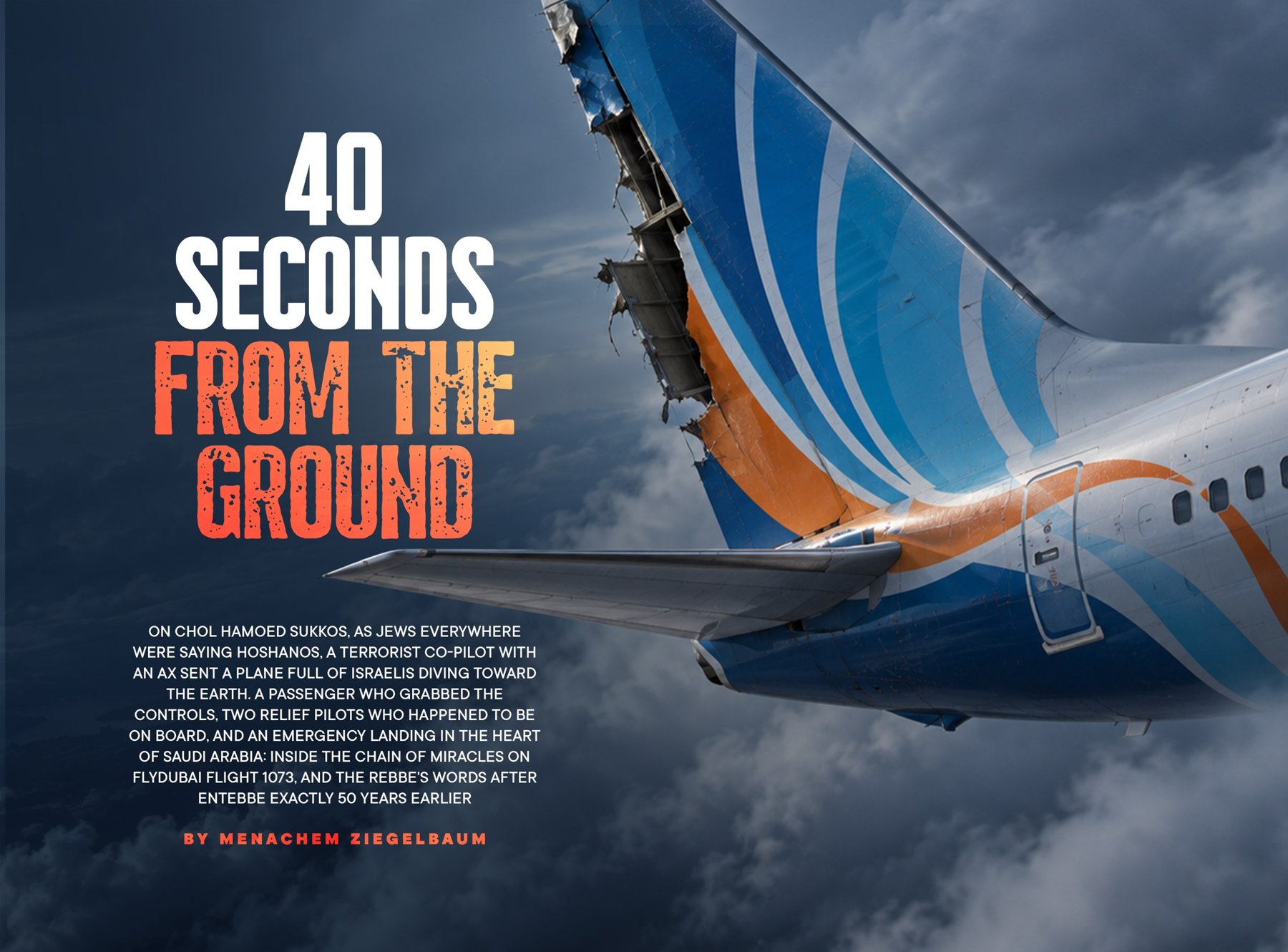
On Chol HaMoed Sukkos, as Jews everywhere were saying Hoshanos, a terrorist co-pilot with an ax sent a plane full of Israelis diving toward the earth. A passenger who grabbed the controls, two relief pilots who happened to be on board, and an emergency landing in the heart of Saudi Arabia: inside the chain of miracles on FlyDubai Flight 1073, and the Rebbe’s words after Entebbe exactly 50 years earlier.
In shuls across Eretz Yisrael, congregations had just finished Hallel with the shaking of the lulav. Moments earlier they had prayed in the Hoshanos: “Save body, spirit, and soul; save sinew, bone, and stature… save [the world] suspended upon nothingness.” Out in the streets, preparations were already underway for that night’s Simchas Beis HaShoeiva.
At that very moment, 34,000 feet above the deserts of the Middle East, a Flydubai Boeing 737 MAX 8 was cruising along as Flight FZ 1073.
On board were 174 passengers, twenty-seven of them children. Nearly all were Jews heading home from Dubai to the Holy Land. People dozed lightly, children played, and the crew went about their work. Everything looked perfectly routine. The navigation map showed the plane crossing the airspace safely.
But just a few yards away, inside the cockpit, a horrifying scene was unfolding—a plot that only bottomless evil could devise. The first officer, Hamam al-Hammami, a 29-year-old Omani citizen, sat beside the captain, Smit Machchhar, an Indian national. As later emerged, the first officer had undergone extreme Islamist radicalization, which according to Emirati investigators began in 2017 while he was studying in Australia. Omani authorities had reportedly been concerned about his radical views. Even so, he passed every vetting check—at Oman Air, then Royal Air Maroc, and finally Flydubai, which hired him in January 2026—with a terrible decision already formed in his heart: to carry out a spectacular, 9/11-style suicide attack by crashing a plane full of Jews straight into the terminal at Ben Gurion Airport.
Suddenly, without any warning, al-Hammami grabbed the emergency crash axe that is stowed in every cockpit as standard safety equipment. His eyes blazing with hatred, he lunged at Captain Machchhar and began striking him in the head with devastating blows. Within seconds, the cockpit had become the scene of an attempted murder. The captain, despite his critical wounds, fought for his life and for the lives of the 170-odd passengers behind him. He knew the magnitude of the responsibility resting on him.
In the middle of the bloody struggle, the terrorist pushed the control column forward and disconnected the autopilot, sending the giant aircraft into a terrifying dive toward the ground.
In the cabin, all hell broke loose at once. “It felt like a roller coaster, only without brakes,” one passenger later recalled. “The plane just plunged sharply downward. Objects flew through the air, people were thrown from their seats and started screaming in terror.” The plane lost some 16,000 feet in about 30 seconds! The rate of descent was so extreme that it caused structural damage to the flight controls and tore away part of the tail.
The wounded captain, lying on the floor in a pool of his own blood, summoned his last reserves of strength. Somehow, he managed to reach the cockpit door and open it, while simultaneously transmitting the international distress code for a hijacking.
Through the open door, the screams of the pilot and the terrorist grappling with each other could be heard.
Amid those moments of panic, as the plane hurtled toward the earth at insane speed, a genuine miracle took place. The moment the bleeding captain opened the cockpit door, an Israeli passenger named Yaniv Hayoun, a plumber seated in row 11, didn’t hesitate for a second.
“I saw the terrorist standing between the seats trying to wreck the navigation instruments to make sure the plane would crash,” Yaniv later recalled in chilling testimony. With his bare hands, Yaniv and two other passengers charged the terrorist and forcefully dragged him out of the cockpit so the other passengers could subdue him.
But the plane was still diving. Yaniv understood there was no time to wait. He went back into the cockpit, climbed into the pilot’s seat, grabbed the control column with both hands, and began pulling it back with all his might. He later explained where he had picked up the right instinct in those critical seconds: he had seen it on a flight investigation TV show. An ordinary Jew with no commercial aviation experience served as the hands of Divine Providence. He halted the vertical dive and managed to level off the giant aircraft at just 15,000 feet.
By hashgacha pratis, two off-duty Flydubai pilots were also on board—the crew assigned to fly the plane back to Dubai. One of them had already noticed the cockpit door opening and closing in a strange way and rushed forward. The two took over from Yaniv and guided the plane toward an emergency landing.
Aviation experts who later examined the data concluded that the plane had been only about 40 seconds away from a fatal impact with the ground.
A Chain of Miracles in the Sky
Among the passengers who rushed forward was Dr. Shota Musayev, an Israeli dentist. “We heard screaming from the direction of the cockpit,” Dr. Musayev said in a tearful interview. “When we burst in, we saw a terrible sight. Everything was covered in blood. The captain was lying on the floor, badly wounded in his head, neck, and hand. The terrorist was trying to drag him inside and lock the door again from within so he could finish bringing the plane down. We understood the situation immediately and charged at the terrorist.”
The Israeli passengers, together with the flight attendants, used tremendous physical force to bring the Omani terrorist down to the cockpit floor, pin him firmly, and overpower him completely. As they tied him up with headphone cords, the two relief pilots took the controls. Using whatever mechanical capacity the damaged plane had left, they fought the enormous forces acting on it and stabilized the aircraft—seconds before disaster.
This is where the hand of Divine Providence enters the picture, in a way that defies any rational explanation—a chain of open miracles from the Creator and Master of the world.
Oded Shapira, a former fighter pilot and an El Al check captain who trains pilots for abnormal situations, says that from a professional standpoint, too, “the Jewish people experienced a sequence of at least three events I can define as miracles.”
The first miracle: Captain Smit Machchhar saved the plane when, with his last ounce of strength, he opened the cockpit door despite the brutal blows he had taken to his head and body. By the time the door opened, very little time remained before the plane would have hit the ground. “If the cockpit door hadn’t opened, the pilot could have done whatever he wanted with the plane, and there would have been almost nothing anyone could do.”
The second miracle: Yaniv Hayoun, together with a group of Israelis, entered the cockpit while the plane was diving. Nobody knows what to do when they see a plane racing toward the ground at high speed. Despite not knowing, Yaniv grabbed the controls and pulled, and in doing so saved the passengers.
“As a check pilot, I’ve tested many pilots, almost all of them highly experienced fighter pilots,” Shapira says. “We practice this situation extensively—it’s called an ‘unusual attitude.’ We practice ‘nose-high’ and ‘nose-low’ scenarios. It’s very hard to recover from that kind of situation. Flying it incorrectly won’t get the plane out. When the plane is descending at high speed, the controls aren’t effective.
“In fact, you could see how the tail of the aircraft was damaged, and that happened because of the high-speed descent, which the plane struggles to withstand. Under certain conditions, the wing can even come apart.”
The third miracle: After the door was opened, the terrorist overpowered, and the controls stabilized, professional pilots were still needed to land the plane properly. “Think about the situation for a moment: they’ve escaped this entire event, they’ve pulled out of the death dive—but now there’s no one to fly the plane. Even experienced pilots who move from one aircraft type to another need time to get to know the plane,” Shapira says.
The presence of two professional pilots among the passengers was itself miraculous. Ordinarily, a commercial airliner carries only two pilots. But on this particular flight, two more Flydubai pilots—qualified on this very aircraft—were sitting in the cabin as passengers, on their way to fly the return leg.
Beyond the three Shapira counts, we can add more.
The fourth miracle: Nina Manes, age 5, was flying home to Tel Aviv with her family in business class. She needed the restroom, and her mother, Tali Manes, stood waiting for her outside the lavatory. Suddenly Tali heard shouting and heavy blows coming from behind the closed cockpit door.
From there, things moved fast: a call went out to the passengers, and several of them quickly pulled themselves together and took up positions by the cockpit entrance. The moment the cockpit door opened, they already knew what they were facing.
The fifth miracle: With the controls shoved forward and the nose pitched sharply down, the plane plummeted thousands of feet in a matter of seconds. Some aviation experts said that by the laws of nature, the aircraft should simply have broken apart in midair in such a steep dive—which did not happen.
A Surprise Emergency Landing in the Saudi Kingdom
With the plane stabilized but damaged, and the cockpit looking like a battlefield, it was clear the aircraft could not continue on its planned route to Ben Gurion. The relief pilots requested immediate permission for an emergency landing. The nearest option was the airport in the city of Tabuk, in northwestern Saudi Arabia.
This was an unprecedented event: a plane carrying 166 Israeli citizens making an emergency landing in the heart of the Saudi kingdom, a country with which Israel has no formal diplomatic relations.
And here comes the sixth miracle. When the damaged Boeing finally touched down on the runway at Tabuk’s international airport, the passengers held their breath. As the media reported in astonishment, more than 160 Israelis suddenly found themselves in the heart of Saudi Arabia—a hard-line Muslim state. In the terms of the old world order, this was a high-risk nightmare scenario, and it deeply alarmed the prime minister and the heads of the security establishment. In Jerusalem, an emergency situation room was immediately set up with Prime Minister Binyamin Netanyahu and the defense minister, who weighed worst-case scenarios of hostage-taking or attempts to harm the passengers on the ground.
But here the great diplomatic miracle unfolded—one that a Jewish eye cannot help but see as a living fulfillment of the vision of the Geula.
The Israeli passengers, certain they were walking into a new crisis in hostile territory, were surprised to find respectful, warm treatment from the Saudi authorities. Instead of hostility, Saudi security and medical personnel treated the frightened passengers with extraordinary humanity and remarkable compassion. The Saudi Interior Ministry announced immediately that the kingdom was acting out of a “humanitarian and international commitment.”
The Saudis opened the terminal gates, and the Israeli Jews were housed in a secured area of the airport and given food, water, and medical care. Israel asked permission to send its own aircraft to bring them home; Saudi Arabia declined. So the passengers waited some eight hours in Tabuk—safe and looked after—until Flydubai’s replacement plane arrived and flew them directly from the heart of Saudi Arabia to Ben Gurion Airport.
One of the passengers, Almog Itali, shared from inside the kingdom: “They’re treating us in the best possible way. We trust them!”
What we saw in Tabuk was an unmistakable Messianic “preview.” An Islamic kingdom that for many years was closed and sealed off to anything Jewish was extending protection, security, and a warm welcome to dozens of Jewish families in the middle of Sukkos. That very day, Crown Prince Mohammed bin Salman stood before his Shura Council and condemned Israel—yet in Tabuk, not a hair on a Jewish head was touched.
Only after they landed in Eretz Yisrael did the passengers fall on one another’s necks in tears, reciting Birchas HaGomel in trembling voices for the astonishing miracle they had experienced.
The Rebbe’s Talk on Miracles — Exactly 50 Years Ago
The great miracle of Flydubai Flight FZ 1073 should stir a deep feeling of gratitude to Hashem. We live in a time when miracles surround us on every side—sometimes openly, sometimes hidden. The Rebbe Melech HaMoshiach calls on us again and again to “open our eyes” and see the signs of the Geula and the kindnesses of Hashem taking place every single day.
How remarkable it is to witness once again the Rebbe’s crystal-clear vision. Exactly 50 years ago, at the Simchas Torah farbrengen of 5737, the Rebbe spoke about the great miracles that occurred during the hijacking of the Air France plane to Entebbe a few months earlier.
The Rebbe devoted a lengthy sicha to the need to thank Hashem for the great miracles that took place in the rescue of the hostages. His words seem to hit the mark precisely on the miracle of the attempted hijacking on Chol HaMoed Sukkos, a jubilee later.
The Rebbe opened by saying that “recently, the nations of the world have been uniting to embitter the lives of the Jewish people,” and therefore “it is all the more relevant and essential that the Jewish people be in a state of kulanu k’echad—all of us as one.”
The Rebbe goes on to connect the great miracle to the month of Tishrei, whose letters spell reishis—the “head” of the entire year, which influences the year as a whole.
In that same sicha, the Rebbe further sharpens the point that “in every matter and event now taking place in the world, it is openly visible to the eye of flesh that we are already standing in ikvesa d’meshicha, and therefore everything must be done to hasten the Geula as much as possible.” He elaborates on the need to thank Hashem for miracles and wonders, bringing proof from the fact that Hashem wished to make Chizkiyahu Moshiach, but because he did not sing shira over the miracles performed for him, he did not merit it.
From this, a lesson must be drawn: to thank Hashem for the great miracles that occurred recently. “Since one hears from many that this event [the Entebbe rescue] is a miracle, they must sing shira to the Holy One, blessed be He!” And the miracle is so open that anyone who was there during the rescue, should he return to that place, must recite the bracha “Baruch she’asa li nes ba’makom ha’zeh.”
Open Your Eyes and Give Thanks
As the passengers celebrated the rest of Yom Tov at home, their joy—and the joy of the entire Jewish people—took on deep meaning. The dancing at Simchas Beis HaShoeiva everywhere was not only rejoicing over the Yom Tov, but over the very gift of life granted anew in those nerve-wracking seconds in the sky. This was not a private miracle for 174 passengers; it was relief and deliverance for the entire Jewish people in Eretz Yisrael.
Prime Minister Binyamin Netanyahu spoke about it at a special Hoshana Rabba learning evening in the Knesset sukka: “What happened yesterday was a chain of miracles—siyata d’shmaya.” Help from Heaven—and this time, quite literally, from the sky. At that gathering, Netanyahu read from the book of Shmuel about the great salvation that came through the initiative of Yehonasan and his armor-bearer, who single-handedly routed the camp of the Plishtim. Netanyahu read: “And all the men of Israel who had hidden themselves in the hill country of Ephraim heard that the Plishtim had fled, and they too pursued them in battle. And Hashem saved Israel on that day, and the battle passed over to Beis Aven.”
Linking Yehonasan to the heroes of the Dubai flight, the prime minister added: “One man, on his own initiative, with boundless resourcefulness, with a courage that can’t be comprehended, goes out against the Plishtim, strikes them, changes the entire battle—and saves Israel.”
Netanyahu concluded: “What we saw, what happened—it was a chain of miracles. It was siyata d’shmaya. That’s what happened here!”
Perhaps the words of Asaf Rajuan, one of the Israeli survivors of the flight, which he wrote and posted afterward, sum up this tapestry of open miracles best:
“Since the incident in which the hijacker’s attempt to take over the flight was foiled, there has been a great deal of media coverage. Many times I’ve been asked which factors, in my view, prevented the terrible disaster that could have befallen our people had the despicable hijacker succeeded in his plans.
“Today, I think I received a special and interesting answer to that question.
“Naturally, after the incident ended and we landed safely in Eretz Yisrael, I felt the need to thank many people: the passengers who worked together; my lioness of a wife and all the mothers and fathers who protected their loved ones; the children who stayed calm; and every Israeli passenger on that plane. Yesterday, I was one of a group of passengers interviewed by an international network. As each passenger described how they experienced the flight, we realized something very important—something you only understand once the dust settles and you get into the small details. We realized that every passenger on that flight played a role.
“I had no doubt that after such a great miracle, I would be in shul on Shabbos morning to say Birchas HaGomel. I’m not a religious person. I believe in G-d in my own way, and I don’t usually look for signs in everything. But today, something happened that completely surprised me. Today in shul, I read from V’zos HaBracha (Devarim 33:26): ‘There is none like the G-d of Yeshurun, Who rides the heavens to your aid, and in His majesty the skies.’ I read the verse, stopped, and got chills—and so did all the other congregants who knew the story and understood why I was there with them.
“After everything that happened on that flight—after the fear, after the breach of the cockpit, after we understood how thin the line is between life and death—to find myself facing exactly these words, ‘Who rides the heavens to your aid,’ was a moment I can hardly explain… Today in shul, when I said Birchas HaGomel, I felt mainly one thing: Thank you! Thank you for life! Thank you for the miracle! And thank you for the privilege of standing here and telling the story!”
Beis Moshiach #1527 • י״ב חשון תשפ״ז • pp. 24-29
© 2026 Beis Moshiach Magazine. All rights reserved.
This article originally appeared in Beis Moshiach #1527. You are welcome to share it with friends and family by email or in print, provided that you do not change, add to or omit any part of it, you credit the author and Beis Moshiach, and you include a link to archive.bmoshiach.org (written out in full in printed copies).
To republish this article in a newspaper, magazine, book or website, please request permission in advance at [email protected].