Printing the Tanya Under Fire
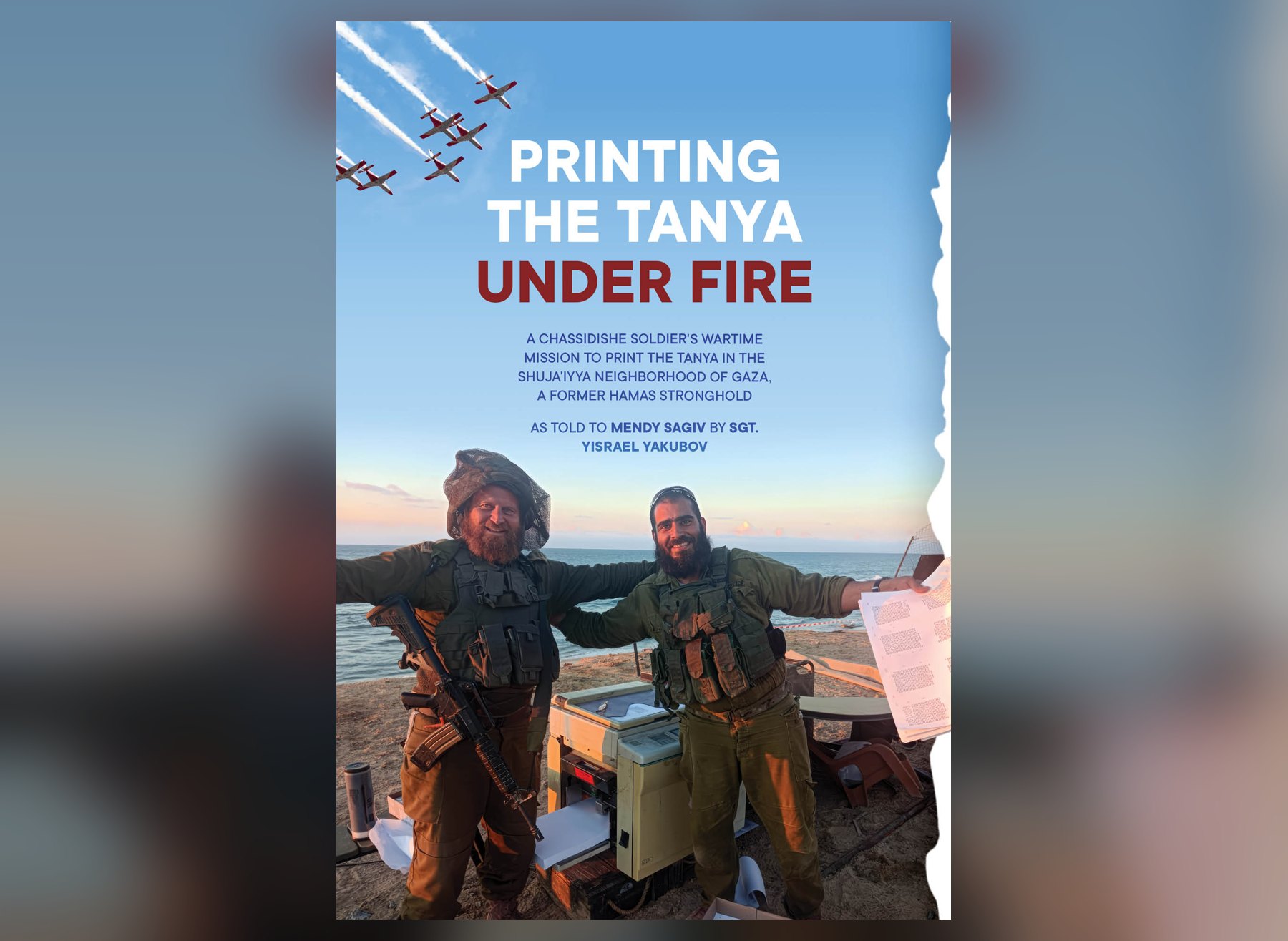
A Chassidishe soldier’s wartime mission to print the Tanya in the Shuja’iyya neighborhood of Gaza, a former Hamas stronghold. As told to Mendy Sagiv by Sgt. Yisrael Yakubov
Shemini Atzeres morning, Kibbutz Ashdot Yaakov. Sirens blare in the background.
My phone rings. As a volunteer in the kibbutz emergency squad, the coordinator calls out, “Run to the armory – this is a second Yom Kippur War…”
Hours later, the army calls, instructing me to report to the base in Ashkelon. “We’re in a war situation,” they said. Knowing I serve in a combat unit, I understood it was time to be on the front lines. I rushed home, put on my uniform, and drove to the base. From there, they took us to Zikim Beach, where we fought a fierce battle against our cruel enemy.
In the first days of the war, I began moving among the soldiers, offering to help them put on tefillin, distribute Jewish educational materials, and discussing faith and trust in Hashem. There was one day when I put tefillin on nearly a hundred fighters!
In my platoon, and in the “Kaplan Force” platoon that joined us, there were soldiers outwardly identified with the Israeli left, for whom religious matters were not particularly interesting, to put it mildly. Initially, they didn’t want to put on tefillin, but over time we talked, and as a Chabad Chassid, I became a kind of religious representative to whom all questions about faith were directed.
During one of my conversations with the soldiers, I spoke with a soldier whose faith – at least externally – did not appear particularly strong. We spoke deeply and openly, and hearts began to open. The Jewish soul started to emerge. There was a breaking point where he began to cry: “I don’t want my son, G-d forbid, to marry outside of Jewish tradition…” Suddenly, I saw that despite the external appearance of a non-believing Jew, inside burned a powerful Jewish neshama.
After a period of open dialogue, some soldiers agreed to put on tefillin. One soldier would immediately roll up his sleeve every time I suggested putting on tefillin. Afew days later, when I was removing the tefillin from him, he shared that his father had not bought him tefillin for his bar mitzva, and he would be happy if I could help him purchase kosher tefillin. I approached the “Tefen” Chabad House of Rabbi Kuti Maidovnik, and with his help, we obtained a beautiful pair of tefillin for the soldier, after he committed to putting them on daily. I’d like to take this opportunity to thank Rabbi Kuti for his significant help.
An Unexpected Mission
A few weeks into the difficult fighting, Rabbi Yaakov Lenchner from Rechovot called me. He proposed something extraordinary: printing the Tanya in the Gaza Strip!
I began thinking about how to execute such a mission. How and when could I enter the Strip to print the Tanya? Not just anyone can enter the Gaza Strip whenever they want. Moreover, bringing in a printing machine requires special authorization from senior ranks. How could we convince them to grant permission?
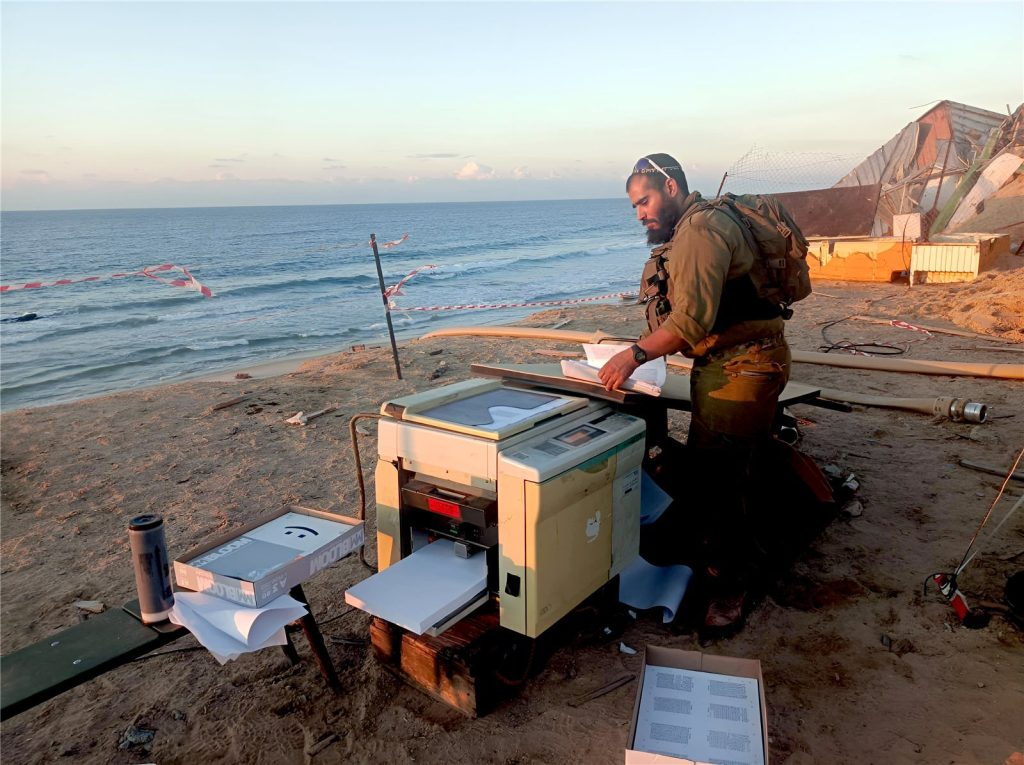
I calculated my timing and realized I could do this only during a brief release for rest. Instead of going home, I would return to Gaza, print the Tanya, and then return home.
I called my wife and told her about the idea – that during my time off, instead of coming home, I would return to print the Tanya. She, of course, heroically agreed. Given my challenging conditions, I couldn’t sit and write a letter to the Rebbe. I asked my wife to write a letter to the Rebbe requesting a blessing for me and the entire matter. She indeed received an amazing letter in which the Rebbe blessed for success regarding spreading the wellsprings of Chassidus.
Through Rabbi Lenchner’s connections, we obtained authorization from the higher ups through the good connections of Sergeant Yair Ansabacher to print the Tanya. With the help of Rabbi Ezra Ben Efraim, the dear Chassid who prints Tanya editions throughout the year in all corners of the country, I received a printing machine, papers, a generator, and all the accompanying equipment.
Hashgacha Pratis in Action
During my time off, I traveled with the printing equipment to the Gaza border fence, where I had planned with an armored vehicle driver to enter Gaza and print the Tanya. Like in every divine mission, there are always obstacles.
When we arrived, the driver unexpectedly decided he didn’t want to take us inside. He started complaining, “Why are you late?” and dismissively asked, “What is this nonsense with the equipment and paper?” On his own accord, he decided not to transport us. It became clear he didn’t understand the profound significance of our mission.
At one point, he thought we were on some public relations campaign, casually suggesting, “Just enter a few meters after the fence, take some photos saying, ‘we’re here’ and go home to print, and that’s it…” He drove away, leaving us by the fence with our heavy equipment.
Honestly, I began to feel frustrated. I couldn’t enter the Gaza Strip to print the Tanya, I had lost the rare permission I received, and I had wasted precious time from my short leave. Instead of returning to my family after three weeks of continuous fighting, I was standing here seemingly for no reason…
But precisely then, I started to see the Rebbe Melech HaMoshiach’s brachos getting to work.
Suddenly, an armored army Hummer arrived on its way inside and stopped next to us. The driver asked in great wonder about our printing equipment. When we explained our plan, he initially refused. But then, an unknown young man standing nearby began explaining the spiritual importance of the Tanya, the need to print it everywhere, and especially now in Gaza. I heard him say the profound words: “By spreading the wellsprings, we will weaken the enemy’s power and emerge victorious”…
After such a ‘sermon’, the Hummer driver was convinced and agreed to transport us inside.
We loaded the equipment and entered the strip. The drive took a very long time, indicating we had penetrated deep into the territory. After a lengthy journey, we stopped and began unloading our equipment. While I wasn’t certain of our exact location, I understood we were near the former Jewish settlements of Nisanit and Dugit, not far from the coast – mere kilometers from Shifa Hospital, the terrorists’ stronghold at the time.
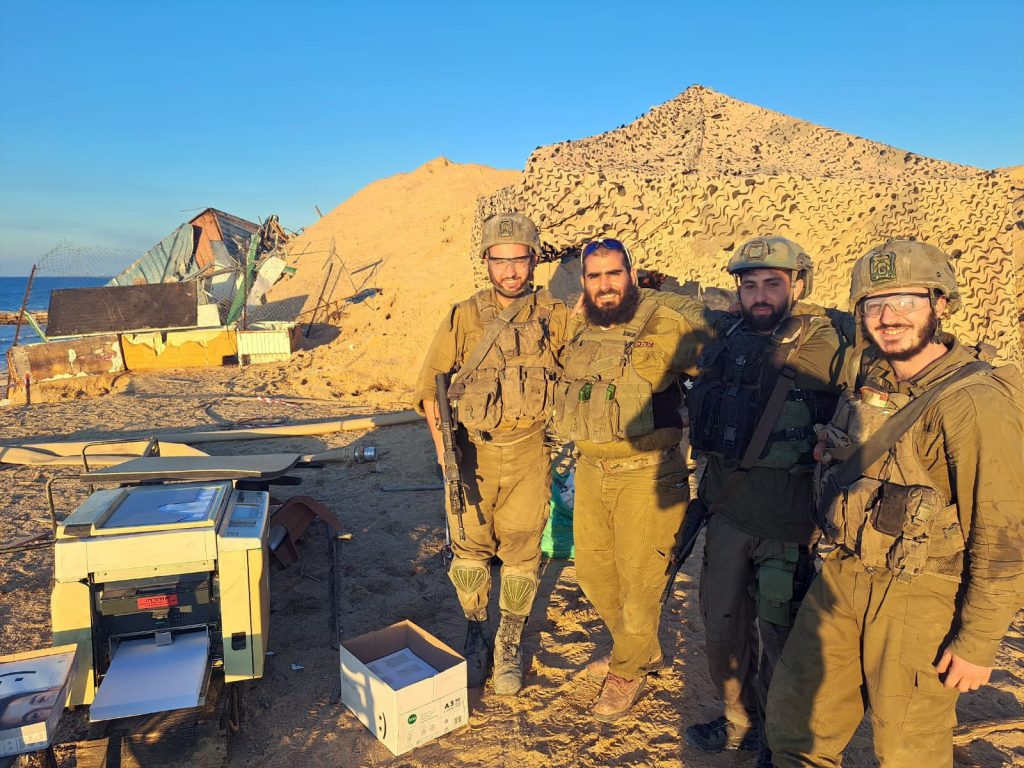
As we started setting up the equipment, soldiers noticed our generator, printing machine, and other equipment. Their curiosity grew, and they approached us, asking questions. This was a perfect opportunity to explain that we were about to print the Tanya and through this, we would defeat our enemies.
Some soldiers had previously visited Chabad Houses and began explaining the Tanya’s importance to their comrades – its guidance in serving Hashem. The event visibly lifted their spirits. I began moving among the soldiers, putting tefillin on dozens of them.
The moment we pressed the machine’s button and printed pages began rolling out, a tremendous excitement engulfed me. I thought to myself: Here we are beginning to return the shechina, the wellsprings themselves – the Tanya – to the holy soil of Eretz Yisrael.
After long hours, we completed the printing and were preparing to return. By Divine Providence, our driver received an escort out of the Strip. We boarded and traveled with stacks of neatly arranged Tanya pages, heading to be bound.
A clear message resonated: Even in the darkest moments, the light of Torah and Chassidus can penetrate, bringing hope and divine protection to our brave soldiers and our beloved land.
A Higher Purpose
Initially, I didn’t want to publicize the matter, as after the initial permit expired, I hadn’t received a formal follow-up authorization. As a result, I didn’t send any videos from the event to friends or family. However, one of the soldiers who participated in the printing released a video, and it began to spread across all social media platforms. Suddenly, I received the video on my device with many warm responses.
The day after, my battalion commander called me and began to scold me: “What is this? Are you crazy! You’re not normal! You didn’t have authorization for this, how did you do this?” After the reprimand, his tone of voice changed, and he revealed that he actually loved the idea: “You don’t know how you raised the morale of the soldiers who were there… The soldiers were ‘fired up’ and were very happy, you gave them a lot of strength to continue fighting,” he said…
I knew the Rebbe was managing the entire situation.
A Veteran’s Encounter with the Rebbe: A Story of Divine Providence
During the fighting, when I wanted to rest a bit, I would request a guard shift. In this role, one can rest a bit from the battle’s intensity, as it doesn’t require too much effort.
One time, while sitting at the entrance, suddenly a elderly man introduced himself as ‘Steve’, and by his Jewish name, ‘Zalman Chaim’. It turned out he wanted very much to help the soldiers fighting on the front lines. He had been thinking about what an 83-year-old could do for them. He and some of his friends had decided to prepare food for the soldiers to pamper them…
When he saw my red shoes, he asked if I was serving in the paratroopers. Without waiting for an answer, he showed me the tattoo of a U.S. Army Paratroopers unit on his hand, with a Star of David underneath. “There are those in America who claim that Jews don’t enlist in the millitary,” he explained, “so here I am, a Jew who also enlisted and is proud of it.”
I suggested he put on tefillin, but he refused, saying it didn’t interest him.
After placing the food packages he brought, he started returning to his car. I thought to myself, a Jewish-American, 83 years old – there’s a high chance he might have a story about the Rebbe.
Before he could get into his car, I asked: “Do you know the Lubavitcher Rebbe? Maybe you have a story connected to him?”
He turned, gave me a long look and said, “Certainly,” and approached me, sat down, and began to tell his story…
***
“In the year 5751 (1991), the Gulf War broke out. Saddam Hussein yemach shemo, was threatening to kill the Jews of Israel with chemical Scud missiles. During those days, I had decided in my heart to fly and help the Jews in the Land of Israel. I made phone calls trying to find a civilian organization where I could volunteer and help as much as possible.”
Someone told him that all civilians were staying in their homes during this period, and there was no need for help. However, if he still wanted to help, he could volunteer at ‘Yad Sarah’. He felt this was a ridiculous suggestion, as someone who had served as a fighter in the past, he had hoped to receive a more meaningful role.
A friend of his, sensing his frustration, said: “Why are you feeling this way? Come with me to the Lubavitcher Rebbe on Sunday, we’ll pass by him when he’s distributing dollars, and you can ask him for a blessing and advice.”
He thought to himself that he had nothing to lose, and they would go.
“On the next Sunday, we traveled to Crown Heights to meet the Rebbe. I saw the Rebbe first. The Rebbe handed me a dollar and wished ‘bracha v’hatzlacha,’ and I continued moving forward. My friend, who passed after me, also received a dollar and immediately said to the Rebbe, “Rebbe, my friend is going to travel to the Land of Israel to volunteer at ‘Yad Sarah’ for the war.”
“They called me back, and the Rebbe looked at me, gave me an additional dollar, and again said ‘bracha v’hatzlacha.’ At that moment, I felt such a good feeling. I felt that this was my purpose, my mission – to fly to the Land of Israel and volunteer at ‘Yad Sarah’. All the previous bitterness disappeared.
“I landed in Israel and arrived at the ‘Yad Sarah’ offices in Jerusalem. They explained to me that my current role was to go around to houses and stick plastic sheeting on windows to protect the residents from shrapnel and shock waves, so they would not shatter and cause damage, G-d forbid.
“I received a car and started driving according to the list I was given.
“During one of the trips, I arrived at a house where a woman lived alone. I knocked on the door and asked to enter. The woman behind the door asked, ‘Who is it?’ I answered that I was from ‘Yad Sarah’, but due to my heavy American accent, the woman heard ‘Yad Satan’… She began screaming at me, ‘Get away from here immediately,’ and ‘blessed’ me with various curses… I understood that because of my accent, she didn’t understand, and I repeated slowly ‘Y-a-d S-a-r-a-h.’ Only after she understood did she open the door and apologize. She said she was alone and afraid. She was so tense that I thought she might not be entirely normal.
“I went to work and started applying plastic sheeting on all the salon windows. When I finished, I moved to the bedroom. Suddenly, I noticed that above the woman’s bed was none other than a picture of the Rebbe.
“I asked her, ‘What is your connection to this picture?’ and she simply responded, ‘What do you mean? The Rebbe of Lubavitch is the amulet of my house, he protects me.’
“At that moment, I felt that the extra dollar I received from the Rebbe as a ‘blessing and success’ to volunteer at ‘Yad Sarah’ was meant to arrive to this woman.
“I told her, ‘You know, I have a dollar for you from the Rebbe of Lubavitch.’
“I went to the car and brought the dollar I had received.
“The moment she received the dollar, she became calm. Not only that, but she asked me to stop applying plastic to the window ‘“because there’s no need’ and offered me water to drink. She began to tell me that her entire family was abroad, and she was the only one remaining in Israel, and she was terribly afraid. She was very grateful for the dollar and began to tell me something in Hebrew about the Rebbe. I didn’t understand much Hebrew in those days, so I nodded my head, wished her well, and went on my way.
“The moment I left her house, I felt that I had just completed an important mission.”
Zalman Chaim (Steve) finished the story, stood up, and said: “Nu, now let’s put on tefillin!”
For my part, I felt that this story about the Rebbe was a message of encouragement and strength here in the midst of the fighting days…
Beis Moshiach #1440 • pp. 24-29
© 2026 Beis Moshiach Magazine. All rights reserved.
This article originally appeared in Beis Moshiach #1440. You are welcome to share it with friends and family by email or in print, provided that you do not change, add to or omit any part of it, you credit the author and Beis Moshiach, and you include a link to archive.bmoshiach.org (written out in full in printed copies).
To republish this article in a newspaper, magazine, book or website, please request permission in advance at [email protected].