“Rebbe-Moshiach, Moshiach-Rebbe – It’s One Thing!”

Rabbi Leibel Groner’s eyewitness account of the Frierdiker Rebbe’s final years in this world including the Rebbe’s (then, “the Ramash”) heartfelt farbrengens with the Chassidim which many times focused on hiskashrus and Moshiach
Before conducting this interview with Rabbi Groner a”h about ten years ago, I did not imagine how many details had yet to be recounted from those early days. It turns out that despite the amazing work done in compiling the work “Yemei Bereishis,” which incorporated the diaries from that period and personal testimony from Chassidim who were present at the time, there still remains much that is not known.
The Groner family was very close to the Beis HaRav. It is told that in Iyar 5704, the Ramash attended the bar mitzva of R’ Groner and even spoke at length, for about an hour and twenty minutes. At the end of his talk, the Rebbe turned to the young R’ Groner and asked him, “Leibel, did you understand what was discussed?” When R’ Groner remained silent, the Rebbe responded, “There is nothing to be ashamed of; many of those standing on the side did not understand either.”
[For editorial purposes, henceforth we will use only the terms Rebbe Rayatz to refer to him, and “Rebbe” to refer to the Rebbe MH”M. The following is presented in first person as recounted by Rabbi Groner]:
Yechidus With The Rebbe Rayatz “I Had Some Nachas From You”
The first time that I merited to enter for yechidus with the Rebbe Rayatz was in the month of Tishrei 5706. The Rebbe Rayatz wished to open a yeshiva “Tomchei Tmimim Lubavitch” in Chicago, and to this end he chose five young bachurim age 15, and I merited being one of them. As such, we were the first “student shluchim” in America.
The Rebbe Rayatz instructed that we travel to Chicago on the day after Yom Kippur. He appointed R’ Yosef Wineberg as the mashpia of the yeshiva and R’ Avrohom Mordechai Hershberg as the Rosh Yeshiva. When we asked R’ Wineberg when the learning would begin, he said after Simchas Torah. We asked R’ Yochil Simpson, the Rebbe Rayatz’s gabbai, to ask whether we could spend Tishrei in Beis Chayeinu. The Rebbe Rayatz’s answer was unequivocal with an eternal message, “When ordered, one must obey.”
The day after Yom Kippur, at seven in the evening, we had yechidus with the Rebbe Rayatz. Since the Rebbe Rayatz did not sleep in his room on Yom Kippur, they would bring his bed to the yechidus room and it was still there when we walked in. The Rebbe Rayatz blessed us for the upcoming shlichus.
Before Pesach, the Rebbe Rayatz allowed us to return to spend Yom Tov with our families. After Pesach, I asked R’ Simpson whether we could have yechidus again before returning to shlichus. R’ Simpson said no, since we had had yechidus just a few months before. I asked him to ask the Rebbe Rayatz and after he asked, he was told to accept us for yechidus the following day at two in the afternoon.
When we entered, the Rebbe Rayatz asked: When are you going? We said, today. The Rebbe Rayatz said: Your trip to Chicago has a two-fold purpose. You are going for yourselves, to be examples of what a talmid in Tomchei Tmimim is. A talmid in Tomchei Tmimim needs to behave according to Chassidus, not only according to Torah; a talmid of Tomchei Tmimim needs to behave also according to Chassidus. I had a little nachas from you, but more is needed. I heard that you publicly review maamarim. I had nachas ruach from that. Reviewing in public is something you must do, but that is not enough. You need to put it into practice. If you review a maamar that deals with matters of avoda, you need to put it into practice with avoda. You need to learn and be devoted to learning and put the learning into practice. I’m not talking about other times; during rest time, you need to rest, but you need to be actually involved in learning. You need to want to learn and be able to learn.
The Rebbe Rayatz added: You are not going with your own kochos; you are given kochos.
In conclusion, the Rebbe Rayatz said: I want to focus your attention and bless you, the talmidim of your yeshiva and the young boys of Chicago. Be successful in your shlichus. Travel in peace and be healthy, physically and spiritually.
Yom Kippur 5710 – The Rebbe Rashab Visits The Rebbe Rayatz
Every Shabbos and Yom Tov, and also on the Yomim Noraim, they would daven in Rebbetzin Shterna Sarah’s room, which adjoined the Rebbe Rayatz’s room. The Rebbe Rayatz would leave his room for the minyan only for the Torah reading, the tekios on Rosh Hashana and for Maftir on Yom Kippur.
(When the Rebbe Rayatz set up residence in 770, he arranged for his mother to be in the room next to the yechidus room, saying he needed to be near her. When she passed away on 13 Shvat 5702, the Rebbe Rayatz was in Chicago. When he returned, he said to R’ Shmuel Levitin: I should not have traveled. I should not have left my mother alone. If I had been here, all would have continued …)
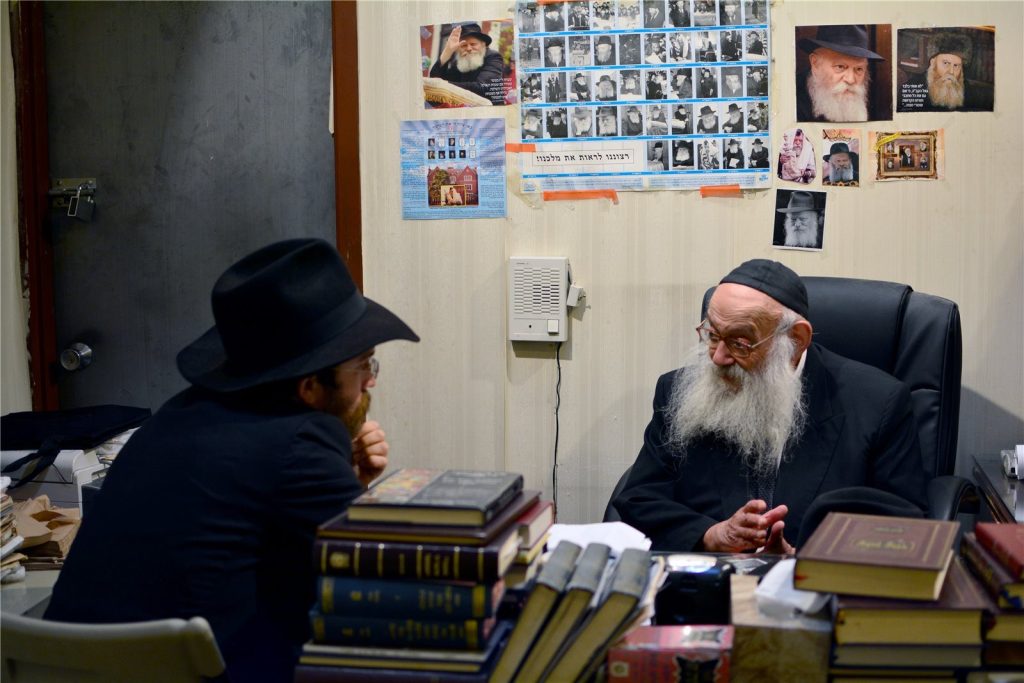
On Yom Kippur 5710, I attended this special minyan along with the elder Chassidim like R’ Shmuel Levitin, R’ Yisroel Jacobson, R’ Yochanan Gordon, R’ Berel Rivkin, and R’ Berel Chaskind. The Rebbe Rayatz was always particular about davening Mincha before sunset but that year sunset came and passed and the Rebbe Rayatz had yet to come out of his room. R’ Yisroel Jacobson tensely said: The sun is about to set. R’ Yochanan Gordon said to him: Yisroel, Hashem has two zun (zun in Yiddish means both sun and son), one zun here and one zun there, and the zun here directs the zun there.
The Rebbe Rayatz’s grandson came out very late and said: My grandfather said that this time he will not be leaving his room. The Torah reading and Maftir will take place in his room and only ten people will be allowed into his room. My grandfather said who the ten men are: My father (Rashag), my uncle (Ramash), me, the Torah reader, a Kohen, a Levi, the baal Musaf, the baal Neila, and one more, and other than them nobody else should enter.
The Rebbe Rayatz allowed the door to remain open so the Chassidim who stayed in the Rebbetzin’s room would be able to hear and participate in the minyan. I stood the closest to the yechidus room in the small alcove between the two rooms and I was able to see the Rebbe Rayatz throughout the davening.
The chazan at Mincha was R’ Avrohom Ziskind who was an oveid and usually davened very slowly. Since it was late, the Rebbe told him: R’ Avrohom, speed up the davening. He began rushing and then the Rebbe Rayatz said to convey that he wasn’t pleased: Why were they rushing? They should daven leisurely. Afterward at Neila, R’ Shmuel Zalmanov went over to the amud and since it was so late and the Rebbe did not want to extend the fast for the Rebbe Rayatz, he told R’ Shmuel: My father-in-law said that regarding Mincha, not Neila. Hurry.
A short while later the Rebbe Rayatz sent a message once again: I said not to rush …
Before they sang “Napoleon’s March,” the Rebbe Rayatz asked everyone to sing as loudly as they are able to and as slowly as possible. Everything was slow and they davened Maariv an entire hour after the fast was over.
On Motzoei Yom Kippur, at the meal, the Rebbe Rayatz said that his father, the Rebbe Rashab, once spoke on Motzoei Yom Kippur about the talent for mental imagery, and he went on to say on that occasion, “This Yom Kippur I felt this palpably.” When they asked him what he meant by this he said: Seeing the face of the Rav.
The Rebbe Rayatz added: Meaning, that Yom Kippur my father saw something that others did not see. And when you stand in such ‘four cubits’ you need to be altogether different.
After the conclusion of the farbrengen, we went down the wooden staircase with the Rebbe. The Rebbe suddenly turned to R’ Shmuel Levitin and said: Now all is understood about why the Rebbe Rayatz delayed the time for Mincha. The Rebbe Rashab was with the Rebbe today and that is why he could not start Mincha as long as his father was in the room. And since the Rebbe Rashab was revealed here, he did not want to leave this room, nor did he want everyone to enter the room, just a limited number. Now, all is understood.
The Missing Yud In Shlita
The regular chozrim at the Rebbe Rayatz’s farbrengens were R’ Shmuel Zalmanov (who wrote the notes known as hanachos) and R’ Mordechai Mentlick. R’ Mendel Tenenbaum also helped with chazara.
The chazara took place in the small zal right after the farbrengens. Each time, when the farbrengen was over, the Rebbe went down to the small zal and told those present: My father-in-law asked that a written account be prepared of the sichos that were just heard.
After they finished writing the hanachos we gave a copy to the Rebbe Rayatz who edited it.
In my work alongside the Rebbe, I merited to prepare the transcribed notes of the Rebbe Rayatz for publication. The Rebbe gave me the Rebbe Rayatz’s notes on the hanachos. It is interesting to note that sometimes the Rebbe Rayatz made an X on an entire page and on the other side he wrote something new that was not said at the farbrengen. So there were things that were said at farbrengens that were never published, and in the published sichos there were parts that were not said at farbrengens.
* * *
The kuntres of maamarim “Basi L’Gani” for 10-13 Shvat was printed on the Erev Shabbos before the histalkus and the Rebbe brought it to the Rebbe Rayatz before Shabbos. Some people noticed a printing error in the introduction to the maamer in which the word “shlita” following the Rebbe Rayatz’s name was missing the letter “yud.”
Rebbe-Moshiach, Moshiach-Rebbe – It’s The Same Thing
Before the nesius, the Rebbe would farbreng with the Chassidim every Shabbos Mevarchim, at the Simchas Beis HaShoeiva and on special days in the calendar. On a Shabbos of an aufruf, the Rebbe would explain the meaning of the chassan’s name and then the kalla’s name and connect the two, and then explain the connection between the chassan’s father’s name and the kalla’s father’s name, all with extraordinary brilliance and while citing quotations from all over Torah regarding these names. After the passing of the Rebbe Rayatz, the Rebbe stopped doing this.
On the last 12 Tammuz which fell out on Shabbos, the Rebbe Rayatz’s farbrengen took place on Sunday, 13 Tammuz. On Shabbos after the davening, the Rebbe sat and began to farbreng. At the beginning of the farbrengen he said: It is really forbidden to speak now since the Rebbe is here and how can one speak in the Rebbe’s presence? But since the Rebbe wants us to farbreng, we farbreng. There is an advantage in this: Since the Rebbe Rayatz is davening now, our talking will be elevated by the Rebbe Rayatz. What he thinks is good, he will raise up above, and what he thinks is not good, he will cast away.
At that farbrengen, the Rebbe spoke heatedly about the Rebbe Rayatz being Moshiach. He said: I have proof from R’ Avrohom Pariz. He told how the Rebbe Rayatz had recently called for R’ Avrohom and told him to return to Eretz Yisroel. R’ Avrohom called the Rebbe and asked for a parting blessing. The Rebbe told him he could come into the office but R’ Avrohom insisted on an official meeting in the Rebbe’s home. At the end of the meeting, R’ Avrohom Pariz wished the Rebbe: That we meet with the Rebbe (i.e. the Rebbe Rayatz) in the Holy Land.
I asked him, why don’t you wish that we meet with Moshiach in the Holy Land? Do you want to know what R’ Avrohom Pariz said? He said, Rebbe-Moshiach, Moshiach-Rebbe, it’s one thing! When you say Rebbe, you mean Moshiach and when you say Moshiach, you mean Rebbe, and it is not necessary to say both. Thus, I have proof that it is possible to say that the shver is Moshiach.
(In order to appreciate who R’ Avrohom Pariz was, the following story should be told. On Erev Shavuos 5704, the Rebbe Rayatz had him type a maamar for Shavuos. As was common by the Rebbe Rayatz, sometimes he said to copy a paragraph from a previous maamar, stating from where until where should be copied. R’ Avrohom did the typing very quickly and instead of copying the paragraph he was told to copy, he typed the Rebbe Rayatz’s instructions and that is how the maamar was printed. At the farbrengen, the Rebbe Rayatz said that since there was an error in the maamar, although since 5701 he did not say maamarim, now he would say a maamar. Concluded the Rebbe: An error made by R’ Avrohom Pariz also requires study.)
Save Me!
On Shabbos, 10 Shvat 5710, there were only a few Chassidim in 770. What happened during that time I heard afterward from the nurse who was in the Rebbe Rayatz’s apartment, and from R’ Shmuel Levitin who was there as well.
The nurse said that when she went to the yechidus room in the morning, she saw the Rebbe’s head on the desk. She tried to rouse him and when she was unsuccessful she rushed to the third floor to call the oldest daughter who, seeing the situation, rushed to send the bachur Sholom Ber Eichorn (who stayed in the Rebbe’s house) to urgently call Dr. Seligson who lived nearby. When Dr. Seligson arrived, at 7:45, he said the Rebbe Rayatz should be taken to his bed in the bedroom, and he tried to stabilize his condition.
A few minutes before his passing, the Rebbe Rayatz lifted himself up a bit from the bed and exclaimed, “Ratevet mir, ratevet mir! (Save me, save me!) Then he lay back down and a scant few minutes later he passed away.
The Rebbe emphasized afterward that when the Rebbe Rayatz passed away, a Kohen (Sholom Ber Eichorn), a Levi (R’ Shmuel Levitin), and a Yisroel (Dr. Seligson) were present.
R’ Shmuel Levitin sent someone to call for the Rebbe at his house and when the Rebbe arrived, he said that the people living nearby should be told. When the news reached us in Brownsville, R’ Mentlick refused to believe it. He said: It is not possible. Surely there is a mistake. He asked that my father not be told since he was so connected to the Rebbe Rayatz and he feared for his health.
Shocked and shaken we walked to 770, refusing to believe the terrible news. When we arrived and saw the faces of the Chassidim, we knew it was true. Since I was already working for the Rebbe, the Rebbe told me to stand next to him so that if it would be necessary for something to be taken care of, I would be able to do so immediately.
At about two, the Rebbe told me to call Dr. Seligson. I went downstairs and he wasn’t there. I called Dr. Ness who was there and told him: Ramash wants to see you. When he entered the Rebbe Rayatz’s bedroom, the Rebbe told me to leave the room and for a few minutes, they were alone.
After he left the room he told me that the Rebbe saw some movement in the Rebbe Rayatz’s body and he told the doctor that it looked like the soul was still present, and perhaps saying he had passed away was a mistake.
“I examined the heart again,” said Dr. Ness, “and said he had definitely passed away and the movement was a result of air that remains in the body for a few hours after the passing. Ramash refused to believe that his father-in-law had passed away.”
About two hours later, the Rebbe called for his brother-in-law, Rashag, and began walking with him in the corridor on the second floor. Although nobody was near them, they did not speak but just paced back and forth for about half an hour. Throughout this time, the Rebbe grasped his brother-in-law’s arm.
During the davening, the Rebbe remained upstairs and he asked me to call him when the minyan downstairs reached the Kaddish Yasom, so he could recite it.
During Shabbos we did not see the Rebbe cry. On Motzoei Shabbos, after the final Kaddish, he left the small zal for the elevator and then he stood near the elevator and began to sob loudly, with heartrending tears.
Then he asked that we call the secretary, R’ Moshe Leib Rodstein, and he told him to tell Anash around the world the bitter news. He asked that the chevra kadisha say when the funeral would be and to inform Anash in outlying areas who would want to attend the funeral.
The Rebbe said that only Anash should dig the grave and not the gentile workers. Likewise, he asked that the casket be made out of the Rebbe Rayatz’s lectern.
At night, Rebbetzin Nechama Dina wanted the Rebbe Rayatz moved from the bedroom to the yechidus room where the elder Chassidim did the tahara. After the tahara, the Rebbe said they should allow everyone present to pass by the aron and ask forgiveness. The Rebbe Rayatz’s aron was placed on two benches and the family stood around it and the elder Chassidim entered through the door from the hallway and left through the other door. The emotions felt at that difficult time are impossible to describe.
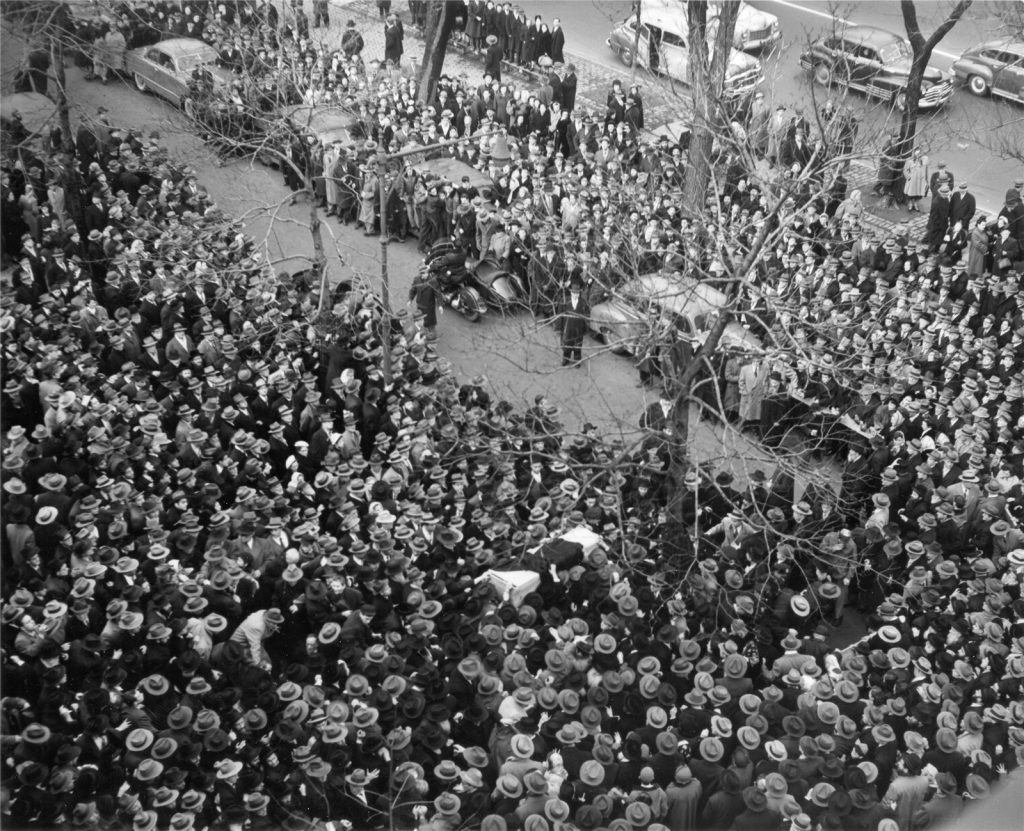
The funeral began at 12:30. When they took the aron out of 770, the Rebbe was on the second floor near the window in Rebbetzin Shterna Sarah’s room. When the aron was close to Brooklyn Avenue, the Rebbe went down and of course they cleared a path for him until he reached the aron. At first, Rashag wanted them to walk with the aron until the yeshiva building on Bedford Avenue, but due to the crowding and pushing, the police said this was not possible. They asked the Rebbe and he said they should go by car to the yeshiva.
The Rebbe Rayatz’s Shabbos silken sirtuk was on the aron. When they placed the aron in the grave, the silken garment disappeared. The Rebbe asked out loud: Where is the shver’s garment? I will not allow them to cover the aron and complete the burial until the garment is returned. Suddenly, the garment reappeared from somewhere and was placed on the aron.
After the burial, the Rebbe and Rashag said Kaddish. The Rebbe tore kriya and when we returned to 770 he said that everyone should tear kriya and sit for an hour. The next day, the Rebbe said that whoever did kriya should sew up the tear, as it is not necessary to walk around like that, but the Rebbe went about with the tear until the Shiva was over.
The day after the funeral, the Rebbe told me: From now on, you will have completely different work.
I understood that quite well.
When Ramash Said To Announce – “The Rebbe Melech Hamoshiach Shlita”
R’ Groner relates:
On Rosh HaShana 5702, after we returned from saying Tashlich at the Botanical Gardens, we stood opposite 770 and the Rebbe asked R’ J. J. Hecht, who was a young bachur with a loud voice, to stand on a bench on the Parkway and make a few announcements as the Rebbe would instruct him, and everybody should repeat after him word for word. The Rebbe told him to say, “Avinu Malkeinu ein lanu Melech ela Ata, Avinu Malkeinu Avinu Ata,” and other Avinu Malkeinus, and then he told him to say:
Avinu Malkeinu, shlach refua shleima lichvod k’dushas Adoneinu Moreinu V’Rabbeinu Melech HaMoshiach shlita!
At first, R’ Hecht hesitated and he told the Rebbe he couldn’t say it. The Rebbe said, then get down from the bench and I will get up and announce it.
Since he saw the Rebbe was adamant about saying it, R’ Hecht said he would say it, and he made the loud announcement with the crowd repeating it after him, word by word.
(At the rally that took place on 21 Elul 5744, R’ Hecht said this story in front of the Rebbe, without repeating the complete version of the Avinu Malkeinu, and he asked the children to stand and announce, “Avinu Malkeinu, shlach lanu Goaleinu Tzidkeinu bi’m’heira b’yameinu.” At that farbrengen, R’ Hecht said that when he made the announcement back then, the Rebbe Rayatz was looking out the window of his room at the Chassidim gathered opposite 770.)
Beis Moshiach #1446 • pp. 12-19
© 2026 Beis Moshiach Magazine. All rights reserved.
This article originally appeared in Beis Moshiach #1446. You are welcome to share it with friends and family by email or in print, provided that you do not change, add to or omit any part of it, you credit the author and Beis Moshiach, and you include a link to archive.bmoshiach.org (written out in full in printed copies).
To republish this article in a newspaper, magazine, book or website, please request permission in advance at [email protected].