The Chronicles of an Ashkenazi Rabbi of the Georgian Community
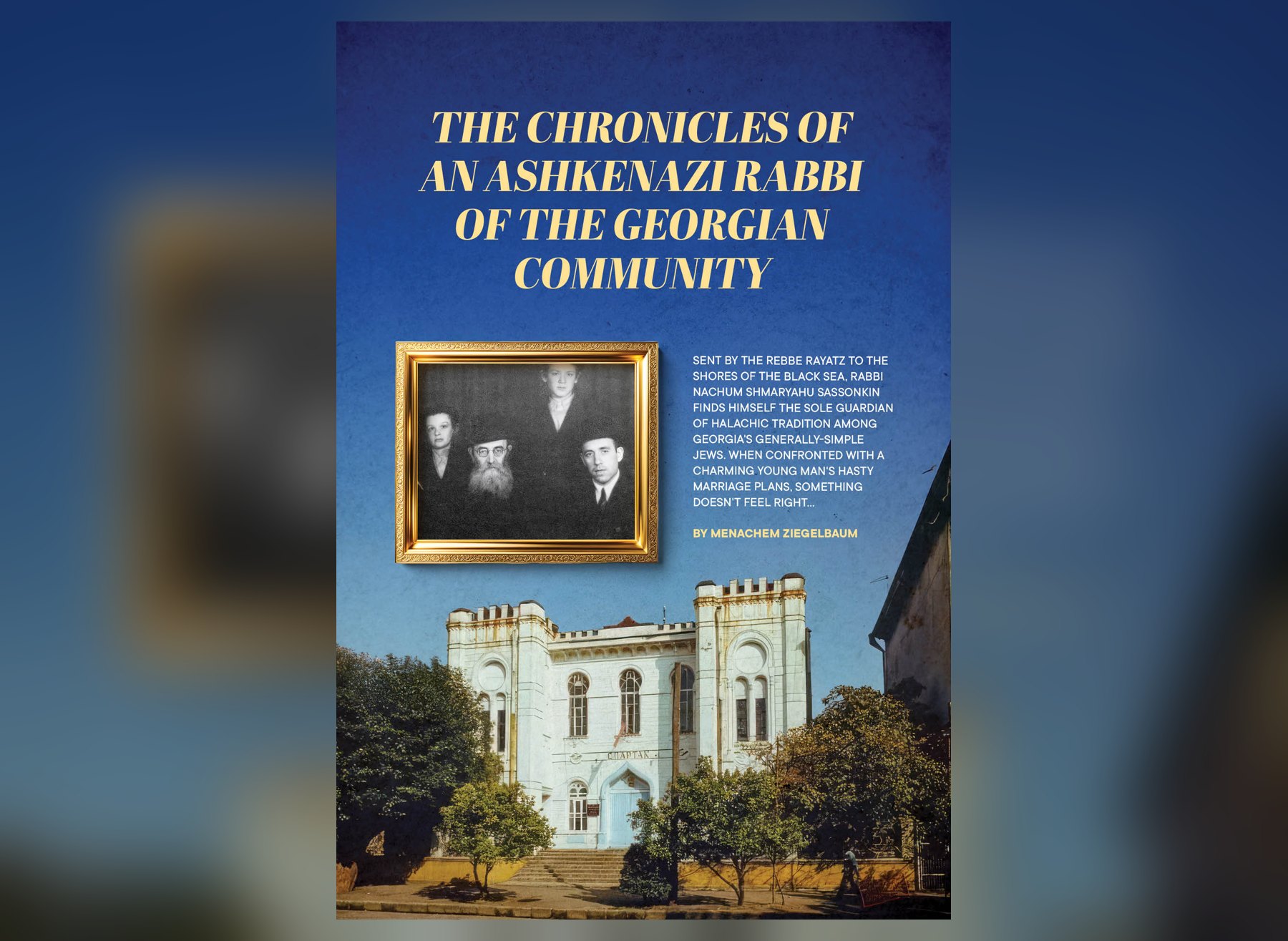
Sent by the Rebbe Rayatz to the shores of the Black Sea, Rabbi Nachum Shmaryahu Sassonkin finds himself the sole guardian of halachic tradition among Georgia’s generally-simple Jews. When confronted with a charming young man’s hasty marriage plans, something doesn’t feel right…
I
A difficult and sensitive mission fell to the Chassid, Rabbi Nachum Shmaryahu Sassonkin, when he served as rabbi of the distant city of Batumi in Georgia.
What brought R’ Sassonkin, a distinctly Ashkenazi man, to such a distant Georgian city?
In fact, his arrival in the city and role as rav came through the personal shlichus of the Rebbe Rayatz, who asked him to establish Torah and halacha in this city, which had many Jews but lacked any halachic authority to oversee religious and halachic matters.
Without a rav moreh horaah to provide guidance, the boundaries of Jewish law were exposed to outside influences. R’ Sassonkin, who came from distant Leningrad, stood fearlessly and defended the ramparts of Torah Judaism with self-sacrifice, even in times when things were not easy at all.
“I saw siyata d’shmaya in every matter that came to me,” wrote R’ Sassonkin several times in his memoirs, and he provides several examples of his heavenly success.
II
One day, several prominent community members appeared at the Rabbi’s house and asked to ‘grant him the privilege’ of the mitzva of conversion. They told him about a young non-Jew who sincerely wished to convert. The Rav, following the Jewish halachic tradition – rejected the convert “with both hands.”
Those seeking the ‘welfare’ of the goy expressed strong resentment that the Rav was rejecting someone who wanted to join the Jewish people…
These people didn’t give up, and on their own authority assembled a Beis Din of three laymen and “converted” the young non-Jew. Shortly after, he married a Jewish girl with whom he had been in a relationship. It turned out that the girl had refused to marry him before he converted, and this demand was behind his desire to convert.
Only half a year passed before the young couple quarreled. In his anger, the non-Jew shouted at his wife “You dirty Jew…” and abandoned her to her fate.
A few months passed until she gave birth to a son; a few community members helped her arrange a bris for the child. During the bris, the mother burst into bitter tears over why she had to get into all this trouble.
It was then that all saw how right the Rav had been and everyone bowed their heads in submission.
III
The Jews of Batumi were simple people. Not all knew the rules, statutes, and laws of Toras Hashem. Some were ignorant of halacha, and in their innocence sought to be lenient or ‘cut corners’ in religious law, without feeling the need to be overly strict…
R’ Sassonkin, who stood guard, feared more than anything else dealing with matters of marriage, which require great caution and extra sensitivity. He knew that due to these and other sensitivities, there could be serious problems.
“Every time before arranging a marriage, I was stymied by lack of information; whether the kalla was truly single and the chassan – whether he was truly single,” Rabbi Sassonkin related.
Nevertheless, “I saw, thank G-d, siyata d’shmaya in every matter that came to me” – this was thanks to the Rebbe’s bracha that accompanied him in his rabbinical role.
One day, a young man appeared at the Rav’s house, with a pleasant appearance, named ‘Lyovke.’ He shook the Rav’s hand in greeting and asked for his help.
“I am a young man, single, and have never been married,” Lyovke began smoothly. “I live in the room of the shamash in the shul building; that is my home and dwelling.”
The Rav nodded. He knew Lyovke somewhat. Occasionally he saw him enter the shul, put on tefillin and pray – something quite unusual among young people during that period of Communist persecution.
When a Yud-Tes Kislev farbrengen was held in the shamash’s home under R’ Sassonkin’s direction, Lyovke participated and showed great interest in the story of the holiday. When the Rav read a short megilla he had written about the day’s miracles, Lyovke asked to keep the megilla for himself, as he enjoyed the whole story and wanted to read it again on his own.
For his livelihood, he worked as a laborer in a leather factory owned by a Jew ‘of our own.’
“I have found a woman after my heart, a daughter of the community,” Lyovke said to the Rabbi. “Could you arrange our chuppa and kiddushin?”
The Rabbi sighed quietly. How he dreaded unfamiliar cases…
“I need to know that you and your chosen one are indeed single, and not married to anyone else,” said the Rav. “I must investigate and inquire into the matter.” Lyovke shrugged, and after a few more minutes of conversation, left the Rav’s house, plotting schemes…
IV
It was a Friday, when R’ Sassonkin left the shul after Shacharis. His tallis and tefillin were lovingly tucked under his arm.
Suddenly Lyovke approached him with a girl from the community by his side.
“Good morning, honorable Rabbi,” Lyovke called cheerfully. “Surely you know that today, G-d willing, our wedding will take place!”
The Rav was stunned. Where did the audacity come from to set a wedding ceremony with the participation of the rabbi without getting his approval, especially since the Rav himself had explicitly told him that he needed to thoroughly check the matter before the wedding.
“No!” R’ Sassonkin took a deep breath, “It’s impossible to arrange your wedding today, as such a thing needs to be known weeks in advance. As I told you, I must verify if I’m allowed to arrange your chuppa v’kiddushin!”
“What do you mean,” Lyovke shouted, “don’t you know me?”
“No, I don’t know you!”
Lyovke opened his mouth insolently: “You should know that the wedding will indeed take place today, come what may!”
The unexpected meeting broke the Rav’s spirit. His heart told him that the event would not pass quietly, and he should prepare for what was to come.
Not long after, the kalla’s brother came to the Rav’s house; a young man, also known in the community, and tried to convince the Rav not to be stubborn…
But the Rav, as a faithful guardian of Jewish religious law, patiently and calmly explained to him that it’s impossible to arrange a wedding for someone whose background is unknown. The Rav further warned the future brother-in-law about their failure to notify him of their intentions several weeks in advance. “He should have provided his address and city of residence, so I could assess his character and verify his identity.
“No less than this troubles me, it should trouble you,” the Rav appealed to the brother-in-law’s heart. “How will you handle it if and when it turns out that the man left behind a wife and children?! What will happen if we postpone the wedding for a few weeks and meanwhile investigate the young man’s nature and marital status?!”
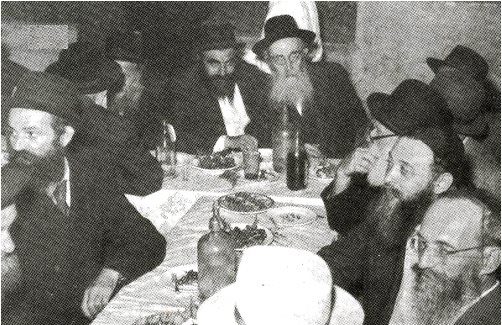
But the brother didn’t give up. “They’ve already set the wedding date for today and have prepared everything, including food for all the guests. The wedding cannot be postponed.”
The Rav, in his great wisdom, understood that the family members would not relent. If he wouldn’t agree to arrange the marriage, they would persuade others to arrange the wedding in his place.
R’ Sassonkin hurried to prevent the problem, and went to the homes of the Georgian community Chacham and shochtim, informing them that within a short time the kalla’s family would likely come to urge them to arrange the wedding ceremony in his place – therefore, he forbade it in the strongest terms.
As the Rav had anticipated, the family members indeed hurried to the shochtim and to the Chacham, but after the warning they had received, they refused to perform the wedding.
The family members, realizing their plan wouldn’t succeed, moved to making threats, saying they would inform the authorities about Rabbi Sassonkin serving as an illegal rabbi – but nothing helped them.
The wedding was indeed canceled and didn’t take place that day. However, this was just the beginning of a great uproar that arose in the city. The family members turned the community against the Rav, portraying him as a harsh person, arguing that “in these times in Soviet Russia, one must accommodate the young generation when they want to arrange a proper religious wedding, and not push them away.”
The propaganda succeeded, and no one in the community stood by the Rav’s side. Even the community leadership, which convened for a special meeting, decided that they needed to “convince” the Rav to show a friendlier face to the young people…
“A rabbi’s role is to do his work faithfully according to Jewish law,” R’ Sassonkin declared. “To arrange a proper Jewish wedding, it’s appropriate to inform me several weeks in advance. If his claims that Lyovke is single are true,” the Rabbi emphasized his reasoning, “why did he arrange the wedding with such suddenness?”
V
Yaakov, a veteran merchant from the community who owned a leather factory, entered R’ Sassonkin’s house. This was the factory where the chassan worked.
He had been sent by community leaders to convince the Rav that Lyovke was a single man eligible to marry his chosen one. The community leaders knew that Lyovke had worked for him for several years, and presumably he knew something about Lyovke’s situation.
“Did your honor send for me to come here?” the merchant asked the Rav when they sat alone.
“No!” replied the Rav briefly.
“I imagine,” the merchant continued, “that I was asked to come here regarding Lyovke, about whom the whole city is in turmoil. Believe me, honorable Rabbi, that I too don’t know him and don’t know who he is, where he came from, or what his past was. But, after all, we are Jews, and since no one else is here, I want to say something in hopes it won’t be revealed, as I too, fear him.”
R’ Sassonkin nodded in agreement.
The Jewish merchant leaned forward, as if sharing a secret:

“A few days ago, I noticed a group of workers standing in the factory whispering among themselves about the fact that Lyovke was planning to marry another woman, while this scoundrel had left behind a wife and three children in his hometown!”
R’ Sassonkin was shocked, but at the same time, a feeling of relief spread through his heart.
The Georgian merchant parted from the Rav with a warm handshake and disappeared from the house.
To conceal the discovery, R’ Sassonkin announced that the factory owner knew nothing about Lyovke’s past, and therefore he would begin investigating him with full vigor.
That same day, he sent a letter to the Rabbi of the town where Lyovke had previously lived, requesting information about Lyovke. “I didn’t know at all if there was a Rav serving there or what his name was, but I tried,” R’ Sassonkin recalled in his memoirs.
About two weeks passed until the Rabbi’s response arrived. “How can a person allow himself to abandon his wife and three children, while she doesn’t know where he suddenly disappeared to,” he wrote bitterly. “If he doesn’t want to continue living with her – he must divorce her but not leave her abandoned as an aguna!”
R’ Sassonkin’s voice was sharp as he read the letter before the members of Batumi’s community leadership. They were shocked.
The news quickly spread throughout the city, and the public understood how great the Rabbi’s foresight was, and how important his caution had been. They regretted their suspicions and doubts about the Rabbi’s actions. Finally, they came to realize that they shouldn’t interfere in rabbinical matters, and that the Rabbi was right about his extra caution regarding marriage arrangements.
Beis Moshiach #1450 • pp. 26-29, 30
© 2026 Beis Moshiach Magazine. All rights reserved.
This article originally appeared in Beis Moshiach #1450. You are welcome to share it with friends and family by email or in print, provided that you do not change, add to or omit any part of it, you credit the author and Beis Moshiach, and you include a link to archive.bmoshiach.org (written out in full in printed copies).
To republish this article in a newspaper, magazine, book or website, please request permission in advance at [email protected].