Two Days In Heaven
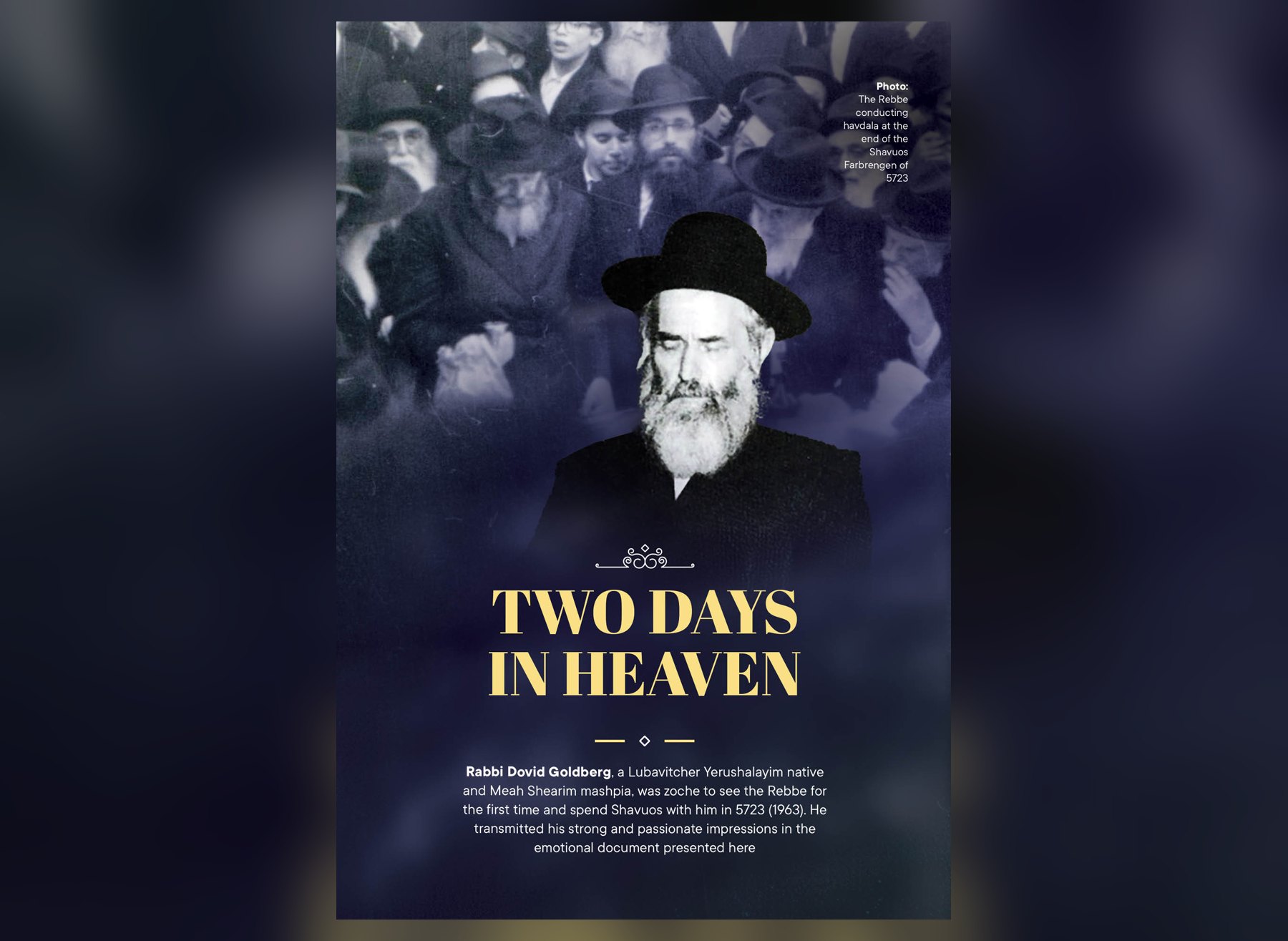
Rabbi Dovid Goldberg, a Lubavitcher Yerushalayim native and Meah Shearim mashpia, was zoche to see the Rebbe for the first time and spend Shavuos with him in 5723 (1963). He transmitted his strong and passionate impressions in the emotional document presented here
Motzoei Shavuos 5723
A special delight wafts up from between the lines of Rabbi Dovid Goldberg’s diary. He was a Chabad Chassid from Yerushalayim who went to the Rebbe, for the first time, in 5723.
“What can I say,” R’ Goldberg waxed nostalgic in his memoirs. “Every moment is precious there. It’s a pity that it ended…”
Bachur and Mashpia
R’ Goldberg was born in Yerushalayim in 5671. He learned in yeshivas Toras Emes in Yerushalayim which was located in the Givat Shaul neighborhood. He was one of the closest talmidim of the mashpia, R’ Alter Simchovitz.
After he finished his learning in Toras Emes, the hanhala asked the Rebbe Rayatz to appoint him as mashgiach for the Chassidus seder. The Rebbe Rayatz approved this and even wrote that they should appoint him as mashpia for Chassidus.
He was the mashpia until 5710 when he decided to leave this position. Some time later, those who davened at the Ohel Yitzchok shul in Meah Shearim appointed him as mashpia of their community.
Rare Opportunity to Go to the Rebbe
Erev Shavuos 5723, R’ Goldberg flew to America. In order to ascertain the reason for the trip, we spoke with his son, R’ Mordechai.
“The reason my father traveled to the Rebbe was because of the wedding of his nephew which took place immediately after Shavuos in New Jersey.
“His sister, my aunt, wanted my father to be the mesader kiddushin at her son’s chuppa and she bought him a ticket. In those days, a ticket cost a fortune and sometimes was equivalent to several months’ salary. This is why my father hadn’t gone to the Rebbe before. This was an opportunity that came to him, and he didn’t have to pay.”
Rabbi Dovid Goldberg went to Beis Chayeinu for the first time in his life and spent Shavuos with the Rebbe. On that visit, he had yechidus.
After an uplifting Yom Tov, he wrote his impassioned impressions in his diary. From the unique style of writing suffused with warm Chassidic feeling, one perceives the intensity of emotion he experienced when he saw the Rebbe for the first time.
Two Days of Pure Spirituality
It’s self understood that the two days of Yom Tov in the diaspora passed in a state of spirituality alone. The first night, we sat up all night and said the Tikkun.
At three in the morning, the Rebbe appeared and said a maamar Chassidus, ‘V’chol Ha’am Ro’im.’ The shul was full and despite the late hour, nobody looked like he wanted to sleep.
The first day of Yom Tov, the second night and the second day, were as usual. On the second day at 8:15, minutes before sunset, the Rebbe appeared and washed for a meal. Everyone had grabbed their places in advance. I was not far from the Rebbe so I could hear every word he said, and here is where the giluyim began.
First, the Rebbe asked whether everyone had washed and asked that people say l’chaim. He began to speak and he spoke three times with breaks, when they sang niggunim. The farbrengen went on until two in the morning.
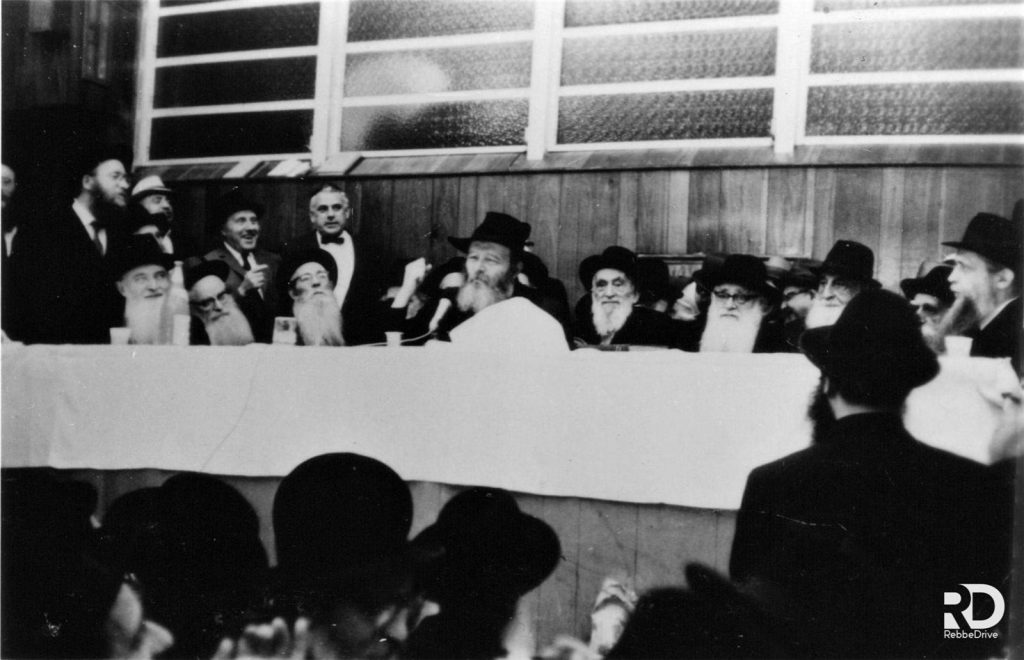
Impoverished is my pen to be able to convey the emotions of the crowd throughout the night. Although we hadn’t slept on the previous nights, we didn’t feel tired. Our feeling was that we were flying in a higher world that we had never seen or heard before.
There was absolute silence in the room. Hundreds of eyes were fixed on the Rebbe’s glowing face. The clarity of the words coming from his holy mouth engendered an immeasurable pleasure (by the way, the women’s section was also full all night). During these hours one forgets the existence of the world and its pleasures; the words penetrate the heart and mind and I am sure that if this feeling remained throughout all the days, the yetzer hara would have nothing to do.
It was very interesting to see the change of his expression depending on the subject. For example, when he said a sicha, his face was serious and he cast glances on every side. When we began to sing, his face turned joyous and everyone said l’chaim. You hold the cup and raise your hand until the Rebbe looks at you and then you say l’chaim.
Suddenly, his face grew very serious and he indicated that the niggun which is sung before the saying of Chassidus should be sung. After the niggun, instantaneously everyone stood up and the Rebbe began a maamar. His eyes were closed and his face contracted like someone thinking deeply into a matter of intellect. This went on for nearly an hour. The maamar ended and singing began and as though conducting a choir, the Rebbe conducted with his hand. When there was no movement of his hand, we sang in a regular tone. When he began to raise his hand and bang on the table, we sang more forcefully.
Since, on Isru Chag Shavuos, the learned people convene and say a pilpul [i.e. the Kinus Torah], the Rebbe began saying a pilpul in Nigleh [by way of his participation in the Kinus Torah].
Then he indicated that the Alter Rebbe’s niggun be sung. He sat motionless and listened with eyes closed. After the niggun, he indicated they should sing the well known niggun, “Nye Zhuritse Khloptzi” and then something transpired which it pays to come from all over the world to see, hear and delight in. That is, in the middle of the niggun, the Rebbe got up from his chair, followed by everyone in the room, and began swinging his hands in a way that his whole body shook, and he began to rise up. His face was awesome and strained at the same time, like someone wanting to lift something heavy that is beyond his abilities and he is marshaling all of his powers at this moment, and the entire crowd automatically got up from their seats and sang with all their might.
One can definitely apply the statement of Chazal, “Whoever didn’t see this joy, never saw joy in his life.”
At this moment, we thought there was no sadness and grief in the world. What value was there to any material pleasures compared to this spiritual delight. Many had tears of joy in their eyes and they had to restrain themselves greatly not to let it show. In front of us was a man who looked like anyone else, without a shtreimel etc, and you see in him spiritual powers which cannot be captured in ink, only the heart and mind feel/recognize that only a hidden and concealed G-dly energy is leading the way and enlivening dry bones that are used to being immersed in material pleasures which are not lacking in the United States.
After this scene, the Rebbe suddenly sat down and in a flash, so did everyone else (whoever had a seat), and he began to say “Shir HaMaalos’ before birkas ha’mazon. After Maariv, he made havdala and gave out kos shel bracha to all. This ended at two a.m.
What can I say… it’s a pity that it ended. Every moment is precious there. The Rebbe spoke a lot about valuing time and directed his words particularly to the yeshiva students.
On the second day of Yom Tov, dozens of Anash went out to speak in shuls, some three hours away; and it was pouring.
On Shabbos, parshas Naso, there was a farbrengen and the Rebbe spoke in continuation of the sichos and pilpul of Shavuos. The Rebbe noted that there were two things he hadn’t said on Shavuos:
1-He blessed Kfar Chabad where the people had came from Russia and settled and said, “Whoever is tight in parnassa can join in and grab.” Hearing this, everyone began saying l’chaim and there was a big commotion. The Rebbe said the noise here was like that of the “ofanim.”
2-He spoke about someone who rose to greatness that he has the privilege that on the first day [after being elected president – referring to Shazar] he made “peace between man and wife.” The Rebbe said he had information that this entailed great difficulty. He then said that there is a rule, “Whoever rises to greatness is forgiven for all of his sins,” and this is regarding the past. As for the future, it says, “Whoever is greater than his friend etc.” and he spoke a lot about this subject. The Rebbe blessed him: What was, was. From now on, may he merit to spread Torah and Yiddishkeit.
Recounting His Visit
An interesting detail that wasn’t written in his diary is something his son, R’ Mordechai, adds:
“My father said that back then, the big zal downstairs hadn’t been expanded yet and it was very crowded in the small zal. Many Chassidim had to read the Tikkun Leil Shavuos outside of 770 by the light of streetlights. But even this didn’t dampen whatsoever the general wondrous feeling that was present throughout the entire time he spent in the ‘dalet amos’ of the Nasi HaDor.”
Another interesting fact from R’ Mordechai Goldberg:
“On the Shabbos after my father returned home, he farbrenged in the Ohel Yitzchok shul in Meah Shearim about what he saw and heard in 770. He described the shivery feeling he had when he saw the Rebbe for the first time. He also reviewed the point of the maamar and ideas from the sichos that the Rebbe said on the special, elevating Yom Tov that he had.”
Beis Moshiach #1412 • pp. 22-25
© 2026 Beis Moshiach Magazine. All rights reserved.
This article originally appeared in Beis Moshiach #1412. You are welcome to share it with friends and family by email or in print, provided that you do not change, add to or omit any part of it, you credit the author and Beis Moshiach, and you include a link to archive.bmoshiach.org (written out in full in printed copies).
To republish this article in a newspaper, magazine, book or website, please request permission in advance at [email protected].