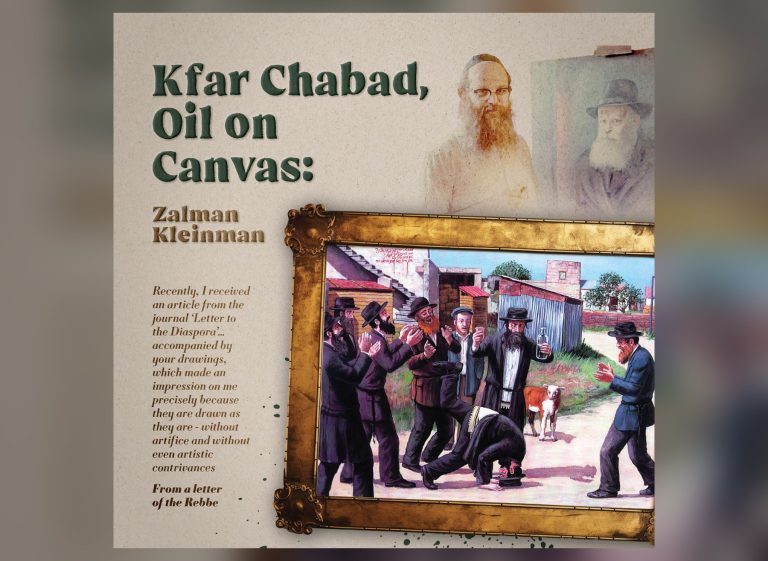
An Art Show Hosted by the Rebbe
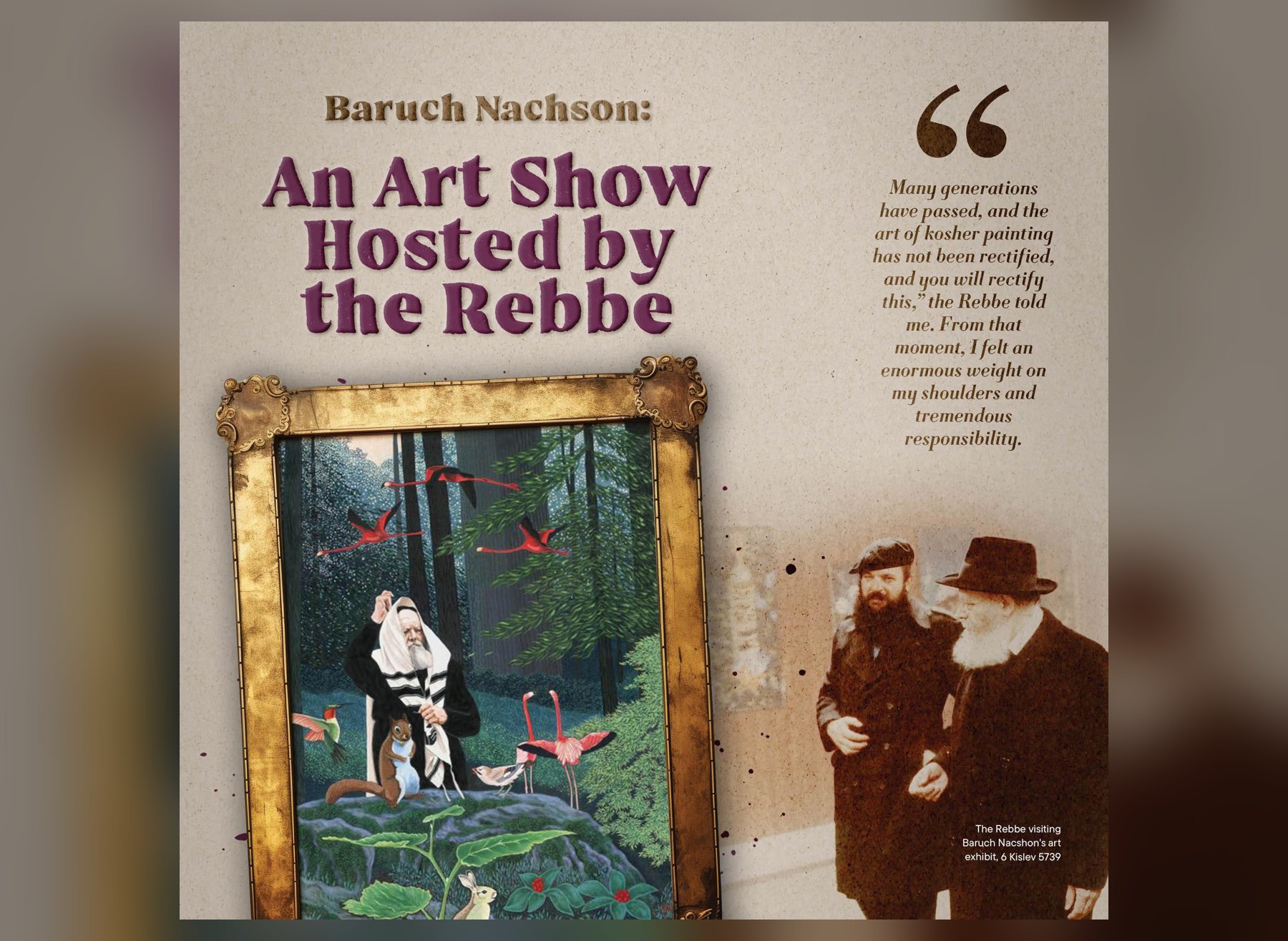
Reb Baruch Nachshon was born in Haifa on the 15th of Menachem Av, 5699 (1939). He grew up in an environment far from Torah and Judaism.
His painting career essentially began in kindergarten… when his teacher wanted some quiet from young Baruch, she would give him papers and crayons, and that was the only thing that would calm him down…
Even in school, he couldn’t find peace. “The atmosphere there weighed heavily on me emotionally. I would go out to the fields. I spent much time hiking in the mountains, developing my artistic imagination, also using the shadows of clouds and sun through a vibrating glass door in our home. I could observe for hours through this glass, thereby enriching my imaginative and artistic powers.”
Beginnings: Nachshon’s Professional and Spiritual Masters
At age 11, he met the art instructor Shlomo Nirni (Narinsky), one of the first photographers who lived in Eretz Yisrael at the beginning of the century. He lived in a solitary house on Mount Carmel, and young Baruch was the only one he permitted to stand behind him as he photographed. “He felt I was his spiritual heir in art. I definitely received the artistic atmosphere from Nirni.”
Baruch’s parents, recognizing their son’s potential, encouraged him to study with Nirni. For several years, he visited him weekly, learning the craft while developing a deep soul connection with the elderly artist.
During his teenage years, he studied at Kerem B’Yavneh, a religious-Zionist yeshiva.
One night, on the eve of the 19th of Kislev, a student in the yeshiva announced they were going to Kfar Chabad for the Yud-Tes Kislev celebration. Baruch asked, “What is Yud-Tes Kislev, and what is Kfar Chabad?” All they could tell him was that it was a village of Chassidim who had managed to escape Stalin’s clutches, and that in every corner there was a barrel of vodka with Chassidim dancing and falling drunk by the roadsides… Nachshon thought this sounded interesting and decided to go see the spectacle for himself.
“When we entered a mostly-empty hall, I heard a group of Chassidim singing melodies that immediately captured my heart,” he later recounted, “and lifted my spirit to high spheres of holiness. I felt the Jewish soul crying out and I said to myself: I belong here.
“I remember that when I first had a private audience with the Rebbe, one of the questions I was asked was ‘How did you get here?’ and I told him the full story and the Rebbe responded with a broad smile… You can say that this trip is what brought me to Chabad.”
After the farbrengen in Kfar Chabad, they took us to the yeshiva in Lod, where I saw spiritually elevated young men. It was a strange sight (one that still stands before my eyes) – Yemenite refugees together with Russian refugees sitting together in a crowded, unaesthetic hall, around a simple table with some bottles of unfamiliar white liquor and a few pitiful tails of herrings… At the head of the table sat Reb Shlomo Chaim, an elderly man with bright eyes, full of joy and inner light, inspiring the students with words of Torah and niggunim full of deep emotion, while in the background the muezzin’s calls from nearby Lod could be heard.”
After this mesmerizing night, joining the yeshiva in Lod was a no-brainer for young Baruch. The young student received a series of letters with guidance and direction from the Rebbe, especially regarding diligence in Torah study. He studied at the yeshiva in Lod for about a year, which left a strong impression on him and paved a light-filled path for his life journey. After his service in IDFs Nachal brigade, he returned to study at in Lod for another year.
Young Baruch began to use his paintbrush and started painting. The yeshiva administrator, Rabbi Efraim Wolf, didn’t know what to do with this ‘creature’ who had landed in his office and was drawing. Instead of learning, boys were wandering around wanting to see the spectacle, which disrupted the normal routine even more. But the mashpia, Reb Shlomo Chaim Kesselman, told R’ Wolf: “He received a special letter from the Rebbe, leave him be.”
“Thanks to that, I remained in yeshiva,” R’ Baruch concluded.
The Mission: “You Will Rectify the Art of Kosher Painting”
In 5722 (1962), Baruch Nachshon married his wife Sarah. The high point for him was, of course, going to meet the Rebbe in person, which happened shortly after his wedding.
“In 5722, I asked to travel to the Rebbe, and I wrote to him about it. The Rebbe didn’t see eye to eye with me regarding the trip and preferred that I stay in Eretz Yisrael. However, when the Rebbe saw my intense desire, he agreed to my coming, and wrote to me:
“…Since you requested once and twice to send you an affidavit, I ordered to send you the affidavit, and it is enclosed with a copy, but my opinion is as above, that it’s better to use the money and time on site [i.e., in Israel]’.”
“After the Rebbe invited me, my wife and I worked for an entire year to finance the travel expenses.”
After three weeks of sailing on a Greek ship, the young couple arrived at the Rebbe’s court.
“My first Yechidus with the Rebbe took place two days after our arrival. This audience lasted more than three and a half hours. I laid out my entire long and tumultuous life journey before the Rebbe. In the Rebbe’s holy room, I felt that everything was open. I felt I was speaking with a man of truth and could tell him the whole truth.
“During that Yechidus, the Rebbe assigned me the mission – which the Rebbe himself testified had not been done since the creation of the world – to rectify the kashrus of painting. ‘Many generations have passed, and the art of kosher painting has not been rectified, and you will rectify this,’ the Rebbe told me. From that moment, I felt an enormous weight on my shoulders and tremendous responsibility. The Rebbe even told me he would give me a one-year scholarship to study art, in addition to funding for rent and living expenses, all at the Rebbe’s expense.”
From Hobby to Vocation: The Rebbe Sent a Weekly Check
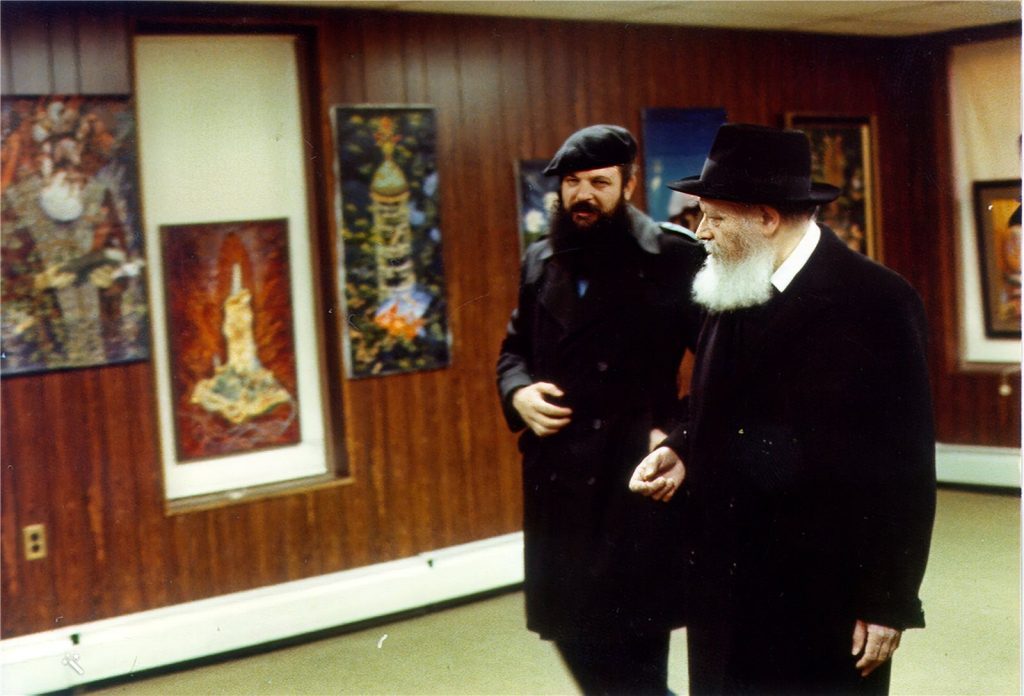
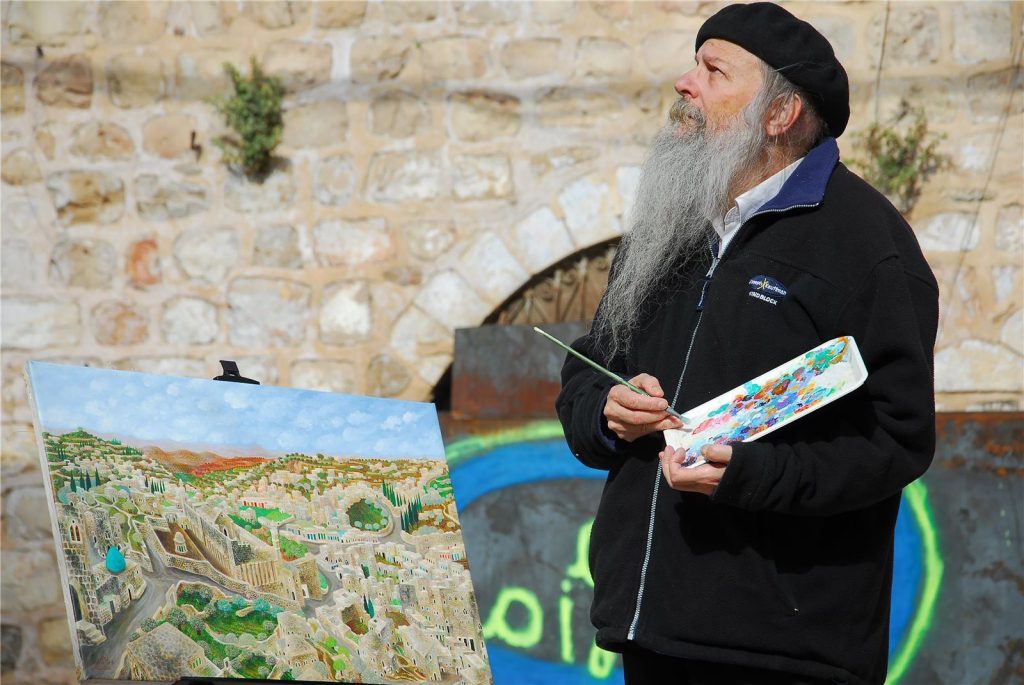
It was a respectable art exhibition held at Beit HaTanach in Tel Aviv, to which all the ‘who’s who’ of the Israeli art scene were invited. Yet the artist-host, Baruch Nachshon, arrived at his own art exhibition wearing rubber sandals, a faded beret (“I want to imitate Rembrandt”) and adorned with a long beard. A thin man with the delicate fingers of an artist and a sense of humor mixed with show talent. How typical of him.
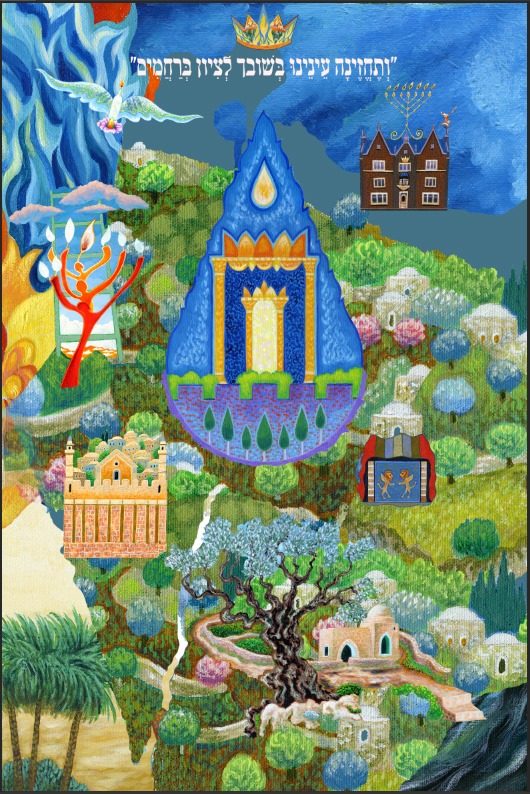
Nachshon, an independent person in every way, paints magnificent Jewish paintings deeply rooted in Jewish motifs, some kabbalistic. His stubbornness in refusing to yield to changing fashions cost him dearly, quite literally.
In fact, the life of international Chassidic artist Rabbi Baruch Nachshon is a constant collision course. On the one hand – his works are rare, masterfully crafted, bold, and groundbreaking. All the factors that could have propelled him forward. On the other hand – he despises the artistic establishment and academia that set rigid rules and frameworks, and he pays a price for it: the price of fame (which he despises with all his might) and the price of professional recognition (which he very much desires) and the lack thereof he feels keenly in the volume of his sales. (-From a media report about Nachshon)
The one who helped his professional career lift off was the Rebbe, who even in the first Yechidus discussed his paintings both as art and as business.
“I asked the Rebbe who would guide me, because I didn’t know the language or mentality then,” R’ Baruch recounted in an interview with Beis Moshiach. “The Rebbe told me, ‘There is a Jew in Boro Park named Nissan Davis. He’s a G-d-fearing man and a young architect. He will guide you.’
“After the Yechidus, I received his address from the secretariat. Nissan Davis turned out to be a Hungarian Breslover Chassid, and he’s the one who, by the Rebbe’s command, went with me to various places.
“At one point, I went with him to the artist and sculptor Chaim Gross. At that meeting, he agreed to give me three scholarships at different institutions where he served as an art professor, but the condition was that I had to participate in all the course series, including studies that were not in the spirit of halacha. I thanked him very much for his generosity and explained that I would do everything to keep the Rebbe’s command to rectify art and make it kosher according to the Shulchan Aruch…
“Fifteen years later, Nissan Davis and I came to him to invite him to an exhibition I was holding in the Lubavitch office building above 770 (the story of which will follow). He was already elderly and not at his best. Nissan showed him an album of my paintings, and he pulled an old memory from his recollection and said that fifteen years earlier, a young Lubavitcher had come to him who he wanted to give several free scholarships to, but he refused to take them because he wanted to keep the command of the Lubavitcher Rebbe. He said at the time that while the Lubavitcher Rebbe understands halacha, Chaim Gross understands art.
“Nissan Davis told him: ‘Here is that young man standing before you’… Chaim Gross looked at me in amazement and at the album of paintings, and he said: ‘Now I see that the Rebbe was right. If you had gone to the academia, you would have been limited and would have had to follow the method of the teacher who taught you, and now you have remained a free, unconstrained person and have reached a level that you could not have reached through any academic study’…”
Throughout his journey, R’ Baruch Nachshon was privileged to receive what few others did: close guidance in the pathways of the art of painting. The Rebbe invested greatly in guiding the ‘sabra’ who had come from Eretz Yisrael, whose soul aspired to greatness, but didn’t know how to express his inner soaring into action (and dollars).
“In that first Yechidus, I asked the Rebbe what ‘kosher painting’ meant,” Nachshon recounted years later. “And the Rebbe told me to ask rabbonim. I approached Rabbi Dworkin and Rabbi Henkin of ‘Ezras Torah,’ and both instructed me exactly what was permitted and what was forbidden.”
The following entry from R’ Baruch’s diary of the 26th of Tammuz 5724/1964 summarizes the instructions and guidance he received in that Yechidus:
“Since I have been gifted with the talent of painting, I must develop it and particularly strive in fine art and express in my work the inner visions of holiness, thereby rectifying the deficiency that has not been filled as of yet, and to be a G-d-fearing artist, and to practically demonstrate that such is possible even without transgressing the Shulchan Aruch. Over time, I should guide young people in the above. During all our exiles and redemptions, this deficiency was not rectified, and in the final Redemption all of these will be rectified, and this is my task.
“Regarding parnassa: I should find a livelihood connected with art, specifically commercial art. The income from it is substantial. I should look into studying the profession in the most expedient way. I should not waste time studying history or English and American literature, and instead focus on learning the profession itself.”
For two years, R’ Baruch Nachshon and his wife Sarah stayed in the United States, with the Rebbe personally taking care of all their needs, so that R’ Baruch could advance and finetune in the art of painting. Every week, the Rebbe sent them a check for their livelihood… R’ Baruch also recounted how before Pesach an unknown woman drove up to their home with a carload of foodstuff for Yom Tov. She said the Rebbe sent her…
The Exhibition in 770: A Royal Visit
“Throughout the years, the Rebbe took interest in how my painting was progressing. During these years, I received countless encouragements and blessings regarding painting and the ability to make a living specifically from it. The Rebbe himself interested various people in my paintings and suggested they help me in selling them!… He even sent me to various exhibitions that took place around the world.
“One of these people was Rabbi Feivish Vogel from England, who organized an exhibition for me in London. Afterward, the Rebbe said to continue the exhibition in Paris as well, even though it wasn’t planned. After the London exhibition, I left the paintings in the safekeeping of Rabbi Berel Futerfas in London, and the following year I told myself it was time to go to the Rebbe and bring the exhibition to the United States.
“The next year, when I came to the Rebbe, I had a Yechidus as usual. While inside, I offered the Rebbe to bring in several original paintings, and then the Rebbe said it would be worthwhile to set up the exhibition in the office building adjacent to 770 and make it open to the public. With a wide smile he added, ‘I will be the opener’…
“The Rebbe indeed came to my exhibition, and for forty-five minutes (an astronomical amount of time in the Rebbe’s terms!) moved around from painting to painting, sharing his comments on the paintings I displayed there.
“The Rebbe stopped by the painting showing a white donkey with the Rebbe sitting on it, with a kind of crown on his head and a lit candle with the verse ‘Menachem mashmi’a shalom’ (the initials of MM”S, the Rebbe’s name). The Rebbe stood by the painting and made a dismissive gesture with his hand and smiled very broadly. To me it was already clear that the Rebbe is the Melech HaMoshiach, and that’s how I painted the Rebbe.
“During the exhibition, the Rebbe asked me various questions, and among other things asked if there were dancing Chassidim in my paintings? I told the Rebbe I hadn’t painted any, because until then I had been painting according to my emotional state… Indeed, since then I make sure to include dancing Chassidim; for example, there is a painting where the Rebbe holds dancing Chassidim with both of his holy hands… or a picture where the Rebbe comes to Chevron with dozens of dancing Chassidim in the background. And so many now identify my paintings with the dancing Chassidim.
“In one of the paintings in the exhibition, a righteous person and a wicked person were depicted, with the wicked person above and the righteous below. The Rebbe remarked that the righteous person should always be above. Indeed, after the exhibition the painting was corrected and the righteous person was ‘upgraded’ to the top, as I added a Jew with tzitzis above the wicked person.
“At the end of the exhibition, the Rebbe asked me to disseminate the paintings through all means and throughout the world.”
The Rebbe’s Guidance on Art
“Once, during a private audience, the Rebbe asked me if I had painted while I was here. I replied to the Rebbe that I hadn’t painted because I was in a dark mood. The Rebbe told me that an artist who doesn’t paint falls into melancholy, and instructed me to paint wherever I travel. Since then, I make sure to paint wherever I go.
“The following incident happened about a year after the exhibition, when I had come to the Rebbe for the Yamim Noraim. As I was passing by during the lekach distribution, the Rebbe asked me to visit Mr. Chaim Potok, who was a Conservative rabbi and well-known author in the United States. During this lekach distribution, it was rare to receive such an assignment…
“I traveled to Mr. Potok along with Rabbi Avraham Shemtov. As soon as I arrived, he remembered me from when we had met after a lecture he gave at the Van Leer Institute in Yerushalayim. An interesting conversation developed between us as we recalled memories from that meeting. Afterward, he said to me: ‘If the Rebbe sent you to me, then I need to give you some advice about your profession. First: do all the public relations for your paintings at this age already. Second: don’t do anything without consulting a lawyer. Third: the center of the art world is New York City.’
“For me, the advice he gave was advice that the Rebbe had given me, but it came through him…
“Today, many years after that meeting, it seems to me that if I had listened and implemented his advice more, my situation would have been better in terms of the public relations for my paintings.”
“Painting My Rebbe”
When asked about the volume of his artistic output over the years, he responded with characteristic humility and a hint of wistfulness. “It’s hard to know,” he said, leaning back in his chair. “Many of the paintings have disappeared; I left them in various places.” He mentioned that a virtual gallery currently [at the time of the interview] being developed contains approximately five hundred of his works, covering diverse subjects, including numerous depictions of the Rebbe.
His portrayals of the Rebbe seem to carry special significance. Nachshon’s eyes lit up when discussing these pieces.
“One of the amazing phenomena I witnessed with the Rebbe was the distribution of dollars for tzedaka,” he explained. He described how thousands of Jews would stand in line to receive a dollar bill from the Rebbe’s hand. “I saw this whole matter as a spiritual one of bringing the Geula closer,” he continued, gesturing animatedly.
This perspective inspired a painting where the Rebbe appears against the backdrop of 770, with tzedaka coins emanating from the building and the Rebbe’s dollars floating on water. According to Nachshon, the painting contains numerous other details that convey the profound significance of this dollar distribution.
He then described another powerful image: the Rebbe positioned between the Beis HaMikdash above and Shaar Yafo (the Jaffa Gate) below – symbolizing the yearning to see the Rebbe reveled as Moshiach in the rebuilt Yerushalayim.
Perhaps most striking is his description of a third painting showing the Rebbe emerging from a sealed shell while holding a Sefer Torah. When I asked what this represented, Nachshon’s voice softened: “It’s an expression of longing and yearning to see the Rebbe coming out and redeeming Am Yisrael when he is revealed as Melech HaMoshiach.”
The level of detail and devotion in his work became apparent when inquired about the time investment these paintings required. “I remember that in a certain painting of the Rebbe,” he shared with a thoughtful smile, “I worked just on the eye for six straight hours!”
Impact
When asked about the effect his paintings have had on others, he shared three remarkable stories.
“I was once at an exhibition in Australia,” he began. “A Jewish man came in with his non-Jewish spouse, seeking a painting of the Rebbe. ‘I am Jewish and I want something Jewish to remind me that I am Jewish,’ he told me earnestly.” Nachshon reflected on this moment with gentle insight: “That’s when I understood how important it is to have something Jewish on the walls.”
At that same exhibition, an unexpected reunion occurred. Nachshon noticed a man with an unusually thick mustache in the fashion of the late 1800s and remarked to his wife that he resembled the guards from early Petach Tikvah. To his surprise, this stranger approached him with a smile and produced from his pocket a drawing that Nachshon had given him decades earlier, in 5718 (1958).
“He introduced himself as Captain Chaim Halperin,” Nachshon recounted. “He reminded me that we had met many years before, when I had enthusiastically told him about the Chassidim who had settled in Kfar Chabad.”
The captain’s words to Nachshon were profound: “You think I forgot that conversation? Perhaps you remember King Shlomo’s proverb, ‘Cast your bread upon the waters, for after many days you will find it.’ Oceans separate us, but Heaven wanted to show you that the result doesn’t always appear in the same place. Since that conversation, I have drawn closer to Yiddishkeit, and today my children study in Lubavitch institutions.”
Reb Baruch shared another equally moving encounter. In 5752 (1992), at an extended stay at the Rebbe’s court, he received an unexpected phone call. “A woman who introduced herself as Chana Cohen told me with great emotion that she had been trying to find me for twenty years because she wanted to thank me for saving her life.”
She explained that years earlier, she had worked as a secretary for a law firm that specialized in pursuing cases against senators and congressmen in Washington. “Whenever she would call a senator and identify herself as calling from this particular law office, she felt an immense power because the person receiving the call would immediately become flustered,” Nachshon explained. “But she also felt conflicted, being a Jewish woman involved in such work.”
One day, she happened to see one of Nachshon’s posters through a display window in Washington. Impressed, she purchased it and spent hours contemplating it at home. By morning, she had resolved to resign from her position.
“From there, her journey took her to the Jewish neighborhood in Baltimore, then to a Chabad institution in Minneapolis, and eventually to Machon Chana in Crown Heights,” Nachshon continued. “Now she’s a mother to six children who study in a Chabad cheder in the neighborhood.”
With characteristic humility, he added a final note: “I wrote this story to the Rebbe, and later, during a dollars distribution, I received a broad smile from the Rebbe. I felt it was for this story.”
As Nachshon related these accounts, the quiet pride in his voice revealed not vanity about his artistic talent, but genuine joy that his work had become a vessel for positive spiritual transformation in others’ lives.
International Recognition
Decades passed before Rabbi Baruch Nachshon’s paintings began to be published on a global scale and received professional recognition.
“The establishment didn’t recognize him,” says his son Shneur from Chevron. “They didn’t know how to digest his unique Jewish art. “Even the exhibition at 770 took a lot of emotional energy from him, as there were many people who didn’t understand his story. If not for the push from the Rebbe, the endless encouragements – there would have been nothing.”
But little by little, the word did get out there. One unique story was the special edition of the Tanya with Nachshon’s art adorning it:
“This edition of the Tanya was published by Rehavam Ze’evi HY”D when he served as chairman of the Israel Museum. He asked for the Rebbe’s permission to print the Tanya at the museum together with my paintings. The Rebbe referred him to Chabad rabbanim, and they approved it in writing. Indeed, in 5751 (1991), the Tanya was printed at the museum with four of my paintings on its covers along with a warm dedication from Rehavam Ze’evi.
“Two years ago, Professor Hok Ski from Tsukuba University in Japan, an expert in Japanese warfare, approached me and asked me to paint a meditation of the Angel Michael for him… That professor was enthusiastic about the painting and wrote to me, ‘It makes a great impression to show what an artist you are, and I hope that in the future you will contribute to the art of religious societies.’ I see in this appreciation from a non-Jew an expression of the Rebbe’s aspiration for me to rectify the art of painting before Moshiach’s revelation.”
The Art of Study and Prayer
Above all, R’ Baruch Nachshon was a Chassid. Only a few knew this side of him. “At night, when the house was quiet, father would paint. In the early morning, he would study Chassidus, Likutei Torah, Torah Ohr, Tanya, and deep hemshechim,” recounts his son R’ Shneur. “On his shelf are copies of Likutei Torah and Torah Ohr punctuated and vowelized by him, which indicates that he studied these books with great depth. He studied the book Pelach HaRimon by Reb Hillel of Paritch from cover to cover.”
His son Rabbi Yossi Nachshon also describes how “the hemshechim of the Rebbe Rashab and the Rebbe Rayatz look well-used… Father could sit all night studying Likutei Torah or Hemshech Samech Vav or a sefer of the Abarbanel, and the next day would maintain a normal daily routine, painting what he had learned at night.
He would study deep concepts, and in his mind would ‘paint’ for himself the ideas he had learned, reducing them to lines and painting them.
“Once he sat with his close friend, the mekubal Rabbi Yitzchok Ginsburgh from Kfar Chabad, and they studied a discourse on the chapter ‘The voice of the L-rd is powerful, the voice of the L-rd is majestic, the voice of the L-rd makes the hinds calve,’ etc. The next day he painted it according to Kabbalah, in the way he understood it. Some time later, he sent the painting to the Rebbe, and the Rebbe replied, ‘I was shocked by the accuracy,’ and asked that it not be released publicly. Father wrote back to the Rebbe that it would remain only with him…”
In a newspaper interview that R’ Baruch Nachshon gave, he was asked about his paintings that express so much light, beauty, and joy – something that might be “completely opposite to how you feel.”
“In my paintings, I retreat inward. The Rebbe taught: ‘Come into the ark,’ he who wishes to be saved will come into the ark of Torah and prayer, there is the salvation. Once I painted reality as I felt it, and I have very difficult pictures from that period. But then I decided to make a switch, so that we would begin to heal ourselves, ‘G-d will wipe away tears from all faces’.
“We need to seek the light, because if we look at what surrounds us, we have nothing to look for here. What strengthens me is that the redemption will come soon, and it will be a redemption of the entire world.”
Beis Moshiach #1455 • pp. 30-39
© 2026 Beis Moshiach Magazine. All rights reserved.
This article originally appeared in Beis Moshiach #1455. You are welcome to share it with friends and family by email or in print, provided that you do not change, add to or omit any part of it, you credit the author and Beis Moshiach, and you include a link to archive.bmoshiach.org (written out in full in printed copies).
To republish this article in a newspaper, magazine, book or website, please request permission in advance at [email protected].