Painting With Mashke
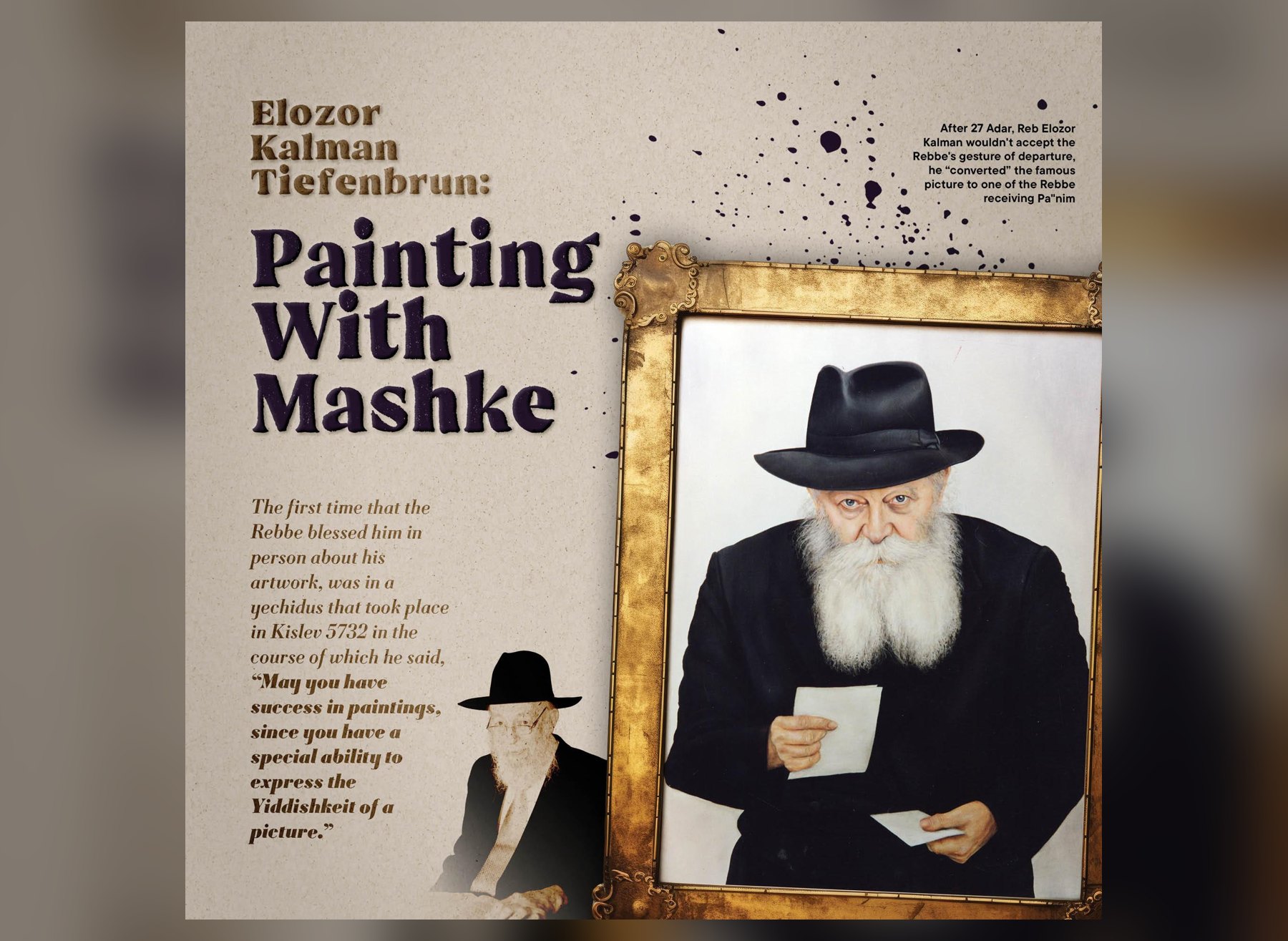
Rabbi Elozor Kalman Tiefenbrun was born on 23 Tammuz 5689/1929. He was a descendant of many Gedolei Yisrael, including the saintly Rabbi Elimelech of Lizhensk. He grew up in England and served as the director of Chinuch Atzmai in England.
Reb Elozor Kalman, as he was fondly called by all, was a “Galicianer” from home. He developed a strong bond with the Rebbe, thanks to his communal work which the Rebbe valued immensely. The connection began in the fifties, when a correspondence ensued between them, with the Rebbe encouraging him in his holy work.
Along with the encouragement, his correspondence with the Rebbe led him to a deep spiritual awakening and he began delving into the teachings of Chassidus. He later established a regular shiur in Tanya, bringing many closer to the way of Chassidus.
Over time, he became one of the pillars of the Chabad community in London where he was known for his warmth and refinement. Despite his success and reputation that he earned for his skills as an artist, his persona was not that of an artist but of a Chassid who was modest, straightforward, and who devoted his life to the Rebbe and the community.
He never systematically studied art. He simply discovered his rare talent for painting as though by chance. But for a Chassid there is no “chance,” and his talent gave him not only an opportunity but also a responsibility and a shlichus which he navigated wisely with instructions, guidance, and encouragement from the Rebbe, over all the years.
In a letter dated 28 Tammuz 5719, it seems that the connection between him and the Rebbe began long before that. In a letter, the Rebbe notes, “I was happy to read about your work to strengthen and spread Yiddishkeit among your friends.” Then the Rebbe encouraged him and wrote that one can never know what are true “accomplishments” even if sometimes, they might seem “small,” since each small plant will eventually produce fruits, and this is all the more true when it concerns the education of young children.
The Rebbe even encouraged him to look to Rabi Akiva, as specifically those five students that he taught in his later years were the ones who transmitted the traditions of the Torah to the generations that followed, till today.
From the letter, it seems that Reb Elozor Kalman wanted to be more involved in the Chabad activities taking place in “Lubavitch House” in London, and the Rebbe advised him to consult with Anash in order to determine in what areas he would be able to contribute.
“Defending Chassidus Means Defending the Torah”
In the next letter that we find, from 14 Elul 5720, the Rebbe refers to an idea he had raised of opening a mail-order company. What became commonplace years later, to buy things through catalogs and later in “internet stores,” was a radical idea in England at that time. The Rebbe said that this type of business was well developed in the US, but it wasn’t certain that the conservative English would go for the idea. Conservative people prefer buying in stores where they can see and touch the items.
On the other hand, considering the changes that resulted from the war, this approach changed a bit and perhaps there was room for such a business. The Rebbe told him to consult with knowledgeable friends and do as they decided.
The Rebbe referred to what Reb Elozor Kalman wrote, that he sometimes found himself forced to participate in debates and defend the honor of Chassidus:
“You are in good company and on the right side, since Chassidus is part of the Torah and defending Chassidus means defending the Torah. Whoever adopts a negative approach toward the Chassidic movement seems as though he is living 200 years ago, when Chassidus first appeared and was suspect. However, today, there is no doubt as to the place of Chassidus and all the suspicions of the past have been proven to be baseless. Chassidus is one of the strongest foundations of the Jewish people.”
The Rebbe encouraged him to participate in activities to spread Torah and Chassidus.
Effusive Response
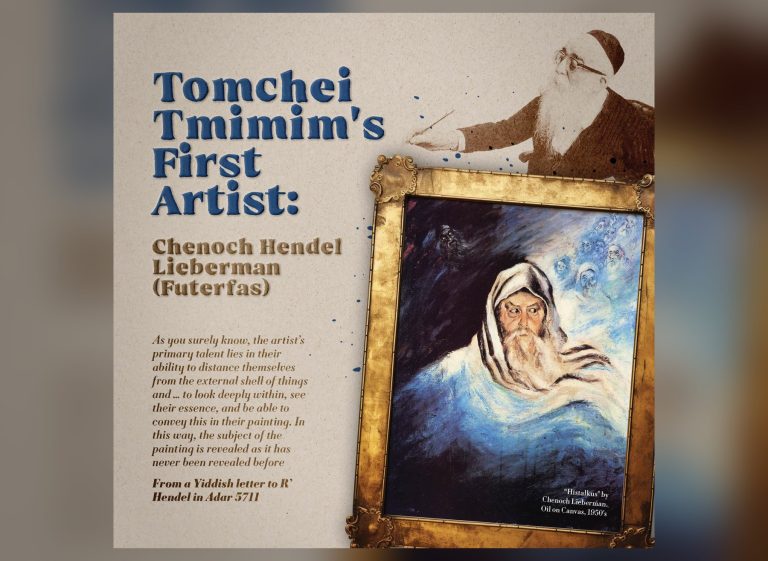
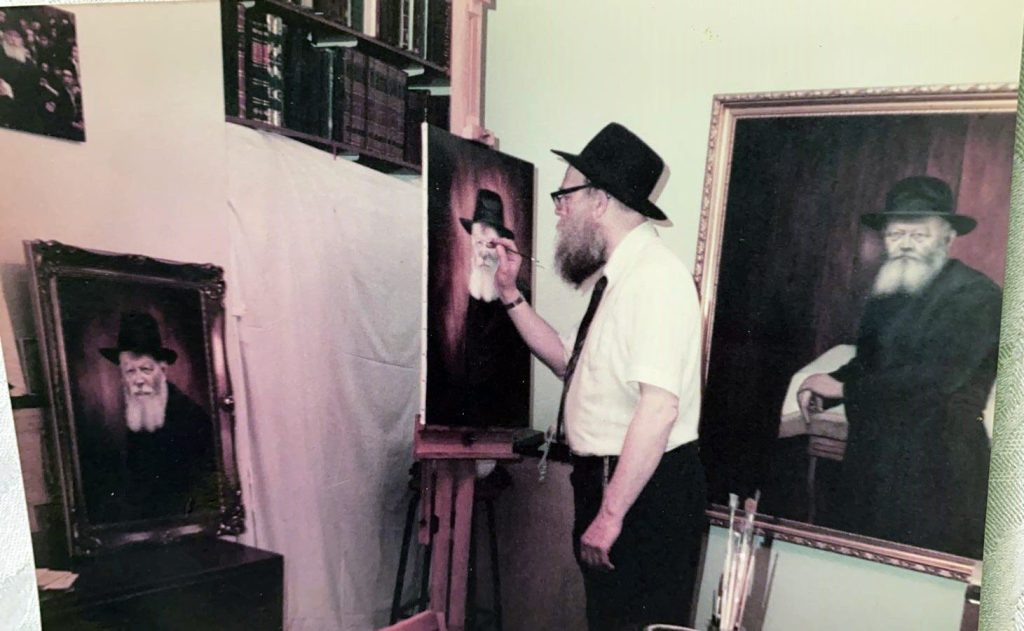
Over the years, Reb Elozor Kalman developed his artistic, G-d given talent. Based on the guidance that he received from the Rebbe, he drew paintings of kedusha. Among his subjects were: the Alter Rebbe, the Noda B’Yehuda (Rabbi Yechezkel Landau), Rabbi Akiva Eiger, the Chasam Sofer, the Netziv, Rabbi Chaim Brisker, the Chofetz Chaim, the Imrei Emes of Ger, and many others.
Rabbi Tovia Preschel wrote that Tiefenbrun’s pictures convey more than just the visages of the subjects, but “the ideals and moral excellence, [that] the portrayed personalities represent . . . Looking at his impressive life-size portraits, you feel as if you were in the presence of these great and holy men.”
His creations became well known, and they adorned many Jewish homes as well as various institutions around the world. You can readily identify his works because of their special warmth and lifelike quality. To him, the portraits of Admorim and rabbanim are “alive” and remain alive and are not just nostalgic depictions of the past. They bring the subject into the house, living room or school where they are found.
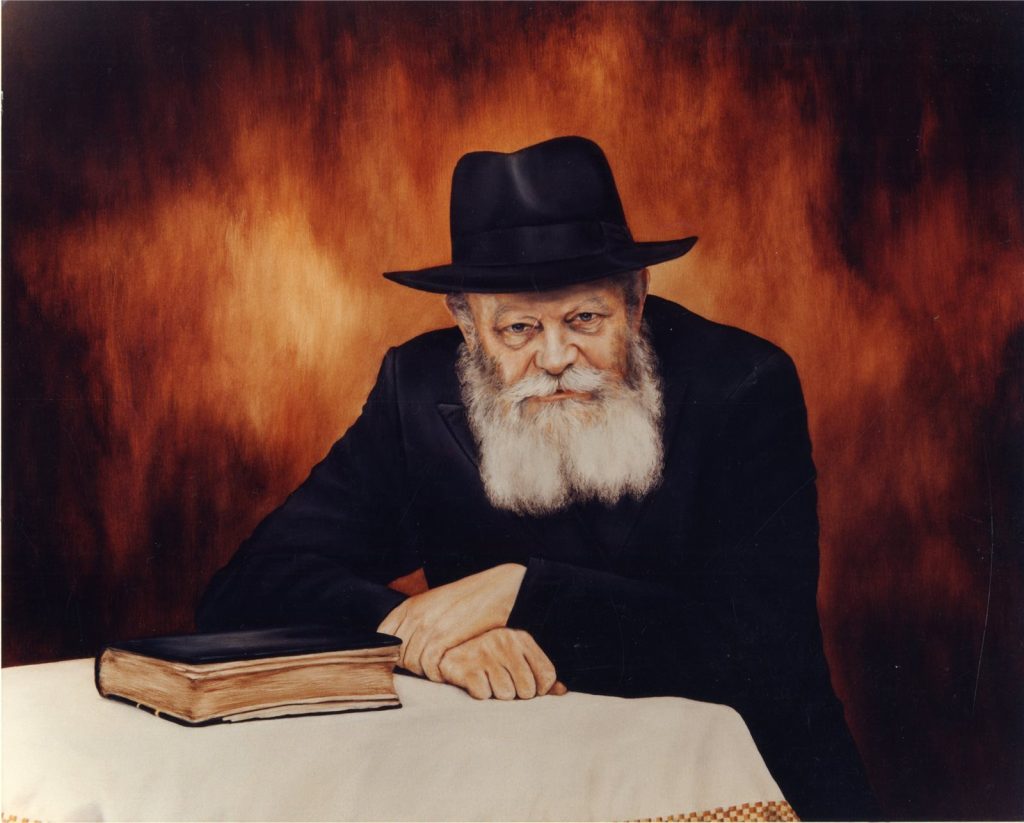
Of course, with his involvement in Chassidus, he painted the Rebbe. It was 5727/1967 when he painted the Rebbe standing next to his shtender while wrapped in a tallis and wearing tefillin. In those days, drawing the Rebbe was a major innovation. This is why he asked permission to publicize it, and he sent the request along with a copy of the painting.
Some time later, he received a “klali-prati” letter [a letter with a standard text the Rebbe would send to many people, sometimes adding a private line or two – Ed.] with an addition in the Rebbe’s handwriting of “blessing in all matters”. He accepted this as approval for him to continue to publicize the painting.
Not long afterward, the askan R’ Avrohom Yitzchok Glick had Yechidus. The Rebbe asked him, “How is Tiefenbrun?” He said, “He is in the middle of a picture of the Rebbe.” The Rebbe asked, “Farvos macht men mir azoi erenst — why am I always made to appear so serious? Does he always make me so serious? Perhaps the painting can be retouched?”
R’ Tiefenbrun related what happened next: “After leaving the yechidus, R’ Glick told me what the Rebbe said and I understood that the Rebbe agreed for me to publicize the painting but his serious expression had to be changed. Then and there, I wrote a letter to the Rebbe and noted that I would try to change it according to the Rebbe’s wishes. In all sincerity, I shared my thought that the entire world knows and understands that the matter of a Rebbe is seriousness, especially when he is wearing tallis and tefillin.
“Just a week later, I received an express letter in which the Rebbe said I should alter the painting if it did not entail exertion or monetary outlay, since a Jew’s money is an important thing.
“From this answer too, I understood that I had the Rebbe’s consent. In general, consent to a painting of the Rebbe, back then, was considered a novelty. Following this exchange, I printed up 3000 copies and disseminated them all over the world, especially in Eretz Yisrael. After that, I was particular about painting the Rebbe smiling.”
Another painting of the Rebbe was sent for 11 Nissan 5733. Here too, the Rebbe is shown in tallis and tefillin. In a return letter (11 Nissan 5733), the Rebbe thanks him for the picture and writes in the margin, “There is what to go on at length about this, but time does not allow. And the main thing is the reaction of the people who see it. Surely he heard directly from them praises and accolades…”
Another time, a copy of a painting was sent to Rebbetzin Chaya Mushka. She responded with a thank-you letter (4 Iyar), “It was a pleasure indeed to receive the portrait in color, of my husband … Your thoughtfulness in sending us the portrait is sincerely appreciated. In addition to the idea itself, the portrait picture is all the more commendable in that it displays both artistic talent and understanding.
“Moreover, it was also a case of ‘the right thing at the right time,’ for the portrait was received in proximity to my husband’s birthday.”
“Aggravation” Of A Chassid
Reb Elozor Kalman had a number of private audiences with the Rebbe that had to do with his art. The first time that the Rebbe blessed him in person about his artwork, was in a Yechidus that took place in Kislev 5732 in the course of which he said, “May you have success in paintings, vibald du kenst aroisbrengen di Yahadus fun a tziur — since you have a special ability to express the Yiddishkeit [i.e., the Jewish soul] of a picture.” After receiving this blessing, he began to engage fully in the work of painting and made a living from it.
He once related an interesting incident that occurred in connection with his paintings, around the time of Shavuos 5732:
“Someone asked about reproducing copies of one of the paintings I made. I went to a meeting in his office to talk to him about it. He worked at a certain organization that raised money for Eretz Yisrael. When I arrived, some of the employees told me that they have complaints against the Rebbe.
“They had organized a dinner on behalf of their organization and since they tried to get people interested in order to prod them to attend the dinner, they wanted to bring some immigrants from Russia. They contacted some of Anash who had come from Russia to Eretz Yisrael and asked them to be the guests of honor. For some reason, at the last moment, they canceled their participation in the event, which weakened the event. Those who worked at the organization were sure that the reason for their cancellation had to do with instructions the Chassidim had received from the Rebbe. That is why they were upset with the Rebbe.
“When I heard this, I took it to heart and immediately said I was sure this had nothing to do with the Rebbe. Those who knew the Rebbe knew that he would not cause harm to an organization.
“When I went to Crown Heights, I didn’t know whether to report this to the Rebbe or not. I figured the Rebbe probably knew about it, yet it was my obligation to inform the Rebbe if someone had complaints against him.
“I wrote a letter and what I had said to the employees. [It should be noted that the letter for Yechidus is not the tzetel brought into Yechidus, but the letter written the morning of the Yechidus and submitted to the secretaries. In the evening, when having Yechidus, a short note with names is given to the Rebbe]. To tell you the truth, I didn’t want my Yechidus to dwell on this subject, I wanted the Yechidus to be about myself and my family. But I had no choice and therefore, I wrote the letter.
“Several hours later, I passed by 770 and saw Rabbi Binyamin Klein looking for me. He told me that Rabbi Chodakov was urgently looking for me. I went to R’ Chodakov’s office and he began talking to me while holding a long piece of paper. ‘Do you see what it says here?’ I immediately identified my handwriting on the paper. He went on, ‘The Rebbe was very surprised by what you wrote since he thought the matter was already settled to the satisfaction of that organization. The Rebbe had nothing at all to do with it and he had no connection with some of Anash canceling their attendance at the dinner.’
“R’ Chodakov concluded, ‘We know where these rumors come from; from those who have no love for Lubavitch.’
“I said to R’ Chodakov that I would do whatever I could to convey this information that I had just received. I went to the secretaries’ office and called the person who spoke to me about the matter and had complaints against the Rebbe. I repeated to him what R’ Chodakov told me and asked him to convey this information to those with complaints. He said he would.
“That night, I had yechidus and the Rebbe spoke to me about this and said, ‘and this that you had aggravation from being a Lubavitcher …’ I reacted in surprise, ‘I had aggravation? It’s my pleasure to be a Lubavitcher!’
Hearing that, the Rebbe smiled broadly and said, “if having aggravation was decreed, then let this be the aggravation …”
* * *
There is another interesting expression from the Rebbe that he heard in that Yechidus. Together with him in the room was his daughter Mrs. Ronya (Fajnland), today a shlucha in Long Beach, California. First, the Rebbe blessed him, “Your success should be such that it should be good for you and good for those who receive the paintings.”
After they spoke about the aggravation in the story mentioned before, the Rebbe said to his daughter (in English), “The same thing goes for you. If you see someone who is not so enthusiastic about Lubavitch, you don’t need to feel worried, because the greater the qualities and the more holiness, the more opposition there is.”
Alcoholic Paint
On every motzoei Yom Tov, the Rebbe would give out wine from his havdala cup to all those in attendance (known as kos shel bracha). Additionally, he would often give his emissaries a bottle of mashke to be given out at farbrengens upon their return to their hometowns.
On the concluding night of Simchas Torah 5739 (1978), R’ Tiefenbrun passed by the Rebbe to receive kos shel bracha. In addition to the usual pour of wine, the Rebbe handed him a bottle of vodka and said (in English): “See to mix it into your paint.”
As Pesach approached, Reb Elozor Kalman approached Dayan Padwa, a respected local rabbi, and inquired what should be done with the leaven-based alcohol. The rabbi advised him to mix the remainder of the alcohol completely into the paint so that it would be rendered inedible even for the consumption of a dog (as stipulated by halacha). This would allow the alcohol to be kept over Pesach without being sold to a non-Jew.
Following the holiday, Reb Elozor Kalman wrote to the Rebbe that he was still in possession of the alcohol, without specifying what exactly he had done to it. Actually, the wording of the letter seemed to imply that it was sold together with the rest of the chametz.
The Rebbe replied that this should not be done again (i.e., the Rebbe’s alcohol should not be sold to a non-Jew).
Reb Elozor Kalman wrote back, explaining that he had not sold the alcohol but had mixed it into the paint so that it would be inedible. He added that if the Rebbe so wishes, he will stop using it and throw it out.
The Rebbe replied by underlining the words “using it” in Rabbi Tiefenbrun’s letter and added: “As is obvious [meaning that he should indeed continue using the paint], so that it will lead to a positive use and not be destroyed, G-d forbid.”
Painting the Royals?
In a Yechidus he had around Shavuos 5735/1975, he asked the Rebbe about the possibility of expanding the range of the subjects of his paintings, perhaps even including the royal family of Britain.
Here is a transcript of that Yechidus:
R’ Tiefenbrun: People have suggested that I paint pictures of well-known, important personalities and the like, as it will attract wider interest.
The Rebbe: I wouldn’t want you to divert the energy you are able to invest in the Jewish pictures. According to Shulchan Aruch [the Code of Jewish Law], I don’t see why not, kol zman es is nisht hepech fun tznius — as long as it is not immodest.
R’ Tiefenbrun: G-d forbid!
The Rebbe: Nevertheless, nowadays even non-Jews are interested in [art pertaining to] Jewish subjects.
An Artist’s Posture
At one point, R’ Tiefenbrun suffered from back problems resulting from a slipped disk. Noticing this, the Rebbe asked him if he paints while sitting or standing. He replied that he paints while standing, because this makes it easier for him to see what he’s painting even at a distance.
The Rebbe said, smiling: “Michelangelo would draw frescoes on the ceiling while lying on his back.”
Reading His Thoughts
In a Yechidus in Tishrei 5739, the Rebbe greeted him with a big smile, “Shalom aleichem to all. May Hashem give all of you a good, sweet year, those who are here and those who remained in England. Hashem should accept all the prayers.” Then he added, “You don’t write anything about the paintings.” Reb Elozor Kalman said, “I didn’t want to lengthen the time of the Yechidus for that subject.” The Rebbe asked, “Nu, but b’poel?”
He replied that he brought four paintings with him that he made for the purpose of trying to sell them in New York. The Rebbe asked about each detail like a concerned, loving father and said, “You brought four paintings?! Did you sell them all yet?”
“No,” said R’ Tiefenbrun, “but I already spoke to people about it.”
The Rebbe blessed him with tremendous blessings, “If parnassa needs to come through painting, it should be an expansive parnassa, You, together with your wife, should raise all the children to Torah, chuppa and good deeds.” Reb Elozor Kalman said that he wanted to thank the Rebbe for everything he did for him until that point and the Rebbe concluded the Yechidus with, “Me, there is no need to thank. You need to thank Hashem.”
R’ Tiefenbrun once recounted a story of open ruach ha’kodesh, when the Rebbe clearly read his thoughts and responded to what he had been thinking:
“After I painted the portrait of the Rebbe’s father, Reb Levi Yitzchok, I sent a copy of the original with someone who was traveling to New York to bring to the Rebbe. I went for a visit to the Rebbe some time later, and I thought that when I would pass the Rebbe at ‘dollars,’ if the Rebbe mentioned the picture at all I would tell the Rebbe that I would be happy to bring him the original painting.
“When I passed by on Sunday at dollars, the Rebbe gave me a dollar for ‘bracha v’hatzlacha’ and did not say anything else to me. After I continued on, the Rebbe suddenly called me back and said, ‘You don’t need to give me the pictures. You must sell them!’ He then gave me an additional dollar ‘for the pictures.’”
“I Already Said Shalom Aleichem to You”
R’ Tiefenbrun recounted:
“At the Yud-Tes Kislev farbrengen in 5732/1971, the Rebbe spoke about the Jews still ‘behind the Iron Curtain’ and asked that niggunim in Russian be sung. During the niggunim, the Rebbe gave out mashke to be distributed in various countries.
“The Rebbe then looked in my direction, and people around me said that it seems the Rebbe wants me to come up too.
“When I approached the bima, the Rebbe asked: ‘Are you a Jew from Russia?’
“I said: ‘No, I’m Tiefenbrun from London.’
“The Rebbe gave me mashke and instructed me to distribute it among the people present at the farbrengen.
“During those moments, I felt rather muddled that the Rebbe did not recognize me and was concerned that perhaps the Rebbe had ‘confused’ me with someone else because of the beard that I began to let grow at that time. I knew that the Rebbe knew about it, as Rabbi Gluck told the Rebbe about it at the end of the past Tishrei.
“Later, when I went in for Yechidus, I decided to ask the Rebbe about it.
“Immediately upon entering for yechidus, the Rebbe said to me, ‘Shalom aleichem’ with a big smile, and added, ‘I already gave you a shalom aleichem.’
“In the note that I handed to the Rebbe, there was only one thing written, that I wanted to know what happened yesterday at the farbrengen because I’m ‘unhappy’ and was very much pained over what happened with the mashke the previous night at the farbrengen. I signed off the note with requests for blessings.
“The Rebbe took the note from my hand, and even before he opened it, he said: ‘This that I did not recognize you, it says ‘and Yosef recognized his brothers and they did not recognize him,’ and Rashi explains, ‘that he left them without a beard and now they encountered him with a beard.’
“The Rebbe went on to say: ‘When you came the first time you did not have a beard and now you have a beard.’
“Only after that did the Rebbe open the note, and respond with a smile about what was written in the note: ‘I answered this already… And what you write that you are unhappy, you need to be happy.’”
The Rebbe then inquired about what his wife has to say about his growing a beard. When Reb Elozor Kalman responded that she is in agreement with him on all matters pertaining to Yiddishkeit, the Rebbe responded with a huge smile.
* * *
Reb Elozor Kalman Tiefenbrun passed away on the 15th of Shevat 5778, and is survived by his children and many grandchildren and great-grandchildren proudly going in the way of Torah and Chassidus.
“Hakitzu v’ranenu shochnei afar,” him included, immediately and now!
Beis Moshiach #1455 • pp. 40-47
© 2026 Beis Moshiach Magazine. All rights reserved.
This article originally appeared in Beis Moshiach #1455. You are welcome to share it with friends and family by email or in print, provided that you do not change, add to or omit any part of it, you credit the author and Beis Moshiach, and you include a link to archive.bmoshiach.org (written out in full in printed copies).
To republish this article in a newspaper, magazine, book or website, please request permission in advance at [email protected].