The Rebbe’s Cartoonist and Logo Designer
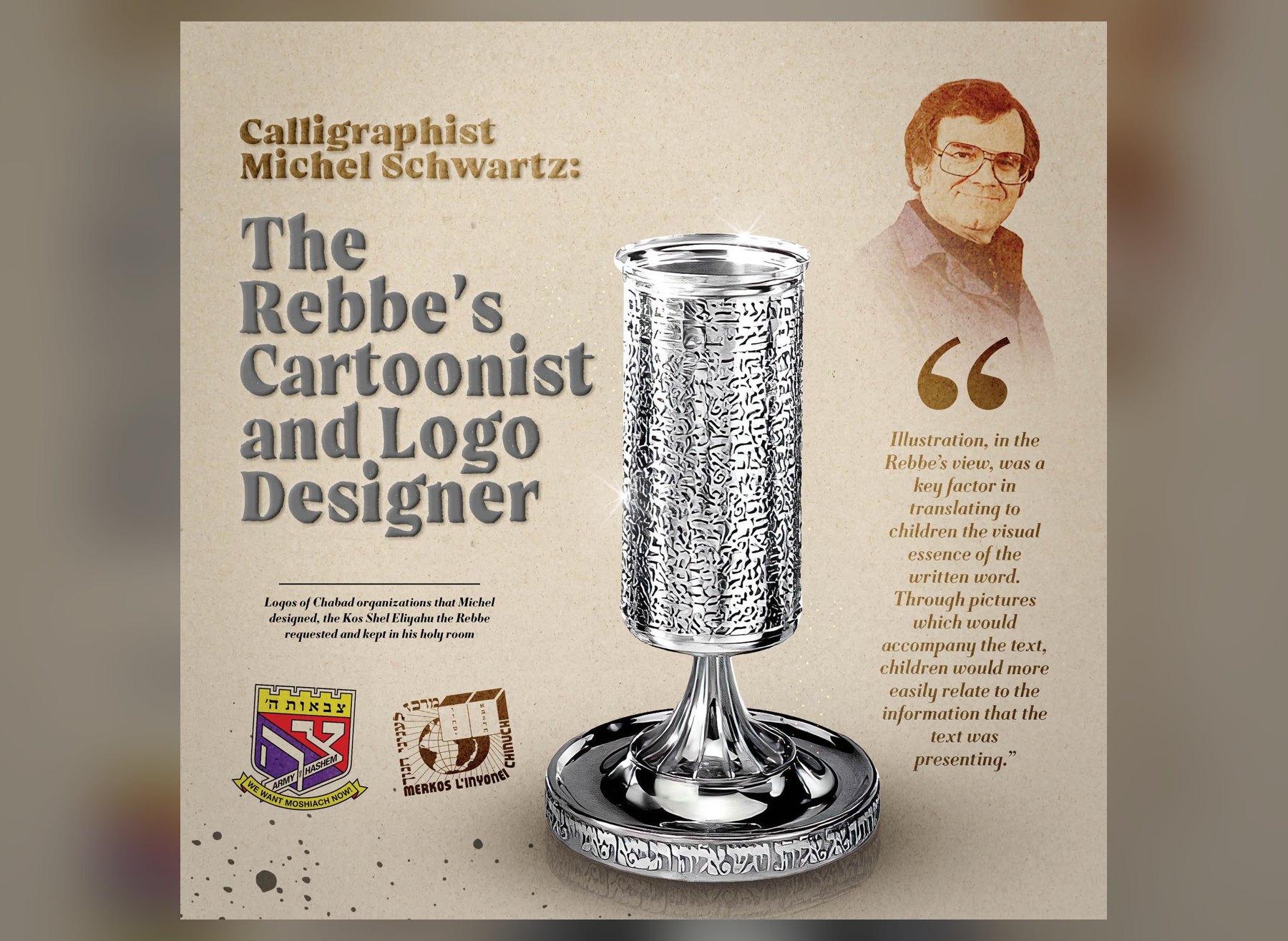
Michel Schwartz was born in 5686 (1926) in the Catskill Mountains of New York to a religious Jewish family. In his youth, he studied at the “Toras Chaim” Yeshiva in Brooklyn and at the RJJ Yeshiva in Manhattan.
From his early childhood, his artistic talents were evident and continued to develop over the years. At the age of 13, after promising to continue his Torah studies in parallel, he enrolled in the New York Institute of Art and Design. Since then, he has been a prolific creator, with his artwork appearing in the President’s Residence in Israel, the Knesset, and Yerushalayim City Hall, as well as in the White House and prestigious collections around the world.
First Connection with the Rebbe
About two years after beginning his art studies, the connection between him and the Rebbe was established when Michel was only 15 years old. He would visit the Rebbe twice a month at his office in 770 to receive guidance on illustrating the “Talks and Tales,” the monthly children’s magazine that the Rebbe had established and other publications of the Merkos L’Inyonei Chinuch.
As Schwartz himself recalled in an article he wrote for a journal published by Tzivos Hashem, an organization he very much cherished: “I was quite excited at the prospect of such direct face-to-face communication with this great teacher, the son-in-law of the Previous Lubavitcher Rebbe, Rabbi Joseph Isaac Schneersohn.
“Rabbi Nissan Mindel ushered me into the office of Rabbi Schneerson, who was standing at his voluminous bookcase reading, deep in thought. We stood there, until he partially turned to me, smiling, and motioned with his right hand for me to have a seat.
“I will never forget this awesome scene, his sparkling blue eyes and welcome smile… without uttering a word. I’m sure I was too young to appreciate the significance of the moment, that I was being invited, by the man who was later to become the greatest of all Rebbes, to execute under his tutelage, some of the earliest pictorial interpretations of Judaism for Lubavitch children’s books.”
At that time, the Rebbe headed Lubavitch’s publishing division, and under his dynamic guidance, the “Merkos L’Inyonei Chinuch” became the largest publisher of books and journals intended for Jews worldwide.
One day, the Rebbe requested adding a new section to the magazine—an illustrated page with five or six little-known facts about Jewish customs and wisdom. The Rebbe wanted this section to become something special that children would look forward to each month. The section was named “Curiosity Corner” and was to appear in the “Talks and Tales” and its Yiddish-language brother, “Shmuesen mit Kinder.”
Initially, young Schwartz worked with the Rebbe’s secretary, Dr. Nissan Mindel, who was appointed to implement various ideas from the Rebbe. Shortly after beginning his work, Rabbi Mindel said to him, “Look, why should I be the go-between person, getting the information from Rabbi Schneerson, conveying it to you, then after you draft the necessary sketches based on this information, I bring it in to Rabbi Schneerson for critical commentary, then deliver his comments and corrections to you, to produce the finished artwork and associated copy? It makes more sense to introduce you to Rabbi Schneerson and let you deal directly with him.” And so it was.
The Rebbe’s Artistic Direction
Schwartz explained that “Illustration, in the Rebbe’s view, was a key factor in translating to children the visual essence of the written word. Through pictures which would accompany the text, children would more easily relate to the information that the text was presenting.”
“He was firmly in favor of producing this work in Yiddish and English. However, since the texts would be different from each other, they would require separate illustrations. As I understood it, the Rebbe felt that even if a child could not read Yiddish, he or she would ask parents or teachers to read and explain what the pictures were about.”
What surprised the young artist was the Rebbe’s familiarity with contemporary media: “When describing the feature, the Rebbe said, ‘It should look like Ripley, — Es zol oys’zehn vee Ripley.’ I was taken by surprise.
“For many years, in many newspapers throughout the country, a square measuring approximately 5”x 5”, contained the work of Robert Ripley, titled ‘Believe It Or Not.’ Here was this venerable Rabbi aware of a column, which appeared daily in ‘The New York Mirror,’ now a defunct Hearst publication, asking me to make our feature in Ripley’s style.”
“On another occasion, the Rebbe asked me to create a true to life character about whom adventure stories could be written. This time he suggested that the format and look should be ‘like Dick Tracy!’”
Schwartz details his creative process with the Rebbe: “Each segment was first discussed with the Rebbe – he had definite input – after which I would write the script, box by box, and prepare pencil sketches of the scenes with balloons for the text. The Rebbe would review each scene or representation, and only after I had his corrections and approval, did I do the finished art, which then went to printer.”
It can be said that from then on, throughout the years, Mr. Schwartz received close guidance from the Rebbe in all professional aspects of the drawings and illustrations he produced.
The Merkos Logo and the True Shape of the Luchos
In 5704 (1944), Schwartz was asked to design an emblem for the Rebbe’s publishing division, “Merkos L’inyonei Chinuch.” As he explains: “I submitted a sketch which showed the world globe in 2 halves super-imposed by the Luchos. The copy around the perimeter of the design was hand-lettered in Hebrew and English, in modern face, which the Rebbe always preferred. The overall design itself was, for those days, considered Avant-garde, as most all seals for Jewish and other institutions were ornately designed in French and Old English thematics. The Rebbe always supported modern trends in design and publication, similar to the more advanced publishers of the times.”
When he submitted the new logo to the Rebbe, “his comment was favorable as to the shape and design. In general, however, he said that the Luchos, the Tablets, were not to be drawn with half-round cupolas at the top of each tablet. The correct design was to draw two vertical rectangles, with a ratio of 1 to 1½, flat at the top as well as the base.”
The Rebbe then provided a historical lesson: “The familiar rounded top was introduced by Roman order, derived from their architectural style, prevalent at the time of the destruction of Jerusalem and the Holy Temple. The Roman desire to eradicate everything Jewish, included even the shapes of our most holy symbols.”
Schwartz took this lesson to heart: “From that day on, I never again drew the ‘Ten Commandments’ with the ‘Roman’ shape at their top. How I always wished that Jewish artists and architects of synagogues and temples would realize that the perpetuation of a mistake is unacceptable, no matter how long the error has been practiced.”
The Map of the Yetzias Mitzrayim
The following tale shows the Rebbe’s deep involvement in Michel’s illustration work:
In the summer of 5754 (1994), Schwartz received a phone call from a rabbi who was preparing a book about the Exodus from Egypt. The rabbi had encountered a map drawn by Schwartz showing the Bnei Yisrael’s route going north along the coastline to Ashkelon, then east to the Holy Land – contrary to other scholarly sources.
“I remembered doing a number of maps and charts for the Rebbe. The Exodus route was in one of them,” Schwartz recalled. When the rabbi asked about the discrepancy with other sources, Schwartz could only reply: “Look, you may have a problem, and I can appreciate your predicament. The Exodus chart was one of the earliest experiences I had with the Rebbe, and in those days, I did what the Rebbe instructed me to do. I’m no authority on the Exodus. I’m sorry I can’t be of more help.”
The special gravity, along with great friendliness, the Rebbe gave to Mr. Schwartz and his drawings can be seen from the fact that when he opened an art gallery in Crown Heights called “Chai Gallery,” the Rebbe gave him a check for $10,000 to help with expenses and instructed that the gallery should serve as an art education center as well.
The Tzivos Hashem Logo
During Sukkos of 5741 (1980), the Rebbe established “Tzivos Hashem” as a spiritual army which school-age boys and girls would join. The Rebbe detailed his vision: tens of thousands of Jewish children around the world would join as soldiers in “Tzivos Hashem” and advance in ranks from private to general through fulfilling mitzvos. The army needed an emblem.
Schwartz vividly recalls how this project came to him: “‘Go see Schwartz,’ the Rebbe said. ‘He will make it for you.’
“Now, this was Saturday evening. At about ten o’clock, I heard the front door chime announcing the arrival of two of my Lubavitch friends, Rabbi Yossi Raichik and Rabbi Mendel Kotlarsky.
“After describing the details of what the Rebbe had discussed earlier that day, they informed me that the Rebbe was waiting for their return to see a sketch of the emblem, so that they could go to press on Sunday with flyers, brochures, patches and stickers to launch Tzivos Hashem.
“I listened in total amazement. I was being asked to put aside whatever I might have been working on to ‘help get the ball rolling.’ I realized that these wonderful young men were serious, and had no reservations about how I would create a ‘military’ motif. They were sure that the Rebbe would approve. He was awaiting them to come back.”
Without hesitation, Schwartz began drawing a fortress-style emblem with five turrets that included the initials ‘Tzaddik’ and ‘Hei,’ for Tzivos Hashem. The letters were separated by a diagonal, with each letter having a separate background. The background of the letter ‘Tzadik’ was blue with stars and a moon symbolizing night, while the ‘Hei’ had a red sun on a yellow field, symbolizing day.
His messengers took the rough sketch to the Rebbe, and returned at about 1 AM with the Rebbe’s comments:
“1. Generally he was pleased with shape, the lettering and the format. 2. He said that Michel should remove the moon & stars from the ‘tzaddik’ background, as this was idol worship. Solid blue would do. 3. The sun with its red rays behind the ‘hey’ recalled the flag of Japan. Solid red would do very well.”
Schwartz recalls: “I revised the rough sketch as the Rebbe suggested, and saw that once again, he was absolutely right. It really looked better, and would be more easily reproduced, even in very small sizes.”
Shortly after, the motto of Tzivos Hashem, “We Want Moshiach Now,” was added to the logo with the Rebbe’s approval.
“Today the Tzivos Hashem emblem is the single most reproduced Jewish organizational symbol in history. Estimates run into the hundreds of millions over the years,” notes Schwartz. “When I consider the strides and accomplishments of this organization, my heart swells with pride, and I feel honored that I was called upon to become involved when the Rebbe first initiated his new idea of Tzivos Hashem.”
In 5749 (1989), additional symbols were designed for the various ranks of the soldiers in Tzivos Hashem. These were also submitted to the Rebbe for his approval. One of the designs containing the Luchos did not receive the Rebbe’s approval. He wrote that the Luchos represent all ranks in Tzivos Hashem and cannot be limited to just one rank.
The Shechina in His Eyes
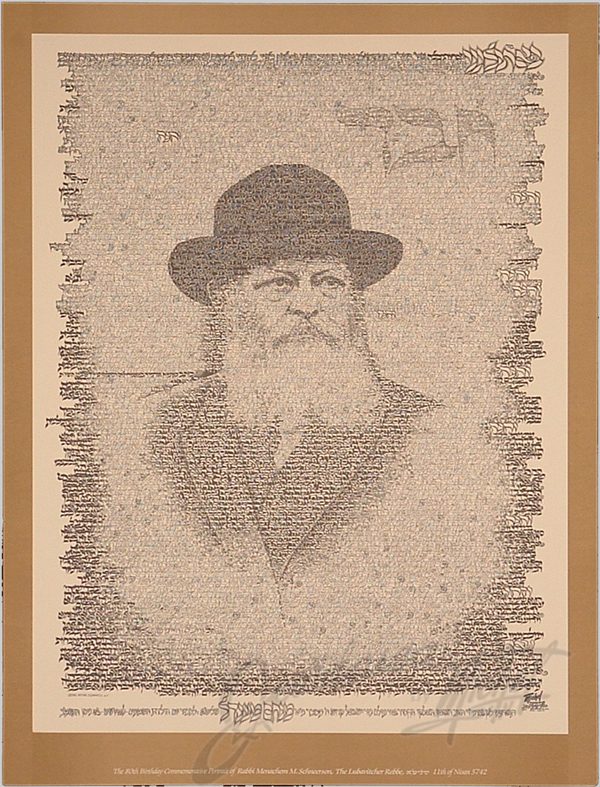
Over the years, several friends suggested that he paint the Rebbe. Michel Schwartz avoided this for many years. “I knew that if I made a painting of the Rebbe, it had to be something special—not just another painting,” he explained. Only after years did he develop the decision to paint the Rebbe’s visage out of letters.
One of his Chabad friends, Rabbi Yossi Raichik, suggested that he paint the Rebbe using letters from the Rebbe’s inaugural “Basi LeGani” discourse that was delivered in 5751 (1951) at the kabbolas ha’nesius.
The complex and careful work continued for a long time. “This work I will never forget,” he related. “During the work I reached a point where the work was finished, but this is actually work that is never completed… one can always improve, add, or subtract.”
The drawing is composed of a huge number of tiny dots. Initially, he made the background and on it the drawing of the face itself. When writing the text that composes the face on the background, he did not plan which word would fall on which part of the face.
“To my great surprise, I noticed in retrospect that both eyes fell exactly on the word ‘Shechina’ which appears several times in ‘Basi LeGani’… only then did I decide that the painting was complete.”
Mr. Schwartz took the painting to Rabbi Yaakov Yehuda Hecht’s office to show him, and even showed him the “mofes” with the two eyes. Rabbi Hecht responded with great seriousness: “This is not by chance. This is Divine Providence, ‘beim Rebbe’n ruht doch di Shechina oif zein kop’.” The Divine Presence rests on the Rebbe’s head…
“Make a Picture of How Moshiach Comes”
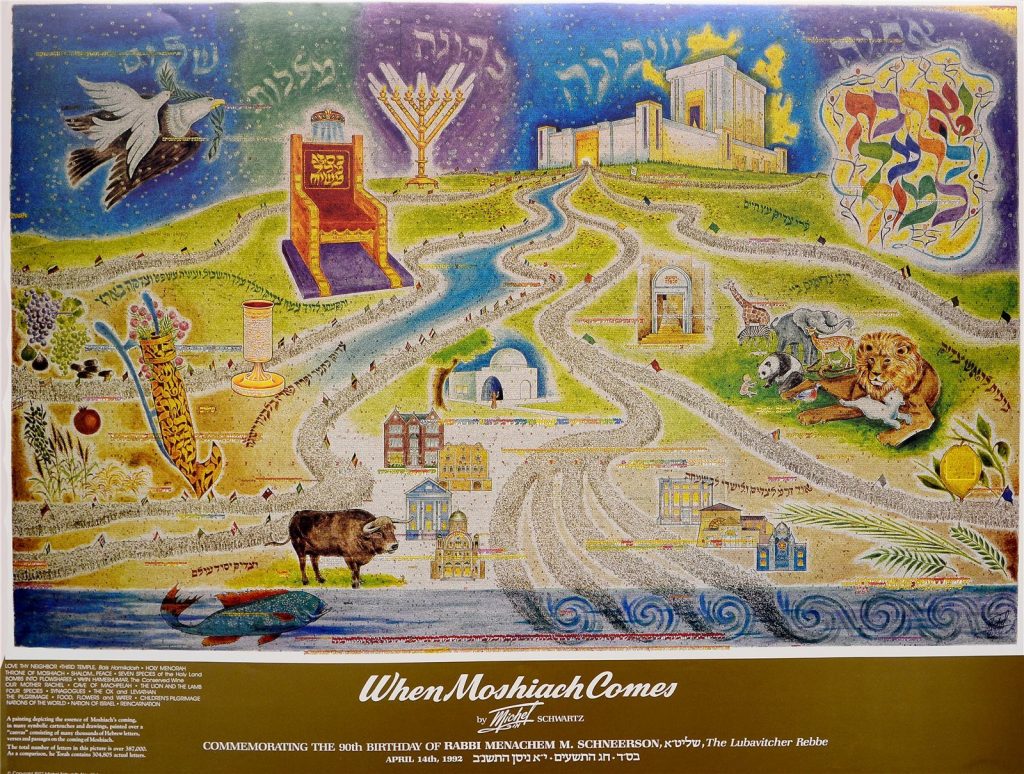
The crowning glory of Schwartz’s artistic works was in the painting “When Moshiach Comes” which the Rebbe requested him to prepare. The painting he was asked to prepare depicts the Messianic era with all its events.
Schwartz describes how this historic commission came about: “’….And now, Michel, I want you to make another picture…. of what the world will look like when Moshiach will come!’
“This historic ‘commission’ was put to me in these simple words, spoken in Yiddish, at ‘Sunday dollars,’ on September 24th, 1989.
“I stood there speechless, completely taken by surprise; but without hesitation, I accepted this most unexpected and historically unprecedented request.
“During my 45 years of working with the Rebbe, I could not recall that he ever requested anything like this from anyone. There was absolutely no elaboration on his part. It was truly out of the ordinary.
“I doubt if there has ever been a similar request to any artist in Jewish history, put forth by any other Rebbe or religious leader of stature.”
Not knowing how to proceed, Schwartz consulted with Rabbi Groner and Rabbi Hecht, but neither could provide specific guidance. Finally, after months of contemplation, he developed his concept:
“I immediately visualized a picture like the portrait had been, on a much larger scale. One which would contain as many references as can be found in the Torah, Prophets, the Writings, the Mishna, Talmud and Sages, all the prophecies about the coming of Moshiach.
“I would confine the painting to 304,805 letters, which is the exact number of letters in the Torah. It would be very large in proportion. I envisioned the canvas approximately 6 feet by 4½ feet. The letters would be half an inch in height. Superimposed on this canvas of letters would be many illustrations pertaining to the prophecies of the great scholars, authors and teachers of our people through the centuries.”
When Schwartz presented his concept to the Rebbe, the Rebbe immediately responded: “But it should be made of many, many letters, so you can earn from it a lot of money, so you can give a lot of tzedaka!”
Rabbi Groner, in amazement, exclaimed: “Michel, that’s just what you said! That’s just what you said!”
Schwartz then told the Rebbe, “The picture will contain 304,805 letters.”
The Rebbe immediately replied, “That is exactly how many letters there are in the Torah!”
On 25 Iyar 5750 (1990), Mr. Schwartz’s brother, Moshe, came to the Rebbe and said that he needed texts from the Rebbeim about the days of redemption to incorporate into the painting, but he did not know where to look for these texts:
This is how the conversation went:
Rebbe: May there be good tidings [gave a dollar in his hand]: This is for the new picture he is going to make.
Moshe Schwartz: I need I need sources from the Rebbeim about what is going to happen regarding Moshiach and redemption. I don’t know who to turn to.
Rebbe: It’s been printed. And there is an index of topics.
Moshe Schwartz: In the index of discourses?
Rebbe: From the discourses of the ‘Tzemach Tzedek,’ there is an alphabetical listing. There you can find everything. Ask to borrow from the library, search under ‘Yemos HaMoshiach’ and ‘Moshiach,’ and you’ll see what is written there.
About half a year later, at the dollars on Sunday, 4 Tishrei 5751 (1990), Michel Schwartz came again to the Rebbe and presented the first part of his work that he had already begun.
The conversation went thus:
Rebbe: Schwartz, shalom aleichem!
Schwartz: A year ago you requested that I make the picture of Isaiah’s prophecy; I’ve brought it now so you can see what has been done. It doesn’t look like much, but there are already forty-four thousand letters here, and it will be three hundred and four thousand eight hundred and five letters.
Rebbe: That’s the number of letters as a complete Sefer Torah.
Schwartz: All the text appearing here is about Moshiach, from Yeshaya to the Rambam and to the Rebbeim. All of them. There will be three hundred and four thousand letters. It begins with Yeshaya’s vision and continues on and on.
Rebbe: But don’t delay too long, because Moshiach will come.
Schwartz: Okay. But this is just the background. Afterward, there will be the entire picture of what is written here; I’ll draw on top of it.
Rebbe: Good tidings, much success.
Professor Yirmiyahu Branover who was present, turned to the artist: Michel, note that in the drawing you’ll also depict how Russian Jews leave Russia.
Rebbe: That’s included too?
Schwartz: It will be in the picture.
Rebbe: Great success, may there be a double portion. Good tidings.
The Rebbe continued to urge Schwartz to complete the painting quickly. At a dollar distribution event on 21 Shevat 5752 (1992), Schwartz arrived with most of the painting completed:
Rebbe: Mr. Schwartz. Yes.
Schwartz: It’s already ready.
Rebbe: With all the letters.
Schwartz: Four hundred thousand letters. And the only thing left is the last one, your text that you wrote about techiyas hameisim. It will be under the words “מכלכל חיים – sustains life” and each of them is like this. [There is text here from] all the Rebbeim, from the Baal Shem Tov until you. I have all the Rambam, everything is already ready, on this I am now doing in color, color through which one can see how the world will look when Moshiach comes.
Rebbe: But make sure not to delay it much until Moshiach comes, may it be in a auspicious hour. Much success.
Schwartz: There is a special line here for each tzaddik. And it will be ready by Erev Pesach.
Rebbe: Perhaps by the 11th?
Schwartz: 11th Nissan, it will be.
Rebbe: May it be in a good hour, this [gives him a dollar] is for expediting.
Schwartz: The next time you see it, it will be ready with a frame and everything. You said a siyum needs to be made.
Rebbe: Yes.
Schwartz: We will make a siyum.
Rebbe: In an auspicious hour with much success. Thank you very much.
Despite the Rebbe’s constant urging, Schwartz did not complete the painting by 11 Nissan of that year, as it was shortly after the Rebbe’s health event.
The completion ceremony—a ceremony that the Rebbe had requested to hold—was held with great public fanfare in combination with a Kabbolas HaMalchus satelite event on 10 Shevat 5753 (1993), in the presence of the Rebbe and thousands of Chassidim and media outlets from around the world.
A few moments after thousands of Chassidim at the live ‘satellite’ event from around the world shouted and sang from the depths of their hearts “Yechi Adoneinu Moreinu V’Rabbeinu Melech HaMoshiach L’olam Va’ed,” Mr. Schwartz completed his painting depicting all the events to happen “When Moshiach Comes”, as he called the artwork.
Reflecting on the enormous undertaking, Schwartz shared: “All in all, it took more than 2500 hours of work … In the end, the painting was not 304,805 letters, as I had envisioned, but 387,000 letters.”
“For over a year, the picture was on display at the Fifth Avenue Synagogue. Privately, I always wanted it to be exhibited in a museum or some place where multitudes of people could view it and understand the meaning of the Rebbe’s desire for the arrival of Moshiach.”
It was a new peak in the artistic world of Mr. Schwartz—the days of Moshiach had been captured through his divinely-inspired artistry.
The Kos Shel Eliyahu
Among Schwartz’s notable works is the Cup of Elijah, which has a special story. While in Yerushalayim, he designed a unique cup made of pure silver with gold overlays, decorated with the song “Eliyahu HaNavi” that is sung by many communities on motzoei Shabbos.
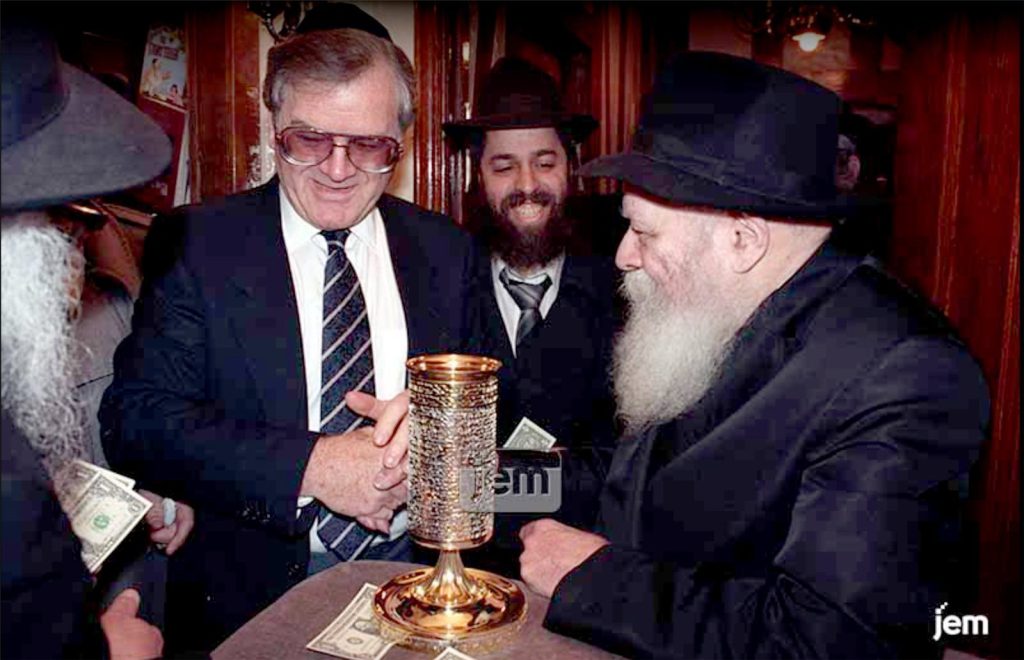
When his brother Moshe showed the cup to the Rebbe during a Sunday dollars distribution, something unprecedented occurred:
“The Rebbe studied the cup deeply as Moshe described its content and design. Then the Rebbe said, ‘Nu, is Michel already in production?’
“To which Moshe responded, ‘No, not yet. However, this is the prototype and the only one in existence at present.’
“The Rebbe studied the cup again, and asked, ‘Nu, if this is the only one, will it be left for me?’”
Schwartz was astonished: “The Rebbe here broke all protocol. As far as anyone could recall, including those who had served the Rebbe since the first day, for more than 35 years, the Rebbe had never in the past asked for a gift.”
Later, arrangements were made to present the cup to the Rebbe as a gift for his 86th birthday, made possible through the generosity of Belle and Jack Rosenbaum.
What touched Schwartz deeply was learning years later that the cup had been kept in the Rebbe’s personal quarters: “The cup you gave the Rebbe, since the Rebbe became ill, it has been standing on a small round table at his bedside day and night. It is never removed for any reason,” an attendant told him.

Rabbi Groner clarified: “No, Michel. Not since he became sick. Your cup had been in his room since the day you presented it to him, for over 4 years.”
He added that the cup rested on a wooden table personally made by the Rebbe Maharash, alongside walking sticks that had belonged to Rabbi Levi Yitzchok of Berditchev and the Rebbe Rashab.
A Lifelong Connection
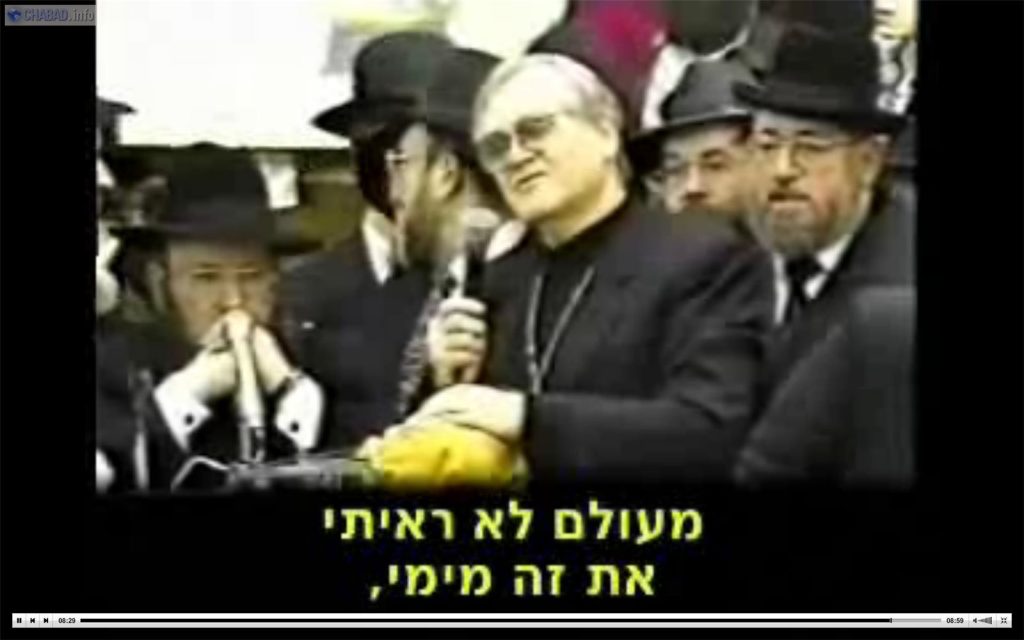
Throughout his life, Michel Schwartz enjoyed a special relationship with the Rebbe, who recognized and nurtured his artistic talents and directed them toward sacred purposes.
Through illustrations for children, organizational logos, maps, ceremonial objects, and monumental paintings, Schwartz became the Rebbe’s artist—translating the Rebbe’s vision into visual form and helping prepare the world for the Messianic era.
“I always knew that the Rebbe supported and encouraged artistic achievement,” Schwartz reflects, “and on a number of occasions, he expressed his feeling that the gift of artistic talent is on the highest level.”
The Rebbe’s guidance transformed not only Schwartz’s art but the spiritual dimension of Jewish art itself, demonstrating how creativity could serve as a powerful vehicle for transmitting Jewish values and hastening the ultimate Geulah.
Beis Moshiach #1455 • pp. 48-57
© 2026 Beis Moshiach Magazine. All rights reserved.
This article originally appeared in Beis Moshiach #1455. You are welcome to share it with friends and family by email or in print, provided that you do not change, add to or omit any part of it, you credit the author and Beis Moshiach, and you include a link to archive.bmoshiach.org (written out in full in printed copies).
To republish this article in a newspaper, magazine, book or website, please request permission in advance at [email protected].