An Aleph Aleph Shliach
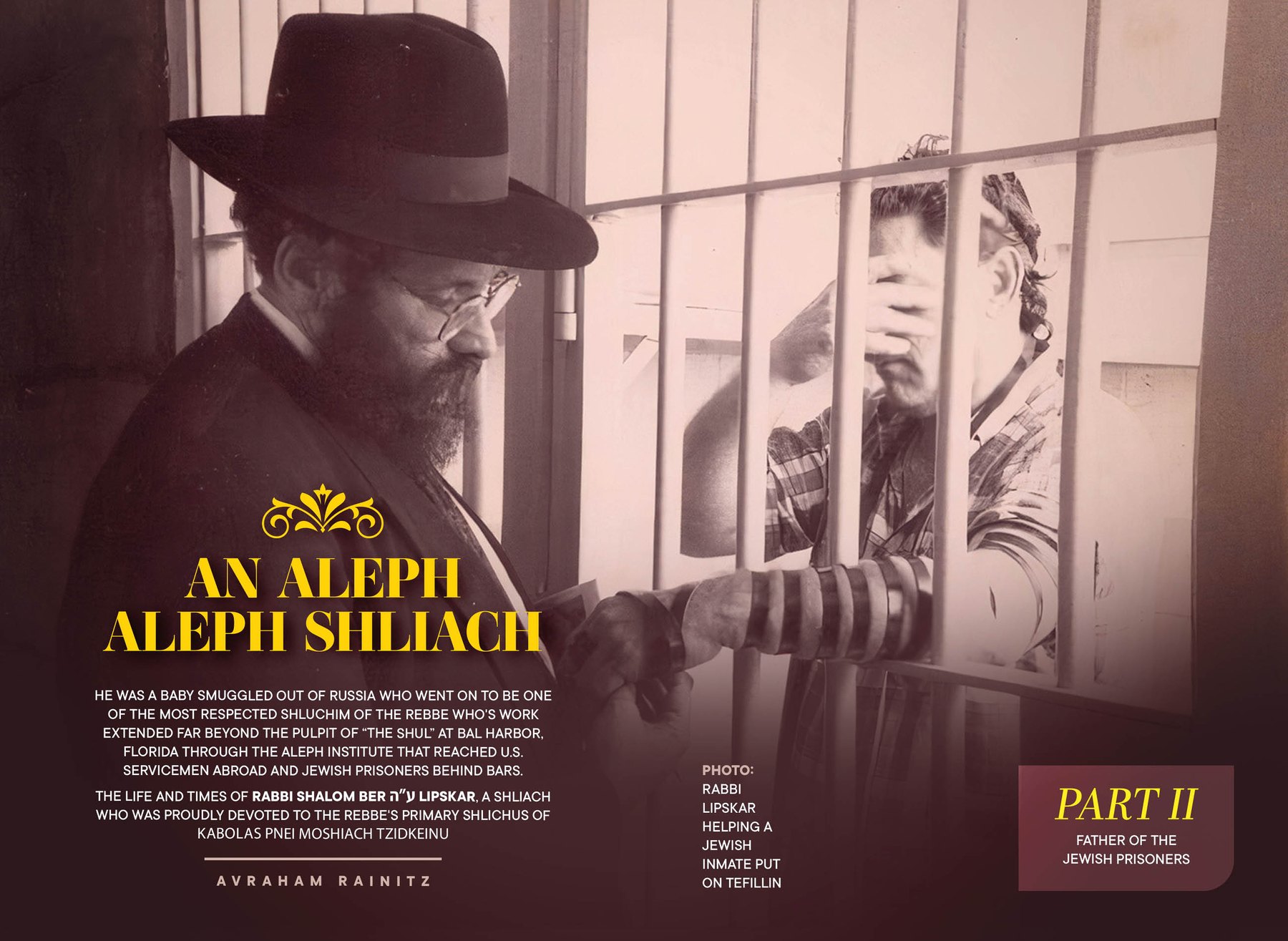
He was a baby smuggled out of Russia who went on to be one of the most respected shluchim of the Rebbe whose work extended far beyond the pulpit of “The Shul” at Bal Harbour, Florida through the Aleph Institute that reached U.S. servicemen abroad and Jewish prisoners behind bars. The life and times of Rabbi Sholom Ber a”h Lipskar: a shliach who was proudly devoted to the Rebbe’s primary shlichus of kabbolas pnei Moshiach Tzidkeinu
“I am traveling with you, but it should be b’simcha! Because if it’s not b’simcha, what purpose would there be in taking me with you?”
The Aleph Institute: Love, Honor, And Individuality
During his educational work, Rabbi Lipskar often encountered stories of Jews who had been completely cut off from the community: these were Jewish inmates in American prisons. To his great astonishment, he revealed that in both state and federal penitentiaries, many Jews sit completely cut off from any connection to a Jewish community, without any access to basic mitzvos such as tefillin, Shabbos observance, or kosher food, and sometimes even without family supporting them from the outside.
With a burning sense of obligation towards his shlichus, R’ Lipskar founded the “Aleph Institute” (Aleph is an acronym for Ahava, L’chabed, Pratiyus – love, honor, and individuality). The institute’s objective is to provide spiritual, educational, and humanitarian assistance for Jewish inmates and their families, in addition to helping Jews serving in the military on distant army bases with no family and community support. This was a pioneering initiative on a national scale that sprouted from the mind and heart of R’ Lipskar. This initiative merited to receive the Rebbe’s bracha and his unceasing encouragement.
The Aleph Institute’s activities began in secrecy: visits by volunteer rabbis to Florida prisons, sending siddurim, Jewish books, and tefillin to prisoners requesting them, and forwarding personal correspondences to those brokenhearted Jews confined behind bars. R’ Lipskar personally would toil long and hard preparing bags full of “holiday packages” containing challos, candles, and informational brochures, and sending them each Erev Shabbos and Erev Yom Tov to local prisons.
In no time at all, deeply moving ‘Thank You’ letters started to arrive at his office: “Rabbi, in your merit, I put on tefillin for the first time in seventeen years”; “I couldn’t believe that anyone would remember me on the Seder night”; “Your letter saved me from total despair.” R’ Lipskar encouraged more and more shluchim throughout the U.S. to join this effort and visit prisoners located in their areas of the country.
Thus, there came into being an unofficial network of spiritual and emotional support for Jewish prison inmates.
This local success also brought some undesirable attention: At one federal prison, the warden took note of a spiritual awakening among the Jewish inmates. A group of them regularly met to learn and daven in a program under Aleph Institute auspices – something that the warden found most intolerable. As a result, he decided to “break up the group.” One morning, 19 Jewish prisoners were suddenly removed from their cells and spread out among other penitentiaries around the country. The warden reasoned that this would break their spirit and put an end to the program.
However, the opposite occurred: Within a few weeks, dozens of letters started arriving at the Aleph Institute offices in Miami Beach from different prisons. Those split up Jewish inmates had written letters to R’ Lipskar, each describing how at every new facility, they came and succeeded in locating other Jews. They asked for siddurim, learning material, and advice on how to continue the spiritual activities in their new venue. With one swift blow, the Aleph Institute turned from one group of Jewish prisoners into a nationwide program. “What they thought would stop us merely transformed us overnight into a coast-to-coast organization,” said R’ Lipskar with a smile.
During the eighties and nineties, the Aleph Institute became established as the main address for Jews in prisons and for their families. R’ Lipskar maintained regular contact with the U.S. Federal Bureau of Prisons, fighting for the religious rights of inmates, e.g., supplying kosher food, allowing them to put on tefillin, holiday furloughs for Torah observant Jews, etc. He even managed to receive official recognition for this purpose from the U.S. Department of Defense, which sanctioned R’ Lipskar and his institute as an organization responsible for appointing and ordaining rabbinical authorities in the U.S. armed forces.
A Group Of Inmates Visit 770
For R’ Lipskar, the public and institutional activities weren’t enough. The heart of his shlichus activities among prison inmates were those of a personal and heartfelt nature. He invested countless hours in writing personal letters to Jewish prisoners asking to hear their troubles and lift their spirits.

Once, he brought a group of reformed prison inmates to spend Shabbos with the Rebbe. He arranged transportation for them, hospitality for Shabbos meals with Chabad families in Crown Heights, and personally accompanied them for that entire spiritually inspiring weekend. The inmates were privileged to see the Rebbe, and they even received his loving attention during the farbrengen.
To arrange seats close to the Rebbe for about twenty prisoners, R’ Lipskar asked several bachurim to grab places nearby, arranging that they would vacate them shortly before half past one, when the inmates arrive in 770 from their hosts’ homes. At around 1:25, they started organizing the group in their prearranged seats. Then, the Rebbe’s secretary, Rabbi Groner, suddenly came and said that the Rebbe asked that the prisoners not sit together to keep their presence from being overly conspicuous and noticeable.
It goes without saying that the prisoners’ appearance was different from the other participants – their clothes in sharp contrast to the traditional attire of the Chassidim. The Rebbe was concerned that if they sat together as a group, people would ask who they were and they would have to say that they were prison inmates, something that would obviously cause them shame. Therefore, it was decided to find them other places throughout the shul. Rabbi Groner added that for this very reason, they shouldn’t go up and ask for a bottle of ‘mashke’ for the group, thereby avoiding their embarrassment.
Nevertheless, in one of his sichos, the Rebbe spoke about people sitting in prison, insisting that while there is a variety of punishments for Jewish transgressors, imprisonment was not one of them. The Rebbe proceeded to explain that imprisonment negates a person’s ability to fulfill his mission in the world. However, the Rebbe added, since in the conduct of the nations of the world, the punishment of imprisonment is deemed an acceptable option – we must seek and find the benefit and value stemming from it. The Rebbe spoke at length about the opportunity given to a prisoner to prepare himself for a new life based upon the foundations of justice and integrity after his release from incarceration. Later in the farbrengen, the Rebbe made an ideological comparison between sitting in prison and the exile of the Jewish People, which also constituted a preparation and period of training for the era of Geula…
Thus, these prisoners not only merited a display of sensitive treatment from the Rebbe, they also heard an entire sicha dedicated to them and their current lives.
After that Shabbos, R’ Lipskar maintained close contact with these people. Some of them became complete baalei teshuva and established Jewish homes after their release from prison, others at least found spiritual comfort and strength to deal with their years of imprisonment in the faith that their people had not abandoned them.
The Elderly Jewish Life Prisoner
There are numerous moving stories connected with R’ Lipskar’s activities with prison inmates. One focuses on an elderly Jewish prisoner who poured his heart to R’ Lipskar because he had been sentenced to remain incarcerated for the rest of his life, totally cut off from his family. Unrelenting, R’ Lipskar worked through various legal channels and by harnessing the influence of public opinion, he eventually assisted in securing a partial amnesty for this prisoner and permission to be released for the final months of his life. The man passed away at home, surrounded by the love of his family members, all thanks to the quiet and determined involvement of R’ Lipskar.
In another instance, R’ Lipskar stood facing a federal judge to propose a Jewish rehabilitation program as an alternative to imprisonment for a young Jewish defendant. This would be part of a modern philosophical framework advanced by the Aleph Institute – rehabilitative and community punishment instead of a lengthy prison term. His vision was not only to help prison inmates, but even changing the manner of thinking of national policymakers on matters of punitive treatment, in the belief that every person is willing to mend his ways if only given the chance and the proper tools. Many in the legal community listened attentively to his ideas and quite often adopted them.
Rabbi Shalom Lipskar’s pioneering work with prison inmates also earned him official tributes. Government authorities and prison services honored him, and he became well-known as an expert and specialist in the field. However, above all, it brought him love from those who failed to receive it themselves – the prisoners. He was sent hundreds of blessings and thank-you letters addressing him with titles such as “the father of the Jewish prisoners”, or “the angel from Heaven.” In his great humility, R’ Lipskar always gave the credit to the Rebbe, who taught him how much every Jew – regardless of his station – is important in the eyes of G-d.
Charisma, A Big Heart, And Stories From The Soul
Alongside his multifaceted activities, the personage of R’ Shalom Ber Lipskar is fondly remembered for his captivating personal charisma – a combination of practical knowledge, a sharp wit, burning faith, and love for his fellow man. All these transformed him into a revered leader. He was an exceptional speaker, combining his drashos with stories of our Sages and Chassidic masters alongside modern-day anecdotes – all in clear language suitable for any congregation.
He had an amazing ability to “speak to one’s soul”, any soul. If facing him stood an assimilated millionaire, he knew how to find the pintele Yid concealed within him. If he was speaking to a confused young man, he discovered the words to instill him with hope and faith. One of his acquaintances described it this way: “When Shalom Ber speaks with you, you feel at that moment that you’re the most important person in the world.”
Thus, the “sign of his recognition” was his personal way of relating to any person that he met, and even if it was only once, he was privileged to receive a quick smile and an inquiring request for a good piece of advice that might change his life.
When Rabbi Lipskar Threw Out 300 Psychology Books
As the rabbi of a vibrant community and a veteran shliach, R’ Lipskar also had no concern over challenging his listeners with his unique flair. In his Shabbos morning drashos, he often carried his congregation away with moving and inspiring stories. His words were a combination of original Chassidic maxims alongside sayings in English – all in his characteristically descriptive style. Many community members would quote during the week portions of his drasha, which served as a Jewish ethical lighthouse in their daily lives.
Rabbi Sholom Dovid Geisinsky, who was closely acquainted with R’ Lipskar, tells that besides his vast Torah knowledge in Nigleh and Chassidus, R’ Lipskar also read outside literature dealing with matters of emotional health, on the level of “If one says there is wisdom among the nations, believe him.” Here, he combined fascinating psychological concepts in his drashos. One day, however, he received a reply from the Rebbe that “there is no need today to peruse external or outside text material, since everything can be found in the sefarim of the true Torah giants.”
R’ Lipskar told R’ Geisinsky about the answer and then concluded: “The next morning, I threw more than three hundred books out of my house!”
Is Your Home Ready For Moshiach?
R’ Lipskar spoke much about the faith of Chassidim that the Rebbe is Melech HaMoshiach. Shortly after Gimmel Tammuz 5754, there was a torrent of attacks by those opposing Chabad Chassidim due to their faith in the Rebbe as Melech HaMoshiach. Things reached a climax during the popular New York radio program hosted by Zev Brenner. R’ Lipskar called in, and in a deeply engrossing presentation, supported by Torah sources from our Sages, of blessed memory, he explained why even after Gimmel Tammuz, it is possible to believe that the Rebbe is Melech HaMoshiach. Among other things, he even asked the individual arguing with him if he personally even believes in the coming of Moshiach…
At the central farbrengen held in Miami last Gimmel Tammuz, R’ Lipskar related how one day he heard from the philanthropist Mr. Shmuel (Sam) Rohr about one of his childhood friends who rebuked him for davening in a Chabad shul when Lubavitcher Chassidim believe that the Rebbe is Moshiach…
R’ Lipskar invited the two of them for a discussion in his office. He pulled out a copy of the Rambam’s Mishneh Torah, opened it to the section bringing detailed signs and conditions for identifying Melech HaMoshiach, and he began learning and explaining the halacha. After they studied the material together, R’ Lipskar asked Mr. Rohr’s friend, “Do you recognize someone in today’s world who fits into this category?” The man shook his head.
“And what about the Lubavitcher Rebbe?” R’ Lipskar continued.
“But he’s no longer here,” the man replied.
“I’m not asking whether he’s here or not,” R’ Lipskar clarified. “I’m asking if he’s fit for this category?” The man again perused the Rambam and admitted: “Yes, he is.”
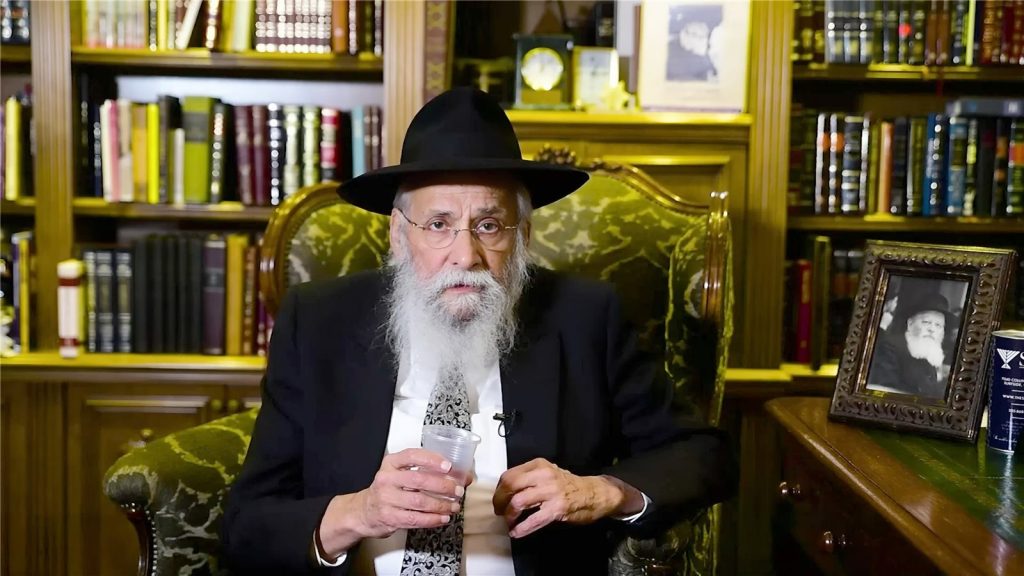
R’ Lipskar summed it up: “You are living in a generation during which a man existed who guided your life, our generation, the leader of the Jewish People, someone fit to be Moshiach! And you told your friend not to daven in Chabad because they believe that the Rebbe is Melech HaMoshiach!?”
In his speeches, he liberally quoted the Rebbe’s call from his sicha of the 28th of Nissan 5751: “Do everything you can to bring Moshiach Tzidkeinu, here and now, immediately.” His practical message, particularly in commemorating thirty years since Gimmel Tammuz, was to demand that people leave their comfort zone and take action: put tefillin on thirty Jewish men, get thirty Jewish women and girls to light Shabbos candles, affix thirty mezuzos, make certain that thirty Jewish children get a proper Jewish education.
He believed that Moshiach is not just a subject – “Moshiach is a way of life”, and he called out to all those within reach of the sound of his voice: “We know who Moshiach is, but are you prepared to live a life of Moshiach? Are you willing to do something for the Rebbe? When you return home at night, make certain that your house is ready to welcome Moshiach at any moment when he knocks on the door… If he’ll come knocking at two o’clock in the morning, there will be no need to clear away the magazines or hide things in the closet. They’re ready for Moshiach!”
A Leader, A Shliach, And A Man Of Kindness
R’ Lipskar had a special koch (passion) for Mivtza Tefillin, a fact that was engraved on his headstone. Just weeks before his passing, he met Itzik Gvili, father of hostage Rani Gvili Hy”d and helped him done tefillin despite his weakness. This typical interaction was shared on an a viral social media video that circulated worldwide after his passing just weeks later. A friend posted the video and added: “He even got him to commit to start putting on tefillin every day. He hasn’t missed a day. The Rabbi got energy and life when you did extra mitzvas. We’ll miss you Rabbi.”
On Shabbos Kodesh Parshas Tazria-Metzora, the fifth of Iyar 5785, Rabbi Shalom Ber Lipskar passed away, leaving behind a tremendous heritage: a loving family – his wife, the shlucha Rebbetzin Chani, and their two children, together with grandchildren and great-grandchildren continuing along his path.
Similarly, he leaves behind him a long line of thriving Torah educational institutions he established and cultivated – “The Landow Yeshiva”, “The Shul”, “The Aleph Institute.” And above all – thousands of students, friends and supporters, whose lives were changed dramatically in the merit of the touch of his soul and his tireless shlichus.
The great appreciation for his activities and his character was demonstrated at his moving levaya, when hundreds of people from all over the world – shluchim, rabbanim, supporters, and simple people wept for the man who was their mentor.
Towards the end of his life, when he was asked how he perceives his life’s work, R’ Lipskar responded with humility: “I don’t think that we have completed our shlichus. I’m not talking about myself, rather every Jew who still hasn’t encountered the light. We are the Rebbe’s shluchim, and our work will come to an end when Moshiach comes. Every Jew getting closer to Yiddishkeit, every child learning Torah, every prison inmate putting on tefillin – these are real achievements…”
Rebbetzin Chani, his partner on a joint spiritual journey for fifty-five years, added: “Every important decision that we made, every significant step along the way, we always asked ourselves: Is this something that the Rebbe would be proud of? As shluchim, our work is not a job. It’s a way of life…”
Rabbi Shalom Ber Lipskar’s legacy, working substantially to illuminate the world with the light of Torah, will continue to illuminate the path of many. As he personally said once: “When the world sees a Chassid of the Rebbe, a shliach of the Rebbe, what he sees is a lamplighter. He sees someone who will bring him simcha…”
These words are a very fitting conclusion to the life story, the shlichus, and the phenomenal legacy of Rabbi Shalom Ber Lipskar.
Beis Moshiach #1464 • pp. 20-25, 26, 27
© 2026 Beis Moshiach Magazine. All rights reserved.
This article originally appeared in Beis Moshiach #1464. You are welcome to share it with friends and family by email or in print, provided that you do not change, add to or omit any part of it, you credit the author and Beis Moshiach, and you include a link to archive.bmoshiach.org (written out in full in printed copies).
To republish this article in a newspaper, magazine, book or website, please request permission in advance at [email protected].