The Zeidy of Camp Chomesh
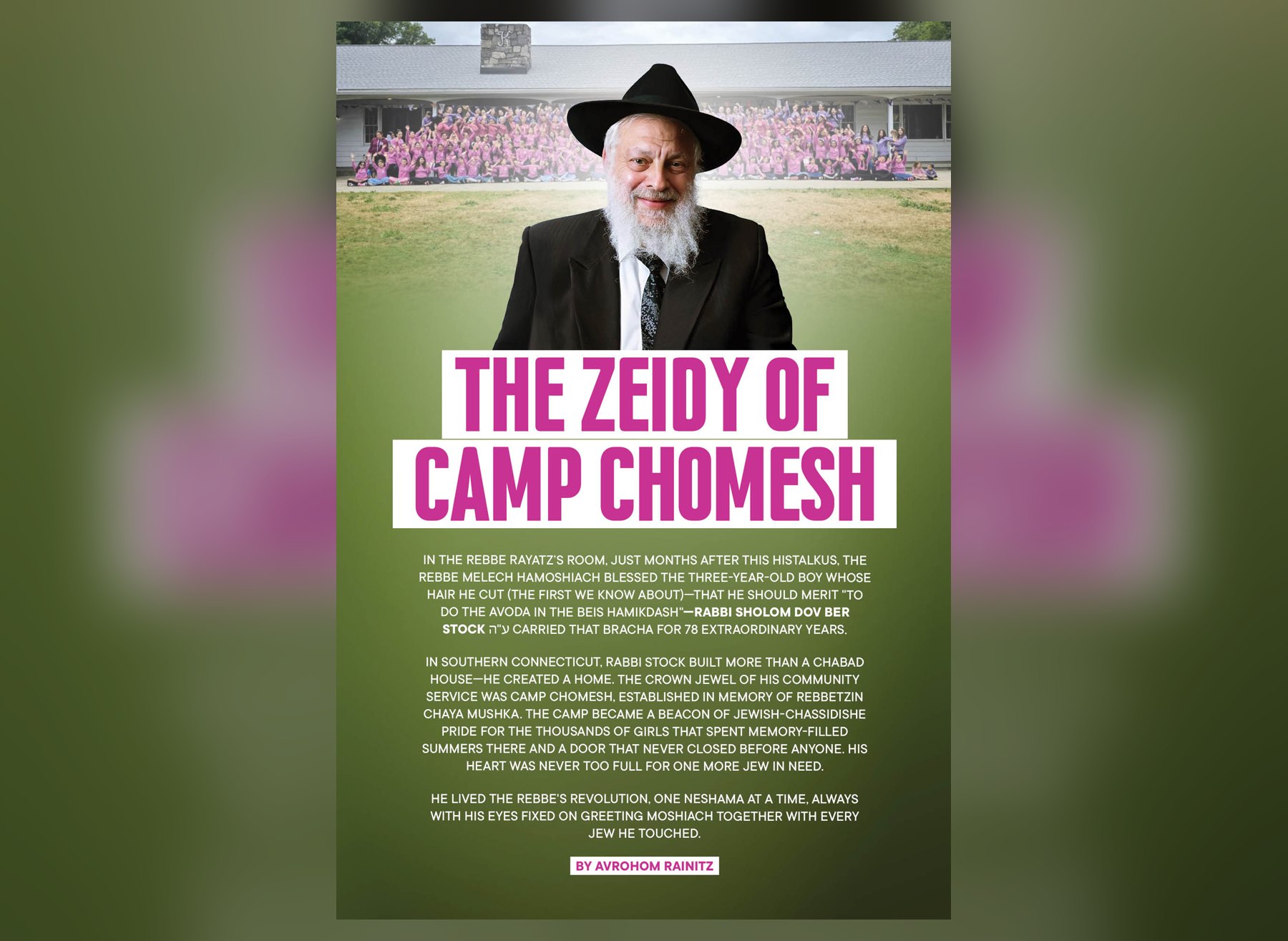
In the Rebbe Rayatz’s room, just months after his histalkus, the Rebbe Melech HaMoshiach blessed the three-year-old boy whose hair he cut (the first we know about) – that he should merit “to do the avoda in the Beis HaMikdash.” Rabbi Sholom Dov Ber Stock a’h carried that bracha for 78 extraordinary years. In southern Connecticut, Rabbi Stock built more than a Chabad House – he created a home. The crown jewel of his community service was Camp Chomesh, established in memory of Rebbetzin Chaya Mushka. The camp became a beacon of Jewish-Chassidishe pride for the thousands of girls that spent memory-filled summers there and a door that never closed before anyone. His heart was never too full for one more Jew in need. He lived the Rebbe’s revolution, one neshama at a time, always with his eyes fixed on greeting Moshiach together with every Jew he touched.
Their situation seemed hopeless. Their great hope for an uplifting summer for their special daughter was shattered in the face of logistical challenges. “We cannot take the responsibility,” they were told at the other summer camp, and their hearts broke. They understood. Their daughter, dealing with a complex medical condition, required different arrangements, suitable staff, which entailed weighty responsibility. The heart was pained, but the door was closed to them. Where would they go now? Where would their daughter be able to experience the light and joy she had yearned for all year?
A rumor reached their ears about a new summer camp, ‘Camp Chomesh,’ which had just opened in Connecticut. With heavy hearts, nervous about another rejection, they approached the director, Rabbi Sholom Dov Ber Stock. They laid out before him the situation, the complexity, the special requirements, expecting to hear again the same polite, understandable, yet so painful refusal.
But instead of hesitation, they met kind eyes and an open heart. Even before they finished their words, Rabbi Stock responded with warmth and simplicity: “Certainly. She will come to us. We are waiting for her.”
The tears that had choked the parents’ throats now burst forth, but this time they were tears of relief, of excitement, of infinite gratitude. This was not a ‘yes’ from a director seeking to fill registration in a new camp. This was a ‘yes’ from a Chassid, from a man of kindness, who saw before him a Jewish soul thirsting for warmth and love, and opened his heart and his home to her widely. He went beyond his duty personally, harnessed the entire camp staff to the mission, and instructed them how to give that girl everything she needed. He saw her as a privilege, not a burden; another diamond in the crown of his shlichus.
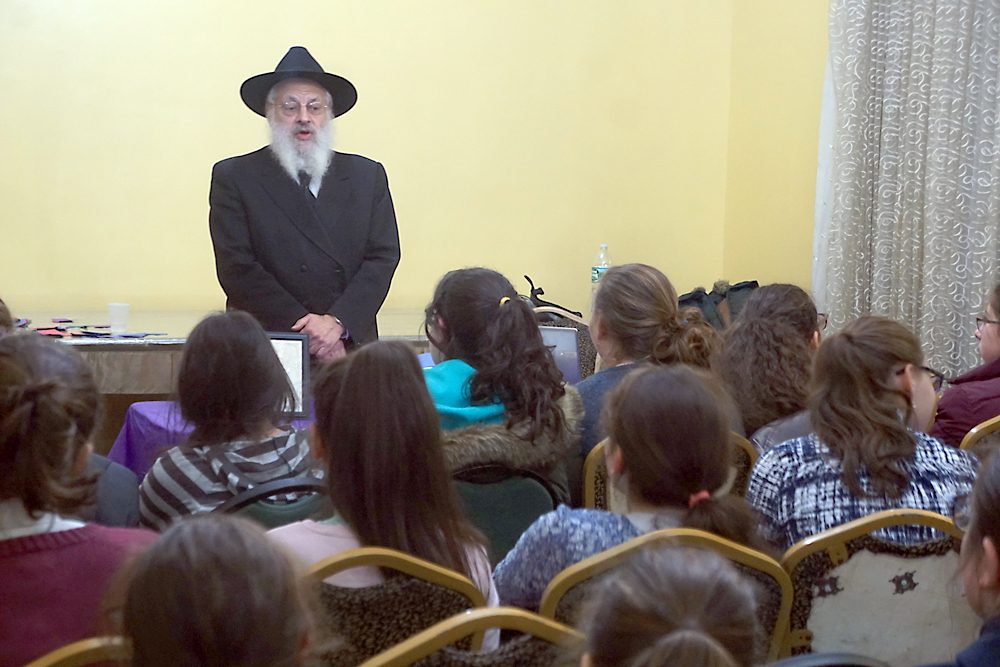
This moving story, which illustrates what Ahavas Yisrael means, was told this week by Rabbi Chaim Dalfin. This story characterizes more than anything the personality of this man of chesed and chinuch, the shliach Rabbi Sholom Ber Stock a’h, who passed away last week, on the 20th of Tammuz, at age 78.
This story is but one wave in an ocean of action, mesirus nefesh and bringing hearts closer that Rabbi Stock left behind during decades of shlichus in Connecticut. A shlichus that began while working alongside his father, continued with a revolution of holiness and Judaism throughout the state, and reached its peak in his life’s great enterprise, Camp Chomesh, which became a lighthouse of Chassidic education for thousands of girls.
Childhood in a Family of Shluchim – Special Closeness to the Rebbe
Reb Sholom Ber was born on the 30th of Nissan, 5707. His father, Rabbi Yisroel HaKohen Stock, was among the first students of Yeshivas Tomchei Tmimim in America with the arrival of the Rebbe Rayatz in 5700. In 5704, he was part of the group that the Rebbe Rayatz sent to establish the yeshiva “Achei Tmimim” in Bridgeport, Connecticut, and in 5725 he went on the Rebbe’s shlichus to the city of Trumbull in Connecticut.
Already in his early childhood, Sholom Ber merited special closeness from the Rebbe. Through the efforts of his grandfather, Rabbi Shlomo Aharon Kazarnovsky, Sholom Ber was the first child whose hair the Rebbe cut in an ‘upshernish’ ceremony. The ceremony was held in the holy room of the Rebbe Rayatz, just months after his passing.
An interesting story occurred on that occasion: One of the fathers insisted that his son – who was older by a few days – should enter first, but the Rebbe replied: “But he is a Kohen!” – and thus gave priority to young Sholom Ber, who was a Kohen, to enter first.
Special Blessing for Bar Mitzva
Before his Bar Mitzva in 5720, Sholom Ber had yechidus along with his parents and grandparents. The Rebbe blessed him in an exceptional way, saying that “there is a custom among the Sefardim, when a Bar Mitzva boy is a Kohen, that they bless him to perform the service in the Beis HaMikdash” – a rare and special bracha that accompanied Rabbi Stock all his days.
This bracha instilled in him a constant expectation for the building of the Beis HaMikdash and the coming of Moshiach, a theme he emphasized in his educational and shlichus efforts throughout the years.
Extensive Shlichus Work in Connecticut
After his marriage, Rabbi Stock worked on shlichus in Detroit, and after several years moved to work in Connecticut, alongside his father.
Based on the foundation his father had laid, Jewish activity in the area continued to expand. In 5735, the community reach was also expanded to additional cities in southern Connecticut, including Stamford and the surrounding area.
Over the years, under his leadership, Chabad houses were established in Connecticut and extensive outreach activities were added: Torah classes, minyanim, public holiday events (central Chanuka lightings, shofar blowing in parks), and extensive activity with youth and families. Rabbi Stock’s talent for creating warm contact with Jews from all backgrounds helped him bring many back to Judaism and draw them closer to the light of Torah.
After his father’s passing in 5748, Reb Sholom Ber continued to carry the banner of shlichus in the southern Connecticut area for more than fifty years.
“Camp Chomesh” – Diamond in the Crown of Shlichus
In the late 1990s, Rabbi Stock and his wife were called upon to manage a Chabad summer camp for girls. The camp was named “Camp Chomesh” after the Rebbetzin a’h.
At the foundation of the camp stood several iron principles, which were an expression of Rabbi Stock’s deep and exceptional educational approach. The first principle was absolute and unconditional acceptance: every girl who wished to come – was accepted. The second principle, which completed it, was ‘we don’t send anyone away.’ Rabbi Stock held firmly that sending a camper back home is not an educational approach at all, and even those who wanted to leave he would encourage to stay, with patience and love.
These principles stemmed from the general spirit of the camp: personal, warm and embracing care for each and every one. Not for nothing, all the campers, throughout all the years, simply called him ‘Zaidy.’ He truly was grandfather to them all, the one who personally took care of every detail, big and small, and ensured that everyone felt at home. This was the unique approach that made Camp Chomesh more than just a camp, but a mosad chinuch that operated under his constant presence and involvement.
They insisted on a warm atmosphere like one family for all the campers and staff. Every Shabbos the Rabbi and Rebbetzin would bake fresh challahs and cakes for all the girls, and even take care of special meals for girls who didn’t like certain foods – all so that everyone would feel “like at home.” The principle of Ahavas Yisrael guided Rabbi Stock in managing the camp, where every camper felt important and surrounded by Chassidic love.
“The joy and Jewish chayus were felt in every corner of the camp,” described alumnae, “the songs, dances and activities – everything was imbued with a Chassidic spirit of joy in serving Hashem.”
After almost 14 years of wandering from place to place, a breakthrough came in 5774 (2014), when Camp Chomesh moved to the town of Moodus, Connecticut. The new site, a spacious private resort of 21 acres, became the permanent home of the camp.
The move to Moodus symbolized the fulfillment of Rabbi Stock’s vision – a Chassidic camp for girls on independently owned grounds, that would continue to shine for generations. Until his last days, Rabbi Stock continued to bear responsibility as camp director, who worked on perfecting the educational programs and accepting more and more campers.
At many farbrengens, Rabbi Stock would speak passionately about how we are in the last generation of exile and the first generation of Geula, and instill in those around him the expectation and preparation for the coming of Moshiach. In Camp Chomesh too he would inspire the campers to merit being in the ‘king’s army’ and to prepare the world to greet Moshiach Tzidkeinu.
Rabbi Sholom Dov Ber Stock left behind a glorious legacy of educational and Chassidic activism. Together with his wife, he raised a large family of eleven children, dozens of grandchildren and great-grandchildren, who walk in the ways of Torah and Chassidus.
Family Stories with the Rebbe
“We Need the Blessings of the Kohen”
One year, after a change in the yechidus protocol, where only the baal ha’simcha himself would enter, Rabbi Stock’s mother entered for a birthday yechidus without her husband. Immediately upon her entry the Rebbe asked her: “Where is the husband?” When she replied that they didn’t allow him to enter according to the new procedure, the Rebbe reacted: “He is a Kohen, we need his blessings, let him be brought in!” The secretaries immediately called for his father to enter.
Faith in Tzadikim Against Doctors’ Words
Rabbi Stock’s grandmother, Rebbetzin Kazarnovsky, was the daughter of the Chassid Reb Asher Nikolayever, and maintained close contact with the Rebbe’s household since her childhood. In 5729, when she became ill and faced dangerous surgery, the medical prognosis was grim. Before the surgery she had yechidus and expressed despair. The Rebbe reacted firmly: “What are you saying?! In whom do you believe – in what the doctors say, or in what I say?! I say you will be healthy!”
And indeed, despite the doctors’ doubts, the grandmother underwent the surgery successfully and lived another twenty years, until her passing at age 95.
“The Shlichus Has Already Ended”
Yud-Aleph Nissan 5747, the birthday of the Rebbe, was also the day of the grandmother’s passing. The day before, she asked to convey to the Rebbe that it was very difficult for her. When the mother conveyed these words to the Rebbe, in mid-sentence the Rebbe stopped her and said: “The shlichus has already ended.” The next day, when the news came that the grandmother had passed away, the family members understood the true significance of these words.
Beis Moshiach #1472 • pp. 10-13, 29
© 2026 Beis Moshiach Magazine. All rights reserved.
This article originally appeared in Beis Moshiach #1472. You are welcome to share it with friends and family by email or in print, provided that you do not change, add to or omit any part of it, you credit the author and Beis Moshiach, and you include a link to archive.bmoshiach.org (written out in full in printed copies).
To republish this article in a newspaper, magazine, book or website, please request permission in advance at [email protected].