When the Hungarian Consul Cleared Lulavim From Customs for Namibia’s Jews…
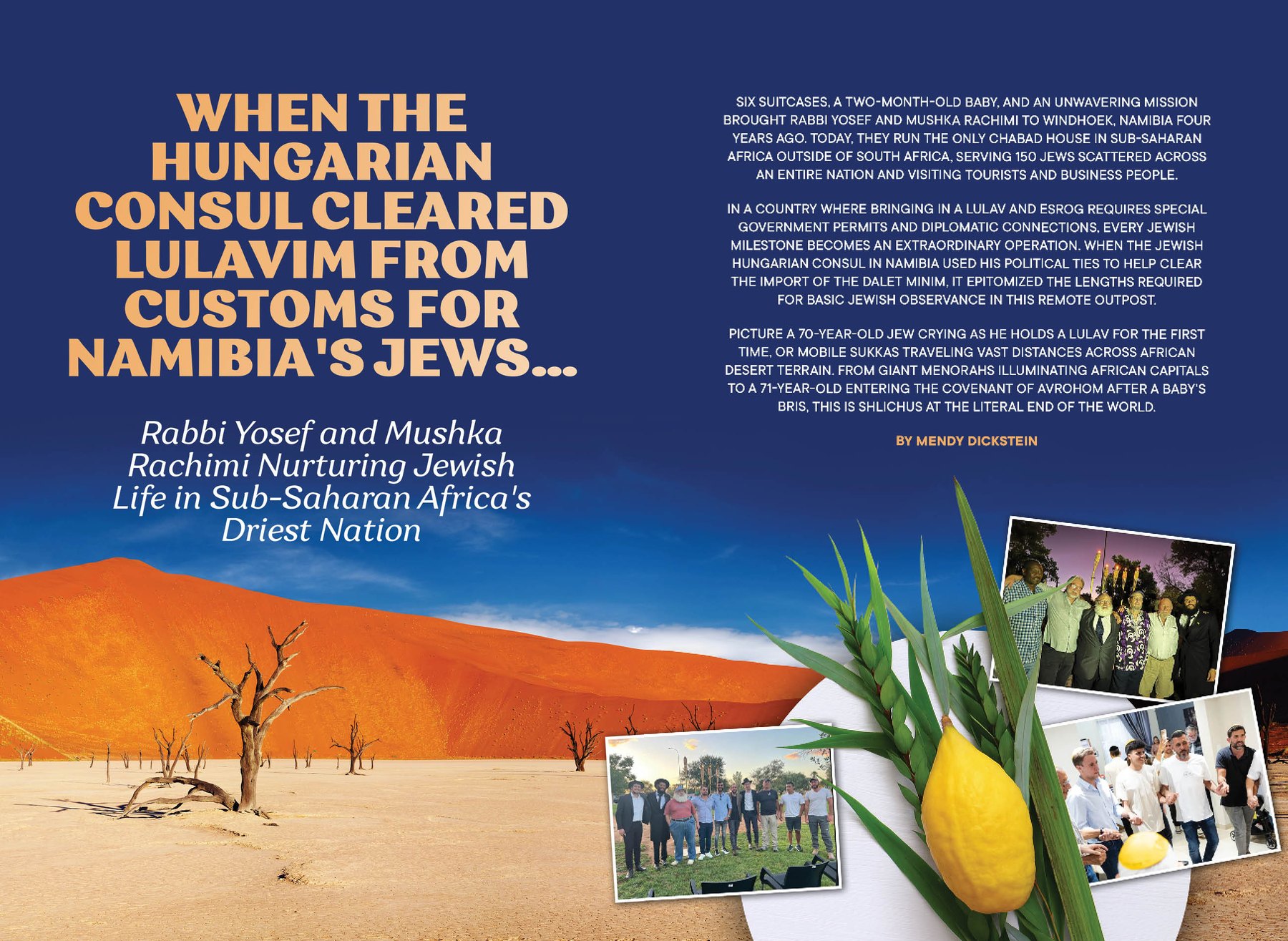
Six suitcases, a two-month-old baby, and an unwavering mission brought Rabbi Yosef and Mushka Rachimi to Windhoek, Namibia four years ago. Today, they run the only Chabad House in Sub-Saharan Africa outside of South Africa, serving 150 Jews scattered across an entire nation and visiting tourists and business people. In a country where bringing in a lulav and esrog requires special government permits and diplomatic connections, every Jewish milestone becomes an extraordinary operation. When the Jewish Hungarian consul in Namibia used his political ties to help clear the import of the dalet minim, it epitomized the lengths required for basic Jewish observance in this remote outpost. Picture a 70-year-old Jew crying as he holds a lulav for the first time, or mobile sukkas traveling vast distances across African desert terrain. From giant menorahs illuminating African capitals to a 71-year-old entering the covenant of Avrohom after a baby’s bris, this is shlichus at the literal end of the world.
In the city of Windhoek in the state of Namibia, in the heart of the African continent, operates a unique Chabad House. Running it are Rabbi and Mrs. Yosef and Mushka Rachimi and their young children, who embarked on the Rebbe’s shlichus almost three years ago to prepare this country as well for the coming of Moshiach.
In a special interview, Rabbi Rachimi opens a window into the fascinating life of shlichus for him and his family in such a remote country, revealing the almost impossible challenges, the achievements, and dreams for the future.
A Bris in Namibia; Nothing is Taken for Granted
Imagine for a moment a bris in Eretz Yisrael. The happy parents book a hall, modest or lavish according to their budget, choose kosher catering, and arrive at the event like royalty with everything arranged and waiting for them. Guests arrive, the mohel arrives on time, and the sandek – a proud grandfather or close friend – holds the baby in the moving moment. Everything flows smoothly with almost no effort.
Now, take a deep breath and imagine the same event, but this time in the heart of Africa – in distant Namibia. This is exactly what happened a little over half a year ago.
Rabbi Yosef Rachimi describes a completely different scene: “Boruch Hashem, we were blessed with the birth of a son in our place of shlichus, Namibia. Immediately after the birth, instead of resting and recovering, we found ourselves planning a complex logistical operation.”
Thus, while in Eretz Yisrael parents simply pick up the phone to call the local mohel, in Namibia it’s a completely different story. Like another world. “We had to fly in a mohel from South Africa,” R’ Rachimi recounts. “It’s not simple – you need to coordinate flights, arrange entry visas, and ensure he arrives on time. Here in Namibia, nothing is taken for granted.”
But all this is just the tip of the iceberg. In Namibia, the new parents had to take on all the preparations and cooking themselves.
“We had to take care of every detail from the ground up,” R’ Rachimi recalls. “Where do you get kosher meat in such quantities? How do you prepare fresh challahs when there’s no Jewish bakery in the entire country, and not even flour?
“We wanted to invite people from all over the country to join us in the celebration,” he explains. “Some traveled for hours to get here. This wasn’t just an event, but a rare opportunity for our small Jewish community to gather and celebrate together. It’s an opportunity for us to strengthen the Jewish community locally.”
But despite all the challenges, and perhaps because of them, the bris in Namibia became an unforgettable experience.
“When everything worked out in the end, when we saw the community gathering, the mohel arriving safely, and the baby finally entering into the covenant of Avrohom Avinu, it was a most moving and uplifting moment,” he concludes with a smile.
“It reminded us why we’re here, and why all the effort is worthwhile, because a bris in Namibia is not just a family event – it’s a declaration of Jewish identity, of continuity, and of the deep connection between all parts of the Jewish people even in the most distant and Jewishly remote places. This is a story of mesirus nefesh and of the power to preserve tradition anywhere in the world.”
Landing In Another World
The Republic of Namibia is a country located in southwestern Africa, situated on the Atlantic Ocean coast. It borders Angola and Zambia to the north, Botswana to the east, and South Africa to the south.
Most of Namibia’s population consists of Black Africans, while whites comprise only about 6% of the country’s population.
The young couple landed there in Kislev 5782, with six suitcases and a two-month-old baby. As far as places of shlichus go this is definitely unusual in the shlichus landscape.
I ask R’ Rachimi to return to the beginning of their shlichus period. A young couple with life ahead of them decides to go on shlichus, but not just anywhere – to distant Africa, to Namibia.
What brought you to decide to be the Rebbe’s shluchim specifically there?
“The shlichus in Namibia wasn’t a random choice. During Covid, when the whole world was closed, someone suggested Namibia to us. We wrote to the Rebbe through the Igros Kodesh and received an explicit answer: ‘In the past, mesirus nefesh meant giving up the body, today what’s required is mesirus ha’ratzọn (giving up one’s will) (whoever had influence with youth in the past should continue with that).’
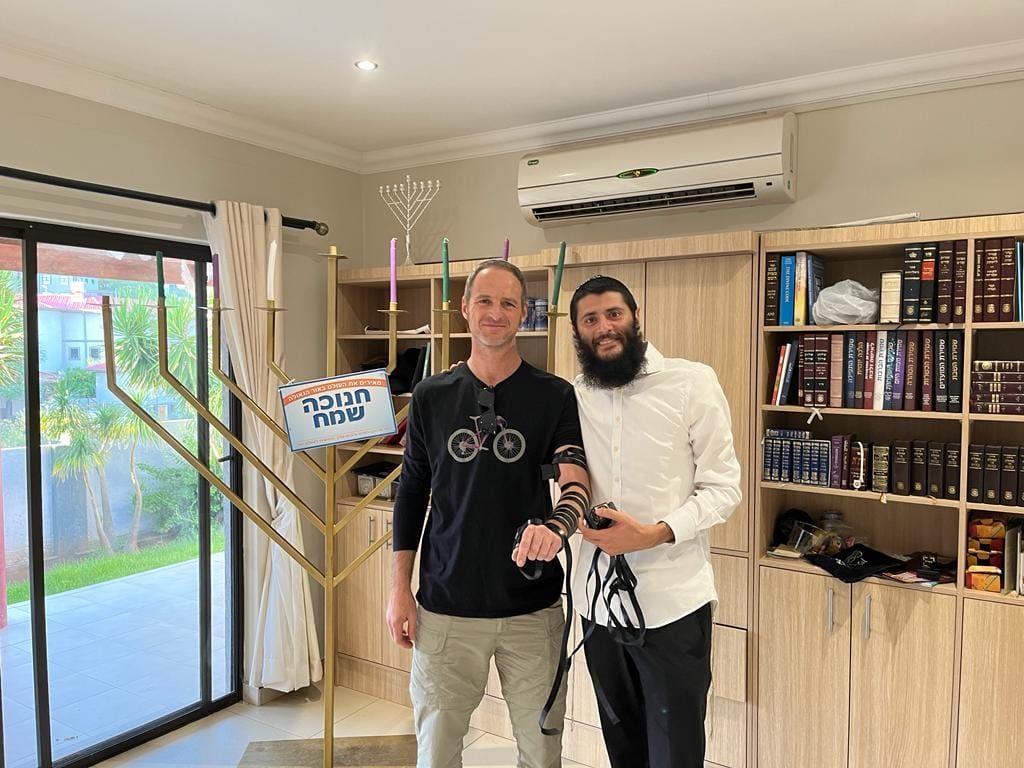
“When we arrived here in winter 5782, we didn’t even know if there were normal supermarkets here. We simply decided we were going.
“Within three weeks we found a house, and that was a great miracle. However, we couldn’t even sign a rental contract ourselves, and someone signed for us. The landing itself was on Beis Kislev, but in the letter from the Igros Kodesh that we opened that day, the Rebbe wrote ‘19th of Kislev,’ and that was the day we entered the house, the Chabad House. Exactly one week later, we held our first event.”
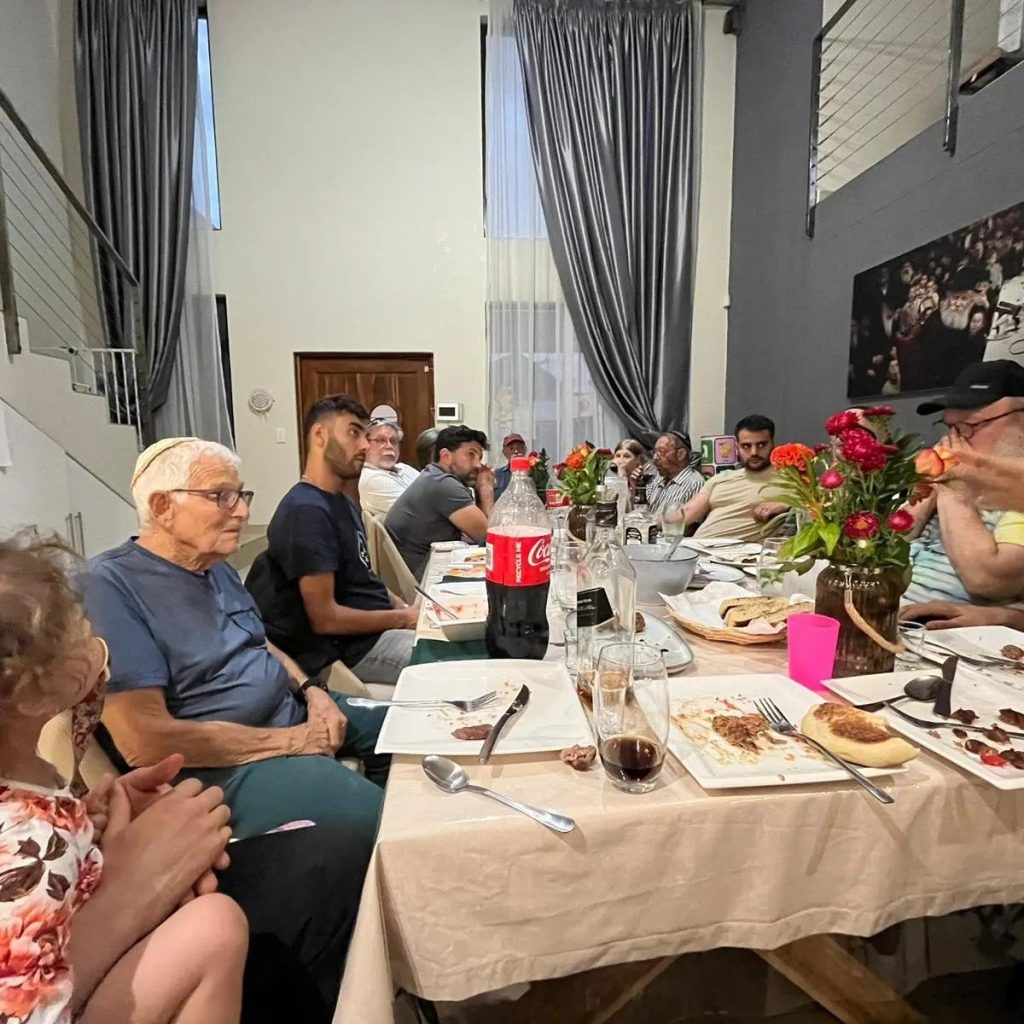
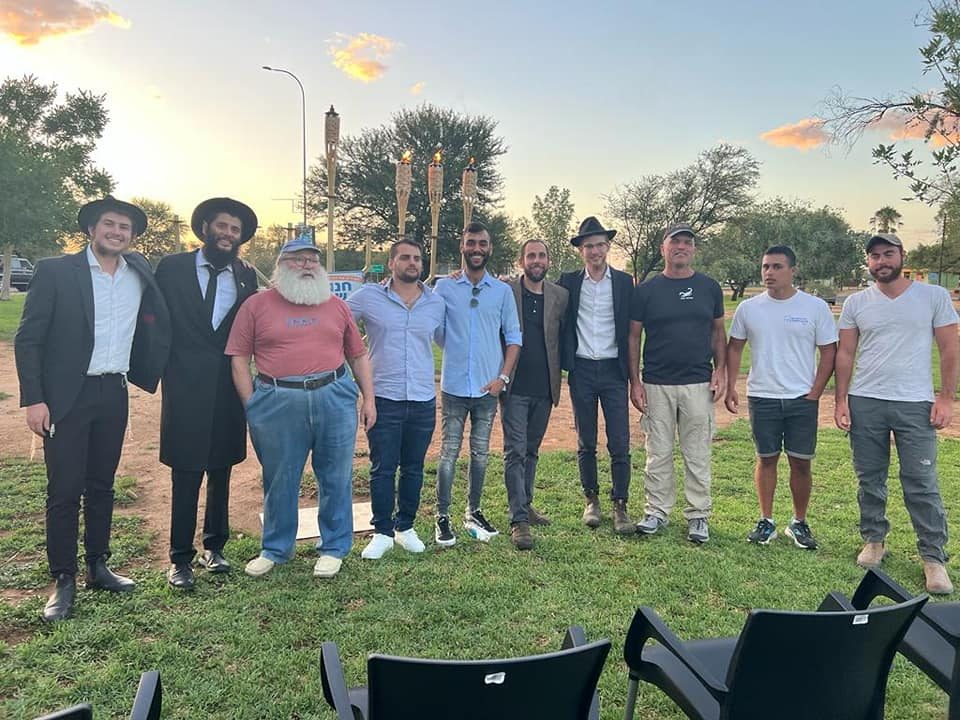
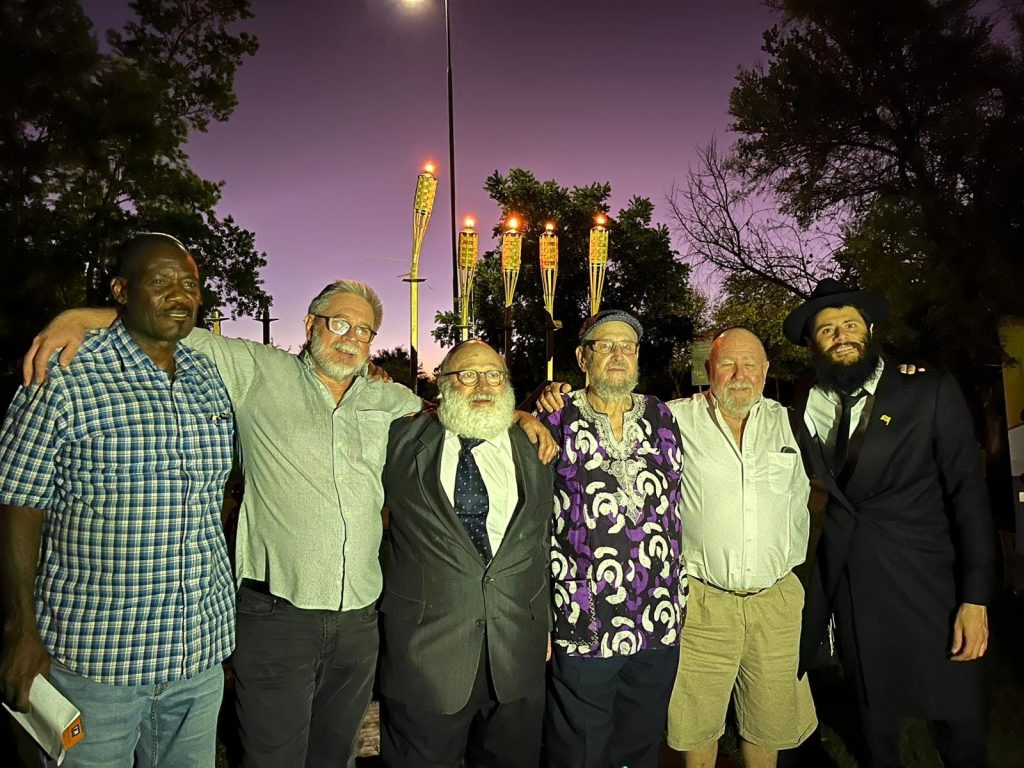
Everything was foreign and different from what they knew. The people, the culture, and the entire street shouted different! The first days were full of challenges. Nevertheless, “Already on the first Chanuka we held three parties. One was for local Jews, one for Israelis, and another in a city park with official permission from the municipality. For us, this was a quantum leap.”
R’ Rachimi describes their excitement: “To see the light of Chanuka candles illuminating the streets of Windhoek, that was something special. People stopped, asked questions, were interested. That was the moment we understood we could really make a difference here.”
How many Jews currently live in Namibia?
“The Jewish community in Namibia is small and diverse, and it definitely surprised us. When we arrived, they told us there were about 30-40 Jews here, but today we already know close to 150 Jews throughout Namibia. There’s an interesting mix here – white Jews from South Africa, some Israelis, embassy people, really all types.”
Rachimi adds an interesting detail about the Jewish history of the place: “The Jewish history here begins about 150 years ago. There were Jews who came from Germany and did business, thus forming the initial core of the community. Namibia was actually part of German colonies, and to this day there are many German motifs here.
“One day we met an elderly Jew who told us that once there was a community here of 450 Jewish families. That was a shock for us. To think that once there was such a large community here, and now we’re essentially starting over.”
One of the biggest and most basic challenges facing the Rachimi family was obtaining kosher food. Even in distant shlichus countries, it’s still possible to obtain certain foods in supermarkets with good kosher supervision, but in Namibia this doesn’t happen. There simply isn’t any.
How do you deal with the challenge of obtaining kosher food on a regular basis?
“At first, we brought meat from South Africa, but customs always made problems. More than once they confiscated entire suitcases of kosher meat from us. It was frustrating every time. We would arrive at the airport full of hope, and then suddenly they would tell us ‘Sorry, you can’t bring this in.’ It was difficult, especially when we knew there were families waiting for the kosher food.”
The solution came in a surprising way. “We wrote to the Rebbe about all these difficulties, and the answer was that we should establish kosher shechita here. This amazed us, and it was also an enormous challenge, but we knew this was the right way.”
Today, the shluchim bring a shochet from South Africa every few months for local shechita. “We are the first Chabad House – and perhaps the only one – in Africa, outside of South Africa of course, that has its own cattle shechita. This not only solves our kashrus problem but also helps Jewish travelers in the area as well as other communities. We even have a Jewish family that removed pork from their home and brought in kosher meat instead. This was an enormous change in their lives.”
Challenges of Distance, Loneliness, and Longing
One of the central challenges for shliach families is the issue of chinuch for their children, which leads to the obvious question:
How do you deal with educating your children in a place without Jewish schools?
Our children are still young, however one of the significant achievements of the Chabad house is opening a Jewish kindergarten. We have, boruch Hashem, five children in the kindergarten. We brought kindergarten teachers from Israel, Chabadniks, who were even here with us during the Tishrei holidays.
Elsewhere, a kindergarten is a routine thing while for us the kindergarten is part of a broader vision. There has never been a Jewish kindergarten in Namibia, which is important of course for future generations. This also affects celebrations and workshops or events we do before holidays for the children. Just before the last Rosh Hashana, ten children participated in a Rosh Hashana workshop. This might sound like few, but in Namibia it’s a lot! To reach the heart of a Jew in Namibia, or a new Jewish family, involves hard work.
I understand that even operating a kindergarten in Namibia is a challenge…
Definitely. Even before talking about bringing staff, or finding a place to live, etc., just bringing Jewish educational materials to Namibia is no simple thing. Every book and every Jewish toy, no matter how small, needs to be brought from abroad. But when we see the children singing Jewish songs and learning about the Yomim Tovim, it’s worth every effort.
What are the biggest challenges in maintaining a Jewish way of life in such a remote place?
There’s the unique aspect of being the only frum Jew in the area. We, of course, are mekarev as much as possible. Take for example the matter of establishing a mikva, something we’re currently working on. The situation is very complex. To immerse in a river or travel to another country is not a solution.
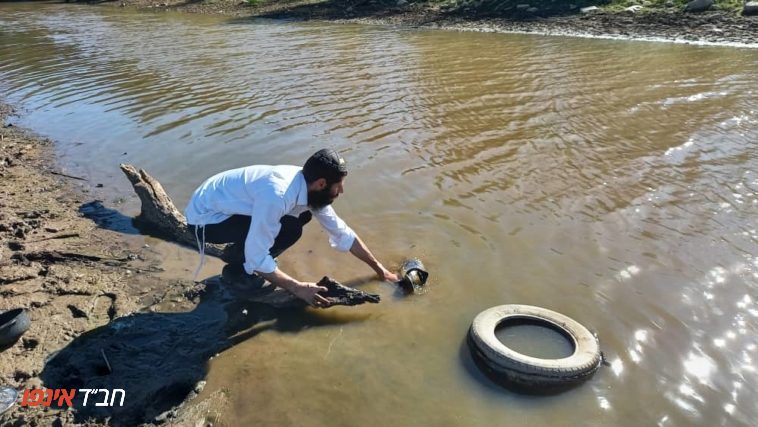
On the other hand, establishing a mikva in Africa is not like establishing a mikva in New York. There are challenges here of climate, building materials, and expertise that doesn’t exist. But since we know how important it is, we don’t give up.
How do you cope with being distant from extended family in particular, and from the Chabad community in general?
There’s also the challenge of loneliness, and that’s a very difficult challenge. We’re far from family and friends, and it’s not easy. However, we feel that the shlichus gives us strength. Once a year we try to get to Eretz Yisrael. From time to time we get issues of Beis Moshiach here, read Sichat HaGeula, and get sifrei Chassidus and sippurei Chassidim, which gives us tremendous strength and energy. It’s hard and it’s complex, but we feel the Rebbe is with us every step of the way.
To what extent do you have contact with shluchim in neighboring African countries?
There’s a very special connection with other shluchim in Africa, largely thanks to a WhatsApp group of Chabad shluchim in Africa. We operate in the spirit of “each man will help his fellow and to his brother he will say be strong.” It’s amazing to see how in every country, in every situation, there’s a shliach working for the Jewish people, and this gives strength.
How do the local non-Jewish residents react to your presence and activities?
We hold classes about the seven Noahide laws. There are many locals who are interested in Judaism and Jewish values. We had a case where a local person started coming to classes, and in the end discovered he had Jewish roots… This opened up a new world for him.
In general, relations with local residents are an important part of the ongoing work of the Chabad house. There are many local people, both white and black, who are interested in Judaism. This is essentially a Christian country that believes in the Bible and admires Jews, and there are many who want to take part in religious matters and mitzvos.
The connection with Bnei Noach is also expressed in material help. In the winter we conducted a chesed campaign for Bnei Noach and distributed several hundred blankets in various disadvantaged neighborhoods, to people who needed them. The local media covered this extensively, which generated many responses – 95% of them were positive responses about us.
Do you have contact with the local government? How does it regard Jewish activity in the country?
Despite the not-simple political complexity in Namibia, the Chabad House manages to maintain good relations with the local administration. Over time I’ve met with several ministers and powerful people, and they’re really happy and really appreciate our being here. As I said, this is a Christian country, so they appreciate Judaism and Jews.
R’ Rachimi tells of a special case: “Once we needed special permission to bring a lulav and esrog into the country. It’s not legal to bring in plants that don’t have approval. There was a Jew here, the Hungarian consul in Namibia, who helped us with his connections in local politics. Thanks to him we managed to bring in the dalet minim, for us and for the entire community.”
Chagim: Not What You’d Think
The crown jewel of Chabad House activities worldwide is Yomim Tovim. Right now it’s erev the chagim; how do you celebrate Jewish holidays in such a small, yet also distant community?
It turns out that like everything else, Jewish holidays also take on special meaning in Namibia:
On the last Rosh Hashana we had minyanim for all the tefillos, which constitutes no small achievement for us, especially since the crowd is based mainly on local Jews who come and connect, and less on travelers. Some heard the shofar for the first time in their lives.
Sukkos brings with it a special challenge. We travel with a mobile sukka throughout the country, we have a vehicle with a trailer or pickup truck, and we bring a sukka throughout the country to provide mitzva opportunities to local Jews. I had a case where a 70-year-old Jew burst into tears when he said the bracha over the lulav. It was the first time in his life.
Before Pesach we distribute packages of shmura matza to every Jewish family throughout Namibia. We import the matzos in a special shipment from Israel. This way, even those who don’t come to the Seder, or people who hold ‘seders’ in their private homes, have shmura matza.
In our second year here, we decided to also hold a Seder in the city of Swakopmund which is several hours drive from us. We knew that 4-5 Jews live there and thought they too deserve to celebrate Pesach properly. In the end, close to 30 Jews came to the Seder. It was amazing to see how people who hadn’t celebrated Pesach for years, some never, suddenly reconnected to the tradition.
R’ Rachimi tells of a special case that occurred during the last Pesach, highlighting the deep connection created between the local community and the Chabad house:
There was a Jew here named Yitzchak Sitton; his wife Chana and his son were murdered on Simchas Torah in Kibbutz Beeri. A few months before that they had taken a family trip to Namibia. Family members came from all over the world and participated in our Seder in Swakopmund.
After the terrible murder, I spoke with his son and he said that the last time the family celebrated together was at our Seder. It was a moving moment that clarified for us how important our work here is; it was a moment that reminded us that every Jew, even one at the end of the world, is part of one large family. Sometimes, the smallest encounter can be so meaningful.
For Chanuka, we do public candle lightings. To see a giant menorah lit in the central square of Windhoek, that’s something no one thought would happen here.
One of the most moving moments in community life was the Hachnosas Sefer Torah to the Chabad house:
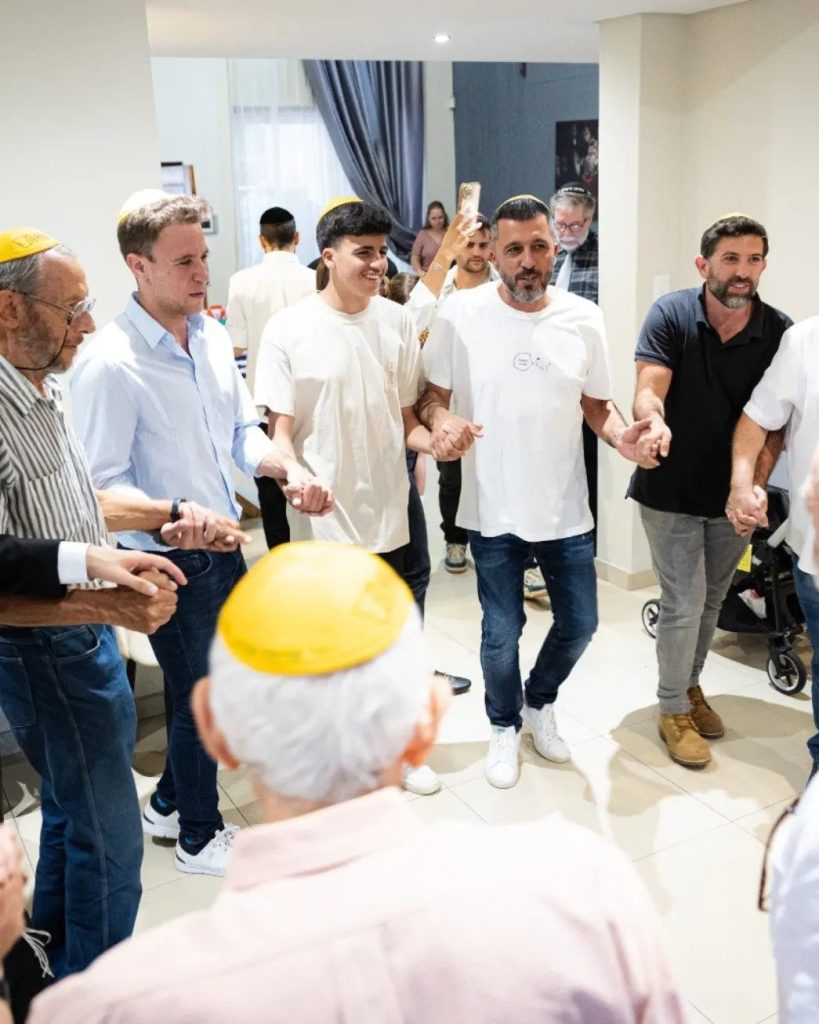
It was a very big event, really a first in the country. The Jews here had never experienced such a thing. There was electricity in the air. People called others during the event, “Come, you must come see what’s happening here”…
There was Chassidic music, good food, and lots of Jewish atmosphere. We also incorporated into the event a prayer for the peace of the soldiers, since one of the community members is himself a reservist fighter working here, and his children are in elite army units.
How Does a Sefer Torah Get to Namibia?
The story of this Sefer Torah is amazing and surprising:
One day I received a call from one of the shluchim in Africa who asked if we had a Sefer Torah. When I answered negatively, he connected me to people who wanted to donate. At first I thought it was just a dream, but they really did it. Every few weeks they would call and update – “We finished Sefer Bereishis,” “Now Shemos.” I felt like it was truly a gift from the Rebbe…”
This event also included a bar mitzva celebration for a 69-year-old Jew. It was so moving, it changed many people’s outlooks here; that Judaism isn’t something that remains as a book or custom, but is something that’s enjoyable to do.
A Bris That Led to Another Bris
Life in Namibia generally brings unique challenges. Even the climate in this country is challenging. As you would expect of Africa, sometimes the heat reaches extreme levels, but sometimes the weather also surprises and becomes very cold. “This affects everything, from modest dress to food preservation.”
One of the challenges arising from the high heat is preserving fresh food. “We buy in quantities, freeze, and if necessary also import from abroad, but it requires meticulous planning.”
Now we return to the story with which we opened the article – the challenge of the bris:
A son was born to us in Namibia. There are private hospitals here, and any decent and high quality medicine is private. Boruch Hashem, medically, the birth went peacefully, but the real challenge came after birth – organizing the bris. It was clear to us that we’re doing a bris mila, not just another event, but a big production to bring as many Jews as possible. We even made a chair for Eliyahu ourselves, thinking about the additional Jewish children who will be born here…
I honored my father to come and be the sandak but he couldn’t make it. In the end I was the sandak. We invited Rabbi Moshe Singer from Johannesburg, who is both a doctor and a mohel, to come here.
The bris indeed became a significant event for the entire community in the country. This changed many things for people here. They saw that Judaism isn’t just something written in books or an old custom, but something living and joyful.
At that same event, we blessed another Jew that he should merit to also have a bris mila. He had discovered his Judaism only a few months earlier. We had previously made a bar mitzva for him, and we blessed him that with G-d’s help he would merit to have a bris soon. He indeed responded to the challenge on the spot, and that same day the mohel performed a bris mila for him in a side room, and thus he entered the covenant of Avrohom Avinu at age 71. It was a moving ceremony.
What are your dreams and plans for the future of the Jewish community in Namibia?
It turns out that despite the challenges, R’ Rachimi is full of hope, and he happily shares his plans for the future:
We want to expand the Jewish kindergarten and even open a small Jewish school. We have a dream to establish a training center for Jewish youth from all of Africa. Lately we’re also working on acquiring a large area that will house all our activities. The idea is to establish a complex that will include a mikva, Jewish kindergarten, shul – everything in one place, safe and accessible. We want it to be a place you can drive into and feel secure. This is Africa after all…
We also want to expand our chesed activities. There’s a lot of poverty here, and we believe that as part of our shlichus, we must help everyone, including non-Jews. The plan is to establish a Jewish center that will be a home for every Jew in Namibia and the entire region; a place that will be a center for Torah, tefilla, and chesed. And also, a place that will be a light unto the nations.
Surely there are difficulties and moments of weakness, how do you overcome them and continue to act with a smile and joy?
R’ Rachimi is silent for a moment, then answers honestly:
Look, when you wake up in the morning or go to sleep in the evening, you don’t think about yourself. At the end of the month you don’t pay your electricity bill, but the Rebbe’s electricity bill. The rent isn’t yours, but the Rebbe’s rent. If you’re busy all the time around the Rebbe and around the Rebbe’s inyanim, it makes your entire day completely different.
In special places like here in Namibia, the Chabad House becomes what’s called a ‘boutique Chabad House’; every Jew feels a personal connection as if this Chabad House was established just for him.
(R’ Rachimi clarifies the point): Over time we learned that you simply need to go with the Rebbe to the end. Many times there are difficulties, whether financial or other challenges, but you simply need to believe, ask for brachos, and the Rebbe is with us throughout the entire journey.
The final shlichus that remains is to bring Moshiach. How is this expressed in your outreach work?
It’s hard to detail specific activity because for us everything is connected to Moshiach; there are flags, signs etc. There are classes on inyanei Geula and Moshiach that make an impact on everyone who enters the Chabad House. The atmosphere in the Chabad House is an atmosphere of Geula…
There was a tourist here who came from a Satmar Chassidic home. She came to the Chabad House and asked, “Why davka Moshiach?” We started of course to explain it in an acceptable way. Today this girl writes to the Rebbe in the Igros Kodesh, connects to the Rebbe and is greatly strengthening herself in ruchniyus. This shows how much the Rebbe touches every Jew.
We also had a case of a family from South Africa that came to Namibia as part of a trip. They told me with amazement, “Here everything has ‘Yechi’ signs. All the pictures of the Rebbe are with ‘Yechi HaMelech,’ in addition to a large Moshiach sign at the entrance.” This showed us that even when we’re not speaking about it, the place speaks for itself.
R’ Rachimi concludes: When we see a Jewish woman lighting Shabbos candles for the first time, or a child learning about Jewish holidays, we know that all the effort to get here was worth it. We feel that we’re part of something greater, part of the Rebbe’s shlichus to illuminate the world. We believe that on the day when the Rebbe Melech HaMoshiach is revealed, Namibian Jewry will also be ready to welcome him.
From Namibia to Gaza
This is the story of the printing of the Tanya that caused a surprising chain of events. R’ Yosef Rachimi recounts:
At a certain point we wanted to print the Tanya here in Namibia. When we checked, we discovered that there had already been a printing in ‘South West Africa,’ the former name of Namibia before it gained independence. From further investigation it emerged that this was only a ‘number allocation,’ but no printing had actually taken place.
R’ Rachimi decided to proceed with the plan:
On that same morning that I received a price quote from the local printer, I received a surprising phone call from a Lubavitcher named Yanky Rubin who lives in Florida. He told me that they print Tanyas in various countries, including Arab countries, and they want to print the Tanya in Namibia.
I couldn’t believe it! I said, “You don’t understand what the Rebbe is arranging here”… It was exactly at the moment I opened the email in which I received the price quote for printing…
In the end, the Tanya was printed in three places in Namibia: in Windhoek, Swakopmund and Walvis Bay.
But the story didn’t end there. At the Kinus HaShluchim, R’ Rachimi met one of the friends of the Chabad House and presented him with a new Tanya from Namibia. Next to them stood Mr. Yair Ansbacher, who was among the fighters in the Simchas Torah attack at Nova. When he heard about the Tanya that was printed and brought from Namibia, he immediately became interested and asked right away: “And what about a Tanya in Gaza?”
“Within two days,” R’ Rachimi recounts excitedly, “I received a video of the Tanya being printed in Gaza. It was amazing to see how the Tanya in Namibia led to the printing in Gaza…
“When I told this to Yanky Rubin, he inquired with the printer in Eretz Yisrael, Rabbi Elazar Ben-Ephraim, about the printing in Gaza. ‘Until now we hadn’t received permission to print in Gaza,’ Rabbi Ben-Ephraim told him, ‘and suddenly, we unexpectedly received permission.’”
This story illustrates how a small action in a remote place can lead to a significant chain of events. “This shows us how every action of ours, even in the most remote place, affects the entire world. This is the essence of the shlichus – to illuminate the world, point by point, until the entire world is illuminated.”
Beis Moshiach #1478 • pp. 36-45
© 2026 Beis Moshiach Magazine. All rights reserved.
This article originally appeared in Beis Moshiach #1478. You are welcome to share it with friends and family by email or in print, provided that you do not change, add to or omit any part of it, you credit the author and Beis Moshiach, and you include a link to archive.bmoshiach.org (written out in full in printed copies).
To republish this article in a newspaper, magazine, book or website, please request permission in advance at [email protected].