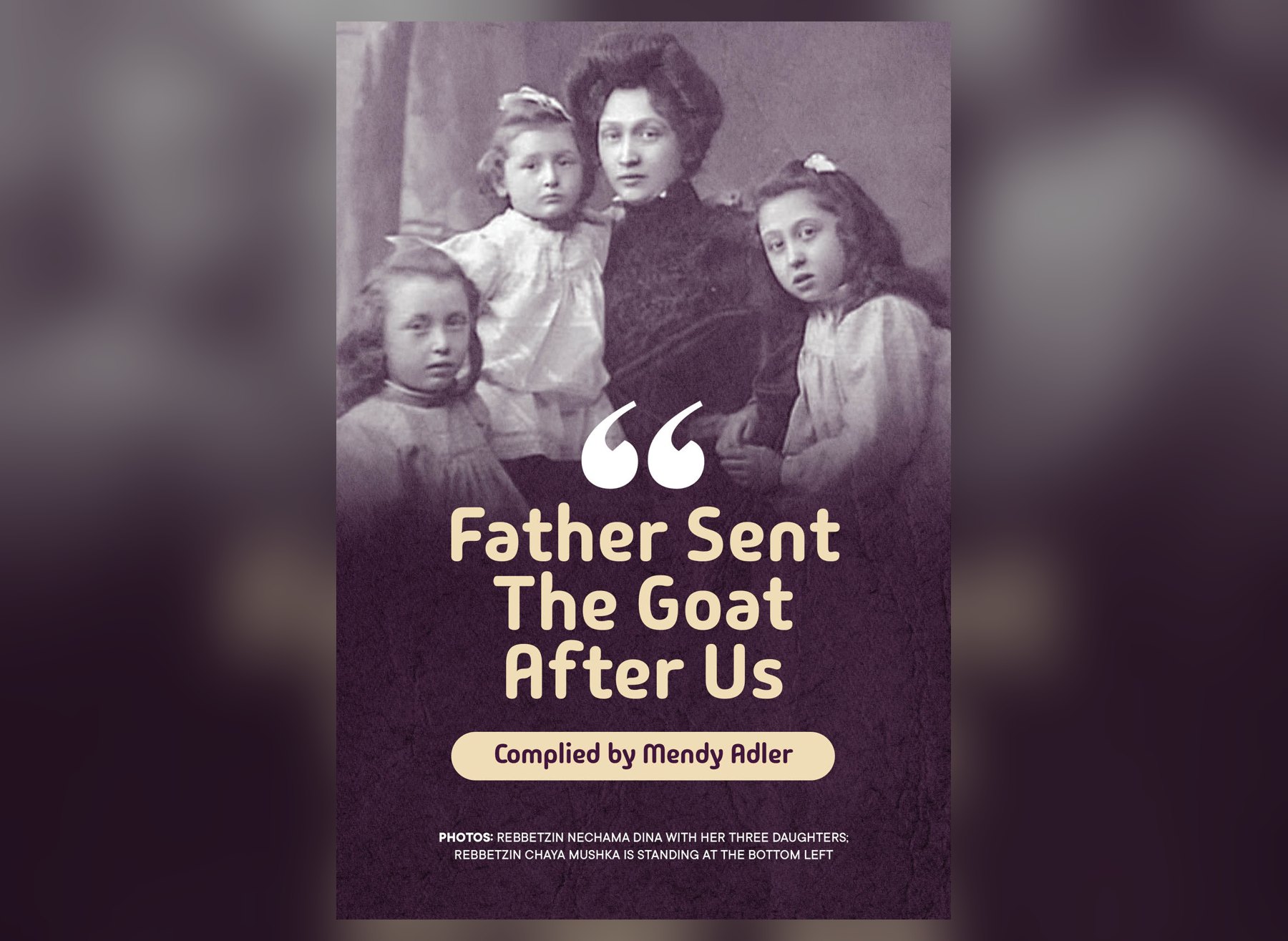
“Father Sent The Goat After Us”
Education Through Stories of Faith
When she was a child, the Rebbetzin studied with a private tutor whom her father, the Rebbe Rayatz, appointed to teach his daughters. The tutor wanted to present all the stories he told the young girls in an intellectual manner, and not to mix them with stories of miracles and mesirus nefesh. Upon hearing this, the Rebbe Rayatz instructed him to tell the Rebbetzin specifically these stories, for it is precisely these that are accepted by a Jewish child and upon which they should be educated.
(Kovetz HaRebbetzin)
When the Rebbe Sends a Goat
Rebbetzin Chaya Mushka related that in her childhood, the Rebbe Rayatz told her and her sisters that he was asking them, although not forbidding them, not to go walking outside [nisht dreyen zich in der oysen].
One day, when the Rebbe Rayatz and Rebbetzin Nechama Dina were not at home, the girls wanted to go outside and take a little walk, as it was a beautiful sunny day. They dressed in nice clothes and went out, since their father the Rayatz had not completely forbidden it.
When they went out, there was much mud and mire in the courtyard with wooden planks laid upon them. They walked on the planks one after the other, taking care not to get dirty.
But then, the goat they had at home began to follow them… When they saw this, they started running quickly so the goat wouldn’t continue with them, as they were embarrassed to walk with a goat in the street. As a result of the running, they fell into the mud and their clothes got dirty. It is understood therefore that they returned home.
They immediately understood and said to each other: “Der tatte hut geshikt noch undz di tzig” [Father sent the goat after us]. And young Chaya Mushka said: “A ponim, der tatte vil nisht, takkeh nisht” [Apparently when father doesn’t want something – it really doesn’t happen]…
(Teshura Rubin, 5776)
A Father Searches for His Children
Rabbi Chonye Morozov, secretary and confidant of the Rebbe Rayatz, once brought his daughters to play with the Rebbe’s young daughters, Chaya Mushka and Sheina.
They began playing blindman’s buff with eyes covered, while the seeker goes around the room trying to catch others without seeing them. R’ Chonye’s daughter, Rochel, was first to seek, and she began moving around the room. Suddenly she bumped into someone and caught them. She removed the handkerchief from her eyes and discovered she was holding the leg of the Rebbe Rayatz. She was very startled, but the Rebbe burst out laughing and said: “You caught me. Now it’s my turn, but where are the others?”
The other participants sheepishly emerged from under the beds and from inside the closet. The Rebbe looked at them and asked: “Is this called fair play? Now I’m the seeker”…
He then covered his eyes as if beginning to search. But suddenly R’ Chonye entered the children’s room and said to the Rebbe Rayatz: “Your father, the Rebbe [Rashab], is calling for you.”
Upon hearing this, the Rebbe Rayatz said: “The Rebbe is searching for his children and I am searching for my children,” and turning to his daughter he added: “And one must be fair, with the small ones as with the big ones.” The Rebbe Rayatz hugged his daughter and left together with Rabbi Chonye.
(From Rabbi Mendel Morozov)
Father – That’s the Gift
In her childhood, Rebbetzin Chaya Mushka would sometimes accompany her father, the Rebbe Rayatz, on his travels throughout Russia.
Once the Rebbe Rayatz arrived with his daughter at one of the Chassidim’s homes in the town of Oryol. The Rebbe sat down to arrange the matter of the assignment he was supposed to carry out, and sent his young daughter Chaya Mushka to play in the room with that Chassid’s daughter who was her age. Apparently due to the confidential nature of the matter, the adults closed the door behind the girls.
The two became engrossed in their play when suddenly, in the midst of the game, Chaya Mushka turned to her new friend: “Do you want me to give you a gift?”
Well, what girl would refuse gifts… and the Chassid’s daughter nodded vigorously.
Chaya Mushka opened the room’s door to a narrow crack, let her friend peek into the adjacent room, pointed at the person sitting there and said: “Do you see him? That’s the gift. That’s my father”…
(From Rabbi Reuven Galperin)
Will Not Bow and Will Not Prostrate
The Rebbetzin related that once when they were in Berlin, she was walking in the street with the Rebbe and saw a group of uniformed Nazis walking and approaching them. At the sight of them she became so frightened that she asked the Rebbe to enter and hide in the nearby store for a brief time.
“But in reality,” she added, “my husband decided to completely ignore their existence and continued walking on his way as if they were not there.”
(Admorei Chabad and the Jews of France, p. 387)
They Are All Schneersons
The Rebbe’s brother, Rabbi Yisroel Aryeh Leib, needed several documents in order to escape from Europe at the beginning of World War II. This was still before the Nazis, may their names be erased, conquered additional countries, but within Germany the Germans ran wild and did as they pleased.
In order not to endanger the Rebbe, the Rebbetzin was prepared to travel alone from Paris to Germany and obtain the necessary documents for her brother-in-law herself. She entered the lion’s den and traveled to the Nazi government offices in the heart of Germany.
Upon arriving at the offices, the Nazi clerks filled out the questionnaire of her personal details and expressed their astonishment that all the family names – of her husband and herself, including her previous family names and those of her father and mother and even of her father’s mother – all of them were Schneerson.
This fact aroused the suspicions of the Nazis that perhaps there was forgery here. Even when they were finally convinced, they declared that when they soon entered Paris, after they conquered France, they would search for her and her husband and conduct a thorough investigation into the matter.
And indeed, one of the first actions of the Nazi occupation officials in Paris was an inspection at the home of the Rebbe and Rebbetzin according to the address that the Rebbetzin had given to the Germans which was kept with them according to bureaucratic rules, except that the Rebbe and Rebbetzin managed to leave the place beforehand.
(Kfar Chabad Issue 322)
A Shliach Carries Out His Shlichus
Reb Leibish Heber related that one day when the Rebbe lived in Paris, he noticed that the Rebbe looked weak and his holy face was unusually pale. At first he didn’t dare speak about it, but when this continued for several days, he dared to approach the Rebbetzin about the matter, saying that apparently the Rebbe was taking too much upon himself and studying beyond his strength.
The Rebbetzin smiled and replied to him: “If you think you can influence my husband, speak with him yourself”…
Two days later, when he asked the Rebbe about this, the Rebbe replied: “I have no time to rest. I am a shliach and the Gemara says ‘there is a chazaka (presumption) that a shliach carries out his shlichus,’ and therefore I must fulfill my shlichus”…
When Reb Leibush first arrived in Crown Heights and learned that the Rebbe and Rebbetzin had also arrived at 770, he hurried to get there in order to meet the Rebbe.
When he met the Rebbe he immediately blessed “She’hecheyanu v’kiyemanu v’higianu lazman hazeh,” hugged the Rebbe and said emotionally: “It is impossible to assess how much this day is a day of joy for me” and burst into tears of joy.
The Rebbetzin who stood to the side and observed what was happening remarked: “Dos iz emese gutte freynt” [These are true good friends].
(Teshura Deutsch, 5776)
Adam and Chava
While the Rebbe and Rebbetzin stayed in Berlin, the Admor Rabbi Aharon of Belz zt’l was hosted by his Chassidim in the city. The Chassidim’s shul was located on the second floor of a building, and between Mincha and Maariv, the Admor went out with his Chassidim to the balcony and said words of Torah and encouragement to them.
On the other side of the street, on the sidewalk, at that same time, by hashgacha pratis, the Rebbe and Rebbetzin were passing by. When the Belzer Rebbe noticed them, he pointed at them and said: “Like Adam and Chava before the sin.”
(From Rabbi Gershon Mendel Garelik)
The Advice That Saved a Life
One day the Rebbetzin was walking on the street along the coastline of Nice, France. On her way she met a woman she knew, the wife of a rabbi from Belgium. They were among the refugees living in the city. When the Rebbetzin asked about her activities in the place, the woman answered that her husband had gone down to immerse in the sea. The woman pointed toward a spot in the sea and said: “There he is.” She explained that her husband wanted to distance himself from the bathers’ beach and went to an isolated place.
Suddenly the Rebbetzin noticed a group of German police approaching the place. She immediately understood that great danger hovered over her friend’s husband if he returned to shore while the Germans were in the area.
The Rebbetzin hurried over to the lifeguard and pointed toward the rabbi staying in the water, not far from shore, and said to him in French: “Do you see that man there in the water? He must be rescued urgently!” While she was speaking she “hinted” to him about the approaching Germans.
The lifeguard understood the hint very well. He hurried to take the rabbi’s clothes that were left on the shore, got on the rescue boat and rowed toward him quickly. When he reached him he grabbed him and brought him up into the boat. At this stage he began rowing the boat far from shore to get away from the danger.
Meanwhile the Germans arrived close to the two Jewish women. The women were not in danger, as generally the Germans would not harm them. They therefore continued to stand in their place and follow the lifeguard’s boat as it moved away.
The rabbi was already far from where the Germans could see him and they decided to leave him alone and continue on their way. The lifeguard let the rabbi off at a distant shore, where the rabbi dressed and returned to his home.
The rabbi’s wife was grateful to the Rebbetzin after she saw how she acted with resourcefulness and with mesirus nefesh, and quickly and wisely succeeded in distancing her husband from the place of danger. In the evening she sent one of her daughters to the apartment of the Rebbe and Rebbetzin to thank the Rebbetzin and inform her that the rabbi returned to his home healthy and whole.
(Ha’Rebbe b’Pariz)
How Manifold Are Your Works
Once the Rebbetzin showed one of the secretaries a picture of the Rebbe and Rebbetzin beside a mountain in Europe, and this is how she told him about where they went to visit (and finally even gave him the picture):
“This was in France. To ascend to the mountaintop one could travel by cable car and one could travel by regular car. The Rebbe wanted to travel by cable car but I was afraid and preferred to travel by regular car. Of course, the cable car travels, faster, and when I arrived by car I searched for the Rebbe for several minutes.
“When I found him, he was standing by the entrance of a cave and looking at a block of ice in a special way, and when I arrived he said to me: ‘This is the true “Ma rabu maasecha Hashem (How manifold and great are Your works).’”
(Teshura Deutsch, 5776)
Beis Moshiach #1493 • pp. 26-29
© 2026 Beis Moshiach Magazine. All rights reserved.
This article originally appeared in Beis Moshiach #1493. You are welcome to share it with friends and family by email or in print, provided that you do not change, add to or omit any part of it, you credit the author and Beis Moshiach, and you include a link to archive.bmoshiach.org (written out in full in printed copies).
To republish this article in a newspaper, magazine, book or website, please request permission in advance at [email protected].