The Soul in the Golden Cage
I
The year 5581 (1821).
Great multitudes of Jews went to Ruzhin in the midst of ordinary weekdays. They assembled to plead for their lives in the courtyard of the home of the tzaddik, Rabbi Yisroel of Ruzhin. From all the villages and towns in the region, hundreds of simple Jewish villagers arrived in order to beseech the tzaddik – for it was a time of trouble.
For several weeks already, the epidemic of the “evil sickness” [a play on the Hebrew “choli ra” – the first Asiatic cholera pandemic] had begun to rage throughout all the cities of Russia. Tens of thousands of residents perished in agony. All attempts by the authorities to halt the epidemic had failed. Each day, reports arrived that more and more regions and districts had been struck by the dreadful disease.
When the terrible epidemic reached the outskirts of Ruzhin, a great cry arose. The Jews of the city and its surroundings knew that in such a time of distress there was nothing to do but hurry to the Rebbe’s courtyard and beseech him so that he would intercede and arouse Heavenly mercy for them and for their families before it would be too late.
However, instead of receiving the masses and blessing them, the tzaddik suddenly informed his gabbais that he wished no one to be admitted to him. In thunderous silence, Rabbi Yisroel secluded himself in his room, separated and withdrawn from the people – as though he wished to sanctify himself through isolation and ascend ever higher, to ascertain behind the heavenly curtain whether the decree had indeed gone forth from Heaven. The tzaddik prayed alone in his room; from time to time the gabbai would enter and bring in the Rebbe’s meals, but after several hours would remove them just as they had been brought. It was clear that the tzaddik was even fasting.
Thus the Chassidim knew that the Rebbe was attempting to open openings in the sealed gates of Heaven and to save the people from destruction. The more discerning among the Chassidim were calm and serene, knowing that their fate was in reliable hands.
Not so the hundreds of villagers and the masses who had gathered in Ruzhin in the hope of seeing the holy countenance and beseeching him. They thought that the gates of Heaven had been sealed, that the decree was final, and that the Rebbe was unable to save them – hence his seclusion in his room. Panic and terror intensified; a tumult erupted in the splendid royal courtyard of Ruzhin.
The villagers assembled in the great shul, proclaimed a fast and an outcry, recited Tehillim, and opened the Aron Kodesh. Their tefillos rose amid bitter weeping.
II
Nesanel was known to be a real character. A Chassid advanced in years, his white beard lent him dignity and splendor; from his eyes shone a spark of mischievous cleverness, and a smile was constantly on his lips.
Nesanel the Chassid was a learned man, and despite his great scholarship and many years, he could often be found among the young Chassidic disciples, with whom he found a common language. They called him simply “Nesanel,” without any honorifics. It was said that this Chassid had merited to shelter in the shadow of the Rebbe’s father, the tzaddik, Rabbi Shalom Shachna of Prohobitsh, and after his passing, the Chassid naturally passed “by inheritance” to the eldest son.
In those turbulent days, it seemed that the radiance of the elderly Chassid’s face had dimmed somewhat. His features tightened, and a contemplative expression rested upon his face – a rather rare occurrence. He himself knew that if the tzaddik had secluded himself, it was a sign that there was nothing to worry about. Yet he saw the distress of the many simple villagers, their bitterness of heart and great pain. He wished to calm them, to encourage them, and to instill in them a spirit of hope – but he knew that even if he explained, their minds could not grasp what the mind of an ordinary Chassid understood.
Deep in thought, he paced back and forth in the great shul, gazing with compassion upon the agitated masses of Jews. His relatives and the sharp-eyed among the Chassidim could discern that a fierce inner struggle was taking place within him.
It seemed that the routine of the days would continue, but one afternoon a rumor suddenly spread that within an hour the holy Rebbe would stand at the window of his room and appear to all the visitors. And was that a small matter?! After long days of seclusion and self-affliction, the Rebbe had consented to appear before the world – surely there was something to it; who knows, perhaps the Rebbe had succeeded in annulling the terrible accusation!
Only a few of those close to the Rebbe’s household knew what had truly happened.
That morning, Reb Nesanel suddenly burst into the Rebbe’s room. He seized a brief moment when the gabbaim had not properly guarded the door, and as a veteran Chassid, he dared to enter the sacred chamber without prior permission from the Rebbe.
The tzaddik, who at that moment was immersed in sublime deveikus, awoke abruptly from his cleaving to G-d and stared in astonishment at the intruding Chassid. Reb Nesanel stood near the doorway, appearing to question his own audacity – but it was too late; he stood exposed before the probing eyes of the Rebbe.
“Holy Rebbe,” he cried, his teeth chattering in fear, “the masses yearn to see you. The people must behold the radiance of your face. They know that only you have the power to save them and to banish the fear of death in their hearts. Bless them, Rebbe – please bless them!”
Reb Nesanel knew that by this act he had risked his life, that the Rebbe’s displeasure could have dire consequences. Yet after long deliberation, he decided to take the risk and sacrifice himself for the community – to interrupt the tzaddik’s mighty spiritual labor in order to soothe the anguish of the many worried visitors.
Rabbi Yisroel of Ruzhin gazed upon his Chassid, immersed in thought, as if he saw him and did not see him. He drew a deep puff from his pipe – a clear sign among the Chassidim that the Rebbe was battling for something – and the room filled with thick smoke.
“Let it be so,” the tzaddik suddenly awakened from his thoughts. “Go and say in my name that within an hour I will stand at the window.”
A tremor of excitement passed through Reb Nesanel’s body, and he hurried to leave the room, his eyes lowered in fear and shame for daring to disturb the Rebbe from his sacred avoda.
A paralyzing shock seized everyone when the pure countenance of the tzaddik appeared at the window at the front of the house. Warm tears flowed from the eyes of many of the visitors, who sensed deeply that this was a moment of revealed mercy and divine favor.
Relief and great comfort came upon the visitors. The great storm subsided, and many returned to their homes and fields with faith and strong hope that the Rebbe’s blessing accompanied them.
Indeed, in time it was found that not a single Jew of Ruzhin and its surroundings was harmed by the terrible epidemic. All attributed this to the great merit of the Rebbe, who had pleaded and prayed on behalf of the entire community of Israel. They said that the Rebbe had battled the Angel of Death – and prevailed.
Only one Jew passed away shortly thereafter – it was Reb Nesanel. In the middle of Shacharis he felt ill, suddenly collapsed, and never rose again.
Thousands of Chassidim accompanied him on his final journey to the cemetery on the outskirts of the city, where he was buried amid great weeping and eulogies. No one understood why this wondrous and exalted Chassid had fallen victim in the great epidemic. Only a few knew the awesome secret – that Nesanel was the man who had risked his life for all of Israel and sacrificed himself to enter the Holy of Holies to intercede for the people.
Those close to the royal household later told that when the gabbai entered the Rebbe to inform him of the passing of the veteran and faithful Chassid, the Rebbe’s face turned ashen. He turned toward the window, gazed at some distant and hidden point. The Rebbe did not respond to the passing with even a single word – and everybody was left wondering.
III
A tranquil morning enveloped Ruzhin, and the dew of dawn still rested peacefully upon the inanimate and the growing things.
The Rebbe left his home and walked with regal steps toward the mikva, his faithful gabbai at his side. Suddenly the tzaddik noticed a gentile boy, bleary-eyed, dressed in rags, standing at the side of the street, holding a small cage with a tiny, colorful bird inside.
It was astonishing when the tzaddik suddenly stopped and gazed at the little bird for a long while. It fluttered nervously inside the small cage, beating its wings as if protesting its forced confinement. The bird was small and wretched, yet its chirping was pleasant and sweet.
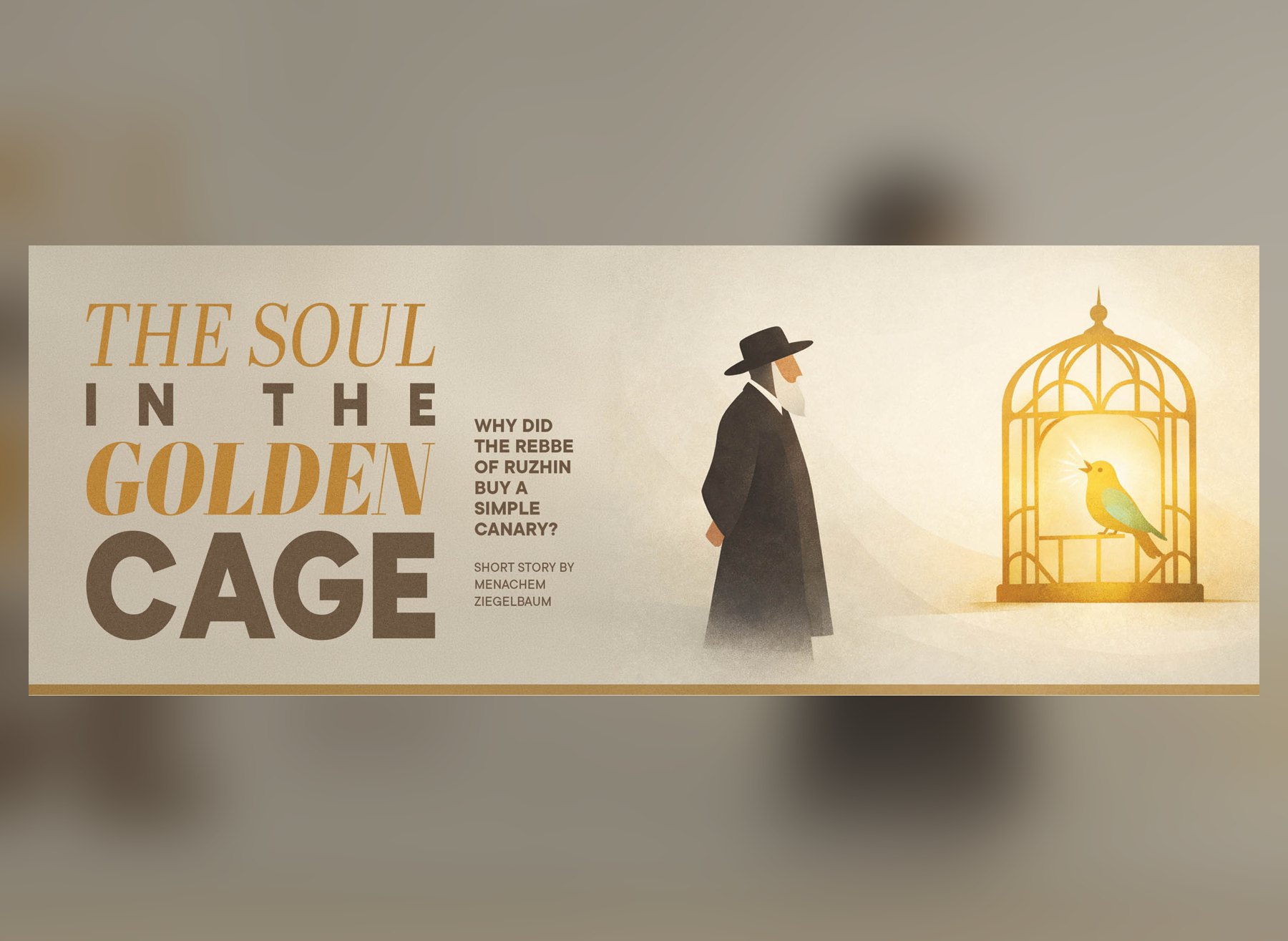
“Buy the bird from him and bring it to my room,” the tzaddik suddenly commanded his gabbai. The latter hastened to do as instructed and placed the miserable bird into a golden cage, which he hung in the Rebbe’s private chamber.
The Chassidim of Ruzhin did not question their master’s actions. They knew that there was meaning within them.
From then on, every morning before tefilla, the Rebbe would stand by the golden cage and gaze at the little canary for a long time, listening in devotion to its sorrowful song. Those close to him understood that this was no simple matter, that the Rebbe – whose ears were open to hear the song of the angels before the Throne of Glory – was not merely interested in the song of a simple canary.
The explanation of this phenomenon became the talk of the day among the “yoshvim” in the kloyz. Aaron “the maven,” as he was called by the Chassidim, suggested that in this bird had been reincarnated the soul of a great tzaddik, and that for the tikun of this soul the Rebbe was turning over worlds.
“But whose neshama is it?” asked Yossel, a young disciple among the Chassidim.
Aaron “the maven” cast him a reproachful glance. “Which of us is wise enough to understand the secrets of Creation?” he retorted.
IV
Months passed. Spring arrived, and flower buds began to peek out on the bare branches of the trees. The fragrances of nature began to fill the air. The month of Nissan approached – “This month shall be for you the first of the months of the year.”
It is an ancient custom that on these days one reads the account of the korbanos of the Nesiim of the Shevatim at the chanukas ha’mizbeiach on the day it was anointed, adding the special “Yehi Ratzon” prayer afterward.
It was the second of Nissan, the day after Rosh Chodesh.
On that day, Nesanel ben Tzuar, Nasi of the Shevet Yissachar, offered his korban.
That morning it was evident that the exalted preparations of the tzaddik before Shacharis were rising to unusually high heights. The Rebbe stood by the golden cage and listened with devotion to the song of the little canary, which sang a heavenly and enchanting melody – she too, in her own way, more than usual. It was evident that the Rebbe was exerting himself in his avodas ha’kodesh.
Those close to the tzaddik stood in the room, awestruck and moved, their hearts pounding with excitement and a vague fear. They were privileged to witness the Rebbe at work with heavenly forces.
Suddenly the tzaddik awoke from his devotion and exclaimed with emotion, “Today is a festive day – the festival day of the Nasi Nesanel! It is his day of joy.”
With surprising haste, the Rebbe completed his preparations and hurried to the great kloyz for Shacharis together with the many Chassidim gathered in the courtyard. Even the Rebbe’s prayer was more joyful than usual, and a light of joy shone from his face.
After the davening, before they began reading about the Nasi of that day, the Rebbe sat in his tefilla room and began reciting the passage of the Nasi for the day. Those close by heard the Rebbe recite the “Yehi Ratzon” with such enthusiasm that it reached the point of ‘expiry of the soul.’ In a sweet melody, the Rebbe uttered the words of the tefilla:
“Yehi ratzon… that You illuminate with Your great kindness the holy souls that are renewed like birds, that chirp and praise and pray on behalf of the holy people of Israel. Master of the Universe, bring these holy birds into the holy place of which it is said, ‘No eye has seen it, O G-d, besides You.’ May it be Your will, Lord my G-d and G-d of my fathers, that if I am Your servant from the tribe of Yissachar, whose Nasi’s portion I read in Your Torah today – oh, sweet Father – then may all the holy sparks and all the holy lights shine upon me…”
When the Rebbe finished the tefilla, he opened his eyes and looked toward the canary in the cage. An expression of sorrow and pain rested upon his face. The little bird too sang differently than usual. Another brief minute passed – and suddenly her voice faded, her tiny wings drooped in eternal stillness.
* * *
“Do you hear?” trembled the voice of the elderly Chassid Rabbi Tzvi Aryeh Billig, as he finished recounting the story to the group of young Chassidic disciples gathered around him in the home of Tevel the Chassid. “Come and see how great is the power of the tzaddik, who knows how to rectify souls in various ways – to refine them, purify them, and raise them to the gates of the palaces of purity.
“I, too, was then among the youngest of the group, and I merited to hear from the ‘mavinim’ among the Chassidim that in the little canary had been reincarnated the soul of the great Chassid Reb Nesanel, and that his neshama found its tikun precisely on the day of the Nasi of Yissachar, Nesanel ben Tzuar – the head of the Shevet of Torah and wisdom.
“L’Chaim!” Rabbi Aryeh concluded his story. “Fortunate are we that we are Chassidim!”
(Adapted from “Funem Rebbin’s Hoif”)
Beis Moshiach #1494 • pp. 24-28
© 2026 Beis Moshiach Magazine. All rights reserved.
This article originally appeared in Beis Moshiach #1494. You are welcome to share it with friends and family by email or in print, provided that you do not change, add to or omit any part of it, you credit the author and Beis Moshiach, and you include a link to archive.bmoshiach.org (written out in full in printed copies).
To republish this article in a newspaper, magazine, book or website, please request permission in advance at [email protected].