My Name Is Esther
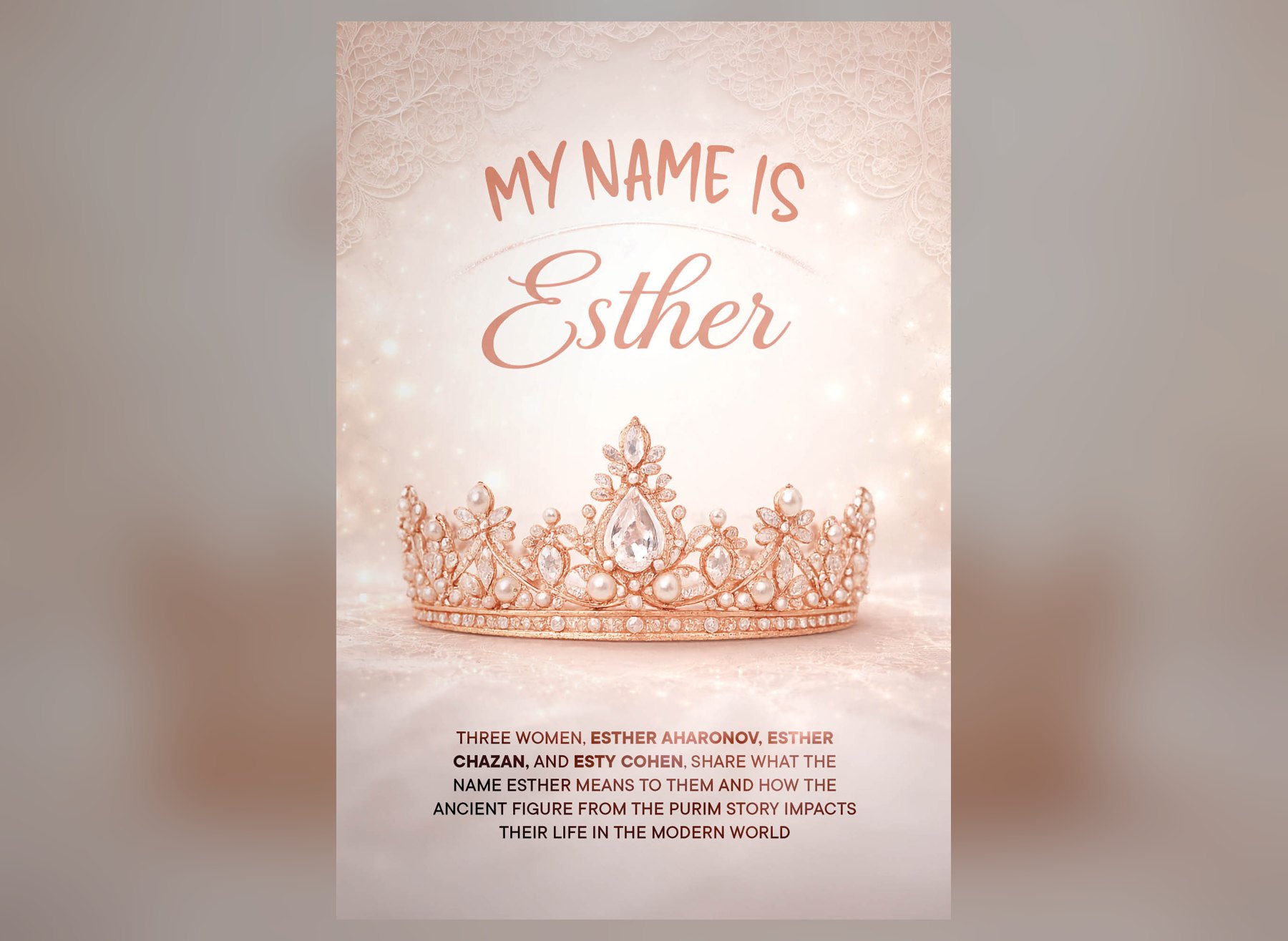
Three women, Esther Aharonov, Esther Chazan, and Esty Cohen, share what the name Esther means to them and how the ancient figure from the Purim story impacts their life in the modern world.
To Be Called By Her Name
A few words about what it’s like to be called by the name Esther?
Esther Chazan: It’s a tremendous, sacred privilege! She was such a holy and special woman. Modest and humble, never seeking honor or publicity. When you study the Megilla, you can also see her wisdom – how she had the two most powerful men in the kingdom wrapped around her little finger, never revealing to the man who ruled the entire world the one secret he demanded to know: who she was and where she came from… When I remember that a name indicates one’s essence, I so hope to discover within myself at least some of these noble qualities.
Esther Aharonov: Unlike most women named Esther, who didn’t choose it themselves, I chose this name for myself. I made aliyah to Eretz Yisrael from the former Soviet Union and began discovering the special light of Jewish life – a light they had hidden from me there. As I progressed in this journey, I felt uncomfortable with the name Ira (from Iryna), which wasn’t Jewish enough for my taste. I searched for a more Jewish name. I was still very superficial and didn’t know enough Jewish women figures. I heard the name Esther at my first Purim celebration. Its sound – not too far from my name Ira – was so gentle, and I found it appealing. There was also an illustrated Megilla there with a very impressive picture of the modest and beautiful queen.
Over the years, as I’ve studied more commentaries on the Megilla and the Rebbe’s sichos, I’ve connected more deeply with this name. It contains tremendous power, but it comes specifically from a very modest and reserved personality. This is an amazing combination for me. I’m proud to be called by her name, feeling that the prophecy parents receive when choosing a name for their baby was also given to me when I chose a Jewish name without yet knowing anything…
[It should be noted, that when people asked the Rebbe for a Jewish name, the Rebbe would usually direct them to choose a name that sounds similar to the previous name.]
Esty Cohen: What’s it like to be called by the name Esther? Honestly, until you asked, I never thought about it… It’s a very ordinary name, like Rivka, Shifra, and Leah. Nobody raises an eyebrow or is impressed. Everyone has already met several Esthers in their life, and I always have to add a last name. The problem is that since my wedding, even that doesn’t help. Esther Cohen? There are a thousand of those on every street… Additionally, I’m also named after my grandmother, a’h, and the whole family is full of Esthers. Esther of Uncle So-and-so and Baruch’s Esty – so even when I thought about my name, I thought three generations back, not two thousand five hundred years… What’s strange is that in hashkafa classes, when we learned about her, I deeply identified with her special character, but I never connected her at all to me and my name…
Esther and Me
Which quality of Esther would you be happy to have?
Esther Chazan: Her modesty. Every year on Purim, when I hear and learn the Megilla again, I’m newly amazed by this special woman. She hid in her home when they were searching for beautiful women; even when her turn came to appear before the king, she asked for nothing. The desire to look good is something basic in a woman’s nature, even the most righteous. You know rebbetzins you admire? They too will make sure to go to lectures in nice, coordinated, respectable clothing, and that’s the way it should be. To hide yourself, not wanting even by accident for anyone to see, look, or be impressed – this is a special and uncommon power.
Esther Aharonov: Her unique bittul to Mordechai. She was a strong woman, one of the strongest women in history. The wife of the man who ruled the entire world, and she had powerful bargaining chips. She doesn’t reveal who she is. She didn’t seek him out; he asked for her hand, had to agree to her conditions. And what does it tell us? “And Esther continued to follow Mordechai’s instructions as she had when he was raising her.” When she was an orphaned niece in the home of the leader of the generation, it was obvious she would be nullified to him. But now she had emerged from under his authority with so much power in her hands, and it doesn’t tell us that she remembers Mordechai or honors him alone, which would also be a great virtue in her situation. It tells us: “As she had when he was raising her” – the new world revealed before her, the splendor, the servants, the banquets, didn’t change her perspective. She remained that same righteous girl, completely nullified to her uncle, the leader of the generation, fulfilling exactly what he said as if she were still a simple woman in the small, holy home in the Jewish quarter of Shushan.
Esty Cohen: Her mesiras nefesh, her self-sacrifice. We’re used to giving up material things to gain more valuable spiritual things. Giving up money and profit to build a home of Torah, giving up a desired career and good position to work in a more guarded, more modest place. It’s not easy, but it’s worth it.
When Esther sacrificed herself, she received tremendous materialism and was forced to give up specifically the spiritual. She was forced to give up a Jewish home, life with Mordechai, the tzaddik of the generation, a life of holiness and purity. And what did she receive? A life full of money, wealth, debauchery, falsehood, flattery, life beside a coarse gentile. The Medrash tells us this wasn’t a short period. From the moment she came to him to request the cancellation of the decree, she could never return to Mordechai again. For the sake of the Jewish people, she sacrificed the rest of her life, gave up the most precious and holy thing – life with the tzaddik.
What from Esther’s life story touches you most?
Esther Chazan: I’m moved every year by the story of Bigsan and Seresh. Esther didn’t want to go to the palace; they forced her. What could she do? The opportunity of her life arrived – someone else would murder the king and she could return home. What did she need to do? Nothing. Just not inform… But Mordechai said to reveal it to the king, so she reveals it. Certainly with great pain. After all, she didn’t yet know that this story would ultimately hang Haman on the gallows…
Esther Aharonov: The moment when she requests, as Chazal teach (Megilla 7a), “Write me for the generations.” When we live our lives, we don’t see them from a historical perspective. Everything is here and now. Even the chain of events that occurred then in the days of Mordechai and Esther initially seemed like a random sequence of events that happened in Shushan. Esther had the distant, broad vision to see here a significant event in Jewish life for generations, not just for that generation.
This moment when Esther is no longer just one woman to whom such and such happened, who gave up or said or did something. She’s part of a long chain of Jewish women, self-sacrificing women.
Esty Cohen: The moment when she stands before the king, understanding that “if I perish, I perish.” Giving everything for us and knowing that’s how she’ll end her life. She has no option to return and live a Jewish life full of light and goodness of a Jewish home, purity, Torah, and an upright generation. She’ll save the nation, and when they celebrate their redemption with new mitzvos and an additional section of Torah, she’ll remain forever imprisoned, alone, in a golden cage.
A moment in life when you felt the name Esther guiding you?
Esther Chazan: A moment in life? Every day, all the time. When I want to leave the house, I look in the mirror and ask myself, “Would Esther go out like this?” I check more carefully that I look as I should – modestly, in the best way. When I need to heed the voice of the Nasi HaDor and it’s difficult, I remind myself whom I’m named after – if she could do it, it gives me strength too.
Esther Aharonov: The name Esther guides me from the very fact that it’s a Jewish name. From time to time I remind myself, “You’re Esther, you’re no longer Ira.” It was okay for Ira to speak that way, rudely, with insufficiently refined words – not for Esther. It was okay for Ira to lounge in bed in the morning, get up late, waste the morning with a cup of coffee and a newspaper; Esther is someone who gets up early, davens, uses her time productively. A Jewish name gives strength.
Esty Cohen: Many times. My mother says Esther is a noble name. My grandmother, who I never met of course, was a very noble woman according to the stories, and I try to prove it as well. If there are moments of inappropriate laughter, slight rowdiness, getting carried away, I always remind myself that this doesn’t suit Esther. Nobility obligates.
The Moment of Meeting
When you meet Esther, iy”H, at techiyas ha’meisim very soon, what will you say to her?
Esther Chazan: I’m already waiting for this moment! First of all, I want to see her up close once. I’ve thought about her so much in my life, imagined what she looked like – I need to see if I was close… I’ll also tell her, “What did you do up there in Heaven to bring the Geula? In Shushan, things happened a bit faster – we counted on you! You know how to speak with kings, to obtain everything you need.” But it will be with a smile. When she’s already here, we’ll understand everything, why the moment of redemption was the most fitting moment for us. May we merit it already!
Esther Aharonov: I’ll tell her thank you. Thank you, Esther, for the miraculous salvation of the entire nation on Purim, thank you for continuing to accompany us all the generations through the Megilla that’s always relevant, which you commanded to be written, thank you for being an inspiring figure for us always, thank you for allowing me to use your name, to draw strength from it throughout my life’s journey.
Esty Cohen: I’ll just cry, unable to say even a word. I hope so much for her that at least after techiyas ha’meisim she’ll have a good and beautiful life of a Jewish woman – righteous and modest. I don’t know exactly how it will be – will she marry Mordechai again? Will she establish a holy, gentle, modest home like she surely dreamed? A home and council of sages, open wide to the poor, fabrengens without end into the night…
Esther within you, Continues still to live. Just take a glance, And you’ll discover – A wave of strength, From kingdom to princess.
Beis Moshiach #1495B • pp. 38-41
© 2026 Beis Moshiach Magazine. All rights reserved.
This article originally appeared in Beis Moshiach #1495B. You are welcome to share it with friends and family by email or in print, provided that you do not change, add to or omit any part of it, you credit the author and Beis Moshiach, and you include a link to archive.bmoshiach.org (written out in full in printed copies).
To republish this article in a newspaper, magazine, book or website, please request permission in advance at [email protected].