He Lost His Legs, But Found His Wings
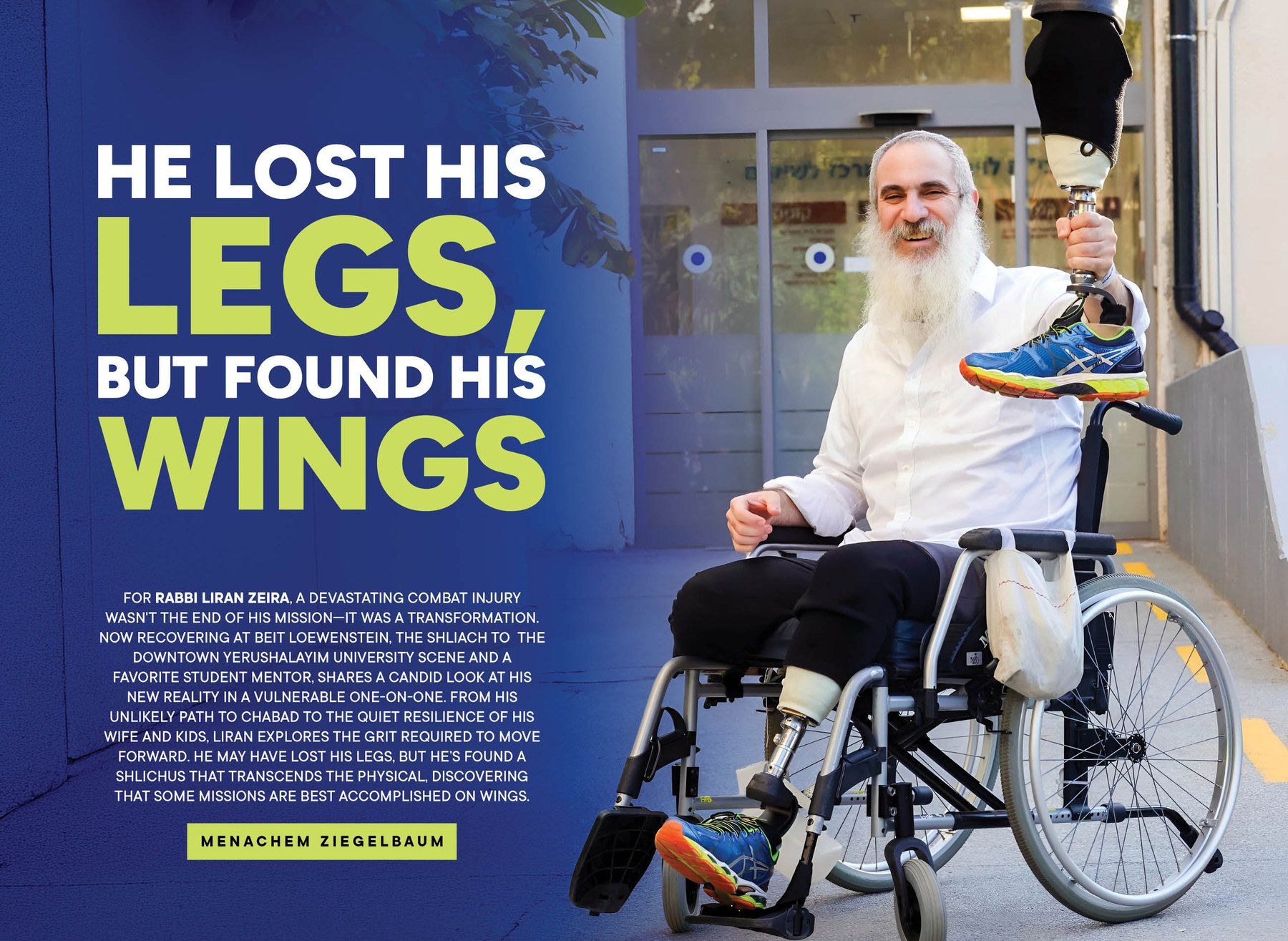
For Rabbi Liraz Zeira, a devastating combat injury wasn’t the end of his mission – it was a transformation. Now recovering at Beit Loewenstein, the shliach to the downtown Yerushalayim university scene and a favorite student mentor shares a candid look at his new reality in a vulnerable one-on-one. From his unlikely path to Chabad to the quiet resilience of his wife and kids, Liraz explores the grit required to move forward. He may have lost his legs, but he’s found a shlichus that transcends the physical, discovering that some missions are best accomplished on wings.
On the eighth floor of the Beit Loewenstein Medical Rehabilitation Center in Raanana, in the limb rehabilitation ward, I meet Rabbi Liraz Zeira – the Rebbe’s shliach to campuses in Yerushalayim – sitting in a wheelchair, his back to me, with several uniformed soldiers seated before him, completely captivated. I prefer not to disturb him with my presence, and remain standing quietly behind him, listening to him talk about the Rebbe’s teaching that there is no such thing as a “beis cholim” (house of the sick) – only a “beis refuah” (house of healing); no “IDF disabled veterans” – only “IDF distinguished veterans,” and so on. He explains at length to his audience about the correct way of looking at the world – a positive, corrective, and constructive perspective. “It took many years, but today more and more large organizations are internalizing that a change in terminology is needed,” he explains.
Afterward, in the “parliament” – the ward’s guest lounge – he tells me that in recent months he has become something of a “spokesman” for things relating to the Rebbe. “Various television and radio channels have invited me to speak about my injury, about coping and the road to rehabilitation. Of course, I use this to spread my shlichus and to bring the Rebbe’s message to audiences I could never have reached had it not been for the injury.”
When Rabbi Liraz speaks about his injury, he speaks about it naturally. There’s no need to dance around it – we don’t speak “about it” in hushed tones, but call the amputation by its name, the legs that are no more, and the prosthetics he only recently began walking with – and he’s walking significant distances with them already.
“Want some arak? Shall we say ‘l’chaim’?” he asks me. “The whiskey ran out,” he laughs.
“It’s Erev Yud Shevat, after all,” I nod. We ended up with cups of coffee, but the farbrengen with R’ Liraz was warm regardless, suffused in a rare strength and energy that is hard to find anywhere else.
The conversation flows. His vibe blends Chassid, warrior, and dry, sharp humor.
“L’chaim v’livracha,” he raises his coffee cup, and the smile on his face doesn’t leave for a moment.
I follow your posts and see the rehabilitation process you’re going through…
I don’t really see the statuses myself – we have someone at the Chabad House who handles media. They asked me to prepare some videos, and they take care of all the postings.
In today’s day and age, you can sit in a wheelchair, without legs, and still reach a million people with your messages… it’s just a matter of simple technology.
That is certainly one of the insights I had at the moment of the injury. Right at the moment of injury – without exaggeration – I suddenly understood that from now on I have a new shlichus, and that’s what kept me going. The knowledge that I can reach an enormous audience, even without two legs, and bring the Rebbe and the Rebbe’s messages forward…
And what are the reactions to everything you post – to your struggle to stand on two feet, even if those feet are prosthetics?
Amazing, embracing, and strengthening in a way that surprises even me. Just last night I went to the wedding of one of our students; I went to say mazal tov. I didn’t know if I’d manage, but in the end I arrived on my legs – that is, with the prosthetics. I walked in and hugged the chassan in the center of the dancing circle. Masses of people I don’t know came up to me and said: “We watch the videos you post – how much they’re mechazek us, thank you so much!” More and more I am exposed to the power that lies in technology.
This reinforced my understanding, which crystallized from the very first moment – even before they put tourniquets on me – that I have a new shlichus. I didn’t yet have a “name” for this shlichus, no “image” of what it would look like, but it was a very strong feeling that I had at that very moment.
Surely there are many people here in the ward who experienced the moment of their injury as a moment of tremendous shock. At what point do people usually understand that “everything has changed”?
Usually it doesn’t happen at the moment of injury… it depends very much on who you are, when, what type of injury. There are people who lost consciousness, some who remained conscious, and there are people for whom it takes time until they understand what the injury has done to their lives.
Right there in the field, even before they evacuated me, I heard the phrase “double-leg amputation.” It was the company commander who was evacuating me and urgently called in a helicopter. He reported over the radio that there had been a double-leg amputation here.
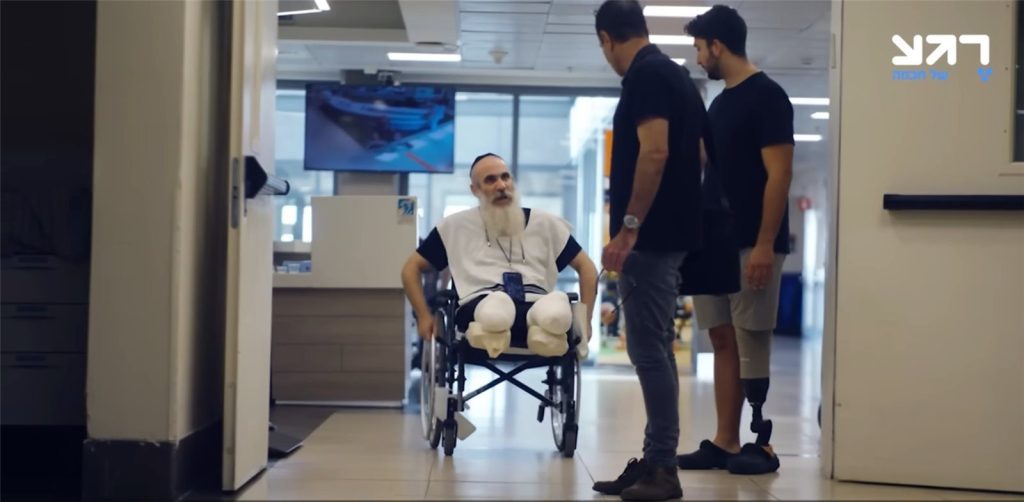
After the injury, I crawled on the ground to get closer to the outpost and call for help. The blood was flowing in massive quantities, and I didn’t have time to look at my legs and assess the extent of the damage. I dragged myself to save my life. But after I heard him, I no longer needed to guess what had happened to me…
And then?
Instead of “Ima’le, oy vey, why me” – I had something like an illumination: Ah, okay. This is what there is. This is something completely new. From now on I have a new shlichus in life. I knew within myself that I had a new shlichus and I needed to stay alive for it…
A New Shlichus
Beis Moshiach recently wrote about Rabbi Liraz, 42, from the Nachlaot neighborhood in Yerushalayim. He grew up in a religious Zionist community, at some point left Yiddishkeit and set out on a bicycle journey through the Far East. Despite his opposition to entering a Chabad House, he eventually did enter one and the study of Tanya won him over.
Years passed during which he himself became the Rebbe’s shliach on the campus of Jerusalem University College.
Alongside his “civilian” shlichus, he served in the reserves for many years as a fighter and commander. He fought in Gaza for more than a year, and in the last months of his service chose to move from a combat role to a position within the military rabbinate. At one point he was even photographed affixing mezuzos to buildings where the IDF was operating in Syria, or accompanying soldiers across the border – and in his characteristic way, encouraging them and infusing them with strength ahead of their continued military service.
On the 7th of Tishrei 5786, everything changed.
“It was a beautiful morning,” he recalls. “A great day with a good atmosphere.”
R’ Liraz was conducting final farewell sweeps in preparation for the withdrawal at the end of the long reserve service he had just completed on the border in southern Syria. He knew that before long he would return to the embrace of his family – his wife and five children. He knew he could put this chapter behind him (at least for now) and return to his shlichus on campus.
“The soldier at the southern position told me he thought the eiruv was pasul. I walked north to the eastern side of the outpost, and suddenly I slipped downward. Both legs fell forward, and I lay like that for a few minutes.”
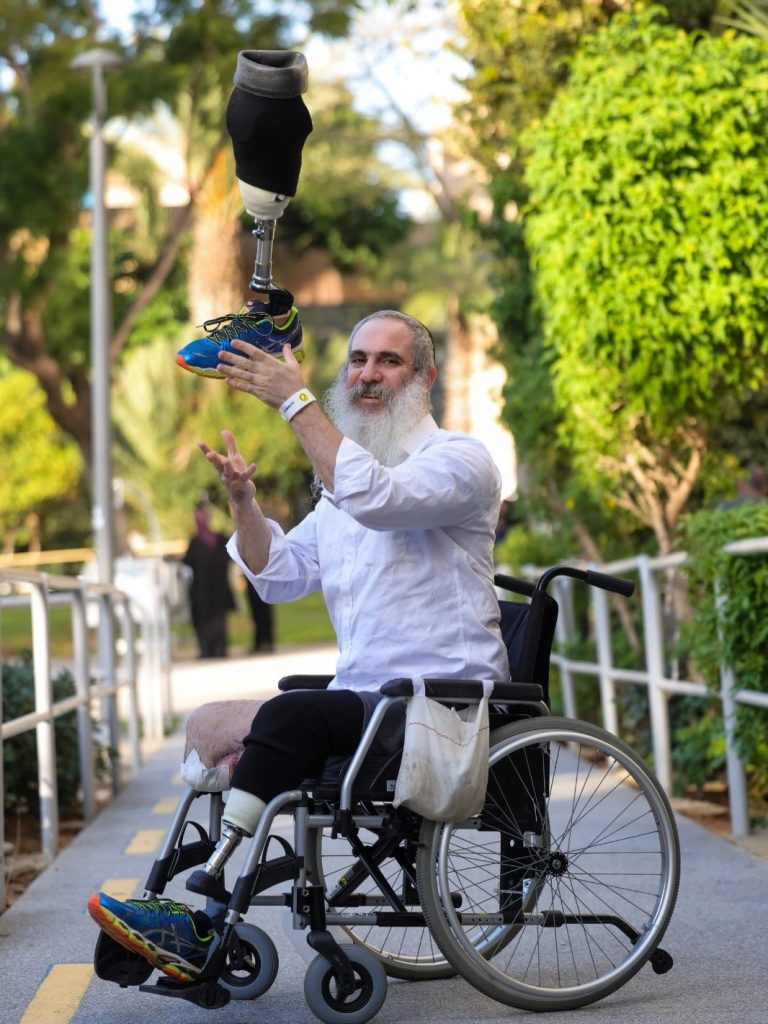
It turned out he had stepped on a grenade that had been lying there since the capture of Tel Kudna, eight months earlier. “Suddenly I heard this boom.”
The injury was severe and he lost his legs in the explosion. He was rushed urgently to Rambam Medical Center in Haifa, where they fought for his life.
On Erev Yom Kippur, word was passed to the many friends who had joined a dedicated WhatsApp group for family assistance, that Rav Liraz Tzvi HaLevi ben Sarah Yehudis had woken on Wednesday, was fully conscious, and had even begun communicating with those around him.
“We’re trying to understand what happened – how a man whose entire activity was through his legs gets injured in his legs,” one of his friends told the media in those difficult days. “R’ Liraz is a man of dancing, of joy – he jumps a lot in his shlichus with students and in his military reserve work. And davka his legs were injured in the attack…”
How well do you remember the first days after the injury, when you went through difficult surgeries?
I remember the moment of the injury clearly. They flew me to Rambam to stop the massive bleeding I had. I was fully conscious – out of the knowledge that this was what would keep me alive. The company commander stood directly above me and reported over the radio: “One casualty, double-leg amputation.” At some point there was almost no pulse, and the body began to shut down. One of the soldiers present saw me reciting Tehillim. He wanted to help and started shouting “Shema Yisrael, Hashem Elokeinu, Hashem Echad.” I grabbed him and shouted: “Not ‘Shema Yisrael’! I’m not leaving here, I’m not going anywhere!” For me, “Shema Yisrael” had one meaning, and I was obligated to keep living…
As we approached Rambam I was still conscious and even spoke with my wife by phone. She had already been updated about the injury, and they let me speak with her. The moment I arrived at Rambam, I was taken into the operating room for a life-saving surgery, where they put me under. In truth, they didn’t know what to do with my knees. There are knees – but there’s nothing to do with them.
Later I was transferred from Rambam in Haifa to Assaf HaRofeh Medical Center for continued treatment.
The journey to Assaf HaRofeh was urgent, since it was the Erev Yom Kippur and we were racing to arrive before the doctors left for the chag. On the way there I said to my wife: “Listen, this has completely changed – our shlichus is going to grow. One of the insights I had then was that our presence on social media must be strengthened. Suddenly I understand that I’m no longer a private person. True, no shliach is a private person – but now you are a person who belongs to the entire public.”
And yet – what about the knees?
Here Dr. Amir Chaim entered the picture – a man with two great loves in life: soldiers and Chabad… He is the director of the orthopedics and rehabilitation ward at Beit Loewenstein. He told the doctor there that he had a solution for my knees – an experimental, new, and highly complex surgery: 12 hours for each knee. When I woke from the surgery, I felt new strength.
How did your wife accept the new reality?
I’ll tell you about an interesting hashgacha pratis that she experienced.
The injury happened on a Monday. On the Shabbos before the injury, we had student guests as usual. During the war we kept a lower profile, since I wasn’t home much during the two years of war – a year in Gaza, seven months in Syria. But even then there were about twelve guests at our Shabbos table. Among them were two female students who spoke with my wife. One of them had a brother-in-law who had undergone a leg amputation; the other told of a brother-in-law who had been in a motorcycle accident and suffered a head injury, and for five months had been sedated and on a ventilator. Difficult situations. My wife said to them: “Wow – an arm or leg amputation, somehow one can recover from that, but a head injury?”
When they told her I had been injured in both legs, those were the words that flashed through her mind at that moment. “I myself said it’s possible to cope with this” – and in this way she actually accepted the new reality. Hashem had given her the opportunity beforehand to internalize the situation and develop the capacity to face it – as preparation for the new reality that was about to arrive.
When the battalion commander called and told her about the injury, she asked whether there were any other injuries and he said: it’s only the legs. We checked – there is nothing above the leg line, not even a scratch – which is itself an enormous miracle. A grenade that explodes has a kill radius of eight meters and an injury radius of fifteen meters, and I stepped directly on the grenade…
In any case, my wife is the anchor. She truly gives me the strength to continue. During the difficult surgery I underwent, she said: “He will rise strong and we will handle everything together…”
In the end, I think the Rebbe gives us two gifts: one is the shlichus – in that you are not preoccupied with yourself all the time. And the second is the special glasses that Chassidus gives you, so that you see things in a completely different way.
During the Covid period I gave a class every week on emuna and bitachon in Hashem. I distributed a lot of “blank checks” on emuna and bitachon back then…
You know, as a shliach one can talk a lot with mekuravim about emuna and bitachon, but when you’re sitting at the wheel and experiencing these things yourself, sometimes the feeling changes. What I’m trying to understand is – is this the “Waze” telling you that you’re continuing in the same direction, just by a different route?
More than that! Not only is it the same emuna I spoke about, but I know the injury upgraded me. Emuna and bitachon aren’t something I say to others first – I say it to myself first and foremost. It’s clear to me that the strength I now have is siyata d’shmaya. What I’m experiencing now is not my own strength… I felt concretely as if the Jewish people were lifting me up in their hands and holding me in places where I, on my own, don’t belong.
Can you give an example?
I remember that when I woke up, I said to my wife: “I feel that I have new strength.” Cynics will say it’s because of the painkillers, but I truly felt that I was being lifted from Above.
And indeed, in those first days, thousands of Jews all over the world made good resolutions for my sake, prayed for my recovery – and I felt those prayers and good deeds. Everyone who said to me then “we are praying for you” – I said “thank you so much, I feel it.” And it really was that way. I felt an enormous embrace from the Jewish people, and it happened immediately when I awoke from surgery, even before I spoke with anyone by phone.
Cynics will say you’re not human in that you don’t experience a fall, not even emotional pain over the loss…
I think what I have now is truly not from my own strength. I feel that the Rebbe gives me the strength to cope. Who knows – perhaps later I’ll go through “al tevi’eni lidei nisayon v’lo lidei bizayon” [don’t bring me to a test or disgrace], but even then we’ll try to face it in the right way..
Last Shabbos I was in Tel Aviv at my brother-in-law’s – suddenly I woke up in the morning with a wound on the stump and was afraid to put weight on the leg. Suddenly there is a certain fear. So yes, things happen. But you know, strangely, the small things – like when there are no cups at the water dispenser here – bother me more than my injury… It’s not that there are no difficulties and that there wasn’t pain – there was! But I feel that Hashem gave us the strength to cope with this.
“The Injury Is Not My Personal Affair”
You said earlier that in your classes on emuna and bitachon, you distributed a lot of “blank checks.” Do you feel that now they are asking you to honor those checks?
I feel they are already being honored, and I feel that I am managing to stand behind them. I don’t know how – it’s a bit like what Chazal say about maaser: commit in advance in order to receive in the future. I feel that’s what happened. Truly very special siyata d’shmaya. It is also seen in the rehabilitation – today I already walk [with the prosthetics] without crutches. Yesterday I walked three and a half kilometers here…
By the way, your rehabilitation, as far as I’ve followed it, is relatively fast.
Not relatively… I have no basis for comparison with others, but the doctors here – and also the person who built my prosthetics, a Chabadnik named Yonatan – told me he has never seen such a rapid rehabilitation. This is not a minor injury. You know, some people have planned amputations where the surgery is scheduled.
Yes, you posted photos of the amputations on social media…
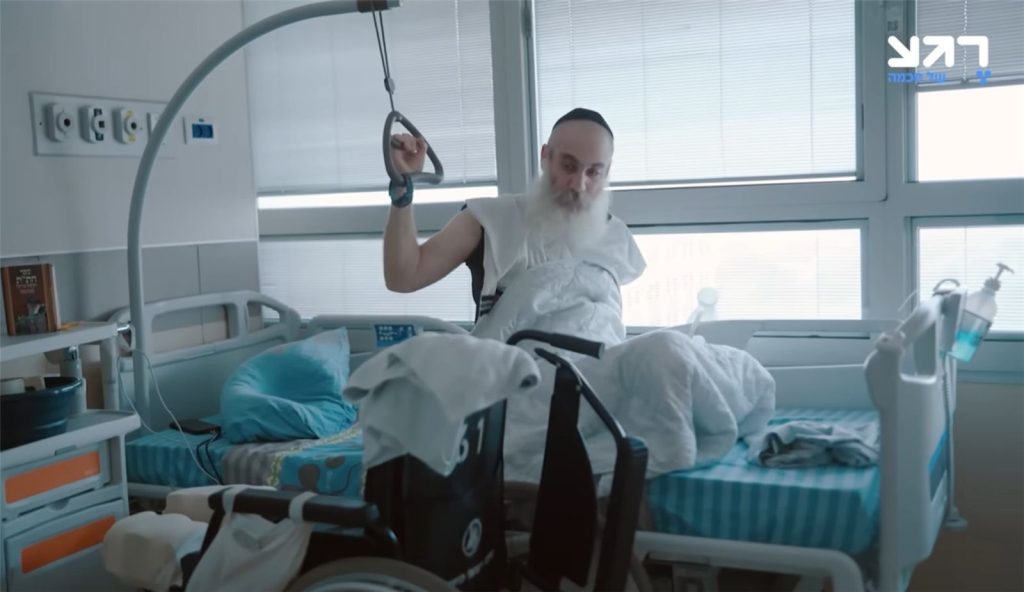
Look, I don’t feel that the injury is my personal affair. I feel it’s something much more inclusive in the sense that… it’s simply something I feel…
Look, I’m here at Beit Loewenstein, and they know that when they need someone to speak with the soldiers or the officers, they come to me – because I feel I’m in a shlichus mindset all the time.
You know, when I went to one of the interviews they did with me, the doctor here warned me: “Don’t forget to say ‘IDF distinguished veterans’ and ‘beis refuah.’” It comes from him now…
And how are your children with all of this?
If there’s a sore spot for me – it’s the children. What worries me is the fear of not being able to be a father. Being a father includes many things, and I didn’t know if I would succeed…
Do you put a lot into reassuring them?
I invest a lot in not reassuring them, but in trying to understand where they are. In the end, each child takes it differently. Before the first time we met after the injury, I was very worried about the meeting. It was not a simple encounter. When they entered my room at the medical center, I said to them: “Chevra, we have now joined a special club. Do you know what ‘IDF distinguished veterans’ means? Do you know how much the Rebbe speaks about this? Well – now we’ve joined this special club too…”
And not incidentally – the Rebbe brought about a very large shift in consciousness in Israeli society, a shift that has been expanding with even greater force in recent years. Until not so long ago, someone walking around with an amputation was a “disabled person” – a mark of Cain, some kind of symbol of failure.
Like many things with the Rebbe, it took years until it permeated the public consciousness. I can tell you that today the perspective is completely different. I meet guys who had amputations 20 years ago and they say to me: “Today I can walk down the street with the metal – I’m proud to walk with the metal. In the past I would look for skin-colored coverings, implanted vein-like designs to make it look natural – today I walk like this, as I am…” Many chevra today have full permission to be proud of their prosthetics.
* * *
The Rebbe teaches us that Hashem brings a person to these and other places because he has a mission. It is not always the one we chose for ourselves – but if that is where we were sent, it is a sign.
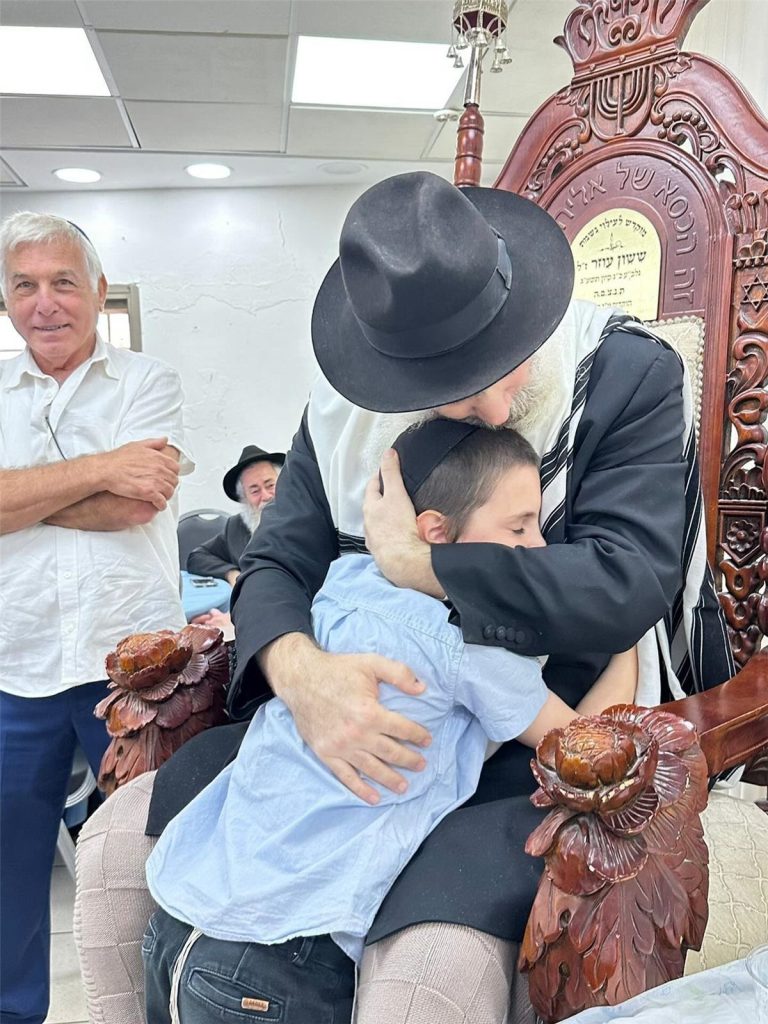
When I arrive at the ward, I see R’ Liraz rolling in his chair through the corridor, brightening the face of each person he meets.
What is your shlichus now, here at Beit Loewenstein?
The very fact that I know that when I wake up in the morning and conduct myself as a Jew – there is an example in that for others. The shlichus begins first of all from you yourself being – you.
That the essence of a shlichus is not outward, but first and foremost inward. To understand: I am a shliach. If I am a shliach, then that is my reality. And from there, the example I radiate to those around me…
In any case, there are people here – not necessarily soldiers – who are recovering from injury or loss, and it’s hard for them to get up in the morning. They have questions: “Why did this happen davka to me?” and they sink. One needs to give them the understanding that the world continues and they have a future – and that perspective comes also from a place of faith…
However, you cannot go to a person and say “Why are you like this? Smile! Be happy!” If you want to depress a sad person, tell them “be happy”… What does “be happy” mean? Leave me alone.
So what then?
The very fact that I am happy and radiate that to others – people come, they want to hear. They see me walking with a sense of utter confidence. I don’t talk about bitachon; they simply see it on me, and they come over to ask “From where does one draw such bitachon?” And conversations develop from there.
You walk around here all the time with your woolen tzitzis spread wide open. What’s up with that? Some kind of statement – “here stands a proud Jew”?
I don’t walk this way davka; it’s simply because I’m hot. Most of the day I’m in physiotherapy and it demands effort. It’s the most practical thing for me.
In the army I always wore a hat alongside the uniform. My company commander – a Druze – would always call to me and say: “Okay, now the Rabbi will say something.” There were times where I told him there are rabbis far more senior than me here, but as far as he was concerned, the very fact that I wore a black hat – I was the rabbi.
I always wear the hat because I know it represents something. It’s also what always invited soldiers to come and ask questions and talk.
Here too at Beit Loewenstein, I feel that the very fact that I roll through the hallways and say “good morning,” “shavua tov,” “hello, how are you?”… people already know and recognize the one who talks all the time, asks, sings…
“There Are Many Reasons to Be Happy”
The shlichus at Beit Loewenstein in Raanana is temporary. Before long, R’ Liraz intends to return to Yerushalayim, to a new and accessible apartment, and to return to his life of shlichus with the academies in the heart of the city of Yerushalayim.
“They took my legs, but they cannot take my joy. That is mine,” he says.
It is known that when Hashem takes something from you, He gives you something else in its place. They took my legs – but in their place I received a new shlichus. Because when you are here, you gain perspective. The knees are there, the head – boruch Hashem – the hands are functioning. There is a reason to continue being happy.
Beis Moshiach #1496 • pp. 12-21
© 2026 Beis Moshiach Magazine. All rights reserved.
This article originally appeared in Beis Moshiach #1496. You are welcome to share it with friends and family by email or in print, provided that you do not change, add to or omit any part of it, you credit the author and Beis Moshiach, and you include a link to archive.bmoshiach.org (written out in full in printed copies).
To republish this article in a newspaper, magazine, book or website, please request permission in advance at [email protected].