Sukka Hopping in 770
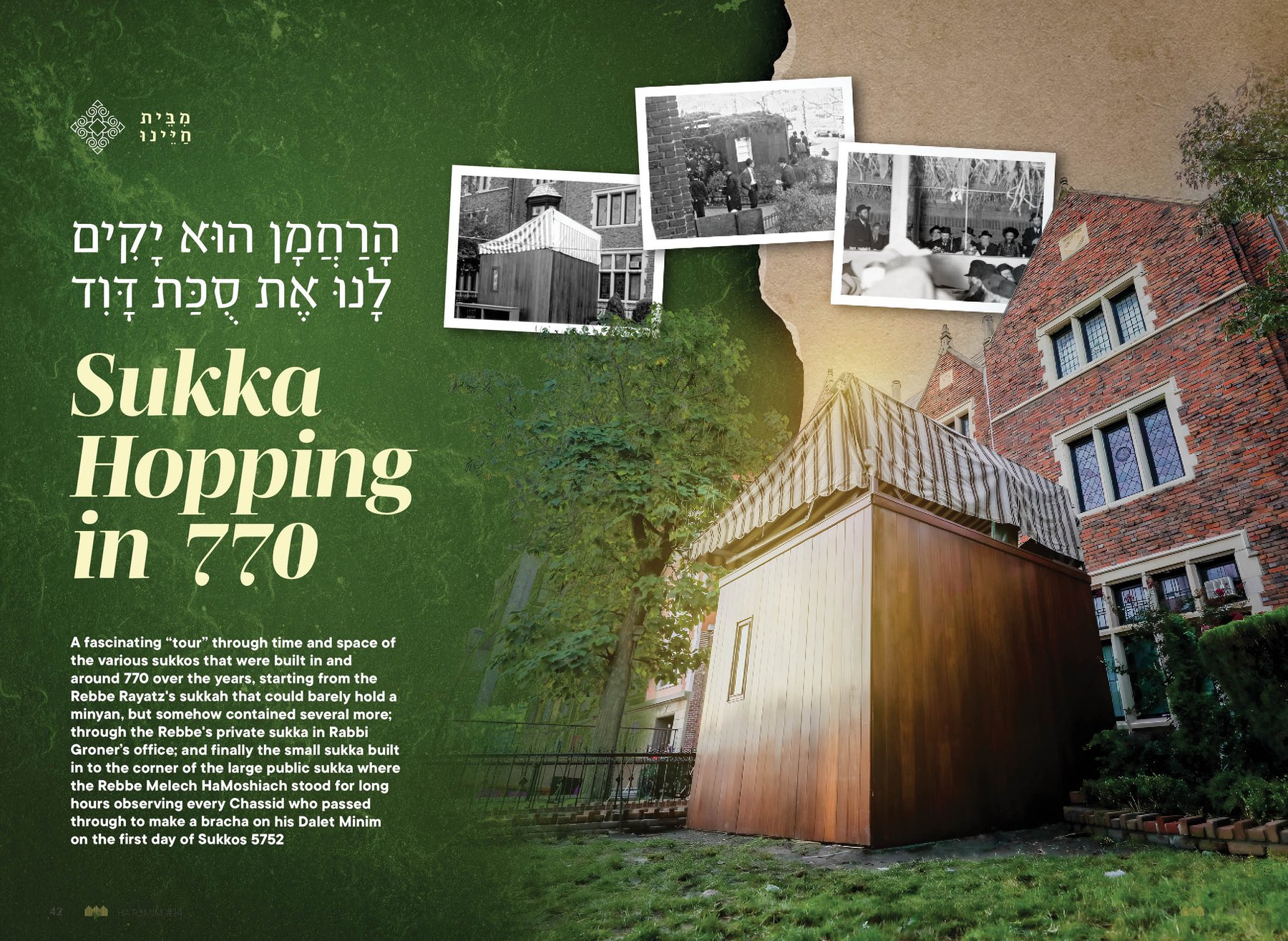
A fascinating “tour” through time and space of the various sukkos that were built in and around 770 over the years, starting from the Rebbe Rayatz’s sukkah that could barely hold a minyan, but somehow contained several more; through the Rebbe’s private sukka in Rabbi Groner’s office; and finally the small sukka built in to the corner of the large public sukka where the Rebbe Melech HaMoshiach stood for long hours observing every Chassid who passed through to make a bracha on his Dalet Minim on the first day of Sukkos 5752.
They came in the hundreds, men, women and children, American Jews dressed in their finery and opulence, and they packed the hall of the shul and didn’t hide their extreme amazement by what they saw. It was enough that there were three sukkos (the big one in the yard, a smaller one on the porch on the first floor of the house – for the Rebbe, and a third on the second floor – for Rabbi Gurary and his family) to amaze the many guests.
Seeing the three beautiful, well-appointed sukkos brought with it, perforce, respect for the holiday in general. So much so that the guests did not slack from going, in groups, and with the greatest respectful awe, to visit the sukkos. Here was revealed before their eyes for the first time what Sukkos means to authentic Jews:
With what dearness and beauty and Jewish grace were these sukkos built. These weren’t the usual sukkos which are unimpressive; this was something else, something that aroused reverence and a feeling of holiness! In the heart of Eastern Parkway, suited for the residence of the ruling class, these sukkos stood gracefully, crowned with greenery as they gave off a scent of holiness. Fathers and mothers were ashamed to look into their children’s eyes, as they read in them the question: Why don’t we have a sukka like this?
Happy and smiling, the guests went up to explore the sukkos and with earnestness and wondering eyes they came back down. From their expressions one could see that something happened in their hearts, an unfamiliar longing filled them and perhaps also a feeling of regret for their American way of life, which withheld from them the delight of themselves being the owners of a sukka and feeling the atmosphere of holiness inside them during the holiday when we sit in the sukka.
These lines, which lyrically describe Sukkos with the Rebbe Rayatz, are part of a Yiddish article that was published in HaKeria V’haKedusha about the first Tishrei in 770 in 5701/1940. In the following article we will try to give readers a bit of an idea about the placement of these three sukkos and mainly, the placement of the various sukkos used by the Rebbe who, as Melech HaMoshiach, is the one to erect the fallen Sukkas Dovid.
The Rebbe Rayatz’s Sukka
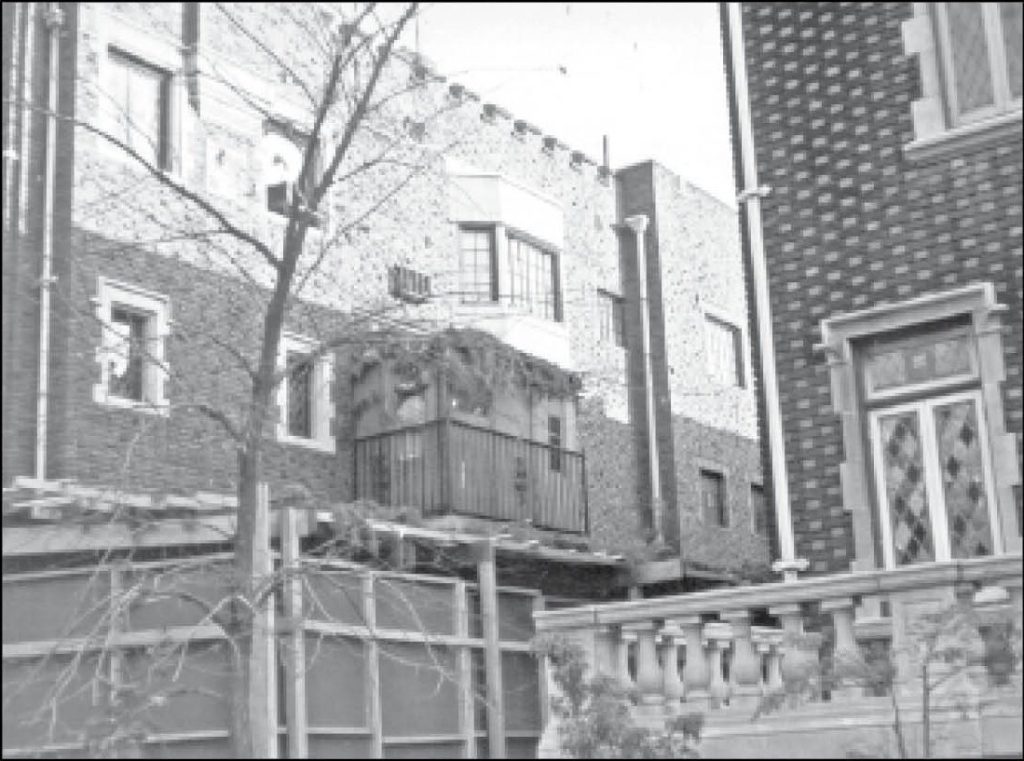
Even now, you can see where the Rebbe Rayatz’s sukka was, on the right side of 770, between it and the library. You can see the porch on the second floor that is connected by a narrow, black door with the Rebbe Rayatz’s yechidus room. It seems that the porch wasn’t there when the building was purchased and it was built (on iron pillars) for Tishrei 5701.
The Rebbe Rayatz would occasionally go out on this porch and learn Mishnayos there, to purify the air. The sukka was built there a few days before Yom Tov (the rest of the year, the boards were stored in the basement of 770).
In Sefer HaSichos it says that once, a piece of schach fell into the Rebbe Rayatz’s bowl of soup and he said, “To draw the makif (schach) into the pnimi (food).”
Rabbi Yosef Goldstein said that one year they had to make the sukka on erev Yom Tov because it had been pouring until then, and Rabbi Sholom Chaskind asked for his help in bringing the schach. Before taking the schach, he removed his hat and jacket because it was very warm. With schach on his shoulder, he went up the stairs to the Rebbe Rayatz’s apartment.
Since you had to go through the yechidus room to get to the sukka, he was sure that the Rebbe was in a different room so the commotion wouldn’t disturb him. When he walked in and saw the Rebbe sitting and writing a letter, he was shocked.
“I was very shaken to see the Rebbe sitting at the table and writing. He was sitting with his yarmulka and the secretary, R’ Chaim Leiberman was standing near him. I was frozen in place out of emotional overwhelm. I couldn’t go in or go out … I didn’t know what to do.”
The Rebbe suddenly looked up at him and the schach and began smiling broadly. After a few seconds, that seemed like an eternity to him, the Rebbe motioned to him to continue what he was doing.
He continued walking into the room toward the sukka, being careful not to turn his back on the Rebbe. When he finally reached the porch, he allowed himself to breathe freely and to calm down from the tumultuous experience. After unloading the schach, the dilemma was how to leave the sukka. At first he thought of jumping over the porch so as not to have to enter the yechidus room again without hat and jacket, this time knowing that the Rebbe was there. He dismissed this idea since he realized that after a few minutes when he didn’t go back in, the Rebbe would wonder. In the end, he opened the door gingerly and snuck through the yechidus room, being careful to do so with maximum speed and care.
Rabbi Leibel Groner told the following story:
On the last Sukkos of the Rebbe Rayatz’s life, the Chassidim were not allowed into the sukka except for ten elder Chassidim. Dozens of Chassidim crowded outside the Rebbe’s apartment door in the hopes of also being allowed to enter. Among the Chassidim were R’ Avrohom Mordechai Yeshaya Groner and his two sons, Moshe and Leibel. When Rebbetzin Nechama Dina heard that R’ Groner was standing outside, she opened the door and asked him to come in with his boys. R’ Groner went in and looked at the Rebbe Rayatz who was eating the seuda.
The Rebbe asked to pass them cups of mashke and told them to say l’chaim. Then he smilingly said to R’ Groner, “R’ Avrohom, either sit or hide your white beard.” R’ Groner immediately concealed his beard behind his lapel.
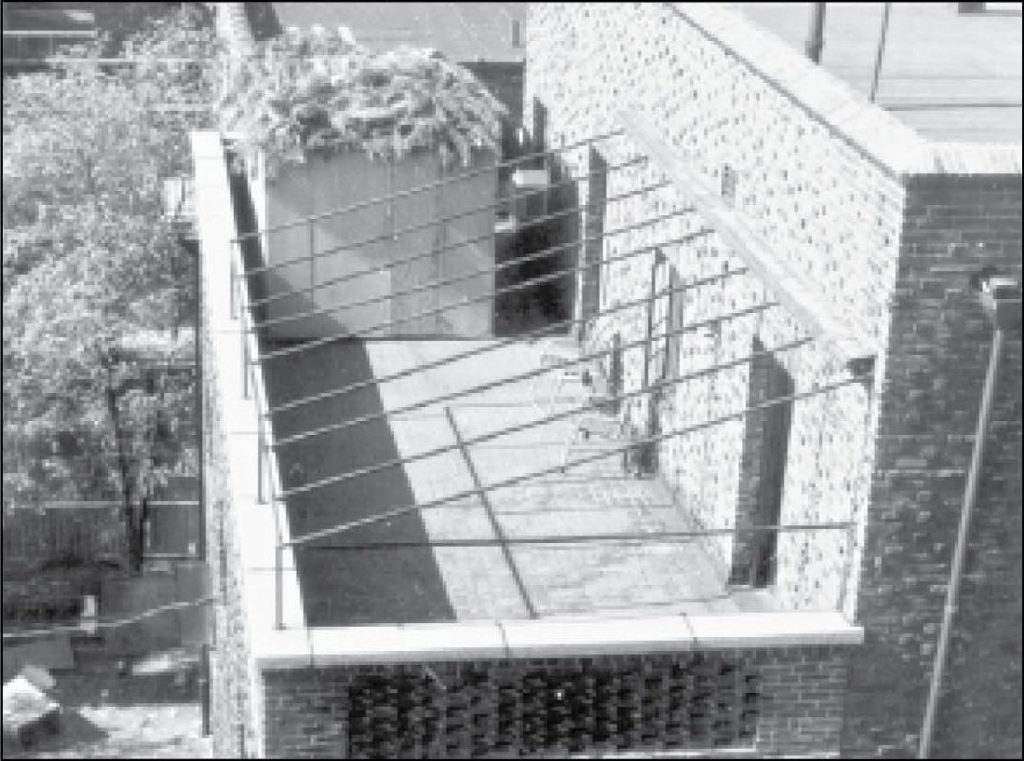
Today, the porch is empty but you don’t need to be one of the elder Chassidim in order to remember the sukka. Until 5731, the sukka was used by the Rebbe MH”M who ate the Sukkos and Shemini Atzeres meals there. Rabbi Meir Harlig, who was at these meals, remembered that every time the Rebbe would enter the sukka through the yechidus room, he would spend some time in the yechidus room and look all around the room, tarrying in particular on the spot where the Rebbe Rayatz was placed after his passing.
Since the porch is very small, ten people could barely fit in, including the waiter. However, despite the crowding, the sacred rules were maintained in the sukka, according to which at the head of the table a place was set for the Rebbe Rayatz. His chair was put on the left side and there was a plate and cutlery. The Rebbe MH”M would sit at the edge of the table to the left of the Rebbe Rayatz. The Rebbetzins ate the seudos inside.
The crowding and the Rebbe’s place at the table made it necessary for the Rebbe to enter first and then everyone else. When leaving, the guests left first, followed by the Rebbe. Generally, anyone who entered at the beginning of the meal, could not leave until the end of the meal.
Rabbi Eliyahu Landau related:
“I was one of the guests at the Rebbe’s table at the Sukkos night meals of 5721. In the middle of the meal, one of the bachurim who served whispered to me that for some reason, one portion of meat was missing and since we were seated near one another, we would manage with one plate. The location was such that this could be hidden.
“All the people seated there waited and the Rebbe did not start eating. The Rebbe asked the bachur, ‘There’s something missing?’ The bachur said, no. The Rebbe asked again and the bachur said, no. Then the Rebbe smilingly said, ‘Is it a secret?’ The bachur said there wasn’t room for another plate, so one plate was for two people. The Rebbe said: The main thing is what’s in the plate; is it for two? He said, yes.
“The Rebbe did not respond. He moved his fork around the plate a few times and then handed it to me saying, ‘It’s clean.’”
The Rebbe and the guests would wash their hands for the meal in the Rebbe Rayatz’s yechidus room where a special device was set up in advance for washing. In the yechidus room is also where they put the candles lit for Yom Tov.
Rabbi Dovid Kratz, who was in 770 for Sukkos 5723, said that when there was a minyan in the small zal, when the Rebbe already finished davening and ate in the Rebbe Rayatz’s sukka, they were careful not to raise their voices too much when answering, “amen yehei shmei raba,” so as not to disturb the Rebbe. They had heard from those present at the seudos that when they heard “amen yehei shmei raba” the Rebbe stopped his meal, raised himself a bit and responded.
Rashag’s Sukka
If we go to the backyard of 770, where the tashlich pool is, and look up to the third floor, we will see a long glass fence which encloses a spacious porch where Rashag’s sukka was. The Rebbe Rayatz would go up to this porch occasionally and work in the fresh air. After Chof-Zayin Adar 5752, the Rebbe visited this porch several times and that’s where he did Kiddush Levana.
The Communal Sukka
In the review quoted earlier from HaKeria V’haKedusha, it was noted that the communal sukka was located in the yard. Some might mistakenly think that this refers to the yard in the front of the building; some might think it’s where the communal sukka presently is, between the building of 770 and the library. The truth is that the yard referred to in the article no longer exists.
For the benefit of readers who don’t remember the old appearance of 770, we will try to paint a general picture. When 770 was bought, the area between 770 and the next building on the left (784) was empty. This area, which served as a parking lot for the ambulances of the clinic that had been in the building before it was purchased, became the ‘shalash’ – where the Rebbe davened on the Yomim Noraim. For Sukkos, it was the ideal spot to build a communal sukka for the Chassidim.
The sukka was particularly large. According to elder Chassidim, its maximum size was a bit less than 450 square feet but back then, it was definitely a “huge” sukka, which served as a model to copy for the residents of the neighborhood.
In those days, all the farbrengens of the Rebbe took place there, every Shabbos of the year and the Simchas Torah farbrengen also took place in this sukka. Since the Rebbe did not want to possibly transgress ‘bal tosif’ by sitting in the sukka on Simchas Torah, every year they brought a goy who moved some branches from over the Rebbe’s place so that the Rebbe wouldn’t be sitting in a sukka. Before the farbrengen began, the Rebbe would look up to make sure the schach had been moved.
This sukka, in various incarnations, existed until Tishrei 5720. That year, they closed the yard and built the first part of the big shul downstairs, and in Tishrei 5721, the sukka for the Chassidim was moved to the yard between 770 and the library.
Along with the sukka, the Rebbe’s farbrengens also moved. By the way, the Rebbe’s farbrengens in the communal sukka began even before he accepted the nesius, when he would farbreng with Chassidim as the Rebbe Rayatz’s son-in-law.
One year, during the Rebbe’s farbrengen, it poured nonstop. The Rebbe went into the sukka wearing a coat which was only on his shoulders. As soon as the farbrengen began, he took off the coat as though it wasn’t raining.
After a few hours, the Rebbe ended the farbrengen and began giving out kos shel bracha. The wife of Rabbi Shlomo Maidanchek was in the small zal. She stood near the window and asked the Rebbe to wear his coat, saying, “We need a healthy Rebbe.” The Rebbe smiled broadly and put on his coat.
At that time, between the yard and library was a place for a car to park and one year in the “chofs” when it became necessary to expand the sukka, they covered the parking area with a wooden floor on pillars and extended the sukka until the wall of the library. Rabbi Dovid Kratz remembers that as it was being built, the Rebbe came from his house, stopped for a few minutes, and appeared as someone who was checking out if the work was being done properly.
As the years went on, the number of Chassidim who came for Tishrei grew and the crowding in the sukka was unbearable. In 5730, due to the terrible crowding, an improvised pyramid collapsed on the foot of Rabbi Kalman Marlow, later the Mara d’Asra of Crown Heights. Doctors spent months trying to rehabilitate his foot and the Rebbe was personally involved in all the medical decisions.
A year later, in Tishrei 5731, the Rebbe told his secretary, R’ Chodakov, that starting that year there wouldn’t be farbrengens in the sukka because it was dangerous.
When the elder Chassidim heard this, some of them went to the Rebbe and asked the Rebbe to farbreng. The Rebbe answered them very sharply and said that their Shulchan Aruch was also his Shulchan Aruch and since this entailed danger to life – even when there is only a doubt-of-a-doubt we rule stringently.
That year, the Rebbe did not cancel farbrengens entirely. He said a maamar Chassidus in the big zal after a Seder Niggunim in which they sang the niggunim of the Rebbeim.
A year later, 5732, when R’ Chodakov went in on the first day of Sukkos to ask about a farbrengen the Rebbe told him there would not be a farbrengen and was surprised by the question. When R’ Chodakov explained himself and said that the previous year there had been a farbrengen in the big zal, the Rebbe said that was a one-time thing.
I Won’t Remain in Debt
The next day, after Shacharis, a group of Russian immigrants asked the Rebbe to farbreng. When the Rebbe said it was impossible to farbreng in the sukka because it was dangerous, they asked him to farbreng in the big shul downstairs. The Rebbe said: The tzibbur isn’t used to doing it ‘dry’ [i.e. without saying l’chaim] but I won’t remain in debt and there will be another farbrengen. The guests asked to at least hear a maamar Chassidus, but the Rebbe refused that too and said they should farbreng among themselves.
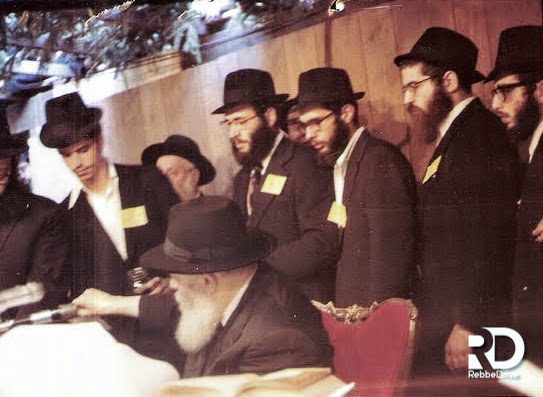
After that, there was only one farbrengen in that sukka, in 5737. This was a special farbrengen for the children of Shelah, which also stood out in that before the farbrengen the Rebbe issued a note with the detailed order of the farbrengen.
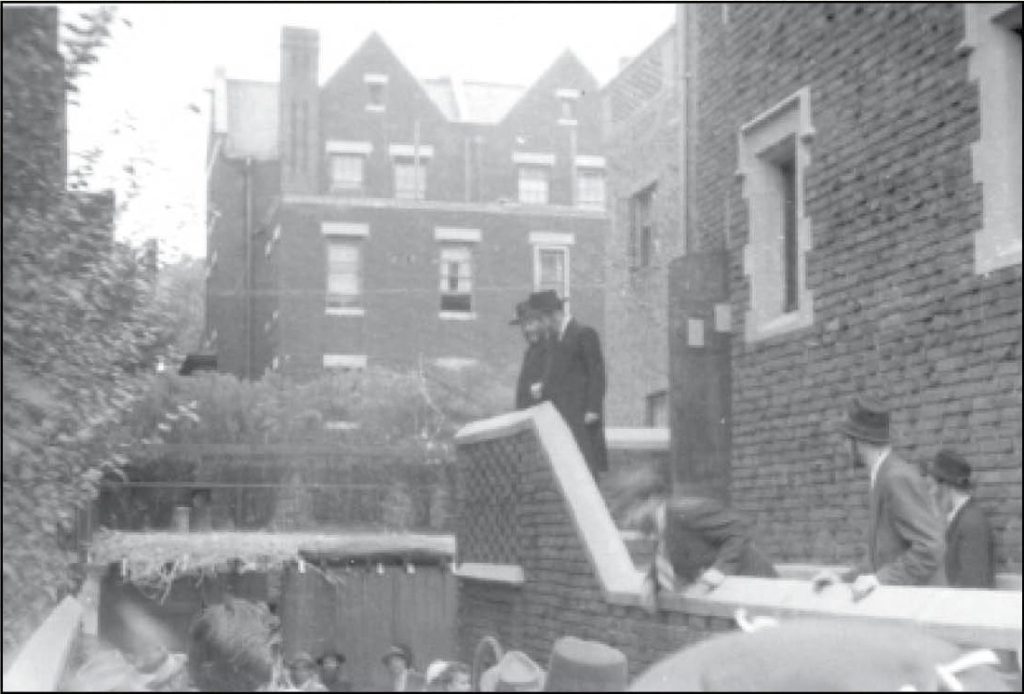
Over the years, a special little room was built in this sukka where people could say a bracha on the Rebbe’s dalet minim. About three decades ago, when the library was expanded and a bridge was made to connect the 770 building with the library, a halachic question arose after it was realized that the bridge crossed over the width of the sukka and turned it into two separate sukkos. At the time, the rabbanim of Crown Heights issued a public statement that from a halachic viewpoint, they were two separate sukkos.
Every year on the first night of Sukkos, the Rebbe went out to the sukka and blessed the guests from a shtender on a platform that was prepared ahead of time. There was enormous crowding around the Rebbe’s place during the bracha.
Today, the sukka is built over nearly the entire space of the porch. Under the porch of the Rebbe Rayatz’s sukka, which is not under the sky, are sinks for use by the public. In this sukka, many farbrengens take place as well as mezonos before the davening which is arranged by R’ Nachum Markowitz.
The meals take place in the sukka of Eshel Hachnosas Orchim in yeshivas Oholei Torah’s parking lot for buses, on the corner of Brooklyn Avenue and Eastern Parkway.
The Rebbe’s Sukka in the Shalash
From when the Rebbe arrived in the United States in 5716, he lived in an apartment building on New York Avenue. Since it wasn’t possible to build a sukka, the Rebbe used the Rebbe Rayatz’s sukka.
One time, one of the elder Chassidim saw the Rebbe sit in the communal sukka and eat a piece of cake before davening. When the Chassid expressed his surprise, the Rebbe said, “I’m not ashamed of Chabad customs.”
Rabbi Zushe Posner was witness to an interesting thing that happened before the Rebbe accepted the nesius. Some of the tmimim, who did not have dalet minim, approached Ramash who was sitting in the communal sukka with a thermos next to him, looking into one of the sefarim of the Rebbe Maharash, and they asked to use his dalet minim.
The Rebbe gave it to them, as a gift on condition that they returned it, and continued looking into the sefer. Someone took the lulav and began checking it and said he thought there was a problem with it. The Rebbe, without looking up, said, “If it’s not good for you, don’t say the bracha.”
After he accepted the nesius, a small sukka was built for the Rebbe in the area between 770 and 784, near the communal sukka. The communal sukka was then located at the end of the space between the two buildings, while the Rebbe’s sukka was located a bit in front of it, in the middle. The sukka was very small, about half the size of the current sukka.
R’ Groner related that in the first years of the nesius, when the Rebbe sat in his sukka, a person who didn’t know the Rebbe walked through the open door and asked, “Where is the Lubavitcher Rebbe?” The Rebbe said, “The Lubavitcher Rebbe is not here, his son-in-law is here.”
Some Chassidim remember how Rebbetzin Chana would go erev Yom Tov and ask that the sukka be opened for her so she could light candles there.
This is where Chassidim said the bracha over the Rebbe’s dalet minim, with the Rebbe sitting facing the door, looking into one of the sefarim of the Rebbe Maharash (usually it was the hemshech “V’Kacha” 5637) and looking at each person as he came in.
By the way, when the Rebbe bought the house on President Street and they built a sukka there, the Rebbe asked that they place a large quantity of schach, saying even so it would be possible to see the stars if they moved some of the schach with a stick… The Rebbe would participate in building the sukka by throwing on some branches of schach.
The Rebbe’s Sukka in the Yard of 770
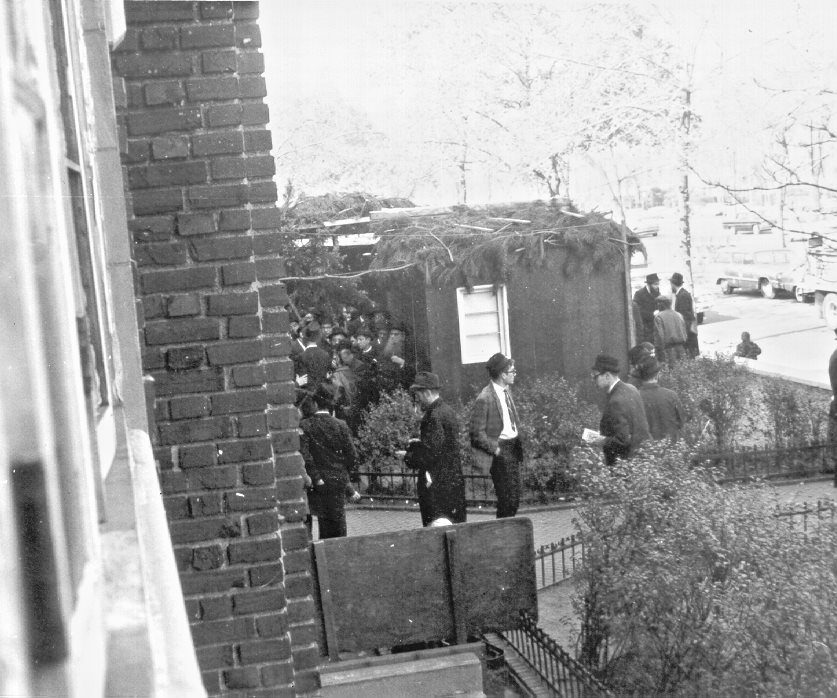
In Tishrei 5721, after the yard was closed in over the course of that year and the first part of the big shul was built (before it was extended under the next door apartment building as it is today), the Rebbe’s sukka was moved to the yard in front of 770, on the right.
Once it was moved to the front of 770, people began saying a bracha on the Rebbe’s dalet minim in this sukka. The next year, 5722, the Rebbe put R’ Meir Harlig in charge of the dalet minim and after that, R’ Harlig would go to the Rebbe every morning and get the dalet minim and let the Chassidim say a bracha over them. (R’ Harlig’s place was in the communal sukka in the part facing Eastern Parkway, and only several years later, when they built a small sukka especially for saying the bracha on the Rebbe’s dalet minim, did he move to this sukka, located near the tashlich pool in back).
This sukka was made of thin boards and aside from a chair, table and light, there were no other trappings of comfort. It was a nice sukka, relative to those years, but very plain, in line with the conduct of the Rebbe who always shied away from any extraneous displays of grandeur. In this sukka, there was a sink for washing hands but no proper drainage system, so the water would run out into the yard.
Fifteen years later, the Rebbe’s plain sukka bothered some tmimim in 770 who decided to do something about it. They were Yosef Yitzchok Brod, Avrohom Zaklikovsky, and Shmuel Lipsker, and they began asking professionals where one could have a beautiful sukka built, befitting the Nasi HaDor.
“We, as Chassidim, considered the Rebbe a king in every respect, so the fact that the Rebbe used such a plain sukka bothered us very much and we decided we had to build him a royal sukka,” said R’ YY Brod.
R’ Zaklikovsky and R’ Lipsker went to an interior designer whom they knew through Merkos Shlichus and asked him to design a plan for building a royal sukka which would include various comforts that would turn it into a real residence.
With the plans in hand, they went to a carpenter who worked in a huge business making furniture, and they explained what they wanted, making it clear that he should not scrimp on costs and he should build the sukka out of the best material on the market in order to produce something fit for royalty.
The sukka was ready after a few weeks. It was a grand piece of craftsmanship. The entire sukka was made of waterproofed wood that used to be used to build high quality ships and all the walls were made of one slab of wood that was cut into even sized panels which created a uniform appearance to all the walls. The double sided panels with a special filling, provided complete insulation from cold or heat.
A special contraption was bought that attached to one of the walls of the sukka and spread an awning over the sukka when it rained and the Rebbe wasn’t in the sukka.
A nice shelf for sefarim and a pushka was installed on the western wall; in the northwestern corner of the sukka was a faucet for washing hands with a sink. The faucet and sink were hidden by tall wooden doors, from the floor to the roof.
The design of these accessories fit the overall design of the sukka. The floor was also made of wooden panels which provided additional support to the walls.
Before the sukka was brought to 770, a proper infrastructure was prepared both for the faucet and sink and for the electricity for the lighting and the warming and cooling units in the sukka.
The organizers wanted to lay down a cement surface to hold the sukka but the secretaries did not allow such a major change to the appearance of the yard. They were concerned that in the end, the Rebbe would not be willing to enter such a fancy sukka. The truth is, the organizers were also concerned about this, but they felt they had to work l’chatchila ariber.
Between Yom Kippur and Sukkos 5736, R’ Brod brought the sukka from the workshop. One by one, the panels were unloaded from a large truck. They were covered with tarps to avoid rubbing and placed in the yard on the right side of the walkway of 770.
It took the bachurim a long time, together with other bachurim, to put up the sukka. A few hours later, they were done. They nervously awaited the Rebbe’s reaction.
“You cannot imagine how relieved we felt when the Rebbe entered the new sukka for the first time. We hadn’t expected even a word of thanks,” said R’ Zaklikovsky. “We wanted only one thing, that the Rebbe enter the sukka and agree to use it despite the magnificence and elegance that were so foreign to him.”
R’ Sholom Ber Brod related the interesting story of what happened on Sukkos 5736:
“That year, it poured from the beginning of Yom Tov until Shemini Atzeres, non stop! The water weighed down the sukka and, since we weren’t allowed to build the cement surface under the sukka, the sukka began sinking into the mud created by the nonstop rain.
“One day, the Rebbe entered the sukka and after a while, R’ Harlig noticed that the Rebbe was turning the doorknob to open the door but the door was already an inch or two in the mud and did not open. R’ Harlig had to fight with the door to get it open.
“A year later, we asked permission to pour the cement and got permission immediately.”
The first year, due to the concern that the Rebbe wouldn’t be willing to enter such a magnificent sukka, the decision was made not to buy a special table and chair but to put in the table that the Rebbe used during the reading of the Megilla and the chair he usually used, upholstered in red velvet.
The red chair left its imprint on the rug spread out on the floor of the sukka. It was a beige carpet which matched the sukka and as a result of the heavy rain that year, the entire rug turned red from the dye that ran from the upholstery. A year later, a new chair was bought with a bright color so it would blend in with the look of the sukka. Buying the chair was a story too.
The chairs in the furniture store were of two standard types, living/dining room chairs are lower and wider and chairs for a dinette are higher and narrower. The Rebbe’s chair, that he used at farbrengens for hours at a time, had to be wide and high enough to be comfortable for extended sitting. This is why, all the chairs bought for the Rebbe were wide, living room chairs and to make it high enough, wooden pieces were added to the legs.
In 5737, When a chair had to be bought for the Rebbe’s sukka, R’ Zaklikovsky ordered a chair specially made to design. It was the first chair to be made according to the Rebbe’s requirements, and Rebbetzin Chaya Mushka chose the fabric out of samples presented to her.
Today, the sukka pieces are stored at the Zirkind house and every motzoei Yom Kippur, some energetic tmimim carry it and build the sukka in front of 770 with the head of the family overseeing the work and sharing interesting stories from years past.
The Rebbe’s Sukka in the Library
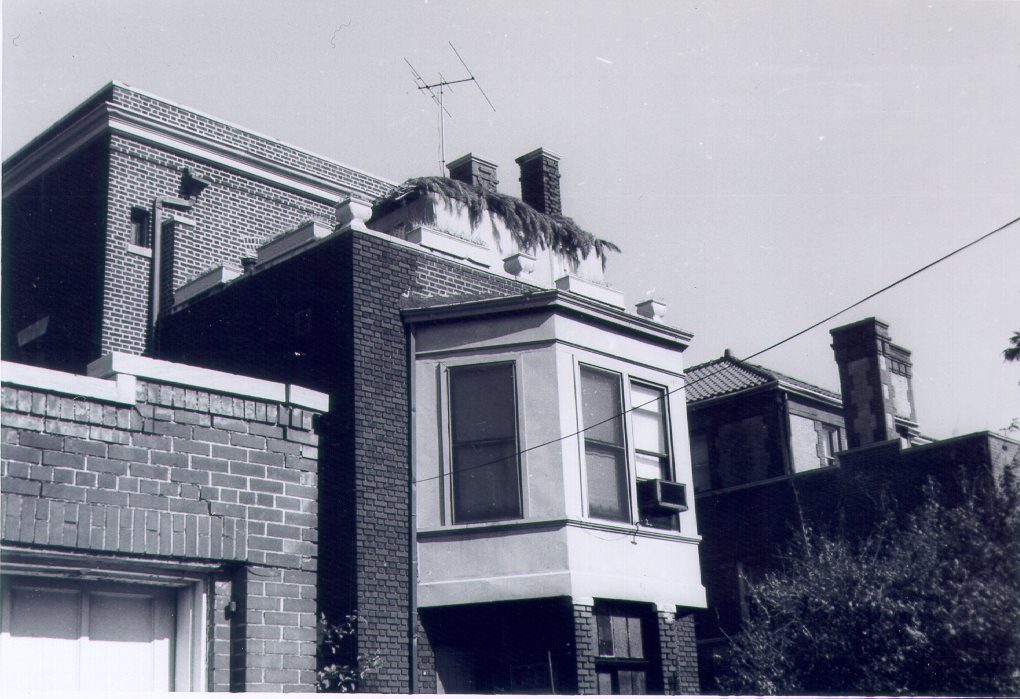
After the Rebbe’s heart attack in 5738 on Simchas Torah, the Rebbe and Rebbetzin began having some of the Shabbos and Yom Tov meals in the library building adjacent to 770. For Sukkos 5739, they built a sukka on the porch on the second floor of the building, in the back.
A year later, to make it easier for the Rebbe and Rebbetzin, they made a sukka on the porch on the first floor, where the meals usually took place. The Rebbe and Rebbetzin ate in this sukka from 5740 until 5748.
Rabbi Dovid Abba Zalmanov said that in 5742, he once walked near the door of the library and the Rebbe, who was standing near the door, called to him and said that someone asked whether the covering of the sukka is now covering the schach. The Rebbe asked him to check, saying he could go up to the second floor of the library and check, or other ways, outside the library. He called Rabbi Binyamin Klein and they went together to the Itkin family, who live near the library. They could see that the covering was not covering the schach. They quickly returned to the Rebbe who was still standing near the library, and only after R’ Klein told the Rebbe that all was fine, did the Rebbe go into the library.
Someone in the Itkin family said that at the time that the Rebbe began speaking strongly about the need to demand that Hashem bring the Geula, he once bent his ear towards the sukka as the Rebbe sat in the sukka, eating his Yom Tov meal, and heard the Rebbe humming, “We Want Moshiach Now.”
The Havdala Sukka
In many shuls, it is customary to make havdala on motzoei Shabbos. This is true year round, but on Sukkos when you can’t drink the wine without a sukka, this nice minhag is skipped over or people go out to the shul sukka.
In 770, they came up with an original solution to this situation, a small sukka built outside the shul, attached to the southern wall of the shul. Through the window in this wall, thousands of people can hear the voice of the one making havdala. Today, the window is located in the top shelf of the middle section of the sefarim shelves that are on the farbrengen platform.
Whoever was in 770 during those years remembers the smile on the Rebbe’s face, whenever the person began reciting havdala.
‘just Today I Will Stand There Myself’
Rabbi Harlig told Beis Moshiach about one of the special events that is etched in the hearts of all those who were there, on the first day of Sukkos 5752:
“Over the years, it would happen that the Rebbe would open the door of his sukka not only to bring the lulav out to the public but to ask for another lulav or esrog.
“On the first day of Yom Tov 5752, the Rebbe opened the door and I saw that he was holding the dalet minim. I thought the Rebbe wanted to exchange one of the minim and I asked, ‘Does the Rebbe want to replace the esrog?’ The Rebbe did not answer and continued to walk. I thought that for some reason, the Rebbe wanted to walk to his room himself and replace whatever it was. Then the Rebbe said to me, ‘Just today, the first day, I will stand there myself.’”
The rest, everyone remembers. The Rebbe stood for six hours in the small sukka and waited until the last Chassidim passed by and said a bracha on the dalet minim, and only then did he go to daven with the tzibbur.
The Rebbe’s Sukka Near Gan Eden Ha’tachton
At the end of the “mems,” the idea was proposed to build a sukka closer to the Rebbe’s office so he wouldn’t need to go out to the yard. When the Rebbetzin heard about this from R’ Dovber Junik, she was happy about it, saying if the Rebbe had to go eat something in the sukka, everyone didn’t need to know about it.
It was decided to build a small sukka under the window of the Rebbe’s room, near the stairs that lead to R’ Groner’s office, from where there was easy egress to the Rebbe’s office. The sukka was very small. It was built up against the door of the stairwell and when you would open the door (from inside) you immediately entered the sukka.
R’ Shimshon Junik said that after he finished building the sukka, the Rebbe asked to see it. R’ Junik together with R’ Groner accompanied the Rebbe and when they reached the sukka, the Rebbe mentioned that in the past, when they built over the ‘shalash,’ there was a plan to build a roof that would be opened on Sukkos, making it into a sukka, a plan that didn’t end up happening.
In connection with this, the Rebbe said, it was discussed that this whole area should be a sukka. The Rebbe then added, but that’s not to say they should do so now.
Afterward, the Rebbe asked whether in this sukka too they had made a covering for the rain. When R’ Groner said no, the Rebbe was pleased since he could go in at any time without bothering anyone.
Even after this sukka was built, the Rebbe continued to light candles in the sukka in front of 770. As far as the dalet minim, the Rebbe would occasionally say a bracha in this sukka and an hour or two later he would go to the sukka in front of 770, stay there briefly and take the dalet minim out for the Chassidim.
Rabbi Shmuel Krauss tells an anecdote that occurred in this sukka in 5749:
“After the passing of the Rebbetzin, there were bachurim who stood watch in gan eden ha’tachton. One night of Chol HaMoed, at nine o’clock, the Rebbe went out to the sukka, leaving the key to his room in the room. When the Rebbe left the sukka, he asked the bachurim to find R’ Groner who had another key to the room and ask him to come and open the room. ‘He is probably at the Simchas Beis HaShoeiva,’ said the Rebbe. Until they found R’ Groner, the Rebbe went back to the sukka and continued learning.”
Two years later, the suggestion was made to build a sukka in the closest possible place, in R’ Groner’s office. R’ Groner’s office, located in the space between 770 and the next building, was the closest place to the Rebbe’s room, and the roof is directly under the open sky. The idea was to remove the ceiling and make a retractable ceiling that could be lifted up to make a sukka.
The suggestion was submitted to the Rebbe who agreed on condition that the Mara d’Asra of Crown Heights, gave a hechsher to a sukka in this room, and that they get the consent of the gabbaim of the shul to make a change to the office which used to be part of the women’s section of the shul.
The rabbanim of the community checked and paskened that a sukka could be made there and the gabbaim gave their consent, and for the next Sukkos, R’ Groner’s room was made into the Rebbe’s private sukka where he ate in 5753 and 5754 too.
To conclude with a story that we heard from R’ Dovber Junik:
One year, he accompanied the Rebbe to his office on motzoei Yom Kippur and as soon as they walked in, before the Rebbe removed his kittel, he went over to the bookcase and took out a Mishnayos Sukka and began learning the laws of sukka, as the custom is to start building a sukka right after Yom Kippur or to at least learn the halachos.
HaTomim #14 • pp. 42-57
© 2026 Beis Moshiach Magazine. All rights reserved.
This article originally appeared in Beis Moshiach #1428. You are welcome to share it with friends and family by email or in print, provided that you do not change, add to or omit any part of it, you credit the author and Beis Moshiach, and you include a link to archive.bmoshiach.org (written out in full in printed copies).
To republish this article in a newspaper, magazine, book or website, please request permission in advance at [email protected].