The Esrog From Gan Eden
From the TzaddikStory.org collection
Hello. My name is Uri, and I come from a small town not far from Strelisk. Money never came easily in our house. I earn my living as a melamed, teaching cheder boys, and my wife works right alongside me, cooking for other families to help put bread on our table. Between the two of us, there was rarely a spare kopeck lying around.
But there was one thing, every single year, that I refused to go without: a beautiful, mehudardige esrog.
It had become something of a name for me in Strelisk. Every Sukkos, neighbors would stop by just to see it—sometimes just to make the bracha on it themselves. I never had the finest house on the block or the finest coat on my back. But for seven days a year, I had the finest esrog in town, and to me, that was worth more than anything else that money could buy.
To afford it, I set aside half of everything I earned all year long, kopeck by kopeck, tucking it away bit by bit into an old tin box. Every Elul, I’d count it all out and set off on foot for Lemberg, where the esrog dealers gathered before every Sukkos. Walking saved the fare, and I needed every ruble I could spare for the esrog itself.
This year was no different. I counted out fifty rubles—a small fortune by our standards. Then I set out for Lemberg, full of hope.
By the time I reached a small inn along the road, it was already time for Mincha. I found a quiet corner, stood facing east, and began davening.
I hadn’t gotten far into my davening when I heard it—a terrible cry, followed by moaning and gasping, the sound of someone in real pain. I couldn’t make out a single word clearly, but something told me right away that whoever was suffering was a fellow Yid. I finished my Shemone Esrei as quickly as I could and turned to see what was happening.
Before me stood a man dressed like a simple farmer, a whip shaking in his hand, waving it about in his distress. It didn’t take long to learn his story. He was a poor Jewish wagon driver, married with several children, working hard to earn a living by hauling passengers with his one thin horse. That very day, the horse had suddenly collapsed in the road and died. Without it, he had no way to earn a living at all. In his despair, he said he might as well give up—there was nothing left for him in this world.
I couldn’t bear to watch a fellow Jew in such pain. I told him not to give up hope—that the Ribbono Shel Olam could help him no matter how impossible things looked.
The innkeeper, moved by the man’s suffering, offered to sell him an excellent horse—worth a good eighty rubles—for only fifty, just to help him out of his trouble. But the wagon driver only grew more upset. “I don’t have five kopecks to my name,” he cried, “let alone fifty rubles. Whoever suggests I buy a horse for fifty rubles is mocking me.”
I just knew it. I knew I couldn’t keep those fifty rubles in my pocket while this man’s whole way of earning a living hung by a thread in front of me. I turned to the innkeeper and asked for his very lowest, final price.
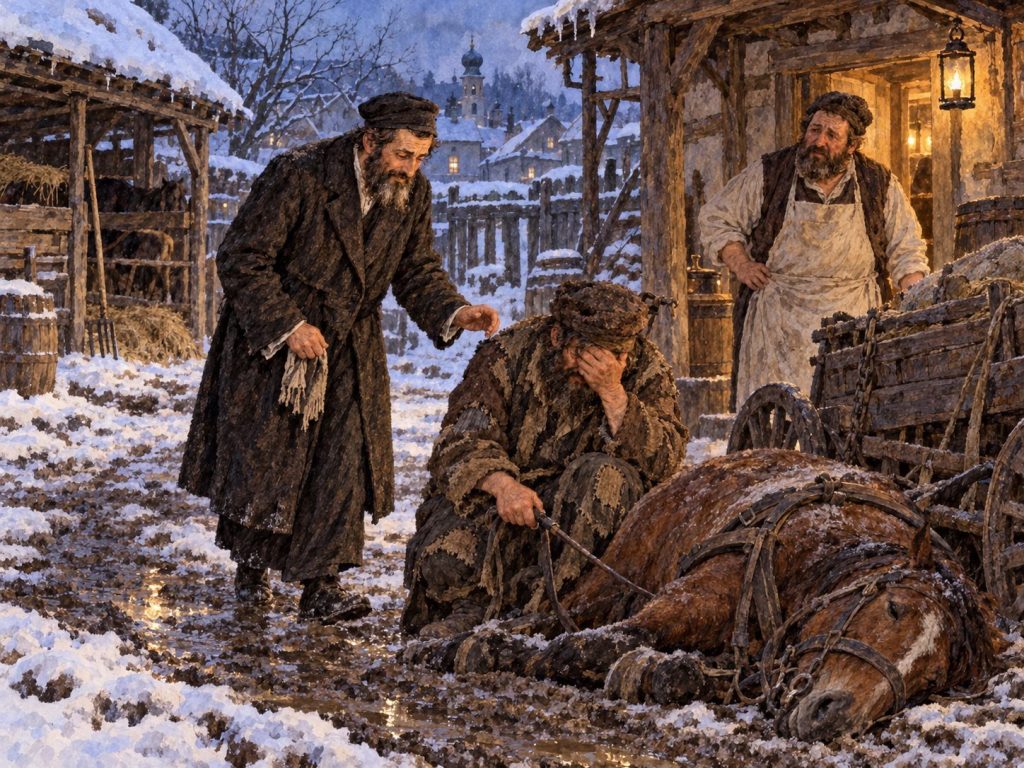
He looked at me as if he could hardly believe what he was hearing. “If you pay cash, right now,” he said, “I’ll let it go for forty-five. Not a kopeck less.”
I counted out forty-five rubles on the spot and handed them over. The wagon driver stared at me, his eyes wide, too shocked to speak. I don’t think he could have found the words to thank me even if he’d tried.
He hurried off with the innkeeper to hitch the new horse to his wagon. I was still gathering my things when I heard it from just outside the door—the sharp crack of a whip, once, twice, a third time. His voice rang out into the night right along with it, though I couldn’t make out a single word of what he was shouting. I had no idea what any of it meant, and no time to stand there wondering about it. I gathered my things quickly and slipped out before his thanks could catch up with me—I had no interest in being on the receiving end of it.
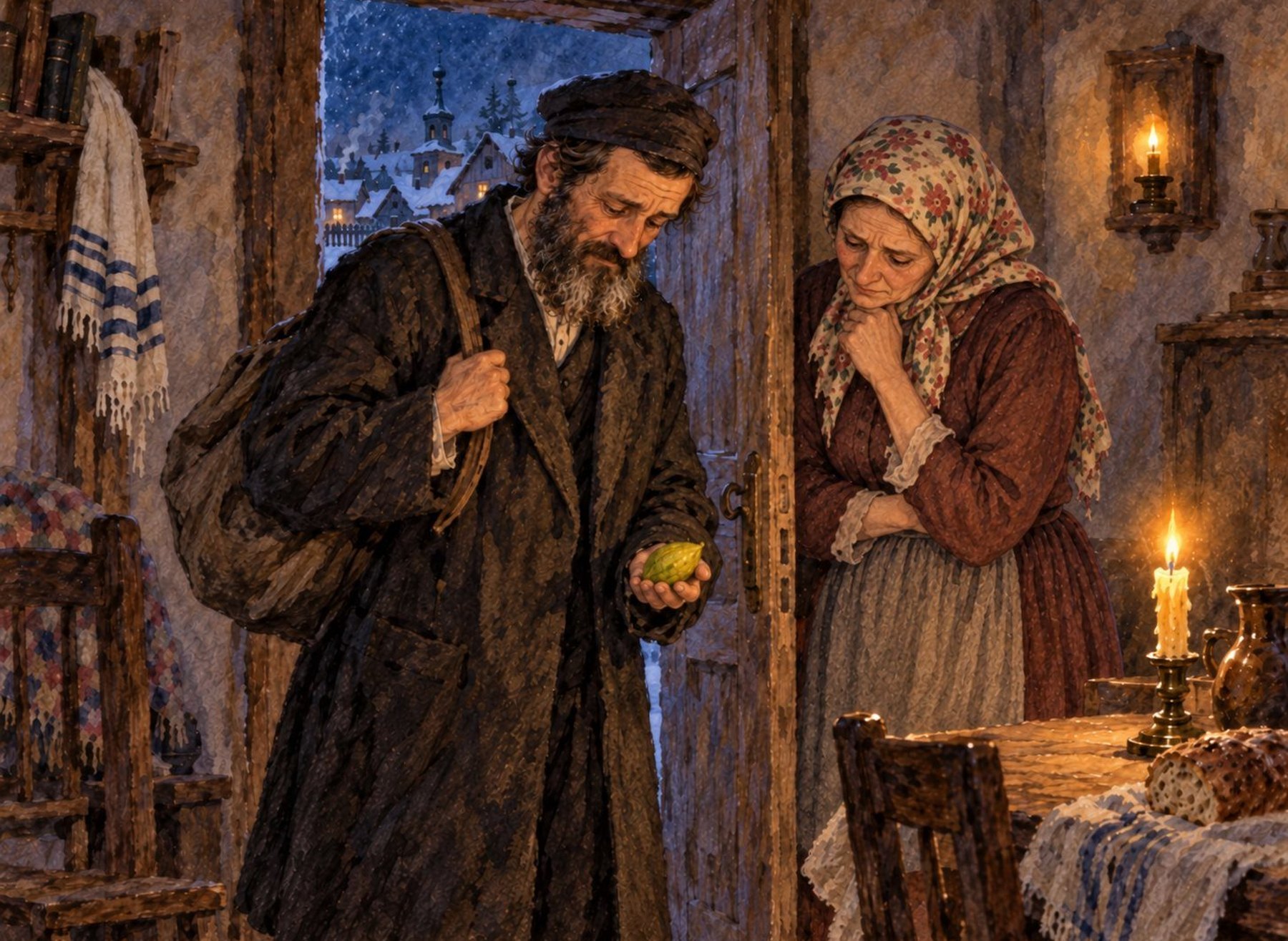
I continued on to Lemberg with five rubles left in my pocket. Naturally, that bought me nothing close to what I’d been hoping for—only a kosher esrog, plain and unremarkable, nothing like the ones I usually brought home.
My wife was waiting by the door when I got back. I could see right away she was expecting the same thing our neighbors would soon be expecting too. When she saw my face, and then the sad little esrog in my hand, her smile faded. I told her the whole story—the wagon driver, the horse, the forty-five rubles—and she listened quietly.
I thought about all those neighbors who’d be knocking on our door any day now, the way they did every year, and I simply couldn’t bear it. “Maybe,” I said, “I’ll spend this Yom Tov somewhere no one knows me. In Lizhensk, at Reb Elimelech’s Beis Medrash. No one there will expect anything of me.”
She nodded sadly. “If that’s what you need to do, then that’s what you need to do.”
* * *
It was the first day of Sukkos. Reb Elimelech had finished Shemone Esrei and stood at the amud, lulav and esrog in hand, ready to begin Hallel—and then he simply stopped. He didn’t chant the bracha. He stood there, still, his face troubled, and the whole Beis Medrash fell into an uneasy silence, waiting.
Reb Elimelech hurried over to his brother, Reb Zusha, who had come to spend Yom Tov with him. I couldn’t hear what passed between them, but a moment later the two of them stepped away from the front of the shul together and began making their way through the room, bench by bench, searching.
They kept coming, closer and closer, until they reached the very back, where I was standing alone with my plain little esrog, trying to make myself as small as possible.
“This is it!” Reb Elimelech called out, right in front of me. “Please, my friend, tell me—who are you, why are you here, and how did you come by such an amazing esrog?”
I was caught off guard by the question. “I’m Uri, from near Strelisk. But with all due respect, Rebbe,” I blurted out, still in shock, “my esrog is not amazing—it’s barely kosher. As to why I’m here, it’s a long story.”
“I have time,” he said. “I’m certain it’s a story worth hearing.”
So I told him—about the road to Lemberg, the inn, the wagon driver’s collapsed horse, the innkeeper’s offer, the forty-five rubles, the strange crack of the whip I’d heard on my way out that I never understood, and the plain little esrog I’d been too ashamed to bring home.
When I finished, Reb Elimelech’s face lit up. “But my dear Reb Uri! Your esrog truly is not like any other. Now I understand where its fragrance of Gan Eden comes from. Let me tell you the rest of the story—the part you never saw.”
And this is what he told me.
The wagon driver—we’ll call him Berke, since I never learned his real name—stood there afterward turning the whole thing over in his mind. He came to believe that the stranger who’d handed him forty-five rubles without a second thought was no ordinary man. He must have been Eliyahu HaNavi himself, sent in disguise to save him in his hour of need. He wanted so badly to thank the Ribbono Shel Olam. But he was a simple man who couldn’t even read, and he had no words of his own to offer. All he had were his hands and his whip. So he raised it toward the heavens and cracked it, calling out with everything in him, “Ribbono Shel Olam, I love You! I love You more than my own wife and children! Let this crack of the whip stand as my sign of love for You!” He cracked it a second time, and a third, louder each time, until his voice cracked right along with it.
It happened to be one of the Aseres Yemei Teshuva, between Rosh Hashana and Yom Kippur. On Yom Kippur itself, Reb Elimelech said, the Ribbono Shel Olam sat in the heavenly court, listening to the tefillos of the holy day rising from every corner of the world.
At that very hour, Reb Levi Yitzchok of Berditchev—the great defender of Klal Yisrael—was pulling a big wagon, piled high with a full year’s worth of mitzvos. He pushed and pulled with all his strength, trying to get it through the gates of Shamayim.
But at the very last stretch of the road, the Satan appeared and blocked the gate. He scattered a full year’s worth of Klal Yisrael’s aveiros across the path—a mountain of them, a tangled pile that caught at the wheels and stopped the wagon cold. Reb Levi Yitzchok pulled and pulled, but it would not move. Reb Zusha and Reb Elimelech himself, he told me, had rushed over to help push. But even the three of them together couldn’t move it, not even a little bit.
Then, from somewhere far below, came the crack of a whip. Berke’s whip. It didn’t fade away like an ordinary sound. Instead, it turned into a beam of light so bright that it lit up every corner of Shamayim, until every angel and every waiting tzaddik could be seen, all trying hard to hear where it had come from. And then came Berke’s own voice, carried on that same beam of light, calling out his love for the Ribbono Shel Olam with everything he had.
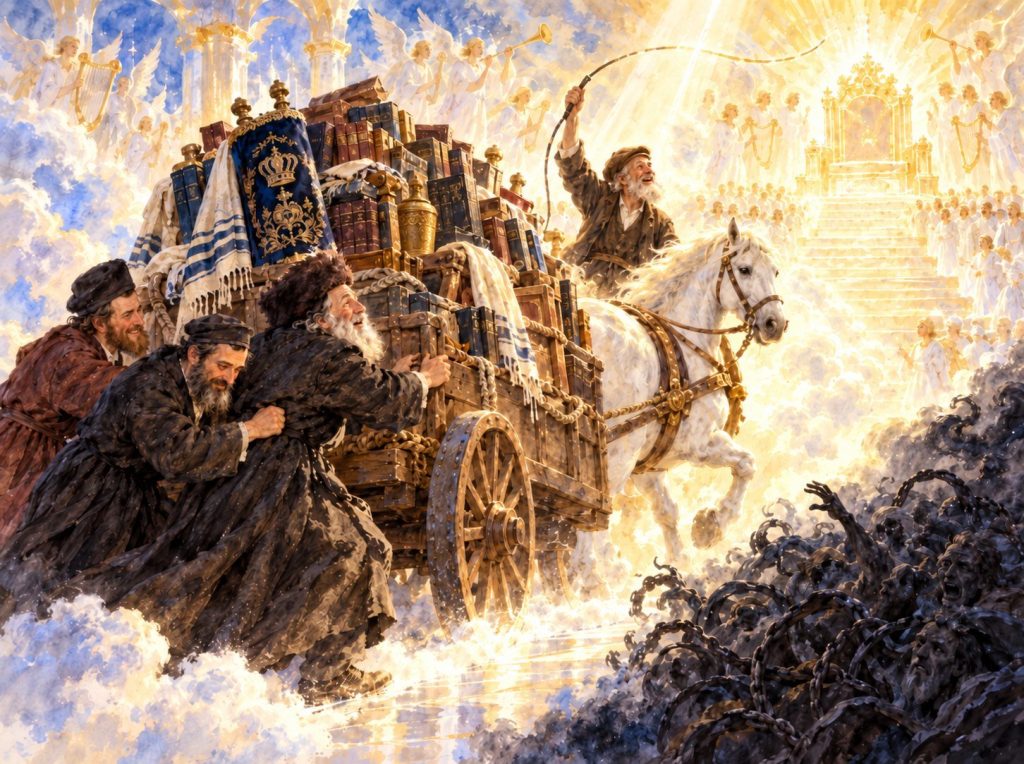
At that instant, the Malach Michoel stepped forward, leading a horse—and just behind him, whip still in hand, came Berke himself. Michoel tied the horse to the wagon of mitzvos. Berke raised his whip one more time and let it fall, and the wagon leapt forward as if shot from a bow. It went thundering straight over that mountain of aveiros and came to rest directly before the Kisei HaKavod. Hashem received it with mercy, and rose from the Kisei Din to sit instead upon the Kisei Rachamim. And so, because of one crack of a whip from a poor Jewish wagon driver who couldn’t even read the letters of a siddur, a good and sweet year was sealed that day for all of Klal Yisrael.
“You see, Reb Uri,” Reb Elimelech finished, his eyes wet, “all of this came about because of you—because of the kindness you showed a stranger on the road, without a second thought for yourself. Go home after Yom Tov. You deserve to be a leader among your people. But first, here, before this entire kehillah, allow me the honor of making the bracha on your magnificent esrog.”
And with that, Reb Elimelech returned to the amud, my plain little esrog raised high in his hand beside his own, and began Hallel with a joy the shul had rarely seen.
Uri stayed on in Lizhensk after that Yom Tov and became one of Reb Elimelech’s devoted talmidim. In time, he grew into a great tzaddik in his own right—known throughout Klal Yisrael as “the Saraf,” R’ Uri of Strelisk, zechuso yagen aleinu.
Salute #1524 • pp. 17-21
© 2026 Beis Moshiach Magazine. All rights reserved.
This article originally appeared in Beis Moshiach #1524. You are welcome to share it with friends and family by email or in print, provided that you do not change, add to or omit any part of it, you credit the author and Beis Moshiach, and you include a link to archive.bmoshiach.org (written out in full in printed copies).
To republish this article in a newspaper, magazine, book or website, please request permission in advance at [email protected].