The Brazilian Boy Who Wanted to Be a Doctor
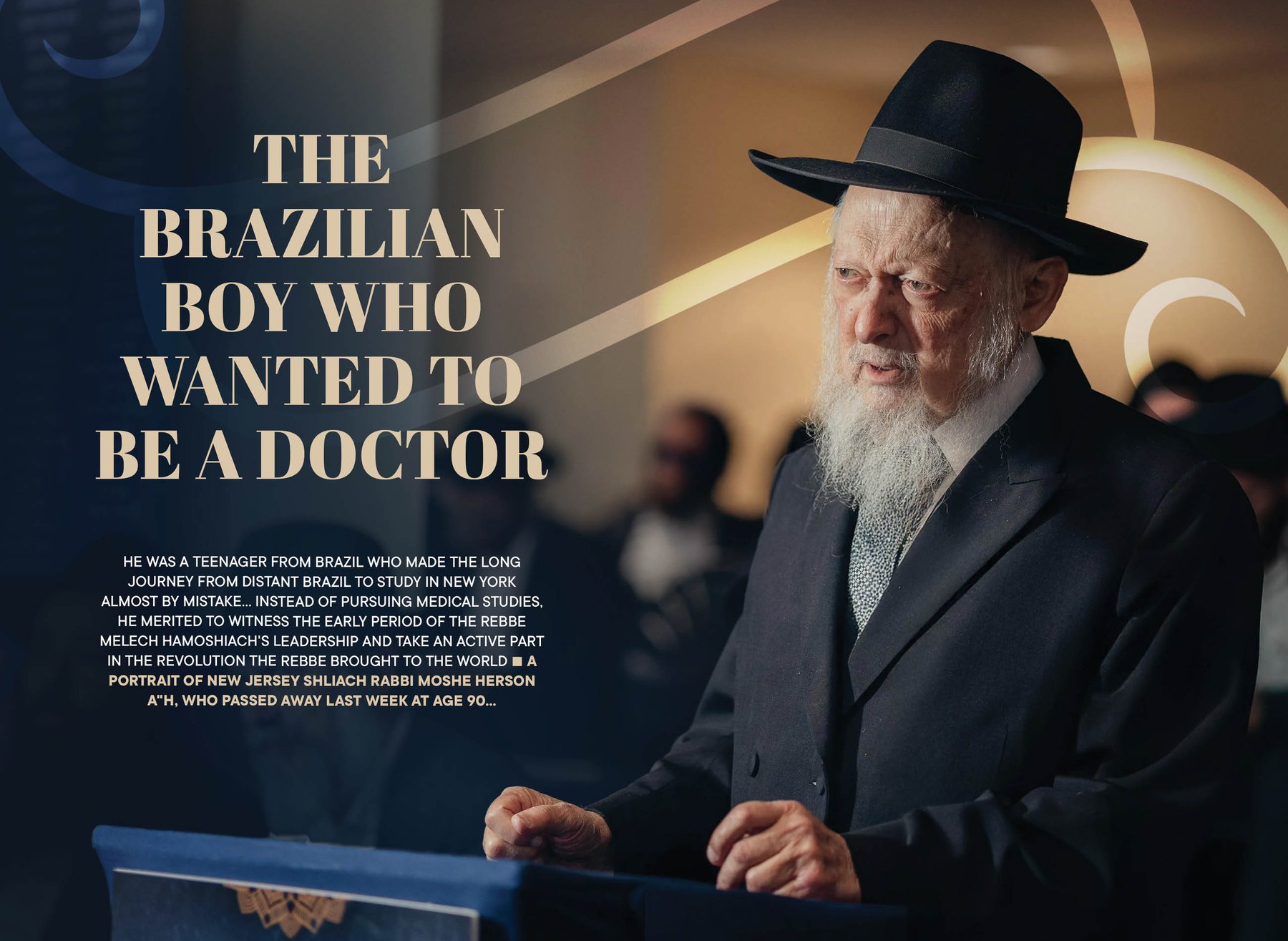
He was a teenager from Brazil who made the long journey from distant Brazil to study in New York almost by mistake… Instead of pursuing medical studies, he merited to witness the early period of the Rebbe Melech HaMoshiach’s leadership and take an active part in the revolution the Rebbe brought to the world * A portrait of New Jersey shliach Rabbi Moshe Herson a”h, who passed away last week at age 90…
Rabbi Moshe Herson was born on the 20th of Tammuz 5694 in Rio de Janeiro, Brazil, to his father Asher Zelig and mother Hinda, the youngest of four brothers. His parents were traditionally observant, without any connection to Lubavitch or Chassidus. During his childhood years, he studied at the local Talmud Torah in his city.
During those childhood years, he lost his father and remained under his mother’s care.
His initial connection to Chabad came thanks to a shlichus assigned by the Rebbe Rayatz to Rabbi Yosef Wineberg. R’ Wineberg would travel to many countries around the globe to raise funds for the Rebbe and for the Tomchei Tmimim yeshivas.
In 1949, before departing for Brazil, the Rebbe Rayatz instructed him not to be satisfied with just ‘taking’ (money) during his visits, but that he must also contribute. As such, during his visit to the city he visited the Talmud Torah, and among other classes, he visited the class where young Moshe Herson studied.
They later met again, and R’ Wineberg inquired whether the young boy would like to go study in yeshiva. Although young Moshe Herson had other plans, he politely answered that “it might be a good idea.”
Change of Plans
“I was only fourteen years old at the time, a Brazilian Jewish boy,” R’ Herson later recalled. “My aspirations in those days were to become a doctor in Brazil. I therefore thought to respond in the negative, but due to his important position and his acquaintance with my parents, and the fact that I respected him as well, I didn’t give a definitively negative answer but rather an evasive one. I said I would decide about it in the future.
“R’ Wineberg didn’t give up. Shortly after returning from Brazil to the United States, he sent me an ‘affidavit,’ a study permit for the United States.
“Over time I began to change my mind. It was actually my mother who, despite it not being easy for her, told me that for the sake of my Jewish education it would be worthwhile to go study for several years in New York. And as for my planned medical studies, we would see what to do about that in the future.”
Drawing Close to the Ramash
And so young Moshe Herson made the long journey from Brazil to New York. In the days before Shavuos 5710, he entered the yeshiva. A boy of almost fifteen, Portuguese-speaking, found himself in a completely new world, where people spoke Yiddish or Hebrew, languages that were foreign to him. He experienced a difficult time transitioning and adapting to full-time yeshiva studies. Those who helped him in the initial period were the students Meir Zajac and Yaakov Begun, also natives of Brazil who had arrived to study at 770 some time before him.
Initially, he studied for several years at the yeshiva branch on Bedford Avenue under Rabbi Mordechai Mentlick, and later moved to study at 770.
The personality of the Rebbe, who had not yet accepted the leadership, his farbrengens and his conduct – captured his heart. “I didn’t understand the things he said at the farbrengens, but I saw his ways and felt that this was my place,” he recalled years later.
As a result, he gave up his original intention to study in yeshiva for only a short period and return to Brazil, and decided to stay in yeshiva.
The Rebbe gave him warm personal attention, which helped him endure his homesickness. The Rebbe’s encouragement motivated him to complete his missing knowledge and invest himself in Torah study. He instructed him to say ‘l’chaim’ at farbrengens and drew him very close. “I merited a loving and welcoming relationship from the Rebbe. The Rebbe guided me in every step of my life and I felt that the Rebbe was like a father to me,” he later recalled.
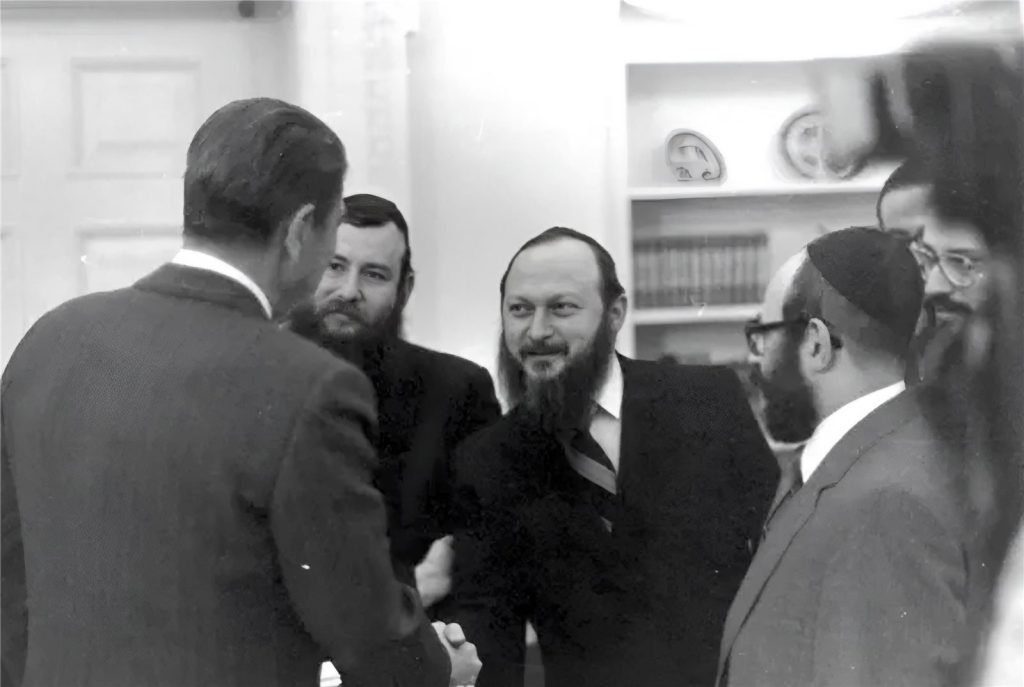
During that period, the Rebbe asked him if he had a picture of the Rebbe Rayatz. Young Moshe replied affirmatively, and the Rebbe instructed him to keep a picture in his wallet or pocket and look at it from time to time…
Rabbi Herson later shared an extraordinary story from that period:
“On the 12th of Tammuz 1950 – the first Chag HaGeula after the Rebbe Rayatz’s passing, the Rebbe traveled together with the Chassidim – and I among them – to pray at the ‘tziyun’ (at that time the ohel over the gravesite had not yet been built).
“Being a young boy, new to Lubavitch, I didn’t know how to conduct myself properly with the Rebbe and since I didn’t have a ‘Maaneh Lashon,’ I stood next to the Rebbe and read together with him from his Maaneh Lashon booklet…
“When the Rebbe finished reciting, he raised his holy eyes, looked with great concentration at the gravesite and whispered: ‘Good Yom Tov, Rebbe!’ He took several steps backward, and burst into terrible weeping…”
Confidential Work in the Service of the Rebbe
This connection bore fruit, and the young boy from Brazil became an integral part of the yeshiva in 770. Two years later, he was well enough acquainted to welcome new students from South America. These students were sent by Rabbi Berel Baumgraten, the Rebbe’s shliach in Argentina, to study at the yeshiva in 770. Since R’ Herson spoke Spanish, he was tasked with learning alongside them and guiding them in their early steps at the yeshiva.
During this time, he also participated in the Rebbe’s holy work, taking on a highly responsible task: translating letters sent to the Rebbe in Spanish or Portuguese. This role required a great deal of confidentiality, and no one knew about this work. This sensitive role showed the high level of trust the Rebbe placed in the young man.
R’ Herson later shared the following about his work:
“One day, while studying in the Beis Medrash on the ground floor of 770, I was called to the office of Rabbi Chodakov, the Rebbe’s secretary, who asked me if I spoke Spanish. Having come from Brazil, I was fluent in Portuguese but also knew Spanish quite well.
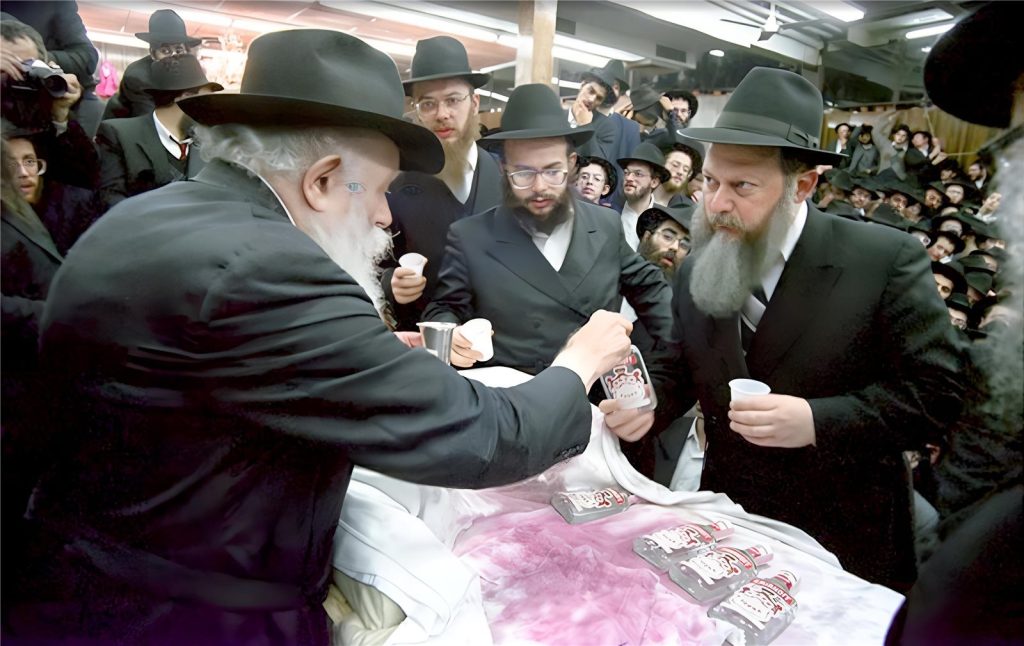
“‘Can we rely on you to translate letters that come to the Rebbe in Spanish and Portuguese?’”
“‘Yes,’ I answered.
“‘You must understand that these are personal and private letters. After translating, you must forget what you read,’ Rabbi Chodakov warned me, emphasizing the strict confidentiality rules in the Rebbe’s secretariat – and I agreed.
“Thus, over the years, I was given letters sent to the Rebbe in Spanish and Portuguese and translated them to the best of my ability. Some of the envelopes had already been opened by the Rebbe, while others had not – but usually, the Rebbe would write on the envelope a directive: ‘Translate,’ underlined for emphasis.
“Every week, there were a few such letters—not a particularly large amount, but the translation work took time. Sometimes, deciphering the handwriting was a challenge in itself, and afterward I had to figure out what the writer intended to express, without knowing them or the specifics of the situation they described. This made me think about what the Rebbe went through daily with the many letters he received…
“In cases where I couldn’t understand the writer’s intent, I would translate literally and add a few notes to indicate that I didn’t fully grasp the meaning. Sometimes I would add a comment mentioning that I had difficulty understanding the letter.
“Living in the yeshiva dormitory made it even harder; I had to find a time and place to do the work without my friends seeing what I was doing. One year, on erev Pesach, I had several letters to translate. While everyone else was busy searching for chametz and preparing for Yom Tov, I felt it was important to make sure these letters reached the Rebbe before Yom Tov, so I returned to 770.
“The place was completely empty. I sat far from the entrance of the Beis Medrash, near the western wall, spread out the letters on the table, and began working. After working quietly for a while, I heard the door to the Rebbe’s room open in the hallway beyond the foyer.
“The Rebbe was preparing to leave for his home, but before he left, he peeked into the Beis Medrash. I didn’t even know he was in the building, but when I saw him standing in the doorway, I stood up in respect and remained standing until he left. The entire moment was very brief; as quickly as he appeared, he turned and left. It was obvious I was writing something, not studying, but I was sitting far enough from the entrance that no one could read the papers in front of me. To an observer, it would have looked like I was in the middle of writing a letter to my parents or friends. But the Rebbe didn’t need much, and later I realized that in those few seconds, he understood exactly what I was doing.
“The next morning, I arrived early at 770 to continue the translations. Since it was erev Passover, a chametz burning ceremony was expected to take place. Normally, the Rebbe would go down to the basement accompanied by one of his secretaries to burn the chametz. There was a boiler there, and the Rebbe would throw the chametz collected the night before into it, along with some other items.
“In due time, more people gathered in the Beis Medrash, waiting for the Rebbe to leave his room and go down to the basement. I positioned myself in the corner of the room so I could continue my work without drawing unwanted attention. Suddenly, the Rebbe arrived at the door of the ‘zal,’ glanced around quickly without entering, and left. He continued down the hallway to a smaller second room, quickly scanning that room too; it seemed like he was looking for someone but couldn’t find him. Then the Rebbe returned to the first door and entered the center of the Beis Medrash. By this time, I had moved from my corner, so now he could spot me and pointed toward me.
“‘Herson, come with me,’ he said. I barely had time to close my pen and gather the papers, and I hurried to follow the Rebbe into his room. There, near the entrance on the floor, he pointed to several well-wrapped bundles that looked to me like letters sent to the Rebbe. ‘If it’s not too much trouble,’ he said, ‘can you help me carry these packages?’
“I lifted them, and out of respect, I stepped aside to allow the Rebbe to exit the room first. The Rebbe hesitated for a moment, then walked ahead. I closed the door behind me, and we headed to the elevator, which was waiting to take us downstairs. I was so nervous that when I got into the elevator, I stood there without pressing the button to descend.
“As soon as the elevator doors closed, the Rebbe asked, ‘Did you close the door properly?’ I responded affirmatively, and then I understood why the Rebbe had hesitated earlier; he wanted to be the last to leave the room to ensure the door was locked correctly. After that, the Rebbe pressed the button, and we descended with the bundles to the boiler. I stayed by the Rebbe’s side until he finished burning the chametz and all the other packages…
“Usually, one of his secretaries would assist the Rebbe with the chametz burning every year. At first, I didn’t understand why the Rebbe called on me specifically to help. He had never done so before, nor had he since. Perhaps the secretary arrived a little late that day – though I doubt that happened – or maybe the Rebbe began the chametz burning earlier than planned that day so he could choose someone else for the task. It’s possible this was his way of giving me the role without offending his secretaries; because when they arrived, the ceremony was already over.
“I can’t say for sure, but it seems that after the Rebbe saw me working on those letters on erev Pesach, he wanted to express his appreciation by giving me the honor of assisting him with the chametz burning.
“This was something I noticed about the Rebbe over the years: Whenever someone did something for him, the Rebbe always sought an opportunity to repay them.”
In the early 1960s, R’ Herson gave up the task of translation, as at that time he began assisting in managing the yeshiva in Newark – among other areas of responsibility he was assigned. He felt the pace of translating the letters was unsatisfactory. After speaking with the Rebbe’s secretary, Rabbi Binyamin Klein, he agreed to find someone else to carry out the work.
“I was too young at the time to understand that I should never have given up this task,” R’ Herson later recalled with regret.
The Rebbe Arranged the Flight from his Room
R’ Herson assisted not only in being mekarev Spanish-speaking Jews who came to the Rebbe’s holy court but also in going on shlichus.
In 1959, he was sent as part of “Merkos Shlichus” to South American countries – Cuba, Colombia, and later Venezuela – together with R’ Binyamin Klein (who would later become a member of the secretariat), to bring the light of Judaism to the Jews of these countries. Before they left, they had a private audience with the Rebbe to receive his blessing.
Moshe Herson, a young student at the time, was somewhat concerned about traveling to Cuba, as it was shortly after Fidel Castro’s revolution. During the yechidus, the Rebbe completely disregarded his concerns, but while looking at the letter in which Herson had outlined the travel itinerary, the Rebbe asked, “Why only one city in Venezuela?” The Rebbe continued to gaze at the letter, then waved his hand and said, “In any case, you must travel to more than one city in Venezuela.”
When they left the audience, Herson told his travel companion that they needed to change their travel plan to visit at least one more city in Venezuela. They called the airline to request a change to the ticket, but the company refused. Merkos Shlichus also tried to modify the itinerary, but without success.
The two of them set out on their journey, visiting Cuba, where they were warmly received by the local Jewish community. From there, they continued to Colombia, visiting several cities and meeting many Jews. Then, while at their hotel, they received a call from the airline: due to some problem, the plane could not land in Caracas, Venezuela’s capital, but would instead land in Maracaibo, in the northwest of the country. “You will need to stay there for a day before flying to Caracas,” they were told.
“We were overjoyed,” R’ Herson later recounted. “I said to R’ Klein, ‘You see, we couldn’t change the ticket, and the people at Merkos Shlichus couldn’t either, but the Rebbe took care of it from his room…’
“The shlichus itself was special. We arrived at the hotel in Maracaibo, and it turned out that the hotel owner was Jewish. We put on tefillin with him. We met more Jews, and afterward, we took a connecting flight to Caracas.”
In Cuba they also experienced success. As mentioned, they arrived during the revolution led by Fidel Castro, and they were concerned about how they would be received by the masses. However, upon their arrival and throughout their stay, everywhere they went, they were greeted with great respect, to their surprise.
They didn’t understand why they were treated so honorably until they realized that it was because of the beards they wore. Many of the young men who had fought for Castro grew beards, and their beards resembled those of the two young students, leading everyone to believe they were part of Castro’s fighters…
“This shlichus was one of the most unique experiences of my time as a bachur at the yeshiva,” R’ Herson later summed up this unique shlichus.
Shlichus to New Jersey
In 1960, Rabbi Mordechai Mentlick, the head of the central yeshiva, told R’ Herson that the yeshiva administration had decided to send him to lead the opening of a new yeshiva in Newark, New Jersey. R’ Herson went to Newark, together with Rabbi Yisroel Friedman (who would later become the Rosh Yeshiva of Ohelei Torah). R’ Friedman served as the Rosh Yeshiva and taught Gemara, while R’ Herson served as a Mashpia and taught Chassidus.
This marked the beginning of shlichus in New Jersey in his life, a chapter that began at that time and continued for the next sixty years!
The reception that awaited them was not easy: they arrived at a place without heating or lighting, and R’ Herson worked hard to build the institution from the ground up.
In those years, R’ Herson thought that this was only a temporary shlichus, and that after his marriage, the Rebbe would send him on a shlichus to Brazil, his country of origin. When he became engaged in 1962, his father-in-law – who was not a Lubavitcher Chassid – asked the Rebbe if it was his intention to send his future son-in-law to Brazil. The Rebbe replied that within the next twelve months, he would not be going to Brazil. Only afterward did the final decision come, when the Rebbe instructed R’ Herson to remain in New Jersey.
During an administrative meeting in the summer of that year, the question was raised whether to continue with the yeshiva for the following year, as the financial situation was extremely difficult. The administration proposed that R’ Herson take responsibility for managing the yeshiva’s financial aspects. On his upcoming birthday, R’ Herson entered into yechidus with the Rebbe and presented the dilemma. The Rebbe answered, “Why change anything? You need to lead the yeshiva both in material matters and in spiritual matters.”
At some point, R’ Herson felt the burden on his shoulders was too heavy, beyond his capabilities. He wrote a letter to the Rebbe explaining this and mentioned that if the Rebbe agreed, he would transfer the spiritual leadership to someone else, while he himself would focus on the material aspects of fundraising. The Rebbe responded, “It is not advisable to ‘slide’ into such approaches. What is written ‘one leader for a generation’ is not said only about a generation, but also regarding a mosad.”
With this, the Rebbe established that the leadership of the yeshiva, both materially and spiritually, would remain under R’ Herson’s responsibility.
Two days after Purim of 1962, R’ Herson married his wife, Pearl, with whom he lived for sixty-three years, and who was his partner in all aspects of the shlichus with remarkable devotion. The couple built their home in New Jersey, of course.
At the Forefront of the Expansion of Activities in New Jersey
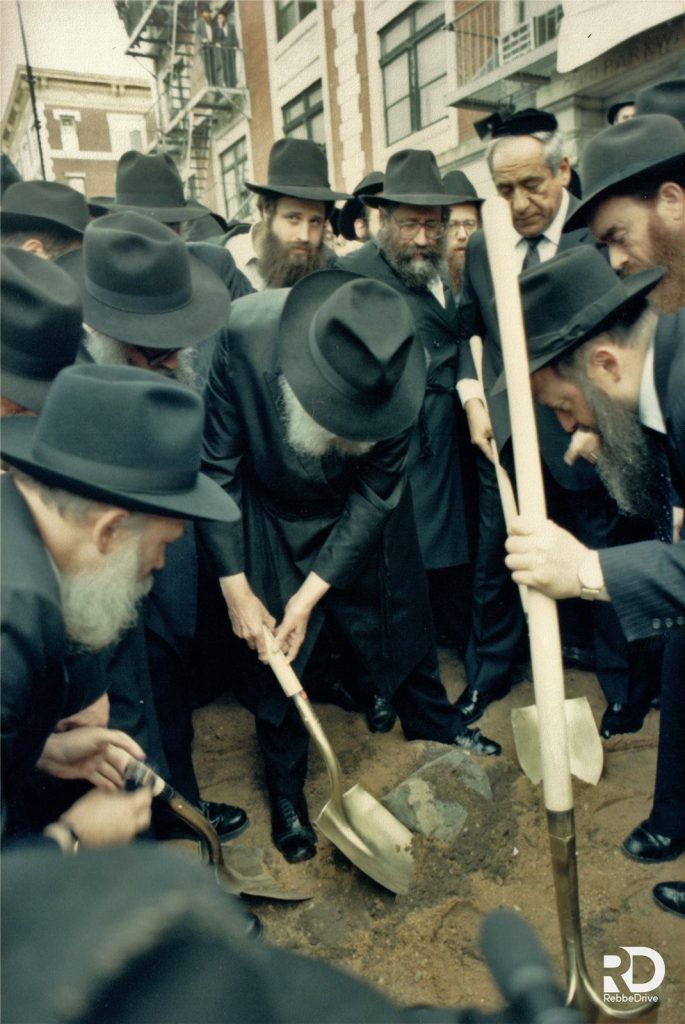
Alongside the yeshiva that began to establish itself in Newark, a Jewish community also flourished in the city, and R’ Herson began to work within it. Among the community members was Mr. David Chase, who at the time managed several department stores in Newark. He offered his assistance and did everything he could to help.
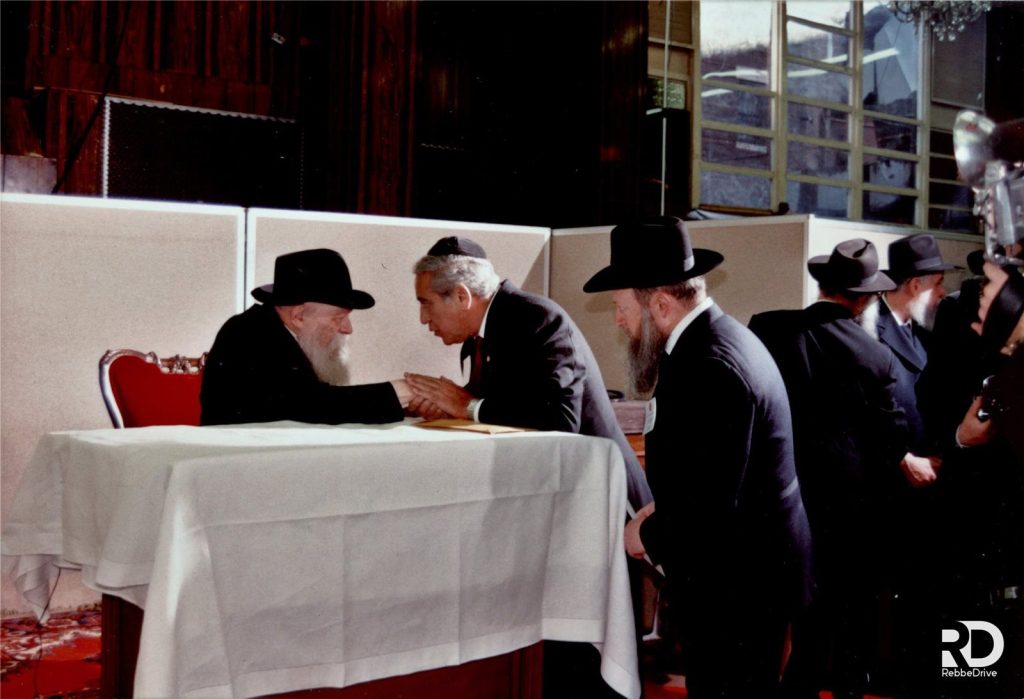
In the following years, the yeshiva and the surrounding institutions grew rapidly. By this stage, it was clear that the yeshiva had outgrown its current space and needed to move to a larger building. At this point, R’ Herson and the yeshiva’s board of directors were granted a rare opportunity to meet with the Rebbe and consult with him about purchasing new buildings and constructing a campus for the yeshiva.
Regarding that meeting, which was pivotal for the development of Chabad in New Jersey, philanthropist Mr. David Chase later recounted:
“We, the board members, entered the yechidus, and one by one, we briefly presented our ideas. Some suggested moving to another area; someone else mentioned a different town in New Jersey where a building was being sold at a low price, and so on.
“The Rebbe listened attentively to all the suggestions, and then said that all of them were good, but none of them truly addressed the needs of the hour. The Rebbe spoke about the crucial role of Jewish education, especially in our time, and said that we must consider this goal and think of a solution on a much broader scale.
“From the Rebbe’s words, it was clear that he expected much more from us, the board members, than we had envisioned before the yechidus. The idea of buying a house elsewhere, which had seemed like a great step forward, turned out to be a very limited view, seeing the yeshiva as something that should continue in the future in the format of the past. In plain language, the Rebbe asked us to think big and act on a large scale.
“At that moment, a deep emotional connection with the Rebbe was established in me. Shortly after that yechidus, the Rebbe wrote me a letter saying, among other things, ‘At our meeting, I received the confidence and certainty that the project will succeed.’
“I’m not sure why I was amazed by the Rebbe’s broad vision – by his rejection of any limitations – or if there were deeper, more personal reasons for it, but from that moment on, I saw myself as deeply connected to the Rebbe.”
In the end, the board of directors found an old building located on a large 14-acre property with sports facilities, outside of Morristown. Before the inauguration of the yeshiva’s new building, R’ Herson had a yechidus with the Rebbe, who blessed him with great blessings: “The Alm-ghty should give you great and tremendous success in this institution and in the institutions you will build around it.” This statement indicated that the Rebbe envisioned the yeshiva as the central institution, with many others built around it.
R’ Herson understood that the yeshiva was to be a lighthouse around which other Chabad institutions would rise, to make Judaism accessible throughout the state. When he decided to expand the yeshiva, he published an article in the newspaper stating, “We strive to open our doors to distant strangers and bring them closer to Judaism.” He wrote this primarily to give weight and substance to the construction plan, although he did not intend to open such an institution; he simply envisioned a regular yeshiva in a quiet place…
At that time, he had yechidus with the Rebbe. Among other things, the Rebbe said to him, “Hashem should grant you great and tremendous success in this institution, as well as in the other institutions you’ve started building around it.”
R’ Herson was taken aback: “What for me was still a distant dream, for the Rebbe was already a reality, as he spoke to me about ‘what you’ve started building…’”
Indeed, over the years, the yeshiva and the Semicha program developed into the flagship institution for rabbinical certification in the Chabad world. At its peak, it had 280 students in its annual cohort. The certificates awarded by the institute are recognized worldwide, and leading poskim in halacha tested the students, expressing satisfaction with their broad knowledge.
Over the years, thousands of students learned at the yeshiva that R’ Herson established, and they went on to establish beautiful and upright Chassidishe homes.
Recognizing the vast number of Jews living throughout New Jersey, R’ Herson began to build additional Chabad centers, Torah institutions, and chesed organizations to further develop the momentum of activity. He started in Bergen County, where he recognized the growing Jewish population and enlisted more shluchim to lead the community.
The next stage was reaching out to the student community. Recognizing the unique needs of the thousands of Jewish students at Rutgers University, Rabbi Yosef Tzvi Carlebach was sent to the campus. Together, they created a warm and welcoming place for Jewish students seeking a sense of community, the observance of mitzvos, and meaningful Jewish experiences.
R’ Herson’s leadership and strategic planning led to the establishment of over seventy Chabad centers throughout New Jersey, even reaching the most remote corners of the state. He always served as a pillar of support for the shluchim, providing them with resources, mentorship, and encouragement to help them succeed in their mission of reviving the spirit of Judaism in every Jew across New Jersey.
Despite speaking with an accent that revealed his Brazilian origin, R’ Herson became one of the most successful builders of institutions in recent decades. He was highly respected by both students and supporters, including leaders and representatives from the state of New Jersey.
Even in his later years, despite serious health challenges, he continued to work with all his strength and energy. It can be said that R’ Herson changed the Jewish landscape of New Jersey over six decades of shlichus, playing a pioneering role in establishing the strong presence of the Rebbe’s shluchim throughout the state.
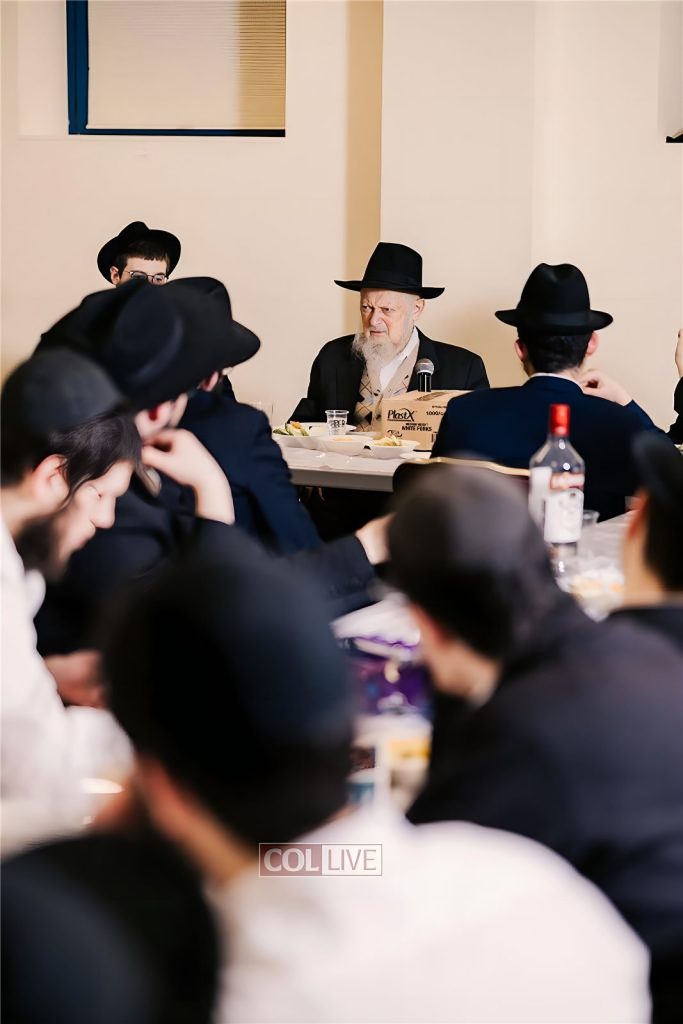
On one occasion, the Rebbe praised, in rare terms, the campus of the mosdos in Morristown, describing it as “a model program, and when completed, it will be a pilot program for all the shluchim in the entire world.”
The Rebbe also added, “R’ Herson and the communal activists, with Mr. David Chase at their head, are energetic people.”
A Role Model for Shluchim
The administration of the yeshiva in Morristown and the large Semicha program, alongside the expanding activity, required significant fundraising efforts. R’ Herson devoted himself fully to this, and he succeeded in raising funds from prominent Jewish philanthropists, including the Chase, Wilf, Kushner, and Lauder families, who became major supporters of Chabad in New Jersey. His charismatic personality drew donors to the authenticity of his work. He was direct – but uncompromising – when requesting their support.
One of the most well-known philanthropists was Mr. David Chase, who later became R’ Herson’s most significant partner in building the Rabbinical College of America and served as the chairman of its board of directors. Over time, David Chase developed a warm and personal relationship with the Rebbe in an extraordinary way.
Indeed, R’ Herson’s persona over the years became a symbol and example for many shluchim around the world. He built large institutions, raised funds on an unprecedented scale, and succeeded in generating a tremendous wave of activity across his state. He was also a man of wide knowledge and extensive experience, always acting according to the Rebbe’s guidance and instructions. Above all, he maintained a model of Chassidishe behavior, dedicating his life to fulfilling his shlichus with a pleasant demeanor, modesty, and humility.
Over the years, he established the institution “Tiferes Bachurim” in Morristown for Baalei Teshuva, which earned worldwide recognition and became one of the success stories of Chabad in the United States.
At the Forefront of a Global Tzedaka Project
In 1985, R’ Herson was appointed by the Rebbe to be a member of Agudas Chassidei Chabad, and in this capacity, he worked on the return of the books that had been stolen from the Lubavitch library in the ‘Book Trial.’ R’ Herson was deeply involved throughout the trial and did everything in his power to help ensure its success.
Many initiatives and projects are credited to Rabbi Herson, the most famous of which is the establishment of the Machne Israel Development Fund.
In 1986, together with Rabbi Berel Shemtov, Rabbi Simcha Zirkind, Rabbi Shmuel Kaplan, and Rabbi Yisroel Shmotkin, they worked to establish the Machne Israel Development Fund (MIDF). This initiative brought together a group of philanthropists who pledged to donate large sums of money for the Rebbe’s holy work, and in return, they were granted personal meetings with the Rebbe – meetings that were no longer possible to receive during those years (except during the dollar distribution). These private audiences became known as ‘yechidus for donors.’
The chairman of the fund was philanthropist David Chase, a close associate of R’ Herson who encouraged his benefactor to generously contribute to other Chabad projects worldwide.
Thanks to this fund, millions of dollars were donated to support Chabad activities worldwide, which significantly expanded Chabad’s outreach efforts.
Sharp and Remarkably Alert
In recent years, R’ Herson struggled with a series of health challenges, but despite this, he remained remarkably sharp and alert. Despite all the difficulties, he continued to work in his office, leading Chabad’s activities in New Jersey, up until just two weeks before his passing.
In a touching celebration held a few months ago to mark his 90th birthday, he was honored by the last generation of his students in recognition of his years of dedication to thousands of students, and in his honor, a new edition of the Tanya was printed.
Rabbi Herson passed away on Thursday, the 23rd of Teves, one month after the passing of his wife, leaving behind their children: Rabbi Asher Herson (Rochelle Park, New Jersey); Mrs. Sarah Berman (Morristown, New Jersey); Rabbi Mendy Herson (Basking Ridge, New Jersey); and many grandchildren and great-grandchildren, following the path of Torah and Chassidus.
The young man from Brazil, who made the long journey from distant Brazil to New York, was privileged to witness the early years of the Rebbe’s leadership and to be an active part of the revolution the Rebbe sparked in the world, as he became one of the pioneering shluchim who set out in those challenging years, long before the concept of ‘shlichus’ became popular.
The “Doctor”
“The Rebbe didn’t see a difference whether the person he was speaking to was from a Chabad family or a ‘new’ Chassid,” R’ Herson later said. “He cared about what a person was doing and achieving in their life, and everything else was secondary, irrelevant. I myself am a good example of this,” he continued. “I didn’t grow up in a Chabad home. I have no family ties to Chabad. The Rebbe ‘took’ me and made me his shliach. The Rebbe truly ‘built’ me, shaped my personality.
“My youthful aspiration to be a doctor didn’t materialize,” R’ Herson liked to joke about what was supposed to be a short trip to New York, which turned into a life journey of shlichus. “However, instead, I was privileged, through the Rebbe’s influence, to become a doctor for Jewish souls…”
‘personally Knowing the Rosh Yeshiva in Morristown’
In 5743, a certain important rav and askan in New Jersey, who was a great friend of Chabad over the years and carried out many secret assignments for the Rebbe, wrote to the Rebbe complaining about Rabbi Herson. He said that he thought R’ Herson was damaging his [the rav’s] mosdos by attracting supporters whom he had cultivated first.
In a rare response that the Rebbe wrote to this rav, the Rebbe defended his shliach and wrote that the premise of his complaints was false:
“Personally knowing the Rosh Yeshiva (in Morristown) [Rabbi Herson] about whom you write… It is certain to me that deviating from the mentioned policy is directly opposite to his nature; all the more so the conduct about which you write does not comport with the administration of (the above-mentioned mosad among) other Chabad mosdos in the USA and in general.”
Beis Moshiach #1447 • pp. 20-31, 32
© 2026 Beis Moshiach Magazine. All rights reserved.
This article originally appeared in Beis Moshiach #1447. You are welcome to share it with friends and family by email or in print, provided that you do not change, add to or omit any part of it, you credit the author and Beis Moshiach, and you include a link to archive.bmoshiach.org (written out in full in printed copies).
To republish this article in a newspaper, magazine, book or website, please request permission in advance at [email protected].